Archive for the Biographical Category

Who will stand up for LGBTQ+ Diversity?

Posted in Biographical, Euclid, LGBTQ+, Politics with tags , , , on February 3, 2025 by telescoper
Progress Pride flag

The only thing that has surprised me about Donald Trump’s assault on Diversity, Equity and Inclusion is the speed with which he has imposed his bigotry on individuals and federal institutions. The first step came within hours of the Felon-in-Chief assuming office with an Executive Order intended to dismantle crucial protections for transgender people and deny the validity of gender identity itself. The new order withdraws a range of executive orders issued by Joe Biden, including those allowing transgender people to serve in the military, advancing the health and well-being of lesbian, gay, bisexual, and transgender (LGBT) youth, and interpreting federal sex discrimination protections in domains like education, housing, and immigration to prohibit discrimination based on sexual orientation or gender identity. And this is just the start, and I don’t think it will be confined to the USA for very long.

The attack on LGBTQ+ rights is part of a wider assault on the Diversity, Equity and Inclusion policies intended to create a level playing field for women and minorities. The intention is to turn the Federal government into a system of oppression operated by people of Trump’s hate-filled mindset that diversity is a threat to white male privilege and must be crushed. He and his crony Elon Musk got where they are not by merit but through inherited wealth. It’s no surprise that they wish to deny others the chance to succeed.

I have addressed the question “why should we care about diversity?” many times on this blog in many contexts, though usually in science and usually in reference to LGBTQ+ rights. The obvious answer _ think – is based on notions of fairness: we should do everything we can to ensure that people have equal opportunity to advance their career in whatever direction appeals to them. But I’m painfully aware that there are some people for whom arguments based on fairness simply don’t wash. Trumpists, for example. For them there’s another argument that should work better. As scientists whose goal is – or should be – the advancement of knowledge, the message is that we should strive as hard as possible to recruit the brightest and most creative brains into our subject. That means ensuring that the pool from which we recruit is as large and as diverse as possible. In large and complex research collaborations, such as the Euclid Consortium (of which I am a member), the range of ideas and perspectives is a real asset when it comes to solving problems. The problem is that this argument doesn’t work either as they are driven purely by mean-spirited ideology and the desire to fill the institutions of state with those of a similar ilk.

The effects of the latest reactionary steps are already starting to show in the area of astronomy. The Diversity and LGBT+ channels on the Vera Rubin-LSST Slack (which is a Federal project, funded by the National Science Foundation and the Department of Energy) have already been deleted. A similar fate has befallen the Space Telescope Science Institute (funded by NASA). It seems to me unlikely that NASA itself will survive long as Musk will have his eyes on dismantling it and using its resources for his own vanity projects.

Over the past year I have given a few talks about my own career in research as an LGBTQ+ person; see for example here. In giving these talks I tried to strike a relatively positive tone, showing how LGBTQ+ rights have improved over the 40 years or so I’ve been involved in cosmological research since I started my graduate studies in 1985. I have, however, ended with a warning that the forces of reaction were gathering, and all the progress we have made could easily be put into reverse. That is exactly what is happening now in the USA.

The question in my mind is who will stand up for diversity? I can quote examples from my own life that prove that some individual institutions have never really taken LGBTQ+ bullying and discrimination seriously. Others may be genuinely supportive, but perhaps that is wishful thinking. It is notable how enthusiastically some US organizations have preemptivly cooperated with Trump’s edicts, even when paused through legal challenge. I grew up in the 1980s when the climate was filled with homophobic hate. It is naive to imagination that all that hate simply disappeared. We will find out very soon whether our self-styled “allies” have only ever been fair weather friends who will happily abandon us when we become politically inconvenient.

The Quickening of the Year Again

Posted in Biographical, History, Maynooth with tags , , , , , , , on February 3, 2025 by telescoper

Today would be the first day of teaching in Semester 2 at Maynooth University, were it not for the fact that it is a Bank Holiday in Ireland. The holiday marks Imbolc, an old Celtic festival occurring halfway between the winter solstice and vernal equinox in the Northern hemisphere. In the modern calendar the date is 1st February. In Ireland Imbolc is often referred to as a Lá Fhéile Bríde,  St Brigid’s Day, after St Brigid of Kildare, whose feast day is 1st February. In the old pagan calendar, this day is regarded as the first day of spring, as it is roughly the time when the first spring lambs are born, daffodils, etc, start to appear, and the days get noticeably longer. It corresponds to the Welsh Gŵyl Fair y Canhwyllau and is also sometimes called, rather beautifully, The Quickening of the Year. It’s a time for rebirth and renewal after the darkness of winter.

I noticed some scepticism on social media about 1st February being the first day of spring, but it makes sense to me. I feel the same way about May being the start of summer too. From living 7 years in Ireland, I’ve always found May/June the most summery months – as far as that means anything in Ireland!

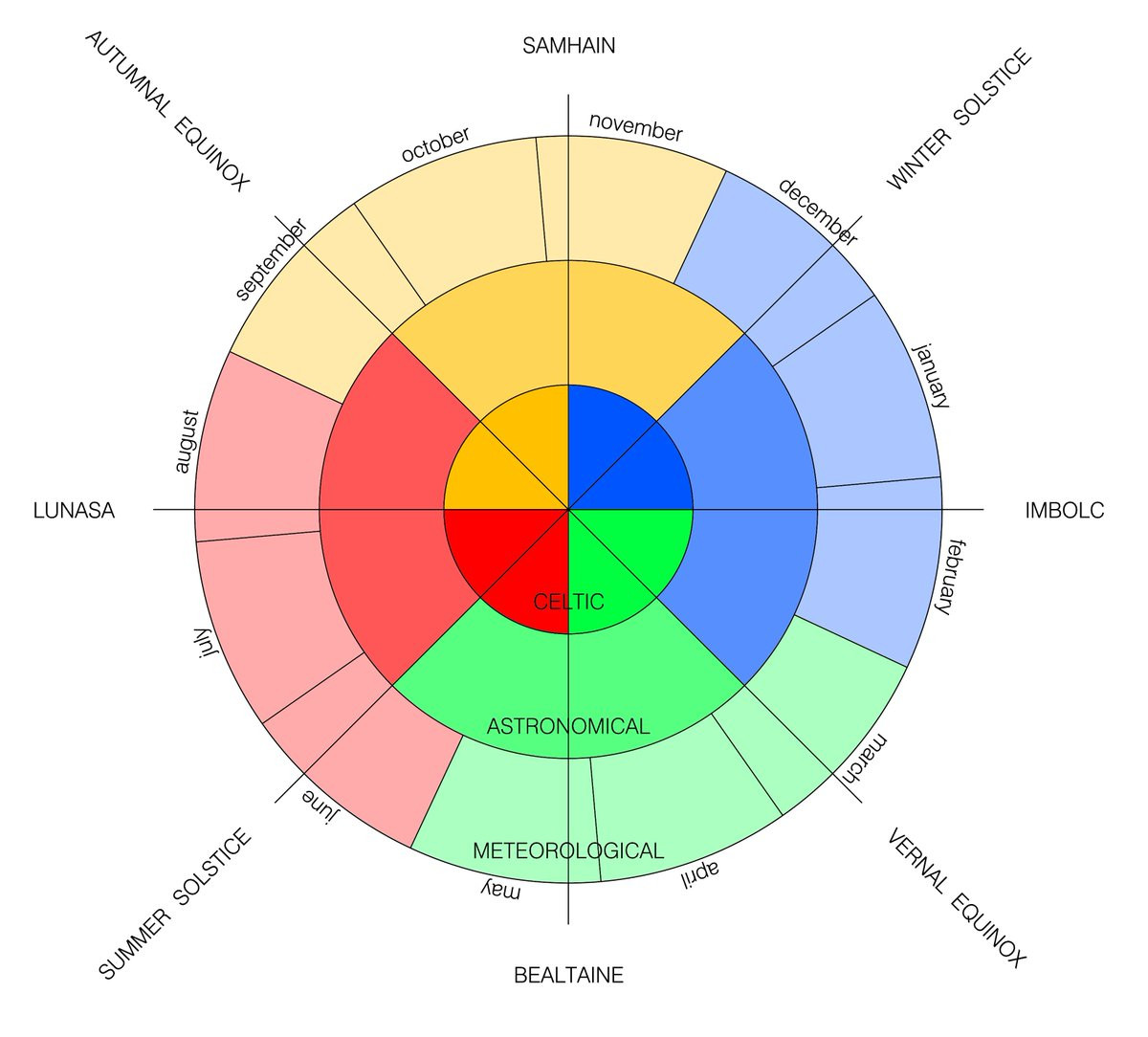
In the Northern hemisphere, in astronomical terms, the solar year is defined by the two solstices (summer, around June 21st, and winter, around December 21st) and the equinoxes (spring, around March 21st, and Autumn, around September 21st). These four events divide the year into four roughly equal parts of about 13 weeks each. If you divide each of these intervals in two you divide the year into eight pieces of six and a bit weeks each. The dates midway between the astronomical events mentioned above are the cross-quarter days, of which Imbolc is one. Here they are represented on a diagram:

The timings are rough because the dates of the equinoxes and solstices vary from year to year. Imbolc is often taken to be the 2nd of February (Groundhog Day) and Samhain is sometimes taken to be October 31st, Halloween but hopefully you get the point that although the Pagan festivals have been appropriated by the Christian church, they have much older origins.

Until 2023 only three of the four cross-quarter days were associated with public holidays in Ireland; there wasn’t a holiday for Imbolc. In 2022 however, the Government decided to create a new Bank Holiday that corrected this anomaly by introducing a new St Brigid’s Day holiday on the first Monday on or after 1st February (or on Friday if 1st February falls on that day), which also happens to be the first national holiday in Ireland to be named after a woman. The first such holiday was Monday, 6th February 2023 and the second was on Monday 5th February 2024. This is the third.

But I digress.

I am glad to have today’s holiday just before teaching starts. Having completed my examination marking duties promptly I was planning to use last week to get my teaching materials ready. Unfortunately I wasn’t at all well for most of the week – though I recovered by Friday – and am way behind schedule. Fortunately, I’ve taught one of the modules (Computational Physics) many times before so not much preparation is required although it is a bigger class than I’ve had on previous occasions which means extra work in due course grading the CA components. The other module, Particle Physics is new for me at Maynooth, though I have taught it elsewhere. This also has a bigger class than I was expecting for a final-year module and my first lecture on it is tomorrow. I’m going to have to spend most of today quickening the writing of the lecture notes and preparing assignments.

P.S. Not particularly relevantly, Particle Physics is an anagram of Happier Cyclists.

Storm Éowyn Passes

Posted in Biographical, Maynooth with tags , , on January 24, 2025 by telescoper

So it’s just after 11am on Friday 24th January 2025 and the Red Alert in my area related to Storm Éowyn has just been downgraded to Orange. It was very windy overnight and this morning, though there was no discernible damage to my house and no interruption to the electricity supply. That has not been the case for many others, though. There are a staggering 715,000 power outages across Ireland this morning. That’s so many that it will probably take many days to fix them all.

Here’s a map showing some of the power outages in my general vicinity:

I’m told that power is off in a few places in Maynooth and various traffic lights are not working; fallen trees are also blocking some roads. It’s still very windy – though the force seems to be abating quite quickly – so I think I’ll leave it a while before going out to see if there is any obvious damage in an around town. Shops and businesses would have been closed during the Red Alert, most planning to open around noon. Obviously that will depend on whether or not they have electricity.

Anyway the storm is now heading North East and its presence will soon be felt in Scotland

Update: 12.08, the weather warning was downgraded to yellow at noon. It’s still very windy though.

Update: 14.11, went for a walk into Maynooth. Traffic lights on Straffan Road out from the Glenroyal up to Main Street. All shops on Main Street closed and apparently without electricity. Traffic lights at the Roost are working as are those on Mill Street. Dunnes stores in Manor Mills is open but the rest of the shops are closed. South Campus was closed but I walked around North Campus; there are lots of branches of various sizes that have sheared off, but no serious damage that I saw. No sign of buses or trains having resumed.

Storm Éowyn Approaches

Posted in Biographical, Maynooth on January 23, 2025 by telescoper

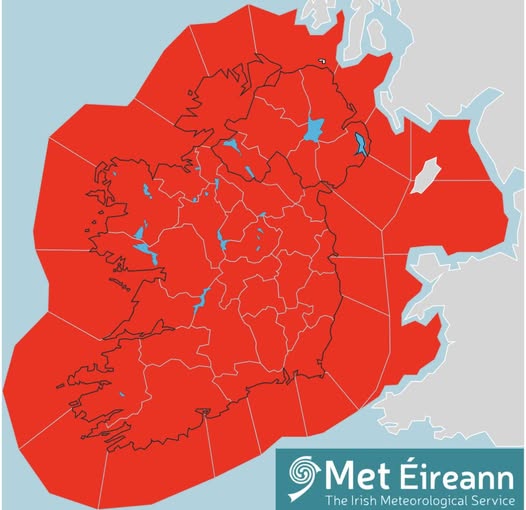
I have seen Red Weather Alerts from Met Éireann before, but never one that covered the whole country! This unprecedented situation is down to Storm Éowyn. This is the map for tomorrow morning, 24th January:

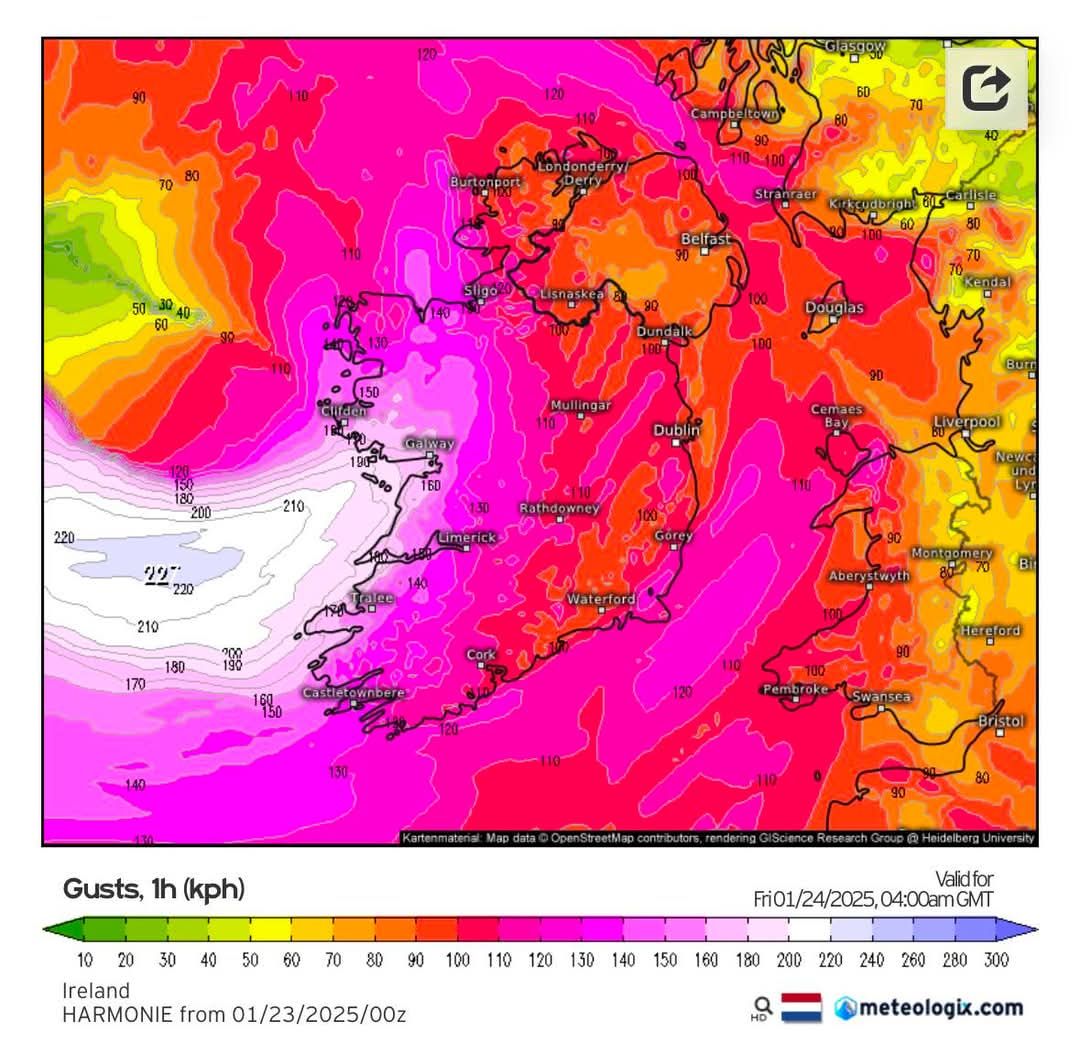
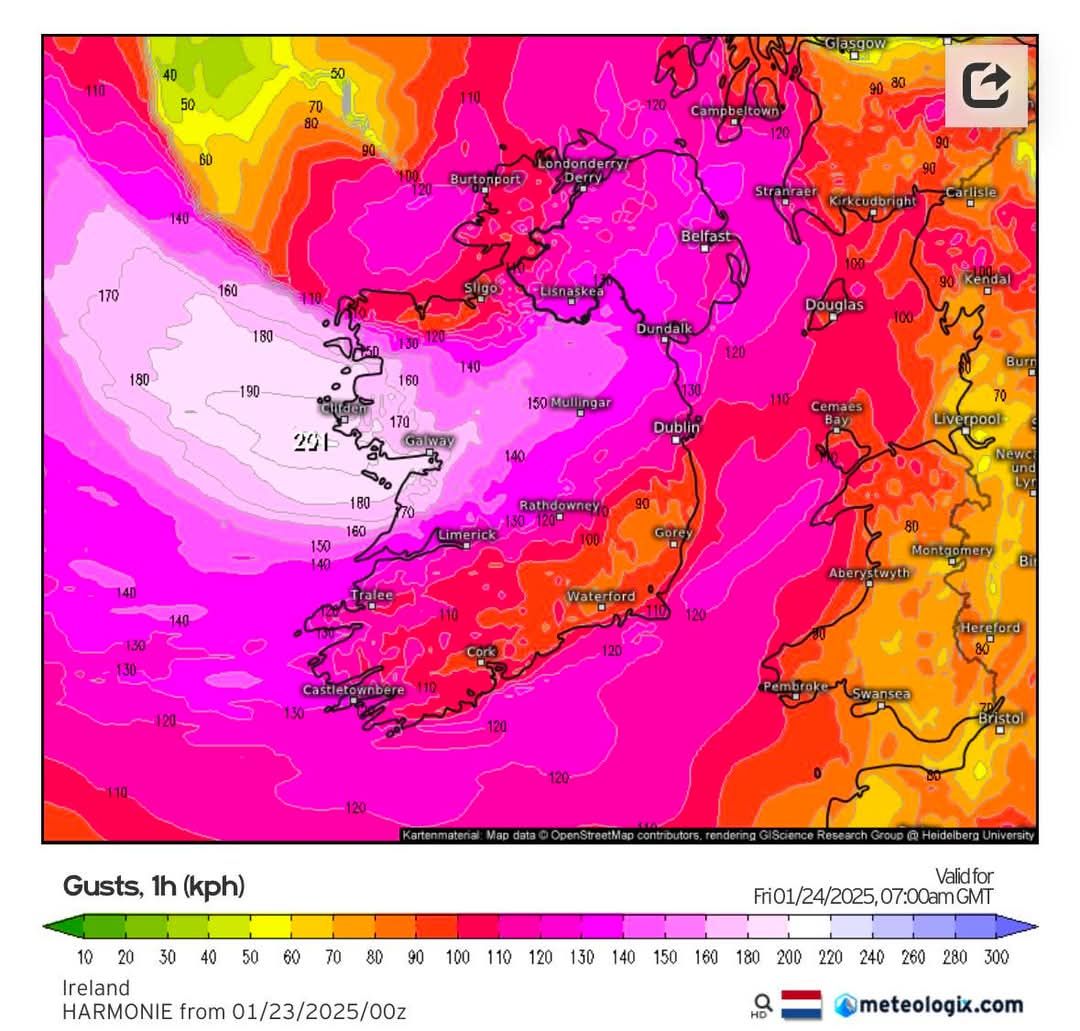
I’ve been following the predictions of the HARMONIE model for Storm Éowyn as they get updated. This storm is an absolutely monster! The latest model maps look like this:

Note the wind speeds, well over 200 km/h in the white areas; these are gusts, not steady average speeds, but could be very damaging. As usual the West coast will bear the brunt. Where I am, in County Kildare, is much more sheltered, but even here gusts are forecast to exceed 100 km/h. The one thing to be optmistic about is that in any location its duration will be relatively short. The Red Alerts start about 2am on the West coast, but in Kildare the maximum danger is between 6am and 11am. The predicted impacts are:

• Danger to life
• Extremely dangerous travelling conditions
• Unsafe working conditions
• Disruption and cancellations to transport
• Many fallen trees
• Significant and widespread power outages
• Impacts to communications networks
• Cancellation of event
• Structural damage
• Wave overtopping
• Coastal flooding in low-lying and exposed areas

(The last two aren’t relevant for Kildare, which is inland. At least I hope “waves overtopping” isn’t relevant 30km from the sea!)

During the red alerts there will be no public transport, and many offices etc will be closed until the Red Alert is over. There will be no postal deliveries anywhere tomorrow either.

Maynooth University Campus is understandably closed tomorrow too. Fortunately the exam period is over and teaching does not resume until the start of February, so this won’t cause too much disruption to academic life. I’ll be working on home. Ireland’s electricity system is fragile at the best of times, however, so there is a significant risk of power cuts and interruptions to internet access. If I don’t blog tomorrow, you will know why! I have plenty of work that I can do without the internet, though.

I have a ticket for a concert at the National Concert Hall tomorrow evening. I usually travel by train into Dublin for such things. Public transport should have resumed by the time I would travel, but I’ll keep an eye on things. Fallen trees are a real hazard around here, and could affect both road and rail transport. If there is continued disruption, I’ll stay at home. If it’s very bad, of course, the event might be cancelled anyway.

My kitchen is entirely electric so in case of power cuts I’ll do a bit of shopping to make sure I have enough food for tomorrow that can be eaten cold. It is raining at the moment but when there’s a gap I’ll move all moveable objects in my garden into the shed, including the wheelie bins, in case they blow away. I have a feeling there’ll be quite a few twigs and branches to clear up on Saturday!

Bluesky Embed Test

Posted in Art, Biographical, Uncategorized with tags , , , on January 16, 2025 by telescoper

It’s been a very busy day today so I just have time to test out the new “Bluesky embed” feature on WordPress. That means I can share a selection of my very best shitposts directly here. Try this one:

It seems to work on some browsers but not others. How is it for you?

Marking Progress

Posted in Biographical, Education, mathematics, Maynooth with tags , on January 14, 2025 by telescoper

I’ve been at home marking examinations almost all day and have decided to knock off until tomorrow when hopefully I can finish the job. I say almost all day because I took a break this afternoon to back to campus to collect some papers that I didn’t get yesterday because they were from students sitting the examination for various reasons in alternative venues on campus rather than the main examination room.

What I do with examination scripts is mark one question at a time rather than one script at a time. What I mean by that is that I go through every script marking all the attempts at Question 1, then I start again and do all the Questions 2, etc. I find that this is much quicker and more efficient than marking all the questions in each script then moving onto the next script. The reason for this is that I can upload into my mind the model answer for Question 1 so that it stays there while I mark dozens of attempts at it so I don’t have to keep referring to the marking scheme. Other advantages are that it’s easier to be consistent in giving partial credit when you’re doing the same question over and over again, and that also you spot what the common mistakes are more easily.

It’s a fairly monotonous job and I find my concentration starts to wander if I try to do too many in one go. Fortunately the exam papers are organized in batches (separated by elastic bands as in the photograph) so I usuallly take a break – as a sort of self-reward- after each batch to break things up. Each batch usually takes a couple of hours or so, so the breaks often end up as times to have lunch and tea. In terms of the timing it’s rather like a game of cricket, actually.

Today I corrected Question 1 in two batches before lunch, then another between lunch and tea. At that point I took a walk into town to do a few errands and then collected the remaining scripts from campus, which I have now just finished correcting. Some people will accuse me of being lazy, taking breaks like this, but I think it’s more efficient to do it this way. Trying to mark examinations for hours on end inevitably leads to more errors, so in the long run it takes longer to complete the job. Slow and steady does it.

I remember using a similar approach when I wrote my thesis many years ago. That’s a much bigger job, of course, but I found what worked for me was to plan out each chapter in terms of sections of roughly equal length, write each in turn and take a break when I’d finished it. Writing a thesis of around 200 pages may seem a daunting task, but if you split it into 1000-word chunks spread over three months or so it’s quite manageable – and you can plan to take time out for relaxtion along the way to avoid getting too burned out by the process.

Anyway, I’ve now finished all the attempts at Question 1 in this examination, including those in the extra scripts I picked up today. Question 1 consists of a set of short problems and is altogether worth 50% of the examination mark, so I’m actually abouty halfway through the marking. There three questions left, each longer than the pieces of Question 1 and worth 25% of the overall mark. Students are supposed to answer two. I’ll start on Question 2 in the morning and hopefully by this time tomorrow evening I will have marked all three, and that will be that. Until the next one…

A Dose of Salts

Posted in Biographical with tags , , , , , on January 12, 2025 by telescoper

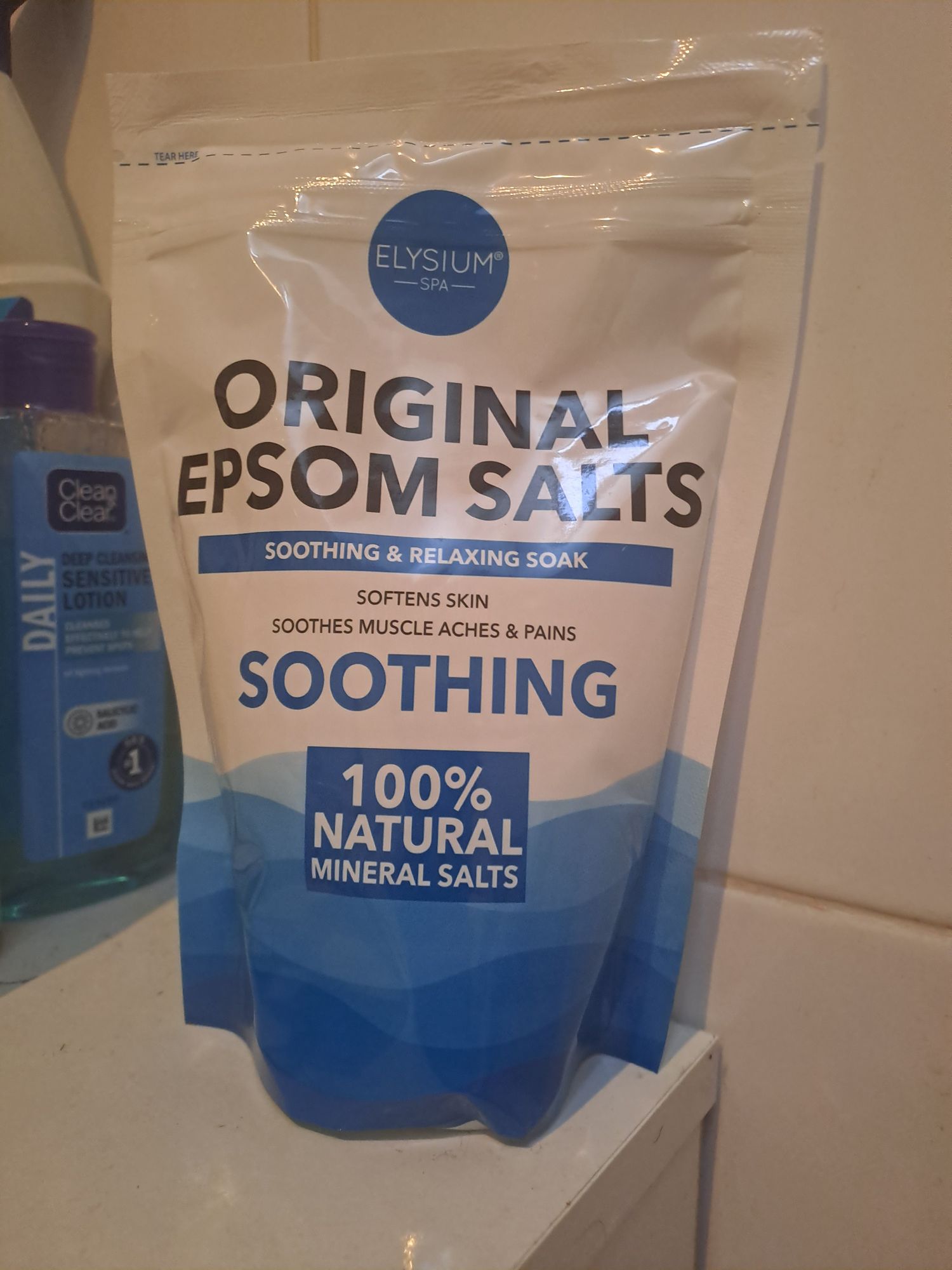
When I was a lad the most widespread use of Epsom Salts (Magnesium Sulphate Heptahydrate) was as a laxative (taken orally) and I believe it is still use for that purpose nowadays. Incidentally, the phrase “a dose of salts” (as in “it went through me like a dose of salts”) is a reference to this property.

It was recently suggested to me, however, that a warm bath with Epsom Salts may be of therapeutic value for arthritis. Although I have had fewer problems with my arthritic knees since I started on a regular course of injections, I did experience a few issues during the recent cold spell so when I saw Epsom Salts on sale in a local supermarket I thought I’d give them a go.

My main method of ablution these days is a shower – mine is of walk-in variety – but I do also have a bathtub so I’ve been experimenting with regular hot baths. Bathing in warm water definitely reduces arthritic discomfort, but the question is whether adding Epsom Salts (or any other kind of salt, e.g. Dead Sea salt) actually makes a positive difference. One can ask the same question about natural hot springs (such as in Bath) which have long been believed to have curative properties, but whether this is just because they are warm or because of the minerals presents is a question to which I do not know the answer. Most of the medical studies I’ve seen on this rely on tiny samples and are very unconvincing.

With specific reference to Epsom Salts, I’ve seen quite a few websites claiming that the absorption through the skin of magnesium ions has a beneficial effect. Others, however, argue that there’s no scientific evidence of any significant absorption via a salt bath. I don’t know how many ions would have to be absorbed to have an effect so I’ll have to remain agnostic on this possibility.

But adding Epsom Salts to bathwater definitely has some effects. For one thing, your skin (e.g. on your fingers) doesn’t wrinkle as in a normal bath, presumably due to some sort of osmotic process in the outer layers. Moreover, the addition of magnesium sulphate to water does change several bulk properties: the specific gravity increases significantly, as does the thermal conductivity, while the heat capacity goes down. The flow of heat away from inflamed areas may be a factor, and it may alter blood circulation. I’m not a medical expert but I would imagine that this is more likely to help with muscle pain than arthritis. Notice that the packaging only mentions “muscle aches and pains”.

I doubt if the specific gravity effect is important in a hot bath at home. It will make a person more buoyant in the water, but my bathtub isn’t big enough to float freely in. This does remind me, however, of the time when I was a graduate student and in response to a suggestion made by a friend I visited a place called the Floatarium, which offered a go in an isolation tank for £15 an hour. That was quite a lot of money in the 1980s! The tank was in a dark and quiet room, and the water was a strong solution of Epsom Salts (so the subject can float easily in it), and held approximately at body temperature, the idea being to deprive the brain of sensory input. The things I remember most about this experience were: (i) almost immediately losing track of the passage of time; and (ii) losing perception of where my hands and feet were. The latter was quite disconcerting – I felt my feet floating off into the distance. Overall it was quite an interesting experience, but not one that I was anxious to repeat (especially not at £15 a go).

Anyway the results of my experimental baths are, as you would probably expect, inconclusive. I have taken baths with Epsom Salts as well as with more commonly avalaible commercial bath salts; the latter contain other ingredients (such aromatic oils), while Epsom salts are odourless. I soaked for around 15-20 minutes (as recommended), but could see no difference over and above a standard bath.

That’s what they call a null result.

The Fires of Los Angeles

Posted in Biographical, Euclid with tags , , , , on January 10, 2025 by telescoper

The wildfires that broke out on 7th January in various parts of Los Angeles have now been raging for three days and, initially driven by very high winds, have destroyed thousands of properties. Almost 200,000 people have been forced to evacuate their homes but so far it seems the loss of life has been limited. Let’s hope it stays that way, though realistically the death toll will probably rise.

The fire that broke out in the Eaton Canyon is still burning over a large area to the North-East of Los Angeles near Pasadena, which is the location of the California Institute of Technology (Caltech), NASA’s Jet Propulsion Laboratory (JPL) and the Carnegie Observatories. Through astrophysics and cosmology I know quite a few people working at these establishments, including members of the Euclid Consortium. As far as I know neither place has been directly affected by the fires, though they have been closed due to heavy smoke and wind damage. I found out today, however, that some colleagues working there and living nearby have lost their homes and all their possessions to the flames. At least they themselves – and their families – are safe and accounted for but it must be a very grim time for them.

When the smoke has cleared I hope they will get practical assistance needed to start that process. In that vein, I see that a Caltech and JPL Disaster Relief Fund has been set up. You might consider making a donation.

On a more personal note I have an old and dear friend – not an academic – who lives near Santa Monica in the area marked on the map as Palisades Fire. Looking at the satellite pictures it seems his home has been destroyed too. It was, however, placed under an evacuation order some time ago. I assume he complied and is safe and sound, though I have so far been unable to contact him.

My thoughts are with anyone affected by these terrible events.

Failing to Teach Particle Physics

Posted in Biographical, Education, The Universe and Stuff with tags , , , on January 7, 2025 by telescoper

As the Christmas holiday draws to a close and I begin thinking about the possibility that sooner or later, in due course, at some point in the future, in the fullness of time, all things considered, when all is said and done, in the end, I will have to start teaching again. Thinking about this is preferable to thinking about the stack of exam marking that I will have to contend with shortly.

One of the modules I am down to teach in the Spring Semester is particle physics, a subject I haven’t taught for well over a decade, so I have been looking through a box of old notes on the subject. Doing so I remembered that I had to explain neutrino oscillations, a process in which neutrinos (which have three distinct flavour states, associated with the electron, mu and tau leptons) can change flavour as they propagate. It’s quite a weird thing to spring on students who previously thought that lepton number was always conserved so I decided to start with an analogy based on more familiar physics.

A charged fermion such as an electron (or in fact anything that has a magnetic moment, which would include, e.g. the neutron)  has spin and, according to standard quantum mechanics, the component of this in any direction can  can be described in terms of two basis states, say “up” for the +z-direction and “down” for the opposite (-z) represented schematically like this:

In this example, as long as the particle is travelling through empty space, the probability of finding it with spin “up” is  50%, as is the probability of finding it in the spin “down” state, the probabilities defined by the square of the amplitudes. Once a measurement is made, however, the state collapses into a definite “up” or “down” wherein it remains until something else is done to it. In such a situation one of the coefficients goes to zero and the other is unity.

If, on the other hand, the particle  is travelling through a region where there is a magnetic field the “spin-up” and “spin-down” states can acquire different energies owing to the interaction between the magnetic moment of the particle and the magnetic field. This is important because it means the bits of the wave function describing the up and down states evolve at different rates, and this  has measurable consequences: measurements made at different positions yield different probabilities of finding the spin pointing in different directions. In effect, the spin vector of the  particle performs  a sort of oscillation, similar to the classical phenomenon called  precession.

The mathematical description of neutrino oscillations is very similar to this, except it’s not the spin part of the wavefunction being affected by an external field that breaks the symmetry between “up” and “down”. Instead the flavour part of the wavefunction is “precessing” because the flavour states don’t coincide with the eigenstates of the Hamiltonian that describes the neutrinoes. For this to happen, however, different neutrino types must have intrinsically different energies  (which, in turn, means that the neutrinos must have different masses), in quite  a similar way similar to the spin-precession example.

Although this isn’t a perfect analogy I thought it was a good way of getting across the basic idea. Unfortunately, however, when I subsequently asked an examination question about neutrino oscillations I got a significant number of answers that said “neutrino oscillations happen when a neutrino travels through a magnetic field….”.

Sigh.

Neutrinos have no magnetic moment so don’t interact with  magnetic fields, you see…

Anyhow, I’m sure there’s more than one reader out there who has had a similar experience with an analogy that wasn’t perhaps as instructive as hoped. Feel free to share through the comments box…

2025: The Year Ahead

Posted in Biographical, Euclid, Maynooth with tags , , , , on January 1, 2025 by telescoper
For last year’s words belong to last year’s language
And next year’s words await another voice.
And to make an end is to make a beginning.

From Four Quartets, ‘Little Gidding’ by T. S. Eliot.

January is named after the Roman deity Janus, who according to Wikipedia, is the god of beginnings, gates, transitions, time, duality, doorways, passages, frames, and endings. Since I did a retrospective post yesterday about 2024 in retrospect, I thought I’d do a quick one today (1st January 2025) to mention a few things looking forward.

January will, as usual, be dominated by examinations, and especially the marking thereof. The first examination for which I am responsible is on January 13th.

February sees the start of a new semester. I’ll be teaching Particle Physics for the first time at Maynooth. I taught this subject for many years at Nottingham and Cardiff (the latter combined with Nuclear Physics), so it should be OK. My other module is Computational Physics which I have taught at Maynooth every year since 2018, apart from 2024 when I was on sabbatical.

The big event in March will be the release of “Q1” data from Euclid. This is only a very small part of the full survey, but is an important milestone and will no doubt attract a lot of press coverage. There’s a blog post by Knud Jahnke here. No doubt I’ll do a few blog posts too. The first full data release DR1 will take place in 2026. The Q1 release is timed to coincide with the annual Euclid Consortium Meeting, which this year takes place in Leiden. I won’t be able to attend in person, as it happens during teaching term, but may be able to follow some of the sessions remotely.

In April we will have a very special visitor to Maynooth to deliver the Dean’s Lecture (of which more anon). Much less significantly, I’ll be giving a Colloquium in the Department of Physics.

May will largely be taken up with second semester exams and assessments – there will be a lot of computational physics projects to correct as well as the usual examinations.

The annual meeting of the European Astronomical Society takes place in Cork in June. I’ve been to Cork before, but am looking forward to going again.

And then it will be summer. I did a lot of travelling during my sabbatical so I am not planning to travel much in 2025, though I may try to visit some more places in Ireland. Hopefully I’ll be able to get on with some research too. This year I am supervising my first MSc project at Maynooth, so that will be an interesting new experience.

And then we’re more-or-less into the next academic year 25/26. That’s beyond my planning horizon. I don’t know what I’ll be teaching, but it may be the same as 2024 (at least for Semester 1). I wonder if I’ll get to teach any astrophysics or cosmology here before I retire? It doesn’t look likely…