Archive for the Biographical Category

Two Years of Covid in Ireland

Posted in Biographical, Covid-19, Maynooth with tags , , on February 28, 2022 by telescoper

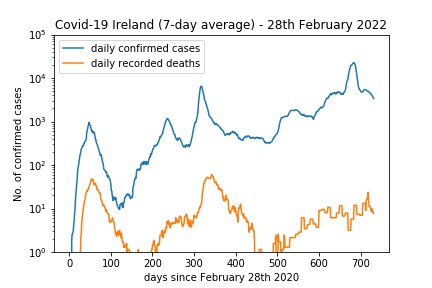
Trying to find something other than the conflict in Ukraine to write about, I thought I’d do a quick post to mark that we have reached the two year mark since the first “official” case of Covid-19 in Ireland was detected. It seems so long ago that I had forgotten that 2020 was a leap year and the date was 29th February, and the case was reported a day later on 1st March 2020.

It was to be another couple of weeks before we went into the first lockdown and I didn’t start keeping a log of all the cases and deaths until 27th March 2020, but you will find a complete record here (backdated to the date of the first case).

Here is the latest plot, with data complete up to today:

Today is the day that most Covid related restrictions are lifted. There is no longer a legal requirement to wear masks anywhere other than in healthcare settings, though at my University there is a recommendation to do so. I dropped into Dunnes this morning to buy a sandwich to have for lunch and I’d say a slight majority of shoppers (including myself) were still wearing masks, though all the staff I saw were unmasked (a fact which I found very disappointing).

I intend to carry on wearing a face covering in shops and, of course, in classrooms (and especially in labs) for the foreseeable future. I didn’t have any teaching this morning so I don’t know what the students are doing. We are told that if a student refuses to wear a mask then lecturers can’t make them, but peer pressure may do the job for us. We do have a significant number of students off and teaching staff unavailable due to Covid-19 infection but we just have to manage this as best we can.

The requirement to have a PCR test if you are symptomatic has also lapsed for most people in Ireland, but not for me. As I’m over the age of 55 I am still required to take a test if I have symptoms.

The drastic reduction in testing implied by the change in regulations will undoubtedly lead to a steep reduction in PCR-confirmed cases (currently running at a seven-day average of around 3500 per day) and in the light of this I’m not sure it’s worth carrying on plotting the data for much longer. I will persevere for the mean time though.

Holding your ground

Posted in Biographical, Brighton, Finance with tags , , , on February 26, 2022 by telescoper

Thinking about the brave defenders of Ukraine, especially in Kyiv, who include numerous civilians I suddenly remembered an old post about a friend I met in Brighton many years ago, a Jewish man of Austrian extraction who went by the name of Solly. He had been sent by his parents to live in England a few years before the start of World War 2 when he was still a teenager.

To cut a long story short, in 1940 Solly ended up joining the Local Defence Volunteers (the Home Guard) in Brighton. This is something he told me reminiscing abut those times. over dinner many years ago.

On 7th September 1940 the War Office issued the following communique:

Message to all UK units: codeword CROMWELL. Home Defence forces to highest degree of readiness. Invasion of mainland UK expected at any time.

After being informed of this signal Solly and his comrades turned up to be issued with the equipment with which they were expected to stop the imminent invasion. In his case it was an ancient pre-WW1 rifle, three rounds of ammunition, and two improvised grenades. With these meagre supplies, they were supposed to hold their positions until reinforced, possibly for up to 7 days.

As they walked to their posts, all the volunteers were certain that they had no chance and that none of them would survive the night. In such a grim situation they were understandably quiet, but what talk there was exclusively concerned the need to make all their shots count. If each of them could kill at least one invader before he himself was killed then the invasion might be thwarted.

After an agonizing wait, and several false alarms, dawn broke. The Germans never came.

Solly clearly found this recollection difficult. Few of us are ever faced with such a stark prospect of death. But I remember one thing he did say, which at the time I didn’t really understand, which is that it was in a way quite liberating – accepting that you are certain to die means that you no longer feel afraid. He had previously worried that he might lack the courage to fight if called upon to do so, but that doubt disappeared on 7th September 1940.

I think we’re already seeing this attitude in Ukrainian President Volodymyr Zelensky, who has emerged as a heroic figure . He must know that he is a marked man, and that his days are probably numbered, but he has refused offers to get him out to safety. The contrast between his courage and another so-called leader, who ran away from reporters to hid in a fridge, could not be greater.

Anyway, as the Russians enter the city of Kyiv, many civilians will be trying to summon up their courage right now. Received wisdom is that in urban fighting, the attacking force needs a numerical advantage of at least five to one and even more if the attackers are poorly trained conscripts, as seems to be the case in some parts of Ukraine. The defenders hold many cards, not least that it’s their land on which they’re fighting.

I fear that there is a bloodbath coming, but it seems to me very likely that the Russians will suffer worse. Not that Putin will be bothered. To him, his soldiers are mere cannon fodder.

The Little Things

Posted in Biographical, Politics with tags , , , , on February 25, 2022 by telescoper

Yesterday morning I heard the news about Russia’s invasion of Ukraine via the radio as soon as it woke me up at 7am. It took me a while to summon up the energy to get out of bed and get ready for my 9am lecture. The routine things of life seem so trivial and futile compared to wars and other disasters over which one has no influence. But it does not help Ukraine (nor anyone else, including yourself) to be overwhelmed by despair. So I got up and did my lecture, as I did this morning with a 9am tutorial.

Somehow, it feels like a duty to persevere. I think that’s partly because the tyrants of this world want people to feel powerless. By persisting with the little things you are, in a very small way, defying those who want you to be terrified. The image of Vladimir Putin as some sort mastermind, a Karla-like bogeyman with strategic superpowers, has hypnotized too many. He’s just a sad old relic of the Cold War.

I try to resist looking at the news too often, my desire to stay informed tempered by a wish to remain sane. I’d like to believe that the Ukrainians can hold out, but they’re massively outnumbered and outgunned so the odds are heavily against them. But they’re fighting on their home soil for a just cause against an invader. That should count for something. The longer they can hold out wear down the Russian army the more chance there is that the tide will turn against Putin at home.

I doubt that sanctions from the West will have any impact on Putin’s murderous intentions, at least not in the short term. In any case they look weak to me. Russian teams are still playing in UEFA tournaments, and Russia will still be in Eurovision. Why is this tolerated?

I spent an hour yesterday on a zoom call related to the European Space Agency’s Euclid mission, which is due to be launched on a Russian Soyuz spacecraft in 2023. The latest batch of sanctions may lead to a delay in Euclid or even its cancellation. That would be a major problem for many scientists around the world. It’s a big thing for us, but it gets smaller when you compare it with what’s happening in the world. I bet a majority of us working in cosmology would prefer to see Euclid scrapped altogether than see further death and destruction unfold. I know I would.

It wouldn’t work that way, of course, but the question we have to ask ourselves is who are we happy to do business with? How could you sleep at night after giving money to or taking money from the Kremlin or its proxies? Maybe Putin will succeed only in giving the West a renewed sense of moral certainty.

For years the West has been corrupted by dirty money from Russia’s gangster oligarchs. Now Ukraine is paying the price. We’ve been far too slow to understand the true nature of who and what we’ve been dealing with. Now it’s time to get serious. “Business as usual” no longer applies, at least not with Russia…

Personal and Postdoctoral Choices

Posted in Biographical, Brighton on February 19, 2022 by telescoper

Over the past week or so I’ve noticed quite a lot of discussion on social media about postdoctoral fellowship positions. These positions are scarce compared to the number of eligible applicants so competition is quite intense. Applications are usually required around November for a start the following year: those lucky enough to have been offered such a position to start in September or October usually have to accept or decline around this time of year; those lucky enough to receive more than one offer have to pick which one they want to accept so that those on a waiting list can be contacted. It’s a nervous time for early career researchers, particularly in the USA where there are few opportunities outside this cycle.

Seeing all these exchanges on Twitter reminded of this time of year in 1988. I was in the last the last year of my PhD DPhil at Sussex – there was only three years’ funding in those days – and had applied before Christmas 1987 for postdoc positions to start in September or October1988. I was fortunate to receive several offers, including one to stay at Sussex.

There was a big complication in my case. I have never written about this on the blog but during the last year of my PhD I was helping to care for a friend who was terminally ill. The medical people couldn’t say how long he would live but said it would be months rather than years. When it came to February 1988 and I had to make a choice, I felt I had no alternative but to make a decision that would allow me to continue to help as long as was necessary if my friend lived past September, rather than abandon him. Accordingly I accepted the position at Sussex and decline the others.

As it happened my friend passed away (peacefully) about six weeks later, but by then I’d made the decision and there was no going back.

I do generally advise younger researchers that moving away from the institute in which they did their graduate studies is generally a good idea in order to broaden your experience. Given that, people have sometimes asked me in person why I decided to stay at Sussex and I usually tell them what I’ve written above.

I have absolutely no regrets about the decision. Sussex was a very good place to be a postdoctoral researcher anyway and things worked out very well for me in the end, career-wise. I also felt I’d done the right thing based on how the situation stood at the time I made the decision.

The point of this post is that you shouldn’t be afraid of including personal considerations in your career choices. We’re all people, not robots. And if you’re that others might think your decision is strange then remind yourself that it’s your life, not theirs. In the end the only person you need to justify yourself to is yourself.

They think it’s all over…

Posted in Biographical, Covid-19, Education, Maynooth on February 18, 2022 by telescoper

This afternoon it was announced that the Government of Ireland would be accepting the latest advice from the National Public Health Emergency Team (NPHET) to wind down most of the remaining Covid-19 restrictions from 28th February 2002. The first officially recognized Covid-19 case in Ireland was reported on March 1st 2020, so that will be two years after the arrival of the pandemic here.

The decision means that face masks will no longer be required on public transport or in shops or in schools, though they will be mandatory in hospitals and other health-care settings. I assume this extends to universities too. Likewise limits on social distancing. The Chief Medical Officer has also announced that PCR testing will no longer be performed for anyone under the age of 55. It seems that even NPHET itself is to be phased out.

I know many people will be celebrating the end of these restrictions, but in case you need reminding here are the latest figures for Covid-19 in Ireland:

PCR-confirmed new cases are still running at 4500+ per day (almost double that if you include self-reported antigen tests). That means medically vulnerable people would be at risk of infection if those around them are not wearing masks. Masks protect others more than they protect the wearer so allowing the wearing of face masks to be discretionary puts such people in danger. For this reason I for one will be continuing to wear a face covering in shops, on buses, etc for the foreseeable future.

I don’t mind this – it was widespread practice in Asia long before the Coronavirus pandemic – and just can’t understand the extreme anti-maskers who liken the wearing of a face covering to being put in a concentration camp. I just hope we don’t get situations in which those who choose to wear a mask on, say, a bus get picked on by those who don’t.

At the moment in the Department of Theoretical Physics at Maynooth the situation is that a significant fraction of our students are staying away from lectures because of illness or self-isolation and one lecturer is having to do his teaching remotely. That’s not too bad; I feared much worse. I think other Departments have worse problems, missing demonstrators and tutors who are unable to come on campus.

The logic behind scrapping these restrictions is that despite the high case numbers the vaccination programme (helped, perhaps by the ‘milder’ omicron variant) does seem to have succeeded in keeping hospitalizations and deaths at a much lower level than in previous waves. Implicitly the strategy is to let Covid-19 wash over the population without worrying that the Health Service will be overwhelmed. My main worry now is what if another variant emerges after we have let our guard down?

Attack of the Rooks

Posted in Biographical, Maynooth on February 15, 2022 by telescoper

In this recent spell of rather cold weather I’ve been especially careful to keep the garden birds well nourished by deploying various feeders around the place. My fat balls are proving particular popular with the birds, but I won’t dwell on that here.

A few weeks ago a solitary rook started visiting my garden. I felt a bit sorry for this bird as it seemed to be on its own and was too big and clumsy to feed off the seed and peanut dispensers. Rooks always look a big glum to me. Eventually this figured one out how to dislodge one of the feeders from its usual place so it crashed to the floor and spilled seed all over the lawn, some of which it ate.

There then followed a sort of arms race. First I attached the feeder more securely to its existing site. The rook again managed after some time to knock it down. Then I moved it somewhere else, only for it to appear on the ground once more. Then I found a place where I could hang it between two branches of a tree in such a way it would be impossible to dislodge. This clearly frustrated the rook and again I felt sorry for it, but only for a short time.

A few days later I looked out in the garden and saw not just one rook but a whole crowd of them five or six in number, no doubt the local gang had been pressed into service. They proceeded to jump up and down on the branches of the tree until both snapped off completely, again dislodging the feeder.

I know I should admire the quality of the teamwork – a characteristic of the Corvid family – but at this rate the trees in my garden are going to be reduced to stumps. I’m not sure what I can do next.

There’s no doubt that rooks are hooligans, but at least they’re not taking all the food. I have two other dispensers that are positioned in such a way that only the little critters can get at them. So far. I’ve had all kinds of tits and finches as well as sparrows and starlings and pigeons as well as the rooks’ slightly less troublesome cousins, jackdaws and magpies.

Third Level Ireland – The Core Problem

Posted in Biographical, Education, Maynooth, Politics with tags , on February 13, 2022 by telescoper

One of the things I noticed straight away when I moved from the UK to my current job in Ireland is how under-resourced the Irish higher education system is. That realization was driven home still further by the Covid-19 pandemic during which those of us working in Irish universities had to switch to online teaching with precious little support.

Academic staff worked very hard to keep going during the various lockdown periods, but I’m sure I’m not the only person to feel deep regret that we were unable to do things better and that many students have a right to feel they have been let down by the system.

Now that we’re back teaching on campus the problems have not gone away. With a significant number of students prevented from attending lectures by the need to self-isolate we should be making recordings or live streams available, but we lack the equipment to do so properly. I have to carry a webcam and a tripod around campus to record my classes in improvised and not very satisfactory fashion. Contrast with the UK, where proper lecture capture facilities were commonplace in universities long before the pandemic. We are at least a decade behind.

This is one example of a deep crisis in the Irish third level system. Sadly it is by no means clear that the current Government is interested in solving it. There is talk of reducing the “student contribution” (currently €3000, the highest in the EU) because of the cost-of-living crisis but cutting this tuition fee (which is effectively what it is) would reduce the money coming into higher education unless offset by an increase in Government funding. According to this report (from November 2019), core state funding per student in third level institutions fell from about €9K in 2009 to under €5K in 2019.

A sizeable fraction of the income of a university is spent on its staff. In Ireland academic staff are treated as public sector employees which means that salary levels are set centrally. After being cut after the financial crisis they are now fairly generous and increase in line with overall pay settlements. Academic staff get annual increments and can get promoted, which adds to costs on top of the cost-of-living increases.

And that’s the crunch.

If the resource per student is decreasing but the salary bill is increasing, universities have to find other ways of generating income (which has been particularly difficult during the pandemic) or to increase the number of students. Keeping staff and student numbers constant means sliding into deficit. The way out of this many have found is to freeze permanent academic hires and instead take on casual teaching staff that can be paid lower wages than full-time staff. With no disrespect at all to people employed on such contracts, who generally do an excellent job, I feel we are short-changing students if they are not taught by academics who are active in research.

Take my current Department of Theoretical Physics at Maynooth University as an example. This has a student-staff ratio of about 15. That would be considered quite high for a physics department in the United Kingdom, but lower ratios are financially viable there because the fee income per student is much higher and physics departments bring in significant research income that makes a contribution to both direct and indirect costs. The latter is very difficult in Ireland because of the lack of research funding, especially in basic sciences; fortunately we have been relatively successful in generating research income and have recently increased student numbers, so we’re keeping our head above water. For now.

The price is that all academic staff in the Department have very heavy teaching loads – about five modules a year. That is way higher than physics departments in the UK, where most staff teach at most a couple. That makes it very difficult to stay competitive in research.

The problem is that science subjects are (a) more expensive to teach and (b) have limited capacity to grow because of constraints on, e.g., laboratory space (and the fact that there is a limited pool of suitably qualified school-leavers). As a consequence there is a strong incentive for universities to expand in subjects that are cheaper to teach. Something has to be done to ensure that Ireland’s universities can continue to provide education in a broad range of subjects.

Given the funding situation and the charges currently levied on students, it amazes me that more don’t seek their tertiary education elsewhere in the EU where fees are much lower (and in some places non-existent) especially since there is such a terrible shortage of student housing In Ireland. Does the Government really want to continue giving its young people such strong incentives to emigrate?

I was going to end this post there, having stated that the mismatch between between income and salary costs is the core problem facing Irish universities. As I went along though I came to think that the really basic problem is at a deeper level than that. Irish universities are public institutions but the political parties that have dominated Irish government for decades are of a neoliberal hue and are at best ambivalent towards the public sector. There are many in the current Government who would privatize everything if they could get away with it. They are pragmatic, though, and realize that these institutions are actually popular, just like the NHS in England. It is however very difficult for public institutions to function when the Government in charge doesn’t really believe in them.

Irreversible Changes

Posted in Biographical, Cardiff, Mental Health on February 12, 2022 by telescoper

There’s a feature on Facebook that reminds you of things you posted there on the same day in previous years. It’s often a pleasant thing to be reminded of past events involving your friends but occasionally the memories are not so nice.

Over the past few weeks Facebook has been bringing back posts that I put up a decade ago, when I was experiencing serious mental health issues that had gone on for months. I ended up in a terrible state in summer 2012, resulting in me spending some time in a psychiatric institution near Cardiff.

Some time after that I wrote a piece for Time to Change Wales from which I’ve taken the following excerpt:

I realize how stupid it was for me not to have sought professional help before. It’s only now, looking back, that I realize how ill I actually was. I had almost left it too late. I know I’m not “cured”. I’ll no doubt have to confront this problem again. But next time I know what to do.

So why did I leave it so long? Fear of the stigma, perhaps. But I suppose also pride. It can be difficult to ask for help, to admit to yourself, your friends and your colleagues that you can’t cope, especially when you’re in a job in which you feel that people “expect more” of you. Difficult, yes, but not impossible, and certainly necessary. Don’t do what I did. Life’s too short.

Although I did not enjoy at all the experience of being in a high-dependency psychiatric unit, I was lucky that I got professional help in time back then. Even more happily, in recent years I haven’t had any problems of the same severity.

I have only just come to understand, however, how far I was irreversibly diminished as a person by that episode, not only in social settings but also intellectually. My ability to concentrate has greatly deteriorated, for example, and I have far less energy. The fact that I’m also getting old – another irreversible change – hasn’t helped!

On top of all this, bridges that you burned when you were not in your right mind can’t be rebuilt, no matter how much you wish they could. You can’t hope to go back to things exactly as they were. It’s taken me a decade to realize that it this is a positive: there’s no point in being haunted by the past and dreaming about undoing things that can’t be undone. Moving on is the only way to move forward.

I don’t know if these thoughts will help anyone else who might happen to read this blog, but I hope they do.

Scientific Computing Then and Now

Posted in Biographical, mathematics with tags , , , on February 10, 2022 by telescoper

This afternoon I was in charge of another Computational Physics laboratory session. This one went better than last week, when we had a lot of teething problems, and I’m glad to say that the students are already writing bits of Python code and getting output – some of it was even correct!

After this afternoon’s session I came back to my office and noticed this little book on my shelf:

Despite the exorbitant cost, I bought it when I was an undergraduate back in the 1980s, though it was first published in 1966. It’s an interesting little book, notable for the fact that it doesn’t cover any computer programming at all. It focusses instead on the analysis of accuracy and stability of various methods of doing various things.

This is the jacket blurb:

This short book sets out the principles of the methods commonly employed in obtaining numerical solutions to mathematical equations and shows how they are applied in solving particular types of equations. Now that computing facilities are available to most universities, scientific and engineering laboratories and design shops, an introduction to numerical method is an essential part of the training of scientists and engineers. A course on the lines of Professor Wilkes’s book is given to graduate or undergraduate students of mathematics, the physical sciences and engineering at many universities and the number will increase. By concentrating on the essentials of his subject and giving it a modern slant, Professor Wilkes has written a book that is both concise and that covers the needs of a great many users of digital computers; it will serve also as a sound introduction for those who need to consult more detailed works.

Like any book that describes itself as having “a modern slant” is almost bound to date very quickly, and so this did, but its virtue is that it does complement current “modern” books which don’t include as much about the issues covered by Wilkes because one is nowadays far less constrained by memory and speed than was the case decades ago (and which circumstances I recall very well).

The Course Module I’m teaching covers numerical differentiation, numerical integration, root-finding and the solution of ordinary differential equations. All these topics are covered by Wilkes but I was intrigued to discover when I looked that he does numerical integration before numerical differentiation, whereas I do it the other way round. I put it first because I think it’s easier, and I wanted the students do do actually coding as quickly as possible, but I seem to remember doing e.g. Simpson’s Rule at school but don’t recall ever being taught about derivatives as finite differences.

Looking up the start of numerical differentiation in Wilkes I found:

This is a far less satisfactory method than numerical integration, as the following considerations show.

The following considerations indeed talk about the effect of rounding errors on calculations of finite differences (e.g. the forward difference Δf = [f(x+δ)-f(x)]/δ or backward difference Δf = [f(x)-f(x-δ)]/δ) with relatively large step size δ. Even with a modest modern machine one can use step sizes small enough to make the errors negligible for many purposes. Nevertheless I think it is important to see how the errors behave for those cases where it might be difficult to choose a very small δ. Indeed it seemed to surprise the students that using a symmetric difference Δf=[f(x+δ)-f(x-δ)]/2δ is significantly better than a forward or backward difference. Do a Taylor series expansion and you’ll understand why!

This example with δ=0.1 shows how the symmetric difference recovers the correct derivative of sin(x) far more accurately than the forward or backward derivative:

R.I.P. Bamber Gascoigne

Posted in Biographical, Television with tags , , , on February 8, 2022 by telescoper

I was saddened this morning to hear of the death at the age of 87 of Bamber Gascoigne who was best known as the original presenter of University Challenge. He was an excellent quizmaster, not least because he actually seemed to know the answers to the questions (rather than just reading them from the cards like his successor Jeremy Paxman did) and often supplied extra pieces of information off his own bat.

Though he cut a stern figure whenever anybody transgressed e.g. the “no conferring” rule, he always seem to be generous in his praise and people who took part in the show say he was very gentle with the contestants who were often very nervous.

I never met Bamber Gascoigne in the flesh, although I attended the same college (Magdalene College, Cambridge) as he did when he was an undergraduate (though not at the same time) and I’m sure he was around at some dinners and other events while I was there.

I used to watch University Challenge a lot when I was at school. It’s sad to have to say goodbye to yet another figure from the era.

Rest in Peace Bamber Gascoigne (1935-2022)