Archive for the Biographical Category

The last ten years

Posted in Biographical on June 4, 2022 by telescoper

Time passes.

Today, as I find myself another year older, I was thinking back over what things of a personal nature have happened in the last ten years. In that time I moved from Cardiff to Sussex and back to Cardiff and then here to Maynooth.

When I was chatting to John Ellis over lunch at the ITP meeting last week he said to me “You move around quite a lot, don’t you?”. I replied “Yes, that has been remarked upon”. He seemed to think that was funny.

I don’t think I’ll be moving jobs again. Sometime in the next ten years I’ll be retiring, hopefully sooner rather than later. At any rate in less than three months I’ll be stepping down as Head of Department, hopefully spending more time on teaching and research and less on pointless bullshit.

Another notable thing that happened in the last decade was that I had a nervous breakdown. I spent a few weeks in a psychiatric institution but recovered well enough to return to work quite quickly. Fortunately, and contrary to my pessimistic expectations, and despite the stresses caused by the pandemic, I have suffered no significant recurrences and am now not even taking any medication (unless you count wine). So that’s all good.

The last ten years also saw my Mam cruelly taken by dementia; she passed away in 2019. Now all my grandparents and both my parents have gone.

The other thing I realised today is that I am now older than my late collaborator and colleague Francesco Lucchin, with whom I wrote a cosmology text book, was when he passed away twenty years ago, in 2002.

Time passes.

Anyway, I’ve done very little today except relax, read and listen to music and to complete the self-indulgence I’m now going to cook dinner and drink some wine while I watch some football on the telly.

R.I.P. David Matravers

Posted in Biographical, The Universe and Stuff with tags , , , on June 3, 2022 by telescoper
David Matravers, pictured on his 80th birthday in December 2017 (Picture Credit: ICG)

I was very sad this morning to hear via George Ellis of the death at the age of 84 of David Matravers. A South African by borth, David moved to (then) Portsmouth Polytechnic in 1990, just before it became the University of Portsmouth, where he set up a group in cosmology and relativity with the Mathematics Department. Though initially small, that group grew steadily branching out into other areas, including observational cosmology, and became, in 2002, the Institute of Cosmology and Gravitation which is recognized throughout the world as a centre of excellence in research. I see it did particularly well in the recent Research Excellence Framework, for example.

NOTE: I am grateful to David Wands for pointing out that David Matravers wasn’t the first Director of the ICG as I said in an earlier version of this post: that was Roy Maartens. David Matravers actually retired just as the ICG was being set up but played a huge role in its creation.

David Matravers is rightly regarded as its founding father of research in cosmology and gravitation at Portsmouth. He therefore leaves a wonderful legacy not only in the ICG itself but in the many alumni who have passed through it at various stages of their careers and are now carrying on their work all around the globe.

During the 1990s I saw David Matravers quite regularly as he visited Queen Mary & Westfield College where I was working at the time to attend our relativity seminars and talk to the relativity group. He was a very cheerful and engaging chap who was always keen to encourage early career researchers. I was in that category at the time and, although I never worked directly with David, he was always very kind and supportive to me. What struck me in particular about him were his enthusiasm and determination, which is no doubt why he was so successful at building up the ICG from scratch. He will be greatly missed.

My condolences to his friends, colleagues and family.

Rest in peace, David Matravers (1937-2022).

Fuzzy Cosmology at ITP2022

Posted in Biographical, Talks and Reviews, The Universe and Stuff with tags , , , on May 26, 2022 by telescoper

As I usually do when I give a talk (which hasn’t been for a while) I’ve uploaded the slides for the presentation I gave at the Irish Theoretical Physics meeting at DIAS this morning. The title of the talk was Fuzzy Cosmology and the abstract reads:

I discuss some applications of the Schrodinger-Poisson wave-mechanical approach to
cosmological structure formation. The most obvious use of this formalism is to “fuzzy” dark matter,
i.e. dark matter consisting of extremely light particles whose effective de Broglie wavelength is
sufficiently large to be astrophysically relevant, but it can be used to model more general scenarios
and has a number of advantages over standard methods based on Eulerian perturbation theory. I
illustrate the formalism with some calculations for cosmic voids and discuss its application to the
cosmological reconstruction problem(s).

I think it went reasonably well despite there being a hitch at the start because the touchpad on my laptop stopped working. Fortunately I was able to produce an emergency mouse. Anyway, here is a picture of me taken during the talk to prove I was there..

ITP 2022

Posted in Biographical, Maynooth with tags , , on May 25, 2022 by telescoper

Just a quick note to say I’ve spent today not only out of the office but out of Maynooth at the first conference I’ve attended since before the pandemic started. The Irish Theoretical Physics Meeting (ITP22) is taking place from today (Wednesday 25th) to Friday 27th at the Dublin Institute for Advanced Studies. I’ll be commuting from Maynooth for the rest of this week. There is quite a big contingent from the Department of Theoretical Physics at Maynooth in fact.

My talk isn’t until tomorrow morning but I chaired one of the sessions this afternoon. It’s an interesting meeting with an eclectic mixture of talks and lots of time for the sort of face-to-face discussion we’ve all missed for so long. If that weren’t enough it’s also a nice change from marking examinations…!

Maynooth University Library Cat Update

Posted in Biographical, Maynooth with tags on May 24, 2022 by telescoper
Picture Credit: Joost Slingerland

I’ve been at home today, doing the last of my examination marking, doing some Open Journal business, and preparing a presentation for later this week so I’m indebted to my colleague Dr Joost Slingerland for the above picture of Maynooth University Library Cat.

I’ve seen him quite a few times recently, as I’ve been on South Campus to collect exam scripts etc, and he seems in fine feline fettle. In the picture he looks like he’s guarding his Library from unwelcome visitors.

Soon the exams will be over and the campus will be relatively quiet again, though no doubt he will continue to be kept well provisioned and not short of company when he wants some.

The Death of the Hubble Parameter

Posted in Biographical, The Universe and Stuff with tags on May 23, 2022 by telescoper

It’s been a very busy day so in lieu of a proper post I thought I’d recycle an old joke with a new picture I took on my way to collect some examination scripts earlier today for marking.

I’m sad to have to use the medium of this blog to report the tragic death of the Hubble parameter. It had been declining for some time and, despite appearing to pick up recently, the end was somewhat inevitable. Condolences to the other parameters, especially Ω (who was in a close relationship with H), on this sad loss.

An older version of this joke, posted 11 years ago, can be found here.

Notes on Eurovision

Posted in Biographical, Music, Politics with tags , , , , on May 15, 2022 by telescoper

To nobody’s surprise Ukraine won last night’s Eurovision song contest after collecting a huge dollop of the televotes. After the jury votes, the United Kingdom’s entry was in the lead which surprised me because I thought it wasn’t much of a song at all. I’ve never been very good at picking the tunes that do well though. I didn’t like Ukraine’s entry – Stefania by the Kalush Orchestra – much either, but obviously there are special circumstances this year and I’m not at all sorry that they won.

In fact I thought the best song – and the best singer – by a long way was the Lithuanian entry sung by Monika Liu, who held the stage brilliantly by standing there and singing, without any fancy staging. She finished a disappointing 14th.

Monika Liu

Other entries I enjoyed were: Spain, catchy dance number with excellent choreography that finished 3rd; Moldova, an energetic performance full of humour (7th); and Norway, whose entry Give that Wolf a Banana was enjoyably deranged (10th). The less said about the other entries the better. I’m still as baffled by how Sam Ryder’s entry for the UK, Space Man, did so well in the jury votes as I am that Lithuania did so badly there, but there you go. What do I know?

I’ll state without comment that the Ukrainian jury gave a maximum douze points to the United Kingdom, but in return the UK jury gave Ukraine nil points

Anyway, three things struck me as I sipped my wine and watched the show:

  1. Ironically the Opera on the radio last night was Wagner’s Die Meistersinger von Nürnberg which is about a sixteenth century song contest that resembles the Eurovision versiononly in the length of time it goes on for. Perhaps someone should write a modern music drama called Die Meistersinger von Eurovision?
  2. I think the Research Excellence Framework would be much more fun if it were done like the Eurovision Song Contest. Each University regardless of size could be given the same distribution of scores to allocate to the others (but not itself). I can see interesting patterns emerging during that!
  3. When I was formally presented with my DPhil in the summer of 1989, the graduation ceremony took place on the same stage (at the Brighton Centre) on which Abba won the Eurovision Song Contest in 1974 with their song Waterloo.

REF 2021 Results and Ranking

Posted in Biographical, Cardiff with tags , , , on May 12, 2022 by telescoper

The results of the UK’s Research Excellence Framework (REF) 2021 have now been published. You can find them all here at the REF’s own website because they are presented there in a much more informative way than the half-baked “rankings” favoured by, e.g., The Times Higher.

To give some background: the overall REF score for a Unit of Assessment (UoA; usually a Department or School) is obtained by adding three different components: outputs (quality of research papers); impact (referring to the impact beyond academia); and environment (which measures such things as grant income, numbers of PhD students and general infrastructure). Scores are assigned to these categories, e.g. for submitted outputs on a scale of 4* (world-leading), 3* (internationally excellent), 2* (internationally recognized), 1* (nationally recognized) and unclassified. Similar star ratings are applied to the impact and environment. These are weighted at 60%, 25% and 15% respectively in the current incarnation of REF.

You can find further discussion of the REF submission rules, especially concerning changes with respect to 2014, here.

The way the star ratings are often reported is via a Grade Point Average reflecting the percentage of in each band. A hypothetical UoA that scored 100% in the top category would have a GPA of 4.0, for example. One that had 50% 4* and 50* 3* would be 3.5, and so on.

In the 2014 REF institutions were allowed to be selective in the number of staff submitted so the GPA wasn’t really a very appropriate measure: some institutions chose to submit only their very best research in order to get a high GPA. The funding allocated as a result of REF turned out to be highly weighted towards 4* so this was a sensible strategy for them, but it made the simple GPA-based rankings even more meaningless than usual. That didn’t stop e.g. The Times Higher making such rankings though.

This time the rules on selection are stricter so the GPA is arguably more relevant, though many institutions have achieved selectivity anyway by moving certain staff onto teaching-only contracts. Staff on such contracts do not have to be submitted. I note that the main REF website does not use the GPA at all but instead gives profiles like this:

I show the example of Sussex because of my bad memories of the last REF (the 2014 exercise). I had moved to Sussex in 2013 at which point preparations were not well advanced and although everyone concerned worked very hard to put together the best submission for Physics & Astronomy we had to face the problem that our staff numbers had grown significantly in 2013 response to an increase in student numbers. While new staff could bring publications with them they couldn’t bring impact or environment, and while the outputs scored well the latter two categories didn’t so the Department of Physics & Astronomy did poorly in the ensuing rankings.

It must be said however that the primary purpose of the REF (allegedly) is to allocate blocks of funding- the so-called QR funding – to support research in the UoA concerned and while the GPA at Sussex was disappointing the fact that the money depends on the number of staff submitted meant that we got a substantial increase in QR dosh. Note further that the formula for allocation of funds to 4*, 3*, etc is not even specified in advance of the exercise: it is likely to be highly concentrated on research graded 4* and that the funding formula will probably different in England, Wales, Scotland and Northern Ireland. A ranking in terms of money earned is likely to look rather different from one based on GPA.

Another, even more fundamental, problem with the GPA is that the scores are so close together that the differences are of doubtful significance. In the Physics UoA, for example, the gap between top GPA (Sheffield) and 5th place (Bristol) is just 0.05 (3.65 versus 3.60) respectively. I see also that Cardiff is ranked equal 18th (with Imperial College) on a GPA of 3.45.

I say these things just to illustrate how much more subtle the criteria for success are compared to a simple GPA. It’s even hard to tell on an objective basis who to congratulate and who to commiserate.

Anyway, back to Sussex I see that Physics & Astronomy has done far better on environment and impact than last time round and the outputs (95% of which are either 4* or 3*) are comparable to last time (96%) so by those measures they have done well although this might not be reflected in a GPA-based ranking. Sussex is 26th in the rankings with a GPA of 3.35, if you’re interested, which is better than last time, though they will probably be disappointed at the presence of 2* elements in their profile.

Indeed, looking through the Physics list I can’t see any UoA that has a lower GPA this time than last time. The pot of money to be allocated for QR funding is fixed so if every UoA does better that doesn’t mean every UoA gets more money; some institutions will no doubt find that their improved GPA is accompanied by a cut in QR funding.

I’ll end by re-iterating that, having moved to Ireland in 2017, I’m very glad to be out of the path of the bureaucratic juggernaut that is the REF. In its first incarnations (as the Research Assessment Exercise) it did fulfil a useful purpose and did, I believe, improve the quality of UK research. Since then, however, it has become an industry that is largely self-serving. I quote from an article in the Times Higher itself:

The allocation of QR funding could be done in a much simpler and fairer way but the REF is now such a huge edifice it will resist being replaced by something smaller. No doubt before long the staff who spent so much time preparing for REF 2021 will start work on the next exercise. And so it goes on.

The changes in ranking that now occur from exercise to exercise are generally small in magnitude and in number. In other words, huge effort and cost are being invested to discover less and less information.

P.S. For completeness I should say that I am glad we don’t have an equivalent of the REF here in Ireland, we don’t have an equivalent of the QR funding either. This latter is a serious problem for the sustainability of research in third-level institutions, and it is not addressed at all in the recent proposals for reform.

The Time of the Pandemic

Posted in Biographical, Books, Talks and Reviews, Covid-19, Science Politics, Talks and Reviews with tags , , , , on May 11, 2022 by telescoper

I’ve posted before about the way the Covid-19 pandemic has played havoc with my perception of the passage of time and today I’ve experienced another example because I was reminded that it was on this day (11th May) last year that I received my first shot of Covid-19 vaccine.

It’s very hard for me to accept that it was just one year ago that I was waiting in City West to get my injection as it seems in my memory further back than that in my memory. It’s not only how long ago things happened, but also even the sequence of events that has become muddled. I wonder how long it will take to restore any normal sense of these things?

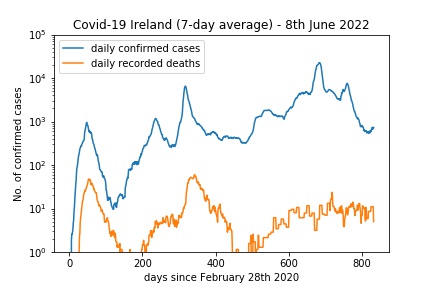
Anyway, I’ve just updated the daily statistics on this blog and although case numbers remain relatively high they do seem to be falling steadily and things do seem to be under control in terms of hospital admissions and deaths. Only 254 people are in hospital with Covid-19 today and the trend is downward.

Maybe the time of the pandemic is drawing to a close?

Further evidence that things may be getting back to normal is that I’m giving the first in-person research talk I’ve done since before the pandemic started at the Irish Theoretical Physics Meeting (ITP22) at the end of this month in Dublin (at the Dublin Institute for Advanced Studies, to be precise). I’m looking forward to giving a talk in the same room as real people. I’m even top of the bill (though only thanks to alphabetical order):

I’ve only got a 30-minute slot so I hope my sense of the passage of time returns at least to the extent that I keep to schedule. My PhD student is travelling to Newcastle next week to give her first ever conference talk at the UK Cosmology Meeting. Hers is a 5-minute talk, which is quite a difficult thing to do well, but I have every confidence it will be excellent.

And talking of research, I see that tomorrow sees the public announcement of the results of the 2021 Research Excellence Framework. Universities have had their results since the start of the week but they are embargoed until tomorrow, no doubt to allow PR people to do their work. I’ll probably post a reaction tomorrow, but for now I’ll just send best wishes to colleagues in the UK – especially in Cardiff and Sussex – who are waiting anxiously hoping for a successful outcome and say that I’m very happy to be here in Ireland, out of the path of that particular bureaucratic juggernaut.

Mental Health and the Reasons for Burnout

Posted in Biographical, Education, Maynooth, Mental Health with tags , , , on May 10, 2022 by telescoper

It is now European Health Week as well as “Employee Wellbeing Month” here at Maynooth University. I’m reminded that ten years ago that I was heading for a breakdown and a subsequent spell in a psychiatric institution so I always try to use this opportunity to encourage friends colleagues and students to do what I didn’t back then, and ask for help sooner rather than later.

Today my colleague from, and former Head of, the Psychology Department at Maynooth shared a piece on twitter that provided me with a new theme, burnout, which is usually described in these terms:

Burnout is a state of emotional, physical, and mental exhaustion caused by excessive and prolonged stress. It occurs when you feel overwhelmed, emotionally drained, and unable to meet constant demands. As the stress continues, you begin to lose the interest and motivation that led you to take on a certain role in the first place.

Burnout reduces productivity and saps your energy, leaving you feeling increasingly helpless, hopeless, cynical, and resentful. Eventually, you may feel like you have nothing more to give.

I’d be surprised if any of my friends and colleagues in the University have not felt at least some of the signs of burnout at some point over the last two years during the which the pandemic drastically exacerbated existing conditions of overwork. I know there’s a tendency among staff to blame themselves for struggling and I know that there’s a even stronger tendency for Management to want staff to blame themselves: “you need to be more resilient” is the catchphrase.

As a counter to this attitude I suggest you read this piece which explains that burnout is not the fault of employees but of the environment created by management. In particular, here are the five main causes of burnout:

  1. Unfair treatment at work
  2. Unmanageable workload
  3. Lack of role clarity
  4. Lack of communication and support from their manager
  5. Unreasonable time pressure

Do any of these look familiar to you? They certainly do to me! I would add a sixth: “6. management determination to make 1-5 even worse in future”. Academic staff on proper contracts are much more expensive than low-paid temporary lecturers on insecure contracts. If you care more about making a profit than providing a quality third level education, why not let the former burn out and replace them with the latter?

My biggest fear is that having seen the lengths to which staff have been prepared to go voluntarily to keep things going during the pandemic, all that has been achieved is to establish in the minds of Management an expectation that this is the way things will be for the indefinite future.

It’s not so bad for me. I’ll be 60 next year and I can see the prospect of retirement on the horizon, but I do worry about what this means for the careers of younger staff.