Archive for the Biographical Category

O-Level Latin Examinations, Vintage 1979

Posted in Biographical, Education with tags , , , , , , on August 20, 2020 by telescoper

Since I’ve just finished marking all my repeat examinations, and examinations are in the news for other reasons, I thought I’d fish out one of the GCE O-level examinations that I took way back in 1979 when I was 16. I have from time to time posted examinations in Mathematics and Science subjects at both O-level and A-level, but I thought it would be fun to share something quite different. In fact my best mark at O-level was in Latin. Latin was a compulsory subject at my (old-fashioned) Grammar School, by the way.

The first of the two Latin exams was basically about the language, and involved unseen translation and comprehension tests. The second involved parts of two set books. We did Book II of Virgil’s Aeneid, a verse epic in strict hexameter, and Book V of Caesar’s Gallic Wars De Bello Gallico. These formed Sections A and B of the same examination although they appear as separate papers. The bit of the Aeneid we did included the Trojan Horse (actually Greek Horse, obviously) and the famous line `Timeo Danaos et dona ferentes’…

The GCE O-levels were replaced by GCSEs a few years after I did mine and I’m not sure how many people do Latin at GCSE these days (or indeed at Leaving Certificate) but I’d be interested in any comments on how these exams compare with modern ones!

No Azed celebration…

Posted in Biographical, Crosswords with tags , on July 26, 2020 by telescoper

I heard today that the special lunch that had been planned to celebrate the 2500th Azed crossword puzzle has been cancelled. It was first planned to take place in May (to coincide roughly with the publication of the 2500th puzzle), then postponed to September and now cancelled altogether. The venue, Wadham College Oxford, is not hosting any large events for the foreseeable future.

I wasn’t surprised by this news, but it is a shame. I was looking forward to using the event as an excuse for a break. I wouldn’t have gone just for the lunch, obviously, but would have stayed for some time either side.

On the other hand, travelling from Ireland to England and back in September would have been difficult, not least because I might have had to quarantine for 14 days in both ditections! Even without that it would have been a disruption to the preparations for the new academic year.

So I guess I’ll be staying here for the rest of the summer, though I might taje a short break somewhere in Ireland if I can.

Anyway, going back to the crosswords I got an HC (highly commended) in the latest Azed Competition (No. 2508). That was a first for me as it is the first entry I have sent in by email rather than in the post. At least I know it arrived safely. As usual I enjoyed solving the puzzle much more than composing a clue. I’m definitely a solver rather than a setter. Next Sunday will be another competition puzzle so I’ll see if I can do better in that.

Three Funerals and a Cartoon

Posted in Biographical, Football, Maynooth with tags , , , on July 21, 2020 by telescoper

I was later than usual coming to the office today as I had to arrange some things to do with the house I’m buying in Maynooth. It was mid morning when I walked up towards campus. I was a little bit confused to see a large crowd of people walking along Main Street, but when I got closer I realized they were all walking behind a hearse on their way to a funeral service at St Mary’s Church. I followed the procession all the way along Main Street and up Mill Street where another large group of people was waiting outside the Church. I don’t know who had passed away but judging by the attendance they must have been popular in the community.

This is the first time I’d seen such a procession here in Ireland, though I was of course already aware that the Irish treat funerals very differently from the English. Coincidentally, though, today saw the funeral of Jack Charlton which began with a procession through the streets of Ashington, the cortege led by piper playing the Northumbrian pipes. Many hundreds turned up to show their respects.

Because of Covid-19 restrictions, only about 20 people could attend the funeral service, which was held at the West Road Crematorium in Newcastle upon Tyne. As it happens, that was where the funeral of my Mam took place about 9 months ago. There were no Covid-19 restrictions then, which makes it seem like a different age altogether.

Anyway, going back to Jack Charlton, I saw last week marvellous comic book tribute to him called The Life and Times of Jack Charlton by David Squires in the Guardian. The poignant last panel is beautifully done.

The Cosmological Evidence – 25 Years Ago

Posted in Biographical, The Universe and Stuff with tags , , , on July 15, 2020 by telescoper

Today Facebook reminded me that the picture below is now 25 years old. I have posted it before and it has done the rounds at a number of cosmology conferences (usually to the accompaniment of lots of laughter), but I thought I’d circulate again as a bit of nostalgia and also to embarrass all concerned with this image. The picture was taken at a graduate school in cosmology in Leiden (in The Netherlands) in July 1995. In my memory that was a sweltering hot summer, which is my excuse for the informality of my attire.

Anyway, various shady characters masquerading as “experts” were asked by the audience of graduate students at a summer school to give their favoured values for the cosmological parameters. from from top to bottom these are:

  • the Hubble constant H0;
  • density parameter Ω0 (not split into dark matter and `ordinary’  matter as is now customary);
  • cosmological constant Λ0,
  • curvature parameter k
  • and age of the Universe t0.


From left to right we have Alain Blanchard (AB), Bernard Jones (BJ, standing), John Peacock (JP), me (yes, with a beard and a pony tail – the shame of it), Vincent Icke (VI), Rien van de Weygaert (RW) and Peter Katgert (PK, standing). You can see on the hi-tech digital display screen blackboard that the only one to get anywhere close to correctly predicting the parameters of what would become the standard cosmological model was, in fact, Rien van de Weygaert. Actually he was the only one of us to include a non-zero cosmological constant. My own favourite model at the time was a low-density model with negative spatial curvature.

Nobody is suggesting that panel discussions are the right way to settle scientific questions, of course, but it is interesting to see the diversity of opinions that were around in 1995.

P.S. Note that not all the combinations of parameters presented there are consistent with a Friedman model, but nobody said they had to be!


Viva Zoom!

Posted in Biographical, The Universe and Stuff with tags , , , , on July 13, 2020 by telescoper

They say that there’s a first time for everything and this morning I conducted my first ever viva voce examination as an External Examiner via Zoom. Given the Covid-19 restrictions it was inevitable that I’d have to do this at some point! As it turned out candidate in question happened to be at University College London.

For those of you not familiar with how this sort of examination usually works, at least in the UK and Ireland, a PhD involves doing research into a particular topic and then writing up what you’ve done in a thesis. The thesis is a substantial piece of work, often in the region of 100,000 words (200 pages or so), which is then assessed by two examiners (one internal to the university at which the research was done, and one external). They read copies of the thesis and write preliminary reports assessing its suitability. Then the candidate has to defend the thesis in an oral examination, which was what happened today, after which the examiners make a final recommendation to the university about whether the degree should be awarded.

There aren’t many rules for how a viva voce examination should be conducted or how long it should last, but the can be as short as, say, 2 hours and can be as long as 5 hours or more. The examiners usually ask a mixture of questions, some about the details of the work presented and some about the general background. The unpredictable content of a viva voce examination makes it very difficult to prepare for, and it can be difficult and stressful for the candidate (as well as just tiring, as it can drag on for a long time). However, call me old-fashioned but I think if you’re going to get to call yourself Doctor of Philosophy you should expect to have to work for it.

As it happens, my own PhD examination (almost 30 years ago!)  was quite long (about 4hrs 30 minutes) and my external examiner was John Peacock. Today’s was a bit shorter – around three hours – and the internal examiner was Andrew Pontzen. Obviously I can’t give details of what went on in the examination except that the internal examiner Andrew Pontzen and I agreed to recommend the award of a PhD to the candidate, Krishna Naidoo. Although it was slightly strange doing this over Zoom instead of in person, it worked out OK. The only thing really missing was a blackboard or whiteboard. I also found it a bit awkward having the PDF thesis and videoconference on the same screen, but that was my fault for not appropriating a spare monitor.

At UCL as in most UK universities, the PhD examiners simply make a recommendation to a higher authority (e.g. Board of Graduate Studies) to formally award the degree, but only in very rare and peculiar circumstances do they not follow the recommendation.

The sad thing about these times of social distancing is that not being there in person I couldn’t shake the hand of the candidate at the end of the examination nor could I join him and his friends and colleagues for a drink afterwards. I’m sure they’ll find a way of celebrating. I couldn’t even join them remotely as I had another Zoom call to make. ..

P.S. If you want an idea of what is in  Krishna’s thesis you could have a look at one of the papers to come from it.

Memories of Italia 90

Posted in Biographical with tags , , , , , , , on July 5, 2020 by telescoper

Twitter reminded me that 30 years ago yesterday (4th July 1990) was the date of the semi final between England and Germany in the 1990 World Cup, an event remembered by most people for Gazza’s tears. Paul Gascoigne cried before England lost (on penalties) because he picked up a yellow card which meant he wouldn’t play in the final even if England got through. As it happened, England lost so none of the England players played in the World Cup Final.

My memories of Italia 90 have somewhat different focus. I travelled to Italy on 1st July 1990 to attend a cosmology conference/workshop in a place called Sesto Pusteria in the region known as Trentino-Alto Adige/Südtirol (South Tyrol). Sesto is a village, set in the Italian Dolomites, primarily a ski resort in the winter but used for conferences in the summer when there is no snow.

I think it was only my second trip to Italy and I had been learning some Italian on the flight. My plane was supposed to land in Venice whence a bus would take conference guests up to Sesto. Unfortunately my flight was diverted to land at Treviso. I missed the bus and decided to stay overnight in a hotel and travel under my own steam the next day.

I found a hotel in Treviso and that night I watched the quarter final between Cameroon and England on my own on the television in my room.

I got up early the next morning and with the aid of the railway timetable supplied by the hotel reception, I set out on a long journey by train. There might have been a quicker way by bus but I was more comfortable doing it by train and was actually looking forward to a bit of exploration.

The route involved four different trains: Treviso to Mestre, then Mestre to Verona, then Verona to Bolzano, then a local (very slow) train from Bolzano up into the mountains to San Candido. The last leg was a little bus from San Candido to Sesto Pusteria. It took me most of the day to get there but I made it without any real difficulty.

I did notice however that on the way there the style of buildings I could see changed from very Italian to very Austrian.

Anyway I arrived in Sesto Pusteria (which is a small place) and found the name of the hotel I was booked in which was Bellavista. I wandered about looking for it – there was no Google Maps in those days – but failed. I did however find the conference centre where the meeting was located. I went in and asked in broken Italian Prego, Dov’è l’hotel Bellavista?

The answer came back in perfect English with a hint of a German accent. It’s down the road on the right, about 50 metres. It’s easy to find because the outside is all white. I was puzzled because I must have walked right past it. Anyway I walked back to down the road and found a hotel with a white exterior. The sign said Hotel Schönblick…

It turned out that my meagre Italian was of no use at all because the locals all spoke German. The South Tyrol has historically been part of Austria. It was annexed by Italy at the end of the First World War and the present border is just a few km from Sesto Pusteria. Attempts to assign Italian names to things however have been only partly successful.

So I made it to the conference, a day late. There weren’t any mobile phones in those days so I’d been unable to contact the organisers so they were quite relieved when I eventually showed up.

And so I saw both semi finals of Italia 90 at the conference: Italy lost theirs against Argentina and England lost on penalties.

After the workshop I travelled with a colleague by car to Trieste to work on a collaboration. During that I remember watching the 3rd/4th playoff (‘Piccolo Finale’) on a big screen from a bar in a public square in Trieste. Italy won that (deservedly). I think I watched the final too, but can remember little about it.

And so to Phase Three..

Posted in Biographical, Covid-19, Education with tags , , , , on June 29, 2020 by telescoper

Well, Phase Three of the Great Reopening happened has started on schedule. As I walked to campus this morning I saw long queues in the street outside every barber’s shop in Maynooth. I decided to wait a few days before trying to get my long overdue haircut. It’s been over three months now.

Maynooth has quite a lot of barber’s shops for a town of its size. It also has quite a lot of nice restaurants. I noticed this evening that quite a few will be opening this week for sit-down meals rather than takeaway. I wish them well, but I think I’ll be sticking with the takeaways for a while longer.

When I got into the office to start work on the risk assessment I’m supposed to complete so staff can return to work, there was quite a lot of activity in the Science Building, including signs of various kinds being put up.

Some of the signs are bisexual bilingual:

All this reminded me of some lines from the Leonard Cohen song Anthem:

We asked for signs. The signs were sent

……

Signs for all to see.

The arrows will be put on the floor at regular intervals to enforce a one-way system around the building to allow people to circulate without bumping into each other.

I’m also expecting to be issued with tape to be used to mark some of the machines in our computer laboratory out of use, to keep users from sitting too close. I was going to remove the chairs but I don’t have anywhere to out them and we’ll probably – hopefully – need them back sometime!

I started work on the risk assessment but didn’t get it finished. I should be able to complete it tomorrow. Then it needs to be approved. Only after that will staff be able to begin routinely working in the Department. Until then, working from home continues.

Before Phase Three..

Posted in Biographical, Covid-19, Maynooth with tags , , on June 28, 2020 by telescoper

Tomorrow (on Monday 29th June) Ireland will enter Phase Three of its (accelerated) Roadmap for Reopening after the Covid-19 restrictions.

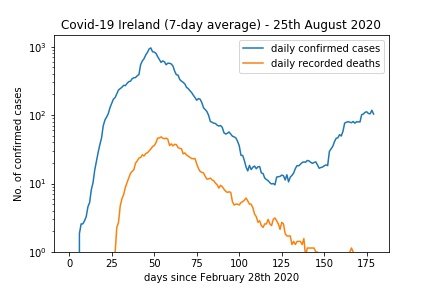
The Coronavirus situation here remains relatively stable, with new cases steady at a low level:

This is not the case for the rest of the world, however. Yesterday two grim milestones were passed: 10,000,000 confirmed cases of Covid-19 worldwide and 500,000 deaths:

Much of the recent numerical growth of the pandemic is associated with North and South America. Brazil is particularly badly affected as are some of the United States. I don’t need to comment on the quality of the political leadership involved.

I am very nervous about the situation in the United Kingdom too, where I feel the reopening is being rushed. Poor leadership is partly responsible for the continuing high levels of infection there too.

Anyway, back to Phase Three in Ireland. Yesterday I bought a copy of the Irish Times and found this booklet inside:

The emphasis is on the fact that despite the low levels in Ireland Covid-19 has not gone away and we all have to be prepared to take special precautions for the foreseeable future. I would be amazed if there wasn’t another flare-up here at some point, actually, it’s just a question of when. And those optimistic about the delivery of a vaccine in the near future, I’ll remind you that there isn’t yet a vaccine for any form of Coronavirus let alone the novel form responsible for Covid-19 (SARS-CoV-2).

Anyway, on Friday I attended a virtual Question and Answer session with the President of Maynooth University, Professor Philip Nolan, about the plans for reopening campus over the Summer and into the new academic year. It is clear that lots will have to be done before staff can return fully and even then it won’t be anything like “normal”.

Incidentally the issue of face masks came up and there was some discussion about their effectiveness. Not being a medical expert I don’t really know about that, but I think one of the important things about masks in a work environment is that their visibility means that they work as a signal to remind people to be aware of Covid-19. I have discarded my home-made face masks and bought a box of proper ones and I intend to wear them whenever I am in a work setting in which anyone else is present.

On Friday evening I finally received (relatively) detailed instructions on how the return to work process will work. The Department of Theoretical Physics at Maynooth University is still basically in Phase 1 while the university working group has been assembling this guidance. It will probably be several more weeks before we can get people back to work because there are many things still to be done: including the installation of hand sanitizers, one-way systems, screens, and new signage.

Another thing that came up during the President’s Q&A was the question of vacations for staff. Fortunately I had muted both my audio and video feeds for this as I laughed out loud. What with organising the return to work, overseeing repeat exams, recruiting a sabbatical replacement, planning teaching for next year, rewriting my own lectures for the “new normal”, etc etc, and (hopefully) moving into a new house, I can’t see any prospect of any summer holiday this year at all!

The Trouble with a J-1 Visa..

Posted in Biographical with tags , , on June 24, 2020 by telescoper

With the news going around about Donald Trump’s decision extend restrictions on travel to the USA, including banning the J-1 visa, I thought you might be interested to hear what happened to me when I tried to apply for a J-1 visa about 15 years ago. The following account is taken from an old post published in 2008.

–o–

When I was working at the University of Nottingham, I was given a sabbatical for one semester for the Autumn of 2005. I had already received an informal invitation from George Smoot at the University of California at Berkeley to visit, specifically from 1st August to 10th December that year. I had visited him the previous year while I was on holiday in California and enjoyed it very much, especially the good food and stupid jokes.

All I had to do was to get my visa and travel arrangements sorted out. The period of the visit was longer than the 90 days for which visa-free travel was allowed, and also the restrictions brought in after 9/11 involved stricter monitoring of scientific visitors. It was therefore necessary to apply for a J-1 visa.

For a J-1 visa for the USA you need first of all a form called a DS-2109 which, in the case of visiting scholars like me, is a kind of formal invitation issued by the host institution. I applied for this using a special form on March 10th 2005. My first problem was that Berkeley did not send the papers back to me until 12th July 2005. However, once I had it I was in a position to get the visa.

Nowadays nobody is issued a US visa without an “interview” at a US Embassy consular division. You are not allowed to book an interview until you have your DS-2109. I called the Embassy visa line (cost £1.30 per minute) and made an appointment. Unbelievably, the first available appointment was a month later, on 11th August 2005, 10 days after my sabbatical visit was supposed to start. Worse still, the instructions I received indicated a minimum of a further 5 working days should be allowed after the interview for the return of the passport with the visa.

You also have to surrender your passport at the interview with no promise of when it will be returned. They don’t even guarantee 5 days. As a matter of fact they don’t guarantee anything at all, as we shall see.

The next thing you have to do is to pay a fee called a SEVIS fee. In my case that was $100. You can do this online, so it was no problem. I paid the fee by credit card and printed out the receipt as instructed. There are then several forms to be filled in. DS-156 is the basic application form. I also needed to fill in a DS-157 and DS-158, which contain detailed information about my work history, qualifications and family circumstances. I was also told I would need to take with me to the interview evidence of my employment, bank statements, mortgage statements, and so on, presumably to prove I was not planning to gain entry to the US to work there; obviously everyone in Britain, even a University professor, really wants to leave their home and work as a waiter in America.

Finally you have to go to a bank and pay the visa application fee (£60) and get a formal receipt. Oh, and you need a photograph. Armed with all this paperwork, and my passport, I went to the Embassy in London on the morning of 11th August 2005. My appointment was scheduled at 12.45, but it’s a two-hour train journey from Nottingham to London. Incidentally, that cost me £94. I got there in good time, and actually entered the Embassy through its extensive security checks around 12.15.

The Embassy operates a take-a-ticket-and-wait system like the deli counter at a supermarket. I took a number and waited. After about an hour, my number was called. I went to a window and a lady who could hardly speak English asked for my documents. I passed them through the window. I then had my fingerprints scanned. And that was that. Except it turns out that is only Stage 1. I returned to my seat and waited for Stage 2, the interview

Three hours later I was finally called for my interview. The consular official was quite polite. He asked me some questions about my job, and work. I thought it was all going fine. It took about 15 minutes. Then he picked up my passport. It was a perfectly valid passport that I had used for a trip to Belgium a few weeks previously without any problems and it still had about two years left to run before a new one was required. He turned to the back page where the photograph was. He picked up a paper knife and stuffed it into the edge of back cover of the passport, between the plastic covering the photograph and the actual back cover, and started to waggle the knife about. He did this so violently that the photograph came loose, which it was not when I entered the Embassy.

Oh dear”, he said. “Looks like someone has tampered with your passport.” He showed me the damaged page through the glass.

I couldn’t believe my eyes. “Yes..you just did.”

Oh, anyone could have done that”, was the response. “Someone could replace your photograph with theirs, so I can’t accept this.”

I was actually shaking with anger and confusion at this point. He continued to the effect that he couldn’t issue a visa until I got a new passport. He gave me a form for the re-application and instructions on how to send everything back to the Embassy by courier. He told me if I did re-apply it would take at least 5 working days to process, but I wouldn’t need to pay another fee or have another interview. Finally, as an added bonus he stamped my ruined passport to indicate a visa had been refused.

Have a nice day”. He actually said that as I left.

Walking back from the Embassy to St Pancras station to get the train back to Nottingham my head was spinning. Had this really happened? Does the US Embassy actually think it has the right to destroy someone’s passport?

I came back to Nottingham that evening half-convinced I had dreamt the whole thing. Why would anyone do that? The passport was fairly old, but had another year or two to run. It was also a machine-readable passport, as is now required. It did not have a digital photograph printed directly on the information page, but the regulations did not actually require that to be the case. My passport was perfectly valid when I entered the Embassy, but it was now useless.

I can only guess that Consular staff had been issued with instructions not to accept passports with old-fashioned photographs in them, even if they were otherwise acceptable. However, rather than print updated guidelines the individual in charge of my application chose to mutilate my passport in order to give him an “official” reason for rejecting it.

Whatever the reason, my passport was ruined and if I was to go anywhere at all I would need a new one. I went to the Post Office the very next day, on Friday 12th August, and applied for a replacement passport. I received a shiny new one (with a digital photograph in it) the following week. As a bonus, the Passports office had noted the fact that my previous one had two years left to run so had given me a passport that wouldn’t expire until 2017.

Now I had to decide what to do. Partly because I had invested so much time and money already, and partly because I was worried about the fact that the immigration records for the US would contain information that I had been refused a visa, I decided to continue with the re-application. After all, if my record showed a refused visa it would be very unlikely I could travel to the USA without extreme difficulty at any time in the future. So I filled in all the forms again, got another photograph, got some more copies of bank statements and all the rest. I rang the Courier (SMS) and arranged for them to pick up the re-application (together with new passport) on 25th August. I paid for the return trip of my documents too. Total cost £19. The courier came and picked up the package to take to the Embassy as arranged.

Fine, I thought. Only 5 days and it will all be sorted. What a fool I was. By September 9th I still hadn’t received anything back. Without my passport I wasn’t able to travel abroad at all. I called the embassy to demand the immediate return of my passport whether it had a visa or not. I no longer cared about visiting the USA. I just wanted my papers back. The Embassy staff said that I would have to wait until it had been processed and, if I read the conditions of application, the five day processing time was never guaranteed.

I contacted the Member of Parliament for my constituency, Nick Palmer, who informed me that I should lodge a formal complaint to the Foreign & Commonwealth Office about the damage to my passport. Since UK passports remain Crown Property at all times, this is the appropriate channel for such matters. I even asked the Foreign Office to attempt the retrieval of my passport from the Embassy.

I was in such a rage I sent a few emails out to friends and colleagues who I thought might be interested in the story, some of whom forward them on. I got a number of nice replies from people all around the world with their own stories. I realized that although I was angry and frustrated, at least I wasn’t having my life torn apart, which is exactly what this kind of petty officialdom can do in different circumstances.

I don’t know which, if any, of these routes actually achieved anything but a few days later my passport arrived back by Courier. It even had a J-1 Visa in it.

Finally! Success!

But wait, there was a covering letter included with my documents. It said that although I had been given a J-1 visa , it wouldn’t be sufficient to achieve entry to the United States. I would have to take with me to the airport all the documents I had taken to the Embassy for my interview. Helpfully, they also pointed out that my DS-2109 had now expired because I should have entered the states on August 1st 2005 and it was now the middle of September. before I travelled I would therefore need to acquire a new DS-2109. Effectively I was back at square one.

Given how long it had taken to get this in the first place, I gave up. I abandoned all hope of ever taking my sabbatical in Berkeley or indeed anywhere in the USA. I had lost six weeks of my allotted time in any case.

I had to find a plan B. I contacted Dick Bond at the Canadian Institute for Theoretical Astrophysics in Toronto and asked if I could go there instead. I didn’t expect him to agree because it was very short notice, but he said yes. Next day I received a formal letter of invitation by FedEx and I booked my ticket to Canada. No visa needed.

I arrived in Toronto at the end of September and spent about three months there. It was an extremely enjoyable time, during which I managed to finish my book From Cosmos to Chaos, as well as a few other things. Of course the climate was a bit different from what I would have experience at Berkeley. It got quite cold in Toronto towards Christmas, but I didn’t mind at all. My only regret is that I wasted so much time and money before deciding to go there when I could have had another six weeks in Toronto without the hassle.

Nothing ever came of any of the formal protests. I’m not surprised about that. The chap who wrecked my passport has diplomatic immunity so can’t be prosecuted. I doubt that the British Government ever even approached the US Ambassador with this matter. Given the collusion of the British in the illegal rendition and torture of prisoners by US agents, it seems unlikely that they give a toss about international law anyway.

I passed the details onto Berkeley who contacted the US Visa Department in Washington, but I never heard anything back from them either. Even less surprising.

So I now have a passport with a J-1 visa in it, but no US entry stamp. I sometimes wonder what would happen if I turned up in the States and showed it to an immigration officer, but then I doubt if I’ll be going to the USA in the foreseeable future. I’ve also been asked about this unusual state of affairs a few times on entering other countries, which gives me the chance to tell the story I’ve just posted or at leas the gyst of it. The best response was from a Canadian Immigration Officer, when I arrived in Toronto in Autumn 2005.

That’s America for you. But you’re in a civilized country now.”

I am sorry I didn’t get the chance to visit George Smoot, though I did manage to meet up with him a year later in Sweden. But that’s another story...


Becoming a Culchie…

Posted in Biographical, Maynooth with tags , , on June 23, 2020 by telescoper

Among all the other things going at the moment, most of them to do with Covid-19, I am in the process of trying to buy a house. I did toy with the idea of moving to Dublin but property prices there are ridiculously high and I wanted to avoid having to commute, so I decided to stay local, not that houses are very much cheaper here in Maynooth…

Another factor has been my arthritis. It’s not at all bad at the moment, but a while ago I was viewing a property which was very nice but had very steep and narrow stairs and I suddenly struck me that in a few years’ time they would probably be quite difficult to manage. Eventually I found a lovely bungalow near Maynooth and last week had my offer on it accepted. There’s a lot that can go wrong from here but all the paperwork, survey, valuation and other stuff is proceeding and I am hoping to move into the new house towards the end of the summer. Fingers crossed. I know that a lot can go wrong in the house-buying business so I’m taking nothing for granted.

There are many similarities in the house buying saga here in Ireland compared to the United Kingdom (where I have bought and sold several properties over the years), but one big difference is the auction process. Estate agents here in Ireland are generally called auctioneers, actually. In order to register to bid you have to first show that you have the necessary funds and then you can place a bid online. It’s easy in an auction to get drawn in so far that you end up spending more than you wanted to, so I decided on an absolutely upper limit on how high I would go. Fortunately the bidding stopped well below that.

There are a few other differences between the UK and Ireland. One is that if you buy a new house here you have to pay VAT on it, which is a considerable increase in cost. Another is that stamp duty is just 1% in Ireland, whereas for a property of similar price in England it would be 5%. Other than that the business of mortgages and valuations and surveys and Land Registry is all tediously familiar.

When I told a friend what I was buying and where he described my putative new house as a “Culchie Bungalow”.
I’d heard the word Culchie before but decided to look it up. The original meaning was a person from rural Ireland, but nowadays it refers more-or-less to anybody who lives outside Dublin. I was quite surprised however to see that Maynooth is specifically mentioned as a place where culchies live on the wikipedia page

Anyway, I don’t mind being called a culchie. I’ve been called a lot worse over the years!