Over the years I have written quite a few pieces on this blog, around the time of Remembrance Sunday, about the wearing of a poppy, the last being in 2016. I have worn a poppy at this time of year for most of my adult life, but in 2017 I decided to stop.
For one thing, there is no pressure to wear a poppy here in Ireland. Indeed, many Irish people see the poppy mainly as a symbol of British militarism and colonial oppression. At a concert to mark the Armistice last year I saw only a few audience members wearing a poppy, and most of them were the shamrock version commemorating the sacrifice of Irish soldiers during the Great War.
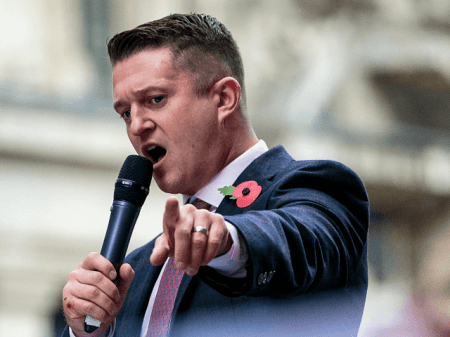
But I don’t think I’ve ever really been that susceptible to peer pressure, so that’s not the main reason for my not wearing a poppy. The main reason is that over the past couple of years the poppy has been appropriated by the likes of racist thug, career criminal and founder-member of the EDL, Stephen Yaxley-Lennon (also known as Tommy Robinson):
I simply cannot bring myself to wear the same badge as this horrible racist gobshite, nor can I stand the hypocrisy of those politicians who make a show of wearing it while happily encouraging the rise of nationalism that caused all the suffering just a century ago. The message of the poppy is supposed to be `Lest We Forget’. I’m afraid far too many have already forgotten.
I have a lecture on Monday 11th November at 11am, when the traditional two minutes’ silence to mark the 1918 armistice is observed. Fortunately, lectures at Maynooth run from five past the hour until five to, so I will be able to observe this on my own before I start the lecture. But I won’t be wearing a poppy.
Is it disrespectful to the war dead to refuse to wear a poppy? No, of course it isn’t. What is disrespectful to them is to seek to reoeat the mistakes that led to wars in the first place.
I’m back in a very cold and windy Maynooth after a trip to Newcastle (via London) for my Mam’s funeral. It went as well as could have been expected, though it was a difficult occasion for all concerned. It was nice to see such a good turnout, though, including several members of my family I haven’t seen for many years. The service was both simple and dignified (and entirely secular).
I’ve got a lot of things to catch up on after the few days I spent away so I don’t have time for a long post today. I did, however, want to put up a short message to express my gratitude to everyone who has contacted me privately to offer condolences and good wishes. All your messages mean a lot, so thank you all. That also goes for all the friends I met at the RAS Club on Friday evening, all of whom were very supportive.
Now, I have three examination papers and two problem sets to write by Monday, five lectures to prepare for next week, and a lengthy review article about the Hubble constant to finish by Friday so I’d best get on with it. Moping about isn’t going to help.
So that’s that. The funeral is over. We all said our goodbyes, and there many tears.
My Mam chose the music for her funeral a long time ago, and the piece that was playing as we arrived in the West Chapel of the West Road Crematorium was one that I wrote about about a decade ago, so I thought I’d indulge myself by posting here the version we heard today.
Years ago my Mam told me that she heard the tune Mabel’s Dream played on the piano by a friend of the family by the name of Johnny Handle. Best known as a folk musician (and founder member of a well-known band called The High Level Ranters) he is also a music teacher and musicologist with a wide range of interests in music. I read somewhere that this lovely tune was originally written by Jelly Roll Morton and performed by him on solo piano, but by far the most famous recording of Mabel’s Dream was made by King Oliver and his Creole Jazz Band in Chicago in 1923. This was the band that the young Louis Armstrong belonged to before going on to make the classic Hot Fives and Hot Sevens, one of which I posted a bit ago. It’s interesting how different the earlier band sounds: with two cornets (King Oliver and Louis Armstrong), clarinet (Johnny Dodds), and trombone (Honore Dutrey) playing together virtually all the time except for short improvised solo breaks. King Oliver usually played lead cornet, at least in their earlier recordings, with Louis Armstrong playing a decorative counterpoint around him rather like a clarinettist might. Later on, they swapped leads freely and completely intuitively producing a sound that was entirely unique.
The ensemble playing is intricate, but the band had no written music, preferring to work exclusively from “head” arrangements. Their music is consistently delightful to listen to, with a succession of marchy themes that makes it impossible not to want to tap your feet when you listen to them.
Over time, this classic type of polyphonic Jazz- derived from its New Orleans roots – gradually morphed into musical form dominated by much simpler arrangements and a succession of virtuoso solos. This change was also reflected in the differing fortunes of Louis Armstrong and King Oliver. The former went on to become an international celebrity, while the latter lost all his savings when his bank went bust during the Wall Street Crash.
Considering the relatively brief time that they played together, King Oliver and Louis Armstrong made an astonishingly large number of astonishingly beautiful records, including this one which I’m posting here to show that as well as many other things my Mam had great taste in Jazz.
Posted in Biographical on November 2, 2019 by telescoper
This is going to be a very short post, but also a very difficult one to write. My Mam has passed away, having lost her struggle against Alzheimer’s Disease. Mercifully at least the end was peaceful and she’s now at rest. Ar dheis Dé go raibh a hanam.
This is a picture of us in happier times taken just outside the Brighton Centre just after I received my doctorate from Sussex University in 1989.
Can that really have been 30 years ago?
The first I knew about her final illness was at the end of 2015 when I visited for Christmas and noticed how much her memory and behavior had changed. Shortly after that came the official diagnosis. Her condition deteriorated rapidly thereafter as dementia cruelly took hold and about eighteen months ago, being virtually completely incapacitated, she had to move into a care home. Fortunately she seemed relatively happy there. In the end it was pneumonia that took her, but at least she slipped away gently.
During the years of her illness I have never written about it here because I couldn’t find the words. Now I have to admit that when I heard the news that Mam had died my first reaction was a sort of relief that her torments were over. That was quickly overtaken by a sense of guilt (a) that I had felt like that and (b) that I hadn’t been there enough or done enough to help. Now I just feel numb, unable really to take it in. I keep hoping for some sort of catharsis, but it doesn’t happen.
My Mam’s illness was one of the causes of stress that led to my decision to step down from my role as Head of the School of Mathematical and Physical Sciences at Sussex University back in 2016. I had a notion that moving to a part-time job I might be able to help look after Mam, but I found the whole situation too painful and other things got in the way. I wasn’t strong enough to contribute anything significant and the burden fell on the shoulders of others. Now I’ll never be able to put that right.
I have to reorganize quite a few things next week so I can attend the funeral in Newcastle, so I’ll occupy myself doing that.
Although it’s still Study Week here in Maynooth I am back at work for the morning and then I’m attending a conferring ceremony this afternoon and later on I have to go into Dublin to give a talk at the Institute of Advanced Study. It’s Hallowe’en, of course, so no doubt there are quite a few weirdly dressed scary-looking people about, but one gets used to that working in a Physics Department. I just hope this evening’s talk isn’t an unintentionally horrible experience.
Anyway, it’s more than a decade since I posted my first blog about the real horror of Hallowe’en so, despite popular demand, I’ll take the excuse of a busy day to repeat it here.
–o–
We never had Hallowe’en when I was a kid. I mean it existed. People mentioned it. There were programmes on the telly. But we never celebrated it. At least not in my house, when I was a kid. It just wasn’t thought of as a big occasion. Or, worse, it was “American” (meaning that it was tacky, synthetic and commercialised). So there were no parties, no costumes, no horror masks, no pumpkins and definitely no trick-or-treat.
Having never done trick-or-treat myself I never acquired any knowledge of what it was about. I assumed “Trick or Treat?” was a rhetorical question or merely a greeting like “How do you do?”. My first direct experience of it didn’t happen until I was in my mid-thirties and had moved to a suburban house in Beeston, just outside Nottingham. I was sitting at home one October 31st, watching the TV and – probably, though I can’t remember for sure – drinking a glass of wine, when the front door bell rang. I didn’t really want to, but I got up and answered it.
When I opened the door, I saw in front of me two small girls in witches’ costumes. Behind them, near my front gate, was an adult guardian, presumably a parent, keeping a watchful eye on them.
“Trick or Treat?” the two girls shouted.
Trying my best to get into the spirit but not knowing what I was actually supposed to do, I answered “Great! I’d like a treat please”.
They stared at me as if I was mad, turned round and retreated towards their minder who was clearly making a mental note to avoid this house in future. Off they went and I, embarrassed at being exposed yet again as a social inadequate, retired to my house in shame.
Ever since then I’ve tried to ensure that I never again have to endure such Halloween horrors. Every October 31st, when night falls, I switch off the TV, radio and lights and sit soundlessly in the dark so the trick-or-treaters think there’s nobody at home.
That way I can be sure I won’t be made to feel uncomfortable.
Today marks the end of the fifth week of teaching at Maynooth University and next week is the October mid-term break, starting with a bank holiday on Monday 28th October: the last Monday of October (Lá Saoire i mí Dheireadh Fómhair), or the Halloween Holiday (Lá Saoire Oíche Shamhna), is a national holiday in Ireland.
The mid-term break, optimistically known as ‘Study Week’, is often called ‘Half Term’ but since we have twelve-week teaching terms and we’ve only done five weeks at this point, I’ve used the more accurate description in the title of this post.
I’ll be back in Maynooth next week but I’m taking a few days off until then. Normal service will be resumed as soon as possible, but there will now follow a short intermission.
I’m taking a quick break for coffee and remembered an article I saw in the Irish Times at the weekend about British immigrants in Ireland. Being one such myself I find a lot of it rings true. You can read the article here (I don’t think it’s behind a paywall). I think it’s well worth a look.
I found quite a few things in it resonate quite strongly with my experiences since I arrived here a couple of years ago. Top of these was the realization of just how ignorant I was about Irish history, thanks to the almost total neglect of this topic in British schools. Lack of education inevitably leads to lack of understanding and more often than not leads to prejudice and one finds a lot of that in the attitude of British people, even senior figures (many of them “educated” at Oxford) who are supposed to know better.
Another point I recognize is how many people ask me to explain Brexit, as if being British means that I should be able to do that. I don’t understand the madness that has descended on Britain but I feel it in my bones that the United Kingdom is headed for very dark times indeed.
I was also struck by the “Not Really Irish” tag, which I think about rather a lot. It’s not really just a question of whether or not you have Irish citizenship or an Irish passport, it’s about the extent to which you belong. I spent over fifty years living in England and Wales so I’m missing a huge amount of cultural background. I won’t ever be able to catch up so I don’t suppose I’ll ever feel `really Irish’. Of course people speak English here but I’m very conscious that I have a funny accent. I suppose that means I’ll always feel like a stranger in Ireland. If there is predominant attitude towards the British over here, however, in my experience it is one of sympathy rather than hostility. And the general friendliness of the locals means that this isn’t a bad place at all to be a stranger.
One final comment: it was mentioned in the Irish Times piece that there are a lot of British TV programmes on Irish television. I do not regard that as a positive at all! In fact I stopped watching UK television long before leaving the UK and have not started again since I moved here.
I wonder how different it feels to be an Irish person living in Britain right now? That might make for an interesting complementary article for a future edition of the Irish Times?
This morning, a certain social media site pointed out to me that it is ten years to the day since I started using it.
My experiences of Twitter haven’t been anything like as bad as some people I know have reported. I think that’s probably because I’m quite liberal with the ‘block’ facility when it comes to bots and trolls and sundry other tediously offensive types. I have found that the positives have definitely outweighed the negatives over the last decade, and I count myself lucky to have encountered some very lovely people on Twitter, some of whom I have eventually met in the real world.
I don’t have a huge following on Twitter, but I’d like to take this opportunity to say that I do appreciate those who do read my tweets and hope that they find at least some of them interesting or amusing!
So here I am in a very rainy London. I arrived yesterday for a meeting of the IOP Diversity and Inclusion Committee, which was an interesting occasion with many new things about to unfold, tempered by a bit of sadness that the wonderful Head of Diversity at the IOP, Jenni Dyer, is leaving shortly to take up a new job. However will we manage?
Anyway, instead of flying back to Ireland last night after the meeting, I stayed in London last night because today there is an ordinary meeting of the Royal Astronomical Society at Burlington House, to be followed by a Club Dinner. I’ll be going home to Ireland tomorrow.
Unfortunately the weather has put a dampener on my plans to spend a bit of time wandering around London because it is raining quite heavily and is forecast to do so for the rest of the day. Still, at least the hotel I’m in has WIFI so I can get a few things done this morning before venturing out into the inclement conditions.
Meanwhile the pound is rising against the euro on optimism that there may be a Brexit deal on the horizon after yesterday’s meeting between Boris Johnson and Leo Varadkar. Nobody knows the details but it seems likely that it’s basically the same as Theresa May’s `deal’ except that the `backstop’ is to be replaced by what is effectively a customs border in the Irish Sea. My personal preference would be Boris Johnson thrown in the Irish Sea.
I doubt the Democratic Unionists will be happy with this, but Johnson is probably gambling that enough Labour quitlings will vote for it that he no longer needs their support. Of course, that all depends on whether what was discussed yesterday turns into a concrete legally-binding agreement signed off by the EU.
P.S. Bookies’ odds on a No-Deal Brexit on October 31st have drifted out from 4/1 to 5/1.
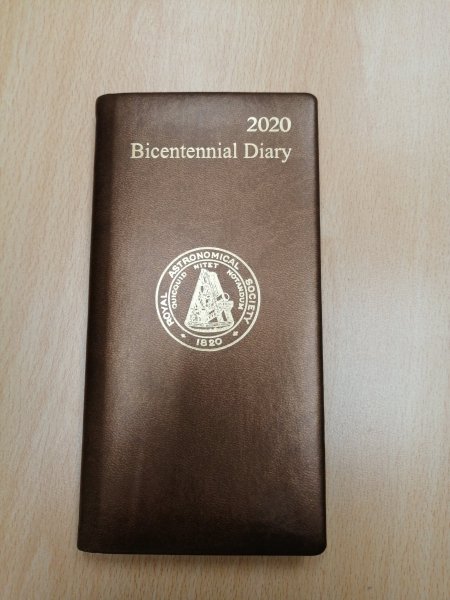
The arrival yesterday of this year’s Royal Astronomical Society diary reminded (for obvious reasons) that next year (2020) sees the bicentenary of the Society and that there will be a number of special events to mark the occasion.
The ‘Astronomical Society of London’ was conceived on 12 January 1820 when 14 gentlemen sat down to dinner at the Freemason’s Tavern, in Lincoln’s Inn Fields, London. After an unusually short gestation the new Society was born on 10 March 1820 with the first meeting of the Council and the Society as a whole. An early setback, when Sir Joseph Banks induced the Duke of Somerset to withdraw his agreement to be the first President, was overcome when Sir William Herschel agreed to be the titular first President, though he never actually took the Chair at a meeting.
The Society became the `Royal Astronomical Society’ in 1831 when it was granted a Royal Charter by William IV, but this is no time to be quibbling about names.
It’s not only the Royal Astronomical Society that has survived and prospered for two hundred years. The group of `gentlemen’ who met for dinner in January 1820 has also carried on in the form of the RAS Club which is, of course, older than the RAS itself.
As well as being a Fellow of the Royal Astronomical Society (and having twice served on its Council), I also have the honour of having been elected a Member of the RAS Club about 11 years ago. I blogged about this here.
The members of the RAS Club are all Fellows of the Royal Astronomical Society. All you have to do to join the Royal Astronomical Society is to find two Felllows to support you, pay some money and sign your name in a book, but to get into the RAS Club you have to be elected by the existing membership. Nominations are solicited each November (via a process called `The Naming of Names’) and the elections held – usually with a great deal of confusion about the voting system – in January. Frankly, it’s all a bit dotty, but I like it. I don’t really carte much for the real world anyway. The club’s various little rituals are a bit bizarre, but quaintly amusing in their own way, and the proceedings are remarkably lacking in pomposity.
Nowadays, the RAS Club usually meets at the Athenaeum in Pall Mall, shortly after the end of the monthly `Ordinary Meetings’ of the RAS at Burlington House (always referred to at the Club as `another place’) which happen on the second friday of each month. That is except when the RAS meeting is the annual National Astronomy Meeting (NAM) which is held at a different location each year; on these occasions the club also meets, but at an appropriate alternative venue near the NAM location.
I think the RAS Club (and even the RAS itself) is sometimes viewed with suspicion and perhaps even hostility by some astronomers, who seem to think the club is a kind of sinister secret society whose existence is intrinsically detrimental to the health of astronomy in the UK. Actually it’s just an excuse for a good nosh-up and some daft jokes, although I was initially disappointed to find out that there wasn’t after all a covert plan for world domination. Or if there is, nobody told me about it.
The other common complaint is that the club’s membership is just a bunch of old male dinosaurs. Now it is true that your typical member of the RAS Club isn’t exactly in the first flush of youth, but that’s no excuse for ageism. And the club does try very hard to secure encourage nominations from female Fellows and the gender balance is improving steadily.
The diary reminded me also that the first meeting of the RAS of the new term, and hence the first Club dinner, will be on Friday October 11th. I hope to be there to find out more about the plans for the bicentennial dinner in January 2020…
Anyway, as a postscript, although many of my colleagues seem not to use them, I like old-fashioned diaries like the one above. I do run an electronic calendar for work-related events, meetings etc, but I use the paper one to scribble down extra-curricular activities such as concerts and cricket fixtures, as I find the smartphone version of my electronic calendar a bit fiddly. I’m interested to know the extent to which I am an old fogey so here’s a little poll on the subject of diaries:
The views presented here are personal and not necessarily those of my employer (or anyone else for that matter).
Feel free to comment on any of the posts on this blog but comments may be moderated; anonymous comments and any considered by me to be vexatious and/or abusive and/or defamatory will not be accepted. I do not necessarily endorse, support, sanction, encourage, verify or agree with the opinions or statements of any information or other content in the comments on this site and do not in any way guarantee their accuracy or reliability.



 In the Dark