This morning, a certain social media site pointed out to me that it is ten years to the day since I started using it.
My experiences of Twitter haven’t been anything like as bad as some people I know have reported. I think that’s probably because I’m quite liberal with the ‘block’ facility when it comes to bots and trolls and sundry other tediously offensive types. I have found that the positives have definitely outweighed the negatives over the last decade, and I count myself lucky to have encountered some very lovely people on Twitter, some of whom I have eventually met in the real world.
I don’t have a huge following on Twitter, but I’d like to take this opportunity to say that I do appreciate those who do read my tweets and hope that they find at least some of them interesting or amusing!
So here I am in a very rainy London. I arrived yesterday for a meeting of the IOP Diversity and Inclusion Committee, which was an interesting occasion with many new things about to unfold, tempered by a bit of sadness that the wonderful Head of Diversity at the IOP, Jenni Dyer, is leaving shortly to take up a new job. However will we manage?
Anyway, instead of flying back to Ireland last night after the meeting, I stayed in London last night because today there is an ordinary meeting of the Royal Astronomical Society at Burlington House, to be followed by a Club Dinner. I’ll be going home to Ireland tomorrow.
Unfortunately the weather has put a dampener on my plans to spend a bit of time wandering around London because it is raining quite heavily and is forecast to do so for the rest of the day. Still, at least the hotel I’m in has WIFI so I can get a few things done this morning before venturing out into the inclement conditions.
Meanwhile the pound is rising against the euro on optimism that there may be a Brexit deal on the horizon after yesterday’s meeting between Boris Johnson and Leo Varadkar. Nobody knows the details but it seems likely that it’s basically the same as Theresa May’s `deal’ except that the `backstop’ is to be replaced by what is effectively a customs border in the Irish Sea. My personal preference would be Boris Johnson thrown in the Irish Sea.
I doubt the Democratic Unionists will be happy with this, but Johnson is probably gambling that enough Labour quitlings will vote for it that he no longer needs their support. Of course, that all depends on whether what was discussed yesterday turns into a concrete legally-binding agreement signed off by the EU.
P.S. Bookies’ odds on a No-Deal Brexit on October 31st have drifted out from 4/1 to 5/1.
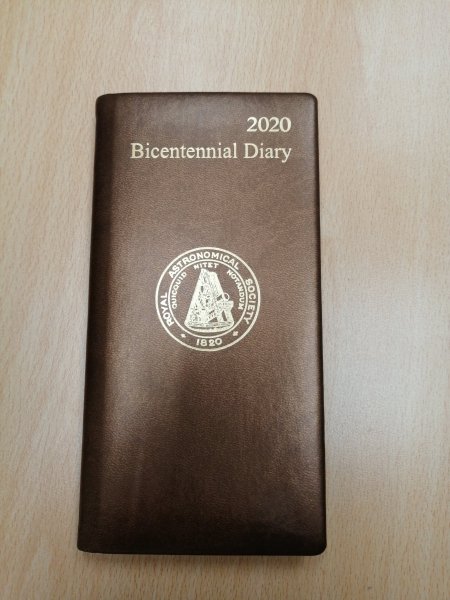
The arrival yesterday of this year’s Royal Astronomical Society diary reminded (for obvious reasons) that next year (2020) sees the bicentenary of the Society and that there will be a number of special events to mark the occasion.
The ‘Astronomical Society of London’ was conceived on 12 January 1820 when 14 gentlemen sat down to dinner at the Freemason’s Tavern, in Lincoln’s Inn Fields, London. After an unusually short gestation the new Society was born on 10 March 1820 with the first meeting of the Council and the Society as a whole. An early setback, when Sir Joseph Banks induced the Duke of Somerset to withdraw his agreement to be the first President, was overcome when Sir William Herschel agreed to be the titular first President, though he never actually took the Chair at a meeting.
The Society became the `Royal Astronomical Society’ in 1831 when it was granted a Royal Charter by William IV, but this is no time to be quibbling about names.
It’s not only the Royal Astronomical Society that has survived and prospered for two hundred years. The group of `gentlemen’ who met for dinner in January 1820 has also carried on in the form of the RAS Club which is, of course, older than the RAS itself.
As well as being a Fellow of the Royal Astronomical Society (and having twice served on its Council), I also have the honour of having been elected a Member of the RAS Club about 11 years ago. I blogged about this here.
The members of the RAS Club are all Fellows of the Royal Astronomical Society. All you have to do to join the Royal Astronomical Society is to find two Felllows to support you, pay some money and sign your name in a book, but to get into the RAS Club you have to be elected by the existing membership. Nominations are solicited each November (via a process called `The Naming of Names’) and the elections held – usually with a great deal of confusion about the voting system – in January. Frankly, it’s all a bit dotty, but I like it. I don’t really carte much for the real world anyway. The club’s various little rituals are a bit bizarre, but quaintly amusing in their own way, and the proceedings are remarkably lacking in pomposity.
Nowadays, the RAS Club usually meets at the Athenaeum in Pall Mall, shortly after the end of the monthly `Ordinary Meetings’ of the RAS at Burlington House (always referred to at the Club as `another place’) which happen on the second friday of each month. That is except when the RAS meeting is the annual National Astronomy Meeting (NAM) which is held at a different location each year; on these occasions the club also meets, but at an appropriate alternative venue near the NAM location.
I think the RAS Club (and even the RAS itself) is sometimes viewed with suspicion and perhaps even hostility by some astronomers, who seem to think the club is a kind of sinister secret society whose existence is intrinsically detrimental to the health of astronomy in the UK. Actually it’s just an excuse for a good nosh-up and some daft jokes, although I was initially disappointed to find out that there wasn’t after all a covert plan for world domination. Or if there is, nobody told me about it.
The other common complaint is that the club’s membership is just a bunch of old male dinosaurs. Now it is true that your typical member of the RAS Club isn’t exactly in the first flush of youth, but that’s no excuse for ageism. And the club does try very hard to secure encourage nominations from female Fellows and the gender balance is improving steadily.
The diary reminded me also that the first meeting of the RAS of the new term, and hence the first Club dinner, will be on Friday October 11th. I hope to be there to find out more about the plans for the bicentennial dinner in January 2020…
Anyway, as a postscript, although many of my colleagues seem not to use them, I like old-fashioned diaries like the one above. I do run an electronic calendar for work-related events, meetings etc, but I use the paper one to scribble down extra-curricular activities such as concerts and cricket fixtures, as I find the smartphone version of my electronic calendar a bit fiddly. I’m interested to know the extent to which I am an old fogey so here’s a little poll on the subject of diaries:
I thought I’d do a quick round-up of my little trip around cultural and historic Dublin yesterday after being stood down from duty at the Higher Options fair at the Royal Dublin Society (RDS). I have to say it was wonderful to see so many people out and about in the City’s beautiful parks and public spaces enjoying the September sunshine as I walked around.
The RDS is in the Ballsbridge area in of Dublin, to the East of the City. My route into town from there took me along Northumberland Road, where I took this picture outside Number 25:
A little further along I went across Mount Street Bridge, passing this memorial.
If you want to know more about the significance of these memorials to the events of the Easter Rising in 1916, see my post here.
My main intention during my afternoon off was to visit the National Gallery of Ireland which is situated on one side of Merrion Square. I have to say that this was even better than I’d expected, and I’m sure to visit again many times in the future. The ground floor is dominated by the work of Irish artists from about 1660 to 1965, together with European Art from 1835 to 1965. You will find works by Monet and Picasso in this section, which has much to savour. Among the Irish artists represented in this show is Jack B. Yeats (brother of poet W.B. Yeats), an extremely interesting artist in his own right.
The highlights for me, however, were found on the 3rd floor which displays examples of European Art from the early Renaissance (c. 1300) to the Enlightenment. One of the interesting things about this collection is that it is arranged thematically rather than by artist (or nationality thereof). There is, for example, an entire room of paintings inspired and influenced by Caravaggio, all of them with an intensely dramatic use of light and shadow. The gallery is worth it just for that room, but there are also fascinating juxtapositions of religious paintings from the renaissance with icons and altarpieces from the Byzantine and Russian orthodox traditions from the same period.
Elsewhere in the collection there are notable works by Vermeer, Rembrandt and Perugino as well as a number of British works by, for example, Gainsborough and Reynolds.
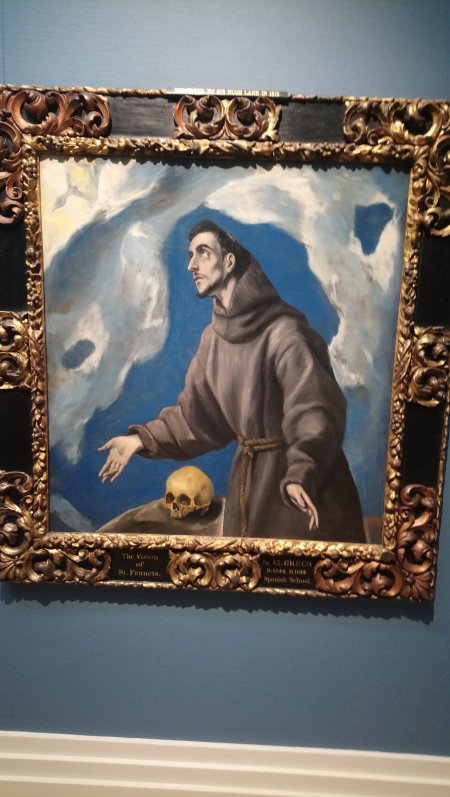
The work that really stopped me in my tracks, however, was this:
This is St Francis Receiving The Stigmata by El Greco. I knew about this painting but had no idea it was in Dublin. Seeing it close up is a revelation: the swirling brushstrokes give it an extraordinary texture that makes it hard to bring the image completely into focus. The hypnotic feel that results is a brilliant depiction of a man undergoing a kind of ecstatic vision. This work has an unbelievably powerful effect on the viewer (or at least on this one).
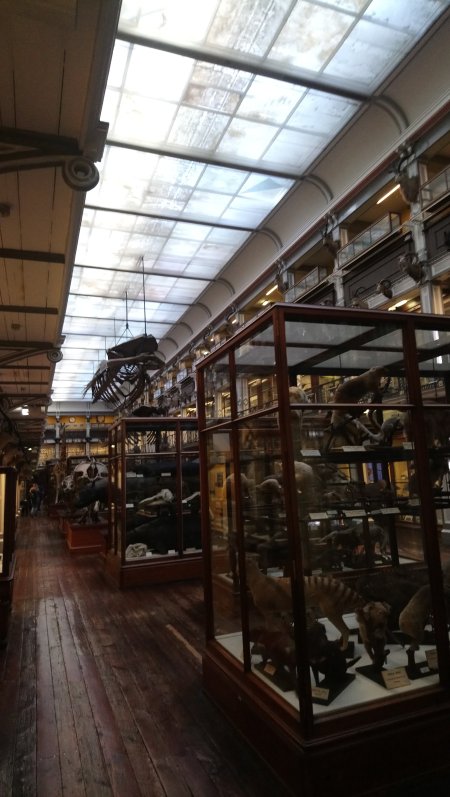
After a break for a sit down and a cup of coffee I visited the Natural History Museum (which is practically next door to the National Gallery). This is a surprisingly old-fashioned affair, with hundreds of stuffed animals and birds crammed into two large rooms:
It reminded me a lot of visits to the Hancock Museum in Newcastle when I was a kid. It’s interesting, but more than a little creepy and would make an excellent setting for a horror story!
After adjourning to a pub for a pint of Guinness the final stop of the day was the National Concert Hall for yesterday’s Culture Night concert. On the way there I saw a big queue of people trying to get into one of the many free events around Dublin. It turns out this Culture Night was the grand opening of the Museum of Literature Ireland, which is situated in Newman House on the South Side of St Stephen’s Green. There’s another one to put on my list of places to visit.
The Culture Night concert was by the RTÉ National Symphony Orchestra conducted by Leonard Slatkin. The opening piece, Kinah, was a composition by the conductor himself and is a sort of memorial to his parents, both of whom were classical musicians, one a violinist and the other a cellist, and together they formed half of the famous Hollywood String Quartet. It was a new piece for me, and I found it very moving indeed. After that there was a bit of reorganization on stage to make way for the Steinway on which the brilliant Xiayin Wang played the Piano Concerto by Samuel Barber, which consists of two fast and furious movements either side of a beautifully lyrical slower movement. This must be a ferociously difficult piece to play – especially the last movement which is at a breakneck pace in 5/8 time – requiring not only dexterity but physical strength. It was a wonderful performance by Xiayin Wang, who rounded off the first half with an encore in the form of a transcription of George Gershwin’s song The Man I Love.
After the wine break interval came the main course in the form of the Symphony No. 4 in E Minor by Johannes Brahms. This is of course a much more familiar work than the previous two, but I really like concerts that mix unfamiliar material with the standard concert repertoire. It also gave me the chance to persevere with Brahms as my friends keep telling me to. It’s not that I don’t like Brahms, it’s just that I don’t find that he moves me as much as many other composers and so many people rave about him that I think I must be missing something. The 4th Symphony is a very fine work, and was performed beautifully last night under the direction of Leonard Slatkin (conducting, incidentally, without a score), but I couldn’t stop myself thinking how much like Beethoven it sounds. That’s not meant to be derogatory, by the way.
But you don’t need to take my word for it. You can listen to (and watch) the whole concert here:
Anyway, after the applause had died down I headed out towards Pearse Station for the train back to Maynooth. I was a bit tired after a very full day and wanted to get the 10.08 train so I didn’t stop to watch any of the numerous musical and artistic events I passed on the way, including an intriguing installation involving images projected onto one of the buildings to the side of St Stephen’s Green. I made it to the station with 5 minutes to spare and discovered that, because it was Culture Night, the train home was free!
So here I am at the RDS in Dublin for the final day of Higher Options which is a sort of trade fair for Irish Universities, other tertiary education institutions and related organisations.
It’s my first trip to one of these events and I was a bit taken aback by the crowds when I arrived. I’m not very good in unfamiliar situations where there a lots of people moving around me.
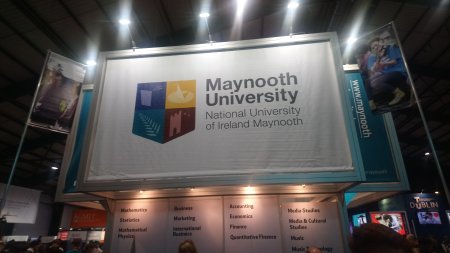
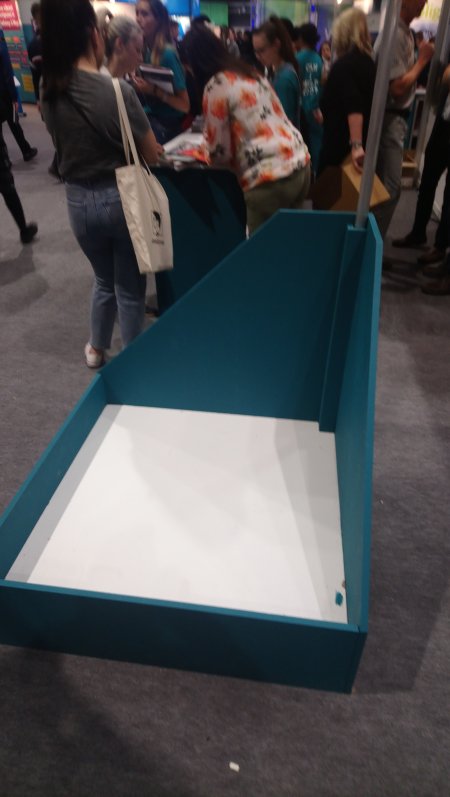
Fortunately I soon found the Maynooth stand, which was fairly conspicuous:
Once I found the sanctuary where I was supposed to be it was all fine. There was a constant stream of people coming to talk to us until about 1pm, when it started to quieten.
Just as well really as we had run out of the relevant literature!
Now I’m a free agent and it’s a lovely afternoon so I’m going to wander around Dublin this afternoon until this evening’s concert at the National Concert Hall. My excuses for not going back to Maynooth are (a) that I didn’t fancy going back just to come into Dublin later this evening and (b) that this is the last day before teaching starts next week, and therefore my last chance of a bit of rest and recreation before term!
Update: there was, apparently, an incident outside the RDS while I was inside, but I wasn’t aware of it at all and only found out about it after I left.
I saw this message from author Matt Haig on Twitter last weekend and it affected me so much I couldn’t write about it at the time.
Tuesday 7 September, 1999. Descend into full breakdown. In a medical centre, vomiting in terror. Can’t sleep. Can’t eat. Whole body shaking. Continual panic attack. Too scared to move.
Saturday 7 September, 2019. Will walk alone on stage at the National Theatre.
Twenty years ago, when he was in his twenties, Matt tried to take his own life. He didn’t succeed, but the attempt left him severely ill as he summarises in that tweet. He wrote about his crisis in his book Reasons To Stay Alive, from which I have borrowed the title of this post.
Why did this message affect me so much? It’s largely because the words he uses to describe his condition also exactly describe what I was like seven years ago when I was admitted to an acute ward in a psychiatric hospital. I wasn’t exactly suicidal, just so exhausted that I didn’t really care what happened next. I was however put on a kind of `suicide watch’, the reason for this being that, apparently, even while sedated, I kept trying to pull the tube out of my arm. I was being fed via a drip because I was ‘Nil by Mouth’ by virtue of uncontrollable vomiting. I guess the doctors thought I was trying to sabotage myself, but I wasn’t. Not consciously anyway. I think it was probably just irritating me. In fact I don’t remember doing it at all, but that period is very much a blur altogether. Anyway, I then found myself in physical restraints so I couldn’t move my arms to stop me doing that.
Eventually I was deemed well enough to move to a general ward and shortly after that I was discharged (with follow-up counselling and medication).
Experiences like that – which I sincerely hope none of you reading this ever have to go through – make you feel very isolated because you are lost inside your own head and body. Knowing that other people go through similar things, and not only survive but prosper, helps a lot. You feel a bit less of an outlier. Of course I’ll never appear on stage at the National Theatre, but although the intervening years haven’t exactly been plain sailing, the last seven have brought far more positives than negatives.
It’s hard to explain why Matt’s message had such a resonance. His experience was clearly far worse than mine, but when I was discharged from hospital the doctors made it very clear just how ill I had been, and that if there was any recurrence I should get help as soon as possible. As well as writing about it on this blog, I did a piece for Time to Change Wales, encouraging people to ask for help if they need it.
Anyway, this brings me to the point of this sermon. Yesterday I received this by email:
It’s from Niteline, an organisation whose volunteers offer students free confidential counselling, and it came with a suggestion (which I will follow) that I should share it with students before and after my lectures. I’m not sure how many students will read this blog, but I thought I would share it here too. If it encourages just one person who is struggling to find someone to talk to then it’s worth it.
So far it has been a very busy but interesting day, involving both the start of a new academic year and the end of the old one. Today I did three subject information talks – to different groups of students – about our Mathematical and Theoretical Physics courses here at Maynooth University. This is part of the pre-term Orientation Week, designed to help new arrivals at the University settle into their courses and choose their options.
In between these sessions signifying the start of the new academic cycle, I had to don academic garb in order to attend my first ever Graduation Ceremony at Maynooth, thus marking the end of the old.
These events are not actually called Graduation Ceremonies here in Ireland but Conferring Ceremonies. I was impressed that the local suppliers of academic dress, Phelan Conan were able to find and supply the correct 1989 vintage DPhil gown from Sussex University as opposed to the less interesting modern one.
Aula Maxima, Maynooth
Conferring Ceremonies in Maynooth are held in the Aula Maxima, on South Campus, which is an excellent venue with lots of atmosphere.I somehow found myself at the front of the academic procession and almost screwed everything up by entering through the wrong door, but a sharp poke in the back from a member of the Psychology Department set me on the right track and I ended up in the right place on the stage.
The ceremony, which was rather shorter those I’ve attended in UK universities, was conducted in a mixture of English, Latin and Irish and was quite enjoyable. The President, Philip Nolan, gave a very nice and well-chosen speech at the end before we spilled out into the drizzle for handshakes and photographs, thence into Pugin Hall for a lunch reception and then, for me at least, a rush back onto North Campus to give another subject information talk.
Whatever their name, graduation ceremonies are funny things. With all their costumes and weird traditions, they even seem a bit absurd. On the other hand, even in these modern times, we live with all kinds of rituals and I don’t see why we shouldn’t celebrate academic achievement in this way.
I love graduation ceremonies, actually. As the graduands go across the stage you realize that every one of them has a unique story to tell and a whole universe of possibilities in front of them. How their lives will unfold no-one can tell, but it’s a privilege to be there for one important milestone on their journey. Getting to read their names out is quite stressful – it may not seem like it, but I do spend quite a lot of time fretting about the correct pronunciation of the names. It’s also a bit strange in some cases finally to put a name to a face that I’ve seen around the place regularly, just before they leave the University for good. I always find this a bittersweet occasion. There’s joy and celebration, of course, but tempered by the realization that many of the young people who you’ve seen around long enough to grow accustomed to their faces, will disappear into the big wide world never to be seen again. On the other hand, this year quite a few graduates of the Department of Theoretical Physics are staying in Maynooth to do Masters programmes so they won’t all be vanishing without trace.
Graduation of course isn’t just about dressing up. Nor is it only about recognizing academic achievement. It’s also a rite of passage on the way to adulthood and independence, so the presence of the parents at the ceremony adds another emotional dimension to the goings-on. Although everyone is rightly proud of the achievement – either their own in the case of the graduands or that of others in the case of the guests – there’s also a bit of sadness to go with the goodbyes. It always seems that as a lecturer you are only just getting to know students by the time they graduate, but that’s enough to miss them when they go.
Anyway, all this is a roundabout way of saying congratulations once more to everyone who graduated today, and I wish you all the very best for the future!
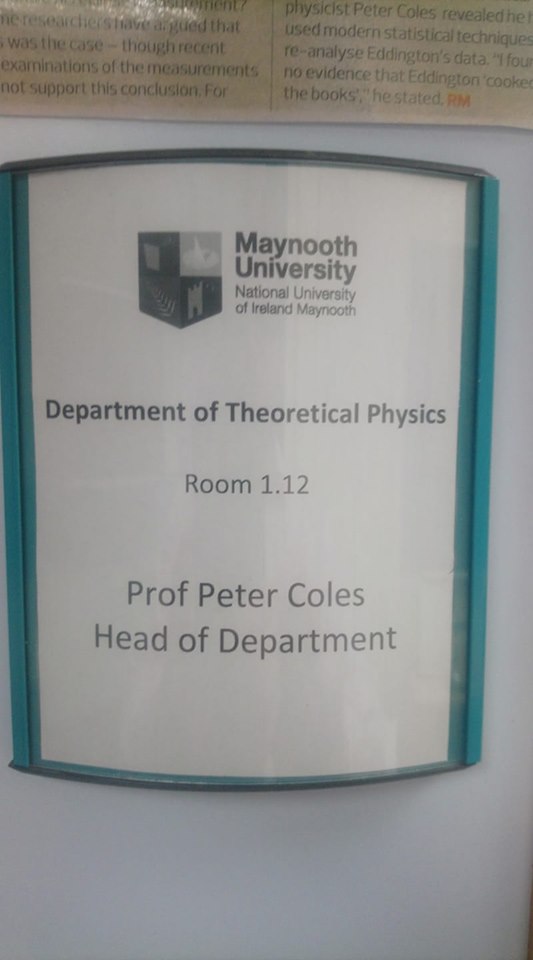
So here I am, then, Head of the Department of Theoretical Physics at Maynooth University.
I’ve even got a sign on my door to prove it!
More to the point I’ve also got a calendar full of meetings!
This morning was my first ever meeting of the Faculty Executive for Science & Engineering. The most exciting part of that was that I managed to leave my umbrella behind when I left.
After that I had a number of meetings with students to discuss the results of the recent Repeat Examinations, go through scripts, and give advice on progression. I also met with the new Head of the Department of Design Innovation to discuss the module in Physics & Mathematics we teach for them.
Coming up shortly I have a Euclid telecon (for an hour).
At the crack of dawn tomorrow I’m heading off to Edinburgh for the day to examine a PhD thesis.
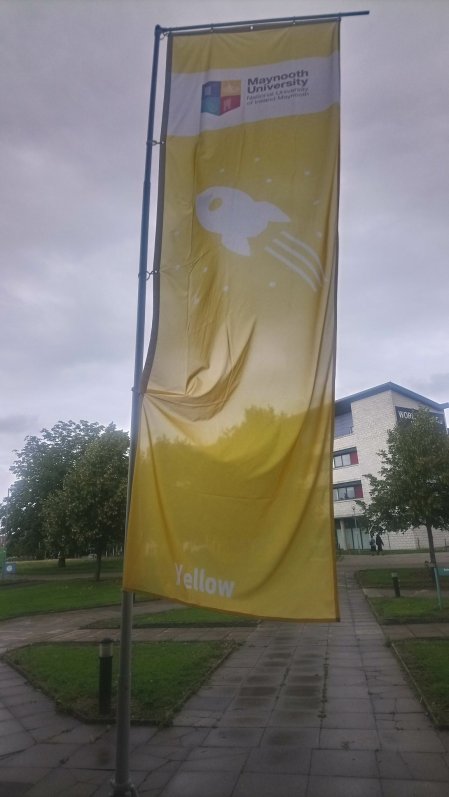
Launchpad banner outside the Science Building last week
As I mentioned a while ago, one of the reasons I had to come back from Armagh before the end of INAM2019 was an event I had to attend on Friday to do with Launchpad.
Launchpad is the Maynooth University Access Programme (MAP) orientation designed to support and ease the transition to third level for students who are coming to Maynooth University through entry routes supported by MAP. These groups include under-represented school leavers, mature students, students with disabilities and members of the Irish Traveller community. Incoming students supported by MAP can get to know fellow first years, ask questions and find out advice from existing student ambassadors on how to navigate the University before starting a new course at Maynooth.
It’s worth mentioning one specific initiative related to mature students, namely the Certificate in Science, which is a programme for mature students who wish to undertake a foundation year in preparation for degree studies in Science or Engineering. In this one year, full-time programme of study, students undertake modules on Mathematics, Engineering Science, Computer Science, Experimental Physics, Mathematical Physics, Biology and Chemistry. Students who do well can progress from this course into one of the science or engineering degree courses on offer at Maynooth.
Anyway, the event I took part in on Friday was a panel discussion involving the MAP advisors from each of the Departments in the Faculty of Science and Engineering and a lecture room full of students just about to start their courses at Maynooth. There were similar panel discussions for the other Faculties. I have assumed the responsibility as MAP advisor for Theoretical Physics this year, as I think it’s important that as Head of Department I make it clear that this programme has a high priority for the Department. Because I haven’t attended any such events before I wasn’t sure what to expect of this session. I worried the students might be very shy about asking question and that as a consequence in might not be very useful. I’m very glad to have been proved completely wrong!
We had a huge number of questions from the audience on a whole range of topics, such as subject choices (especially for the Omnibus Science course), coursework requirements, note-taking and all kinds of other issues too numerous to mention, filling up the entire 90 minute slot scheduled for the event. It was a very interesting and enjoyable session and great to see the students so engaged and enthusiastic. Thanks to all who attended and especially to the new students for playing their part!
Teaching term doesn’t start for another couple of weeks during period which there will be further introductory sessions for the MAP students and others. My calendar is already rather full, but I don’t mind that at all if the events are as enjoyable as Friday’s.
I found out on the way home from Armagh yesterday that this year’s Breakthrough Prize in Fundamental Physics (worth $3,000,000) has been awarded to the team behind the Event Horizon Telescope which was featured in newspaper and magazines around the world in April this year and which I blogged about here. There are 347 members of the team so it amounts to an average of less than $9000 per person, but let me offer them all my sincerest congratulations!
Coincidentally, just before my talk at INAM2019 yesterday I noticed that the Armagh Observatory and Planetarium stocks these items:
I’m not sure they are intended to be used as beer mats but that’s what they look like! Anyway, I picked one up and showed it at the end of my talk. I was talking about the 1919 eclipse expeditions, which I have done rather a lot these days, and finished up by mentioning that the events of a hundred years ago ushered in a century of developments in relativistic astrophysics, including gravitational lensing, gravitational waves and of course the Event Horizon Telescope.
If you’re interested here are the slides I used for this (short) talk:
The views presented here are personal and not necessarily those of my employer (or anyone else for that matter).
Feel free to comment on any of the posts on this blog but comments may be moderated; anonymous comments and any considered by me to be vexatious and/or abusive and/or defamatory will not be accepted. I do not necessarily endorse, support, sanction, encourage, verify or agree with the opinions or statements of any information or other content in the comments on this site and do not in any way guarantee their accuracy or reliability.