Archive for the Books, Talks and Reviews Category

My talk at “The Origins of the Expanding Universe”

Posted in Books, Talks and Reviews, The Universe and Stuff with tags , , , , , , on October 9, 2012 by telescoper

You may recall that I gave a talk recently at a meeting called The Origins of the Expanding Universe in Flagstaff, Arizona. I put the slides up here. Well, the organizers have now put videos of the presentations online so you have the chance to see mine, warts and all.

I was relieved when I saw this on Youtube that the organizers were kind enough to edit out the embarrassing bit at the start when my laptop refused to talk to the data projector and I had to swap to another one. Sorting all that out seemed to take ages, which didn’t help my frame of mind and I was even more nervous than I would have been anyway given that this was my first public appearance after a rather difficult summer. Those are my excuses for what was, frankly, not a particularly good talk. But at least I survived. Better is the end of a thing than the beginning thereof.

More on Slipher and the Expanding Universe

Posted in Books, Talks and Reviews, The Universe and Stuff on September 22, 2012 by telescoper

Here’s an account of the conference I recently attended in Flagstaff, about The Origins of the Expanding Universe, by Cormac O’ Raifeartaigh ( fellow blogger, who was also there).

cormac's avatarAntimatter

In an earlier post, I mentioned an upcoming  conference in Arizona to celebrate the pioneering work of the American astronomer Vesto Slipher. As mentioned previously, 2012 marks the centenary of Slipher’s observation that light from the Andromeda nebula was Doppler shifted, a finding he interpreted as evidence of a radial velocity for the nebula. By 1917, he had established that the light from many of the distant nebulae is redshifted, i.e. shifted to lower frequency than normal. This was the first  indication that the most distant objects in the sky are moving away at significant speed, and it was an important step on the way to the discovery of the expanding universe.

Vesto Melvin Slipher (1875-1969)

The conference turned out to be very informative and enjoyable, with lots of interesting presentations from astronomers, historians and science writers. It’s hard to pick out particular talks from such a great…

View original post 635 more words

The Origins of the Expanding Universe

Posted in Books, Talks and Reviews, The Universe and Stuff with tags , , , , on July 30, 2012 by telescoper

Not having much time to write anything particularly original, I thought I’d use this blog to advertise a forthcoming centenary celebration which I hope to attend and speak at, if my recovery goes to plan.  The text below is taken from the conference website for a meeting due to take place at the Lowell Observatory in Flagstaff, Arizona from September 13-15. I’m sure they won’t mind me borrowing it, as it helps promote the event.  Registration is open until 10th August…
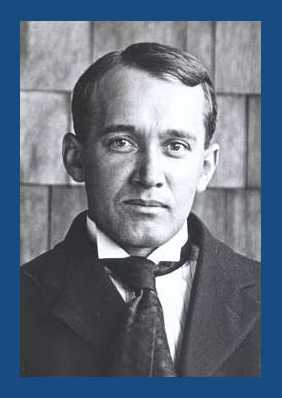
On September 17, 1912, Vesto Slipher obtained the first radial velocity of a “spiral nebula” – the Andromeda Galaxy. Using the 24-inch telescope at Lowell Observatory, he followed up with more Doppler shifts, and wrote a series of papers establishing that large velocities, usually in recession, are a general property of the spiral nebulae. Those early redshifts were recognized as remarkable by Slipher, and were critical to the discovery of what came eventually to be called the expanding Universe. Surprisingly, Slipher’s role in the story remains almost unknown to much of the astronomical community.

The nature, and especially the distance, of spiral nebulae was fiercely argued – most famously in the 1920 Shapley-Curtis debate. Hubble’s 1923 discovery of Cepheids in Andromeda, along with Henrietta Leavitt’s period-luminosity relation for Cepheids, led to a distance scale for the nebulae, enabling Lemaitre (1927) to derive a linear relation between velocity and distance (including a “Hubble constant” and, by 1931, a Primeval Atom theory).

Meanwhile, a new concept of space and time was formulated by Einstein, providing a new language in which to understand the large-scale Universe. By 1932, all the major actors had arrived on stage, and Universal expansion – the most general property of the Universe yet found – acquired a solid basis in observation and in the (relativistic) concept of space. “Space expands”… or does it? How did Lemaitre and Hubble interpret this concept? How do we interpret it? It continues to evolve today, with cosmic inflation and dark energy presenting new challenges still not fully assimilated.

This conference is in honor of Vesto Melvin Slipher and is timed to coincide with the 100th anniversary of the first measured Doppler shift in a Galaxy (then known as a Spiral-Nebula) on September 17, 1912:Slipher 1913 Lowell Obs 2, 56

We are bringing together astronomers and historians of science to explore the beginnings and trajectories of the subject, at the place where it began. 

Book Signing Caption Competition

Posted in Biographical, Books, Talks and Reviews on June 29, 2012 by telescoper

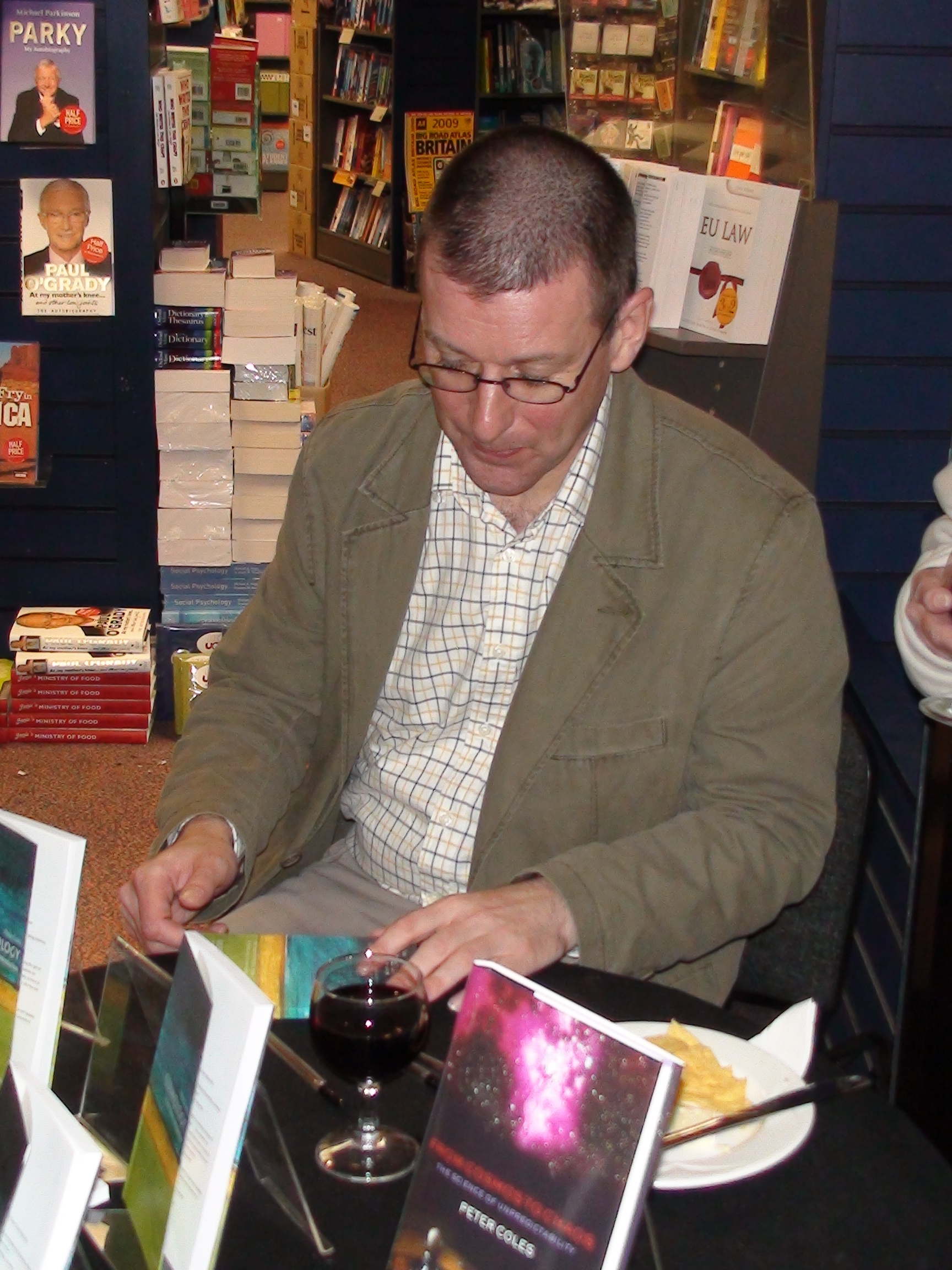
Having had a bit of fun recently at Ant Whitworth’s expense, I think it’s only fair I should let you have a go at me. Here’s a picture of me taken at a book signing a while ago….

Please feel free to suggest a caption through the comments box…

The Train and the River

Posted in Biographical, Books, Talks and Reviews with tags , , , on May 12, 2012 by telescoper

Well, here I am back in Cardiff after my little trip to Merseyside. The weather behaved itself and so did the trains in both directions, so it was quite a pleasant travelling experience. In fact, going there yesterday I managed to make a technically impossible connection at Crewe, owing to the train from Cardiff being a minute or two early and the train to Liverpool being a minute late.

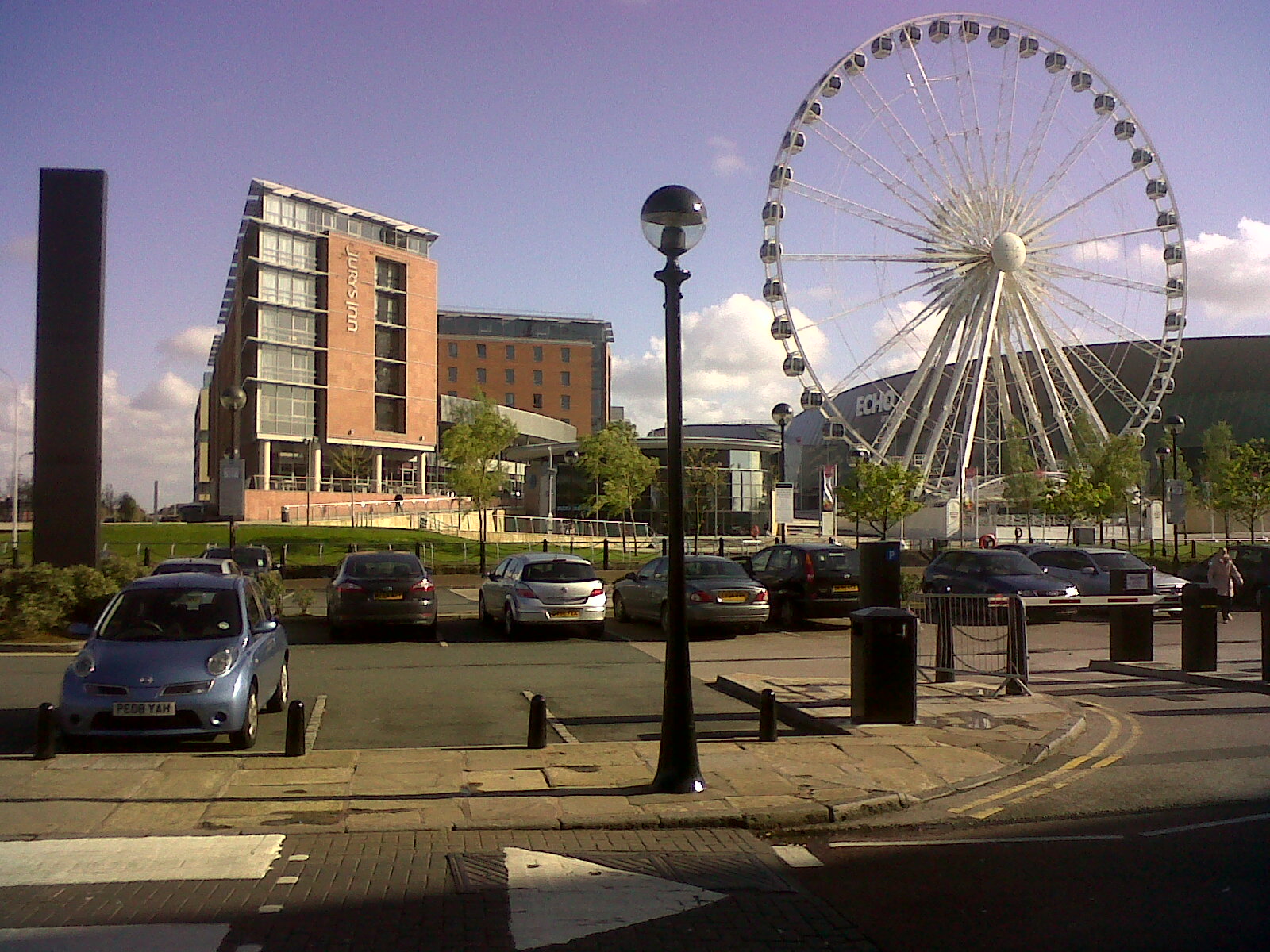
I stayed last night at the Jury’s Inn at Albert Dock, shown on the left here. There’s a sort of Ferris Wheel thing next to it. These contraptions seem to be popping up all over the place. Next thing you know there’ll be one in London! The hotel was of its type, generic but reasonably comfortable. Brings back memories of STFC panel meeting; the Jury’s Inn there is a standard place to stay in Swindon when sentenced to hard labour. Unfortunately the one I stayed in was booked up by multiple stag and hen parties and was ridiculously noisy all night. I didn’t really get any sleep until well after 4am. Grump.

Anyway, last night we had a very nice dinner at the Clove Hitch restaurant/bistro (which I definitely recommend) preceded by a pint at the famous Philharmonic Pub. Thanks to Phil and Sue for looking after us so nicely.

My talk opened the proceedings at the Merseyside Astronomy Day, which was held at Spaceport on the Birkenhead side of the Mersey. Here’s a view of Liverpool’s impressive skyline taken from there, with a nice sailing barge on the Mersey.

The small auditorium – usually used for Planetarium shows – was pretty full and I think my talk went quite well, although it’s not really for me to say. They did actually record everything so if I can get hold of a copy I might post it. Anyway, after my turn there was a fascinating lecture by Prof. Peter Read of Oxford University about the atmospheres of Jupiter and Saturn.

After a quick lunch we used Liverpool’s excellent public transport to zip back to Liverpool Lime Street and I had a relaxing and punctual journey back to Cardiff, albeit with no miracle change at Crewe this time. Dozing on the train I quite startled to wake up near Shrewsbury to find a vintage steam locomotive in sight:

No doubt there’ll be someone out there in internetshire who will tell me all about this train through the comments box but for now I’m going to make some dinner and take it easy as I’m rather knackered.

Merseyside Astronomy Day

Posted in Books, Talks and Reviews, The Universe and Stuff with tags , , , , on May 11, 2012 by telescoper

I’m just about to head by train off up to Merseyside (which, for those of you unfamiliar with the facts of British geography, is in the Midlands). The reason for this trip is that I’m due to give a talk tomorrow morning (Saturday 12th May) at Merseyside Astronomy Day, the 7th such event. It promises to be a MAD occasion.

My lecture, entitled The Cosmic Web, is an updated version of a talk I’ve given a number of times now; it will focus on the large scale structure of the Universe and the ideas that physicists are weaving together to explain how it came to be the way it is. Over the last few decades astronomers have revealed that our cosmos is not only vast in scale – at least 14 billion light years in radius – but also exceedingly complex, with galaxies and clusters of galaxies linked together in immense chains and sheets, surrounding giant voids of empty space. Cosmologists have developed theoretical explanations for its origin that involve such exotic concepts as ‘dark matter’ and ‘cosmic inflation’, producing a cosmic web of ideas that is in some ways as rich and fascinating as the Universe itself.

Anyway, I’m travelling to Liverpool this afternoon so I can meet the organizers for dinner this evening and stay overnight because there won’t be time to get there by train from Cardiff tomorrow morning. It’s not all that far from Cardiff to Liverpool as the crow flies, but unfortunately I’m not going by crow by train. I am nevertheless looking forward to seeing the venue, Spaceport, which I’ve never seen before.

If perchance any readers of this blog are planning to attend MAD VII please feel free to say hello. No doubt you will also tell me off for referring to Liverpool as the Midlands…

Experiment Marathon, Reykjavik 2008

Posted in Art, Books, Talks and Reviews, The Universe and Stuff with tags , , , on May 8, 2012 by telescoper

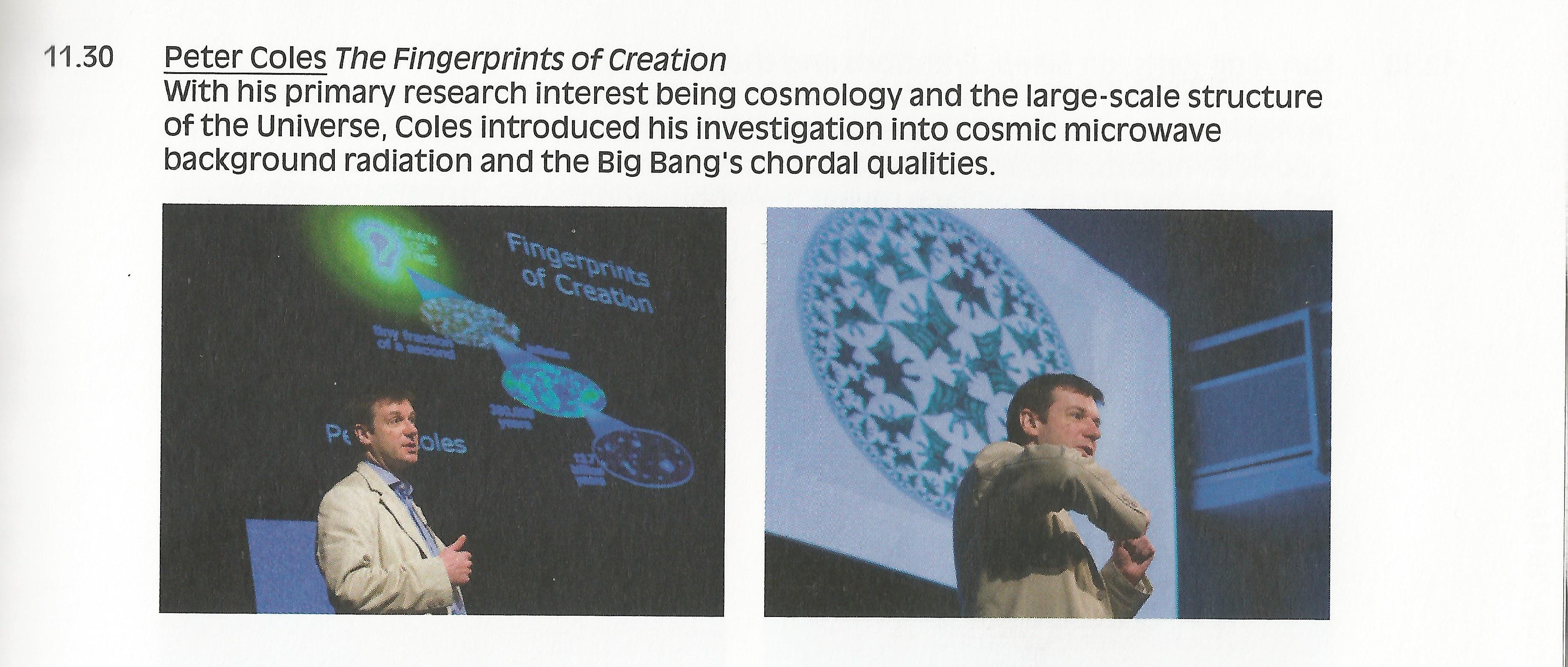
A while ago I blogged about an event I attended, called  Experimental Marathon, which was held in Reykjavik Art Museum in May 2008. I was reminded about this for various reasons recently and managed to dig up a couple of pictures of my presentation, which appeared in the glossy book of the event that was produced later on.

As you can probably infer, I gave a talk which was basically about the cosmic microwave background. My “experiment” was a television set that wasn’t tuned properly producing a screenful of static. I pointed out that some (actually not that much) of the buzz was coming from the beginning of the universe. Pretty unoriginal and gimmicky, I know, but it seemed to go down quite well with the audience and I had some nice questions and comments at the end of my 20 minutes.

During the three days of the event I also got to meet quite a few artists, scientists and other luminaries whose names are on the list here.:

You can find one of the numerous reviews of this event here, which also includes quite a few pictures of various experiments including one that some might consider to be NSFW …

Bayes, Bridge and the Brain

Posted in Books, Talks and Reviews, The Universe and Stuff with tags , , , on April 12, 2012 by telescoper

I was having a chat over coffee yesterday with some members of the Mathematics Department here at the University of Cape Town, one of whom happens to be an expert at Bridge, actually representing South Africa in international competitions. That’s a much higher level than I could ever aspire to so I was a bit nervous about mentioning my interest in the game, but in the end I explained that I have in the past used Bridge (and other card games) to describe how Bayesian probability works; see this rather lengthy post for more details. The point is that as cards are played, one’s calculation of the probabilities of where the important cards lie changes in the light of information revealed. It makes much more sense to play Bridge according to a Bayesian interpretation, in which probability represents one’s state of knowledge, rather than what would happen over an ensemble of “random” realisations.

This particular topic – and Bayesian inference in general – is also discussed in my book From Cosmos to Chaos (which is, incidentally, now available in paperback). On my arrival in Cape Town I gave a copy of this book to my genial host, George Ellis, and our discussion of Bridge prompted him to say that he thought I had missed a trick in the book by not mentioning the connections between Bayesian probability and neuroscience. I hadn’t written about this because I didn’t know anything about it, so George happily enlightened me by sending a few review articles, such as this:

I can’t post it all, for fear of copyright infringement, but you get the idea. Here’s another one:

And another…

Nature Reviews Neuroscience 11, 605 (August 2010) | doi:10.1038/nrn2787-c1

A neurocentric approach to Bayesian inference    Christopher D. Fiorillo

Abstract A primary function of the brain is to infer the state of the world in order to determine which motor behaviours will best promote adaptive fitness. Bayesian probability theory formally describes how rational inferences ought to be made, and it has been used with great success in recent years to explain a range of perceptual and sensorimotor phenomena.

As a non-expert in neuroscience, I find these very interesting. I’ve long been convinced that from the point of view of formal reasoning, the Bayesian approach to probability is the only way that makes sense, but until reading these I’ve not been aware that there was serious work being done on the possibility that it also describes how the brain works in situations where there is insufficient information to be sure what is the correct approach. Except, of course, for players of Bridge who know it very well.

There’s just a chance that I may have readers out there who know more about this Bayes-Brain connection. If so, please enlighten me further through the comments box!

Dyson on Eddington

Posted in Books, Talks and Reviews, The Universe and Stuff with tags , , , , , , on April 10, 2012 by telescoper

I’m grateful to George Ellis for sending me a link to a book review written by Freeman Dyson that appeared in a recent  edition of the New York Review of Books. I was particularly interested to read the following excerpt about Arthur Stanley Eddington. I have been intrigued by Eddington since I wrote a book about his famous expeditions (to Principe and Sobral) in 1919 to measure the bending of light by the Sun as a test of Einstein’s general theory of relativity; I blogged about this on its ninetieth anniversary, by the way, in case anyone wants to read any more about it.

Although I read quite a lot about Eddington, not only during the course of researching the book but also afterwards, as there are many things about his character that fascinate me. He died long before I was born, of course, but whenever I meet someone who knew him I ask what they make of him. Not altogether surprisingly, opinions differ rather widely from one person to another as his character seems to have been extremely contradictory. He doesn’t seem to have been very good at small talk, but was nevertheless a much sought-after dining companion. He was a man of great moral integrity, but at times treated his colleagues (notably Chandrasekhar) rather shamefully. He was a brilliant astrophysicist, but got himself hooked on his peculiar Fundamental Theory which was a dead end. He remains an enigma.

Anyway, this is what Dyson has to say about him:

Eddington was a great astronomer, one of the last of the giants who were equally gifted as observers and as theorists. His great moment as an observer came in 1919 when he led the British expedition to the island of Principe off the coast of West Africa to measure the deflection of starlight passing close to the sun during a total eclipse. The purpose of the measurement was to test Einstein’s theory of General Relativity. The measurement showed clearly that Einstein was right and Newton wrong. Einstein and Eddington both became immediately famous. One year later, Eddington published a book, Space, Time and Gravitation, that explained Einstein’s ideas to English-speaking readers. It begins with a quote from Milton’s Paradise Lost:

Perhaps to move
His laughter at their quaint opinions wide
Hereafter, when they come to model heaven
And calculate the stars: how they will wield
The mighty frame: how build, unbuild, contrive
To save appearances.

Milton had visited Galileo at his home in Florence when Galileo was under house arrest. Milton wrote poetry in Italian as well as English. He spoke Galileo’s language, and used Galileo as an example in his campaign for freedom of the press in England. Milton had witnessed with Galileo the birth struggle of classical physics, as Eddington witnessed with Einstein the birth struggle of relativity three hundred years later. Eddington’s book puts relativity into its proper setting as an episode in the history of Western thought. The book is marvelously clear and readable, and is probably responsible for the fact that Einstein was better understood and more admired in Britain and America than in Germany.

As a student at Cambridge University I listened to Eddington’s lectures on General Relativity. They were as brilliant as his books. He divided his exposition into two parts, and warned the students scrupulously when he switched from one part to the other. The first part was the orthodox mathematical theory invented by Einstein and verified by Eddington’s observations. The second part was a strange concoction that he called “Fundamental Theory,” attempting to explain all the mysteries of particle physics and cosmology with a new set of ideas. “Fundamental Theory” was a mixture of mathematical and verbal arguments. The consequences of the theory were guessed rather than calculated. The theory had no firm basis either in physics or mathematics.

Eddington said plainly, whenever he burst into his fundamental theory with a wild rampage of speculations, “This is not generally accepted and you don’t have to believe it.” I was unable to decide who were more to be pitied, the bewildered students who were worried about passing the next exam or the elderly speaker who knew that he was a voice crying in the wilderness. Two facts were clear. First, Eddington was talking nonsense. Second, in spite of the nonsense, he was still a great man. For the small class of students, it was a privilege to come faithfully to his lectures and to share his pain. Two years later he was dead.

The Long Weekend

Posted in Books, Talks and Reviews, The Universe and Stuff with tags , , , , , on April 5, 2012 by telescoper

It’s getting even warmer in Cape Town as we approach the Easter vacation. The few clouds to be found in the sky over the last couple of days have now disappeared and even the mountain behind the campus has lost its white fluffy hat:

It’s going to be a busy weekend in these parts over the forthcoming weekend. As in the UK, tomorrow (Good Friday) is a national holiday and there will be a 5K fun run around the campus. The temporary stands and marquees you can see in the picture are associated with that. On Saturday there’s a really big event finishing there too – the Two Oceans Marathon – which will finish on the University of Cape Town campus. At the moment it’s 30 degrees, but the forecast is to cool down a bit over the holiday weekend. Good news for the runners, but not I suspect for everyone who’s disappearing off for a weekend at the beach!

Anyway, I did my talk this morning which seemed to go down reasonably well. It was followed by a nice talk by Roberto Trotta from Imperial College in a morning that turned out to be devoted to statistical cosmology. I didn’t get the chance to coordinate with Roberto, but suspected he would focus on in the ins and outs of Bayesian methods (which turned out to be right), so I paved the way with a general talk about the enormous statistical challenges cosmology will face in the era after Planck. The main point I wanted to make – to an audience which mainly comprised theoretical folk  – was that we’ve really been lucky so far in that the nature of the concordance cosmology has enabled us to get away with using relatively simple statistical tools, i.e. the power spectrum.This is because the primordial fluctuations from which galaxies and large-scale structure grew are assumed to be the simplest possible statistical form, i.e. Gaussian.  Searching for physics beyond the standard model, e.g. searching for the  non-Gaussianities which might be key to understanding the physics of the very early stages of the evolution of the Universe,  will be more difficult  by an enormous factor and will require much more sophisticated tools than we’ve needed so far.

Anyway, that’s for the future. Cosmological results from Planck won’t be freely available until next year at the earliest, so I think I can still afford to take the long weekend off  without endangering the “Post-Planck Era” too much!