Archive for the Covid-19 Category

A Year of Covid-19 in Maynooth

Posted in Biographical, Covid-19, Maynooth with tags , on February 22, 2021 by telescoper

One useful thing about having a blog is that I can look through my back catalogue of posts quite easily to remind me exactly when things happened. Doing that over the weeked I discovered that it was exactly a year ago today that I travelled from Maynooth into Dublin to see a production of Fidelio. That was a few weeks before Covid-19 related travel restrictions were introduced. I was planning to fly to Cardiff in March but couldn’t do so because of the collapse of FlyBe.

And so it came to pass that I now haven’t left Maynooth for an entire year. I have of course moved house, but only by a few hundred yards. I have spent 12 months entirely within a 5km radius.
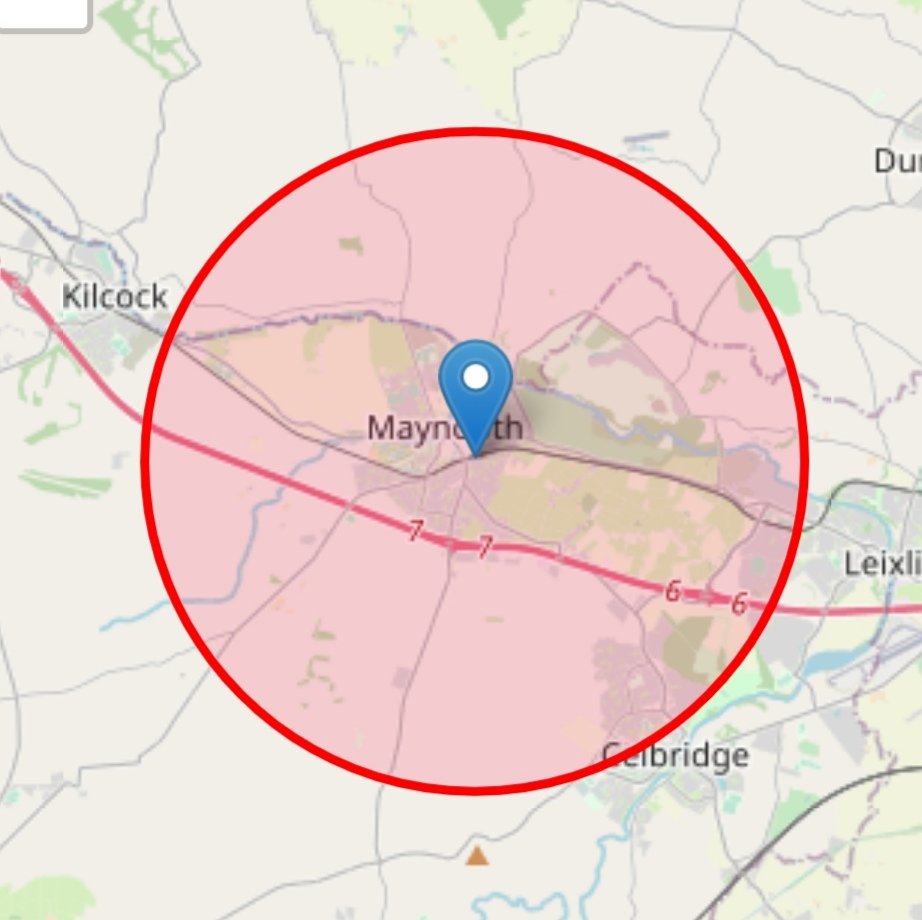
The only time I’ve (accidentally) broken the rules was when, during a walk up the Moyglare Road, I accidentally strayed into County Meath. Travel across county boundaries is verboten, you see. The County boundary is shown on the map, to the North of the town, and is closer than I had thought.

Anyway, it looks as I’m going to have a 5km horizon for some time to come. The state of play with Covid-19 as of yesterday isn’t particularly promising. Case numbers and hospitalizations are falling, but very slowly.
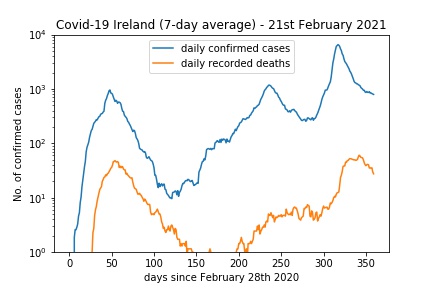
The reduction in new cases is only around 15 per day on average and at the current level of around 800 that’s far too high to be even thinking about opening up again.

Why is this reduction so slow? The answer to that question is fairly obvious: far too many people are flouting the existing rules. I have hardly been outside the house since Christmas, mainly to follow the health advice, but also partly because it annoys me to see so many people out and about ignoring social distancing, face coverings, and the rest. The sad thing is that by not taking responsibility now, these people are ensuring that this wretched pandemic lasts even longer.

Ireland’s vaccination programme is going steadily with over 100,000 fully vaccinated and twice that number having received one dose.
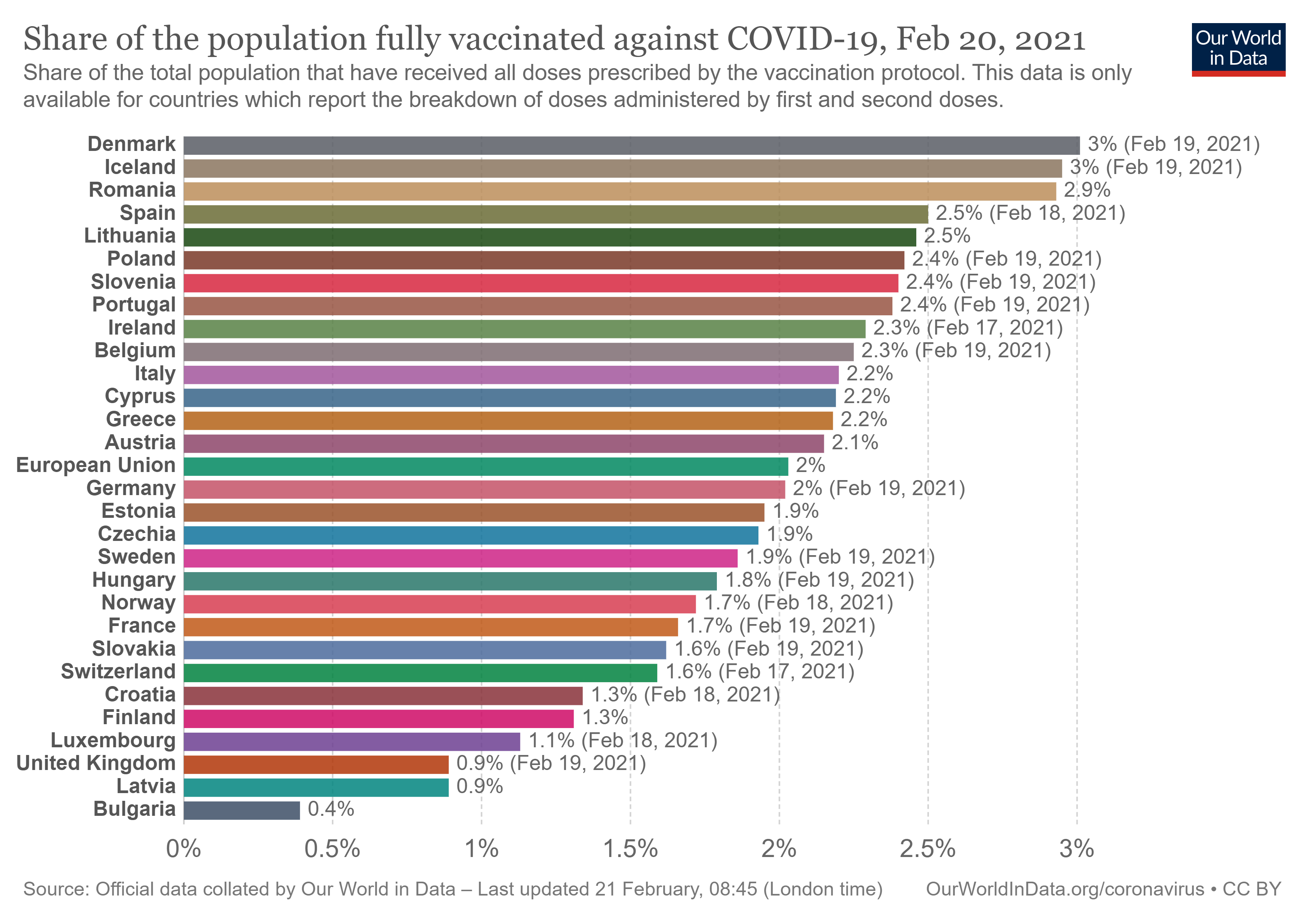
Note the considerable variation in vaccination progress across the different countries*. Denmark is top of the heap, probably because it has a fully computerised nationwide health system. Things would obviously be going faster had one of the major suppliers not decided to renege on its contract with the EU but, despite the sharp practice from AstraZeneca, there is expected to be a big increase in vaccines available from April onwards, with about three million doses available between April and June.

*The UK has adopted a different strategy from most others, by giving one dose to as many as possible as quickly as possible by delaying the second dose. This may turn out to be an effective approach. I’m not sufficiently expert to comment.

Today is the start of week 4 of Semester Two of the academic year at Maynooth University. That means we have three weeks to go until the mid-term study break (which was when the first lockdown began last year). Halfway to halfway through the Semester, in other words.

The way things are going I think I’ll be remaining within the 5km horizon until June at the earliest, and probably until September, assuming I’m not carted off to an institution before then.

The Return to Schools in Ireland – The Facts

Posted in Covid-19, Education, Politics on February 20, 2021 by telescoper

There is some confusion going around about precisely when schools will reopen in the Republic of Ireland. In order to provide a service to the community I therefore thought I would summarize the main points here as clearly, concisely and coherently as possible.

At Primary schools, Junior infants or perhaps Junior and Senior infants and perhaps also including First and Second Class will return either separately or together on either 1st March or possibly 8th March. All other pupils will definitely return on 15th March or possibly a week or two weeks later but definitely by three weeks later than that unless there’s a change of plan.

At Secondary schools, the Junior Cycle will continue as normal apart from not actually happening: the Junior Certificate will be replaced by a voucher to spend on computer games. The Senior Cycle will return at the same time as Primary Schools, or at some different time depending on the circumstances, or perhaps just for the day before the Leaving Certificate examinations. Pupils will be able to choose either to take the examination or to receive a grade based on all the coursework they haven’t done because the schools have been closed or to receive a grade based on how much their parents can afford to pay. Leaving Certificate examinations will take place according to the published timetable unless they’re cancelled at the last minute.

Transition Year students have been completely forgotten but no doubt somebody will think of something when they remember.

I hope this clarifies the situation.

Norma Foley is 51.

]

Goin’ Down Slow – Archie Shepp & Horace Parlan

Posted in Covid-19, Jazz with tags , , , , , on February 7, 2021 by telescoper

I just updated my Coronavirus page with the days statistics for Ireland (1024 new cases, 12 deaths). We’re obviously well past the Christmas peak but cases are falling very slowly. At this rate we’ll still have several hundred a day by the end of February (which, incidentally will be a year since the first Covid-19 case was recorded in Ireland).

Unlocking with case levels in the hundreds before Christmas was a disaster and I sincerely hope there’s no repeat of that foolishness.

Anyway, the current state of play remind me of this track from a great album called Trouble in Mind which I bought as a vinyl LP about 40 years ago. It’s by Archie Shepp (tenor sax) and Horace Parlan (Piano). Both made their reputations as avant garde jazz musicians but in this album they went back to the roots and explored the classic blues repertoire. Goin’ Down Slow dates back to 1941 and it’s a standard 12-bar blues (usually performed in B♭). Horace Parlan passed away in 2017, but Archie Shepp is still going strong.


Teaching from Home

Posted in Covid-19, Education, Maynooth on February 3, 2021 by telescoper

Determined to follow the public health advice and work from home I decided to set up a blackboard in my study so I can do lectures online. I find the blackboard shows up better on camera than a whiteboard and using this arrangement allows me to stand up while I deliver the material, which I find much more comfortable than sitting down.

I’m fortunate of course in having enough space to do this. Not every University lecturer can do this.

The bit you see on the board was the start of my second Engineering Mathematics lecture to first-year students. I had asked the students at the end of Lecture 1 to think about the Laplace Transform of f(t)=t and began Lecture 2 by going through the necessary integration on the board.

Today I have three lectures – another Engineering Maths and two Advanced Electromagnetism to give so the board will be more extensively used. I just hope my internet connection stays up!

P. S. Playing back today’s videos I have discovered an optical defect in the Panopto system that makes my hair look grey.

P.P.S. Three lectures in an afternoon (12-1, 2-3 and 4-5) is quite hard work but at least I had breaks between them!

The Term Ahead

Posted in Covid-19, Education, Maynooth with tags , , , , on January 28, 2021 by telescoper

After a recent Government announcement that current Covid-19 restrictions would be extended until at least March 5th, this morning we received the expected communication from the University authorities that almost all our teaching at Maynooth University would be online until March 22nd at the earliest. This is because the half-term “study break” is from 15th to 19th March (to include St Patrick’s Day) and there would be no point in trying to get students back for one week (8th-12th March) before breaking up for the following week. In fact, if I had to bet money on it I would say we’ll probably be online all the way through to the summer, and possibly beyond, but that decision has not been made yet.

To nobody’s surprise we’re also going to have online examinations in the summer again. We’ve done two rounds of these already so are getting used to them now so that’s not a problem.

The St Patrick’s Day break was basically when we flipped – by which I mean “changed teaching methods” rather than “went mad” – last year so at least we’ve already got teaching prepared for the second half of the forthcoming semester if Level 5 restrictions do continue.

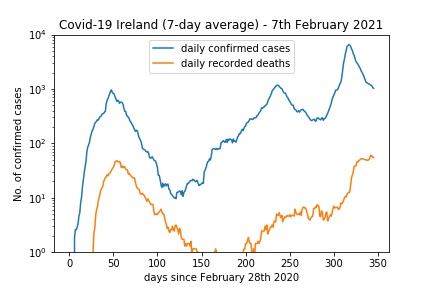
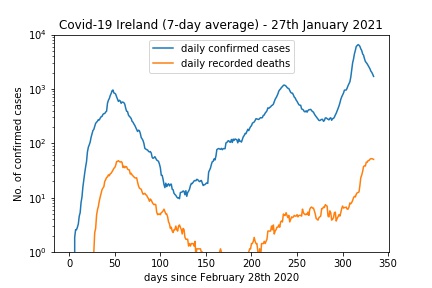
I am actually a bit annoyed at the politicians for making hints about when the restrictions might end. It is clearly far too early to be talking about that. Here are yesterday’s numbers:

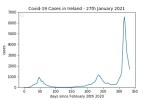
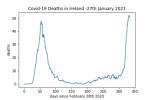
If you prefer them on a linear scale here they are:

New cases have fallen significantly since the latest peak but at least part of that is due to the fact that automatic close contact tracing couldn’t cope and was abandoned. Testing positivity rate has fallen to around 8.2% (from over 20%) , hospital admissions admissions are falling, and deaths may have peaked, so the evidence suggests there is a is a reduction, but the numbers are still way too high. They need to come down to much less than a 100 before any lifting of restrictions can be contemplated. At the current rate of decline that will take many weeks.  Suggesting opening up is going to happen soon will only make people impatient and reduce compliance.

Teaching term at Maynooth starts on Monday (1st February) and I have three modules to deliver, one of them a module I’ve never given before. Because there has been so much to do behind the scenes since Christmas I don’t think I’ll ever have started a term feeling so exhausted. The cycle of academic life carries on remorselessly despite the fact that everything takes longer to do under Covid-19 restrictions. It is an effort just to keep up.

Still at least we’ve all still got jobs to do and are still getting paid. It’s time to knuckle down and focus on reaching the mid-term break in one piece and then seeing where we go thereafter.


Teaching after Covid

Posted in Covid-19, Education, Maynooth with tags , , , on January 26, 2021 by telescoper

I know it’s a Business lecture, but at least there is a periodic table on the wall to remind students of the time when Universities used to care about science.

Near the end of a planning meeting this morning I was asked to give my thoughts about any long-term impacts of the Covid-19 pandemic on teaching and/or research. That also echoed a discussion I had with staff in the Department of Theoretical Physics on Teams a while ago, which touched on the same question.

My own view in general is that although we find ourselves constantly saying things like “When we get back to normal…” I think we have to accept that the pandemic is going to change many things irreversibly. We’re going to have to get used to new ways of working in both teaching and research. Some changes will be made to make financial savings owing to loss of income over however long the pandemic lasts, and some of those will no doubt be painful and sad. Others will be opportunities created by us learning how to do things differently and a number of these could be very positive, if we seize the initiative and make the most of them.

One specific thing in the latter category is that Maynooth University installed a system of lecture capture to help deliver teaching when access to campus was restricted (as it is now). The hardware and software installed is fairly basic and isn’t by any means perfect, but it has worked pretty well. The main problem is that the cameras that have been installed are very limited webcams and are not capable of capturing, e.g. a blackboard.

One thing I hope will happen in the long term is that we include lecture capture as a routine way of augment students’ learning. That will require additional investment in infrastructure, but I think it would be well worth it.

Some years ago I blogged about this at another institution, which had facilities allow lecturers to record videos of their own lectures which are then made available for students to view online.

This is of course very beneficial for students with special learning requirements, but in the spirit of inclusive teaching I think it’s good that all students can access such material. Some faculty are apparently a little nervous that having recordings of lectures available online would result in falling attendances at lectures, but in fact there is evidence that indicates precisely the opposite effect. Students find the recorded version adds quite a lot of value to the “live” event by allowing them to clarify things they might not have not noted down clearly. In my experience they rarely watch the whole video, instead focusing on things they didn’t get first time around. And if a few students decide that it’s good enough for them just to watch the video, then so what? That’s their choice. They are adults, after all.

I’ll add that I do feel we should still make the effort to return to doing live lectures in some form and not rely entirely on recordings. I think that what you can do in a lecture is fairly limited part of the overall educational package, but that’s not the same as saying that they should be scrapped. Many students do enjoy lectures and find them very helpful. I just think we should make the best of the available technology to offer as wide a range of teaching methods as possible. No two students are the same and no two students learn precisely the same way. Let us offer them a variety of resources and they can choose which serves them best.

Another important, but perhaps less tangible, aspect of this is that I think education is or should be a shared experience for students. Just having everyone sit in the same room “enjoying” the same teaching session is a great benefit compared with having them sit in their room watching things on a laptop screen. I think that’s one of the worst issues with remote teaching, and wish we had found better ways of dealing with that over the past year.

There is a benefit for the lecturer of having a live audience too, in that actually seeing the people you’re trying to teach helps you gauge how well you’re getting it across.

Anyway, I started a poll on lecture capture a while ago before the pandemic. Feel free to add your opinion. It will be interesting to see if opinions have changed!

Imagining an Eighties Coronavirus Pandemic

Posted in Biographical, Covid-19, History, Television on January 25, 2021 by telescoper

Thinking about the TV series It’s A Sin I blogged about on Saturday a couple of things struck me in relation to our current situation trying to cope with the Covid-19 pandemic.

In the early 1980s we had no access to the internet – it only really get going until 1983 and most households didn’t get connected until much later. There wasn’t even email either. And nobody had mobile phones – smart or otherwise, so there were no text messages.

Had the Covid-19 pandemic occurred forty years ago we would have had to face it in very different ways. Working from home for most people would have been impossible so any kind of lockdown would have had dire economic consequences.

In the education sector, in which I work, the existence of the internet has allowed us to switch to remote teaching and learning (and assessment). Although it has been very far from ideal, at least we have been able to do something. What would we have done in the 1980s? I really don’t know.

One possibility is to have used the TV to broadcast some form of educational service. But until 1982 (when Channel 4 arrived) there were only three channels in the UK so it would not have been easy to devote a lot of time for live broadcasts. On the other hand people did have video recorders, so programmes could have been transmitted during the night for later consumption. I guess also that some materials, assignments, etc could have been delivered using the regular mail rather like old-fashioned correspondence courses. The Open University was already doing that, of course, but expanding it to include every student at every level in the country at very short notice would have been very difficult indeed.

The number of people in other sectors who would be able to work from home would also have been very small, so the economic cost of a lockdown would have been even higher than at present. I suspect that Governments wouldn’t even have tried, with the resulting increase in mortality.

And there is also the social dimension. During this pandemic people have been able to use software such as Zoom to stay in touch, including with elderly relatives who might otherwise be completely isolated. That would have been impossible in the Eighties.

In any case socializing for young people during the 1980s – which is what I was then – was very different. We didn’t (because we couldn’t) use texts or mobile phone calls to arrange nights out or other things. I didn’t get my
first (very basic) mobile phone until the 1990s – and I think I was an early adopter. I kept in touch with my friends in normal times by frequenting the same bars and clubs as my friends. We’d often meet up without arranging anything specifically.

There were no dating apps then either, so people used to hook up in bars and clubs (and frequently elsewhere). I suppose that has changed a lot over the past couple of decades (although I don’t go to such places any more, being an oldie).

Suffice to say that compared to today the impact on social lives and wellbeing would have been even more drastic had we had lockdowns in the 1980s.

SARS-Cov-2 Vaccine strategy: One Jab or Two?

Posted in Covid-19 with tags , , , , , on January 13, 2021 by telescoper

I’ve been thinking quite a lot about the issue of the Coronavirus vaccination programmes currently underway and have had some interesting and informative exchanges on Twitter about it. This morning’s news that AstraZeneca has finally applied to the European Commission for permission to market its vaccine within the European Union reminded me of those discussions so I thought I’d post a question here. I genuinely don’t know the answer, incidentally, so there’s no agenda here!

As you probably know all SARS-COV-2 vaccines (Moderna, Pfizer/Biontech and AstraZeneca) require two doses, administered about three weeks apart, for maximum efficacy. It’s worth saying before going on that the scientists involved deserve high praise for developing these highly effective vaccines at a speed that has exceeded all expectations.

At the moment however supplies of these vaccines are fairly limited and it’s early days for immunization programmes so there are serious logistical problems to be solved before we get anywhere near full vaccination. I grabbed this from Twitter yesterday showing the state of play in various countries:

Note, incidentally, that Denmark is doing particularly well within the EU but France, Netherlands, Luxembourg and Belgium have started very slowly. Ireland is about mid-table.

At the top of the league is Israel, though  they are not offering vaccination to the Palestinian people whose lands they occupy. Israel has just reported that after 12 days the Pfizer/BioNTech vaccine has about 50% efficacy after one dose based on results from its own programme. That number is roughly consistent with initial estimates of from trials this vaccine but the statistics aren’t great and there is a considerable margin of error on these figures.

Now the question I am asking myself is that given the limited supply is it better at this stage to give as many people as possible one dose of the vaccine, or follow the manufacturers’ original plan and give two doses to half as many people? There are reports that the UK has been deferring the second dose beyond the recommended interval, where there is no data on its efficacy. Perhaps I’m being excessively cynical but it seems to me that the UK Government’s approach is more driven by public relations than by public health considerations.

I understand that there are difficult issues here, not least the ethical one of having people sign up for a specific two-dose vaccination only to find that’s not what they get. Another issue is the speed with which doses are being made available relative to the size of the population. Yet another issue is who you prioritize.

Above all, though, there is the question of what you mean by “better”. One criterion would be to save as many lives as possible. Another might be to slow the rate of infections as much as possible. Another might be to allow the economy to open up as early as possible. These are all different and would lead to different decisions, particularly with regard to who should get the vaccine. Saving lives obviously means protecting the vulnerable and the people who care for them (e.g. health workers). Economic considerations would however lead you to prioritize those on whom the economy depends most directly, which would include workers who can’t easily work from home (many of whom are in low-paid manual jobs).

The following poll is therefore going to be very unscientific, but I’m interested to find out what people think. In  order to keep it simple, lets suppose you have a batch of two million doses of a vaccine (say the Pfizer one) and the next batch is due in three months.

You have to decide between the following two options:

  1.  Give 1,000,000 people one dose now and another dose in three weeks’ time
  2.  Give 2,000,000 people one dose now and hope that it is effective for three months (or that additional supplies appear more quickly than anticipated).

Vote now!

A similar poll I did on Twitter a while ago can be found here: there are some quite interesting comments in the ensuing thread.

Comments are of course welcome through the Comments Box!

P.S. I’m quite low down the pecking order in Ireland so it’s unlikely I’ll get vaccinated before the summer.

Covid-19 in Ireland: where it all went wrong

Posted in Covid-19, Politics with tags , , on January 10, 2021 by telescoper

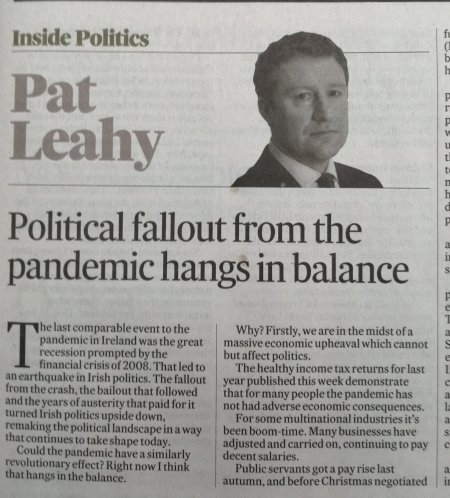
I don’t buy a daily paper, but I am a regular reader of the Irish Times Weekend edition. The reporting, especially on international news, is generally good and although it is basically an Establishment newspaper it is fairly balanced. That can’t be said for the opinion pieces however, which are frequently execrable. A particularly shitty example is provided by a column by Political Editor Pat Leahy in this Weekend’s edition.

It’s bad enough that he writes as if the most important thing about the pandemic is not that people are dying but that there might be implications for Ireland’s political establishment. And that he takes the opportunity to take churlish swipes like “Many public servants have, of course, been working furiously hard. Some haven’t.” As a public servant who has put in countless hours of unpaid overtime over the past year that snide comment really got my goat, coming as it does from a Political Editor who trots out lazy evidence-free rubbish for a living.

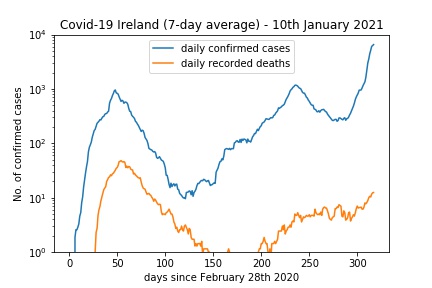
This is the trajectory of the Covid-19 pandemic in Ireland.

Restrictions were lifted on 1st December. New cases started to climb steeply almost immediately, doubling roughly every 7 days. It was obvious then – by simple extrapolation of the exponential curve – that there would be around 1000 new cases per day by Christmas and about 2000 by New Year.

The only reason we didn’t have 2000 cases per day by 31st December was that the system couldn’t cope with so many positive test results and a backlog developed. Today, 10th January, 6888 cases were reported. Hospitalizations, ICU admissions and, sadly, deaths are now tracking upwards after the inevitable delay.

Loosening the restrictions with new cases at hundreds per day always looked to me to be very wrong-headed. I’m not happy to have been proven right.

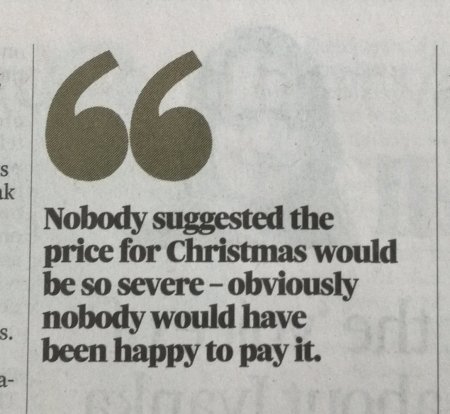
Against this backdrop Pat Leahy says this:

What?

This is simply untrue. It is true that there was a general expectation that the growth curve would not be so steep, with perhaps 500 cases by Christmas. That was wrong by about a factor two but given the doubling time and no interventions 1000 would have been reached a week later. As someone who argued for relaxation in December, Mr Leahy is rather obviously trying to rewrite history to make him appear less culpable.

In my view the reason why the residual restrictions in December did not slow the increase in Covid-19 cases was that the messaging from the Government was too complicated, had too many exceptions, and gave the appearance that it was arbitrary and without clear justification. This, together with persistent lobbying by vested interests in the hospitality sector, encouraged enough people to ignore even the weakened restrictions in the run-up to Christmas and through the holiday period. In short, the Government has lost the room. Worryingly, I don’t think that it understands this even now.

Even now with a dire health emergency in clear view, I still see people circulating in groups without face coverings. What went wrong, in my opinion, is that the Government was too weak to stick to the advice given to it from the National Public Health Emergency Team and instead started tinkering about trying to satisfy various lobby groups.

But back to Mr Leahy. The statement that “nobody suggested the price for Christmas would be so severe” is plainly untrue: plenty of people knew exactly what was coming and said so loudly and publicly. Neither he nor the politicians listened. If there’s any justice the “political fallout” from this catastrophic weakness will be severe.

Anyway, after being angered by that dreadful Opinion column I’m seriously thinking of switching to a different paper. Any suggestions?

There’s a Moose Loose Aboot this Hoose!

Posted in Covid-19, Maynooth, Music with tags , on January 8, 2021 by telescoper

Artist’s Impression

I am working from home at the moment owing to Covid-19 restrictions on campus activity but I have been informed by on campus staff that an unauthorized mouse bas been seen in the Department of Theoretical Physics. This is a very serious situation as access to the Science Building is for essential work only and this does not include rodents, even if they have a PhD. Furthermore, the mouse is not wearing a face mask and, from what I have heard, is not observing proper sanitary procedures.

More importantly, our Covid-19 protocols require all visitors to the Department to be in receipt of a letter authorizing their presence. I have contacted Human Rodent Resources and no such letters have been issued.

I have therefore instructed all staff and students in the Department that if they see this mouse they should instruct it to leave and that any refusal to comply will be met with disciplinary action, initially taking the form of a formal written warning but escalating if necessary to a meeting with Maynooth University Library Cat.

There now follows a  message concerning these developments from Professor Brian Dolan.

I hope this clarifies the situation.