Archive for the Education Category

Flying Visit(s)

Posted in Biographical, Education, The Universe and Stuff with tags , , , , , , , on June 2, 2024 by telescoper

So here I am, not in Barcelona. On Thursday night I flew to the fine city of Newcastle upon Tyne to act as external examiner for a PhD candidate. Since I knew I would be arriving quite late I stayed in a hotel near Newcastle Airport. It was just as well I did so because, it being Ryanair, I arrived even later than expected. On Friday morning I took the Metro from the Airport to Haymarket and spent the morning in the School of Mathematics, Statistics and Physics at Newcastle University ahead of the viva voce examination.
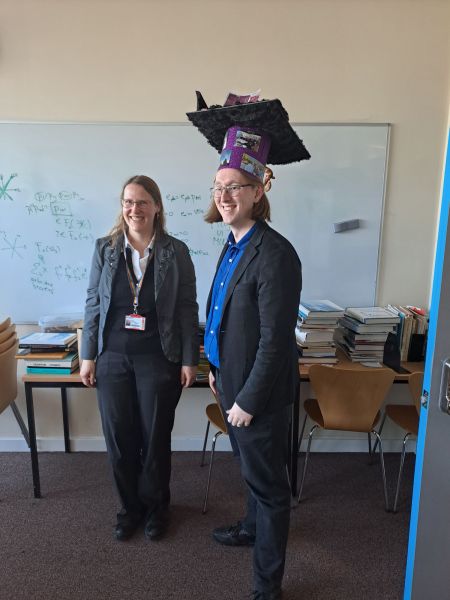
The PhD candidate was Alex Gough (pictured right, after the examination, with supervisor Cora Uhlemann). Cora being German we were treated to the tradition of successful PhD candidates having to wear a elaborate hat, after the examination (fortunately not during it). Some champagne was consumed, followed by dinner at a nice Indian restaurant on Clayton Street.

For those of you not familiar with how the PhD system works in the UK, it involves doing research into a particular topic and then writing up what you’ve done in a thesis. The thesis is a substantial piece of work, often in the region of 100,000 words (200 pages or so), which is then assessed by two examiners (one internal to the university at which the research was done, and one external). They read copies of the thesis and then the candidate has to defend it in an oral examination, which was what happened on Friday, after which they make a recommendation to the university about whether the degree should be awarded.

There aren’t many rules for how a viva voce examination should be conducted or how long it should last, but the can be as short as, say, 2 hours and can be as long as 5 hours or more. The examiners usually ask a mixture of questions, some about the details of the work presented and some about the general background. The unpredictable content of a viva voce examination makes it very difficult to prepare for, and it can be difficult and stressful for the candidate (as well as just tiring, as it can drag on for a long time). However, call me old-fashioned but I think if you’re going to get to call youself Doctor of Philosophy you should expect to have to work for it. Some might disagree.

Obviously I can’t give details of what went on in the examination except that it was quite long primarily because the thesis was very interesting and gave us lots to discuss. At the end internal examiner Danielle Leonard and I agreed to recommend the award of a PhD. In Newcastle as in other UK universities, the examiners simply make a recommendation to a higher authority (e.g. Board of Graduate Studies) to formally award the degree, but they almost always endorse the recommendation. I’ve never been sure exactly when a successful candidate is allowed to call themselves “Doctor”, actually, but congratulations to Dr Gough!

Anyway, the celebratory dinner ended just after Women’s International football match between England and France (which France won) had finished at St James’ Park and the Metro was consequently crammed full, but I got back to the hotel at a reasonable hour. Thank you to everyone in the group, especially Cora and Ian Moss, for being so friendly and making me feel so welcome during this brief visit.

Tomorrow I shall be heading to the part of not-Barcelona known as Oxford, where I believe there is a University of some sort, to give a lecture about which I’ll post more tomorrow.
General Science at Maynooth

Posted in Education, Maynooth with tags , , , , , , , on May 27, 2024 by telescoper

Following on – sort of – from yesterday’s post – here is a little promotional video about the ‘Omnibus’ Bachelor of Science undergraduate course (codename MH201). I have blogged about this course before (e.g. here) but this gives me an opportunity to repeat the salient points.

Currently, most students doing Science subjects here in Maynooth enter on the General Science programme a four-year Omnibus BSc course that involves doing four subjects in the first year, but becoming increasingly specialized thereafter. That’s not unlike the Natural Sciences course I did at Cambridge, except that students at Maynooth can do both Mathematical Physics and Experimental Physics in the first year as separate choices. I’d recommend anyone who wants to do Physics in the long run to do both of these, as they do complement each other. Other possibilities include Chemistry, Computer Science, Biology, etc.

In Year 1 students do four subjects (one of which has to be Mathematics). That is narrowed down to three in Year 2 and two in Year 3. In their final year, students can stick with two subjects for a Joint Honours (Double Major) degree, or specialise in one, for Single Honours.

I like this programme very much because it does not force the students to choose a specialism before they have had a taste of the subject, and that it is flexible enough to accommodate Joint Honours qualifications in, e.g., Theoretical Physics and Mathematics. It also allows us to enrol students onto Physics degrees who have not done Physics or Applied Mathematics as part of the Leaving Certificate.

Anyway, this video features Oisín Davey, who took Mathematical Physics, Experimental Physics, Chemistry and Mathematics in his first year. As a matter of fact I taught him in Year 1 (Mechanics & Special Relativity) and Year 2 (Vector Calculus and Fourier Series) but, despite that, as he explains, he has decided to persist with Mathematical Physics. He will be in the final year next academic year, after he returns from his summer in CERN, and I’ll be back from sabbatical.

Free Atkins!

Posted in Biographical, Education, The Universe and Stuff with tags , , , , , , on May 26, 2024 by telescoper

I took my first degree in the Natural Sciences Tripos at the University of Cambridge. This involved doing a very general first year comprising four different elements that could be chosen flexibly. I quickly settled on Physics, Chemistry and  Mathematics for Natural Sciences to reflect my A-level results but was struggling for the fourth. In the end I picked the one that seemed most like Physics, a course called Crystalline Materials. I didn’t like that at all, and wish I’d done some Biology instead – Biology of Cells and Biology of Organisms were both options – or even Geology, but I stuck with it for the first year.

Having to do such a wide range of subjects was very challenging. The timetable was densely packed and the pace was considerable. In the second year, however, I was able to focus on Mathematics and Physics and although it was still intense it was a bit more focussed. I ended up doing Theoretical Physics in my final year, including a theory project.

My best teacher at School, Dr Geoeff Swinden,  was a chemist (he had a doctorate in organic chemistry from Oxford University) and when I went to Cambridge I fully expected to specialisze in Chemistry rather than Physics. I loved the curly arrows and all that. But two things changed. One was that I found the Physics content of the first year far more interesting – and the lecturers and tutors far more inspiring – than Chemistry, and the other was that my considerable ineptitude at practical work made me doubt that I had a future in a chemistry laboratory. And so it came to pass that I switched allegiance to Physics, a decision I am very glad I made.

(It was only towards the end of my degree that I started to take Astrophysics seriously as a possible specialism, but that’s another story…)

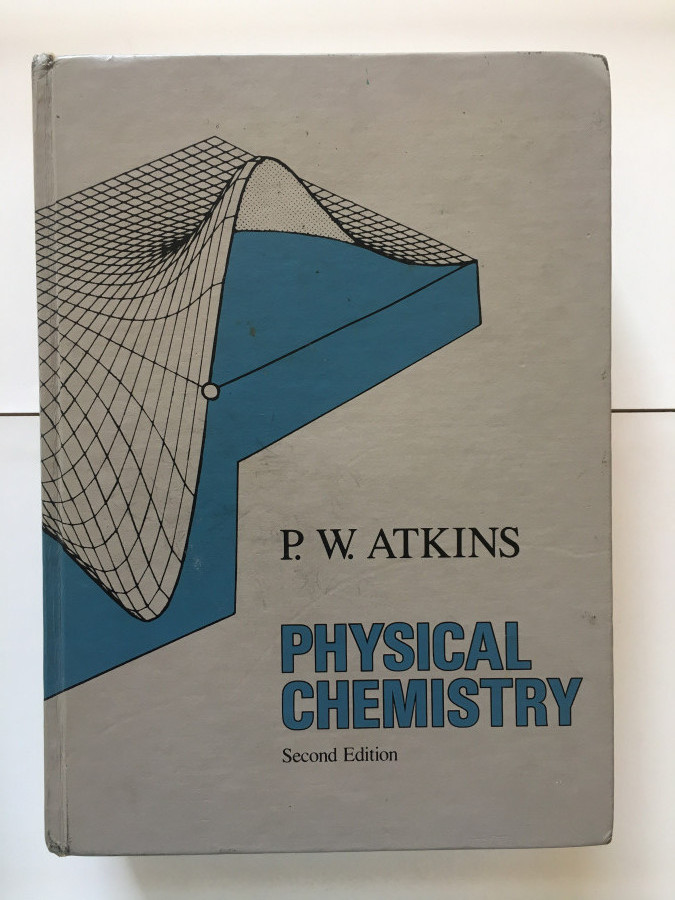
Anyway, when I turned up at Cambridge over 40 years ago to begin my course, and having Chemistry as a probable end point, I bought all the recommended text books, one of which was Physical Chemistry by P.W. Atkins. I found a picture (above) of the 1982 edition which may well be the one I bought (although I vaguely remember the one I had being in paperback). I thought it was a very good book, and it has gone into many subsequent editions. I also found the Physical part of Chemistry quite straightforward because it is basically Physics. I even got higher marks in Chemistry in the first year than I did in Physics but that didn’t alter my decision to drop Chemistry after the first year. When I did so, I followed tradition and sold my copy to a new undergraduate along with the other books relating to courses that I dropped.

Yesterday I found out that Peter Atkins has decided to make one of his books available to download. The book concerned is however not the compendious tome I bought, but a shorter summary called Concepts in Physical Chemistry, which was published in 1995. This is no doubt a very useful text for beginning Chemistry students so I thought I’d pass on this information. You can download it here, although you have to do it chapter by chapter in PDF files.

P.S. Chemistry in Spanish is ‘Química’. Since Physics and Chemistry share the same building in the University of Barcelona, where I am currently working, I frequently walk past rooms with doors marked ‘Quim’ (but I have never taken the opportunity to enter one).

Examination Time in Maynooth

Posted in Barcelona, Education, Maynooth, The Universe and Stuff with tags , , on May 17, 2024 by telescoper

Today ( Friday 17th May) is the first day of the Summer Examination Period in Maynooth. Although I’m not there right now I thought I’d take the opportunity to wish all students the best for their examinations:

You shouldn’t really be relying on luck of course, so here are some tips for the examination period (especially for physics students, but applicable elsewhere).

  1. Try to get a good night’s sleep before the examination and arrive in plenty of time before the start. Spending all night cramming is unlikely to help you do well.
  2. Prepare well in advance so you’re relaxed when the time comes.
  3. Read the entire paper before starting to answer any questions. In particular, make sure you are aware of any supplementary information, formulae, etc, given in the rubric or at the end.
  4. Start off by tackling the question you are most confident about answering, even if it’s not Question 1. This will help settle any nerves. You’re under no obligation to answer the questions in the order they are asked.
  5. Don’t rush! Students often lose marks by making careless errors. In particular, check all your numerical results on your calculator at least twice
  6. Please remember the units!
  7. Don’t panic! You’re not expected to answer everything perfectly. A first-class mark is anything over 70%, so don’t worry if there are bits you can’t do. If you get stuck on a part of a question, don’t waste too much time on it (especially if it’s just a few marks). Just leave it and move on. You can always come back to it later if you have time.

Meanwhile, in Barcelona, Monday is a public holiday (Pentecost) so I am faced with the prospect of having to endure a long weekend break. Such is life…

Masters in Theoretical Physics & Mathematics at Maynooth

Posted in Education, Maynooth, The Universe and Stuff with tags , , on April 30, 2024 by telescoper

I may not be in Maynooth this academic year but that doesn’t stop me using the medium of this blog to advertise the fact that the MSc in Theoretical Physics & Mathematics is open to applications for entry in September.

This postgraduate course is run jointly between the Departments of Theoretical Physics and Mathematics & Statistics, with each contributing about half the material. The duration is one calendar year (full-time) or two years (part-time) and consists of 90 credits in the European Credit Transfer System (ECTS). This is split into 60 credits of taught material (split roughly 50-50 between Theoretical Physics and Mathematics) and a research project of 30 credits, supervised by a member of staff in a relevant area from either Department.

Here is an instagram post advertising the course:

This course is a kind of follow-up to the existing undergraduate BSc Theoretical Physics & Mathematics at Maynooth, also run jointly. We think the postgraduate course will appeal to many of the students on that programme who wish to continue their education to postgraduate level, though applications are very welcome from suitably qualified candidates who did their first degree elsewhere.

There is a central system for postgraduate applications in Ireland (called PAC) that is similar to the undergraduate admissions system. You will need to apply online via PAC after the following the instructions here. The requisite PAC code for the full-time version of the course is MHQ56.

The closing date for applications is 30th June 2024.

In Praise of the Public Thesis Defence

Posted in Barcelona, Education, The Universe and Stuff with tags , , , , , on April 12, 2024 by telescoper

The ICCUB is quite large, which means that there are quite a few talks to go to, including seminars and colloquia but also thesis defences, such as one I attended this morning. The format for these events is a talk by the candidate in the presence of a panel of experts, who ask questions at the end, but the whole thing is open to the general public. After the panel questions there is an opportunity for questions from the audience, but only from those who have a doctorate. I was tempted, but didn’t put my hand up.

Anyway, this morning’s talk was well attended and of very high quality and, as usual, the whole event lasted getting on for two hours. It’s a very different experience from the form of viva voce examinations used for PhDs in the UK and Ireland.

I like to attend these public thesis defences because they’re a very good way of finding out about the research going on in areas away from my own specialism. In physics the people who are really working at the coal face are the PhD students so one often learns more about the details from such talks than from colloquia from senior folk, which are usually cover a wider area but at a more superficial level.

Another nice thing is that there is a little gathering afterwards (on the right) with a selection of food and drink available to celebrate the candidate’s success. In fact it was a double celebration as the candidate was offered a postdoctoral research position just two days ago. I abstained from the champagne as alcohol at lunchtime usually sends me to sleep in the afternoon, and I have a lot to do in the rest of today.

Masters in Theoretical Physics & Mathematics at Maynooth

Posted in Education, Maynooth, The Universe and Stuff with tags , , on February 6, 2024 by telescoper

Yesterday was a holiday in Ireland but now, with the January examinations over, it’s back to teaching. I am not in Maynooth to enjoy the fun but I can use the medium of this blog to advertise the fact that the MSc in Theoretical Physics & Mathematics is now open to applications for entry in September.

This postgraduate course is run jointly between the Departments of Theoretical Physics and Mathematics & Statistics, with each contributing about half the material. The duration is one calendar year (full-time) or two years (part-time) and consists of 90 credits in the European Credit Transfer System (ECTS). This is split into 60 credits of taught material (split roughly 50-50 between Theoretical Physics and Mathematics) and a research project of 30 credits, supervised by a member of staff in a relevant area from either Department.

This course is a kind of follow-up to the existing undergraduate BSc Theoretical Physics & Mathematics at Maynooth, also run jointly. We think the postgraduate course will appeal to many of the students on that programme who wish to continue their education to postgraduate level, though applications are very welcome from suitably qualified candidates who did their first degree elsewhere.

Postgraduate admissions in Ireland operate differently from the UK, in that there is a central system in Ireland (called PAC) that is similar to the undergraduate admissions system; in the UK PG courses are dealt with by individual institutions. You will need to apply online via PAC after the following the instructions here. The requisite PAC code for the full-time version of the course is MHQ56.

The closing date for applications is 30th June 2024.

Reformscape – the Video!

Posted in Education, Maynooth with tags , , , on February 2, 2024 by telescoper

Not long ago, I posted an item about the San Francisco Declaration on Research Assessment (DORA). I was interested this week to see the latest initiative from DORA which is called Reformscape. You can read much more about here. Here are some excerpts from the introduction:

  • The old ways of assessing the quality of research and progressing the careers of researchers are no longer fit for purpose. These dated approaches are neither fair nor responsible and often leave talented people overlooked, holding back progress in diversity, equity and inclusion. Institutions are increasingly expected to move with the times and update their assessment practices, but making meaningful change isn’t easy. 
  • Luckily, many have gone before you. Institutions around the world have been busy figuring out how to overcome the challenges of reforming academic career assessment, and we are here to help you learn from their experiences.
  • DORA Reformscape is an online tool where you can explore examples of how to bring responsible assessment for hiring, promotion and tenure into your institution, and to share your approach with others.
  • DORA Reformscape is an online tool where you can explore examples of how to bring responsible assessment for hiring, promotion and tenure into your institution, and to share your approach with others.

There’s also an introductory video:

Since my own institution, Maynooth University, is a signatory of DORA I am sure that it will already be working to implement the Reformscape recommendations into its own processes…

Rankings Junk

Posted in Education with tags , , , , on January 31, 2024 by telescoper

A few weeks ago I did a post in response to the fact that Professor Philip Moriarty of Nottingham University – a former colleague of mine – had written a blog post in protest at his institution’s most recent and most blatant attempts to game the wretched world university rankings.

One of the targets of his ire were the Quacquarelli Symonds (QS) rankings. Ironically, I was looking in my spam folder yesterday and what did I find but an invitation to participate in the QS rankings, correctly identified as junk:

Clearly my email filters know what they’re doing!

Anyway, this gives me an excuse to boost Phil’s post again. The open letter contained therein is aimed at persuading not only Nottingham but other universities both in the UK and elsewhere to follow the example of Utrecht and abandon these absurd and meaningless rankings. To sign the open letter please follow this link and to see a list of signatories see here.

For Democratic Governance of Universities

Posted in Education with tags , , , on January 30, 2024 by telescoper

Yesterday I stumbled across a paper by Blanca Missé and James Martel of San Francisco State University with the title For Democratic Governance of Universities: The Case for Administrative Abolition.

The abstract is:

In this essay, we argue for administrative abolition, that is, the elimination of all college presidents, provosts, deans and other top level administrators who we argue form a parasitical group that was developed over time in order to exercise both political and financial control over faculty, staff and students. We examine the way that the idea of “shared governance” disguises the de facto dictatorship of administration over faculty self-governance, explore the history of how this power grab took place and furthermore explore alternative forms of faculty self-management in both US history and abroad (especially in Latin America).

Theory & Event, vol. 27 no. 1, 2024, p. 5-29. Project MUSEhttps://doi.org/10.1353/tae.2024.a917791.

You can find the whole paper here. I encourage everyone working in a university to read it.

I’m sure this article will ring true to many academics, besides myself, who dream of a time when universities direct their resources to teaching and research rather than squandering it on the bloated apparatus of management that hinders the very activities it should be supporting.