Archive for the Education Category

Lá Bealtaine shona daoibh go leir!

Posted in Biographical, Education, Maynooth on May 1, 2023 by telescoper

Spring on Campus

As well as being International Workers Day, today, 1st May, is Beltane (Bealtaine in Irish) is an old Celtic festival. The month of May is called Bealtaine in Irish and May Day is called Lá Bealtaine, which is one of the so-called Cross-Quarter Days that lie (roughly) halfway between the equinoxes and solstices, in this case the Spring Equinox and the Summer Solstice. The upshot of all this is that today is a Bank Holiday, so I have the day off.

If the weather holds I shall spend a bit of time in the garden. Yesterday was quite warm but very showery. I tried three times to hang out my washing to dry in broad sunshine only to have to bring it in again when a torrential downpour arrived. Eventually I gave up.

On the corresponding days last year, the year before and the year before that I was wondering about how the pandemic would pan out. Back on May 1st 2020 I didn’t think it would last until May 2021 and back in 2021 I did not forecast that we would still have over a thousand new infections every day in May 2022.  Fortunately the pandemic seems to be dying down, though the consequences will be with us for some time.

After toady’s holiday we have four days left of teaching term at Maynooth University, then there’s a study week for the students and then the exams begin. I’ve more-or-less managed to keep on track so my remaining classes will be mainly revision. It will be quite a busy week though. Friday 5th May is the deadline for this year’s Computational Physics projects, so I’m anticipating last-minute queries all week. As well as this, and revision lectures and tutorials, I will be attending the annual Dean’s Lecture on Wednesday and attending a concert performance by members of Irish National Opera in the Aula Maxima on campus on Thursday as part of the Arts and Minds Festival.

A Draft Strategic Plan for Maynooth (via ChatGPT)

Posted in Education, Maynooth with tags , , on April 23, 2023 by telescoper

Senior managers at Maynooth University are currently engaged in the expensive and time-consuming process of compiling a new “Strategic Plan“. All universities seem to feel the need to have one of these, although I’ve never understood what purpose is served by such a document. They are all remarkably similar to one another in any case. Anyway, this is what ChatGPT produced for free in a matter of seconds in response to the query “please write a first draft strategic plan for Maynooth University”:

Introduction:

Maynooth University is a leading university in Ireland founded in 1795. The University aims to provide high-quality education to its students and prepare them for successful careers and to contribute positively to society as a whole. As a forward-thinking institution, Maynooth University recognizes the need for strategic planning to continue its legacy of excellence and ensure that it remains at the forefront of education and research.to conduct innovative research that address the challenges of the 21st century. In order to achieve its goals, the university needs to develop a strategic plan that outlines its priorities and the steps it needs to take to achieve them.

Vision:

The vision for Maynooth University is to become a world-class institution of higher education that promotes excellence in teaching, research and community engagement. The university will strive to provide a stimulating and inclusive environment that inspires its students, faculty and staff to achieve their full potential.

Mission:

The mission of Maynooth University is to provide a transformative student experience that prepares graduates to be leaders in their fields. The university will contribute to the creation and dissemination of new knowledge through its research and scholarship. It will engage with local, national and international communities to promote social and economic development.

Goals:

The following are the key goals of Maynooth University:

1. To enhance the quality of teaching and learning:

Maynooth University will provide its students with a challenging and engaging learning experience that equips them with the knowledge and skills required to succeed in their chosen fields. The university will invest in innovative teaching methods, modern teaching equipment, and professional development opportunities for its faculty to enhance their teaching skills and delivery.

2. To advance research and scholarship:

Maynooth University aims to become a leading research institution known for its excellence in research, innovation, and scholarship. The university will prioritize research funding and support for its faculty, students, and research teams. It will also invest in research infrastructure, facilities and equipment to support cutting-edge research across a range of disciplines.

3. To foster community engagement:

Maynooth University will strive to promote social and economic development through community engagement, public service, and outreach. The university will work with communities, government, and other stakeholders to address societal challenges and create positive social impact. Maynooth University will also prioritize outreach and engagement with schools, businesses, and cultural organizations in the region.

Strategies:

The following are the strategies that Maynooth University will use to achieve its goals:

  1. Develop innovative and relevant degree programs that meet the needs of employers and society.
  2. Support faculty development, recruitment, and retention to ensure that Maynooth University maintains its position as a leading research institution.
  3. Expand research partnerships, collaborations and funding through strategic alliances with other universities, government and industry.
  4. Foster a culture of interdisciplinary research, linking research with teaching and learning, and research with community engagement.
  5. Promote a sense of community and belonging among the Maynooth University community through effective communication and engagement strategies.

Conclusion:

Maynooth University is committed to providing a world-class education, conducting innovative research, and contributing to the social and economic development of communities. The strategic plan outlines the goals and strategies that the university will undertake to achieve its vision and mission. The university will continually review and update its strategies to ensure they are aligned with changes in the higher education landscape to maintain its standing as a leading institution of higher learning.

Meanwhile, in an Arts & Humanities Faculty near you…

Posted in Education with tags on April 22, 2023 by telescoper
From Private Eye Magazine

P.S. I can’t wait to see what ChatGPT produces for Maynooth University’s new Strategic Plan…

Maynooth Open Day Admissions

Posted in Education, Maynooth with tags , , on April 22, 2023 by telescoper
The Day Before The Open Day

Well, it’s Saturday 22nd April and it’s another Open Day at Maynooth University. I was there for the similar event at this time last year, and many others before that, but others are doing it this year so I’m sitting at home drinking coffee and writing this blog. I hope it’s going well (though it is raining quite heavily as I write this).

This year’s event is in the new TSI building on the North Campus, a change of venue since last year when it was in the Iontas building. I went in there last night on my way home to have a look at the setup. Our stand was pretty bare then but it will be a bit more exciting now (I hope).

In previous years I taught the first-year module in Mathematical Physics taken by new students, some of whom recognized me from an Open Day. I won’t be teaching the first-years this September, though. I won’t be teaching anyone else this September, either, as I’ll be away on sabbatical for the whole academic year.

The real problem facing first-years, however, is that it seems that yet again this year’s Leaving Certificate results will be late. Last year, new students started a week later than returning students, meaning their teaching term was truncated. The shift from August release to September was excusable during the Covid-19 pandemic, but its continuation is a farcical and is causing huge stress for new students, arising from difficulties in finding accommodation and no time for proper induction events on top of the delayed start to lectures. Well have to wait until June to see how much all this has affected progression rates.

There was an opinion piece about this in the Irish Times last week, from an academic at Trinity, which I agree with and I think is well worth reading. Here’s a quote:

This may all have once felt like an inevitable consequence of the pandemic, but the novelty has long since worn off. Students and universities alike have been left frustrated and hugely discommoded.

The word “discommoded” is a considerable understatement. Let’s just hope that the start of next year is less chaotic than the last three. The academic year at Maynooth starts and ends a bit later than other Irish third-level institutions, so our students have only lost a week at the beginning. Elsewhere more time has been lost: two weeks at Trinity, for example. I wonder if this particular selling-point will be mentioned to prospective students at the Open Day?

Teaching those who want to learn

Posted in Biographical, Education, mathematics, Maynooth with tags , , , on April 21, 2023 by telescoper

Yesterday afternoon I ran the last formal Computational Physics laboratory of the term. As is often the case with these sessions, the students were given a Python task to work through, with assistance available from myself and a demonstrator (and indeed other students). We have 25 students registered on this module, who are split into two groups, so about a dozen students were in yesterday’s session. That’s a comfortable number to make sure everyone can get some help.

This is the sixth year I’ve done this module, and I decided a long time ago that the best way to ensure that students learn the necessary skills is to give them things to do and let them work things out for themselves (with help where necessary). A couple of years ago, on my module feedback questionnaire, a student wrote an intended criticism along the lines of – “It’s like he expects us to learn to code by doing it ourselves, rather than him teaching us”. That is, of course, exactly what I intended, though we do give plenty of help during the labs.

Just as the best way to learn a foreign language is by speaking it, the best way to learn coding is by writing programs. Some of the students on this module have done any before, so for them the early stages of the module are rather straightforward. At least half the class, however, haven’t done any programming, so for them it’s a fairly steep learning curve.

Anyway, it being the last formal session of term this week’s task was a rather challenging one, involving the solution of a boundary value problem via the shooting method. It’s a good exercise because it brings together methods for solving ordinary differential equations with root-finding, as well as requiring some thought as to the general construction of a code that combines these two.

As expected, given the difference in background of the students, some finished this in good time, but others went more slowly. Some very excellent things happened, though, which made me very happy with the the whole experience.

One was that instead of leaving as soon as they had finished, a few of the students who had completed the task early stayed behind to help their friends. I encourage this, but it doesn’t always happen as much as yesterday. It’s called teamwork, and it’s essential not only in physics but also in everyday life.

The lab session was supposed to finish at 4pm, but not all students were done by then. Another excellent thing though was they didn’t just quit when they had run out of time. I stayed well past 4pm to help those who were determined to finish. In one case it was just a ‘0’ that should have been a ‘1’ in the index of an array that stopped it working. I don’t know why it took me so long to spot this, but we got there in the end.

One student, however, had another class at 4pm so left, only to return at five to continue. The student finally left, having completed the exercise, at about 6.45. The persistence shown by the students in refusing to be defeated was truly admirable. This harks back to a piece of advice I gave some time ago:

If you really want to develop as a physicist, don’t just solve a lot of easy problems; challenge yourself by tackling difficult ones too. Don’t be afraid to get “stuck” or make a mistake, as those are both necessary parts of the learning process. Above all, develop the confidence in your ability to take on a problem and back yourself to solve it and don’t be deterred if the answer doesn’t come quickly!

You may say that if it took some students much longer than the allocated time to finish then the problem was too difficult. That may be the case, but do you ever really learn if you’re not stretched? There is a place for straightforward formulaic tasks in higher education, but there’s much more to a university education than doing things like that.

Obviously the lab took up much more of my time as I had originally planned – more than double, in fact – but I went home pleased with a good day’s work. As I’ve said on this blog many times before, there are few things more rewarding than teaching students who want to learn.

Marking and Assessment Boycott

Posted in Education with tags , , on April 20, 2023 by telescoper

Meanwhile, in the UK, members of the University and College Union have begun a marking and assessment boycott as part of the lengthy industrial action they are taking against employers over pay and working conditions. I am no longer involved in UK academia, of course, and indeed I will be spending much of this afternoon correcting class tests, but I know plenty of people who are so I’d like to express my support for this just cause.

I’m taking this opportunity to share this video made by UCU of a presentation about the marking and assessment boycott, which I hope may prove useful.

Student Feedback and Lecture Recordings

Posted in Cardiff, Education, Maynooth with tags , , on April 19, 2023 by telescoper

This afternoon we had a very interesting meeting about teaching in the Department of Theoretical Physics at Maynooth University, involving teaching faculty and student representatives from each year of each of the courses we offer.

It was nice that most of the feedback gathered by the student reps from their peer groups was positive. For one thing, they really like the blackboard-based teaching we use to deliver most of our modules. Most of the negative comments, however, related directly to lack of resources.

A particular concern, expressed unanimously by all the student reps at the meeting, was the lack of lecture recordings. I don’t think I am alone among the teaching staff in the Department in saying that I wish we could offer lecture recordings as routine. Unfortunately, however, and much to my disappointment, the Senior Management at Maynooth University has discouraged lecture recording as a matter of policy and has not invested in the technology required to make this possible so it is not practicable anyway.

My two previous employers – the University of Sussex and Cardiff University – both had systems in place long before the Covid-19 pandemic and all lectures were recorded as standard . I blogged about this 8 years ago, in fact. In my view the benefits of lecture capture far outweigh the disadvantages, and we should incorporate recordings of lectures as part of our standard teaching provision, as a supplement to learning rather than to replace face-to-face sessions. Every student learns in a different way and we should therefore be doing as much as we possibly can to provide a diverse range of teaching resources so that each can find the combination that suits them best. Technology allows us to do this far better now than in the past.

Some really enjoy live in-person lecture sessions, especially the ability to interact with the lecturer and the shared experience with other students, but others don’t like them as much. Others have reasons (such as disability) for not being able to attend in-person lectures, so providing recordings can help them. Others still have difficulty attending all lectures because of a dratic shortage of student accommodation. Why not in any case provide recordings for everyone? That seems to me to be a more inclusive approach.

The problem with lecture capture in Maynooth is that we will need to improve the cameras and recording equipment in the large lecture rooms to make it possible for lectures with a significant mathematical content. The existing setups in teaching rooms do not easily allow the lecturer to record material on a whiteboard or blackboard. In Cardiff, for example, the larger rooms have more than one camera, usually one on the lectern and one on the screen or whiteboard (which has to be placed further away and therefore needs to be of higher resolution). In Maynooth we only have small podium cameras in the teaching rooms. In fact I have far better facilities in my study at home – provided at my own expense – than my employer is prepared to provide on campus.

My home teaching room

I’m baffled and frustrated by Maynooth’s decision in this matter, which is generating a great deal of negativity amongst faculty and students alike. I hope The Management can be persuaded to change its mind. Persisting with the current policy would send a clear message that teaching and learning are not valued at Maynooth. Maybe they just aren’t?

P.S. The single most common inquiry I have received about the new MSc course announced recently has been whether it is possible to take it remotely. Given our lack of recording facilities, regrettably the answer to this is “no”.

Voices

Posted in Biographical, Education, Poetry with tags , , , on April 15, 2023 by telescoper

Not long ago I did a post about an anthology of Poems I studied at school many years ago. I bought that second-hand at the same time as I bought the three volumes shown above, Books 1-3 of Voices (edited by Geoffrey Summerfield). I seem to remember that we studied these at an earlier stage of 11+ education, probably in consecutive years before O-level. I remember the covers quite well, especially the rather spooky picture on Book 3.

They’re quite interesting books, each of which contains an eclectic collection of poems, including traditional rhymes and there is even some music at the back to accompany some of the verses that work as songs.

Anyone else remember these books?

Why Are Universities So International?

Posted in Biographical, Education, Maynooth on April 15, 2023 by telescoper

This is an interesting post about internationalization in universities. The Faculty in the Department of Theoretical Physics at Maynooth provides a good illustration. It includes seven people, only two of whom were born in Ireland. The others were born in the Netherlands, Norway, Czech Republic, USA and UK. The blog post says there are two reasons why universities are so international: specialization and diversification. Both of these do apply, but there is a third reason, which concerns personal life, love, the pursuit of happiness, politics, and so on. I gave my reasons for moving to Ireland here.

The personal dimension shouldn’t be ignored, though it is much more complex than the others. Academics are people after all.

4gravitons's avatar4 gravitons

Worldwide, only about one in thirty people live in a different country from where they were born. Wander onto a university campus, though, and you may get a different impression. The bigger the university and the stronger its research, the more international its employees become. You’ll see international PhD students, international professors, and especially international temporary researchers like postdocs.

I’ve met quite a few people who are surprised by this. I hear the same question again and again, from curious Danes at outreach events to a tired border guard in the pre-clearance area of the Toronto airport: why are you, an American, working here?

It’s not, on the face of it, an unreasonable question. Moving internationally is hard and expensive. You may have to take your possessions across the ocean, learn new languages and customs, and navigate an unfamiliar bureaucracy. You begin as a temporary resident, not…

View original post 437 more words

Newsflash – New MSc Course at Maynooth!

Posted in Education, mathematics, Maynooth with tags , , on April 8, 2023 by telescoper

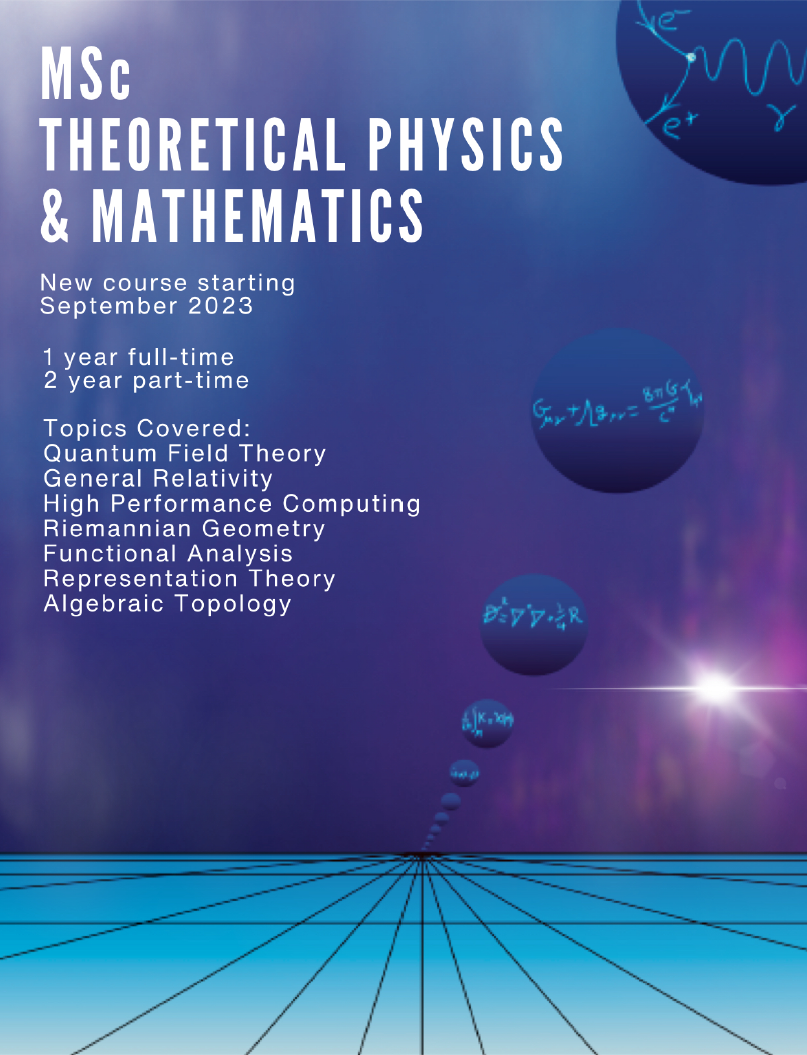
I know it’s the Easter holiday weekend but I couldn’t resist sharing the exciting news that we have just received approval for a brand new Masters course at Maynooth University in Theoretical Physics & Mathematics. The new postgraduate course will be run jointly between the Departments of Theoretical Physics and Mathematics & Statistics, with each contributing about half the material. The duration is one calendar year (full-time) or two years (part-time) and consists of 90 credits in the European Credit Transfer System (ECTS). This will be split into 60 credits of taught material (split roughly 50-50 between Theoretical Physics and Mathematics) and a research project of 30 credits, supervised by a member of staff in a relevant area from either Department.

This new course is a kind of follow-up to the existing undergraduate BSc Theoretical Physics & Mathematics at Maynooth, also run jointly . We think the postgraduate course will appeal to many of the students on that programme who wish to continue their education to postgraduate level, though applications are very welcome from suitably qualified candidates elsewhere.

Although the idea of this course has been on the cards for quite a while, the pandemic and other issues delayed it until now. This has so recently been agreed that it doesn’t yet exist on the University admissions webpages. This blog post is therefore nothing more than a sneak preview. There isn’t much time between now and September, when the course runs for the first time, which is why I decided to put this advanced notice on here! I will give fuller details on how to apply when they are available. You will also find further information on the Department’s Twitter feed, so if you’re interested I suggest you give them a follow.