Archive for the Education Category

Strategic Plans

Posted in Biographical, Education, Maynooth with tags , , on September 18, 2022 by telescoper

Maynooth University is in the middle a consultation exercise involving the construction a new Strategic Plan Envisioning Our Future for the period 2023-28. This is something higher education institutions do from time to time, and it usually involves dreaming up ways of spending money they haven’t got on things they don’t need. I’ve seen a few Strategic Plans in my time, but yet to see one that was worth the glossy paper it was expensively printed on. I can’t envision this one being any different,

You could dismiss the current Strategic Plan as merely an irrelevance but it is having a real effect, in that it has completed distracted the University management away from crucial operational matters, such as new appointments and fixing various failing systems. Moreover, it seems very likely, there being little chance of a substantial increase in government funding, that any new “initiatives” arising from the Strategic Plan will be paid for by further plundering already hard-pressed departmental budgets.

The other day I looked up “Strategy” in a dictionary and found

Noun: a plan of action designed to achieve a long-term or overall aim.

The biggest issue is not the plan of action bit, it’s the articulation of the aim and the interpretation of long-term as being “the next five years”. I know I am excessively old-fashioned but I think a university – especially a publicly funded one – should be aiming to be as good as possible at teaching and research. If we have to have a plan for the next five years, at a bare minimum it should involve increasing the investment in its existing departments and providing better teaching facilities. I don’t see either of those happening at all. We’ve got a new teaching building, but nothing has been done to improve any of the other teaching rooms on campus. It’s very dispiriting for front-line academic staff to appearance such neglect of what should be the core functions of the institution.

Anyway, now that I am no longer Head of Department and free of the requirement to attend pointless meeting after pointless meeting I am going to focus what remains of my energy on teaching and research, even if The Management does not deem these important.

Tomorrow (19th September) is the first week of teaching term for the 2022-23. Though new students don’t officially start until 26th September, some are already here and I have even spoken to them. Although we have had a very rough couple of years, our first-year numbers look healthy, which is a good point to be handing over the reins. I have two new PhD student and one Research Masters student arriving this academic year which should help me with my research plans.

Undergraduate science degrees and PhD degrees in Maynooth are typically of four years’ duration. I’ll be sixty during this academic year and over the last few weeks I have been doing a bit of strategic planning of my own. Although I can’t be made to retire until I’m 70, I think it will be a good time to go when the incoming UG & PG cohort finishes, i.e. four years from now. I love teaching and enjoy my research but there is a point at which one should step aside and make way for someone younger.

Assuming, that is, that: (a) I live that long; (b) I can sell my old house and pay off my mortgage; (c) my USS pension is not worthless by then; (d) I’m not sacked in the meantime for insubordination.

Writing Things

Posted in Biographical, Education, Maynooth with tags , , , , on September 14, 2022 by telescoper

I learned yesterday from Keith Flett’s blog that the new King of England appears to have had a bit of problem with his writing equipment. It must be difficult to face such a severe challenge at such an early stage of his reign but I’m sure he’ll sort it out, or perhaps his servants will.

As a result of this important news I was thinking that I must be very old-fashioned in continuing to use fountain pens. I have four different pens like that, three for everyday use, and one for “best” i.e. mainly for signing important letters. Although I don’t have a blotter, I do fill my pens with ink from a bottle rather than from cartridges. I have noticed, however, that it is rather difficult to buy bottles of ink these days so I tend to buy several bottles at a time. Another issue is that not all forms of paper are suitable for writing on with a fountain pen. I use this as an excuse to buy quite posh notebooks. In particular, fountain pens are useless for doing crosswords as the ink spreads into an illegible smudge on the paper,

You might think I’m an old fuddy-duddy for using such pens rather than biros or even doing everything using a word processor but old habits die hard. When I was at school my handwriting was very bad so a teacher suggested I start using a fountain pen in order to improve it. That didn’t work, but I got into the habit of using that sort of pen and I’ve never broken it (though I have broken many nibs).

I use a keyboard when writing documents nowadays but whenever I have to do calculations, I write out the complete thing (with equations), when I’ve checked it, using a fountain pen. After that I type them up using LaTex. The chaotic scribbles I produce during the actual process of calculating are usually done in pencil or biro, but the final version to go in my notebook is written out with actual ink.

Another example is when I am preparing to give a lecture. Although we have printed notes – like a textbook – I never lecture directly from them. I think a lecture should have a coherent structure to it so I always write out what I want to say with a beginning, middle and end. Writing it out longhand means it enters my mind far better than just reading from the notes.

On reflection, I think these approaches are extensions of the technique for taking lecture notes I used as an undergraduate student. Another teacher at school spent one lesson teaching us all how to write very quickly without looking at the paper. Doing that means you don’t waste time moving your head to and fro between paper and screen or blackboard.

Of course, the notes I produced using this method weren’t exactly aesthetically pleasing, but my handwriting is awful at the best of times so that didn’t make much difference to me. I always wrote my notes up more neatly after the lecture anyway, using a fountain pen. But the great advantage was that I could write down everything in real time without this interfering with my ability to listen to what the lecturer was saying.

An alternative to this approach is to learn shorthand, or invent your own form of abbreviated language. This approach is, however, unlikely to help you take down mathematical equations quickly.

My experience nowadays is that many students simply aren’t used to taking notes like this – I suppose because they get given so many powerpoint presentations or other kinds of handout –  so they struggle to cope with the old-fashioned chalk-and-talk style of teaching that some lecturers still prefer (and which actually works very well in mathematically-based disciplines). That’s probably because they get much less practice at school than my generation did. Most of my school education was done via the blackboard..

Even if I hand out copies of slides or other notes, I always encourage my students to make their own independent set of notes, as completely as possible. I don’t mean by copying down what they see on the screen and what they may have on paper already, but by trying to write down what I say as I say it. I don’t think many take that advice, which means much of the spoken illustrations and explanations I give don’t find their way into any long term record of the lecture.

And if the lecturer just reads out the printed notes, adding nothing by way of illustration or explanation, then the audience is bound to get bored very quickly.

My argument, then, is that regardless of what technology the lecturer uses, whether he/she gives out printed notes or not, then if the students can’t take notes accurately and efficiently then lecturing is a complete waste of time. In fact for the modules I’m doing this term I don’t intend to hand out lecture notes at all during the lectures, although I do post lecture summaries and answers to the exercises online after they’ve been done.

As a further study aid, most lectures at my previous institutions (Sussex University and Cardiff University) are recorded and made available to students to view shortly after the event. I have seen no evidence that availability of recorded lectures lowers the attendance at lectures. It appears that students use the recordings for revision and/or to clarify points raised in the notes they have taken, and if anything the recordings allow the students to get greater value from lectures rather than persuading them that there’s no need to attend them. Unfortunately we don’t have lecture capture at Maynooth, and a recent policy decision at high level is basically to ban lecture recordings here. I think that is regrettable to say the least, but since we don’t have proper equipment we can’t do it anyway so there’s nothing I can do.

I do like lecturing, because I like talking about physics and astronomy, but as I’ve got older I’ve become less convinced that lectures play a useful role in actually teaching anything. I think we should use lectures more sparingly, relying more on problem-based learning to instill proper understanding. When we do give lectures, they should focus much more on stimulating interest by being entertaining and thought-provoking. They should not be for the routine transmission of information, which is far too often the default.

As a matter of fact don’t think I ever learned very much about physics from lectures – I found problem-based learning far more effective – but I’m nevertheless glad I learned out how to take notes the way I did because I find it useful in all kinds of situations. Effective note-taking is definitely a transferable skill, but it’s also in danger of becoming a dying art. If we’re going to carry on using lectures, we old fogeys need to stop assuming that students learnt it the way we did and start teaching it as a skill.

Irish Times Supplement

Posted in Education, Maynooth with tags , , , , on September 9, 2022 by telescoper

I don’t usually buy a newspaper during the week but I noticed that today the Irish Times published a special supplement to mark these momentous times so I made an exception. Yes, today is the day the full set of CAO points are published in the print edition, about a year since last year. The official low-tech results for Maynooth are here. Minimum points required for Maynooth’s most important course, MH206 Theoretical Physics and Mathematics, are 510 this year, down a little from 521 last year, but the same as two years ago. Generally speaking, as expected, the points for other courses seem roughly the same as last year.

Students now have to decide whether to accept their first-round offer or try to change course. I suspect there might be fewer this year doing that because of the accommodation shortage, but that remains to be seen…

P.S. There was another supplement in today’s Irish Times about the death of Queen Elizabeth II.

A Day for Celebrations

Posted in Biographical, Education, Maynooth with tags , on August 31, 2022 by telescoper

It’s quite a busy day today. I spent a slice of of this morning attending the Autumn Examination Board (online). Students taking repeat exams will get their results on Friday which, coincidentally, is the same day that this year’s Leaving Certificate Examinations will come out.

I have one major task to finish today, completing the revisions of a paper to get it ready to resubmit. I’ve been struggling with this over the last few days but I think only minor changes are left to do so I should get it done after lunch. I’ll be at the Irish National Astronomy Meeting tomorrow (Thursday) and Friday so I’d like to get that done before that.

I already have two causes for celebration today. The first is that my first Maynooth PhD student’s first paper has now hit the arXiv. The second is that today is the last day of my three-year as Head of the Department of Theoretical Physics. As I wrote on the occasion of my appointment:

It’s about three years now since I stepped down as Head of School at the University of Sussex at which point I didn’t imagine I would be stepping up to be Head of Anything again, but to be honest this position has a smaller and much better defined set of responsibilities than the one I used to hold so I’m actually quite looking forward to it.

The idea that the job would have “a smaller and much better defined set of responsibilities” turns out to have been one of the worst miscalculations of my life, entirely for reasons outside the Department and not only because of the pandemic. Suffice to say that it’s been a difficult three years. I have to say though that the staff and students in the Department have been great to work with over this period, and their support is the only thing that made the job bearable. I will of course be continuing to work with them as a teacher and researcher and will do the best I can to support my replacement, assuming the University management gets around to appointing a successor, which it has yet to do despite having many months to do so.

Now, to finish revising that paper.

The Notional Lottery

Posted in Biographical, Education, Maynooth with tags , , on August 29, 2022 by telescoper

On Friday evening I got an email to tell me I’d won a prize on the Euromillions lottery. My excitement was short-lived, however, as I discovered on checking my ticket that my winnings amounted to the princely sum of €5, not the jackpot of nearly €100 million.

As regular readers of this blog might know, I play the Euromillions every week. I use the same numbers each time and always stake the minimum amount (€2.50) . Some think it is strange, but I see it partly as one of those little rituals we all invent for ourselves and partly as a small price to pay for a little frisson of excitement when the numbers are drawn.

But I do sometimes wonder what on Earth I would do if I won the huge jackpot prize. I have no dependents. I don’t have a car and have no interest in getting one, especially a fancy one. I don’t need a bigger house, or a yacht, or a private jet.  Frankly, there’s nothing that I would really want to buy that I couldn’t buy already. It’s not that I have a huge salary, just that I’m not exactly very materialistic. I would of course pay of my mortgage, but that wouldn’t make much of a dent in €100 million!

Would I quit my job? Would I quit teaching? If you had asked me those questions a decade ago I would have said a firm “no” but now I’m not so sure. If I could ditch the admin stuff, I would of course do so. I still enjoy teaching and research, though. On the other hand I’m pushing sixty now, and my departure from a paid position would open up opportunities for someone younger. I might carry on in some voluntary arrangement if this were possible.

So what would I do with the money? I think what I would probably do is set up some sort of philanthropic foundation to give most of it to good causes, including the arts and sciences; the latter would include a big donation to arXiv.

One thing I wouldn’t do would be to give the money directly to universities, as any donation would be swallowed up by the central coffers and most of it would probably just be wasted on management salaries and vanity projects instead of education and research. I suppose if I set up a foundation I could give grants directly to researchers and students for specific purposes bypassing the top layer.

Anyway, all this is notional because I only won €5. Maybe next week…

The ABC of A-levels

Posted in Biographical, Education, Rugby with tags , , , on August 25, 2022 by telescoper

Yesterday I was having a bit of a clear-out of my office at home ahead of the new teaching term when I came across the above clipping at the back of a box of old papers. It’s from the Newcastle Evening Chronicle in 1981 and it shows the number of A-levels passed that summer by pupils at the Royal Grammar School in Newcastle, which I went to.

I don’t know why I’ve kept this for so long, neither do I know why the local paper felt important to list this information. It probably isn’t allowed to publish such things these days owing to Data Protection regulations but it did so routinely back then. I think it’s OK to publish it now because it has been in the public domain, technically speaking, for over 40 years. The Chronicle also published O-level passes with names, and I have the list with me in it from 1979.

A few things struck me about this list. One is that, while I can put faces to many of the names, there are many to which I can not. Indeed some of the names don’t ring any bells at all. I’m sure I’ve been forgotten by most people in the list too! When I arrived at the school in 1974 I was assigned to a “House” called Eldon along with about 30 other boys. In the first year we were placed at desks in our classroom in alphabetical order. Obviously the first people I got to know were those sitting in adjacent desks. It’s interesting that seven years on, the two names preceding mine in the list above were also in Eldon and had been sitting next to me on the very first day I arrived and they are among the few people from RGS that I am still in regular contact with.

The Sixth Form (two years, “Lower 6th” and “Upper Sixth” to coincide with the length of the A-level course) was divided into Arts and Sciences. The Arts are listed first in alphabetical order, then the Sciences. I was in the latter group. My 4 A-levels were Mathematics, Further Mathematics, Physics & Chemistry. I also did two special papers, in Physics and Chemistry. After A-levels, along with about 20 of the people on the above list, I stayed on for a “7th term” to do the Cambridge Entrance Examination, and the rest is history.

I also note that very few of us had only a single first initial like me. That’s a Coles family trait. My Dad always said that you only use one name so why have extras?

One final comment. Near the bottom of the list you will see the name “J M Webb”. That name is not to do with the James Webb of Space Telescope fame, but Jonathan Webb did go on to play Rugby for England. I didn’t know him well at school because, as well as being separated by alphabetical considerations, he was in a different House (Horsley if I remember correctly).

In Defence of Blackboards

Posted in Covid-19, Education, Maynooth with tags , on August 21, 2022 by telescoper
Lecturing from Home

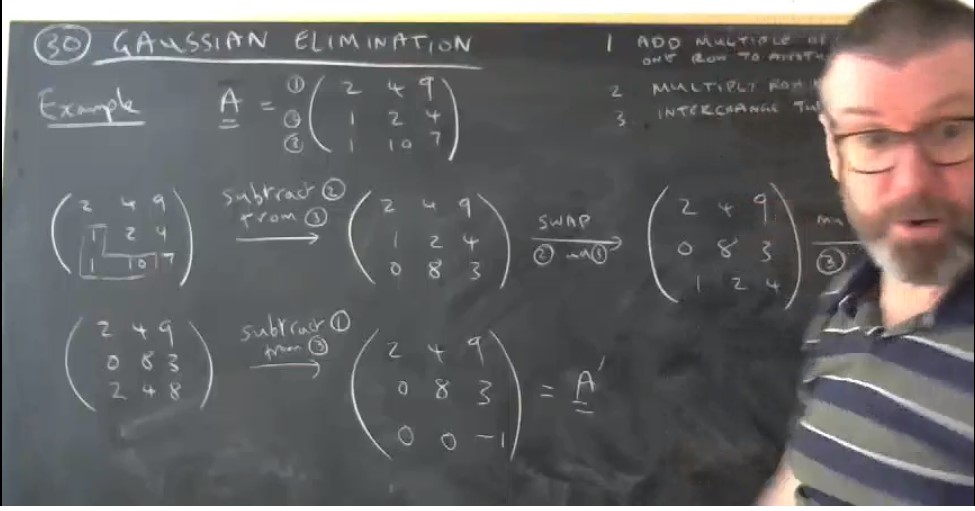
I wasn’t very surprised to find that the large lecture theatres in the swanky new building at Maynooth University are not equipped with chalkboards, as I had been told that the powers-that-be were finding it difficult to “source” boards of the appropriate size. I was more surprised and disappointed to find that none of the smaller teaching rooms have blackboards either; the best they have is very small whiteboards which are useless for teaching mathematical subjects.

I know people think I am very old fashioned in persistently using a chalkboard (a better word than “blackboard” as many chalkboards are actually dark green). They also find it quite amusing that I bought one especially so I could do lectures during the pandemic from home using it. One reason for that is that it’s far easier to get a decent contrast on camera than using a whiteboard. I also find that standing up and walking around allows me to communicate more effectively, at a decent pace and with a reasonable amount of energy which made the lectures from home a little less unbearable to give and, hopefully, to watch. Here’s the green blackboard in my office that I used to give some lectures during lockdown:

The very chalky chalkboard in my office on campus

It was never the intention of course that the board in my office would be used for lecturing. We have such things to facilitate the communication of ideas during a discussion by scribbling mathematical expressions or diagrams.

I found some time ago an article about why Mathematics professors at Stanford University still use chalkboards. I agree with everything in it. The renowned Perimeter Institute in Canada and the Isaac Newton Institute in Cambridge also have blackboards, not only in teaching rooms but also in corridors and offices to encourage scientific discussions.

For teaching I think the most important thing for the students in a lecture on a subject like theoretical physics to see a calculation as a process unfolding step-by-step as you explain the reasoning, rather than being presented in complete form which suggests that it should be memorized rather than understood. Far too many students come to university with the impression that their brain is just a memory device. I fill it’s our job as lecturers to encourage students develop genuine problem-solving skills. The example in the first picture above – Gaussian Elimination – is a good illustration of this. Most of my colleagues in Theoretical Physics and in the Department of Mathematics and Statistics seem to prefer chalkboards too, no doubt for similar reasons.

I know that many in Senior Management think of us as dinosaurs for clinging to “old technology” but the fact is that new technology isn’t always better technology. Whiteboards are just awful. As well as being impossible to read in a large room or to record from, the marker pens are expensive, filled with nasty solvent, and impossible to recycle when empty. Unfortunately the purveyors of these items seem to have cornered the market I hate whiteboards so much I call them shiteboards.

Anyway, with the new academic year due to start in a month, and there being no likely resolution of the accommodation crisis, it looks like many students will be unable to attend lectures in person. It doesn’t matter whether rooms have blackboards or whiteboards or enhanced multimedia digital display screens if the students can’t get to the campus…

The Accommodation Crisis Again

Posted in Education, Maynooth with tags , , on August 20, 2022 by telescoper

There’s an article on the RTÉ website drawing attention to the national crisis in student accommodation. Included in the article is an example of a student at Maynooth:

Clara Battell is heading into her second year of studying Law and Criminology at Maynooth University. The Sligo student and her four friends thought they’d beat the crowd when they started looking for accommodation shortly after Christmas. However, eight months on, they’re still looking.

I checked this morning on daft.ie and there are just two properties currently available to rent in Maynooth; the rest are miles away and would require the tenant(s) to have a car. One is property is a studio apartment for €1,250 per month (which is way beyond the budget of a typical undergraduate student) and the other a four-bedroom shared house suitable at €3,800 per month. And remember that new students haven’t even started looking yet as this year’s CAO offers are not out until September. Clara Battell might end up having to commute from Sligo:

I’m from Sligo, it’s a three hour train journey and the only option at this stage appears to be commuting. It’s surely not feasible, six hours every day – and you’re not getting the best out of your education if you are travelling so much. We are all a bit stuck really.

Not to mention of course the inability to participate in clubs, societies and other extra-curricular activities. Clara’s situation is by no means atypical. Some brave students may try long-distance commuting this for a week or two, but few will keep it up for the entire academic year when they know how tough it is going to be.

The reality is that a great many students will have to choose between lengthy commutes and skipping lectures. This is particularly bad at Maynooth where the University Management has failed to invest in lecture recording equipment that would at least do something to mitigate the negatives of not being able to attend campus teaching sessions. I can see attendance on campus being very low this forthcoming term, as it was last term. The reality for many students is that they will be stuck at home just like during the lockdown, but without online classes. This was entirely predictable, but little has been done. It’s extremely frustrating for staff as well as students.

I heard this week of a much-needed proposal for a new housing complex including 260 student beds in Maynooth. It’s not on campus, but within walking distance on the other side of the Moyglare Road. This is good news, but the application for planning consent has only just been lodged; a decision is not expected until November 30th. Even if permission is granted it will take years to build and remember that there are 15,000 students in Maynooth so 260 beds is a drop in the ocean.

It is important to stress what is driving this. With costs increasing but income per student falling over many years, third-level institutions have had no choice but to recruit more and more students. The same Government that has driven this requirement is also responsible for inadequate investment in housing across the country. Some people are trying to blame the current crisis on the 48,000 Ukrainian refugees now in Ireland, but all their presence has done is to expose the long-term negligence of the Government at whose door the blame must rest.

It will take at least two years, and probably much longer, to fix this crisis. The big question is whether Ireland’s University system will survive that time without disintegrating.

A-level Again

Posted in Education with tags , , on August 18, 2022 by telescoper

So once again it’s the day that students in United Kingdom are receiving their A-level results. It seems the number of top grades is down this year but as always my advice to students who got disappointing results is

There’s always the clearing system and there’s every chance you can find a place somewhere good. If you’re reading this blog you might be interested in Physics and/or Astronomy so I’ll just mention that both Cardiff and Sussex have places in clearing and both are excellent choices.

At least you’ve got your results; students here in Ireland will have to wait until September 2nd to get theirs!

My experience of over 30 years teaching in UK universities has convinced me that A-levels are not a very good preparation for higher education anyway and the obsession with them is unhealthy. Some of the best students I’ve ever had the pleasure of teaching came to University with poor A-level grades (for a variety of reasons).

In fact I’d go as far as to say that the entire system of University admissions in the United Kingdom needs to be overhauled. As I said in a post over a decade ago:

…if we had the opportunity to design a process for university admissions from scratch, there is no way on Earth we would end up with a system like the current one.

Of course I longer work in the UK so there’s no longer a “we”, but the system in Ireland is not that much different, with the Leaving Certificate playing the role of A-levels for the vast majority of students.

As things stand in the UK, students apply for university places through UCAS before they have their final A-level results (which don’t come out until August). Most applications are in by January of the year of intended admission, in fact. The business of selecting candidates and making offers therefore usually makes use of interim results or “predicted grades” as supplied by teachers of the applicant.

In my (limited) experience most teachers systematically overestimate the grades of their pupils, which is presumably why so many of this year’s A-level results are being downgraded, but there are lots of unconscious biases at play here and I accept that some teachers may be unduly pessimistic about their students likely performance.

But the inaccuracy of predicted A-level grades is not the only absurdity in the current system. Universities have to engage in enormous amounts of guesswork during the admissions process. Suppose a department has a quota of 100, defining the target number students to take in. They might reasonably get a minimum of 500 applications for these 100 places, depending on the popularity of university and course.

Each student is allowed to apply to 5 different institutions. If a decision is made to make an offer of a place, it would normally be conditional on particular A-level grades (e.g. AAB). At the end of the process the student is expected to pick a first choice (CF) and an insurance choice (CI) out of the offers they receive. They will be expected to go to their first choice if they get the required grades, to the insurance choice if they don’t make it into the first choice but get grades sufficient for the reserve. If they don’t make either grade they have to go into the clearing system and take pot luck among those universities that have places free after all the CFs and CIs have been settled.

Each university department has to decide how many offers to make. This will always be larger than the number of places, because not all applicants will make an offer their CF. They have to honour all offers made, but there may be penalties if they under or over recruit. How many offers to make then? What fraction of students with an offer will put you first? What fraction of them will actually get the required grade?

The answers to these questions are not at all obvious, so the whole system runs on huge levels of uncertainty. I’m amazed that each year any institution manages to get anywhere close to the correct number, but they do tend to get very close indeed by the end. Usually.

It’s a very skilled job being an admissions tutor, but there’s no question it would all be fairer on both applicants and departments to remove most of the guesswork by which I mean allowing students to apply to University after they have got their results. But there is the rub. There are two ways I can see of changing the timetable to allow this:

  1. Have the final A-level examinations earlier
  2. Start the university academic year later

The unavoidable consequence of the first option would be the removal of large quantities of material from the A-level syllabus so the exams could be held several months earlier, which would be a disaster in terms of preparing students for university.

The second option would mean starting the academic year in, say, January instead of September. This would in my opinion be preferable to 1, but would still be difficult because it would interfere with all the other things a university does as well as teaching, especially research. The summer recess (July-September), wherein much research is currently done, could be changed to an autumn one (September-December) but there would be a great deal of resistance, especially from the older establishments; I can’t see Oxbridge being willing to abandon its definitions of teaching term! And what would the students do between July and January?

Either of these options would cause enormous disruption in the short-term, which is presumably why they have never been implemented. However, this year everything is disrupted anyway so there’s an opportunity to redesign the whole process.

I don’t really imagine the Government is will do any of this but here are some suggestions of elements of a new admissions system:

  • Students to apply after receiving A-level* grades (i.e. implement 1 or, preferably, 2 above)
  • All university applications to be anonymous to prevent discrimination.
  • The identity of the applicant’s school to be withheld to prevent undue influence.
  • Teachers to play no part in the process.

*I don’t think A-levels are fit for purpose so here I mean grades of whatever examination replaces them.

Quiet Quitting

Posted in Biographical, Education, Maynooth with tags , , on August 16, 2022 by telescoper

Not long ago I had lunch with a friend and former colleague from Sussex now working elsewhere. During the conversation I found myself saying words to the effect of “It’s only easy being a manager of something if you don’t care”. Speaking in the context of University management I meant “care” about the things that matter, i.e. staff and students and teaching and research, not metrics, rankings and key performance indicators.

Over the years that I’ve worked in universities, I’ve seen them systematically taken over by people who really don’t care at all about the important things. The result among ordinary staff is exhaustion caused by the overwork required to meet arbitrary criteria of productivity imposed by a remote and uncaring managerial class. Universities are thus a microcosm of neoliberal society at large, with the management being the propertied class, the academics being the workers, and the students being mere commodities.

The drive to alienate and demoralize staff through overwork accelerated during the Covid-19 pandemic. Teaching staff were required to transform their working methods, undertake countless hours of unpaid overtime and suffer long periods of isolation and stress. Being a Head of Department with lots of responsibilities but no actual power and no reduction in teaching load to compensate for the administrative burden, compounded this They did it because they knew there was an emergency and because they actually care. In return for this sacrifice they have generally received no appreciation except for platitudes and nothing by way of financial compensation, with the notable exception of Queen’s University Belfast which paid a bonus to staff in recognition of their exceptional efforts. Well done to them, but they are the exception rather than the rule. Elsewhere the only reward for efforts during the pandemic looks likely to be real-terms cuts in pay.

My worry, which is rapidly becoming reality, is that in the post-pandemic era The Management, aware of how far their employees were prepared to go during the pandemic, will continue to take them completely for granted, increase their workload by recruiting more and more students to be taught with fewer and fewer resources, all of it driven by financial targets. Why do we continue to put up with this gross exploitation? Are we doomed forever to labour under the dead weight of managerialism?

Over the past few weeks I’ve seen a number of articles about quiet quitting, most recently this one in the Guardian. Roughly speaking “quiet quitting” means fulfilling one’s contract but not going any further – no work at evening or weekends, taking one’s full holiday entitlement, and so on. Staff have generally done these things because they care but that care has been and is still being systematically exploited. Indeed, it says something about the way higher education institutions operate nowadays that “working to contract” is generally regarded as a form of industrial action! Universities would grind to a halt without the good will of staff, and there’s very little of that still left. In my own case, my employer still hasn’t fulfilled the terms of my employment contract almost five years after I joined.

So am I now going to join the ranks of those quitting quietly? You might very well think that. I couldn’t possibly comment. What I will say is that my union, IFUT, is going to ballot its members next month on industrial action over pay. I think you can probably guess which way I’ll be voting…