We have reached the end of Week 9 at Maynooth University, so there are now just three weeks to go until end of term. All of sudden the shops are filled with Christmas whatnots and thingies, and I’ve finally bowed to pressure and bought a ticket for this year’s Messiah.
As usual for this time of the year we have a pair of Open Days for undergraduate admissions. The first was today, Friday, and catered mainly for school trips whereas tomorrow’s (i.e. Saturday’s) is usually more parents with their offspring. During the pandemic these events have been online but we’re now having them on campus so that prospective students see the important features on campus in the flesh:
For the last few years, I’ve been the main person responsible for running the Theoretical Physics part of these Open Days but now that duty has passed on to the new Head of Department. It’s not that I disliked doing these events, it’s just that I think it’s better from now on to have a fresher face doing them. Today for me has therefore largely been a normal teaching day and I’m also able to have a lie-in tomorrow morning.
In past years, before the pandemic, some lectures have been cancelled to make way for Friday Open Day talks. That has included the Friday lecture of my 2nd year module on Vector Calculus which takes place in a room previously needed for admissions business on Open Days. Now, however, a new teaching building is available and many of the Open Day talks are in there so my lecture went ahead as planned. The room next door to mine was however used for the Open Day and a group of about ten schoolgirls, dressed in green blazers and plaid skirts in a manner highly reminiscent of the Derry Girls, almost came into my lecture by mistake.
I saw quite a few visitors around the campus this morning, and some came into the Science Building for a look around, but I don’t know how busy the day was in comparison to previous November events on campus. I don’t know how busy it will be tomorrow either, as I shall be putting my feet up at home.
Today wasn’t quite a normal day, however. I had lunch in Pugin Hall. I used to do that regularly before the pandemic but today was the first time I’ve been there since March 2020. Either Pugin Hall has been closed or I’ve been too busy to have anything other than a sandwich in my office.
Following last week’s Maynooth Astrophysics and Cosmology Masterclass, a student asked (in the context of the Big Bang or a black hole) what a singularity is. I thought I’d share my response here in case anyone else was wondering. The following is what I wrote back to my correspondent:
–oo–
In general, a singularity is pathological mathematical situation wherein the value of a particular variable becomes infinite. To give a very simple example, consider the calculation of the Newtonian force due to gravity exerted by a massive body on a test particle at a distance r. This force is proportional to 1/r2,, so that if one tried to calculate the force for objects at zero separation (r=0), the result would be infinite.
Singularities are not always signs of serious mathematical problems. Sometimes they are simply caused by an inappropriate choice of coordinates. For example, something strange and akin to a singularity happens in the standard maps one finds in an atlas. These maps look quite sensible until one looks very near the poles. In a standard equatorial projection, the North Pole does not appear as a point, as it should, but is spread along straight line along the top of the map. But if you were to travel to the North Pole you would not see anything strange or catastrophic there. The singularity that causes this point to appear is an example of a coordinate singularity, and it can be transformed away by using a different projection.
More serious singularities occur with depressing regularity in solutions of the equations of general relativity. Some of these are coordinate singularities like the one discussed above and are not particularly serious. However, Einstein’s theory is special in that it predicts the existence of real singularities where real physical quantities (such as the matter density) become infinite. The curvature of space-time can also become infinite in certain situations.
Probably the most famous example of a singularity lies at the core of a black hole. This appears in the original Schwarzschild interior solution corresponding to an object with perfect spherical symmetry. For many years, physicists thought that the existence of a singularity of this kind was merely due to the special and rather artificial nature of the exactly spherical solution. However, a series of mathematical investigations, culminating in the singularity theorems of Penrose, showed no special symmetry is required and that singularities arise in the generic gravitational collapse problem.
As if to apologize for predicting these singularities in the first place, general relativity does its best to hide them from us. A Schwarzschild black hole is surrounded by an event horizon that effectively protects outside observers from the singularity itself. It seems likely that all singularities in general relativity are protected in this way, and so-called naked singularities are not thought to be physically realistic.
There is also a singularity at the very beginning in the standard Big Bang theory. This again is expected to be a real singularity where the temperature and density become infinite. In this respect the Big Bang can be thought of as a kind of time-reverse of the gravitational collapse that forms a black hole. As was the case with the Schwarzschild solution, many physicists thought that the initial cosmologcal singularity could be a consequence of the special symmetry required by the Cosmological Principle. But this is now known not to be the case. Hawking and Penrose generalized Penrose’s original black hole theorems to show that a singularity invariably exists in the past of an expanding Universe in which certain very general conditions apply.
So is it possible to avoid this singularity? And if so, how?
It is clear that the initial cosmological singularity might well just be a consequence of extrapolating deductions based on the classical ttheory of general relativity into a situation where this theory is no longer valid. Indeed, Einstein himself wrote:
The theory is based on a separation of the concepts of the gravitational field and matter. While this may be a valid approximation for weak fields, it may presumably be quite inadequate for very high densities of matter. One may not therefore assume the validity of the equations for very high densities and it is just possible that in a unified theory there would be no such singularity.
Einstein, A., 1950. The Meaning of Relativity, 3rd Edition, Princeton University Press.
We need new laws of physics to describe the behaviour of matter in the vicinity of the Big Bang, when the density and temperature are much higher than can be achieved in laboratory experiments. In particular, any theory of matter under such extreme conditions must take account of quantum effects on a cosmological scale. The name given to the theory of gravity that replaces general relativity at ultra-high energies by taking these effects into account is quantum gravity, but no such theory has yet been constructed.
There are, however, ways of avoiding the initial singularity in classical general relativity without appealing to quantum effects. First, one can propose an equation of state for matter in the very early Universe that does not obey the conditions laid down by Hawking and Penrose. The most important of these conditions is called the strong energy condition: that r+3p/c2>0 where r is the matter density and p is the pressure. There are various ways in which this condition might indeed be violated. In particular, it is violated by a scalar field when its evolution is dominated by its vacuum energy, which is the condition necessary for driving inflationary Universe models into an accelerated expansion. The vacuum energy of the scalar field may be regarded as an effective cosmological constant; models in which the cosmological constant is included generally have a bounce rather than a singularity: running the clock back, the Universe reaches a minimum size and then expands again.
Whether the singularity is avoidable or not remains an open question, and the issue of whether we can describe the very earliest phases of the Big Bang, before the Planck time, will remain open at least until a complete theory of quantum gravity is constructed.
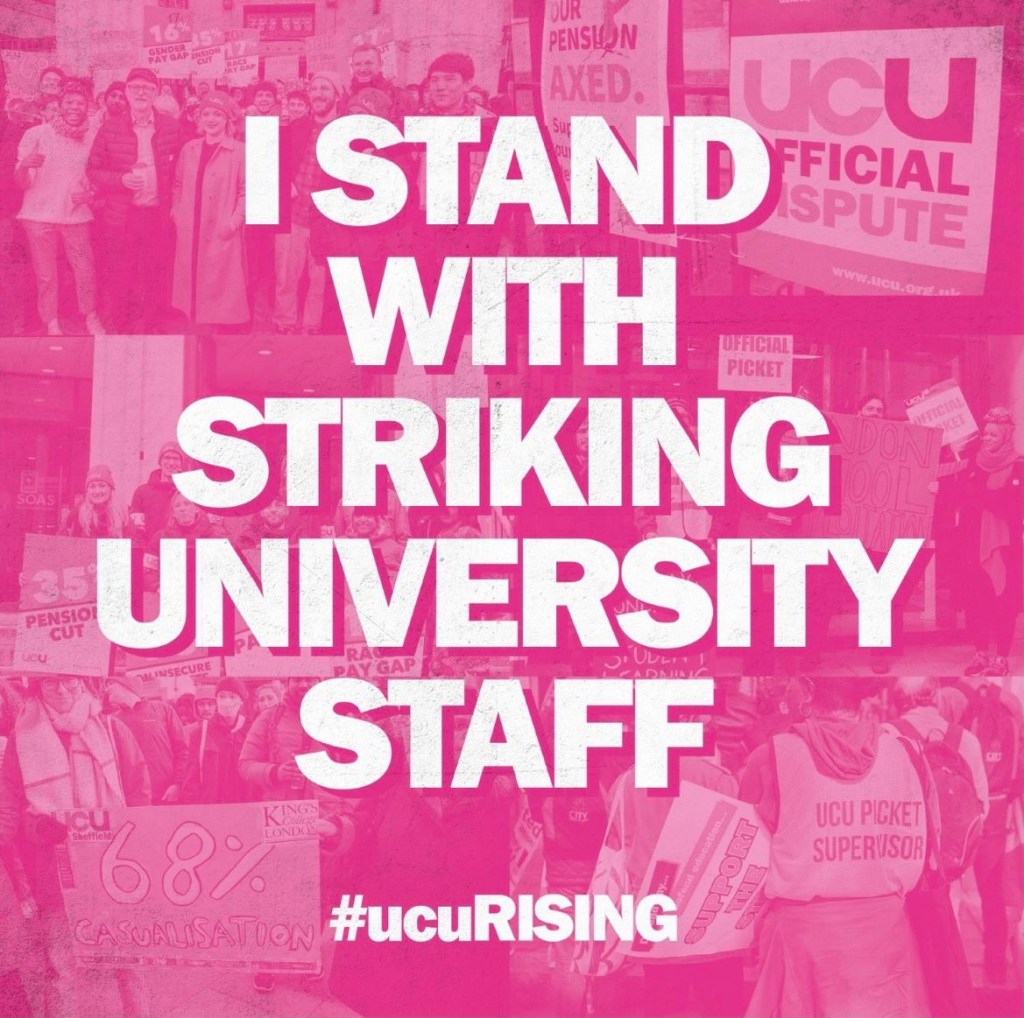
Today (and tomorrow) 70,000 members of the University and College Union at all 150 UK universities are on strike over over pay, working conditions and pensions.
Had I still been employed in the UK Higher Education system I would probably be standing on a picket line but I’m not, but at least I can send this message of solidarity to everyone who is!
So here we are then. The study break is over. Tomorrow we resume teaching. Six weeks of the semester gone. Another six to go. I didn’t do half the things I meant to do last week but at least I’m not behind with teaching things. I should be able to cover everything I need to cover in the second half without having to speed up too much. That’s the hope anyway.
Over the weekend I’ve been thinking a bit about my social media strategy, if you can call it that. It seems Elon Musk has realized that Twitter isn’t worth a fraction of what he paid for it, and is worth even less now that advertisers are fleeing, so has decided to recoup at least some of his losses by giving priority to anyone who wants to pay $8 a month so they can broadcast whatever they like withouyt moderation. The famous “blue tick” will no longer even mean a verified user, just someone willing to pay to shout at everyone else. Musk is also in the process of sacking about half his workforce.
I’m not going to pay anything to the Chief Twit and don’t like the way Twitter is going anyway so I’ve decided that I will indeed move to Mastodon, which I quite like, and where you can find me here. I don’t have a huge Twitter following so migrating to Mastodon is no big deal for me. I see many thousands I know on Twitter and many more I don’t are doing likewise.
Posts from this blog are automatically sent to Twitter and I won’t stop doing that, but I won’t be logging on there much except from time to time to block anyone I see who has a blue tick on their profile…
Anyway, in other news, the forthcoming week also sees me resume my feeble attempts to learn the Irish language, so it’s possible I may be boring you all with updates over the next few weeks and months. You have been warned.
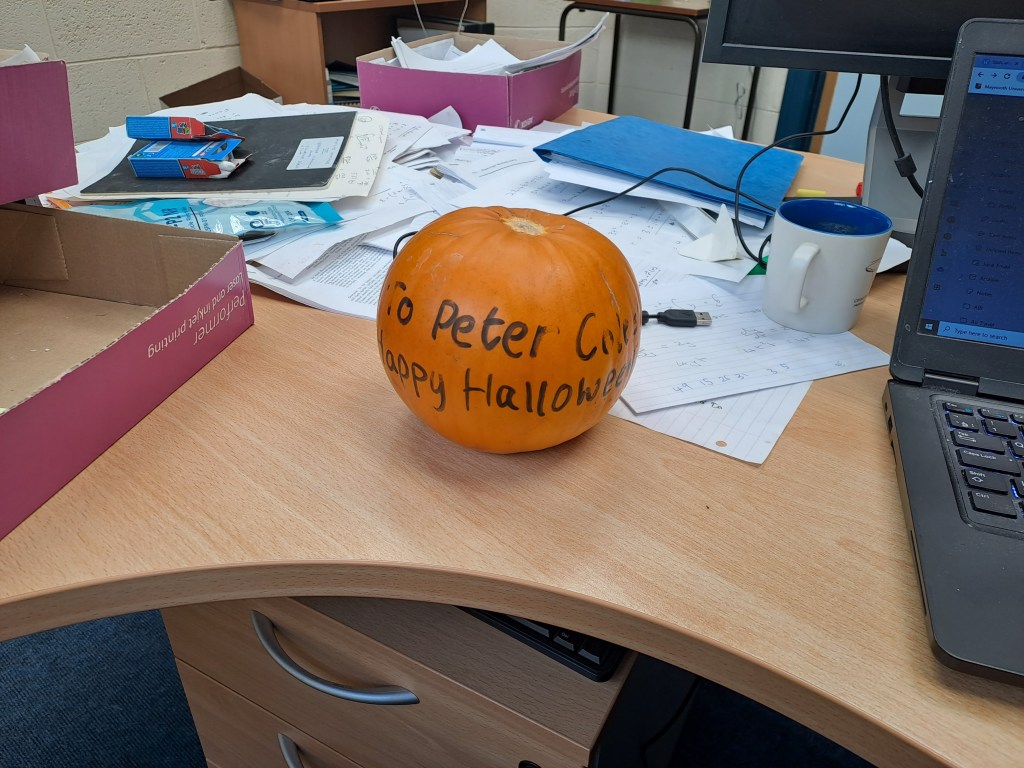
Yesterday my Vector Calculus students gave me the above Hallowe’en gift, which was nice of them, although I did chastise them for missing the apostrophe. Of course Hallowe’en itself is not until Monday, but that is a Bank Holiday in Ireland and the rest of next week is Study Week so there are no lectures or tutorials.
Hallowe’en is, in pagan terminology, Samhain. This, a cross-quarter day – roughly halfway between the Autumnal Equinox and the Winter Solstice, represents the start of winter (“the dark half of the year“) in the Celtic calendar. Samhain is actually November 1st but in Celtic tradition the day begins and ends at sunset, so the celebrations begin on the evening of 31st.
Incidentally, Samhain is pronounced something like “sawin”. The h after the m denotes lenition of the consonant (which in older forms of Irish would have been denoted by a dot on top of the m) so when followed by a broad vowel the m is pronounced like the English “w”; when followed by a slender vowel or none “mh” is pronounced “v” or in other words like the German “w” (which makes it easier to remember). I only mention this because I will be resuming my Irish language education after the break with classes every week for the rest of the academic year. Hopefully I’ll make some progress.
This term has been very tiring so far. I have to teach a very big first-year class this year which meant adding another tutorial group. Although I stepped down as Head of Department at the end of August the powers that be delayed appointing a replacement until well into term which caused a lot of unnecessary stress for everyone. Once we got under way, though, everything has settled down reasonably well.
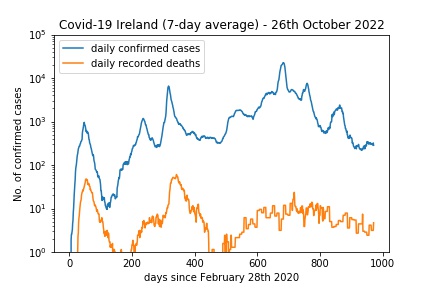
One thing I was a bit worried about this term was that the resumption of in-person teaching would lead to a surge in Covid-19 cases, not only in Maynooth but across the country. However there isn’t any evidence of significant increases in the latest figures (updated weekly nowadays, on Wednesdays):
Some students have come down with Covid-19 of course but not in the numbers I had feared. Also despite accommodation shortages and other difficulties, attendance at lectures and tutorials has so far held up well.
I like having the study break. I’ve never previously worked at an institution that has such a thing, but I think 12 weeks of non-stop teaching would be extremely exhausting. Anyway, after the break we have a further six weeks of teaching until December 16th, which is the official end of term, but for now I have Monday off completely and the rest of the week without teaching duties. That’s not to say I’ll be on holiday though. I have a number of tasks to catch up on, including setting examination papers for January…
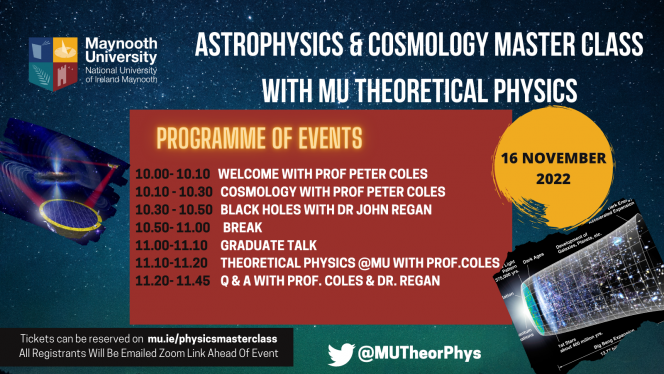
Regular readers of the blog – both of them – may remember that we have twice previously presented a Masterclass in Astrophysics & Cosmology in Maynooth. Well, owing to popular demand, we’ve decided to do a re-run of the event on Wednesday 16th November 2022 during this year’s Science Week. Last year’s event was a big success, with over a hundred schools joining in, with probably over a thousand young people listening and asking questions.
Like last year’s event this year’s will be a half-day virtual event via Zoom. It’s meant for school students in their 5th or 6th year of the Irish system. There might be a few of them or their teachers who see this blog so I thought I’d share the news here. You can find more information, including instructions on how to book a place, here.
Here is the flyer for the event:
I’ll be talking about cosmology early on, and John Regan will talk about black holes later on. After the coffee break one of our students will talk about why they wanted to study astrophysics. Then I’ll say something about our degree programmes for those students who might be interested in studying astrophysics and/or cosmology as part of a science course. We’ll finish with questions either about the science or the studying!
Here is a more detailed programme:
Fortunately this year I don’t need to dash away at noon to do a lecture!
A couple of articles appeared recently that I encourage people to read who are studying physics, or interested in studying physics.
The first article by Carl Wieman is from Physics Today and is entitled How to become a successful physicist. It is aimed at graduate students, though most of what it says is relevant to those at an earlier stage of their studies. Here’s an excerpt from near the beginning:
The primary characteristic of a successful physicist is being a good problem solver.
The article goes on to say some very interesting and instructive things, and is well worth reading in its entirety. There are one or two things that I don’t agree with though. One is the statement that…
…textbook problems provide all the information needed and have a single well-defined path to a solution.
That’s true of many problems at an elementary level, but problems at undergraduate or graduate level often have more than one way of finding the solution. That’s certainly true of many that I set as assignments. Indeed, sometimes the students come up with better ways of approaching them than I did! The important difference between textbook and research problems is that you know the textbook problems have a solution. Research is scarier because you don’t know at the outset that an answer can be found!
The second article, by Ethan Siegel, is called The secret to becoming an excellent physicist. Here is a quote from that, revealing the “secret”:
It’s simplicity itself: you become good at physics by solving physics problems. That’s it: that’s the secret. If you want to become competent at physics, you will solve physics problems in the area you wish to learn.
I hope you get the message. It’s not about rote-learning facts and formulae. The brain is much more than a memory device. It’s all about problem-solving. The ability to do that effectively can only be learned through practice.
I’m currently teaching two modules on Mathematical Physics and I devote most of the time in lectures for both of them to doing worked examples rather than proving theorems or presenting facts, theorems, derivations, formulae, etc to learn. I spend quite a lot of time in lectures giving students things to work out, which makes classes more interactive, but students also have tutorials built around problem-solving tasks to complement this.
I’d add one piece of advice. If you really want to develop as a physicist, don’t just solve a lot of easy problems; challenge yourself by tackling difficult ones too. Don’t be afraid to get “stuck” or make a mistake, as those are both necessary parts of the learning process. Above all, develop the confidence in your ability to take on a problem and back yourself to solve it and don’t be deterred if the answer doesn’t come quickly!
Here is a promotional video made just two years ago which describes an exciting and much needed new Student Centre at Maynooth University:
According to the Youtube page
This video is the first time we can share with you the vision for our new Student Centre. It gives you an impression of the dedication of MSU and MU in delivering a top-class student experience. We cannot wait to see the physical works begin and we will keep the student body updated as the project progresses.
Well, yesterday the student body was “updated” alright. The project has been abruptly cancelled by the Governing Authority. The reason is
The project has been adversely impacted by rapidly escalating costs, linked to technical construction issues as well as hyperinflation.
Not to be pedantic, the current economic situation in no way corresponds to “hyperinflation” as it is normally defined. However, it is true that costs are increasing especially in the construction industry and this will have put pressure on the University Management who took the easy way out by cancelling the project. I believe this to have been a very wrong, and indeed reprehensible, decision.
Students at Maynooth University voted in 2015 to pay a special levy of €150 per year specifically to fund this new Student Centre. Current students, who have just started the new academic year, will have paid this year’s levy – about 14,000 of them. All that money taken from students (many of whom struggled to afford it) has now been written off. Not surprisingly students feel that they have been fleeced. I say “not surprisingly” because they undoubtedly have been. It’s a scandal and a disgrace.
If you are on Twitter you can see some of the reaction under the hashtag #WheresMyLevy.
Here’s an example:
Did you attend Maynooth between 2015-2022?
Your money has been taken under false pretences.
Since 2015, a €150 per year student levy was introduced to build a new Student Centre.@MaynoothUni has today terminated the project. Do we get our money back?#wheresmylevy
At very least the amounts collected should be returned. Whether that can be enforced by law is an open question.
The decision to sneak this announcement out while Ireland’s media were preoccupied with yesterday’s budget can have been taken for the purpose of burying it. The story did, however, make it onto the BBC website, and I’m sure the national media will follow. I hope this escalates to the highest levels of Government. I have written to my TD and I’m sure others will do likewise. Universities should not be allowed to treat their students like this.
MORE UPDATES: the story is now in the Irish Times, Irish Examiner, and The Journal, to name but three. There has also been lots of radio coverage. Student recruitment is going to be interesting this year...
The sum that has been wasted on this project in consultancy and architect fees up to now is so far undisclosed by Maynooth University, but I’m sure a Freedom of Information request will reveal it…
I’m afraid the decision to terminate the Student Centre is symptomatic of the current management of Maynooth University, which seems to think of students as mere commodity, and academic staff as a insubordinate servants. I could write about other reprehensible failures of governance here, but will refrain from doing so until proper procedures have been completed. Suffice to say that there’s a struggle going on for the soul of this institution, and at the moment it’s not going well.
I know this radical suggestion may prove controversial, but perhaps if university managements really want to get the best out of their staff and students then maybe they shouldn’t treat them like shit all the time?
The panel discussion I took part in was called Do I Belong Here? The answer, at least initially, was “no” because I went to the wrong room. I blame that on the fact I was wearing my new glasses. When I did make my way to the correct lecture theatre the discussion involved people from diverse backgrounds who have experience of finding their place at university and how to make a valuable contribution by retaining their identity and getting involved with opportunities and activities. I think it went reasonably well, and I enjoyed having the chance to chat to students afterwards in the foyer of the new TSI building.
On the way home afterwards I discovered that my local supermarket is selling bottles of Barolo at half price, so I bought one to have with my dinner which now beckons!
Yesterday I gave my first lecture of the new academic year. It was the first lecture of the second-year Mathematical Methods module I’ve been teaching for several years now, and was about partial differentiation. Because of the late Leaving Certificate results this year, first-year students don’t officially start until next week but we have some doing my second module and most of them actually came to my first lecture. For most of the new arrivals this week is Welcome Week, with a variety of events – both social and administrative – to help them settle into student life before they start their education proper next week.
As often seems to be the case in late September, the weather is very nice today. The Welsh phrase Haf Bach Mihangel (Michael’s Little Summer) refers to this kind of spell. St Michael is also the origin of the term Michaelmas, which is the name of the Autumn term at Cambridge University. Michaelmas Day itself is on 29th September.
This all takes me back to when I myself left home to go to University in 1982, as thousands of fledgling students are doing in their turn right now.
I started my journey by getting on a train at Newcastle Central station with my bags of books and clothes. I said goodbye to my parents there. There was never any question of them taking me in the car all the way to Cambridge. It wasn’t practical and I wouldn’t have wanted them to do it anyway. After changing from the Inter City at Peterborough onto a local train, we trundled through the flatness of East Anglia until it reached Cambridge. The weather, at least in my memory, was exactly like today. It suddenly struck me this week that that was 40 years ago.
I don’t remember much about the actual journey on the train, but I must have felt a mixture of fear and excitement. Nobody in my family had ever been to University before, let alone to Cambridge. Come to think of it, nobody from my family has done so since either. I was a bit worried about whether the course I would take in Natural Sciences would turn out to be very difficult, but I think my main concern was how I would fit in generally.
I had been working between leaving school and starting my undergraduate course, so I had some money in the bank and I was also to receive a full grant. I wasn’t really that worried about cash. But I hadn’t come from a posh family and didn’t really know the form. I didn’t have much experience of life outside the North East either. I’d been to London only once before going to Cambridge, and had never been abroad.
I didn’t have any posh clothes, a deficiency I thought would immediately mark me as an outsider. I had always been grateful for having to wear a school uniform (which was bought with vouchers from the Council) because it meant that I dressed the same as the other kids at school, most of whom came from much wealthier families. But this turned out not to matter at all. Regardless of their family background, students were generally a mixture of shabby and fashionable, just like they are today. Physics students in particular didn’t even bother with the fashionable bit. Although I didn’t have a proper dinner jacket for the Matriculation Dinner, held for all the new undergraduates, nobody said anything about my dark suit which I was told would be acceptable as long as it was a “lounge suit”. Whatever that is.
Taking a taxi from the station, I finally arrived at Magdalene College. I waited outside, a bundle of nerves, before entering the Porter’s Lodge and starting my life as a student. My name was found and ticked off and a key issued for my room in the Lutyen’s building. It turned out to be a large room, with a kind of screen that could be pulled across to divide the room into two, although I never actually used this contraption. There was a single bed and a kind of cupboard containing a sink and a mirror in the bit that could be hidden by the screen. The rest of the room contained a sofa, a table, a desk, and various chairs, all of them quite old but solidly made. Outside my room, on the landing, was the gyp room, a kind of small kitchen, where I was to make countless cups of tea over the following months, although I never actually cooked anything there.
I struggled in with my bags and sat on the bed. It wasn’t at all like I had imagined. I realised that no amount of imagining would ever really have prepared me for what was going to happen at University.
I stared at my luggage. I suddenly felt like I had landed in a strange foreign land where I didn’t know anyone, and couldn’t remember why I had gone there or what I was supposed to be doing. One thing I certainly didn’t think then was that 40 years on I’d still be wondering what I’m going to do when I leave University…
The views presented here are personal and not necessarily those of my employer (or anyone else for that matter).
Feel free to comment on any of the posts on this blog but comments may be moderated; anonymous comments and any considered by me to be vexatious and/or abusive and/or defamatory will not be accepted. I do not necessarily endorse, support, sanction, encourage, verify or agree with the opinions or statements of any information or other content in the comments on this site and do not in any way guarantee their accuracy or reliability.