Archive for the Education Category

The Term Ahead

Posted in Covid-19, Education, Maynooth with tags , , , , on January 28, 2021 by telescoper

After a recent Government announcement that current Covid-19 restrictions would be extended until at least March 5th, this morning we received the expected communication from the University authorities that almost all our teaching at Maynooth University would be online until March 22nd at the earliest. This is because the half-term “study break” is from 15th to 19th March (to include St Patrick’s Day) and there would be no point in trying to get students back for one week (8th-12th March) before breaking up for the following week. In fact, if I had to bet money on it I would say we’ll probably be online all the way through to the summer, and possibly beyond, but that decision has not been made yet.

To nobody’s surprise we’re also going to have online examinations in the summer again. We’ve done two rounds of these already so are getting used to them now so that’s not a problem.

The St Patrick’s Day break was basically when we flipped – by which I mean “changed teaching methods” rather than “went mad” – last year so at least we’ve already got teaching prepared for the second half of the forthcoming semester if Level 5 restrictions do continue.

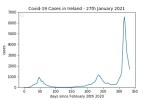
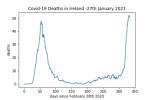
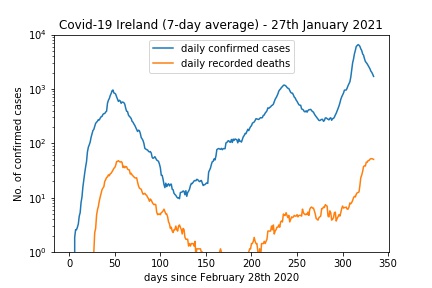
I am actually a bit annoyed at the politicians for making hints about when the restrictions might end. It is clearly far too early to be talking about that. Here are yesterday’s numbers:

If you prefer them on a linear scale here they are:

New cases have fallen significantly since the latest peak but at least part of that is due to the fact that automatic close contact tracing couldn’t cope and was abandoned. Testing positivity rate has fallen to around 8.2% (from over 20%) , hospital admissions admissions are falling, and deaths may have peaked, so the evidence suggests there is a is a reduction, but the numbers are still way too high. They need to come down to much less than a 100 before any lifting of restrictions can be contemplated. At the current rate of decline that will take many weeks.  Suggesting opening up is going to happen soon will only make people impatient and reduce compliance.

Teaching term at Maynooth starts on Monday (1st February) and I have three modules to deliver, one of them a module I’ve never given before. Because there has been so much to do behind the scenes since Christmas I don’t think I’ll ever have started a term feeling so exhausted. The cycle of academic life carries on remorselessly despite the fact that everything takes longer to do under Covid-19 restrictions. It is an effort just to keep up.

Still at least we’ve all still got jobs to do and are still getting paid. It’s time to knuckle down and focus on reaching the mid-term break in one piece and then seeing where we go thereafter.


Teaching after Covid

Posted in Covid-19, Education, Maynooth with tags , , , on January 26, 2021 by telescoper

I know it’s a Business lecture, but at least there is a periodic table on the wall to remind students of the time when Universities used to care about science.

Near the end of a planning meeting this morning I was asked to give my thoughts about any long-term impacts of the Covid-19 pandemic on teaching and/or research. That also echoed a discussion I had with staff in the Department of Theoretical Physics on Teams a while ago, which touched on the same question.

My own view in general is that although we find ourselves constantly saying things like “When we get back to normal…” I think we have to accept that the pandemic is going to change many things irreversibly. We’re going to have to get used to new ways of working in both teaching and research. Some changes will be made to make financial savings owing to loss of income over however long the pandemic lasts, and some of those will no doubt be painful and sad. Others will be opportunities created by us learning how to do things differently and a number of these could be very positive, if we seize the initiative and make the most of them.

One specific thing in the latter category is that Maynooth University installed a system of lecture capture to help deliver teaching when access to campus was restricted (as it is now). The hardware and software installed is fairly basic and isn’t by any means perfect, but it has worked pretty well. The main problem is that the cameras that have been installed are very limited webcams and are not capable of capturing, e.g. a blackboard.

One thing I hope will happen in the long term is that we include lecture capture as a routine way of augment students’ learning. That will require additional investment in infrastructure, but I think it would be well worth it.

Some years ago I blogged about this at another institution, which had facilities allow lecturers to record videos of their own lectures which are then made available for students to view online.

This is of course very beneficial for students with special learning requirements, but in the spirit of inclusive teaching I think it’s good that all students can access such material. Some faculty are apparently a little nervous that having recordings of lectures available online would result in falling attendances at lectures, but in fact there is evidence that indicates precisely the opposite effect. Students find the recorded version adds quite a lot of value to the “live” event by allowing them to clarify things they might not have not noted down clearly. In my experience they rarely watch the whole video, instead focusing on things they didn’t get first time around. And if a few students decide that it’s good enough for them just to watch the video, then so what? That’s their choice. They are adults, after all.

I’ll add that I do feel we should still make the effort to return to doing live lectures in some form and not rely entirely on recordings. I think that what you can do in a lecture is fairly limited part of the overall educational package, but that’s not the same as saying that they should be scrapped. Many students do enjoy lectures and find them very helpful. I just think we should make the best of the available technology to offer as wide a range of teaching methods as possible. No two students are the same and no two students learn precisely the same way. Let us offer them a variety of resources and they can choose which serves them best.

Another important, but perhaps less tangible, aspect of this is that I think education is or should be a shared experience for students. Just having everyone sit in the same room “enjoying” the same teaching session is a great benefit compared with having them sit in their room watching things on a laptop screen. I think that’s one of the worst issues with remote teaching, and wish we had found better ways of dealing with that over the past year.

There is a benefit for the lecturer of having a live audience too, in that actually seeing the people you’re trying to teach helps you gauge how well you’re getting it across.

Anyway, I started a poll on lecture capture a while ago before the pandemic. Feel free to add your opinion. It will be interesting to see if opinions have changed!

Thought For The Year

Posted in Education, Maynooth with tags , , on January 13, 2021 by telescoper

In the midst of the January examination period I’ve been thinking about how tough this year has been nd will continue to be for all students in third-level institutions, but especially the cohort currently in the first year of their course. I think it’s now fairly clear that nearly all their study this year will be done remotely. We on the teaching side have all tried to make the best of this situation but there’s no question that the learning experience we have been able to offer is not as good this year as in other years. On top of that the students – especially in the first year – have been denied the chance to get to know other students through personal interactions, clubs & societies, or through joint interests. Those of us who went to University in more normal times know that many of the friendships we made when we first arrived at college stayed with us for the rest of our lives.

Thinking about this I want to make a suggestion. It is that every student currently in their first year of study at a third-level institution should be offered the chance to start again in the autumn and repeat the whole academic year, regardless of how well they do this time round. Not all students will want to do this, and not all will be able to because of personal circumstances, but I feel we should at least offer them the possibility and back it up with funding for the repeated year. My own suspicion is that it would be a minority, but probably a significant minority, that would opt for this. It would cost money, but I think it would mean a lot to a considerable number of students.

I can anticipate an objection that students repeating their first year will take up places that would normally go to next year’s new intake. That depends on how many would take up the repeat offer, of course. Extra capacity may be needed for some but not all courses. But it also seems to me that this year’s Leaving Certificate students will have had their studies affected too. Perhaps final-year school students should be offered the chance to repeat their year too?

Would starting and/or finishing college a year later really be such a problem given the extraordinary nature of the Covid-19 crisis?

P.S. I’ve talked about the situation in Ireland, but everything I’ve said will apply elsewhere too.

Postponed: Astrophysics & Cosmology Masterclass at Maynooth

Posted in Education, Maynooth, The Universe and Stuff with tags , , on January 10, 2021 by telescoper

Regular readers of this blog may recall that the Department of Theoretical Physics at Maynooth University  planned to host a Masterclass in Astrophysics & Cosmology on January 14th 2021 (i.e. next Thursday). Unfortunately the closure of schools in Ireland until at least the end of January has given us no alternative but to postpone this event. It’s not cancelled though and we intend to run it as soon as possible: the date is now set provisionally for 25th February.  Limited places remain available and bookings are still open. You can find more information, including instructions on how to book a place, here.

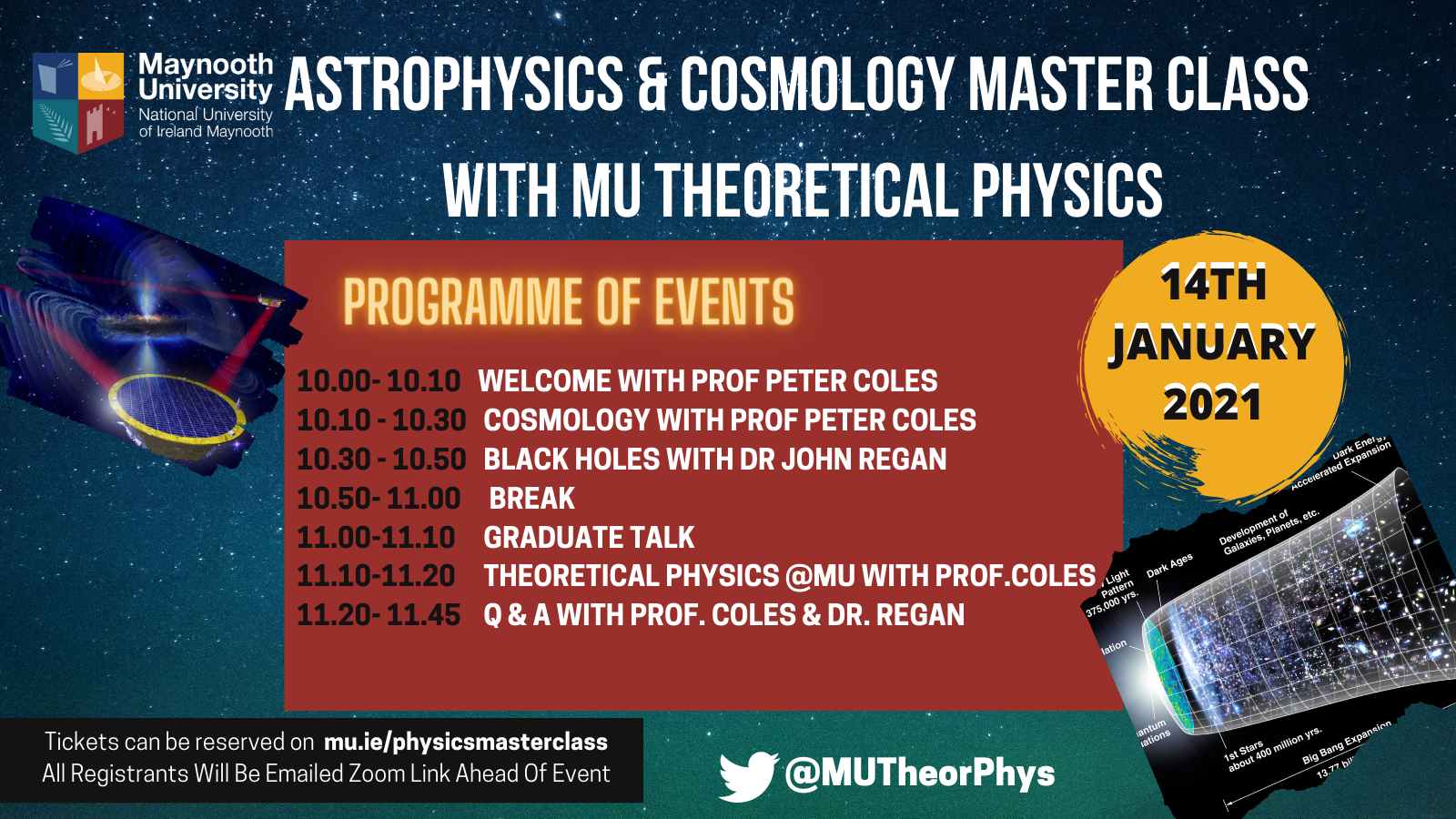
Here is the official poster and the programme (timings still apply, but not the date..):

I’ll be talking about cosmology early on, while John Regan will talk about black holes. After the coffee break one of our PhD students will talk about why they wanted to study astrophysics. Then I’ll say something about our degree programmes for those students who might be interested in studying astrophysics and/or cosmology as part of a science course. We’ll finish with questions either about the science or the courses.

For updates please follow the Department’s on twitter-feed:

Remote Exam Time

Posted in Education, Maynooth with tags , , , on January 7, 2021 by telescoper

It’s the day before the start of the January examination period at  Maynooth University so I thought I’d do a quick post on the topic of examinations or, as they are right now, online timed assessments.

First, for readers elsewhere, full-time undergraduate students at Maynooth what is called 60 “credits” in a year, usually split into two semesters of thirty credits each. This is usually split into 5-credit modules with an examination in each module at the end of each semester. Projects, and other continuously-assessed work do not involve a written examination, but the system means that a typical student will have at least 5 written examination papers in January and at least another 5 in May.  This is very similar to the system in most UK universities that I am aware of except that a full year’s work over there is 120 credits so there’s a conversion factor of 2:1. A 5-credit module in Ireland would be a 10-credit module in the United Kingdom, for example, but otherwise the system is similar.

Each examination is usually of two hours’ duration. We’ve kept that length after moving examinations online, although students are given extra time to scan and upload their answers. The question papers themselves have been slightly adapted online use by having much less “bookwork”. Generally these asssessments are unsupervised and students are allowed to consult notes and textbooks so there is little point in asking them to copy out standard derivations and formulae. That means we can concentrate on the problem-solving aspects of theoretical physics, which are the most interesting bits (and perhaps the most challenging).

One big difference between our examinations in Theoretical Physics in Maynooth and those at other institutions I’ve taught at in the UK is that most of the papers here offer no choice of questions to be answered.  A typical format for a two-hour paper is that there are two long questions, each of which counts for 50 marks. Elsewhere  one normally finds students have a choice of two or three questions from four or five on the paper.

One  advantage of our system is that it makes it much harder for students to question-spot in the hope that they can get a good grade by only revising a fraction of the syllabus. If they’re well designed, two long questions can cover quite a lot of the syllabus for a module, which they have to in order to test all the learning outcomes. To accomplish this, questions can be split into parts that may be linked to each other to a greater or lesser extent to explore the connections between different ideas, but also sufficiently separate that a student who can’t do one part can still have a go at others. With such a paper, however, it is a  dangerous strategy for a student to focus only on selected parts of the material in order to pass.

As an examiner, the Maynooth style of examination also has the advantage that you don’t have to worry too much if one question turns out to be harder than the others. That can matter if different students attempt different questions, but not if everyone has to do everything.

But it’s not just the number of questions that’s important, it’s the duration. I’ve never felt that it was even remotely sensible for undergraduate physics examinations to be a speed test, which was often the case when I was a student. Why the need for time pressure? It’s better to be correct than to be fast, I think. I always try to set examination questions that could be done inside two hours by a student who knew the material, including plenty of time for checking so that even a student who made a mistake would have time to correct it and get the right answer. If a student does poorly in this style of examination it will be because they haven’t prepared well enough rather than because they weren’t fast enough.

The structure of the Maynooth examinations at more introductory level is rather different, with some choice. In my first year module on Mechanics & Special Relativity, for example, there is a compulsory first question worth 50 marks (split into several pieces) and then the students can pick two out of three shorter questions worth 25 marks each. This is a somewhat gentler approach than with the more advanced papers, partly adopted because we have quite a few students doing the General Science degree who taking Mathematical Physics as one of their 4 first-year subjects but will not be taking it further.

As both my examinations are not until next week, I’ll have to wait to find out how my students have done. This will be the examination taken at University level for most of my class, so let me take this opportunity to pass on a few quick tips.

  1. Try to get a good night’s sleep before the examination!
  2. Be ready well before the start and try to ensure you won’t be disturbed for the duration.
  3. If you’re doing an unsupervised examination
  4. Read the entire paper before starting to answer any questions. In particular, make sure you are aware of any supplementary information, formulae, etc, given in the rubric or at the end.
  5. Start off by tackling the question you are most confident about answering, even if it’s not Question 1. This will help settle any nerves.
  6. Don’t rush! Students often lose marks by making careless errors. Check all your numerical results on your calculator at least twice and – PLEASE – remember to put the units!
  7. Don’t panic! You’re not expected to answer everything perfectly. A first-class mark is anything over 70%, so don’t worry if there are bits you can’t do. If you get stuck on a part of a question, don’t waste too much time on it (especially if it’s just a few marks). Just leave it and move on. You can always come back to it later.

Oh, and good luck to anyone at Maynooth or elsewhere taking examinations in the next few weeks!

P.S. It snowed overnight in Maynooth, although only a centimetre or so…
Last Day Off

Posted in Biographical, Covid-19, Education, Maynooth on January 3, 2021 by telescoper

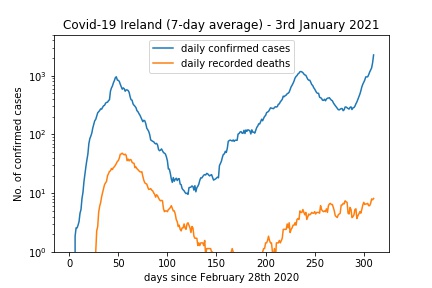
Tomorrow is officially my first day back at work after the Christmas break. Not that I’ll be going back to my office on campus in the morning. Thanks to the state of the Covid-19 pandemic I will be working from home for the foreseeable future. It’s looking pretty grim at the moment, and I think it’s going to get a lot worse before it gets better:


I know I’m not alone in thinking that it was a big mistake to relax the Covid-19 restrictions so soon before Christmas with cases at such a high level. What has happened since then in terms of new cases and hospitalizations is even worse than the experts predicted; today almost 5000 cases were reported, taking the total past 100,000. I hope the current Government is properly held to account for the way it bowed to pressure from vested interests (especially the so-called “hospitality industry”) the way it did.

I haven’t read my work emails since the end of last term (December 18th 2020). I do hope I don’t have to work through a mountain of them when I finally open my inbox tomorrow morning. No doubt as  we get back to work there will be detailed instructions on what we can and can’t do. Semester Two of teaching in Maynooth doesn’t start until February 1st so we have a bit of time to see how things progress, but I honestly can’t see any prospect of a return to on-campus classes for the rest of the academic year. I do hope we’re not going to be required to make yet another set of elaborate plans that will never be put into practice…

At least this term I will be “working from home” in better conditions than previously, in my own house with a good internet connection and a proper study that I can close the door on when I need a break. I’ll be teaching three modules next Semester, including one (Advanced Electromagnetism) that I’ve never taught before. Teaching isn’t the only thing, but the other important matters to be dealt with this month are not things I can really write anything about at this stage.

The January examination period starts on Friday (8th) and ends two weeks later (Friday 22nd) so getting through that and getting the examinations marked is going to be the first priority. As in May all these examinations will be in the form of online assessments. We have done this sort of examination before, which makes it a bit easier than last year, but they still cause a lot of stress for staff and students alike. I will have about 100 scripts to mark and will have to do all of them on screen. I’m not looking forward to that at all, but it has to be done. In between those we will be running our first Astrophysics & Cosmology Master Class, which I am looking forward to enormously. It seems to have generated a lot of interest, but we won’t know precisely how many will tune in until the day arrives. It might be a lot if the Schools are closed, which they may be.

I was tempted at this point to make a list of all the things I have to do tomorrow, but that would be breaking my resolution to take a complete break so I will leave that until the morning and instead go and have a nap.

Erasmus Minus

Posted in Covid-19, Education, Politics with tags , , on December 27, 2020 by telescoper

The news that the UK is to leave the Erasmus+ scheme for student exchanges shouldn’t have come as a surprise. After all, the Prime Minister Boris Johnson explicitly promised in the House of Commons in January 2020 that it wouldn’t happen and what he says is virtually guaranteed to be the opposite of the truth.

I quote:

There is no threat to the Erasmus scheme. We will continue to participate. UK students will continue to be able to enjoy the benefits of exchanges with our European friends and partners, just as they will continue to be able to come to this country.

In a similar vein, the stated reason for this decision (“financial considerations”) is also untrue. (Contrary to popular myth the United Kingdom is not the most popular destination for Erasmus students; that is Spain.) The cost of participating in Erasmus is modest and the benefits huge for both incoming and outgoing students and indeed the relevant home and host institutions. The real reason for this act of vandalism is demonstrated by the announcement of a new £100 million Turing scheme that is one-way only. Evidently the UK doesn’t want any nasty foreign students coming here. Equally evidently the UK Government believes that other countries will gleefully accept thousands of UK students in their universities while not having the mutual benefit of an exchange programme. Above all, most young people in the United Kingdom did not vote for Brexit in the referendum and remain strongly pro-EU. To the Brexit Government that means they must be punished. Come to think of it, the Erasmus slogan (“Enriching Lives, Opening Minds”) is pretty much the antithesis of the UK Government’s isolationist stance.

It’s “interesting” (and, to me, sickening) that the name of Alan Turing has been appropriated for this new programme. Turing, I’ll remind you, was a man whose life was destroyed by the British authorities despite everything he did for the United Kingdom during World War 2. The (perhaps unintentional) symbolism is obvious. If any of the institutions to which participating students are sent via this scheme are in countries where homosexuality is still illegal, the irony will be complete.

According to the UK Government’s own numbers, the £100 million cost of the Turing scheme will support 35,000 students to study or work internationally. That works out at less than £3000 per student. How much will that pay for? In the absence of a mutual fee waiver (which is how Erasmus+ works) it seems it will cover only a small fraction of the cost of a year abroad. Not to mention the need to acquire a visa which was not the case for movement within the EU. Still, that probably doesn’t matter, as it is only the rich who are meant to benefit.

There are a number of interesting points about UK participation in Erasmus+ which may not have been fully thought through by the Johnson government. I know it’s astonishing to think that a Cabinet full of such stellar intellects might have missed something important, but in fact Higher Education is a devolved responsibility in the United Kingdom. What the Government says about Education policy therefore only really applies to England. Scotland and Wales could in principle decide to continue as members. Moreover, if the Turing scheme is administered through the Department of Education, appropriate funding should be passed to the devolved nations by the Barnett formula which they can spend on continuing Erasmus+ participation if they wish. There’ll be legal arguments of course, but on the face of it that seems to be the situation.

Students in Northern Ireland won’t have to worry, however, as the Republic has already offered to fund the participation of NI students, a decision as generous and politically astute as the English decision is petty and mean-spirited.

The decision to withdraw from Erasmus+ will make life very difficult for many UK Higher Education institutions as many run degree programmes that include a year abroad facilitated by the scheme. As of January 1st 2021 they will no longer be able to offer these programme. I know from my own past experience how long it takes to set exchange programmes, how much work is involved in keeping it going, but how rewarding the participating students find it. Tragically, all that will disappear in the New Year.

But there may be silver lining for Ireland. Students from the EU wishing to study in an English-speaking country are likely to be looking at Irish universities in increasing numbers. We already have quite a few at Maynooth (though not this year because of Covid-19 travel restrictions); for information see here. I think there’s a strong case to exploit the British mistake and boost the involvement in Erasmus+ across the Republic.

I would very much like to do this in the Department of Theoretical Physics at Maynooth University. Though a small Department, we are in a good position to develop more international partnerships because of our collaborative networks. Indeed, although it is the Christmas break, I today received two emails from colleagues abroad wondering if we would be interested in replacing UK institutions. I think we could offer a very nice option for students from Spain and Italy. The problem is that to balance the books we really need to encourage more of our own students to venture abroad. That is difficult because, in Ireland (as in the UK), only a small number of students studying Physics at third level institutions have proficiency in a European language (other than Irish). That may not effect the teaching too much, as many European universities do teach science courses in English, but for life in general it is more difficult if you can’t speak the local language to any real extent. For this reason, it may be better for us to target postgraduate rather than undergraduate students for such an arrangement.

That’s another job to add to my list for the New Year!

Lecture Summary

Posted in Biographical, Education, Maynooth with tags on December 16, 2020 by telescoper

Yesterday I gave my last full lectures of the term. The picture shows a summary of my final lecture on Mechanics & Special Relativity for first-year students. It may look a bit thin on content but I’m very tired. How I managed to pad it out to 50 minutes I have no idea.

Today we have presentations by project students via Microsoft Teams which I can watch from home while I await the delivery of a blackboard which I’m going to put in my study at home. (UPDATE: Predictably, the Courier didn’t show up.)

Later today I have my last lecture slot which I will use to pass on some information about the examination online timed assessment in January.

And that will be the end of my teaching for the (calendar) year, which seems to have lasted at least a decade. Let’s hope next year is better.

Vaccination Priorities

Posted in Covid-19, Education, Maynooth on December 15, 2020 by telescoper

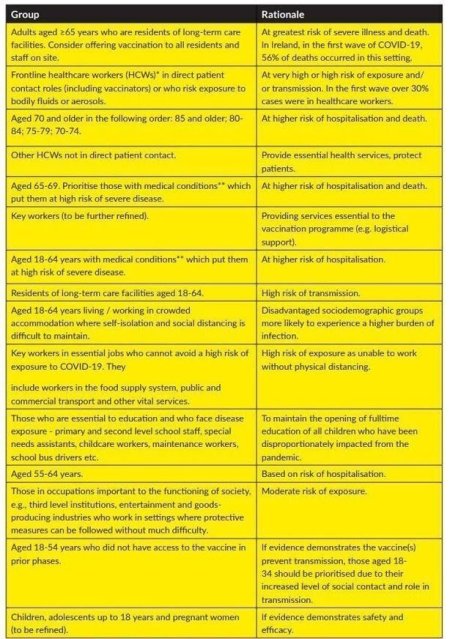
In the news today is the fact that the Irish Government “rolled out” (I hate that expression) its Covid-19 vaccination plans. These are summarised here:

I’m not at all surprised to see that I’m in a low priority category, although I beat some of my colleagues in the University sector by one notch by virtue of being over 54 years of age!

It seems likely that they won’t get around to the likes of me until well into the summer, but at least there’s a plan.

The lack of imminent vaccination for staff or students and the strong likelihood of a post-Christmas spike of Covid-19 cases means that there is no realistic prospect of a significant increase in on-campus teaching in this academic year. We have therefore taken the decision to keep our teaching entirely online next Semester. Hopefully things will start to improve from September 2021.

Message from President Michael D. Higgins to Third-Level Students

Posted in Covid-19, Education, Politics with tags , on December 11, 2020 by telescoper

I saw this yesterday and thought I’d share it here, partly because it contains lots of thoughtful comments* for students – especially first-year students – currently in third-level education, and partly because it is a reminder that it is possible for the President of a country to be an intelligent, kind and empathic person…

*I’m proud to say that many of his comments echo those I used to make at induction events for new students long before the Covid-10 pandemic!