Archive for the Education Category

Going Dutch: a new approach to Research Funding?

Posted in Education, Maynooth with tags , on October 18, 2020 by telescoper

My attention was recently drawn to a proposal for a radical overhaul of the research funding system in the Netherlands by the Dutch Academy of Sciences.

The document I linked to above is in Dutch but the principles are easily understood. To prevent academics having to waste so much time writing proposals that have a very limited chance of success, it is proposed to introduce “rolling grants” for which no application is needed.

Every new Assistant Professor (equivalent to Lecturer) would be given €250K working capital to be used to fund research as the person sees fit. This would rise to €375K on promotion to Associate Professor (equivalent to Senior Lecturer/Reader), and €500K for a full Professor.

This system would have the advantage of giving all new staff the chance to establish their research without having to go through the lottery of a responsive-mode grant system while also ensuring that academics would have the freedom to choose their own priorities without having to follow an agenda imposed by external bodies (which is often influenced politically in such a way as to stifle original research in fields deemed not to be of immediate economic benefit, which is particularly true here in Ireland).

The creation of such a scheme guaranteeing a baseline of research funding for all academic staff would cost money beyond the savings made by reducing the wasted effort associated with the writing and reviewing of lengthy applications. That is the main reason it will not be implemented in Ireland where the Government sees University funding as a very low priority. I cite the almost complete neglect of the Third Level sector in last week’s budget, apart from the €250 given to each student in the hope that it will stop them complaining about having most of their teaching switched online…

It does seem to me to be a completely crazy system that employs people on the basis of their research experience but gives them no resources to carry out their research. For myself I’m not complaining so much about lack of funding – as a theorist my research is very cheap – but of lack of that most precious resource of all, time.

Against Hierarchies

Posted in Education, Politics, Television with tags , , , , on October 13, 2020 by telescoper

Being too tired to do anything else, last night I had a rare look at the television and found an interesting programme on RTÉ One called The Confessors which I watched to the end. The theme of the show was the tradition of the confession box in the Irish Catholic Church. As someone brought up in the Anglican tradition, the confessional has always been a bit of a mystery to me, which is one reason I found it interesting. It also touched on a number of wider issues (including the possible role of the seminary at Maynooth in establishing Ireland as an outpost of Jansenism. Some of the priests contributing to the programme also talked very frankly about the systematic sexual abuse of children by priests and the way it was covered up by the Church.

I was very interested to hear several of the contributors complaining that this problem was exacerbated by the power structure of the Catholic Church which made it easy for complaints to be stifled.

That discussion reminded me of thoughts I’ve had previously about harassment and abuse in other contexts (not of children) and the way they are suppressed by official hierarchies. This problem extends to universities, whose management structures often resemble those of church hierarchies, even down to the terminology (e.g. Deans) they have inherited from their origins as theological institutions.

This sort of structure creates a problem that is extremely deeply rooted in the culture of many science departments and research teams across the world. These tend to be very hierarchical, with power and influence concentrated in the hands of relatively few, usually male, individuals. A complaint about (especially sexual) harassment generally has to go up through the management structure and therefore risks being blocked at a number of stages for a number of reasons. This sort of structure reinforces the idea that students and postdocs are at the bottom of the heap and discourages them from even attempting to pursue a case against someone at the top.

These unhealthy power structures will not be easy to dismantle entirely, but there are simple things that can be done to make a start. “Flatter”, more democratic, structures not only mitigate this problem but are also probably more efficient by, for example, eliminating the single-point failures that plague hierarchical organisational arrangements. Having more roles filled on a rotating basis by members of academic staff rather than professional managers would help. On the other hand, the existing arrangements clearly suit those who benefit from them. If things are to change at all, however, we’ll have to start by recognizing that there is a structural problem.

Lecture Streaming

Posted in Education, Maynooth with tags , , , on October 7, 2020 by telescoper

When we were told, at the start of this term, to move all our teaching online my initial intention was to record most of the lectures in my office for the students to watch at their leisure rather than streaming them live.
The system we’re using, Panopto, allows for both webcast (i.e. live streaming) and pre-recorded (offline) videos. I thought that only very few students would want to watch the broadcast version. I have however changed my mind about this and am now streaming all my lectures (as well as recording them for later viewing). It also meant that I could record the lectures in advance at my without being constrained by the timetable.

Last week my office wasn’t usable for recording videos because of noise from building work so I had to find somewhere else to record the videos so I decided to go to the lecture theatre at the scheduled time primarily because I knew the room would be available at that time. When I started the first lecture I thought I might as well webcast it as well, thinking only a few students would tune in. In fact, out of my class of 45 or so second-year students, about 39 were online while I did the lecture. Since then I’ve done all the lectures live and plan to do so until further notice.

A handful of students even turn up in person to the lectures. I see no problem with this. The restrictions are designed to minimize as far as possible the number of students coming to campus, but if they are here anyway because of labs (which can’t be done virtually) then why shouldn’t they come to the lectures? (Provided, of course, that they follow the public health guidance, wear masks, wash their hands, practice social distancing, etc). I find their presence very helpful, actually. Talking to an audience is far easier than talking only to a camera. You do have to remember to look at the camera though!

It is possible to edit the webcast recording before sharing it with the students. That way you can get rid of all the mistakes, hesitations and other defective bits. Starting with a 50 minute lecture that usually means you end up with about 10 minutes of good material.

Having settled on this approach I was dismayed on Monday to find the Panopto system wasn’t working in either webcast or offline recording mode. I assumed at first that I was doing something wrong but it turns out it was a major outage affecting all of Europe that went on all day. Twitter was full of comments from academics complaining about! Panopto uses cloud storage with very little being held locally so when the connectivity fails the user is helpless. I did the lecture by Teams instead, but had lost some time faffing around trying to get Panopto to work.

Yesterday morning Panopto was back working and my office was quiet so I reran the lecture using the blackboard in my office and recorded it as an offline video. That way the students now have the lecture in the right space on the Moodle page. After that I did two more lectures as webcasts using Moodle – Tuesday is a busy teaching day this term – and everything worked fine.

I think there are two morals to be drawn from this. The first is not to assume that you know what students will find useful. The second is wherever possible to have a backup plan. Putting all your eggs in the basket marked Panopto is risky.

Teaching Improvisation

Posted in Biographical, Education, Maynooth with tags , , , on September 29, 2020 by telescoper

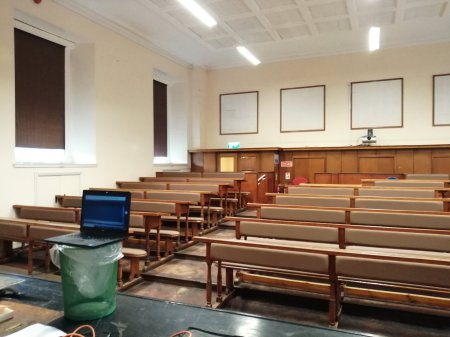
The sudden switch of all our teaching online on Friday has necessitated a certain amount of improvisation. I had intended to do my introductory session on Mechanics and Special Relativity to first-year students as a kind of interactive workshop using the blackboard in Physics Hall. When we were told to move everything online I thought I’d just do yesterday’s session from my office which has quite a good blackboard and a setup I had already tested. Unfortunately however an office refurbishment project I was assured would be finished before the start of teaching but which has barely started meant that yesterday there was constant hammering and drilling in the Department. That made it impossible to do an online lecture (or do anything else) in my office. I knew there would be nobody in Physics Hall, though, so I did the lecture there to an empty room.

The camera provided in that room is fixed to a monitor at once side of the theatre and is therefore useless for capturing the blackboard, so I used my laptop camera plus a handy litter bin to raise it up. It wasn’t great but was better than nothing.

You might ask why I don’t do this from home. The answer to that is that I haven’t yet got an internet connection in the new house, so I can do online activities from there.

You might also ask why a refurbishment job, which could have been completed at any point during the summer when the building was empty, has only just started now we’ve started teaching again. If I had an answer I would tell you. I think the six people whose offices are currently unusable would like to know too, though at least they can work from home. It’s tough enough trying to keep everything together these days without this.

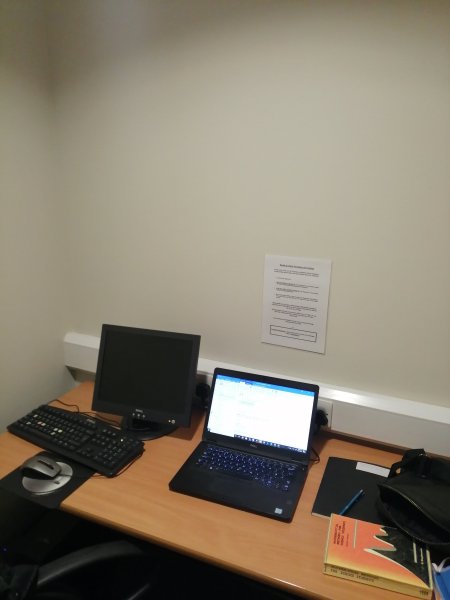
Fortunately today a colleague in the Department of Psychology found me a quiet place to work. It’s a small windowless cubicle normally used for experiments. At least it’s quiet. I think the next step will be a padded cell somewhere.

On the Exploitation of Postgraduates

Posted in Education, Maynooth with tags , , , on September 27, 2020 by telescoper

Thinking through the implications of Friday’s announcement for teaching I saw the following advice sent out to students from Maynooth University

For the next few weeks most lectures will move online. You will be invited on-campus for practical classes, tutorials and for the teaching which requires a lot of interaction.

I can’t see significant numbers of students travelling to campus for a tutorial when they have no other teaching sessions but thinking about this yesterday I was struck by the decision that tutorials should go ahead while lectures shouldn’t. Tutorials are largely given by postgraduate students and it seems extremely unfair to me that they should be required to run the risk and incur the expense of travelling to campus in order to carry out in-person teaching, when full-time staff can minimize their chances of infection by staying at home and teaching remotely.

I’ll therefore be instructing all postgraduate tutors in my Department that they are not expected to run their tutorials on campus.

Yesterday I moaned about university staff being taken for granted but the situation is even worse for postgraduate tutors, who make an invaluable and essential contribution to teaching but are often treated horrendously badly by universities.

Take for example the scandalous situation at NUI Galway, where postgraduate students are being required to undertake 120 hours of unpaid teaching duties per year. The University’s justification for this is the following

Contributing to teaching is an integral part of the training of a research Master’s or PhD student. Teaching assists you in the acquisition of generic and transferable skills, and is an important element in the formation of a research graduate.

This may well be true but it does not constitute an argument why such work should be unpaid. I would argue that an even more “important element in the formation of a research graduate” is learning not to allow oneself to be exploited.

One of the very few things I can say I achieved in my time at Sussex was to abolish the use so-called Graduate Teaching Assistantships in the School of Mathematical and Physical Sciences that required postgraduates to do unpaid teaching and make all such work voluntary and paid.

I am well aware of the reason why Galway is trying this on – it’s the chronic underfunding of Ireland’s universities and colleges exacerbated by rampant managerialism – but that’s no excuse for institutionalised exploitation. I wholeheartedly support the postgraduates at Galway refusing to carry out unpaid teaching duties and hope the University will withdraw this unjustified and iniquitous policy.

Third Level at Level Three and Back to Square One

Posted in Covid-19, Education, Maynooth with tags , on September 26, 2020 by telescoper

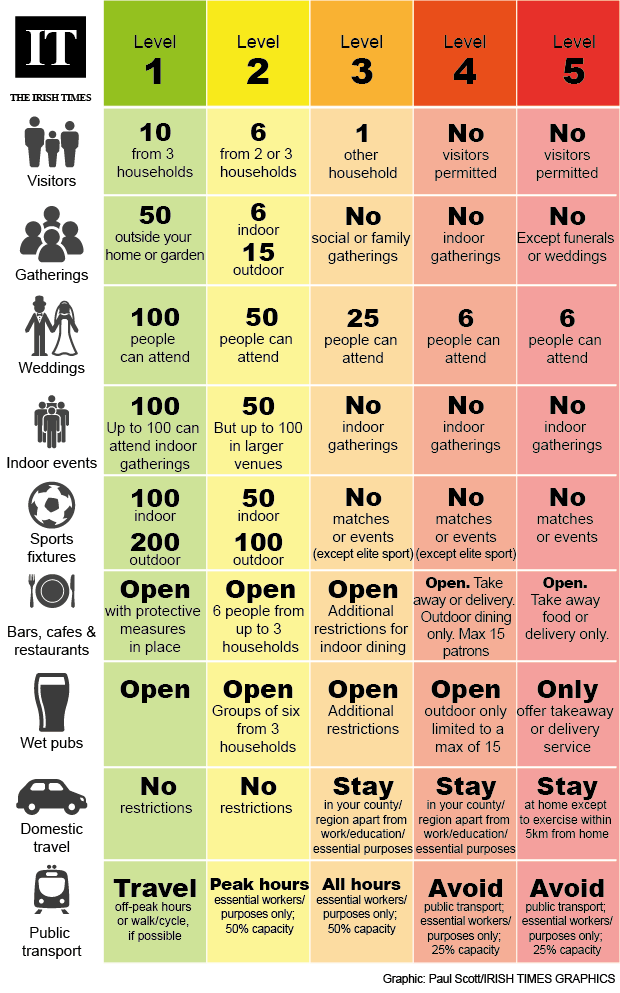
I spent a big chunk of yesterday assigning students to groups and organization rotations to allow them to attend lectures on campus at Maynooth University in a manner consistent with public health guidelines relating to Covid-19. Then, late yesterday afternoon, the Irish Government announced that all third-level institutions should move practically all* their teaching online. In effect, all higher education institutions have been raised to Level Three on the Government’s scale of restrictions.

This announcement came as a shock, not least because of the timing. Announcing drastic changes on the Friday before the Monday teaching is due to start has bounced a huge number of lecturers (including myself) into having to work all weekend to revise our plans and to contact students to tell them in time that they shouldn’t come onto campus on Monday morning. As far as I am aware there was no discussion of this move with the University sector. It’s yet another example of those in authority taking for granted the willingness of academic staff to work at weekends.

Maynooth University had anticipated some of the changes by reducing the maximum class size to 30 but the Government announcement is much more stringent than these. It seems to have been motivated by developments in universities elsewhere at which high levels of infection have arisen. The extent to which these are due to transmission in lecture halls and laboratories as opposed to student residences is unclear to me though. Many of our students are already on campus. I’m not sure that having them here but cooped up in halls will achieve very much.

Institutions like Maynooth University have spent all summer putting in stringent measures to comply with public health guidance to allow in-person teaching for the new semester. Now it is clear that was all a complete waste of time and resources. Moreover, the decision to keep students off campus is tantamount to an admission that the measures previously suggested by the HSE were inadequate.

I know colleagues at other institutions that made the decision some months ago to go online this Semester are saying “I told you so”. They’re justified in feeling a bit smug. All our attempts to bring students onto campus have achieved is to distract us from putting more time and resources into preparations for online teaching. We tried because we think the on-campus teaching is valuable to the student experience. I think it was worth a shot, but it has come to naught. We’re now back where we were in March. It’s very frustrating, to put it mildly, to have spent so long on a fool’s errand.

Anyway, all our lectures will be online from next week for the foreseeable future. The official Government line is “for two weeks”, but that’s what we were told on March 12th. I think it’s much more likely that we’re online for the entire academic year.

I’m not going to mention the considerable number of other things that went wrong last week, but I trudged home last night overwhelmed with fatigue. And term hasn’t started yet. I’m too old for all this.

* There is a possible exemption for laboratories and other practical sessions, as well as small-group tutorials. Students in experimental subjects will therefore get some tuition on campus. As for tutorials, though, I can’t really see students travelling for a tutorial when they have no lectures to attend on campus, so we’ll probably move them online too.

Plan B for Teaching

Posted in Covid-19, Education, Maynooth with tags , , , on September 21, 2020 by telescoper

Yesterday’s Covid-19 figures for Ireland were a bit of a shocker, with 396 new cases (241 of them in Dublin). The latest 7-day average is 283.1 new cases per day. We haven’t seen figures like this since April. Here’s the latest log-linear graph:

Just a reminder: I keep a complete record of the daily figures here.

The surge in cases in Dublin is the the reason for the imposition of additional restrictions. Although we’re not in Dublin, many of our students travel to campus from the areas of West Dublin where the rate of infection is high (such as Tallaght) so Maynooth University has decided to ‘escalate protective measures‘. This means, among other things, that the maximum class size for in-person lectures on campus is 30.

So this morning I’ve been grappling with the implications of this for our teaching plans in the Department of Theoretical Physics. Student registrations are coming in now and though they are not complete we have a much better idea of how many students we will have in each class. The limit of 30 really just makes a difference to second year Mathematical Physics modules where the class size is around 40. We had intended to teach these all together but now they will need to be split into two groups to be taught separately. It will also impact our teaching for Engineering and Product Design, both of which have more than 30 students in class.

The remaining issue is the first year Mechanics & Special Relativity module MP110 which is a much larger class that I’d already decided to split into three groups. The problem would arise if the size of these groups exceeded the capacity constraints. First-year registration has not yet finished but it looks at the moment that we’ll be OK with Plan A. Possibly.

One of the difficulties will be communicating the arrangements to new students in time for the start of lectures on Monday 28th September, a week today. It is important that we don’t have students turning up for sessions to which they have not been assigned. There will be a lot of messages flying around about this for the rest of this week and over the weekend. Even even set up a departmental Twitter feed which you can follow here:

If the situation in Dublin (and nationally) continues to deteriorate we may well be back in the situation in which we found ourselves in March, with everything going online but that isn’t where we are at the moment. The limit of 30 on class sizes is a challenge, but it is our intention that lectures in Theoretical Physics will go ahead on campus starting next Monday.
How long it will take to move to Plan C is anyone’s guess.

Culture Night 2020

Posted in Biographical, Covid-19, Education, Maynooth, Music on September 19, 2020 by telescoper

Yesterday evening was Culture Night 2020. I’m afraid the only event I was able to enjoy was the concert from the National Concert Hall by the RTÉ National Symphony Orchestra under the direction of Gavin Maloney that consisted of:

Bartok: Romanian Folk Dances, BB 76

Mozart: Clarinet Concerto K.622 in A Major
John Finucane (clarinet)

Mendelssohn: Symphony No.4 Op.90 in A Major (Italian)

Here is the concert as it appeared on the live stream.

The bright and breezy Italian Symphony by Mendelssohn was a welcome tonic at the end of yet another exhausting and stressful week.

On Culture Night last year I was actually in the National Concert Hall after spending a very enjoyable afternoon wandering around Dublin. Yesterday however it was announced that after a surge in Covid-19 cases in the capital additional restrictions would be imposed there. What a difference a year makes! On Culture Night 2019 nobody had even heard of Covid-19.

Because many of our students come from the West Dublin area it has been decided to ‘escalate protective measures‘ at Maynooth University. This means, among other things, that the maximum class size for in-person lectures is 30. That means we have to revise our teaching plans yet again with just a week to go before the students arrive on campus, though I think for Theoretical Physics it really only changes the second-year modules. That is unless there are further restrictions, which is not unlikely.

Another exhausting and stressful week beckons!

Points and Offers

Posted in Education, Maynooth with tags , , , , on September 13, 2020 by telescoper

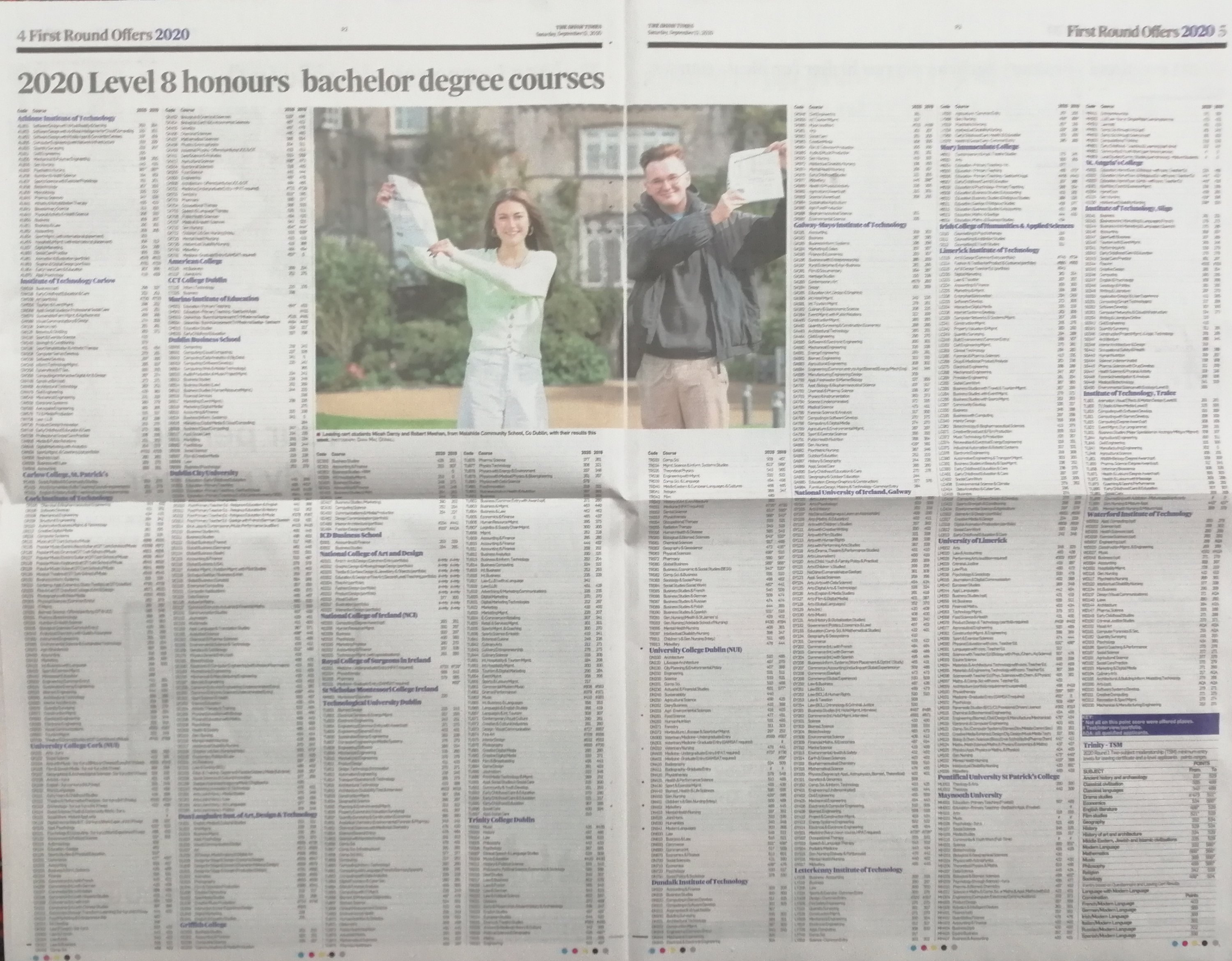
I spent a bit of time yesterday poring over the CAO offers supplement in the Weekend edition of the Irish Times. The extensive listings, of which the above picture shows just part, show the minimum number of points needed for first round offers at Ireland’s third-level institutions. Students who have met the requirements for a course they applied to have until 16th September to decide whether to accept. There is then another round of offers starting a week later on 23rd September and closing on 25th September.

Much has been made of the increase in points needed for many courses since last year. That is indeed borne out by the table, though many of the increases are relatively small.

The denominated programme in Theoretical Physics and Mathematics at Maynooth University, for example, is up 22 points on 510 from last year’s 488 but that’s not an exceptionally high figure in historical terms.

On the other hand, offers for both Mathematics and Theoretical Physics at Trinity College are both down on last year (to 531 from 566 and from 565 to 543, respectively).

There are other courses here and there that have gone down too. I suspect part of the reason for this is that some courses have been allocated extra places and have had to drop their points to recruit the additional students.

Finally I noticed that the first-round points for Equine Business at Maynooth University are unchanged on last year at 357. That may not be the final offer, though. There is probably quite a lot of horse-trading in store…

A Semester of Covid-19

Posted in Biographical, Covid-19, Education, Maynooth, Music with tags , , , , , , , on September 12, 2020 by telescoper

It’s the Twelfth of September so it’s now precisely six months to the day since schools and colleges in Ireland were closed because of the Covid-19 pandemic. The initial announcement on 12th March was that the closure would be until 29th March. Little did we know then that six months later campus would still be closed to students.

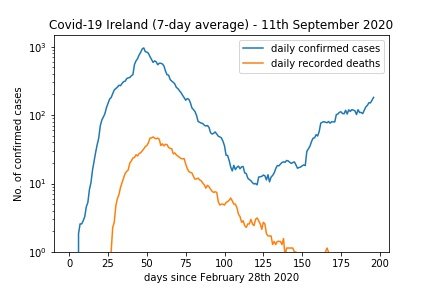
Here is how the pandemic has progressed in Ireland since March:

On 12th March, 70 new cases of Covid-19 were announced in Ireland; yesterday there were 211. The current 7-day average in Ireland is over 180 new cases per day and is climbing steadily. Things are similar, if not worse, elsewhere in Europe. as countries struggle to contain the pandemic while simultaneously attempting to reopen their economies. We are heading towards a very difficult autumn, with a large second peak of infection definitely on the cards. Who knows how this will turn out?

The word ‘semester’ is derived from the Latin for ‘six months’ but the term now applies almost exclusively to half a university teaching year, usually more like four months.

I’m looking ahead to the next teaching semester at Maynooth University, which starts in two weeks. The last time I gave a face-to-face lecture was on the morning of March 12th (a Thursday). Going home that evening I was engulfed by morbid thoughts and wondered if I would ever see the students again. Now we’re making plans for their return to (limited) on-campus teaching. Outline teaching plans have now been published, so returning students will have an idea how things will go. These will be refined as we get a better idea of student numbers. Given the continued increase in Covid-19 cases there is a significant chance of another campus closure at some point which will necessitate going online again but, at least to begin with, our students in Theoretical Physics will be getting 50% or more of the in-person teaching they would have got in a normal year.

Yesterday third-level institutions made their first round of CAO offers. Maynooth’s can be found here. Our offer for MH206 Theoretical Physics & Mathematics is, like many courses around the country, up a bit at 510 points reflecting the increase in high grades in this year’s Leaving Certificate.

We won’t know the final numbers for at another week or more but based on the traffic on Twitter yesterday Maynooth in general seems to be very popular:

Outline teaching plans are available for new students but these will not be finalised until Orientation Week is over and students have registered for their modules, which will not be until Thursday 24th September, just a few days before teaching starts. The weekend of 26th/27th looks like being a very busy one!

Returning to the original theme of the post I have to admit that I haven’t set foot outside Maynooth once in the last six months. I haven’t minded that too much, actually, but one thing I have missed is my weekly trip to the National Concert Hall in Dublin. Last night saw the start of a new season of concerts by the RTE National Symphony Orchestra at the NCH. There is no live audience for these so it’s not the same as being there in person, but watching and listening on the live stream is the next best thing.

Last night’s programme was a very nice one, of music by Mendelssohn Mozart and Beethoven, that not only provided a welcome tonic to the end of a busy week but also provided a great example of how to adapt. I’m glad they’re back and am looking forward to the rest of the season.