Archive for the Education Category

Astrophysics & Cosmology Masterclass at Maynooth

Posted in Education, Maynooth, The Universe and Stuff with tags , , on November 24, 2020 by telescoper

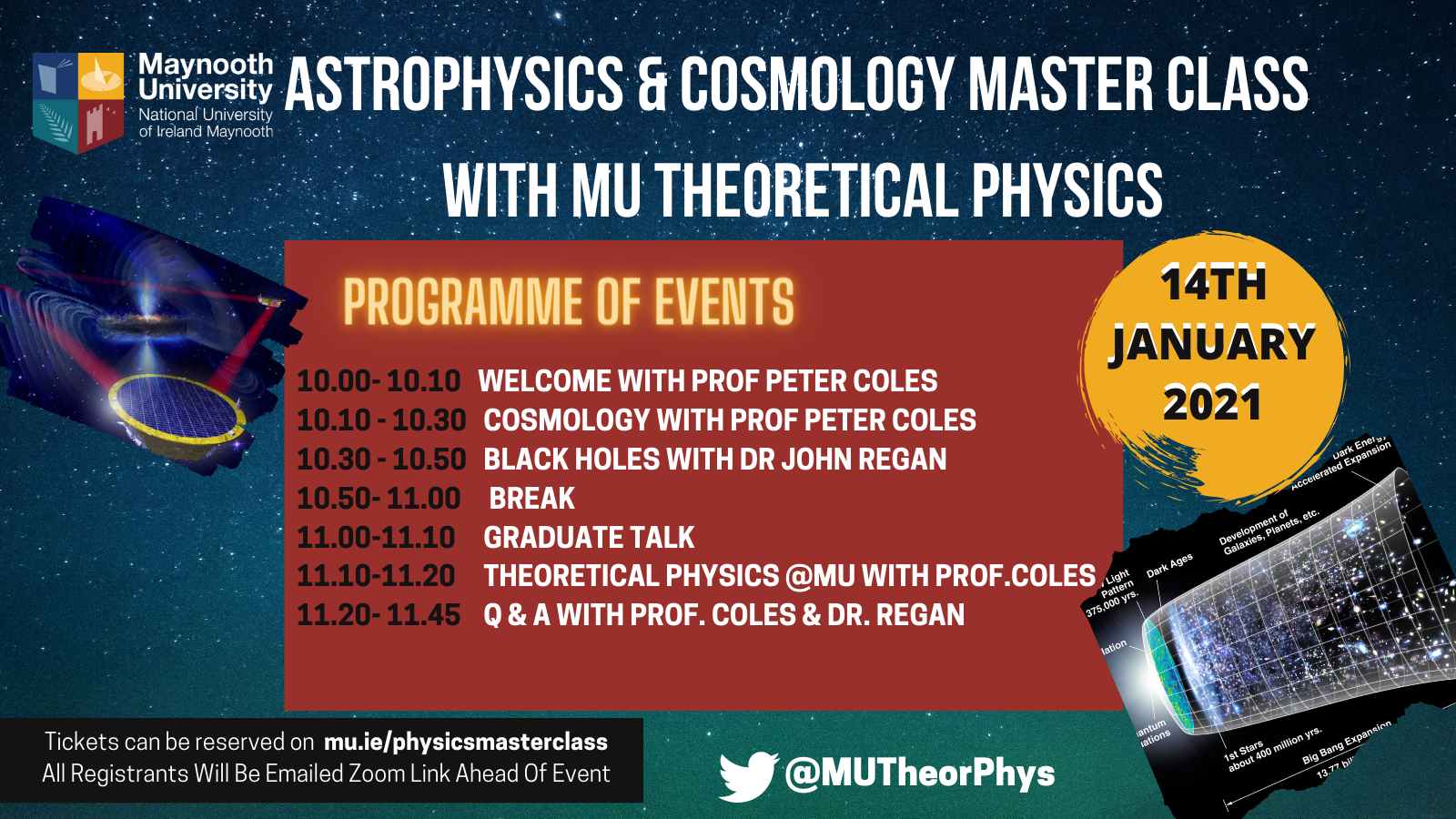
Stealing the idea from our long-running Particle Physics Master Class (which sadly had to be cancelled this year for Covid-19 related reasons, but will resume in 2021), the Department of Theoretical Physics at Maynooth University has decided to launch a Masterclass in Astrophysics & Cosmology. The first one will be on January 14th 2021.

This will be a half-day virtual event via Zoom. It’s meant for school students in their 5th or 6th year of the Irish system, but there might be a few of them or their teachers who see this blog so I thought I’d share the news here. You can find more information, including instructions on how to book a place, here.

Here is the official poster and the programme:

I’ll be talking about cosmology early on, while John Regan will talk about black holes. After the coffee break one of our PhD students will talk about why they wanted to study astrophysics. Then I’ll say something about our degree programmes for those students who might be interested in studying astrophysics and/or cosmology as part of a science course. We’ll finish with questions either about the science or the study!

Four Weeks To Go

Posted in Biographical, Covid-19, Education, Maynooth with tags , , , , , on November 23, 2020 by telescoper

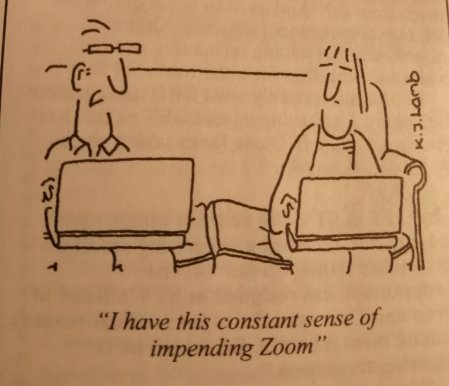
As I await another Zoom meeting I remembered this cartoon from last week’s Private Eye, which sums up the prevalent mood amongst academics these days (and no doubt people in other kinds of job too).

At the start of this morning’s Panopto lecture I realised that there are still 4 weeks left of this Semester before the Christmas break. I was a bit surprised by that as this term seems to have lasted a decade already. The time certainly hasn’t zoomed by. Still, at least I’ve more-or-less kept up with my planned schedule of lectures in both of my modules without slipping. I may even be able to finish lectures to my 2nd year Vector Calculus in time to do a bit of revision in the final week.

That’s not to say other things haven’t slipped. The greatly increased time for teaching needed to move everything online hasn’t left much time for research or anything else. I keep meaning to work in the evenings to deal with outstanding things but mostly I find once I’ve done the necessary admin and teaching stuff all I can do is sleep. It seems that I’ll have to work over Christmas to finish off the backlog. Given that I didn’t have a holiday this summer that’s not ideal, but it’s unlikely I’ll be going anywhere over the “festive” season owing to Coronavirus restrictions so I might as well make the best of it.

We don’t have much idea how things will work out next Semester. The politicians seem to be wanting universities to have more on-campus teaching in the New Year. They also want to end the current restrictions to end before Christmas. In fact the current regime is suppose to end on December 2nd, which is next week, and cases are still running around 400 per day. I don’t think they can do both of these and for the Covid-19 situation to remain under any semblance of control. I think the likeliest scenario is that cases surge over the next few weeks and the Christmas break and we have to go back into full restrictions in January or February.

There is however the prospect of a vaccine or vaccines being available fairly early next year so maybe the end of this is in sight. I really hope we can get back to campus normality at some point in 2021. I do feel very sad about the effect all these restrictions has been having on the students. It’s not just having to have remote lectures. I think having a lecturer in the same room is an advantage, but the loss of it is not the worst issue. We encourage our students to work with each other in their learning, and I’m sure students learn at least as much from each other as they do from the lecturer. Peer group learning is more difficult when your peers are sitting in separate locations most of the time.

Earlier today I found myself using the phrase “getting back to normal” in connection with plans for next teaching year. Then I realise that we staff know what we mean by “normal” but our first-year students don’t. I have a feeling that may might find it more difficult to adjust to the old normal than they did to the new one.

And in any case many of our students in all years did not take up accommodation in Maynooth at the start of this year because of the remote teaching. Even if we did on campus lectures or tutorials next term, I suspect many will stay at home anyway to avoid substantial cost of rented accommodation. We will therefore have to continue making material available online whatever happens.

Anyway, what may or may not happen next Semester is to a large extent out of my hands so I won’t be making any firm decisions on what approach I will be taking until much closer to the start of Semester 2 In the meantime the goal is to fight the exhaustion and try get through to the end of term in one piece.

Dreams, Planes and Automobiles

Posted in Biographical, Covid-19, Education, Maynooth, The Universe and Stuff with tags , , , , , on November 20, 2020 by telescoper

I’ve blogged before about the strange dreams that I’ve been having during this time of Covid-19 lockdowns, but last night I had a doozy. I’ve recently been doing some examples of Newtonian Mechanics problems for my first-year class: blocks sliding up and down planes attached by pulleys to other blocks by inextensible strings; you know the sort of thing.

Anyway, last night I had a dream in which I was giving a lecture about cars going up and down hills taking particular account of the effects of friction and air resistance. The lecture was in front of a camera and using a portable blackboard and chalk, but all that was set up outside in the middle of a main road with traffic whizzing along either side and in the presence of a strong gusty wind. I had to keep stopping to pick up my notes which had blown away, dodging cars as I went.

It would undoubtedly make for much more exciting lectures if I recorded them in such a situation, but I think I’d be contravening traffic regulations by setting up in the middle of the Straffan Road. On the other hand, I could buy myself a green screen and add all that digitally in post-production…

A Vice-Chancellor on University Rankings

Posted in Education with tags , , on November 12, 2020 by telescoper

I couldn’t resist sharing this clip of Nobel Laureate and Vice Chancellor of the Australian National University, Brian Schmidt giving it to the university rankings system with both barrels. The whole video is quite long but the link hopeully takes you to the point where Brian takes aim:

If it doesn’t jump to about 23.28 please go there manually using the slider or try this link.

There are two important points to amplify here. One is a lesson I learned in my own brief time as sort of Senior Management at Sussex, which is that rankings are not just “important” in such circles: they are literally the only thing that drives decision-making. The reason for that is something Brian touches upon, namely that most Vice-Chancellors are driven by their own ambitions more than they are by the good of education and research. Those that think this way want to make sufficient impact on the league table position of their University so by the end of their period of tenure they will be in line for a more prestigious job with an even higher salary. Not every VC thinks like this of course – Brian for one certainly doesn’t – but those that do are in the majority. That’s why so many institutions are driven by short-term decision-making in a way that reminds me of a warship, forever steering towards the last fall of shot.

In my view the pathological obsession with rankings is at least in part a symptom. The underlying cause is this group of management types who know little about and care little for what the purpose of academia actually is. In my opinion the quickest way to improve universities worldwide is to eliminate these Leadership positions and instead have Vice Chancellors or Presidents or Whatever They’re Called and simply have leaders elected by the academics of the institution from among their ranks.

Standing Up for Online Lectures

Posted in Covid-19, Education, mathematics, Maynooth with tags , , , , on November 3, 2020 by telescoper

I have a break of an hour between my last lecture on Vector Calculus (during which I introduced and did some applications of Green’s Theorem) and my next one on Mechanics & Special Relativity (during which I’m doing projectile motion), so I thought I’d share a couple of thoughts about online teaching.

I started the term by doing my lectures in the form of webcasts live from lecture theatres but since we returned from the Study Break on Monday I’ve been doing them remotely from the comfort of my office at home, which is equipped with a blackboard (installed, I might add, at my own expense….)

I still do these teaching sessions “live”, though, rather than recording them all offline. I toyed with the idea of doing the latter but decided that the former works better for me. Not surprisingly I don’t get full attendance at the live sessions, but I do get around half the registered students. The others can watch the recordings at their own convenience. Perhaps those who do take the live webcasts appreciate the structure that a regular time gives to their study. Even if that’s not the reason for them, I certainly prefer working around a stable framework of teaching sessions.

“Why am I still using a blackboard?” I hear you ask. It’s not just because I’m an old fogey (although I am that). It’s because I’m used to pacing myself that way, using the physical effort of writing on the blackboard to slow myself down. I know some lecturers are delivering material on slides using, e.g., Powerpoint, but I have never felt comfortable using that medium for mathematical work. Aside from the temptation to go too fast, I think it encourages students to see the subject as a finished thing to be memorized rather than a process happening in front of them.

I did acquire some drawing tablets for staff to enable them to write mathematical work out, which is useful for short things like tutorial questions, but frankly they aren’t very good and I wouldn’t want to use them to give an hour long lecture.

In addition to these considerations, my decision to record videos in front of a blackboard was informed by something I’ve learnt about myself, namely that I find I am much more comfortable talking in this way when I’m standing up than sitting down. In particular, I find it far easier to communicate enthusiasm, make gestures, and generally produce a reasonable performance if I’m standing up. I know several colleagues who do theirs sitting down talking to a laptop camera, but I find that very difficult. Maybe I’m just weird. Who else prefers to do it standing up?

Life at Level Five

Posted in Covid-19, Education, Maynooth, Politics with tags , , , on October 20, 2020 by telescoper

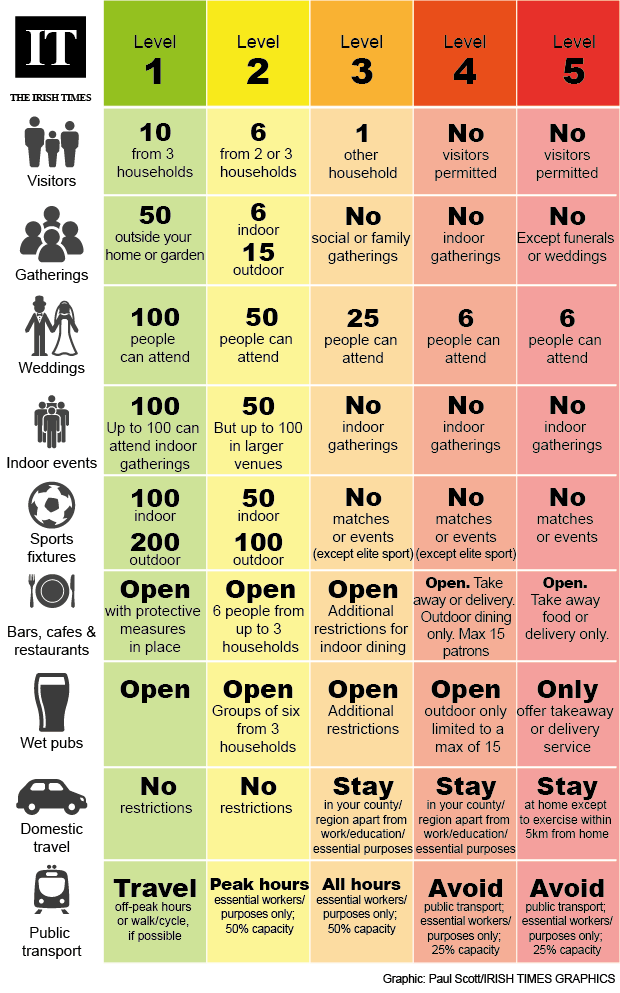
After refusing to do so two weeks ago, last night the Government decided to move all Ireland onto Level 5, the highest level of Covid-19 restrictions, for six weeks (although with some tweaks, e.g. the number of people allowed to weddings):

I think the previous refusal to implement tougher restrictions was a big mistake and has cost two weeks of exponential growth in new cases for no obvious benefit. I thought at the time that moving to Level 5 was inevitable giving the steep growth in numbers:

https://twitter.com/telescoper/status/1313445173142183938

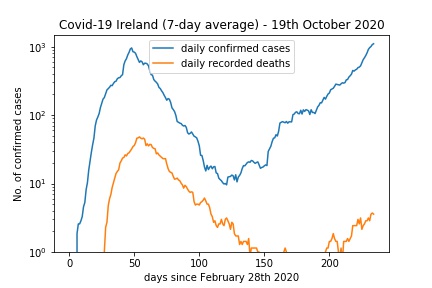
Here, for information is the latest plot of confirmed cases (as of last night):

The 7-day average of new cases is higher than it was at April’s peak, though thankfully the number of deaths is lower. Hospital (and specifically ICU admissions) are however, rising steadily.

We don’t know yet of any specific implications for teaching here at Maynooth University, though it will certainly mean even more teaching moves online. I think my own lectures will continue as Panopto webcasts in much the same way as before, except from my office rather than from a lecture theatre and without the handful of students who have so far been attending them in person. Next week (beginning 26th October) is our Study Week break which offers a bit of time to rearrange things. My first-year module has lectures on Mondays, Tuesdays and Wednesdays. Because the new restrictions kick in at midnight on Wednesday, that lecture will be the last one I do in a lecture theatre for a while. At least I got the best part of four weeks’ worth of lectures in that way.

More generally workers are required to work from home if they can with an exception for “essential services”. The general guidance given here includes:

11. The following services relating to professional, scientific and technical activities:

(a) the provision of engineering, technical testing activities and analysis (including the performance of physical, chemical and other analytical testing of materials and products);

(b) the provision of scientific research and development services;

(c) regulation, inspection and certification services, in accordance with law, of a particular sector by a body created by statute for that purpose.

and

16. The following services relating to education activities:

(a) primary and post primary school;

(b) higher and further education, insofar as onsite presence is required and such education activities cannot be held remotely.

This implies that the campus will not be closed like it was in March, so that this is not going to be a complete lockdown for either research or teaching. Moreover 16(b) does suggest that even laboratory-based teaching may carry on, but we await confirmation on that.


Going Dutch: a new approach to Research Funding?

Posted in Education, Maynooth with tags , on October 18, 2020 by telescoper

My attention was recently drawn to a proposal for a radical overhaul of the research funding system in the Netherlands by the Dutch Academy of Sciences.

The document I linked to above is in Dutch but the principles are easily understood. To prevent academics having to waste so much time writing proposals that have a very limited chance of success, it is proposed to introduce “rolling grants” for which no application is needed.

Every new Assistant Professor (equivalent to Lecturer) would be given €250K working capital to be used to fund research as the person sees fit. This would rise to €375K on promotion to Associate Professor (equivalent to Senior Lecturer/Reader), and €500K for a full Professor.

This system would have the advantage of giving all new staff the chance to establish their research without having to go through the lottery of a responsive-mode grant system while also ensuring that academics would have the freedom to choose their own priorities without having to follow an agenda imposed by external bodies (which is often influenced politically in such a way as to stifle original research in fields deemed not to be of immediate economic benefit, which is particularly true here in Ireland).

The creation of such a scheme guaranteeing a baseline of research funding for all academic staff would cost money beyond the savings made by reducing the wasted effort associated with the writing and reviewing of lengthy applications. That is the main reason it will not be implemented in Ireland where the Government sees University funding as a very low priority. I cite the almost complete neglect of the Third Level sector in last week’s budget, apart from the €250 given to each student in the hope that it will stop them complaining about having most of their teaching switched online…

It does seem to me to be a completely crazy system that employs people on the basis of their research experience but gives them no resources to carry out their research. For myself I’m not complaining so much about lack of funding – as a theorist my research is very cheap – but of lack of that most precious resource of all, time.

Against Hierarchies

Posted in Education, Politics, Television with tags , , , , on October 13, 2020 by telescoper

Being too tired to do anything else, last night I had a rare look at the television and found an interesting programme on RTÉ One called The Confessors which I watched to the end. The theme of the show was the tradition of the confession box in the Irish Catholic Church. As someone brought up in the Anglican tradition, the confessional has always been a bit of a mystery to me, which is one reason I found it interesting. It also touched on a number of wider issues (including the possible role of the seminary at Maynooth in establishing Ireland as an outpost of Jansenism. Some of the priests contributing to the programme also talked very frankly about the systematic sexual abuse of children by priests and the way it was covered up by the Church.

I was very interested to hear several of the contributors complaining that this problem was exacerbated by the power structure of the Catholic Church which made it easy for complaints to be stifled.

That discussion reminded me of thoughts I’ve had previously about harassment and abuse in other contexts (not of children) and the way they are suppressed by official hierarchies. This problem extends to universities, whose management structures often resemble those of church hierarchies, even down to the terminology (e.g. Deans) they have inherited from their origins as theological institutions.

This sort of structure creates a problem that is extremely deeply rooted in the culture of many science departments and research teams across the world. These tend to be very hierarchical, with power and influence concentrated in the hands of relatively few, usually male, individuals. A complaint about (especially sexual) harassment generally has to go up through the management structure and therefore risks being blocked at a number of stages for a number of reasons. This sort of structure reinforces the idea that students and postdocs are at the bottom of the heap and discourages them from even attempting to pursue a case against someone at the top.

These unhealthy power structures will not be easy to dismantle entirely, but there are simple things that can be done to make a start. “Flatter”, more democratic, structures not only mitigate this problem but are also probably more efficient by, for example, eliminating the single-point failures that plague hierarchical organisational arrangements. Having more roles filled on a rotating basis by members of academic staff rather than professional managers would help. On the other hand, the existing arrangements clearly suit those who benefit from them. If things are to change at all, however, we’ll have to start by recognizing that there is a structural problem.

Lecture Streaming

Posted in Education, Maynooth with tags , , , on October 7, 2020 by telescoper

When we were told, at the start of this term, to move all our teaching online my initial intention was to record most of the lectures in my office for the students to watch at their leisure rather than streaming them live.
The system we’re using, Panopto, allows for both webcast (i.e. live streaming) and pre-recorded (offline) videos. I thought that only very few students would want to watch the broadcast version. I have however changed my mind about this and am now streaming all my lectures (as well as recording them for later viewing). It also meant that I could record the lectures in advance at my without being constrained by the timetable.

Last week my office wasn’t usable for recording videos because of noise from building work so I had to find somewhere else to record the videos so I decided to go to the lecture theatre at the scheduled time primarily because I knew the room would be available at that time. When I started the first lecture I thought I might as well webcast it as well, thinking only a few students would tune in. In fact, out of my class of 45 or so second-year students, about 39 were online while I did the lecture. Since then I’ve done all the lectures live and plan to do so until further notice.

A handful of students even turn up in person to the lectures. I see no problem with this. The restrictions are designed to minimize as far as possible the number of students coming to campus, but if they are here anyway because of labs (which can’t be done virtually) then why shouldn’t they come to the lectures? (Provided, of course, that they follow the public health guidance, wear masks, wash their hands, practice social distancing, etc). I find their presence very helpful, actually. Talking to an audience is far easier than talking only to a camera. You do have to remember to look at the camera though!

It is possible to edit the webcast recording before sharing it with the students. That way you can get rid of all the mistakes, hesitations and other defective bits. Starting with a 50 minute lecture that usually means you end up with about 10 minutes of good material.

Having settled on this approach I was dismayed on Monday to find the Panopto system wasn’t working in either webcast or offline recording mode. I assumed at first that I was doing something wrong but it turns out it was a major outage affecting all of Europe that went on all day. Twitter was full of comments from academics complaining about! Panopto uses cloud storage with very little being held locally so when the connectivity fails the user is helpless. I did the lecture by Teams instead, but had lost some time faffing around trying to get Panopto to work.

Yesterday morning Panopto was back working and my office was quiet so I reran the lecture using the blackboard in my office and recorded it as an offline video. That way the students now have the lecture in the right space on the Moodle page. After that I did two more lectures as webcasts using Moodle – Tuesday is a busy teaching day this term – and everything worked fine.

I think there are two morals to be drawn from this. The first is not to assume that you know what students will find useful. The second is wherever possible to have a backup plan. Putting all your eggs in the basket marked Panopto is risky.

Teaching Improvisation

Posted in Biographical, Education, Maynooth with tags , , , on September 29, 2020 by telescoper

The sudden switch of all our teaching online on Friday has necessitated a certain amount of improvisation. I had intended to do my introductory session on Mechanics and Special Relativity to first-year students as a kind of interactive workshop using the blackboard in Physics Hall. When we were told to move everything online I thought I’d just do yesterday’s session from my office which has quite a good blackboard and a setup I had already tested. Unfortunately however an office refurbishment project I was assured would be finished before the start of teaching but which has barely started meant that yesterday there was constant hammering and drilling in the Department. That made it impossible to do an online lecture (or do anything else) in my office. I knew there would be nobody in Physics Hall, though, so I did the lecture there to an empty room.

The camera provided in that room is fixed to a monitor at once side of the theatre and is therefore useless for capturing the blackboard, so I used my laptop camera plus a handy litter bin to raise it up. It wasn’t great but was better than nothing.

You might ask why I don’t do this from home. The answer to that is that I haven’t yet got an internet connection in the new house, so I can do online activities from there.

You might also ask why a refurbishment job, which could have been completed at any point during the summer when the building was empty, has only just started now we’ve started teaching again. If I had an answer I would tell you. I think the six people whose offices are currently unusable would like to know too, though at least they can work from home. It’s tough enough trying to keep everything together these days without this.

Fortunately today a colleague in the Department of Psychology found me a quiet place to work. It’s a small windowless cubicle normally used for experiments. At least it’s quiet. I think the next step will be a padded cell somewhere.