Archive for the Education Category

Some Good News For Maynooth!

Posted in Education, Maynooth with tags on August 30, 2019 by telescoper

These days more than ever it’s a relief when there’s some good news to share, so I was very happy this morning to hear that the Irish Government has awarded Maynooth University a capital grant of €25 million for a major new building project. This is a big slice of a total of  almost €100 million capital investment for projects across the sector. The other recipients were: IT Sligo (€6.6M); NUI Galway (€15M); University College Cork (€25M); and University College Dublin (€25M). The official press release can be found here.

This investment reflects the fact that Maynooth is Ireland’s fastest-growing university, at least partly because of the rapidly increasing demographic demand for higher education in the area to the west of the Dublin metropolitan area.

As I write, building work has already started on the North Campus of Maynooth University near the Science Building. This new building is due to open in late 2020. For further details see here.

Maynooth University Library Cat was unavailable for comment.


On The Launchpad!

Posted in Education, Maynooth with tags , , , , on August 21, 2019 by telescoper

As we are approaching the start of the next academic year I’ve spent a little bit of time today preparing for events taking place over the next few weeks. One of the things on the immediate horizon is Launchpad, which takes place from Thursday 5 September to Saturday 7 September 2019 on the Maynooth Campus.

Launchpad is the Maynooth University Access Programme (MAP) orientation designed to support and ease the transition to third level for students who are coming to Maynooth University through entry routes supported by MAP. These groups include under-represented school leavers, mature students, students with disabilities and members of the Irish Traveller community. Incoming students supported by MAP can get to know fellow first years, ask questions and find out advice from existing student ambassadors on how to navigate the University before starting a new course at Maynooth. I will be attending a panel Q&A discussion for Launchpad on 6th September, which I am looking forward to!

Here’s a little video about Launchpad, produced by Maynooth University, which includes some student voices as well as some nice views of the campus:

It’s worth mentioning one specific initiative related to mature students, namely the Certificate in Science, which is a programme for mature students who wish to undertake a foundation year in preparation for degree studies in Science or Engineering. In this one year full-time programme of study, students undertake modules on Mathematics, Engineering Science, Computer Science, Experimental Physics, Mathematical Physics, Biology and Chemistry. Students who do well can progress from this course into one of the science or engineering degree courses on offer at Maynooth.

Maynooth Offers

Posted in Education, Maynooth with tags , , , on August 16, 2019 by telescoper

Well I’ve had a busy week here in Maynooth marking and checking repeat examinations (just finished this morning) during which from time to time I’ve been keeping an eye on things to do with students admissions for the forthcoming year, both here and in other institutions across Ireland. Universities and students received their Leaving Certificate results earlier in the week, but institutions then had a couple of days to decide on the basis of course capacity and the results obtained which students would receive offers of a place on which courses. This is usually expressed in terms of a points total: the more popular the course, and the better the results for applicants to that course, the higher the points required would be. Yesterday first-round offers went out from CAO across the country – there’s a summary in the Irish Times. Students who don’t get an offer from their first choice course can try in subsequent rounds to get a place at another institute.

As of yesterday afternoon, Maynooth University is expecting to admit 3,225 new first year students this year. This is the largest ever intake for the university and represents an increase of 3% from last year. This growth reflects a strong demand for places: more than 4,200 students chose Maynooth University as their first preference, an increase of 7% from last year (which I mentioned earlier this year).

At the moment it looks like being a particularly good year for our BSc Course in Theoretical Physics and Mathematics, but I’d rather wait until the process is over and numbers are confirmed before commenting further.

Anyway, as the CAO process is ongoing, I thought I’d include this little video about what Maynooth has to offer undergraduate students with particular emphasis on the flexibility of its programmes whether they be in Arts & Humanities or Sciences. I wrote about the advantages of the `Omnibus Science’ programme here. If you are reading this and didn’t happen to get the points for your first-choice course then you could do a lot worse than consider Maynooth!

The Case of Norm versus Criterion

Posted in Education with tags , , on August 15, 2019 by telescoper

I saw a news item last night that revealed the grade boundaries for some of this year’s A-level examinations in the United Kingdom. Among the surprises were that for one board an A-grade in Mathematics corresponded to a mark of 55% and an A-grade in Physics was 59%. I’m sure I’m not the only one to find these results a bit disturbing.

The explanation given for these figures is basically that there’s a new style of A-level examination this year and the boundaries were adjusted so as not to penalize the current set of students with respect to previous years. In other words, students did much worse than expected on the new examinations so the grade boundaries were lowered.

Most assessments of academic performance such as A-levels can be classified into two broad types: criterion-referenced and norm-referenced. In the former performance is measured relative to defined goals, whereas in the latter it is defined relative to the performance of others taking the same test.

University assessments in the UK and Ireland (especially in the sciences) are usually criterion-based, meaning that the % score (and hence the grade) is determined by comparing the marks with a pre-prepared marking scheme based on the expected learning outcomes of the course. It is possible for all students taking an examination to get A-grades if they all meet the criteria. On a norm-referenced system one allocates the grades based on the distribution of scores and not on the absolute level of performance attained. In reality when marking examinations under a criterion-based system, one has a bit of discretion in how to award partial credit when a question is not done completely, so this is a bit of a simplification but those are the two approaches in a nutshell.

Some universities allow marks for a component of assessment to be scaled up (for example if there is a problem with an examination paper), which has the same effect as lowering the grade boundary, but this does not usually apply to the entire mark. Some universities don’t allow scaling at all in any circumstances.

In the universities with which I am familiar, an A-grade (corresponding to First-class performance) is fixed at a mark >70%, a B (2.1) is 60-69%, a C (2.2) is 50-59%, and so on. The pass mark at undergraduate level is 40%; it might be 50% at Masters level.

This is why the figure of 55% being an A-grade at mathematics comes as a such a shock to university-based academics: that score would be in the middle of the lower-second class range in a university examination.

This episode demonstrates one of the serious issues with A-levels as preparation for university entrance. On the one hand, especially in the sciences,  we want students to be equipped with certain basic skills and knowledge to enable them to cope with their course. That calls for a criterion-based system of assessment. On the other hand, in any one year, the `top’ universities want to recruit the `top’ students (in many cases because they want to have a high position the league tables because their entry tariff is high). It’s hardly surprising that the system is dysfunctional when it is being pulled in two mutually incompatible directions.

The upshot of this year’s mathematics and physics A-levels is that universities that take in students with an A-grade in Mathematics -can’t really have much confidence in what they have learned. To make matters worse, the grade boundaries differ from one Examination Board to the next. It’s a mess. At least here in Ireland there is a truly national examination system: there is a single Leaving Certificate examination in each subject that all students take.

While I am on about A-levels I’ll just mention another disadvantage that they have compared to the Leaving Certificate (and, for that matter, the International Baccalaureate) which is that they force students to choose a very narrow post-16 curriculum. Most students take three A-levels (not counting the useless `General Studies’) which for science students often means three science subjects (e.g. Maths, Physics & Chemistry). In the Leaving Certificate students take six or seven subjects and in the IB they take six. I’ve been in Ireland for less than two years so I’m not so familiar with the system here, but my experience with the IB over about 30 years in UK higher education, is that students are certainly no less prepared for university study if they took that than if they did A-levels.

There is currently a major review of the Irish Leaving Certificate going on. One of the things that surprises me about Ireland is that, despite its hard-won independence from the United Kingdom, it has a tendency to copy slavishly many of the silly things that the UK introduces, especially in higher education. I sincerely hope that the review of the Leaving Certificate does not fall into the trap of making it more like A-levels.

Admissions Matters

Posted in Education, Maynooth with tags , , , , on August 12, 2019 by telescoper

Well, the wait is almost over. Tomorrow is the day that students in Ireland get their Leaving Certificate results. Tomorrow’s date is Tuesday 13th August, so I hope that’s not a bad omen! A couple of days later this week, on Thursday, UK students get their A-level results.

Here in Ireland, University admissions are dealt with through the Central Applications Office (CAO) which, for UK readers, is roughly equivalent to UCAS. Earlier this year we heard Maynooth University received its highest-ever number of first_preference applications, which is a very positive sign, but we don’t know yet exactly how many of those actually made the grade needed to start here next month.

As is the case in the UK with A-level results, Irish institutions receive the Leaving Certificate results a bit before the students do, which means that on both sides of the Irish sea higher education institutions will be very busy sorting through their applications to see who has made it onto what course. This is a very stressful time for all concerned, not only the prospective students but also the university staff involved in processing the results and academics wondering how many students they will have to teach next year.

From time to time one hears suggestions that the system could be made much fairer and less stressful if students could remove some of the uncertainty by applying  to university after getting their Leaving Cert (or A-level) results rather than, as is the case now, before. UPDATE: here’s a piece in the Guardian by Angela Rayner arguing this.

The problem is that there are only two ways that I can see to achieve this:

  • have the final school examinations earlier;
  • start the university academic year later.

The unavoidable consequence of the first option would be the removal of large quantities of material from the syllabus so the exams could be held several months earlier, which would be a disaster in terms of preparing students for university.

The second option would mean starting the academic year in, say, January instead of late Septembe. This would in my opinion be preferable to 1, but would still be difficult because it would interfere with all the other things a university does as well as teaching, especially research. The summer recess (July-September), wherein much research is currently done, could be changed to an autumn one (October-December) but there would be a great deal of resistance, especially from the older establishments; I can’t see Oxbridge being willing to abandon its definitions of teaching term! And what would the students do between July and January?

Repeat Message..

Posted in Education, Maynooth with tags , , , on August 8, 2019 by telescoper

Back in Ireland and straight away it’s the repeat examination period at Maynooth University, which started yesterday. My first one was yesterday, actually, for just one student, and I’ve been virtuous and marked the script already.

I’ll be marking quite a few more repeat exams over the next week or so, so here’s a message for any student anywhere taking any at this time:

I thought it was worth mentioning for any university teachers out there reading this that although they are held at roughly the same time of year in the two countries there’s a difference in the way resits are handled in the institutions I’ve worked at in the United Kingdom and the way repeats work here in Maynooth which is implied by the slightly different name.

In UK institutions with which I am familiar students generally take resits when, because they have failed one or more examinations the previous May they have not accumulated sufficient credits to proceed to the next year of their course. Passing the resit allows them to retrieve lost credit, but their mark is generally capped at a bare pass. That means the student gets the credit they need for their degree but their average (which determines whether they get 1st, 2nd or 3rd class Honours) is negatively affected.

This is the case unless a student has extenuating circumstances affecting the earlier examination, such as bad health or family emergency, in which case they take the resit as a `sit’, i.e. for the first time with an uncapped mark.

Here in Maynooth, repeat examinations are generally taken for the same reason as in the UK but the mark obtained is not capped. Indeed, some students – though not many – elect to take the repeat examination even if they passed earlier in the summer, in order to increase their average mark. Another difference is that all students have to pay a fee  for each repeat they take; resits in the UK do not attract additional fees.

When I told former colleagues at Cardiff in the pub last week that repeat examinations are not capped they didn’t like the idea because they felt that it would lead to many students playing games, i.e. deliberately not taking exams in May with the intention of spreading some of their examination  load into August. There’s not much sign of students actually doing that here, to be honest, for the reason that the results from the repeat examination period are not confirmed until early September so that students that deploy this strategy do not know whether they are going to be able to start their course until a couple of weeks before term. That could cause lots of problems securing accommodation, etc, so it doesn’t seem to me to be a good ploy.

Anyway, I’d welcome comments for or against whether resits/repeats should be capped/uncapped and on what practice is adopted in your institution.

Old-School Physics

Posted in Education, History, The Universe and Stuff with tags , , , on July 27, 2019 by telescoper

The recent circulation to his staff of daft (and in some cases erroneous) rules to be used when writing documents has led to much hilarity on the media we call social. Among the obvious errors are that the correct abbreviation for `Member of Parliament’ is `MP’ not ‘M.P.’ and that `full stop’ is actually two words (not `fullstop’). On top of those his insistence that civil servants use Imperial units for everything actually may be unlawful as the official system of units for the United Kingdom is the metric system.

The latter exhortation has caused a particular outcry among people under the age of about 50 (who have never been taught Imperial units), and especially scientists (who understand the obvious superiority of the SI system).

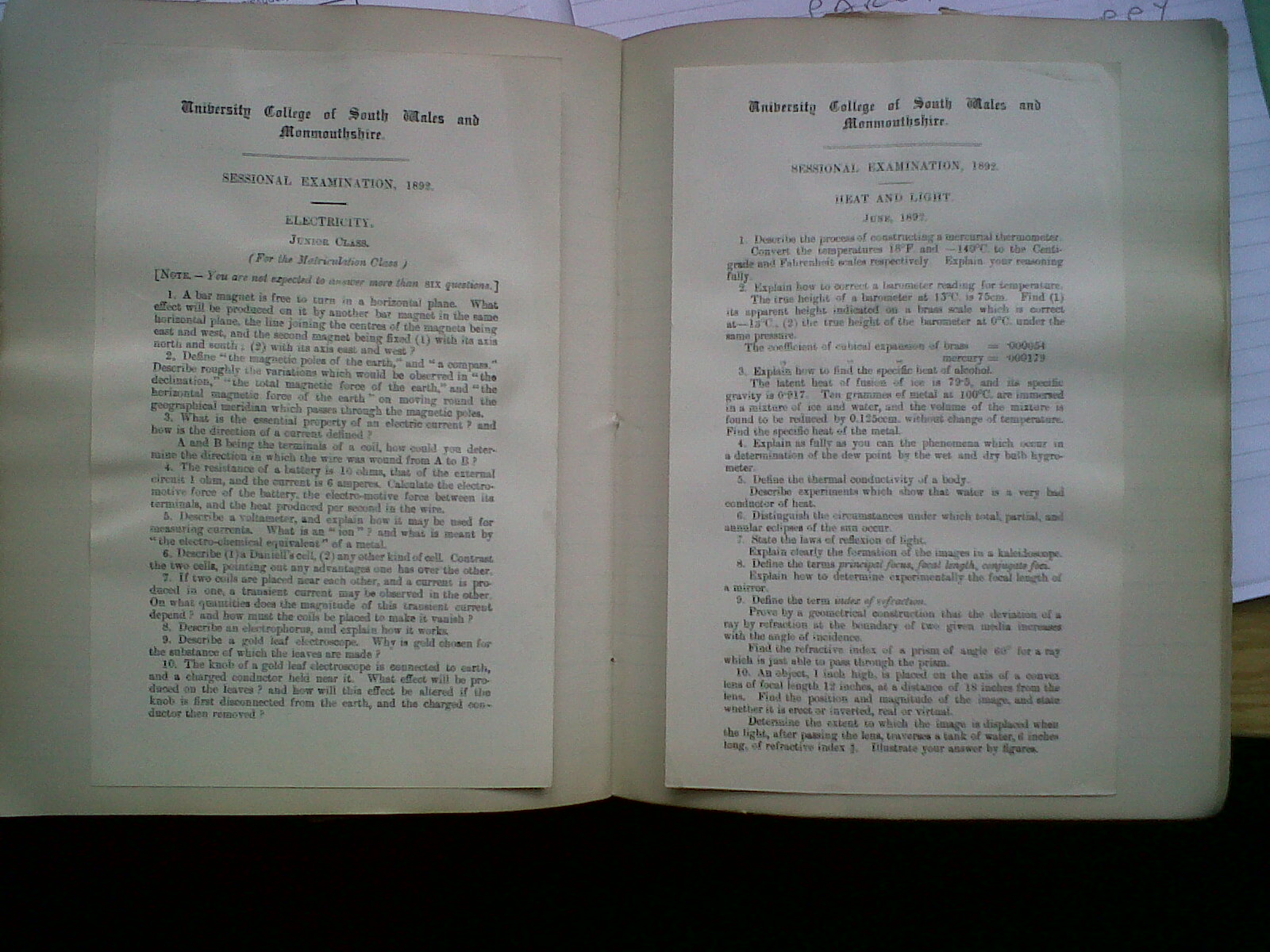
Anyway, all this reminded me that many years ago when at Cardiff there came into my possession a book of very old school and university physics examinations, which are of interest because I’ve been posting slightly less ancient examples in recent weeks. These examinations were set by the University College of South Wales and Monmouthshire, which was founded in 1883,  an institution which eventually became Cardiff University. I find them absolutely fascinating.

The papers are rather fragile, as is the book containing them, so I daren’t risk trying to scan them systematically in case flattening them out causes damage. Here instead are a few random examples that I photographed on my desk, in the manner of an old-fashioned secret agent. Sorry they’re not all that clear, but you can see them blown up if you click on them.

The collection is fairly complete, covering most of classical physics, at all examination levels from university entry to final Honours. Of course there are no questions on relativity or quantum physics appear (which had yet to be invented) but other than that – and the units! – they’re not too different from what you might find in the examinations for the early stages of contemporary physics programmes.

Work in Progress

Posted in Education, Maynooth with tags , , on July 3, 2019 by telescoper

It was less than a year ago that I posted this photograph of a sign I saw by the Kilcock Road on my way into work in the Science Building at Maynooth University.

It was a planning notice that started the process of constructing extra buildings to accommodate various new teaching and study spaces on campus.

By way of an update, here are a couple of pictures taken near that location this morning that show how things have progressed.

Although I had some experience of this kind of construction project from Sussex days I’m not really au fait with the technicalities. The main work being done so far seems to be preparatory: levelling the ground, laying drains and sewers, adding pipes for communications cables, changing the road layout and so on. They call this `readying work’. There’s no sign of actual buildings going up yet, but that is to be expected. Using modern building techniques construction of the actual edifice can be very rapid once the groundwork is done.

I’m in the building on the right of the photograph with the mechanical digger in it, so I was a bit worried that all this would lead to an intolerable amount of noise but it’s actually not too bad. The main inconvenience is for people with cars, since a road has been closed for this work, but I walk into campus so it doesn’t affect me directly.

When it’s all done the new building should look like this:

The University’s News item about this project can be read here.

I’ll post further updates when there’s more to report!

Admissions, Consultations and Congratulations!

Posted in Education, Maynooth with tags , , , , , , on July 2, 2019 by telescoper

Some good news for Maynooth University arrived this morning. Yesterday (1st July) was the deadline for applicants to Irish universities to change their mind about first preference courses through the Central Applications Office (CAO) which, for UK readers, is roughly equivalent to UCAS). That deadline having passed, CAO has now released details of the number of first-choice applicants to each course at each university.

The news for Maynooth University is very positive, in that it has received its highest-ever (>4,200) first preference applications. This figure represents a 7% increase on Maynooth applications from last year. In particular the number of students applying for the Bachelor of Science degree is up a whopping 33% on last year!

I like our `Omnibus’ Science degree programme, for reasons which I’ve discussed here and am glad to see it’s proving so attractive to students.

Of course it now remains to be seen how many of those students get the required points on their Leaving Certificate examinations (which have just finished) but the prospects are looking good! I’m particularly looking forward to meeting new students in Theoretical Physics next year!

Yesterday was also an important day for existing Maynooth students. The main University Examination Board was held last Thursday and yesterday students received all their results. Of course I saw all the marks last week but couldn’t say anything before the final results were released so it was nice yesterday to join in the congratulations of the final-year students in Theoretical Physics who have done extremely well this year. You couldn’t wish to meet a nicer, friendlier and harder-working group of students and I’m delighted for their success. Some will be leaving to pursue studies abroad,  but some are staying on to do Masters programmes here so there will be some familiar faces still around in Theoretical Physics next year.

An innovation this year is that the Examinations Office has set up an Exam Results Information Centre to advise students on what to do if there are issues arising from their results (such as taking repeat examinations):

For subject-specific inquiries to do with academic matters we have a Consultation Day tomorrow (Wednesday 3rd July) during which students can, if they wish, ask to see their marked examination scripts as well as asking other questions about their academic studies. This is something I feel very positively about too (as I wrote here). I’ll be on duty in Theoretical Physics tomorrow, actually. If Theoretical Physics students can’t make it in tomorrow then just email us and we’ll try to arrange another time.


Additional Mathematics O-level 1979

Posted in Biographical, Education, mathematics with tags , , , on July 1, 2019 by telescoper

Yesterday a comment appeared on an old post of mine about the O-level Examination I took in Mathematics when I was at School. With a shock that reminded me that it was FORTY years ago this summer that I was taking my O-levels at the Royal Grammar School in Newcastle. That’s a memory lane down which I wasn’t anxious to take a trip.

For any youngsters reading this, the GCE (General Certificate of Education) Ordinary Level Examinations O-levels were taken at age sixteen in the United Kingdom back in the day; they were replaced during the 1980s by the modern GCSE Examination. For readers in Ireland the O-levels were roughly equivalent to the Junior Certificate, just as A-levels are roughly equivalent to the Leaving Certificate.

Anyway, that also reminded me that I never got round to posting the other O-level I took in Mathematics that summer, in Additional Mathematics. I thought I’d remedy that failing now, so here are the two papers I took (on Tuesday 26 June 1979 and Thursday 5 July respectively.

I had forgotten that there was so much mechanics in this actually (Section C of each paper). Is that different from equivalent papers nowadays? In fact I’d be interested in comments about the content and level of difficulty of this compared to modern examinations in mathematics via the box below.

P.S. I did ten O-levels that summer of ’79: Mathematics; Additional Mathematics; Combined Science (2); English Language; English Literature; French; Latin; History; and Geography. I still have all the papers and have only posted a subset. If anyone has requests for any others please let me know and I’ll scan them.