Archive for the Education Category

Advice for Prospective Physics Students

Posted in Education with tags , , , , , , , on February 25, 2013 by telescoper

Just got time for a quickie this morning before I head up to the Big Smoke for the first meeting of the Astronomy Grants Panel of the Science and Technology Facilities Council (STFC). I had thought that the last round would be my last, but I must have misbehaved somehow and my sentence has been extended accordingly.

Anyway, I thought I’d follow up Saturday’s post with a response to a question that a few prospective Physics students asked me during our Admissions Day. Those attending these days have already applied to this University but, at this stage of the annual undergraduate admissions cycle, the applicants are still deciding which University to put as their first or firm choice. I see our job in the Admissions Days simply to make available as much information as possible to the applicants to help them make a choice. Quite a few people I spoke to on Saturday, however, said that they had already made up their minds and just wanted some advice about what to do during the summer after they have finished their A-levels to help them prepare for their undergraduate studies in Physics (and/or Astronomy).

The answer I gave was pretty simple: practice your mathematics, especially your calculus! 

The justification for exhortation is that the big difference between Physics at A-level and Physics at undergraduate University level is that the latter is taught in a much more mathematical way than the former. This is because the physical laws that underpin our understanding of the natural world are expressed in a mathematical language; the more fluent you are in this language the easier you will find it to assimilate the physical concepts. To put it another way, you will find it difficult to understand the physical meaning of what is being taught if you are struggling with the mathematical meaning of the symbols being used or the manipulations needed to obtain useful solutions to the relevant equations.

Newton’s Second Law, for example,  relates the rate of change of momentum of a body to the force exerted upon it. If you’re comfortable with calculus you don’t think twice about writing d(mv)/dt for the rate of change of momentum and then constructing a differential equation which you can (hopefully) solve. You won’t absorb the importance of laws like this unless you become so familiar with the mathematics that it ceases to occupy the part of your mind that’s needed to really think.

I think that learning to do Physics is a bit like learning to play a musical instrument. Practicing such basic mathematical procedures as integration and differentiation is analogous to the five-finger exercises you have to do when learning to play the piano. The more you practice them, the greater the extent to which they become hard-wired. Your brain can therefore concentrate on the more interesting conceptual stuff – that’s really the hard part of learning Physics. We do of course do as much as we can to help with this once you’ve got to University, but doing some preparation on your own beforehand would greatly smooth the transition.

So I’d tell any prospective physics student wondering what to do this summer to get hold of as many basic calculus exercises as they can and do them whenever they get the chance. It may not be the most exciting way to spend your post A-level holiday, but it is the single thing you can do that will best prepare you for life as a Physics student.

On the other hand, the advice I’d give to physicists rather later in their careers is to think very carefully before agreeing to be on committees or panels…

Open for Mathematics, Physics, Astronomy (and Astrophysics)…

Posted in Education, The Universe and Stuff with tags , , , , , , , , on February 23, 2013 by telescoper

I’ve been here on campus at the University of Sussex all day helping out with an Admissions Day. We were all a bit apprehensive in the School of Mathematical and Physical Sciences about today simply because so many students and guests were scheduled to come that we wondered how well we could organize the large number of groups being shown around. There was also the question of the British weather. It was very cold this morning, with flurries of snow as I made my way to campus. I was wondering whether the weather might put some people off travelling, but as it happened we had a lot of visitors and although we were very busy there was a very good buzz about the place.

Notwithstanding the inclement weather this morning there are also definite signs that spring is on the way:
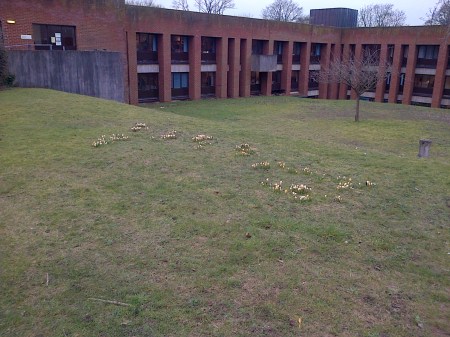
IMG-20130221-00065

Anyway, it was nice to have the chance to talk to prospective students and parents in both Mathematics and Physics & Astronomy. Although Mathematics, Physics and Astronomy are combined within the School, there are clear distinctions between the way Mathematics and Physics are taught so the topics discussed with Mathematics students tended to be different from those in Physics and Astronomy. However, a chat with one group led eventually to the question What’s the difference between Astronomy and Astrophysics? This is something I’m asked quite often, and have blogged about before, but I thought I’d repeat it here for those who might stumble across it.

The Oxford English Dictionary gives the following primary definition for astronomy:

The science which treats of the constitution, relative positions, and motions of the heavenly bodies; that is, of all the bodies in the material universe outside of the earth, as well as of the earth itself in its relations to them.

Astrophysics, on the other hand, is described as

That branch of astronomy which treats of the physical or chemical properties of the celestial bodies.

So astrophysics is regarded as a subset of astronomy which is primarily concerned with understanding the properties of stars and galaxies, rather than just measuring their positions and motions.

It is possible to assign a fairly precise date when astrophysics first came into use in English because, at least in the early years of the subject, it was almost exclusively associated with astronomical spectroscopy. Indeed the OED gives the following text as the first occurence of astrophysics, in 1869:

As a subject for the investigations of the astro-physicist, the examination of the luminous spectras of the heavenly bodies has proved a remarkably fruitful one

The scientific analysis of astronomical spectra began with a paper by   William Hyde Wollaston in the Philosophical Transactions of the Royal Society Vol. 102, p. 378, 1802. He was the first person to notice the presence of dark bands in the optical spectrum of the Sun. These bands were subsequently analysed in great detail by Joseph von Fraunhofer in a paper published in 1814 and are now usually known as Fraunhofer lines.  Technical difficulties  made it impossible to obtain spectra of stars other than the Sun for a considerable time, but  William Huggins finally succeeded in 1864. A drawing of his pioneering spectroscope is shown below.

Meanwhile, fundamental work by Gustav Kirchoff and Robert Bunsen had been helping  to establish an understanding of the spectra produced by hot gases.  The identification of features in the Sun’s spectrum  with similar lines produced in laboratory experiments led to a breakthrough in our understanding of the Universe whose importance shouldn’t be underestimated. The Sun and stars were inaccessible to direct experimental test during the 19th Century (as they are now). But spectroscopy now made it possible to gather evidence about their chemical composition as well as physical properties. Most importantly, spectroscopy provided definitive evidence that the Sun wasn’t made of some kind of exotic unknowable celestial material, but of the same kind of stuff (mainly Hydrogen) that could be studied on Earth.  This realization opened the possibility of applying the physical understanding gained from small-scale experiments to the largest scale phenomena that could be seen. The science of astrophysics was born.

One of the leading journals in which professional astronomers and astrophysicists publish their research is called the Astrophysical Journal, which was founded in 1895 and is still going strong. The central importance of the (still) young field of spectroscopy can be appreciated from the subtitle given to the journal:

Initially the branch of physics most important to astrophysics was atomic physics since the lines in optical spectra are produced by electrons jumping between different atomic energy levels. Spectroscopy of course remains a key weapon in the astrophysicist’s arsenal but nowadays the term astrophysics is taken to mean any application of physical laws to astronomical objects. Over the years, astrophysics has therefore gradually incorporated nuclear and particle physics as well as thermodynamics, relativity and just about every other branch of physics you can think of.

I realise, however, that this  isn’t really the answer to the question that potential students want to ask. What they (probably) want to know is what is the difference between undergraduate courses called Astronomy and those called Astrophysics? The answer to this one depends very much on where you want to study. Generally speaking the differences are in fact quite minimal. You probably do a bit more theory in an Astrophysics course than an Astronomy course, for example. Your final-year project might have to be observational or instrumental if you do Astronomy, but might be theoretical in Astrophysics.  If you compare the complete list of modules to be taken, however, the difference will be very small.

Over the last twenty years or so, most Physics departments in the United Kingdom have acquired some form of research group in astronomy or astrophysics and have started to offer undergraduate degrees with some astronomical or astrophysical content. My only advice to prospective students wanting to find which course is for them is to look at the list of modules and projects likely to be offered. You’re unlikely to find the name of the course itself to be very helpful in making a choice.

One of the things that drew me into astrophysics as a discipline (my current position is Professor of Theoretical Astrophysics as well as being Head of School) is that it involves such a wide range of techniques and applications, putting apparently esoteric things together in interesting ways to develop a theoretical understanding of a complicated phenomenon. I only had a very limited opportunity to study astrophysics during my first degree as I specialised in Theoretical Physics.  This wasn’t just a feature of Cambridge. The attitude in most Universities in those days was that you had to learn all the physics before applying it to astronomy. Over the years this has changed, and most departments offer some astronomy right from Year 1.

I think this change has been for the better because I think the astronomical setting provides a very exciting context to learn physics. If you want to understand, say, the structure of the Sun you have to include atomic physics, nuclear physics, gravity, thermodynamics, radiative transfer and hydrostatics all at the same time. This sort of thing makes astrophysics a good subject for developing synthetic skills while more traditional physics teaching focusses almost exclusively on analytical skills.

The Quantum of Teaching

Posted in Education with tags , , , , on February 19, 2013 by telescoper

I’m gradually finding out enough about the way things are organized here at the University of Sussex to make some comparisons between teaching in the School of Mathematical and Physical Sciences here and in the School of Physics and Astronomy at my former employer, Cardiff University.

One difference I’ve noticed is probably something you find rather trivial, but I think it’s quite important. In the usual scheme of undergraduate teaching, which applies across most of the United Kingdom, students gain “credit” for taking and passing modules. A normal year would correspond to 120 credits, so that a three-year BSc degree involves a total of 360 credits and a four-year MPhys (or equivalent) is 480. In universities that run a two-semester teaching year the load per semester is thus 60 credits.

The question then is what is the best way to divide up that 60 credits into smaller pieces? Until recently at Cardiff the basic unit of teaching was a 10-credit module, which meant that students were typically doing six different things alongside each other. An ordinary ten-credit module would involve two lectures per week. Not all of these are lecture courses, however; there’s usually laboratory or computational work as one of the 10 credit chunks. During a recent course review it was decided to increase the size of some of the modules to 20 credits. That’s how it came to pass that I taught a new module of that size last semester (for the first and last time).

The motivation for increasing the size of modules was twofold. One is that having lots of small modules makes the overall study programme disjointed and “bitty”, with students having lots of things on the go at the same time and little opportunity to study any topics in real depth. The other is that having four hours per week instead of two allows the lecturer to use the time more flexibly, in particular with  sessions intended to develop problem-solving skills.

Although the “core” modules at Cardiff increased to 20 credits, the others remained at 10. There was a lot of discussion about increasing all modules, but in the end the new programme was left as a mixture.

Interestingly, here at Sussex the normal module size is 15 credits (and “modules” are also called “courses”), meaning that students actually only do four things at the same time in a typical semester.  In fact this was what I originally suggested when we started the teaching review at Cardiff, but it was thrown out immediately on the grounds that the University had decreed that modules must be multiples of 10 credits only. I’m not sure whether there was an educational reason for this, or just that it made the arithmetic simpler.

Anyway, I like 15 credits as a basic unit but am not sure how many other Schools and Departments run that system. I’d be interested to learn about module sizes favoured elsewhere through the comments box, and here’s a poll so you can vote:

Another difference is that although Sussex has two teaching semesters, the School of Mathematical and Physical Sciences (MPS) does not have mid-year examinations, so First Semester courses are examined in the Summer along with the Second Semester ones.  In Cardiff, modules are examined at the end of the semester in which they are taught. There are pros and cons with this. I think students who are used to mid-year examinations like the fact that the examinations are not all concentrated in one period during the summer and also that they get some feedback on their progress during the year. On the other hand, students may see an end-of-semester examination as an encouragement to close the lid on a particular module and forget about it as soon as it is over, making it harder to understand how different aspects of physics interconnect.

Students at Sussex seem keen not to have mid-year examinations, while those at Cardiff seem equally keen to retain them. I don’t know what that means, so here’s another  poll to see if there’s any clear opinion one way or another among my readers…

Two cultures, or none?

Posted in Art, Biographical, Education with tags , , on February 14, 2013 by telescoper

Just a quick rehash of an old post by way of a follow-up to Sunday’s blog about Emotion and Creativity which touched on the negative stereotypes sometimes used to characterize scientists.

Anti-science attitudes are far from unusual among the Arts & Humanities fraternity, even in the supposedly enlightened environment of a University, which I think is a real shame. After all, you’ll have to work very hard to find a scientist who would be prepared to stand up in front of audience and proudly announce “I hate art”. Many of my scientific colleagues have deep passions for the performing arts (especially music and drama) as well as being very well read across a wide range of subjects.  Many also hold strong  (and often idiosyncratic) political opinions and are involved in a huge range of activities outside science.

In short, scientists don’t just sit in their labs and offices making dangerous chemicals or torturing small animals. We live in the real world and have as much contact with wider society as anyone else. Imagination, creativity and free thinking can be found in scientists, just as they can in the arts.  Scientists both contribute to and participate in our society’s cultural heritage. Scientists are human beings. Culture belongs to us too.

Some time ago there was an article in the Times Higher with the title “Life depends on science but the arts make it worth living“. I agree with a lot of what is written in the piece, in fact, although it does seem also to contain numerous examples of non sequitur and I think it’s both poorly argued and highly exaggerated. The arts are undoubtedly among the things that make  life worth living, but there are others, such as “ordinary” human relationships and the “simple” enjoyment of the natural world, which academics of all persuasions all too frequently neglect.

One of the most prominent examples of non sequitur in the Times Higher article is that we have music, literature, poetry and the rest but how much of this is actually done in universities? The article compares Einstein with Beethoven. Albert went to University in Zurich. Beethoven didn’t go to a university. There’s a big difference between making art and writing about it. One of the big cultural differences between art and science is that we don’t have science critics, although we do have people who popularize it and also people who try to explain it to the general public. Much of the impenetrable cultural analysis that emerges from academia concerning the arts seems to have the opposite aim. Does any university have a Professor of the Public Understanding of Art?

You probably think I’m going to go off on a rant about the famous Two Cultures thesis advanced  by C.P. Snow, but I’m not. I think Snow’s analysis is only marginally relevant. I do think that there are “two cultures”, but these are not “science” and “the arts”. One is a creative, thinking culture that encompasses arts, the humanities and science. The other is its antithesis, a “culture” that sees the sole function of education as being to train people  to take their place on the never-ending treadmill of production and consumption.

The way we are heading, it’s not “two cultures” that we should be worried about. It’s no culture at all.

Brighton at home, and at home in Brighton

Posted in Biographical, Education, Football with tags , , , on February 9, 2013 by telescoper

So here I am again, in the office on a Saturday. This morning was the first UCAS Admissions Days during my tenure as Head of School so I came up to campus in order to make a short speech to welcome the prospective students and their parents to the University. Although I’ve only been in post for a week and hadn’t had time to prepare a proper presentation I think it went reasonably well. It’s bound to sound like a cliché when someone like me stands up and says it’s a very exciting time to be coming to the University of Sussex, but it just happens to be true in this case. We’re currently in the middle of quite a large expansion in the faculty across the School of Mathematical and Physical Sciences, or MPS for short, which means that there’s a lot of new blood coming with lots of new ideas in both teaching and research. The buzz around the place is unmistakable.

As far as MPS  is concerned,  today’s event was exclusively for students applying to do Mathematics so I had to pretend to know about  draw on my past experience of working in a Mathematics department in speaking to students and their parents. Of course the various activities inside the School were more detailed, so I tagged along a bit in order to find out what goes on in such events. Among the things that have changed since I was a postgraduate student here 25 years ago, is that there’s a thing called the Creativity Zone, which is a flexible interactive working space for the students to use in a variety of ways. I’m not saying we didn’t have any creativity when I was a student but teaching was rather one-dimensional in those days. I think the wider the range of teaching methods we can deploy the better, because different students respond differently to any given style; what’s best for one may not be best for everyone.

Anyway, in case anyone is interested I managed to find myself a flat in Brighton and took possession of the keys on Thursday morning. I then had to dash around buying bits and bob – bedlinen etc – before coming into work for some meetings in the afternoon. OnThursday evening I made a quick trip back to the old homestead in Cardiff to check everything was OK and  pick up some stuff for the flat (and my P45 which hadn’t arrived by the time I left last week). Passing through London on the way to Brighton last night I managed to make it to the Athenaeum for dinner with the RAS Club before returning late and very tired to my new Brighton residence.

If I hadn’t had to do the honours on campus this morning I would happily have slept until noon. It’s been such a busy week, that I’m definitely a bit knackered.  But then I knew it was going to be hectic and it’s all gone fairly well so far really. Now I’m going to head back home, put my feet up and do today’s crosswords.

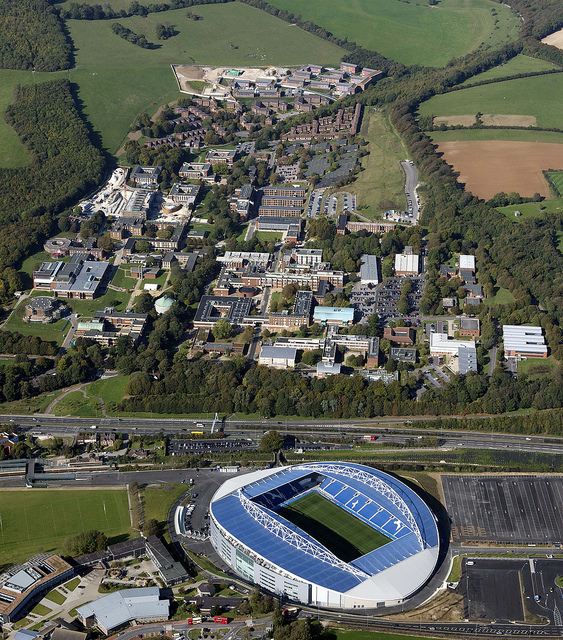
The one complication is that Brighton and Hove Albion are playing at home today (against Hull) and their stadium,as you can see from the map, is right next to the campus, just on the other side of the A27…

campus

However, the match is not until this evening (17.20) so I should be able to get home without too many problems.

A Lab of Honour

Posted in Education, The Universe and Stuff with tags , , on February 5, 2013 by telescoper

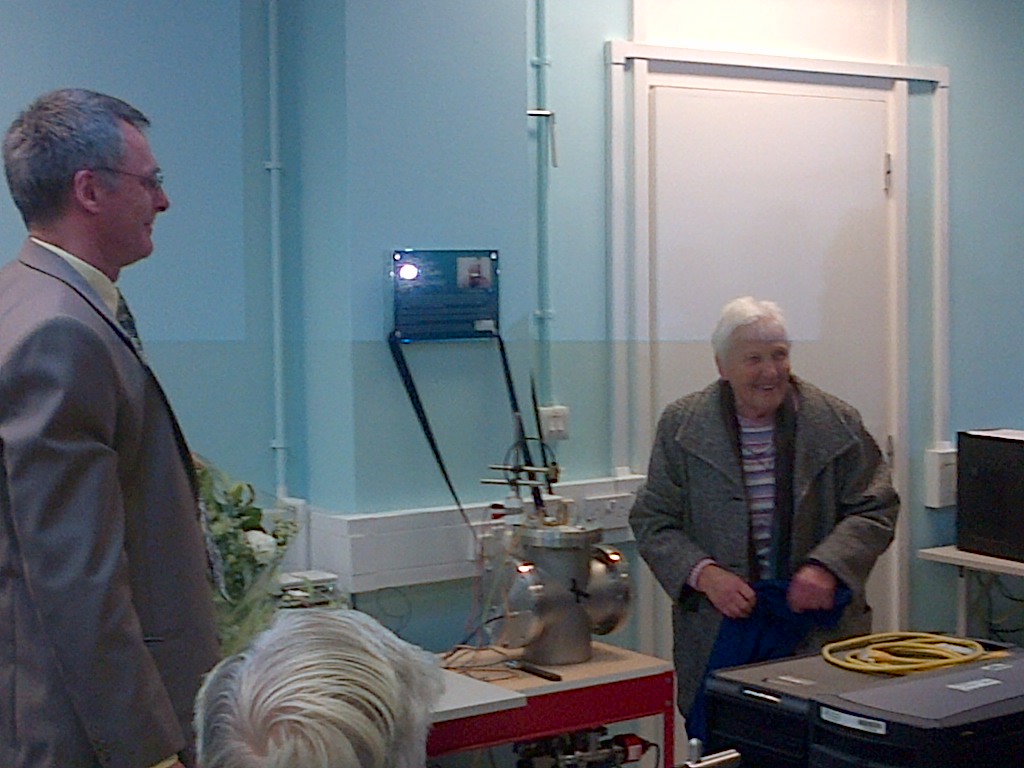
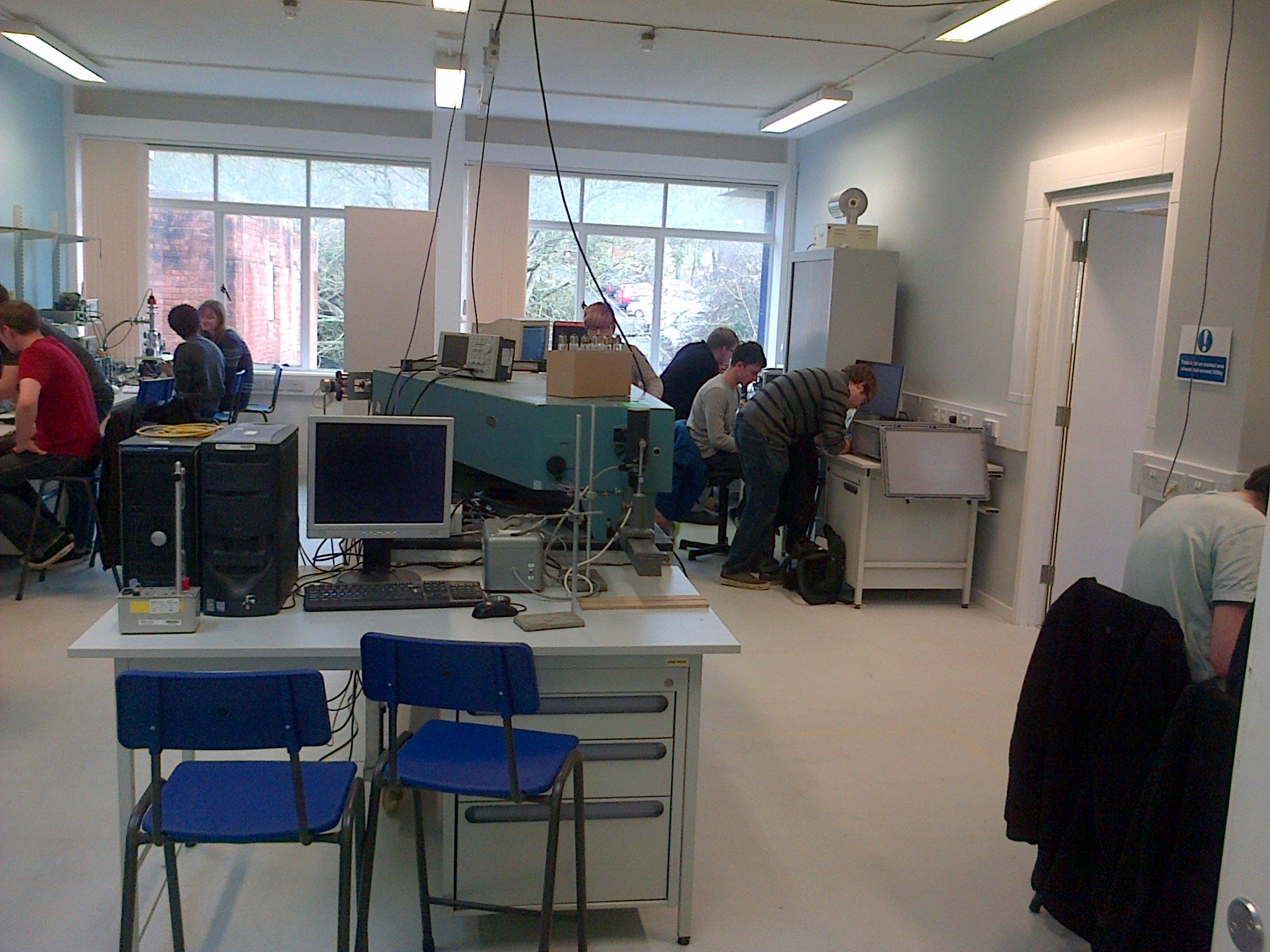
Last Friday, my first day in post here at the University of Sussex, there was a small ceremony to mark the formal opening of a new undergraduate teaching laboratory. Appropriately, it was named after Professor Ken Smith who died last year. Professor Smith was an outstanding experimental physicist who joined the University of Sussex way back in 1960 before the campus had even been built. Over the next three decades, as well as developing a new research activity in which the Department is now world-leading, he made substantial contributions to laboratory teaching in particular. He also played his part in the administration of the Department, serving as the first Chairman of Physics, and then as Dean of the School of Mathematical and Physics Sciences (MAPS) and later as Laboratory Director. Prof. Smith retired in 1988, which was the year I finished my DPhil from the (then) School of Mathematics and Physical Sciences.

IMG-20130201-00049

Anyway, it was a pleasant occasion at which Prof. Philip Harris (to the left of the picture), Head of the Department of Physics & Astronomy, spoke of Professor Ken Smith’s many achievements, Ken’s widow Verena unveiled the commemorative plaque, and we all gathered for tea and cakes in the foyer so as not to disturb further the students still hard at work at their experiments…

IMG-20130201-00050

Switching Allegiances

Posted in Biographical, Education, Football, Rugby with tags , , , , , on February 3, 2013 by telescoper

So here I am, then, in the office on a Sunday afternoon,which I suspect is going to be a pretty regular occurrence for the foreseeable future. I mainly came in to sort out papers for tomorrow’s Senior Management Group meeting, which will be the first such meeting I’ll be attending in my new capacity. I have managed to prepare for it in fine style by losing my diary, which isn’t a very good start to my career as any kind of manager.

Yesterday was taken up with flat-hunting which, if all turns out well this time, was successful. I also had time to watch a bit of the opening match of the Six Nations Rugby between Wales and Ireland. For the last five years or so I’ve always been in Cardiff for Wales’ first home game of the competition, although I’ve never actually managed to get a ticket for the match. It felt a bit strange not being there anyway. It has to be said that Wales were pretty chronic in the first half, going into the break at 30-3 down, but they recovered in the second half and it was quite an absorbing match all considered. Ireland’s excellent defence held off a spirited Welsh comeback and Ireland won 30-22.

Although I’ve lived in Wales for a while, and have enjoyed the match-day atmosphere in Cardiff, I’ve never switched allegiance from England as far as rugby is concerned. Later on yesterday England beat Scotland in their opening match of the Six Nations, showing quite a bit of flair in doing so but also making quite a lot of mistakes. The 38-18 scoreline flattered England, I felt, and they’ll have to up their game a lot if they’re going to match Wales’ Grand Slam last season.

Football is another matter in which allegiances are difficult to change. Many’s the time I’ve thought of giving up being a Newcastle United supporter but I’ve never managed it. I disapprove of people who think they have an option concerning which team to support, actually. I was born in Newcastle therefore I support Newcastle United. That’s the end of it. We all have our cross to bear. Anyway, yesterday brought an unexpected ray of sunshine into a gloomy season for the Toon with a 3-2 victory over Chelsea. Following a first away win of the season against Aston Villa last week it may even be possible that they’ll avoid relegation. Perhaps.

Switching allegiances between universities is almost as difficult. In today’s academic world we’re supposed to think of higher education as a marketplace in which different institutions compete for funding for both teaching and research. I’ve never felt comfortable with the idea that opening up higher education to “market forces” is in anyone’s interests. Certainly on the research side, there are so many collaborations between groups in different universities that cooperation is more the rule than competition although, as with any rule, there are exceptions. Friendly rivalry is as good a thing in higher education as it is in football, but anything more serious than that can only be justified in the case of Sunderland.

Critical Masses

Posted in Education, Science Politics with tags , , , , , , , on January 26, 2013 by telescoper

One of the interesting bits of news floating around academia at the moment is the announcement that my current employer (until the end of next week), Cardiff University is to join forces with the Universities of Bath, Exeter and Bristol in an alliance intended to create a ‘critical mass of knowledge’ and help Cardiff  ‘better compete for more research income’ (apparently by pretending to be in England rather than in Wales).  How successful this will be – or even what form this alliance will take – remains to be seen.

There’s been a lot of gossip about what inspired this move, but it’s not the first attempt to create a collaborative bloc of this kind. Last year five universities from the Midlands announced plans to do something similar. The “M5” group of   Birmingham, Leicester, Loughborough, Nottingham and Warwick got together primarily to share infrastructure in order to help them win grants, which is probably what also lies behind the Cardiff-Bath-Exeter-Bristol deal.

Of course there are also a myriad  alliances at the level of individual Schools and Departments. I’ll shortly be joining the University of Sussex, which is a major player in SEPNET – the South-East Physics Physics Network which was set up with help from HEFCE There are other such networks in England, as well as SUPA in Scotland, funded by the devolved Scottish Funding Council. Attempts to form a similar arrangement for Physics in Wales were given short shrift by the Welsh Funding Agency, HEFCW. The inability or unwillingness of HEFCW to properly engage with research in Wales is no doubt behind Cardiff’s decision to seek alliances with English universities but I wonder how it will translate into funding. Surely HEFCE wouldn’t be allowed to fund a Welsh University, so presumably this is more aimed at funding from the research councils or further afield, perhaps in Europe. Or perhaps the idea is that if GW4 can persuade HEFCE to fund Bath, Bristol and Exeter, HEFCW will be shamed into stumping up something for Cardiff? Sneaky.

Anyway, good luck to the new “GW4” alliance. Although I’m moving to pastures new I’ll certainly keep an eye on any developments, and hope that they’re positive. The only thing that really disturbs me is that the name “Great Western Four” is apparently inspired by the Great Western Railway, now run by an outfit called First Great Western. My recent experiences of travelling on that have left a lot to be desired and I’m sure the name will have negative connotations in the minds of many who are fed up of their unreliable, overcrowded, overpriced and poorly managed services. They say a rose by any other name would smell as sweet, but so far this is only a name – and one with a distinctly questionable odour.

I’m appalled

Posted in Biographical, Education with tags , , , , , on January 22, 2013 by telescoper

I was a research student at the University of Sussex from 1985 until 1988, as a result of which I can now put the letters DPhil after my name.  Now I’m gearing up to begin recruiting research students at Sussex when I move there at the end of this month; a list of available projects can be found here, if you’re interested.

However, in the course of this I learned that the University of Sussex has changed the abbreviated form of its postgraduate doctoral degree from DPhil to PhD. Future Susssex researchers will therefore be deprived of the ability to write the letters MADPhil after their name as I do.

The idea that anything in academia should ever actually change sets a dangerous precedent.  What were they thinking of? Everyone knows that PhD just stands for Doctor of Photocopying.

Not to put too fine a point on it, I’m appalled…

University Admissions Turbulence

Posted in Education with tags , , , , on January 21, 2013 by telescoper

This morning I’ve been compiling various bits of statistical information for our Annual Programme Review and Evaluation. Yes, it really is as exciting as it sounds. In the course of this I remembered a news item in last week’s Times Higher concerning the latest University admissions figures from UCAS.

The story compares overall admissions figures (i.e. the total number of students entering each university) for 2011 and 2012, pointing out that there are huge changes in some institutions with winners and losers even within the Russell Group. The University of Bristol, for example, increased its intake by a whopping 28% whereas Sheffield was down by 13%.

Similar comments can be found here, in the Grauniad.

For your information you can find complete lists for 2011 and 2012 on the UCAS website.

What I usually do when statistics like this are released is look at the places I have worked in my own career, so here we are:

2011

2012

change

Cardiff

5130

5799

+13%

Nottingham

7187

7160

-0.4%

Queen Mary

3704

3484

-5.9%

Sussex

3203

3221

+0.6%

My current employer, Cardiff University, was well up in 2012 compared with 2011, whereas Queen Mary was significantly down. Nottingham was slightly down and Sussex slightly up, but both these variations are really within the level of √N noise.

Of course these are overall (institutional) figures, and I suspect they hide considerable variations at subject level. For example, although Physics has seen something of a resurgence in popularity lately, it’s difficult for Physics departments to over-recruit given constraints on laboratory space.

I’ve heard these changes described as “Darwinian”, but I’m not sure I agree. The big factor allowing Bristol to do so well has been the ability of institutions to recruit unlimited numbers of students with at least AAB at A-level. This completely changed the dynamics of the UCAS clearing system so it’s not at all surprising that it generated short-term chaotic variations. This year it is different again, with ABB now set to be unrestricted; similar turbulence is inevitable.

It’s difficult enough for universities to navigate safely through such unpredictable waters, and persistent tinkering with the controls is not helping in the slightest. Will the chaos decay naturally, or will it be constantly regenerated by badly thought-out interventions from those in charge?