Archive for the Education Category

How to Address Gender Inequality in Physics

Posted in Education, The Universe and Stuff with tags , , , , on January 26, 2014 by telescoper

Last night I was drinking a glass or several of wine while listening to the radio and thinking about a brainwave I’d had on Friday. Naturally I decided to wait until I reconsidered it in the cold light and sobriety of day before posting it, which I have now done, so here it is.

The idea that came to me simply joins two threads of discussion that have appeared on this blog before. The first is that, despite strenuous efforts by many parties, the fraction of female students taking A-level Physics has flat-lined at 20% for over a decade. This is the reason why the proportion of female physics students at university is the same, i.e. 20%. In short, the problem lies within our school system.

The second line of argument is that A-level Physics is not a useful preparation for a Physics degree because it does not develop the sort of problem-solving skills or the ability to express physical concepts in mathematical language on which university physics depends. Most physics admissions tutors that I know care much more about the performance of students at A-level Mathematics than Physics.

Hitherto, most of the effort that has been expended on the first problem has been directed at persuading more girls to do Physics A-level. Since all universities require a Physics A-level for entry into a degree programme, this makes sense but it has not been successful.

I now believe that the only practical way to improve the gender balance on university physics course is to drop the requirement that applicants have A-level Physics entirely and only insist on Mathematics (which has a much more even gender mix). I do not believe that this would require many changes to course content but I do believe it would circumvent the barriers that our current school system places in the way of aspiring female physicists.

Not all UK universities seem very interested in widening participation, but those that are should seriously consider this approach.

The Student Education Paradox

Posted in Education, The Universe and Stuff with tags , , , on January 24, 2014 by telescoper

An exciting new paper by a leading theoretical physicist prominent educationalist has just appeared on the arXiv. In it the author addresses the important question of whether information is destroyed in black holes students actually learn anything during lectures.

Until recently it was generally believed that any information falling into a black hole entering the mind of a student was lost forever even though black holes do evaporate students do take examinations after a finite time. This belief is motivated by the properties of Hawking radiation produced by black holes observations of examination scripts written by students, which some claim to be entirely random, i.e. devoid of any information content whatsoever.

This picture has however been challenged by a number of educationalists theorists with a variety of counter-arguments. For example, some have argued for a statistical interpretation in terms of the multiverse a very large class; although information may be destroyed in individual black holes students, in a infinite multiverse large enough class, there may be a finite number of examples in which some information is retained.

The latest article (referred to above) offers a different resolution of the Black Hole Information Student Education Paradox which rests on the idea that information radiated by black holes examination scripts written by students are not in fact entirely random, just produced so chaotically that, although information is present, for any practical purposes such information is so garbled that it is impossible to decipher.

This intriguing suggestion has led to a number of interesting, if somewhat speculative, extensions. Some have even argued that there may after all be some information present in the speeches of Education Minister Michael Gove, though this idea obviously remains highly controversial.

Stephen Hawking is 72.

Eleven Plus Forty Years On

Posted in Biographical, Education with tags , , , on January 23, 2014 by telescoper

Today is the fortieth anniversary of an important historical event. Well, no. It’s not actually. It is however the fortieth anniversary of an important event in my life or, as they say on Facebook, a life event on my timeline.

On January 23rd 1974 (in the middle of the “Three Day Week“), I arrived at the Royal Grammar School in Newcastle upon Tyne to take the Eleven Plus entrance examination. The RGS was basically a private school, but it operated under what was called the Direct Grant system, which meant that applicants who did well in the entrance examination could have their fees paid by the local authority. That was the only possibility for me to go to there, in fact, as there was no way my parents could have afforded the fees. It wasn’t my idea to go for the examination either. I would have been happy to go to the local comprehensive with my friends from Pendower Junior School and in any case thought I faced humiliation in the examination, as I’d had no preparation for it (unlike many of the more well-to-do applicants). Nevertheless, my parents insisted and I turned up on a cold Thursday morning to take the test.

I remember little about the examination, except that it comprised several papers including one on English comprehension and another on Arithmetic. I’d never sat an examination before and I do remember that I found the whole thing excruciatingly hard. I think I found the Arithmetic paper so difficult that I almost decided to get up and leave; I may even have cried. I left with a sense of relief that it was all over, and a certainty that I would not be going to the RGS.

Nevertheless, a short time later, in February I think, I was summoned for an interview which experience terrified me despite the fact that the staff involved were really very kind and friendly. I was very surprised to have got that far.

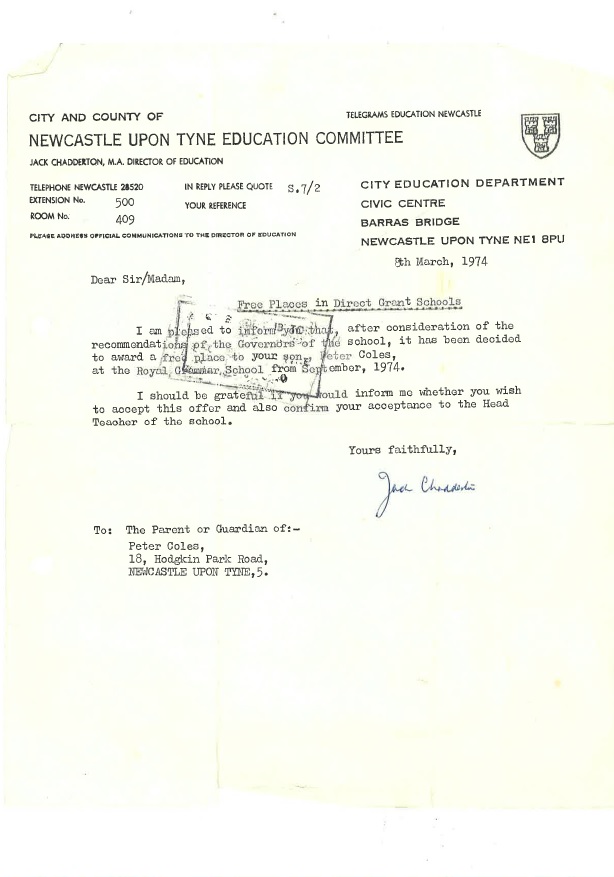
School PlaceSurprise turned to astonishment in March when the letter arrived (left) confirming that not only had I passed but I had been awarded the scholarship that I needed to allow me to go there. And before you ask why I kept the letter, I’ll admit that I also still have all my school reports from the RGS. Vanity is part of the reason, I suppose, but the other is to remind me of how lucky I’ve been with the opportunities that have come my way. I remain completely convinced that I got my place and scholarship as a result of some form of administrative error, but I vowed to make the best of the opportunity.

The UK education system has all changed (several times) since then, of course, and I often wonder how many youngsters far cleverer than me from working class backgrounds would nowadays have any chance of following a path like that which presented itself to me.

Qualification Matters

Posted in Biographical, Education with tags , , , on January 18, 2014 by telescoper

Yesterday evening I had a very enjoyable dinner with a seminar speaker and group of students from the Kobayashi-Maskawa Institute at Nagoya University. On the way back to the guest house I’m staying in, at about 9.30pm, we passed a group of young kids in uniform apparently returning from school. I was told that they were students from a Junior High School (chūgaku) who had been studying late in preparation for an entrance examination to the (selective) Senior High Schools (kōtōgakkō). I was a bit surprised to see young teenagers putting in such long hours, but such behaviour seems quite normal here in Japan.

One of the things I have to get to grips with when I get back to the School of Mathematical Sciences at the University of Sussex on Monday is the annual admissions cycle. I have meetings in my calendar for next week about this, and we are hosting an applicant visit day on Saturday 25th January; we have of course already made offers to a large number of students based on their predicted grades at GCE A-level. This process is fraught with difficulties, not least because there some schools seem to over-predict the grades that their pupils achieve in order to maximise the chance of them getting into University. Predicted grades being rather unreliable, it would of course be fairer on all concerned to use actual grades, i.e. to defer university applications until after the A-level results come out, but that would be far too sensible so obviously will not happen in the United Kingdom. I’m actually quite sceptical of the usefulness of A-levels for preparing students for University in general, but that’s another matter.

Anyway, the mini-rant above isn’t main point of this post, which is instead to issue a warning to those  students taking A-levels later this year. It is  based on anecdotal evidence, but quite a lot thereof. The point is that universities will often reduce their usual offer at A-level when they find an applicant with very high predicted grades, sometimes even making an unconditional offer (actually the minimum is two E grades) to high-fliers. This happened a lot in the old days when I was applying for a place at university. Though it is less common nowadays the government’s policy of lifting controls on universities’ ability to recruit students with three A-level grades at ABB or better is bound to increase the amount of game-playing as competition between recruiters intensifies.

This creates a number of issues, but the one I want to pick out arises when a student is predicted to get three As at A-level, but his/her first-choice university gives them an unconditional offer. Their first reaction will obviously be “whoopee! I’ll accept that offer and, what’s more, I don’t need to fret too much about my summer examinations..”.

In fact I’ve known plenty of students who came into university with quite modest A-level grades, but did brilliantly well at their studies and ended up with first-class degrees. There can be many explanations behind such cases quite apart from the relaxation effect. Some schools don’t have good specialist science teachers, for example; this can mean that a student’s interest is really only ignited once they get into university.

The problem is, though, that A-levels results are not just for university entry, they’re for life. A student may graduate with a good degree, even a First,  but so do many others. When selecting for postgraduate jobs, or even postgraduate study, recruiters often have a large number of people with excellent degrees; that’s an obvious consequence of the expansion of the Higher Education sector in recent years. What happens, therefore, is that employers and PG admissions tutors have to look at other factors; naturally, that includes A-level results but also even GCSEs. You might be surprised to learn that even if you get a first-class degree, your chances of getting a PhD place at a top institution depends on your performance at School but they definitely do. I’m not saying that this should, be the case, just that it in practice it is.

I recall hearing recently from one former student who had a first-class degree in Physics and a PhD from an excellent University, and who was applying for a job in a research institute (not in the university sector). The application form he received asked him to list not only his A-levels but also his GCSE results!

I hope I’ve made my point to any prospective students, but I’ll summarize it in case I haven’t. If you get a generous offer from your chosen university then that’s a good thing, because it means that they want you. You should be happy. But don’t ease off on your studies because if you end up getting poorer A-levels than you deserve, they may one day come back to haunt you.

A Summer of Undergraduate Physics Research

Posted in Biographical, Education, The Universe and Stuff with tags , , , , on January 14, 2014 by telescoper

I was compiling a bibliography for a new paper yesterday and noticed that a paper published in December 2013 cited one I wrote in 2005 with Andrew Stannard while I was working at the University of Nottingham; the rarity of anyone actually referring to any of my papers caught my attention. I include the abstract of the Stannard-Coles paper here for reference:

We investigate the properties of the (complex) coefficients obtained in a spherical harmonic representation of temperature maps of the cosmic microwave background (CMB). We study the effect of the coefficient phase only, as well as the combined effects of phase and amplitude. The method used to check for anomalies is to construct a `random walk’ trajectory in the complex plane where the step length and direction are given by the amplitude and phase (respectively) of the harmonic coefficient. If the fluctuations comprise a homogeneous and isotropic Gaussian random field on the sky, the path so obtained should be a classical `Rayleigh flight’ with very well known statistical properties. We illustrate the use of this random-walk representation by using the net walk length as a test statistic, and apply the method to the coefficients obtained from a Wilkinson Microwave Anisotropy Probe (WMAP) preliminary sky temperature map.

This seems like ancient history now, particularly with regard to the use of “preliminary” WMAP data, but it was only just over 8 years ago. I never imagined during the time that we were working on this paper that I’d be moving twice! By contrast, Andrew Stannard remained in Nottingham, doing a PhD there and is now employed as a Research Fellow, although he switched fields after the project and moved into nanoscience.

Anyway, I wasn’t posting this so I could take a trip down memory lane. I thought I’d post it in order to point out that this paper actually came about as an undergraduate research project that Andrew did under my supervision during the summer of 2005, funded by a Mary Cannell Summer Studentship. Mary Cannell was the author of a book about the life of George Green (the famous mathematician who came from Nottingham); she passed away in 2000 leaving some money to the School of Physics & Astronomy to fund summer research placements for undergraduates. If I recall correctly, we completed the analysis and wrote the paper during the summer of 2005, submitting it in August and having it accepted in September. If only it were always so straightforward! Since publication it has garnered 15 citations according to the ADS website; not exactly earth-shattering, but respectable enough, especially given the background. I think it may get a few more in the next few years because the quality of data from Planck may now be good enough to actually detect the features we were looking for all those years ago!

It’s worth mentioning that in the School of Physics and Astronomy at the University of Sussex we have a degree programme in which students receive a stipend to cover living expenses during a summer vacation placement with one of the research groups each and every year of their studies. This is in addition to the usual lectures and laboratory work of the standard  course. This involves many more students than was the case back in Nottingham in 2005, but since I’ve only been at the University of Sussex for  a year I don’t know how many such placements have led to actual publications.

Does anyone know of any really important papers out there that came from undergraduate research projects? If so, please let me know through the comments box..

Viva Elsewhere…

Posted in Biographical, Education with tags , , on December 18, 2013 by telescoper

I just came back from a meeting of the Heads of  the science Schools here at the University of Sussex where, among other things, we discussed PhD completion rates across the University. I sat there smugly because ours in the School of Mathematical and Physical Sciences are pretty good. The meeting started at 10am which also happens to have been the starting time for a PhD examination in at Cardiff University involving my (former) student Ian Harrison. I would have liked to have been there, but unfortunately I have several appointments today in Sussex so couldn’t make it.

It’s not normal practice for the supervisor of a PhD to be present at the examination of the candidate. The rules allow for it – usually at the request of the student – but the supervisor must remain silent unless and until invited to comment by the examiners. I think it’s a very bad idea for both student and supervisor, and the one example that I can recall of a supervisor attending the PhD examination of his student was a very uncomfortable experience.

I always feel nervous when a student of mine is having their viva voce examination, probably because I’m a bit protective and such an occasion always brings back painful memories of the similar ordeal I went through twenty-odd years ago. Although I have every confidence in Ian, I can’t help  sitting in my office wondering how it is going. However, this is something a PhD candidate has to go through on their own, a sort of rite of passage during which the supervisor has to stand aside and let them stand up for their own work. Usually, of course, I would be there for the event (if not actually present in the examination room), but now I’m a considerable distance away it feels a bit strange.

I’ve actually blogged about a paper of Ian’s already. He finished his thesis well within the usual three-year limit and has moved to the Midlands (Manchester, to be precise) to take up a postdoctoral research position there.  He’s not technically allowed to call himself Doctor Harrison yet, but I’m sure it’s just a matter of time. In the words of Miss Jean Brodie, my students are, without doubt, la crème de la crème.

It’s now 11.45. Fingers crossed for some news soon…

UPDATE: 13.00. Still no news…

UPDATE: 13.07. Congratulations, Dr Harrison!


Caught in the Middle

Posted in Education, Politics with tags , , , , on December 7, 2013 by telescoper

Academics these days are caught between a rock and a hard place.

On one side we have a government which seems not only malevolent but also utterly incompetent. I cite the recent example of the Department of Business Innovation and Skills, which has completely lost control of its budget, meaning that further cuts are likely to a higher education sector already struggling to cope with the instability generated by constant meddling from successive governments.

On the other we have our students, who are definitely getting a very raw deal compared with those of my generation. Most are justifiably  unhappy with the high level of fees they have to pay. Many also feel generally alienated by the way the country is run, for the benefit of the rich  at the expense of the young and the poor. Recent campus protests across the country are clearly a manifestation of this groundswell of resentment, although in some cases they have clearly been hijacked by extremist elements who will protest about anything at the drop of a hat just for the sake of it.

In between we have us academics, the vast majority of whom agree with the students  that UK higher education is in a complete mess and that the UK government is responsible. However, most of us also believe in the importance of universities as places of research, scholarship and teaching and want to carry out those activities as best we can for the benefit not only of our current students but for society as a whole.

So what should we academics who find ourselves caught  in the middle do?

Unsurprisingly, opinions differ and I don’t claim to speak for anyone but myself when I state mine. I think it’s the responsibility of academic staff to recognize the burden placed on our students by government and in the light of that do absolutely everything in our power to give them the best education we can. That means ensuring that as much of the money coming into universities from tuition fees goes directly towards improving the education of students – better teaching facilities, more and better trained staff and a better all-round experience of campus life. That is the reason that I did not participate in the recent strikes over pay: I absolutely refuse to take any action that would be in any way detrimental to the education of students in my School. Call me a scab if you wish. My conscience is clear. For me it’s not a matter of choice, it’s a matter of responsibility.

So what about the recent wave of student protests? Again, all I can do is give my own opinion (not that of my employer or anyone else) which is that I believe in the right to protest – as long as it’s peaceful – but targeting universities is short-sighted and counterproductive.  I’m sure that all the government is delighted that none of the latest protests have been in Whitehall, which is where the focus of complaint should be, but instead dissipated at arms length in a series of futile and divisive campus demonstrations.

And if one of these protests causes enough disruption that it succeeds in closing down a university for good – and don’t tell me that this government won’t allow that to happen – what good will that have done?

The World’s Oldest Professor?

Posted in Education with tags , , , on December 1, 2013 by telescoper

Yesterday I was sitting at home listening to the radio when someone used the phrase “The World’s Oldest Profession”. Naturally, that made me think of those such as myself who Profess for a living (although that’s apparently not what the original expression applies to). Anyway, that idle thought made me wonder whether there is, in the Guinness Book of Records or elsewhere, a recognized holder of the title World’s Oldest Professor?

A short tweet about this elicited one suggestion: Professor Ephraim Engleman of the University of California at San Francisco who is an extremely distinguished Professor of Rheumatology and is still active at the age of 102. Blimey. That’s going to be a pretty though record to beat, but I thought I’d post about it to see there are any other contenders for (a) the world’s oldest professor in any discipline and (b) the world’s oldest professor in physics and astronomy?

Suggestions through the comments box please.

P.S. Apart from anything else, Prof. Engleman’s inspirational example has made me feel guilty for moaning about the advancing years at the tender age of 50; he’d reached my current age before I was even born!

The Russell Groupies

Posted in Education, Politics with tags , , , on November 29, 2013 by telescoper

There’s an interesting article in Research Professional upon which I thought a brief comment would be appropriate. The article is mainly about the recent demise of the 1994 Group of universities, made inevitable when some of its larger members jumped ship to climb on board the much posher Russell Group. I’ve always felt that mission groups of this type were of little interest or value, but the growth of the Russell Group has, in my view, become rather sinister because it involves a cynical attempt to manufacture status when none is justified by performance.

The piece in Research Professional says:

Vice-chancellors and principals are not the only ones playing the status game. Students, employers, academics and government ministers—who seem to love visiting Russell Group universities—all want to be associated with high-status universities, even if those institutions do not necessarily provide better education or research. A 2009 analysis of the results of the 2008 Research Assessment Exercise, carried out by the Higher Education Policy Institute, found that Russell Group institutions performed only half a percentage point better than the overall average, and that when universities in the golden triangle were excluded the score fell to below average. Truly, this is an emperor with very modest clothes.

This echoes my experience. Before moving to the University of Sussex earlier this year I worked in two Russell Group universities (and one which wasn’t in the Russell Group when I worked there but is now). All these institutions have much to recommend them – and I have no desire whatsoever to say negative things about former colleagues – but it is clear to me that they (or at least their Physics Departments) can’t claim to be any better than the one in which I currently work. Indeed the Physics department that performed best in the 2008 Research Assessment Exercise was Lancaster, which is also not in the Russell Group.

It’s also noticeable that the primary characteristic of Russell Group universities in the National Student Survey tables is that they generally do quite poorly relative to non-members. Does Russell Group status mean promoting research at the expense of teaching and the student experience generally?

There’s no doubt that by many metrics there is a group of “elite” English universities – Oxford, Cambridge, UCL, and Imperial. The Russell group comprises these and a few other excellent institutions. But the later additions are simply a group of fairly average universities who thought the £500,000 joining fee was worth paying to try to convince students and others that they had elite status too. Worryingly, it seems that the Russel Brand Group Group Brand has been marketed so effectively that politicians are starting to talk as if “research intensive” and “Russell Group” mean one and the same thing.

Lecture Capture

Posted in Education with tags , , , , on November 27, 2013 by telescoper

One of the things that I found out when I came to the University of Sussex in February this year is that it provides something that I think is a very good thing for both staff and students – facilities for lecture capture which are in all the main lecture theatres on campus. These facilities allow lecturers to record videos of their own lectures which are then made available for students to view online. This is of course very beneficial for students with special learning requirements, but in the spirit of inclusive teaching I think it’s good that all students can access such material. Some faculty were apparently a little nervous that having recordings of lectures available online would result in falling attendances at lectures, but in fact the evidence indicates precisely the opposite effect. Students find the recorded version adds quite a lot of value to the “live” event by allowing them to clarify things they might not have not noted down clearly.

Anyway, I like this idea a lot and am very keen to do it with my own lectures. It does seem to be the case however that some staff are wary of this innovation. I thought this might be an interesting issue to put to a public poll open to staff, students and interested others either at Sussex or elsewhere to gauge the general feeling about this:

If you don’t like the idea I’d welcome a comment explaining why. I’d also be interested in comments from colleagues in other institutions as to the extent to which lecture capture technology is used elsewhere.