Archive for the Euclid Category

News from Euclid 2018

Posted in Biographical, Euclid, The Universe and Stuff on June 11, 2018 by telescoper

At the second attempt I managed to check in for my flight to Cologne (which is apparently near a place called) en route to Bonn for the Euclid 2018 Consortium Meeting.

I was mightily relieved when a plane actually arrived this time.

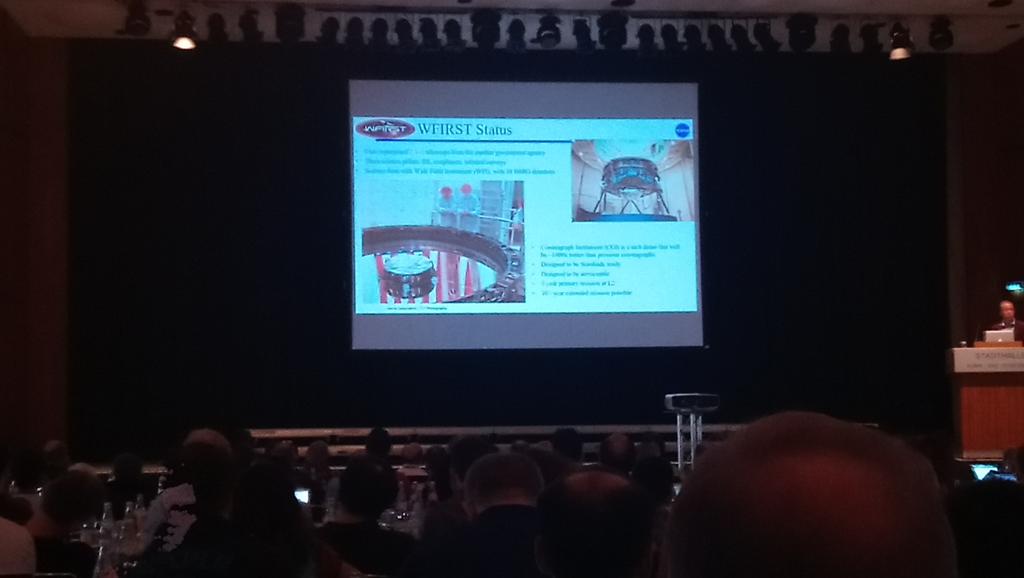
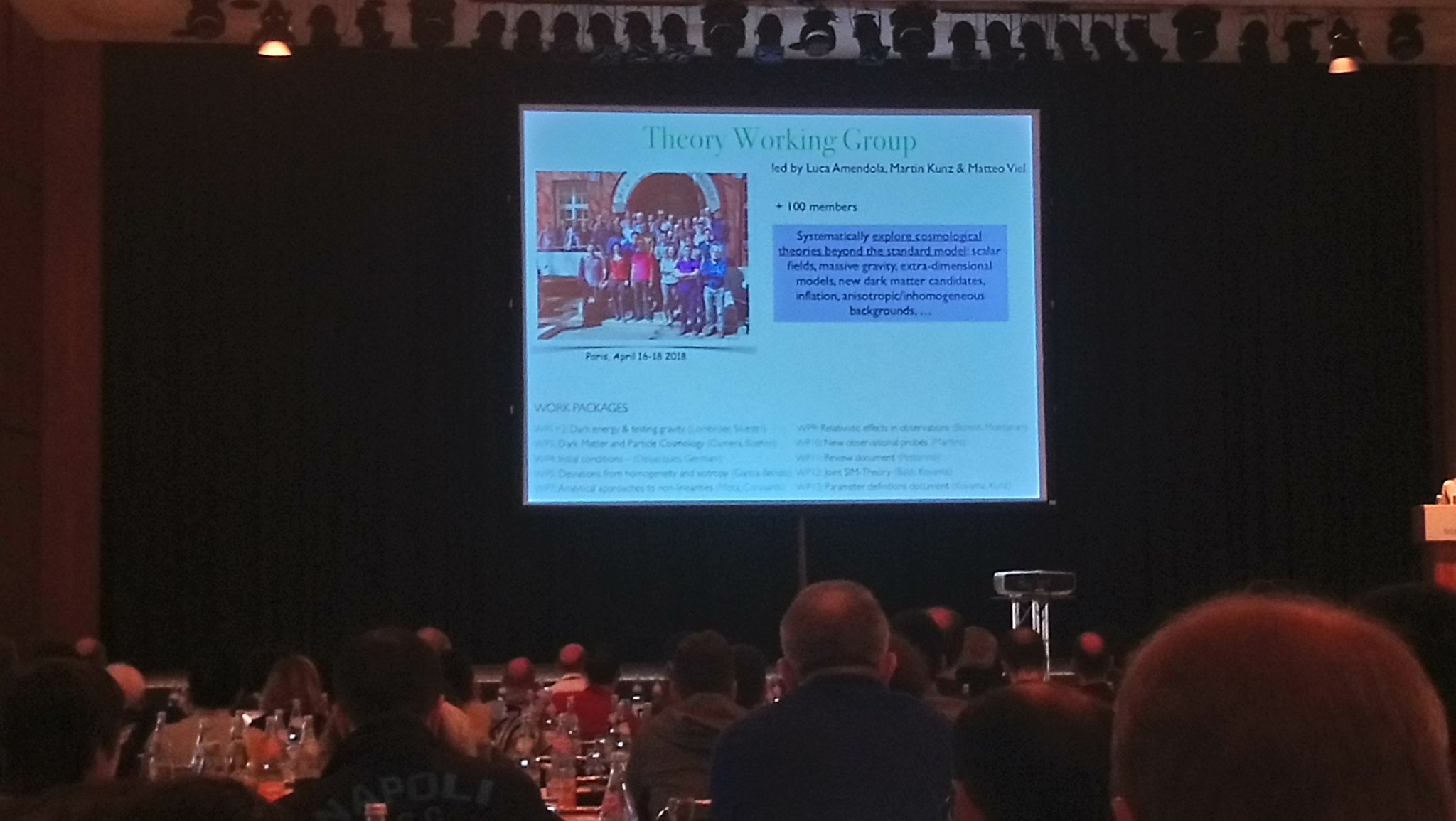
We got to our destination just about on time. I bumped into fellow Euclidean Tom Kitching in the airport and we made it to the conference venue in time for a spot of lunch, after which the afternoon session was kicked off by Mark Cropper:

I missed the morning session, during which the most important piece of news was an official announcement that the launch date of Euclid has been moved back from 2020 until 2022. This was not unexpected, and is largely driven by problems with on-board electronic system, but it will obviously impact the timetable of the mission significantly.

Since the flight of Euclid will be delayed for two years, I wonder which hotel it will be staying in at ESA’s expense?

Maynooth joins the Euclid Community

Posted in Euclid, Maynooth, The Universe and Stuff with tags , , , on January 10, 2018 by telescoper

There’s a nice webpage showing all the institutions around the world who belong to the consortium behind the European Space Agency’s Euclid Mission. Here’s a screen grab that shows all the logos of all the institutions involved in this very large Consortium:

There are so many that it’s hard to see them all, but if you look very closely about half way down, among the Ms, you will see Maynooth University among them. This is the first institution in Ireland to have joined the Euclid Consortium and it has just been officially added thanks to yours truly moving there later this year. Ireland is a member state of the European Space Agency, by the way.

Euclid’s Flagship Simulation

Posted in Euclid, The Universe and Stuff with tags , , on July 28, 2017 by telescoper


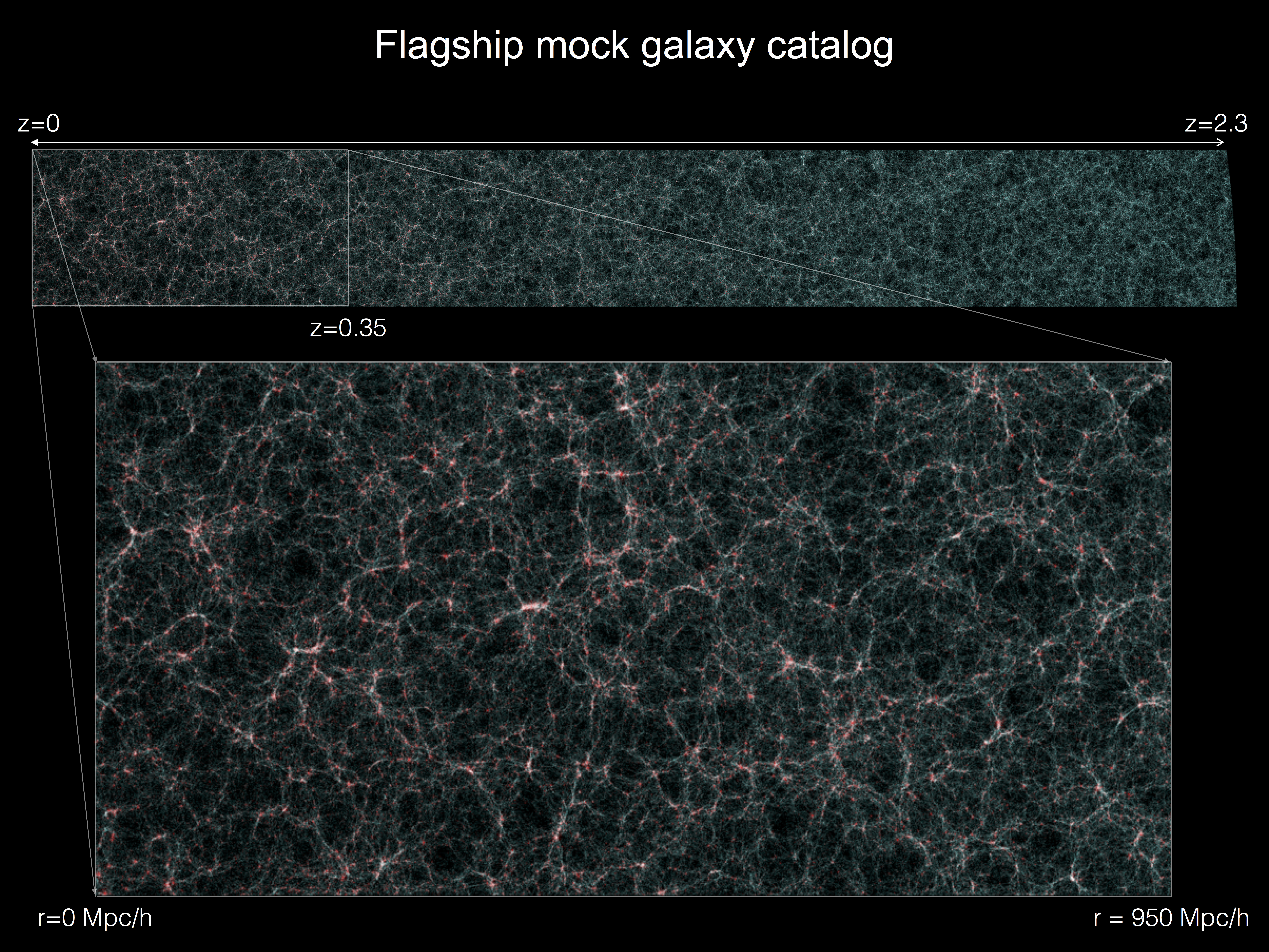
Credit: J. Carretero/P. Tallada/S. Serrano for ICE/PIC/U.Zurich and the Euclid Consortium Cosmological Simulations Science Working Group.

The above image is taken from the world’s largest simulated galaxy catalogue, which has been constructed to help prepare for the  forthcoming Euclid space mission. The image actually shows only a small part of the full Euclid Flagship mock galaxy catalogue, which contains more than 2 thousand million galaxies distributed over the 3-dimension cosmological volume that Euclid will survey. Synthetic galaxies in this simulation mimic with great detail the complex properties that real sources display: ranging from their shapes, colours, luminosities, and emission lines in their spectra, to the gravitational lensing distortions that affect the light emitted by distant galaxies as it travels to us. The simulation is large enough to allow full `light-cone’ effects to be taken into account, as the look-back time to the edge of the Euclid survey volume is long enough for significant evolution to have occurred; according to the standard cosmological model, the time taken for light to travel from redshift z=2.3 to now is about 10.8 billion years, a significant fraction of the age of the Universe.

`Mock’ catalogues like this are needed to plan large observational programmes, whether using space missions or ground-based facilities, and to help prepare the data analysis strategies and tools needed to deal with the real data when it arrives. They can also be used to make excellent images for PR and outreach purposes.

The use of the word `simulation’ always makes me smile. Being a crossword nut I spend far too much time looking in dictionaries but one often finds quite amusing things there. This is how the Oxford English Dictionary defines SIMULATION:

1.

a. The action or practice of simulating, with intent to deceive; false pretence, deceitful profession.

b. Tendency to assume a form resembling that of something else; unconscious imitation.

2. A false assumption or display, a surface resemblance or imitation, of something.

3. The technique of imitating the behaviour of some situation or process (whether economic, military, mechanical, etc.) by means of a suitably analogous situation or apparatus, esp. for the purpose of study or personnel training.

So it’s only the third entry that gives the meaning intended to be conveyed by the usage in the context of cosmological simulations. This is worth bearing in mind if you prefer old-fashioned analytical theory and want to wind up a simulationist!

In football, of course, you can even get sent off for simulation…

To Edinburgh for Euclid

Posted in Euclid, The Universe and Stuff with tags , , on December 17, 2015 by telescoper

This morning I flew from London Gatwick to Edinburgh to attend the UK Euclid meeting at the Royal Observatory, which lasts today and tomorrow. It turns out there were two other astronomers on the plane: Alan Heavens from Imperial and Jon Loveday from my own institution, the University of Sussex.

The meeting is very useful for me as it involves a number of updates on the European Space Agency’s Euclid mission. For those of you who don’t know about Euclid here’s what it says on the tin:

Euclid is an ESA mission to map the geometry of the dark Universe. The mission will investigate the distance-redshift relationship and the evolution of cosmic structures by measuring shapes and redshifts of galaxies and clusters of galaxies out to redshifts ~2, or equivalently to a look-back time of 10 billion years. In this way, Euclid will cover the entire period over which dark energy played a significant role in accelerating the expansion

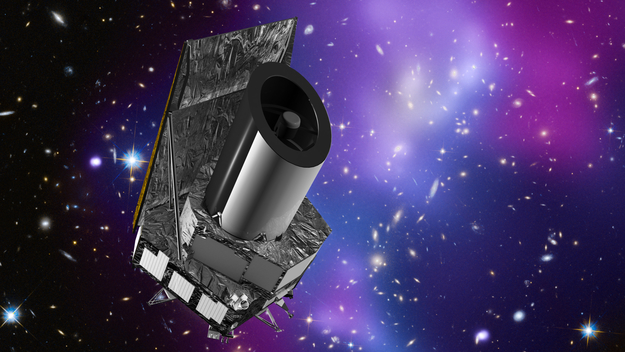
Here’s an artist’s impression of the satellite:

euclid

Do give you an idea of what an ambitious mission this is, it basically involves repeated imaging of a large fraction of the sky (~15,000 square degrees) over a period of about six years. Each image is so large that it would take 300 HD TV screens to display it at full resolution. The data challenge is considerable, and the signals Euclid is trying to measure are so small that observational systematics have to be controlled with exquisite precision. The requirements are extremely stringent, and there are many challenges to confront, but it’s going well so far. Oh, and there are about 1,200 people working on it!

Coincidentally, this very morning ESA issued a press release announcing that Euclid has passed its PDR (Preliminary Design Review) and is on track for launch in December 2020. I wouldn’t bet against that date slipping, however, as there is a great deal of work still to do and a number of things that could go wrong and cause delays. Nevertheless, so far so good!


ESA Endorses Euclid

Posted in Euclid, Science Politics, The Universe and Stuff with tags , , , , , , on June 20, 2012 by telescoper

I’m banned from my office for part of this morning because the PHYSX elves are doing mandatory safety testing of all my electrical whatnots. Hence, I’m staying at home, sitting in the garden, writing this little blog post about a bit of news I found on Twitter earlier.

Apparently the European Space Agency, or rather the Science Programme Committee thereof, has given the green light to a space mission called Euclid whose aim is to “map the geometry of the dark Universe”, i.e. mainly to study dark energy. Euclid is an M-class mission, pencilled in for launch in around 2019, and it is basically the result of a merger between two earlier proposals, the Dark Universe Explorer (DUNE, intended to measure effects of weak gravitational lensing) and the Spectroscopic All Sky Cosmic Explorer (SPACE, to measure wiggles in the galaxy power spectrum known as baryon acoustic oscillations); Euclid will do both of these.

Although I’m not directly involved, as a cosmologist I’m naturally very happy to see this mission finally given approval. To be honest, I am a bit sceptical about how much light Euclid will actually shed on the nature of dark energy, as I think the real issue is a theoretical not an observational one. It will probably end up simply measuring the cosmological constant to a few extra decimal places, which is hardly the issue when the value we try to calculate theoretically is a over a hundred orders of magnitude too large! On the other hand, big projects like this do need their MacGuffin..

The big concern being voiced by my colleagues, both inside and outside the cosmological community, is whether Euclid can actually be delivered within the agreed financial envelope (around 600 million euros). I’m not an expert in the technical issues relevant to this mission, but I’m told by a number of people who are that they are sceptical that the necessary instrumental challenges can be solved without going significantly over-budget. If the cost of Euclid does get inflated, that will have severe budgetary implications for the rest of the ESA science programme; I’m sure we all hope it doesn’t turn into another JWST.

I stand ready to be slapped down by more committed Euclideans for those remarks.

Euclid Alone Has looked On Beauty Bare

Posted in Euclid, Poetry, The Universe and Stuff with tags , , on September 25, 2011 by telescoper

Euclid alone has looked on Beauty bare.
Let all who prate of Beauty hold their peace,
And lay them prone upon the earth and cease
To ponder on themselves, the while they stare
At nothing, intricately drawn nowhere
In shapes of shifting lineage; let geese
Gabble and hiss, but heroes seek release
From dusty bondage into luminous air.
O blinding hour, O holy, terrible day,
When first the shaft into his vision shone
Of light anatomized! Euclid alone
Has looked on Beauty bare. Fortunate they
Who, though once only and then but far away,
Have heard her massive sandal set on stone.

by Edna St Vincent Millay (1892-1950)