Archive for the Euclid Category

Not the Euclid Consortium Meeting

Posted in Biographical, Euclid, Maynooth, The Universe and Stuff with tags , , on May 4, 2020 by telescoper

It’s a bright sunny Bank Holiday Monday and I’m here in my flat in Maynooth taking a coffee break before resuming work from home.

Before the Covid-19 outbreak started I had imagined that I’d be spending this week (or at least most of it) in Sitges near Barcelona for the annual Euclid Consortium Meeting which was planned to take place there. That has understandably been cancelled and replaced with a virtual meeting. Yet more Zoom sessions beckon…

Over the past weeks my workload has increased enormously but I’ve tried to clear the decks a little so I can tune in to some of the sessions but I won’t be able to make them all or even most.

I hope the virtual meeting goes well. Euclid is due to be launched in 2022 so time is getting short and there is much preparatory work still to do.

Well, talking of work I better get back to it! The first plenary is not until this afternoon and I’ve lots to do before then.

I wonder if normality will have returned in time for there to be a Euclid Consortium Meeting next year?

Euclid Updates

Posted in Euclid, The Universe and Stuff with tags , , , , on June 17, 2019 by telescoper

Following the Euclid Consortium Meeting in Helsinki a couple of weeks ago, here are a couple of updates.

First, here is the conference photograph so you can play Spot The Telescoper:

(The picture was taken from the roof of the Finlandia Hall, by the way, which accounts for the strange viewpoint.

The other update is that the European Space Agency has released a Press Release releasing information about the location on the sky of the planned Euclid Deep Fields. Here they are (marked in yellow):

These deep fields amount to only about 40 square degrees, a small fraction of the total sky coverage of Euclid (~15,000 square degrees), but the Euclid telescope will point at them multiple times in order to detect very faint distant galaxies at enormous look-back times to study galaxy evolution. It is expected that these fields will produce several hundred thousand galaxy images per square degree…

Selecting these fields was a difficult task because one has to avoid bright sources in both optical and infrared (such as stars and zodiacal emission) so as not to mess with Euclid’s very sensitive camera. Roberto Scaramella gave a talk at the Helsinki Meeting showing how hard it is to find fields that satisfy all the constraints. The problem is that there are just too many stars and other bits of rubbish in the sky getting in the way of the interesting stuff!


For much more detail see here.


From Helsinki to Maynooth

Posted in Biographical, Euclid with tags , on June 7, 2019 by telescoper

So here I am, back in Maynooth once more, one more Euclid Consortium meeting over and one more coffee cup added to the Departmental collection..

Euclid 2019 is still going on as I write, but I had to leave this morning in order to get back in time for an Examination Board meeting this afternoon. The morning flight to Dublin with Finnair left at 8.15 (local time) from Helsinki and I was up at 5.30 to make sure I got to the airport on time. That means I was up at 3.30am Dublin time, so I’m more than a little tired. I hope the meeting doesn’t go on too long!


P.S. Next year’s Euclid Consortium meeting will be in Sitges….!!

Equality, Diversity and Euclid

Posted in Euclid, The Universe and Stuff with tags , , on June 7, 2019 by telescoper

So here I am, back in my hotel, after the second pleasant wine and food reception of the week – this time hosted by the University of Helsinki. I have to leave early tomorrow morning to get back to Maynooth so I’m not among those going for dinner afterwards.

It’s been a very satisfying meeting, in terms of scientific content, organization and even the weather which has been warm and sunny throughout.

That said I feel obliged to mention one less than satisfactory episode which happened this afternoon. Euclid is a very large consortium working on a complex mission. That requires certain management structures to be put in place, including how to deal with the many scientific publications that will hopefully result from the Euclid mission to be as fair as possible to everyone working on the various projects as well as ensuring the scientific quality of resulting papers.

This afternoon a very distinguished senior member of the Euclid Consortium presented an overview of the publication policy on behalf of the Editorial Board which included this slide:

Not knowing all the names I didn’t think twice about the various panels until at the end of the talk a member of the audience pointed out that none of the individuals named are female.

I wasn’t alone in being surprised that such a situation had arisen, especially since Euclid has a Diversity Committee. But what made matters worse was the apparently dismissive response of the speaker, which caused a sharp intake of breath around the auditorium, and left many with the impression that the Consortium needs to look at whether unconscious or other bias might have been involved in the selection of these members. The impression given may have been inadvertent but appearances matter, and I know I’m not the only person who was troubled by what went on this afternoon. I sincerely hope the Diversity Committee looks into this issue as soon as possible.

UPDATE: 21st June 2019. I understand that this issue has been looked into in depth by the Euclid Consortium and active measures are being taken to improve the gender balance in future, which is a very positive outcome.

Hello Helsinki!

Posted in Biographical, Euclid with tags , , on June 3, 2019 by telescoper

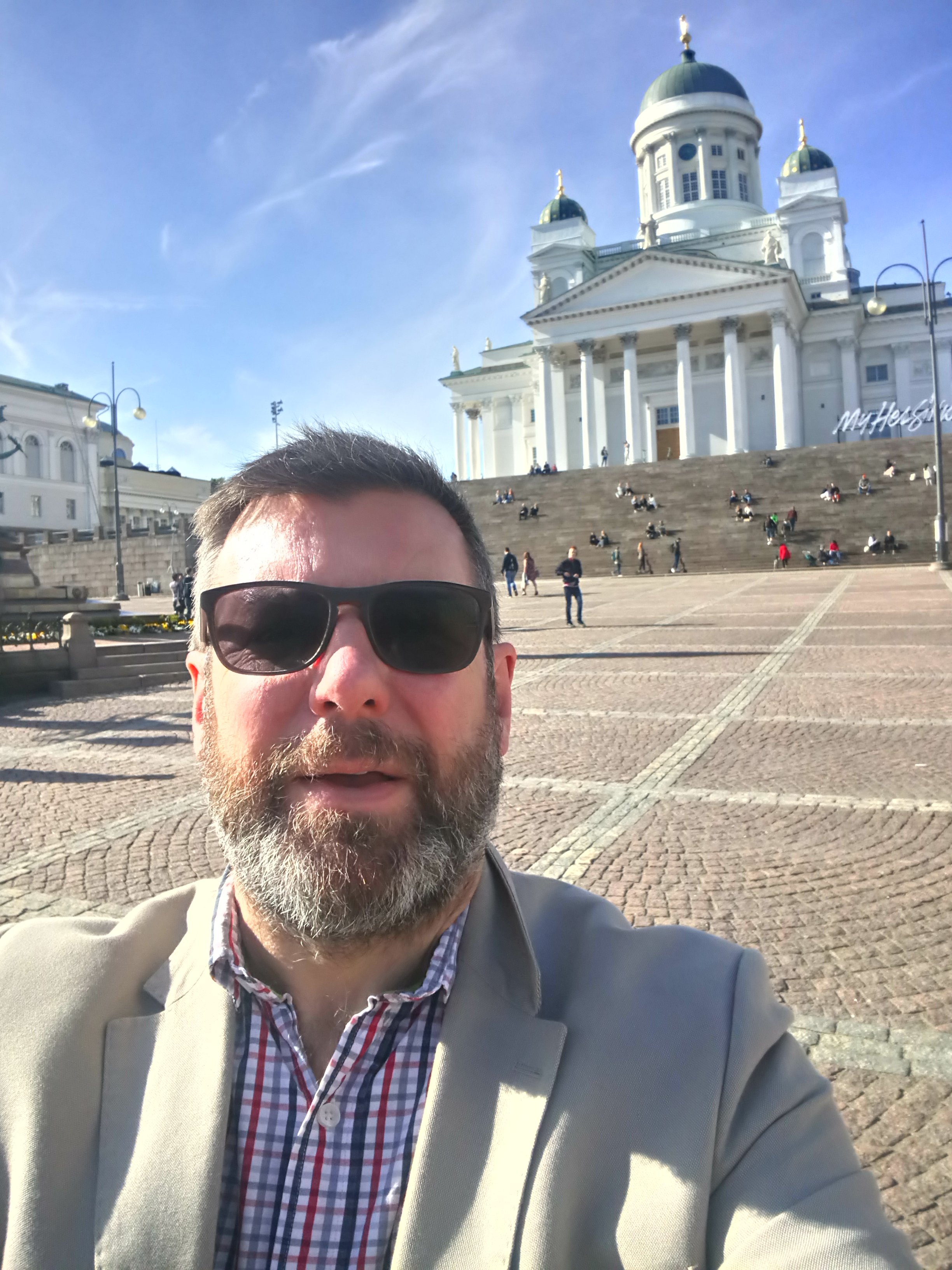
This picture will show you that I am not in Maynooth…

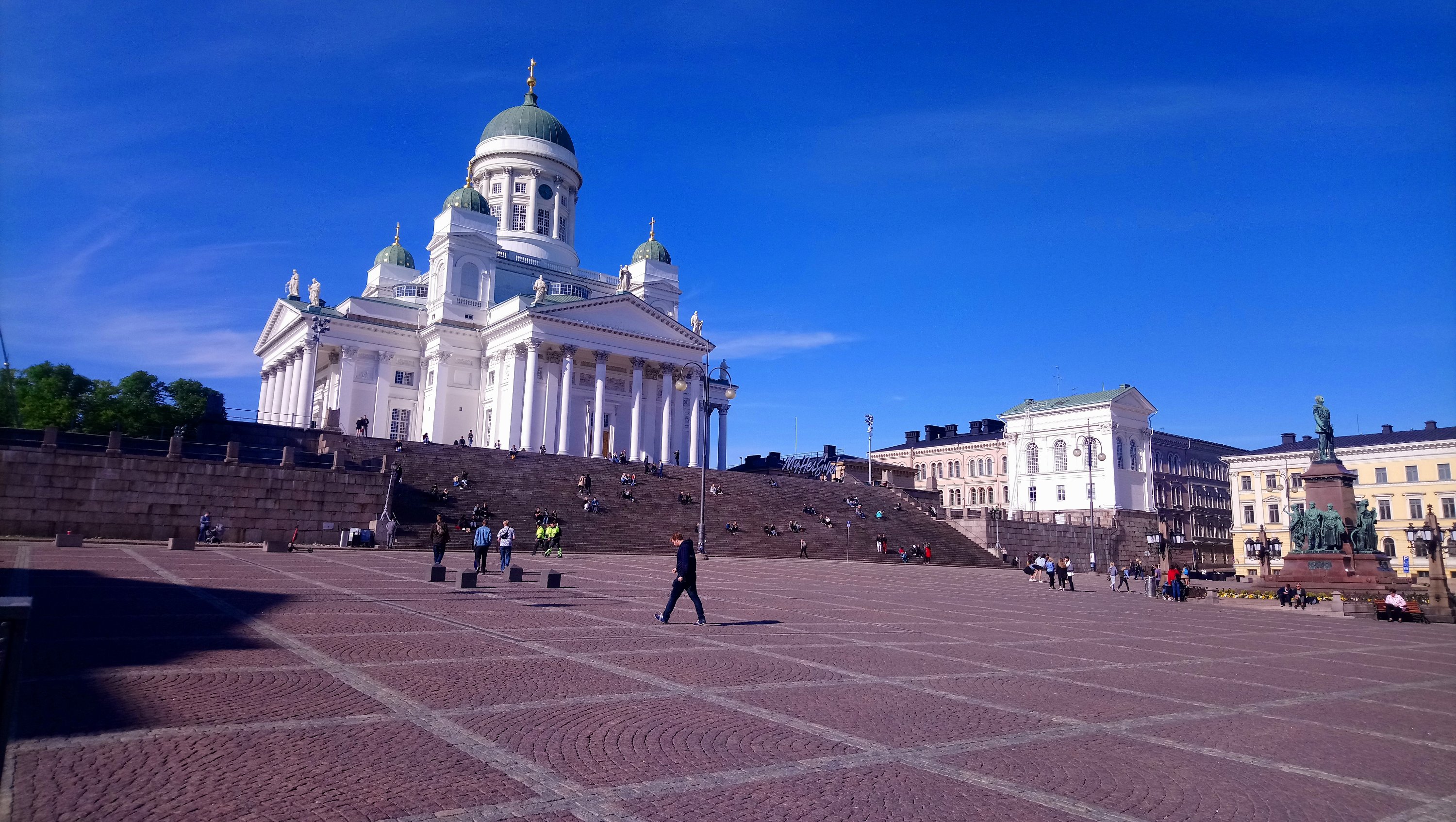
In fact I am in Helsinki. Here is a better picture of the splendid Cathedral behind me in the selfie.

The Cathedral is Lutheran by the way. I’m not sure Luther was into cathedrals, but there you go..

It’s about a three hour direct flight from Dublin to Helsinki via Finnair (and a two hour time difference) but all went according to plan. I also found my accommodation without difficulty: it seems comfortable enough.

I took a long walk around this afternoon because the weather is lovely and I wanted to stretch my legs after the flight. It’s a very pleasant city for a stroll, with lots of public spaces and plenty of places to stop for a coffee or something stronger.

All that done, it’s time for dinner!

The reason for being here, by the way, is the annual Euclid Consortium meeting but enough of that tomorrow..

Euclid 2018: Day 3

Posted in Biographical, Euclid, The Universe and Stuff with tags , , on June 14, 2018 by telescoper

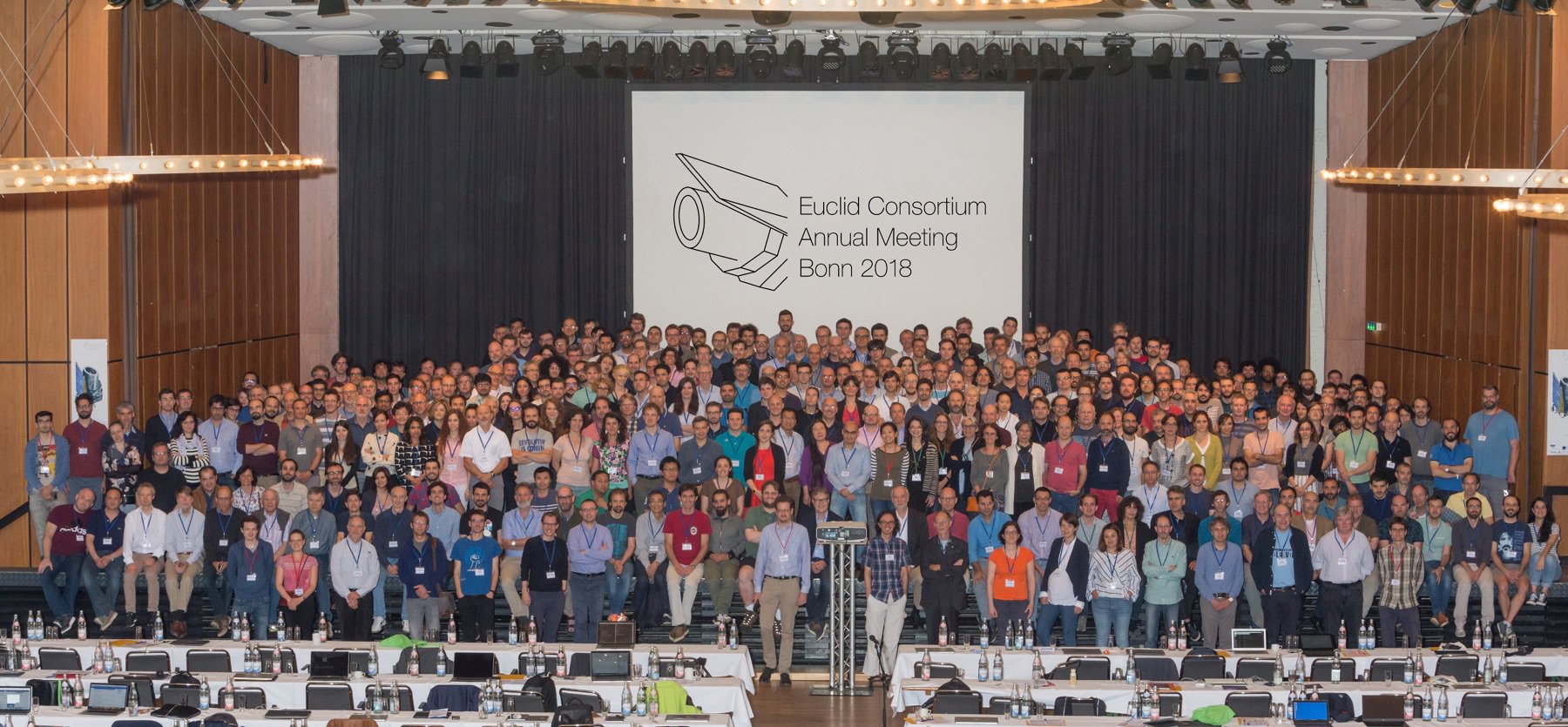
It’s the morning after the conference dinner the night before, so as Day 4 of the Euclid Consortium meeting gets under way I’ve just got the time and bandwidth to do a brief post about the events of yesterday. First of all, the conference photo arrived and is shown above. You’d be hard pressed to spot me in it, as there are a lot of people in it (and bear in mind that only about a quarter of the membership of the Euclid Consortium are actually present here in Bonn).

Yesterday I went to splinter meetings related to the working groups on cross-correlating Euclid with cosmic microwave background data (morning) and clusters of galaxies (afternoon). The latter session produced the following diagram, which makes everything clear:

After the day’s work was done I took a walk down to the western bank of the Rhine (just about 15 minutes’ walk from my hotel), on the way to the conference dinner at the . Sadly, I didn’t see any Rhine Maidens or find any gold to make into a ring.

Anyway, the dinner was at the splendid Rhein Hotel Dreesen and I had the good fortune to sit with some Italian friends from way back – by which I mean over 20 years!

Fortunately I didn’t have far to go to get back to my hotel after the festivities!

Euclid2018: Highlights of Day 2

Posted in Biographical, Euclid, The Universe and Stuff with tags , , , on June 13, 2018 by telescoper

I’ve just had my breakfast so I thought I’d do a quick post before the start of play at Day 3 of the 2018 Euclid Consortium Meeting in Bonn.

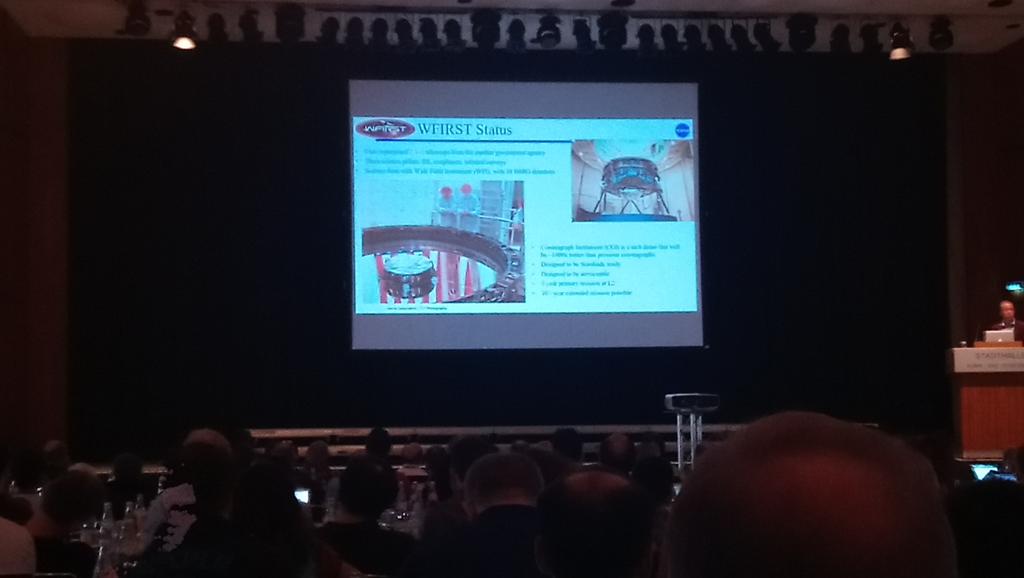
Day 2 was largely devoted to updates from the various Science Working Groups, but there was also an important presentation from Jason Rhodes about WFIRST, which is in some ways a rival to Euclid, or perhaps a complementary mission depending on how you look at it.


There was dismay in the global astronomy community last year when Donald Trump proposed taking the axe to WFIRST but it was good to hear that Congress not only reversed his decision but granted it additional funds over and above the original request.

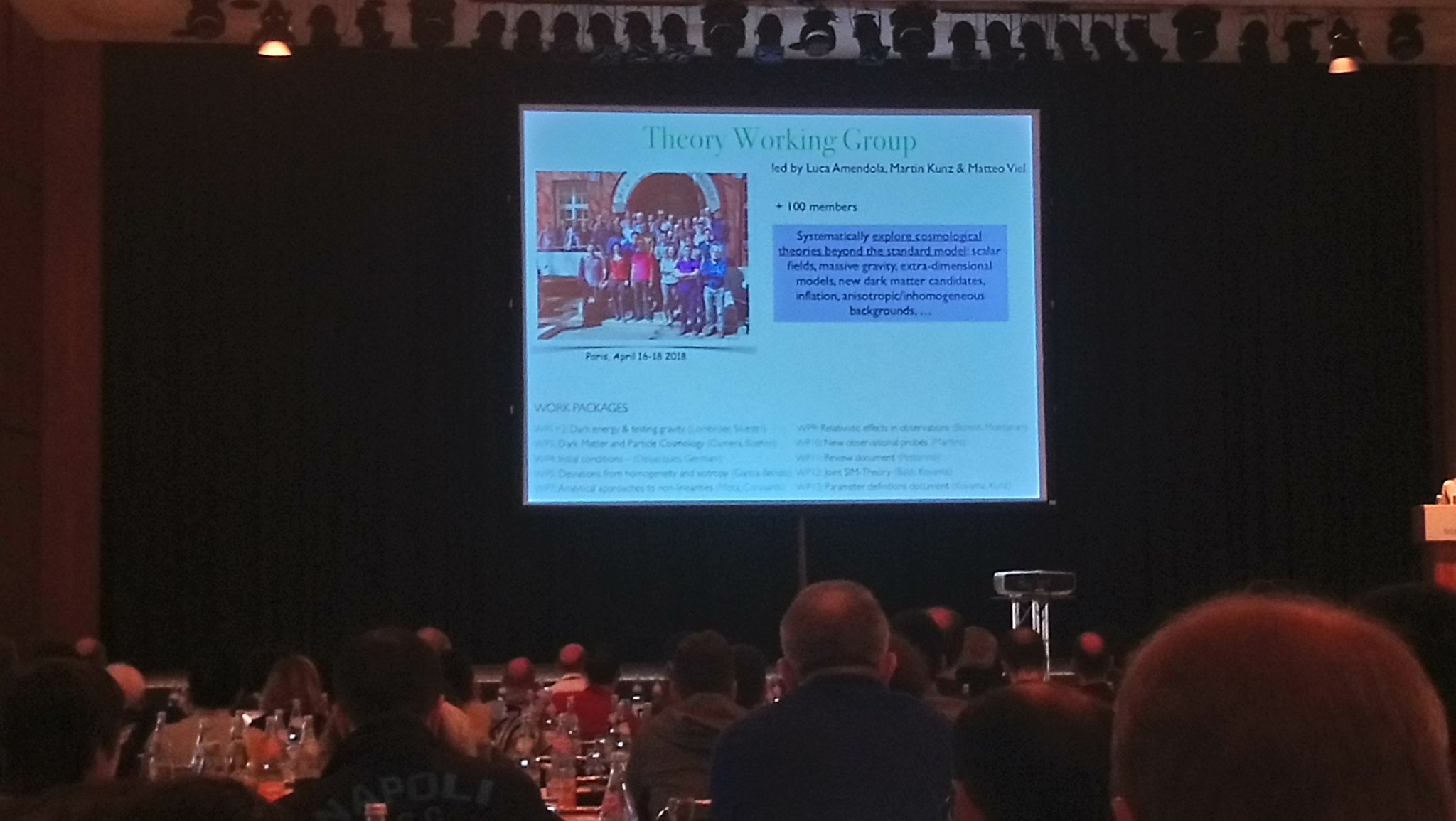
Among the SWG updates was one by Alessandra Silvestri from the Theory Working Group concentrating on how Euclid could be used to test cosmology beyond the standard model. She focussed quite a lot on Horndeski Gravity, which is the most general four-dimensional scalar-tensor theory that leads to equations of motion that have the form of second-order differential equations.

Towards the end of the day there was a session devoted to the award of the Euclid Star Prizes.

The individual awards went to Micaela Bagley, Carmelita Carbone, Teake Nutma, Bertrand Morin, and Stefanie Wachter; more details on the winners and the awards they won will be posted here. The team award was given to the Flagship simulation team. Coincidentally, I posted about the Flagship simulations last year. Much of the preparation for Euclid would be impossible without these simulations, and the award of a prize to the team is very well justified.

The day finished with short talks from each of the prizewinners. That brought to the end two days of plenary sessions in the big hall of the Stadthalle. The next two days will be the `Splinter sessions’ which are held in parallel.

Oh, and one other thing: the 2019 Euclid Consortium Meeting will be held in Helsinki from June 4-7. Looks like I’ll be spending my birthday in Finland next year!

P.S. Previous Euclid Consortium meetings were: Bologna (2011);  Copenhagen (2012); Leiden (2013); Marseille (2014);  Lausanne (2015); Lisbon (2016); and London (2017).

News from Euclid 2018

Posted in Biographical, Euclid, The Universe and Stuff on June 11, 2018 by telescoper

At the second attempt I managed to check in for my flight to Cologne (which is apparently near a place called) en route to Bonn for the Euclid 2018 Consortium Meeting.

I was mightily relieved when a plane actually arrived this time.

We got to our destination just about on time. I bumped into fellow Euclidean Tom Kitching in the airport and we made it to the conference venue in time for a spot of lunch, after which the afternoon session was kicked off by Mark Cropper:

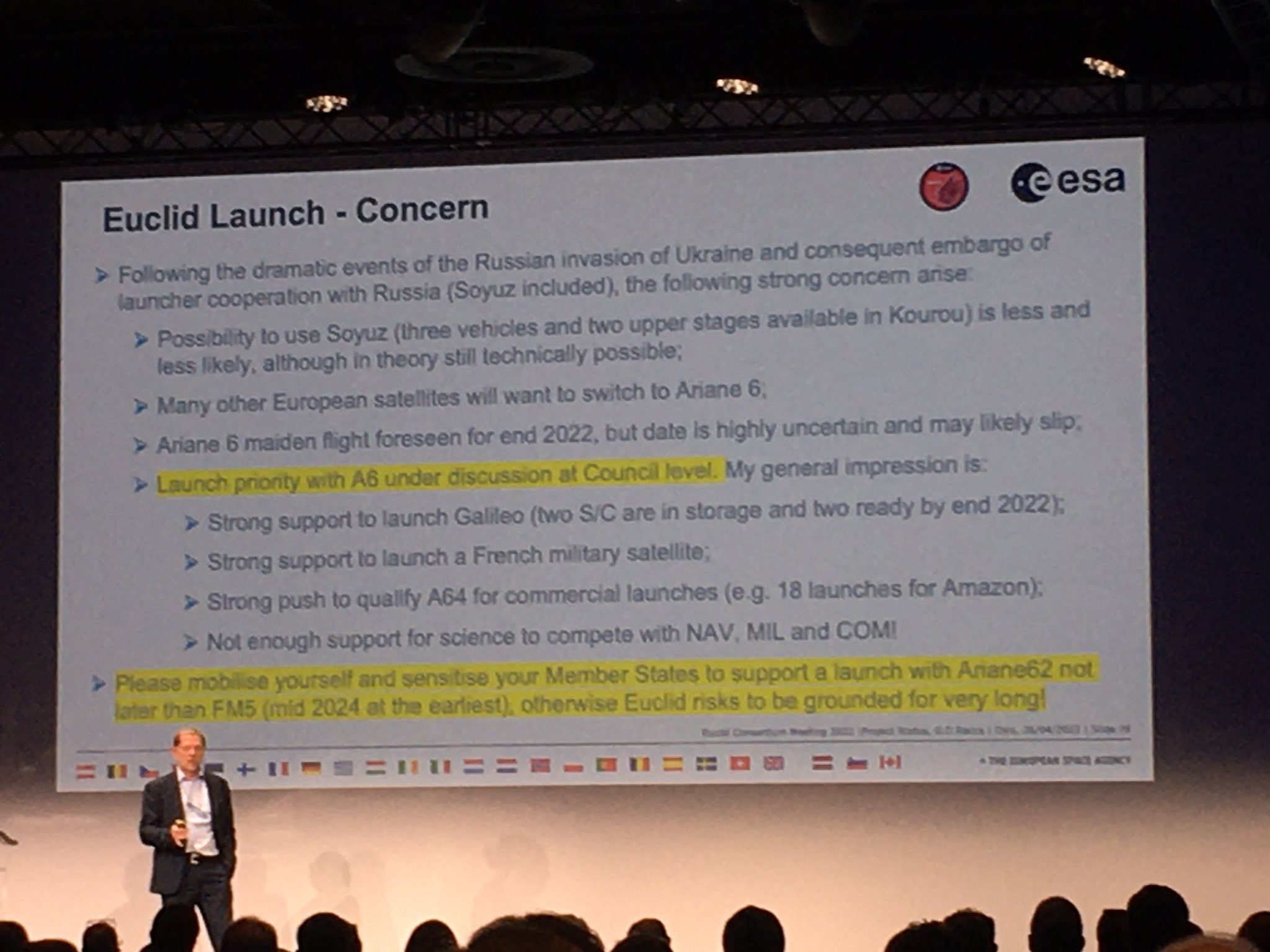
I missed the morning session, during which the most important piece of news was an official announcement that the launch date of Euclid has been moved back from 2020 until 2022. This was not unexpected, and is largely driven by problems with on-board electronic system, but it will obviously impact the timetable of the mission significantly.

Since the flight of Euclid will be delayed for two years, I wonder which hotel it will be staying in at ESA’s expense?

Maynooth joins the Euclid Community

Posted in Euclid, Maynooth, The Universe and Stuff with tags , , , on January 10, 2018 by telescoper

There’s a nice webpage showing all the institutions around the world who belong to the consortium behind the European Space Agency’s Euclid Mission. Here’s a screen grab that shows all the logos of all the institutions involved in this very large Consortium:

There are so many that it’s hard to see them all, but if you look very closely about half way down, among the Ms, you will see Maynooth University among them. This is the first institution in Ireland to have joined the Euclid Consortium and it has just been officially added thanks to yours truly moving there later this year. Ireland is a member state of the European Space Agency, by the way.

Euclid’s Flagship Simulation

Posted in Euclid, The Universe and Stuff with tags , , on July 28, 2017 by telescoper


Credit: J. Carretero/P. Tallada/S. Serrano for ICE/PIC/U.Zurich and the Euclid Consortium Cosmological Simulations Science Working Group.

The above image is taken from the world’s largest simulated galaxy catalogue, which has been constructed to help prepare for the  forthcoming Euclid space mission. The image actually shows only a small part of the full Euclid Flagship mock galaxy catalogue, which contains more than 2 thousand million galaxies distributed over the 3-dimension cosmological volume that Euclid will survey. Synthetic galaxies in this simulation mimic with great detail the complex properties that real sources display: ranging from their shapes, colours, luminosities, and emission lines in their spectra, to the gravitational lensing distortions that affect the light emitted by distant galaxies as it travels to us. The simulation is large enough to allow full `light-cone’ effects to be taken into account, as the look-back time to the edge of the Euclid survey volume is long enough for significant evolution to have occurred; according to the standard cosmological model, the time taken for light to travel from redshift z=2.3 to now is about 10.8 billion years, a significant fraction of the age of the Universe.

`Mock’ catalogues like this are needed to plan large observational programmes, whether using space missions or ground-based facilities, and to help prepare the data analysis strategies and tools needed to deal with the real data when it arrives. They can also be used to make excellent images for PR and outreach purposes.

The use of the word `simulation’ always makes me smile. Being a crossword nut I spend far too much time looking in dictionaries but one often finds quite amusing things there. This is how the Oxford English Dictionary defines SIMULATION:

1.

a. The action or practice of simulating, with intent to deceive; false pretence, deceitful profession.

b. Tendency to assume a form resembling that of something else; unconscious imitation.

2. A false assumption or display, a surface resemblance or imitation, of something.

3. The technique of imitating the behaviour of some situation or process (whether economic, military, mechanical, etc.) by means of a suitably analogous situation or apparatus, esp. for the purpose of study or personnel training.

So it’s only the third entry that gives the meaning intended to be conveyed by the usage in the context of cosmological simulations. This is worth bearing in mind if you prefer old-fashioned analytical theory and want to wind up a simulationist!

In football, of course, you can even get sent off for simulation…