Archive for the Finance Category

Farewell, then, Leighton Andrews…

Posted in Education, Finance, Politics with tags , , , , , , , on June 27, 2013 by telescoper

Although I no longer live in Wales I couldn’t resist commenting on the resignation, announced on Tuesday, of the Welsh Education Minister, Leighton Andrews. It seems that Mr Andrews was spotted holding a placard protesting against the planned closure of a school, a closure that results from his own policies. Personally, I think that it’s quite an imaginative move for a Minister to campaign against his own policies. It shows an open-mindedness absent in most politicians.

Leighton Andrews will probably be best remembered as the architect of the policy that students domiciled in Wales would be protected from having to pay large tuition fee rise by a system of grants, meaning that the Welsh Assembly will pick up the tab for Welsh students. They will still have to pay the “old”  fee level of £3290 per annum, but the WAG will pay the extra approx £6K charged by most Universities since the fee cap was raised. This is good news for the students of course, but the grants will be available to Welsh students not just for study in Welsh universities but wherever they choose to go. Since about 16,000 Welsh students are currently at university in England, this means that the WAG is handing over a great big chunk (up to 16,000 × £6000 = £96 million) of its hard-earned budget straight back to England. This has always seemed to me a very strange thing to do when the Welsh Government is constantly complaining that the Barnett formula doesn’t give them enough money in the first place.

What’s more, the Welsh Assembly grants for Welsh students are paid for by top-slicing the grants that HECFW makes to Welsh universities. So funding cuts for universities in Wales have been  imposed in order to subsidize English universities. This is hardly in the spirit of devolution either!

English students wanting to study in Wales will have to pay full whack, but will be paying to attend universities whose overall level of state funding is even lower than in England (at least for STEM subjects whose subsidy is protected in England). Currently about 25,000 English students study in Wales, compared with the 16,000 Welsh students who study in England, but I wonder how many of them realize that if they study England their £9K fee attracts an additional investment of £1.5K from HEFCE whereas there is no equivalent central resource supplied by HEFCW if they study in Wales? To put it another way, each £1 of tuition fee paid by a STEM student is worth £1.16 in England, but just £1 in Wales.

The other drastic implication of this policy is that HEFCW will have no money left to fund research via the QR mechanism that pertains in England (at least for the time being). I blogged about this a couple of days ago so won’t say any more today.

I don’t think any of my former colleagues in Cardiff are terribly upset to see Leighton Andrews go, but there is some nervousness about whether the replacement might be even worse. The new Education Minister is Huw Lewis. I wish him well in his new post, and hope he has the courage to question some of the decisions made by his predecessor that have had such a negative effect on education in Wales.

Anyway, in bidding farewell to Leighton Andrews I thought I’d show him all due respect, and do him the honour of presenting a look-alike. All reference to Muppets purely coincidental…

Slide1

University Research Funding: Will the Axe Fall on QR?

Posted in Finance, Politics, Science Politics with tags , , , on June 25, 2013 by telescoper

As we tremble in anticipation of this week’s Spending Review, which will determine the budgets for Science and Higher Education in 2015/16, there’s fairly strong evidence that Chancellor of the Exchequer George Osborne is looking to save about £11.5 billion of public spending. Given that funding for some Whitehall departments is ring-fenced there is considerable speculation that the axe will fall heavily on the Department for Business, Innovation and Skills (BIS), which seems likely to have to make over £1 billion of savings.

But where will these savings in the BIS budget be made? The government has made noises that it will protect science funding (at least in cash terms) so big cuts in the larger research council budgets appear unlikely. However, Treasury officials have been rumoured as thinking that the Universities are now “awash with money” and should therefore be cut. On the other hand, incoming for University teaching now largely comes from fees so there’s very little of the HEFCE teaching budget to cut further.

Now here’s the rub. The part of HEFCE’s budget that deals with research amounts to about £1.6 billion per year. This, the so-called `QR’ funding, is currently being distributed to Higher Education Institutions according to the outcome of the 2008 Research Assessment Exercise (RAE). This year we
are preparing submissions to a new system called the Research Excellence Framework (REF), which was always intended to be used to distribute QR funding from 2015/16 onwards. But what if the government decides that the only way to balance the books is to remove the QR funding stream entirely?

The 2012 funding letter from HEFCE states explains that it is distributing

£1,558 million for research. The ring-fenced settlement for science and research means that we will be able to maintain overall funding, in cash terms, until 2014-15.

But this does not include the period covered by the spending review, so it’s perfectly possible that the “ring fence” could be removed, or at least re-interpreted as a result of this spending review.

The government could argue that QR and Research Council grant income correlate so well that there’s no need to continue with the current dual funding system, by which the Research Councils provide grants for specific projects and programmes and the higher education funding bodies provide block grant funding to universities via the QR line. It could also argue that the high fees being charged mean that Universities will be able to cope with these cuts without undue hardship. There is a precedent in Wales, where HEFCW will not be awarding any QR funding after the 2013 REF, so why shouldn’t England do the same? They could also get away with the argument that this money isn’t part of the ring fence mentioned above.

The only problem is that so many institutions have spent so much time on preparations for the REF that cancelling the funding associated with it will mean all that effort is wasted. Indeed, the only remaining justification (if it can be called that) for Universities participating in the REF is for position in various league tables, which is rather a lot of expense for something of extremely debatable value.

Anyway, if I were a gambling man (which I am, actually) I don’t think I’d be betting against this outcome. Predictions are very difficult, especially about the future, but this one is mine. And I hope it’s proved wrong…

Tuition Fee Caps

Posted in Education, Finance, Politics with tags , , , , , , , on May 27, 2013 by telescoper

I know it’s a Bank Holiday, but I’ve been thinking…

About a week ago I posted an item arguing that the current system of higher education funding is detrimental to the health of STEM disciplines (i.e. Science, Technology, Engineering and Mathematics). The main reason for this is that present funding arrangements fail to address the real difference in cost of degree courses in various disciplines: the income to a University for a student doing Physics is about £10.5K whereas for a student doing, say, English it is £9K. I would  estimate the extra cost for the former corresponds to at least a factor two and probably more. That’s partly because Physics requires laboratory space and equipment (and related technical support) that English does not, but also because Physics students receive many more contact hours with academic staff.  The issue is just as much about arts students being ripped off (as they undoubtedly are being) as it is a strategic failure to protect the sciences.

The problem is that the Council responsible for distributing funding (HEFCE) is strapped for cash, so is unable to fund STEM disciplines at the higher level of resource that it used to.  Since the government has decided, in its  (finite) wisdom, to transfer most of the cost of higher education to the students, HEFCE can now exert very little influence on how universities plan their portfolio of courses. Since it is a lot cheaper and easier to expand capacity in Arts & Social Sciences faculties than in the more expensive STEM disciplines, this is an incentive for Universities to turn away from the Sciences. Given our economic predicament this policy is simply perverse. We need more scientists and engineers, not fewer.

This morning I read an article in the Times Higher about the present £9K tuition fee cap. Not surprisingly the Russell Group of self-styled “elite” Universities wants it lifted, presumably so its Vice-Chancellors can receive even bigger pay rises. But that’s not the point. The article made me think of a cunning (or perhaps daft) plan, which I’m floating here with the prediction that people will shoot it down through the comments box.

Now before I go on, I just want to make it clear that I’m not – and never have been – in favour of the present funding system. I don’t object to the principle that students who can afford to should contribute to the cost of higher education, but the arrangements we’re stuck with are indefensible and I don’t think they will last long into the next Parliament. It’s telling that, only a decade after introducing tuition fees, Germany is now scrapping them. I’d prefer a hybdrid system in which the taxpayer funds scholarships for STEM disciplines and other strategically important areas, while leaving universities to charge fees for other disciplines.

However, since we’ve been lumbered with a silly system, it’s worth exploring what might be achieved by working within it. There doesn’t seem to be much creative thinking going on in the coalition, and the Labour Party just says it would reduce the fee cap to £6K which would squeeze all academic disciplines equally, without doing anything about the anomalies mentioned above.

My  idea is quite simple. I propose that universities be entitled to lift their fee levels for STEM subjects by an amount X, provide that they reduce the fees for Arts and Social Sciences students by the same amount. The current fee level is £9K for all disciplines, so an example might be for STEM subjects to charge £12K while A&SS (if you pardon the abbreviation) get £6K. That would achieve the factor of two differential I mentioned above.

The advantages of this proposal are that it gives an incentive for universities to promote STEM disciplines and more properly reflects the difference in cost of the different subjects, without increasing the cost to the Treasury. In fact only about 25% of students study in STEM disciplines, at least for the moment, so the cost of fee loans will actually go down

The biggest potential flaw is  that increasing the cost to STEM students would put them off. There’s simply no data on which to base an argument as to whether this would be the case or not. I suspect however that a difference in price would be perceived by many as a difference in value.

Anyway, it’s just an idea. That’s what blogs are for. Thinking out loud as it were. Feel free to object..

The Threat to STEM from HEFCE’s Funding Policies

Posted in Education, Finance with tags , , , , , on May 19, 2013 by telescoper

In my job here as Head of the School of Mathematical and Physical Sciences (MPS)  at the University of Sussex, I’ve been been spending a lot of time recently on trying to understand the way the School’s budget works, sorting out what remains to be done for this financial year, and planning the budget for next year. In the course of doing all that it has become clear to me that the current funding arrangements from the Higher Education Funding Council for England (HEFCE) are extremely worrying for Science, Technology, Engineering and Mathematics (STEM) disciplines.

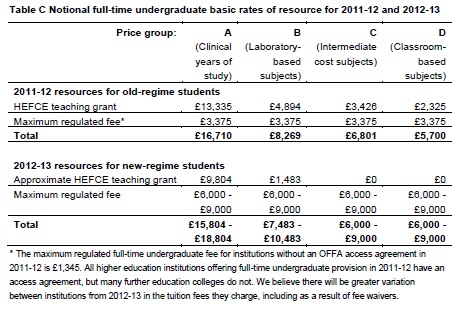
Before the introduction  of the £9K tuition fees this academic year (i.e. in the `old regime’), a University would receive income from tuition fees of up to £3375 per student and from a `unit of resource’ or `teaching grant’ that depends on the subject. As shown in the upper part of Table C below which is taken from a HEFCE document:

Budgets

In the old regime, the  maximum income per student in Physics was thus £8,269 whereas for a typical Arts/Humanities student the maximum was £5,700. That means there was a 45% difference in funding between these two types of subject. The reason for this difference is that subjects such as physics are much more expensive to teach. Not only do disciplines like physics require expensive laboratory facilities (and associated support staff), they also involve many more contact hours between students and academic staff than in, e.g. an Arts subject.  However, the differential is not as large as you might think: there’s only a factor two difference in teaching grant between the lowest band (D, including Sociology, Economics, Business Studies, Law and Education) and the STEM band B (including my own subject, Physics). The real difference in cost is much larger than that, and not just because science subjects need laboratories and the like.

To give an example, I was talking recently to a student from a Humanities department at a leading University (not my employer). Each week she gets 3 lectures and one two-hour seminar, the latter  usually run by a research student. That’s it for her contact with the department. That meagre level of contact is by no means unusual, and some universities offer even less tuition than that.

In my School, MPS, a typical student can expect around 20 contact hours per week including lectures, exercise classes, laboratory sessions, and a tutorial (usually in a group of four). The vast majority of these sessions are done by full-time academic staff, not PDRAs or PhD students, although we do employ such folks in laboratory sessions and for a very small number of lectures. It doesn’t take Albert Einstein to work out that 20 hours of staff time costs a lot more than 3, and that’s even before you include the cost of the laboratories and equipment needed to teach physics.

Now look at what happens in the `new regime’, as displayed in the lower table in the figure. In the current system, students still pay the same fee for STEM and non-STEM subjects (£9K in most HEIs) but the teaching grant is now £1483 for Physics and nothing at all for Bands C and D. The difference in income is thus just £1,483 or in percentage terms, a difference of just 16.4. Worse than this, there’s no requirement that this extra resource be spent on the disciplines with which it is associated anyway. In most universities, all the tuition income goes into central coffers and is dispersed to Schools and Departments according to the whims of the University Management.

Of course the new fee levels have led to an increase in income to Universities across all disciplines, which is welcome because it should allow institutions to improve the quality of their teaching bu purchasing better equipment, etc. But the current arrangements as a powerful disincentive for a university to invest in expensive subjects, such as Physics, relative to Arts & Humanities subjects such as English or History. It also rips off  staff and students in those disciplines, the students because they are given very little teaching in return for their fee, and the staff because we have to work far harder than our colleagues in other disciplines, who  fob off  most of what little teaching their supposed to do onto PhD students badged as Teaching Assistants. It is fortunate for this country that scientists working in its universities show such immense dedication to teaching as well as research that they’re prepared to carry on working in a University environment that is so clearly biased against STEM disciplines.

To get another angle on this argument, consider the comments made by senior members of the legal profession who are concerned about the drastic overproduction of law graduates. Only about half those doing the Bar Professional Training Course after a law degree stand any chance of getting a job as a lawyer in the UK. Contrast this with the situation in science subjects, where we don’t even produce enough graduates to ensure that schools have an adequate supply of science teachers. The system is completely out of balance. Here at Sussex, only about a quarter of students take courses in STEM subjects; nationally the figure is even lower, around 20%…

I don’t see anything on the horizon that will alter this ridiculous situation. STEM subjects will continue to be stifled as universities  follow the incentive to invest in cheaper subjects and will continue to overproduce graduates in other areas. The present Chief Executive of HEFCE is stepping down. Will whoever takes over from him have the guts to do anything about this anti-STEM bias?

I doubt the free-market ideologues in Westminster would even think of intervening either, because the only two possible changes are: (i) to increase the fee for STEM subjects relative to others; and (ii) to increase the teaching grant. Option (i) would lead to a collapse in demand for the very subjects it was intended to save and option (ii) would involve increasing public expenditure, which is anathema to the government even if it is an investment in the UK’s future. Or maybe it’s making a complete botch of the situation deliberately, as part of a cunning plan to encourage universities to go private?

Should UK Research Funding Be Reorganized?

Posted in Finance, Science Politics with tags , , , , , , , , , , on April 13, 2013 by telescoper

A couple of recent news items spurred me on to reflect a bit about the system of research funding in the UK. The first of these was an item I noticed a while ago in Research Fortnight about the (ongoing) Triennial Review of the research councils, and specifically, input from the Wellcome Trust to that review that was rather critical of the Science and Technology Facilities Council and suggested it might be dismantled.

For context it’s probably a good idea to look back to the formation of STFC in 2007 via the merger of the Particle Physics and Astronomy Research Council (PPARC) and the Council for the Central Laboratories of the Research Councils (CCLRC). Previously, PPARC had looked after particle physics and astronomy (including space science) and CCLRC had run large experimental facilities in other branches of science. The idea of merging them wasn’t silly. A large chunk of PPARC’s budget went on managing large facilities, especially ground-based astronomical observatories, and it was probably hoped that it would be more efficient to put all these big expensive pieces of kit under the same roof (so to speak).

However, at the time, there was considerable discussion about what should happen in general with science grants. For example, physicists working in UK universities in areas outside astronomy and particle physics previously obtained research grants from the Engineering and Physical Sciences Research Council (EPSRC), along with chemists, engineers and even mathematicians. Some experimentalists working in these areas used facilities run by the CCLRC to do their work. However, astronomers and particle physicists got their grants from PPARC, the same organisation that ran their facilities and also paid subscriptions to international agencies such as CERN and ESA. These grants were often termed “exploitation”  or “responsive mode” grants; they involved funding for postdoctoral researchers and staff time used in analysing observational or experimental data and comprised relatively little money compared the the cost of the PPARC facilities themselves. PPARC also funded PhD studentships and postdoctoral fellowships under the umbrella of its Education and Training division, although needless to say all the Education and Training involved was done in host universities, not by PPARC itself.

The question was whether the new merged organisation, STFC should continue giving grants to university groups or whether the responsibility for doing this should be moved elsewhere, perhaps to EPSRC. At the time, most astronomers were keen to have their research grants administered by the same organisation that ran the facilities. I thought it made more sense to have research scientists all on the same footing when it came to funding and in any case thought there were too many absurd divisions between, say, general relativity (EPSRC) and relativistic astrophysics (PPARC), so I was among the (relatively few) dissenting voices at the time.

There were other reasons for my unease. One was that, during a previously funding squeeze, PPARC had taken money from the grants line (the pot of money used for funding research groups) in order to balance the books, necessarily reducing the amount of science being done with its facilities. If STFC decided to do this it would probably cause even more pain, because grants would be an even smaller fraction of the budget in STFC than they were in PPARC. Those EPSRC physicists using CCLRC facilities seem to have managed pretty well so I didn’t really see the argument for astronomy and particle physics being inside STFC.

The other reason for me wanting to keep research grants out of STFC was that the (then) new Chief Executive of PPARC, Keith Mason, had made no secret of the disdain he felt towards university-based astronomy groups and had stated on a number of occasions his opinion that there were too many astronomers in the United Kingdom. There are two flaws with this argument. One is that astronomy is essential to the viability of many physics departments because of its appeal to potential students; without it, many departments will fold. The other problem is that Mason’s claim that the number of astronomers had grown by 40% in a few years was simply bogus.  This attitude convinced me that he in particular would need only the slightest excuse to divert funds away from astronomy into areas such as space exploration.

It all seems a very distant memory now, but six or years ago UK physics (including astronomy) was experiencing a time of relative plenty. The government had introduced a system whereby the research councils would fund research groups on the basis of the Full Economic Cost of the research, which meant more money coming into research groups that were successful at winning grants. The government increased funding for the councils to pay for this largesse and probably diminished the fear of another funding pinch. Astronomers and particle physicists also felt they would have more influence over future strategy in facility development by remaining within the same organisation. In the end what happened was that STFC not only kept the portfolio of astronomy and particle physics grants, but also acquired responsibility for nuclear physics from EPSRC.

But then, in 2007, just after STFC came into existence,  a major financial disaster broke: that year’s comprehensive spending review left the newly formed STFC with a huge gap in its finances. I don’t know why this happened but it was probably a combination of gross incompetence on behalf of the STFC Executive and deliberate action by persons higher up in the Civil Service. The subsequent behaviour of the Chief Executive of STFC led to a public dressing down by the House of Commons Select Committee and a complete loss of confidence in him by the scientific community. Miraculously, he survived, at least for a while. Unfortunately, so did the financial problems that are his legacy.

I don’t like to say I told you so, but that’s exactly what I am going to dp. Everything that happened was predictable given the initial conditions. You might argue that STFC wasn’t to know about the global economic downturn.As a matter of fact I’d agree. However, the deep cuts in the science budget we have seen have very little to do with that. They all stem from the period before the Credit Crunch even started. Although Prof. Mason was eventually replaced (in 20111), the problems inherent in STFC are far from solved.

The last Comprehensive Spending Review (2010) was less bad for STFC than some of us feared – with a level cash settlement which still holds. In real times the funds are now being eroded rather than being slashed further, but the situation remains very difficult because of past damage. I don’t think STFC  can afford to settle for flat cash at the next spending review. The new Supreme Leader  Chief Executive of STFC, John Womersley, said much the same thing at last night’s RAS dinner, in fact.

I know this preamble has been a bit long-winded, but I think it’s necessary to see the background to what I’m going to propose. These are the steps I think need to be taken to put UK physics back on track.

First, the powers that be have to realize that university researchers are not just the icing on the cake when it comes to science: they actually do most of the science. I think the new regime at STFC recognizes this, but I’m not sure the government does. Another problem is that  that the way scientists are supported in their research is a complete mess. It’s called the dual support system, because the research councils pay 80% of the cost of research grants and Higher Education Funding Councils (i.e. HEFCE in England) are meant to provide the other 20%. But in reality it is a bureaucratic nightmare that subjects researchers to endless form-filling and costs hundreds of millions in wasteful duplication. This was true enough of the old Research Assessment Exercise, but has been taken to even higher levels of absurdity by the forthcoming Research Excellence Framework, the decisions coming out of which will be more influencing by guesswork and institutional game-playing than actual research excellence.

The Research Councils already have well-managed systems to judge the quality of research grant applications, so do we really needed the REF on top of them?  The second article I referred to in the introduction, on a study showing that Research Council grant income, appeared in last week’s Times Higher. That study shows -at least at institutional level – that the two streams are pretty closely correlated. While REF/RAE income is awarded on a retrospective basis, and grant awards are based on proposals of future activity, it should be a surprise that people with a good track-record are also good at thinking up interesting new projects. Moreover, panels such as the STFC Astronomy Grant Panel (of which I am a member) certainly take into account the applicants’ track-record when assessing the viability of research proposals.

So if we don’t need two systems, what could we have instead? Moving grants from STFC to EPSRC, as some proposed in the past,  would go part of the way, but EPSRC has many problems too. I would therefore prefer to see a new organisation, specifically intended to fund blue-skies scientific research in universities. This organisation would have a mission statement that  makes its remit clear, and it would take over grants, studentships and fellowships from STFC, EPSRC and possibly some of the other research councils, such as NERC.  The new outfit would need a suitable acronym, but I can’t think of a good one at the moment. Answers on a postcard.

As a further suggestion,  I think there’s a strong case to be made that HEFCE should be deprived of its responsibility for research funding. The apparatus of research assessment it uses is obviously  flawed, but why is it needed anyway? If the government believes that research is essential to universities, its policy on selectivity doesn’t make any sense. On the other hand, if it believes that university departments don’t need to be research groups then why shouldn’t the research funding element be administered by a reserch organisation? Even better, a new University Research Council along the lines I have suggested  could fund research at 100% of the Full Economic Cost instead of only 80%. The substantial cash saved by scrapping the REF should be pumped into grants to be administered by the new organisation, reversing the  cuts imposed we’ve endured over past years.

So what should  STFC become after the Triennial Review? Clearly there is still a role for an organisation to manage large experimental facilities. However, the fact that the UK now has its own Space Agency means that some activity has already been taken out of the STFC remit.  The CERN and ESO subscriptions could continue to be managed by STFC along with other facilities, and it could in some cases commission projects in university research groups or industrial labs as it does now. Astronomers and particle physicists would continue to sit on its Board.  However, its status would change radically, in that it would become an organisation whose job is to manage facilities, not research. The tail will no longer be wagging the dog.

I very much doubt if these suggestions are at all in line with current political “thinking” nor with those of many of my colleagues. The input to the Triennial Review from the Institute of Physics, for example, is basically that nothing should change. However, I think that’s largely because most of us working in STFC area,  have much greater confidence in the current management than we did in the previous regime rather than because the structure is right. Some of the bureaucrats in the Treasury, RCUK and HEFCE won’t like my suggestion  either, because they’ll all have to go and do something more useful.  But unless someone stands up for the university sector and does something to safeguard future funding then the ongoing decline in funding levels will never be reversed.

I very much doubt if many of my fellow physicists or astronomers agree with my suggestion either. Not to worry. I’m used to being in a minority of one. However, even if this is the case I hope this somewhat lengthy post will at least get you thinking. As always, I’d be interested in comments..

R.I.P. Ray Bradbury (1920-2012)

Posted in Finance, Literature with tags , , on June 7, 2012 by telescoper

I was deeply saddened yesterday to hear news of the death at the age of 91 of writer Ray Bradbury. The resulting wave of comments on twitter and facebook from friends and colleagues and the wider world testifies to the joy and wonder he brought into so many lives. Bradbury was so much more than a science fiction writer (although he did write great science fiction). He was a rare example of an author whose work transcended genre. His limitless imagination and fluid writing style also allowed him to make light work of that most difficult form, the short story.

One of my  very first blog posts – way back in October 2008 – was inspired by a collection of Ray Bradbury stories called The October Country.  To mark his passing I thought I’d recycle it here. World news hasn’t changed much, so it’s still relevant. Except  it’s not October. Yet.

–0–

I don’t know why I stopped reading science fiction and fantasy stories. I don’t know exactly when either. Perhaps it was a gradual thing to do with getting older. But when I was a teenager that’s the sort of thing I read all the time. I was a big fan of Michael Moorcock and read book after book of his stories, from the swords and sorcery novellas to the amazing End of Time series, and even the trippy psychedelic 1960s adventures of Jerry Cornelius. I enjoyed Tolkien, Mervyn Peake, Isaac Asimov,  Arthur C. Clarke and many others which I usually binge-read by buying everything I could find by a given author and ploughing through them one after the other.

One of the authors whose work I devoured in this way was Ray Bradbury, and his books are among the few that I still like to re-read from time to time. To be honest, I wasn’t all that keen on the pure science fiction books like The Martian Chronicles, but I loved his collections of macabre short stories. Perhaps it’s because I now know how difficult it is to write in that genre that my appreciation of his story-telling skill has if anything grown with time.

I was watching the news last night about the continuing tailspin in the world’s stock markets and it reminded me of one of my favourite collections of Ray Bradbury stories, The October Country. I rummaged around in the stacks of old paperbacks I still haven’t got around to putting on shelves – mainly because I haven’t got around to buying enough shelves – and finally located my copy. It’s a weirdly eclectic mixture of the whimsical and the frightening.

The October Country of the title isn’t a specific place. It is many places:

..a picturesque Mexican village where death is a tourist attraction; a city beneath the city where drowned lovers are silently reunited; a carnival midway where a tiny man’s most cherished fantasy can be fulfilled night after night. The October Country’s inhabitants live, dream, work, die–and sometimes live again–discovering, often too late, the high price of citizenship. Here a glass jar can hold memories and nightmares; a woman’s newborn child can plot murder; and a man’s skeleton can wage war against him. Here there is no escaping the dark stranger who lives upstairs…or the reaper who wields the world.

What binds the separate tales together is the way Bradbury conjures up an atmosphere that is both autumnal and alien, both familiar and unnerving, like that of a long-forgotten room where dust gathers on lost artefacts of the past.

But what does this have to do with Stock Markets?

The baffling thing is that the greatest episodes of spine-chilling terror that grip the stock market from time to time also always seem to happen in October. The great Wall Street Crash of 1929 happened in October. More recently, the 1987 crash known Black Monday happened in the same month. Now, in 2008, although the credit crunch has been with us for a significant time, the most dramatic drops in share prices have also been in October.

In order to find the answer to why this is the case I went to Wikianswers and discovered somebody has already posted the question, but so far there have been no answers.

Whatever it is, something about October seems to give investors the jitters.

I blame Ray Bradbury.

49 not out

Posted in Biographical, Finance, Politics with tags , , on June 5, 2012 by telescoper

Yesterday having been my birthday – which Her Majesty The Queen kindly declared to be a national holiday – I am now just a year short of a half-century. HMQ has decreed that today is also a national holiday, thus giving me the chance to get rid of my hangover before returning to work a year older on Wednesday.

Fortunately I didn’t have to endure the Queen’s Official party at Buckingham Palace on TV  last night, and instead went to see the fabulous Lady Boys of Bangkok who are in Cardiff all week as part of their UK Tour. They perform in the purpose-built mobile Sabai Pavilion which for this week is situated in Cardiff Bay. Not only did I enjoy the show, I also escaped being hauled up on stage and turned into part of the act. Other members of the audience weren’t so fortunate…

I suspect most of the audience there were also celebrating birthdays or other special occasions, but some were probably just trying to escape from the all-encompassing Jubilee celebrations, of which I’m sure I’m not alone in being completely bored.  So bored, in fact, that I can’t even be bothered to go into the whole Monarchist versus Republican thing.

Still, at least I wasn’t forced to work as an unpaid steward at the stupid river pageant on Sunday, and required to sleep rough under London Bridge, under threat of losing my benefits. Slavery is another fine British tradition.

I think the people who focus on getting rid of the  Monarchy are misguided. Of course it’s an undemocratic and anachronistic institution, but it only has a symbolic status; it doesn’t have any actual power. The real threat to democracy is not the Royal Family, but the rampant capitalism that taken the world’s financial systems to the brink of chaos. Only when we’ve come up with a sensible plan for the world economy in the post-capitalist era – which, in my view, is approaching rapidly – will it be worth making the effort to remove some of the tattered decorations left behind by the old system.

The ongoing financial crisis gripping the world’s economy only exists because governments were persuaded of the need to use taxpayers’ money to underwrite losses in the banking sector. Bankers like capitalism when it comes to making profits, but are happy to fall back on socialism when they make a mess. Now the bankers’ losses have turned into a crippling burden of sovereign debt that could take decades to pay off. And who profits from this? The people who made the mess in the first place.

There is an obvious solution to this problem. A one-off tax of 20% of the accumulated wealth  of the top 10% of the population would raise a staggering £800 billion for the Treasury. This option isn’t even discussed in Parliament because our politicians know their masters wouldn’t like it. And so we go on squeezing ordinary folk and letting the rich off the hook. I don’t think this can go on forever without someone figuring out that we’ve been royally had.

Is this the “Squeezed Middle”?

Posted in Education, Finance with tags , , on March 29, 2012 by telescoper

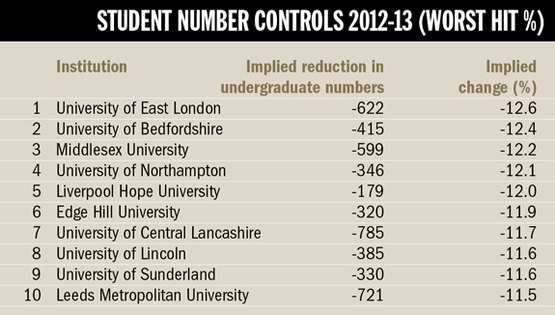
As reported in the Times Higher , the Higher Education Funding Council for England (HEFCE) has announced its allocations to English Higher Education Institutions for 2012/13. As expected, many universities are receiving substantial cuts next year. Here is a table of the biggest losers:

The Times Higher article describes this as the “Squeezed Middle”. It looks more like the “Squeezed Bottom” to me, but then I suppose that would have made an inappropriate headline.

Is there really a University of Sunderland?

Anyways, this allows me the chance to congratulate the former Director of Learning and Teaching in the School of Physics & Astronomy at Cardiff University on his move to the University of Central Lancashire, currently riding high at Number 7 in the above table…


The Budget – a Pictorial Guide

Posted in Finance, Politics with tags , , on March 21, 2012 by telescoper

Courtesy of the BBC Webshite.

Worries for Science in Spain

Posted in Finance, Politics, Science Politics with tags , on March 10, 2012 by telescoper

I recently received the following email letter, concerning the state of science funding in Spain.  As well as passing it on to colleagues I thought I would post it on this blog where it might have wider impact:

Dear colleague,

You probably know very well how the global crisis is affecting southern Europe, and in particular Spain. Some of us are promoting a campaign among the worlwide scientific community to prevent our conservative government from straining even more the science system in Spain, that so many successes has obtained in the last decade, but whose future is now at stake.

In the next few weeks, and contravening recommendation from the European Commission stating that public deficit control measures should not affect Research and Development (R&D) and innovation, the Spanish Government and Parliament could approve a State Budget for 2012 that would cause considerable long-term damage to the already weakened Spanish research system, contributing to its collapse.

There is an open letter that we are sending to distinguished scientists all over the world, including many Nobel Prize Winners and Members of Academies of Science, asking them to sign, support the motion and spread the word:

http://www.investigaciondigna.es/wordpress/sign

Please do help us by signing the letter and passing it on to your colleagues.

Kind regards,

Alexander Knebe

The “open letter” you can read by clicking on the link contains some interesting – and alarming – information that has serious implications for our colleagues not only in Spain but elsewhere in Europe. Take a look, for example, at the following picture that shows the fraction of GDP being invested in science:

This isn’t just about Spain, although the situation is clearly especially serious for Spanish Science. It’s a timely reminder that the UK is also well below the EU average in terms of science spend. Is it a coincidence that the EU’s worst-performing economies are all on the right of this figure? Is that where we want the UK to be too?