Archive for the History Category

200 Years of the RAS Club

Posted in History, The Universe and Stuff with tags , , on January 11, 2020 by telescoper

Here I am in Heathrow Terminal 2 waiting for flight back to Dublin. I managed to get to London from Birmingham in time for a special dinner to mark the 200th anniversary of the RAS Club. As I have mentioned in previous posts, according to the brief history published on the RAS website:

The ‘Astronomical Society of London’ was conceived on 12 January 1820 when 14 gentlemen sat down to dinner at the Freemason’s Tavern, in Lincoln’s Inn Fields, London. After an unusually short gestation the new Society was born on 10 March 1820 with the first meeting of the Council and the Society as a whole. An early setback, when Sir Joseph Banks induced the Duke of Somerset to withdraw his agreement to be the first President, was overcome when Sir William Herschel agreed to be the titular first President, though he never actually took the Chair at a meeting.

Since the RAS Club always dines on the second Friday of the month after Ordinary Meetings of the Royal Astronomical Society itself, January 10th was the closest date to that first dinner. As expected for such a special occasion, there was a very big turnout with more than double the usual number of diners (and many more guests than usual). It was very nice to see some people I haven’t seen for ages! The food and wine were excellent and we ended with champagne and a slice of a cake baked and decorated for the occasion. Unfortunately it was so crowded in the Gallery Room that I couldn’t get close enough to take a photo of it before it was whisked away to be cut into slices.

After dinner we had some speeches, including one really brilliant one by my former colleague from Cardiff days, Mike Edmunds who had researched the `14 gentlemen’ who attended that first dinner. I had known previously that Charles Babbage and John Herschel were there but here (thanks to Mike) is a complete list:

Charles Babbage, Esq. M.A. F.R.S. L. & E. No. 5 Devonshire Street Portland Place
Arthur Baily, Esq, Gray’s Inn
Francis Baily, Esq. F.R.S. & L.S. Gray’s Inn
Major Thomas Colby, of the Royal Engineers, LL.D. F.R.S. L. & E. Tower
Henry T. Colebrooke, Esq. F.R.S. & L.S. Albany, Piccadilly
Olinthus G. Gregory, LL.D. Professor of Mathematics Royal Military Academy, Woolwich
Stephen Groombridge, Esq. F.R.S. S.R.A.Nap. Blackheath
J.F.W. Herschel, LL.D. F.R.S. Slough
Patrick Kelly, LL.D. Finsbury Square
Daniel Moore, Esq. F.R.S. S.A. & L.S. Lincoln’s Inn
Rev. William Pearson, LL.D. F.R.S. East Sheen, Surrey
James South, Esq. F.R.S. and L.S. No. 11 Blackman Street Southwark
Charles Stokes, Esq. F.R.S. S.A. & L.S. Gray’s Inn
Peter Slawinski D.P. Proff. University Wilna

P.S. Because I was attending the LGBTQ+ STEMinar I couldn’t get to the ordinary meeting of the Royal Astronomical Society earlier in the day, which was a shame because it was there that the winners of this year’s awards were announced. You can find a full list here. Congratulations to all!

Classics in the Russell Library

Posted in History, Literature, Maynooth, Uncategorized with tags on January 9, 2020 by telescoper

Here’s a taster of the wonderful collection of books and manuscripts in the Russell Library at Maynooth University..

Special Collections's avatarMU Library Treasures

Ruth O’Hara, Collections and Content

Ruth pic 1

Study of the classical world has been a staple of this University for centuries. The Russell Library’s classic’s collection, which was amassed largely by the early professors of St. Patrick’s College, is eclectic covering all areas of the ancient world and indeed it transcends disciplines. So, besides Homer and Virgil, for example, sit the poems of Catullus, the theological tracts of Ambrose of Milan, and the philosophical musings of Aristotle. One blog can’t hope to capture the extent and range of such a collection so, instead, I just want to look at some of the ways that we in the Russell Library continue to foster interest in this diverse subject area by integrating it into the research, teaching and life of the University.

We have found our classics collection to be a really useful resource for postgraduate students, for example, who engage with primary source…

View original post 426 more words

Change in Northern Ireland

Posted in History, Politics with tags , , on December 17, 2019 by telescoper

One of the potentially most significant outcomes of the 2019 General Election, but one barely mentioned in the English media, was what happened in Northern Ireland. For the first time ever, a majority of the MPs elected in the six counties were nationalist. The Social Democratic and Labour Party (SDLP) gained two seats to add to the seven of Sinn Féin (including a significant gain in Belfast North) while the Democratic Unionist Party (DUP) lost two to finish with eight. The remaining seat went to the Alliance, originally a moderate unionist party but now basically a liberal centrist (and anti-Brexit) party.

Here’s how the electoral map of Northern Ireland changed:

Sinn Féin seats are dark green, DUP orange, SDLP light green and Alliance yellow.

In terms of the popular vote, the DUP+UUP got 42.3% whereas SDLP+ Sinn Féin got 37.7. Both SF and DUP lost vote share compared to 2017 (by 6.7% and 5.4% respectively) at the expense of the Alliance (up 8.8%) and SDLP (up 3.1%).

Incremental differences, perhaps, but significant nonetheless – especially as Brexit hasn’t yet happened. After Brexit there will be a border in the Irish Sea, which will bring the end of partition one step closer. The probability of seeing a United Ireland in my lifetime has definitely increased.

It was no surprise to see the hashtag `#UnityPlan’ trending on Twitter immediately after the election. Irish unification will only happen if there is a public vote and a majority on both sides of the border agree. For that vote to be fair it is vital that there is a definite plan on how to proceed in the event that the vote is in favour, so the public know what they are voting for. The Irish should not make the mistake that Britain did over Brexit.

For many unionists religion was the primary reason for wanting to remain in the United Kingdom at the time of partition in 1921: Protestants felt that their identity would be threatened if they were made to join the Catholic South. Maybe they were right to feel nervous, as the original constitution of the Irish Free State enshrined “the special position of the Holy Catholic Apostolic and Roman Church”.  But the section including that phrase was deltd from the Constitution way back in 1973 and the Roman Church has far less influence in the Republic than it did. Ireland is now an open and progressive country, so I hope those fears have receded.

Just to confuse matters even further I should mention that my Grandfather, the one born in Belfast, to whom I owe my Irish citizenship,  was a protestant republican…

Those in the North who wish to keep their British passports should be able to do so in a United Ireland, just as those of us who were born in Britain but now live in Ireland can keep ours. I’ll be keeping mine, at least until it expires…

P.S. It is worth mentioning (primarily for British friends) that there are three counties in Ireland that belong to the province of Ulster but are not part of Northern Ireland as it was formed after partition: these are Monaghan, Cavan and Donegal. The northernmost point of Donegal, Malin Head, is actually the northernmost point on the island of Ireland.

Those `Former Mining Communities’

Posted in Biographical, History, Politics with tags , , , , , , , on December 15, 2019 by telescoper

I’ve generally avoided the UK media over the last few days but couldn’t resist commenting on a phrase that has appeared again in the context of constituencies in the North and Midlands of England that voted in Tory Members of Parliament in the 2019 General Election.

The first of these to declare a result was Blyth Valley, in Northumberland, a place that I know reasonably well as I grew up in the North-East. This constituency was created in 1955 and had a Labour MP continuously from then until December 12th 2019.

(Incidentally, the winning candidate in Blyth Valley, Ian Levy, presented himself as an NHS nurse, which he has never been. I doubt anyone cares, though. Bare-faced lying seems to be completely acceptable these days.)

(Left) Bates Colliery in Blyth in 1986 when it closed; (Right) the scene in 2014. Picture Credit Newcastle Evening Chronicle.

I should state for the record that I was born in Walker, to the East of Newcastle upon Tyne, but grew up in Benwell, to the West. When I was a child all the pits in the immediate vicinity, such as the Montague Main Colliery in Denton Burn, had already closed because the inland coal seams had been exhausted. Those remaining open were deep mines in which the coal faces were out under the North Sea.

Anyway, Blyth Valley was described in the media after the election result as a `Former Mining Community’. The town of Blyth is a port and was at one time a major centre for shipbuilding as well as coal mining, but the coal industry –especially Bates colliery – was indeed an extremely important factor in the town’s economy.

But Bates Colliery closed in 1986. A bit further inland the larger, and probably more famous, Ashington Colliery closed in 1988. The last mine in the North West Durham coalfield closed in 1994. Further South, Bolsover Colliery (in the Derbyshire constituency by Dennis Skinner for 49 years, until December 12th 2019) closed in 1993. And so on. All these places, and many others. decided to return Conservative MPs in 2019.

None of these places has had a working coal pit for 25 years or more, yet they are still consistently described in the media as `former mining communities’. I find that very telling, when there hasn’t been any mining there for a generation.

Coal mining forged the identity of these places. Almost everything revolved around the pits. Many of the houses were specifically by colliery owners to house the miners and their families. In the North-East, miners even had their own dialect, Pitmatic (distinct from Geordie). It wasn’t by any means an easy life being a miner but to be a miner at least meant having a distinct and proud identity,

The foundations of these communities were taken away during the Thatcher years. It’s not just about the local economic devastation, though that was bad enough, it was that the entire raison d’être disappeared. Over the subsequent decades little effort has been made by any Government of any complexion to stimulate the towns and villages so they remain `former mining communities’. Their past is well-defined, their future not.

After a decade of particularly severe austerity it’s hardly surprising that people in such areas expressed their anger at a political system that has failed them so badly, first in the 2016 referendum and then in this year’s General Election.

What’s less comprehensible (at least to me) is why anyone would think that their situation is likely to improve under the same Tories that have ignored them so consistently for so long. All I can guess is that it’s something to do with finding a sense of identity in a mining community that’s no longer a mining community. I suppose that, for some, this entails adopting increasingly nationalistic attitudes, such as were encouraged by the Conservative Party’s consistently xenophobic and anti-immigrant rhetoric.

For myself I don’t see what identity has to do with nationality at all. We can identify ourselves in all kinds of ways without having to rely on the geographical accident of our birthplace.

I have no idea what the next five years will bring for places like Blyth Valley and Bolsover. But the wider question is whether by the time of the next General Election we will will be talking about the former United Kingdom.

The Eddington Eclipse Expeditions and Astronomy Ireland

Posted in History, Talks and Reviews, The Universe and Stuff with tags , , , , , , on December 10, 2019 by telescoper

After a full shift during the day at Maynooth University, yesterday evening I made my way into Dublin to give a talk to a very large audience in the famous Schrödinger Lecture Theatre in Trinity College, Dublin, an event organized by Astronomy Ireland. I have given a number of talks on the topic of the 1919 Eclipse Expeditions during this centenary year, but I think this one had the biggest audience! We adjourned to a local pub for a drink afterwards before I dashed off to get the last train back to Maynooth.

Here are the slides I used during the talk:

This time there was an important addition to my usual talk, courtesy of Professor Peter Gallagher of DIAS. He brought along the actual 4″ object glass used in the expedition to Sobral (Brazil) in 1919. I have previously only shown a picture of it. The appearance of the actual lens drew a spontaneous round of applause from the audience, and I have to admit it was a remarkable feeling to hold a little piece of history in my hand!

Obviously I was careful not to drop this item. It is on permanent display in Dunsink Observatory, by the way, if you want to see it yourself. I hope it made its way back here safely!

After the talk was over I was chatting to a couple of members of the audience when Peter Gallagher took this nice picture actually through the lens:

Picture Credit: Peter Gallagher

I look rather old in this picture. Obviously a trick of the lens.

How Ireland Made Einstein Famous

Posted in History, Talks and Reviews, The Universe and Stuff with tags , on December 6, 2019 by telescoper

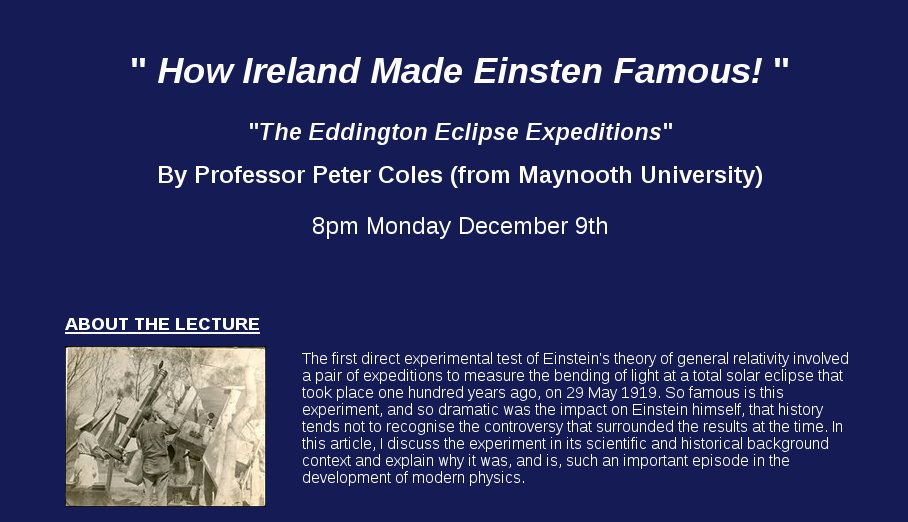
Before I depart for the weekend I thought I’d mention that I’m giving a talk on Monday evening (9th December) at 8pm in the Physics Building at Trinity College Dublin. The talk is followed by a reception in the Lombard Inn. Part of the advert is shown above but you can read more details at the Astronomy Ireland website.

If you’re around in Dublin on Monday then maybe I’ll see you there!

The Funeral of Lorentz

Posted in History, The Universe and Stuff with tags , , on December 6, 2019 by telescoper

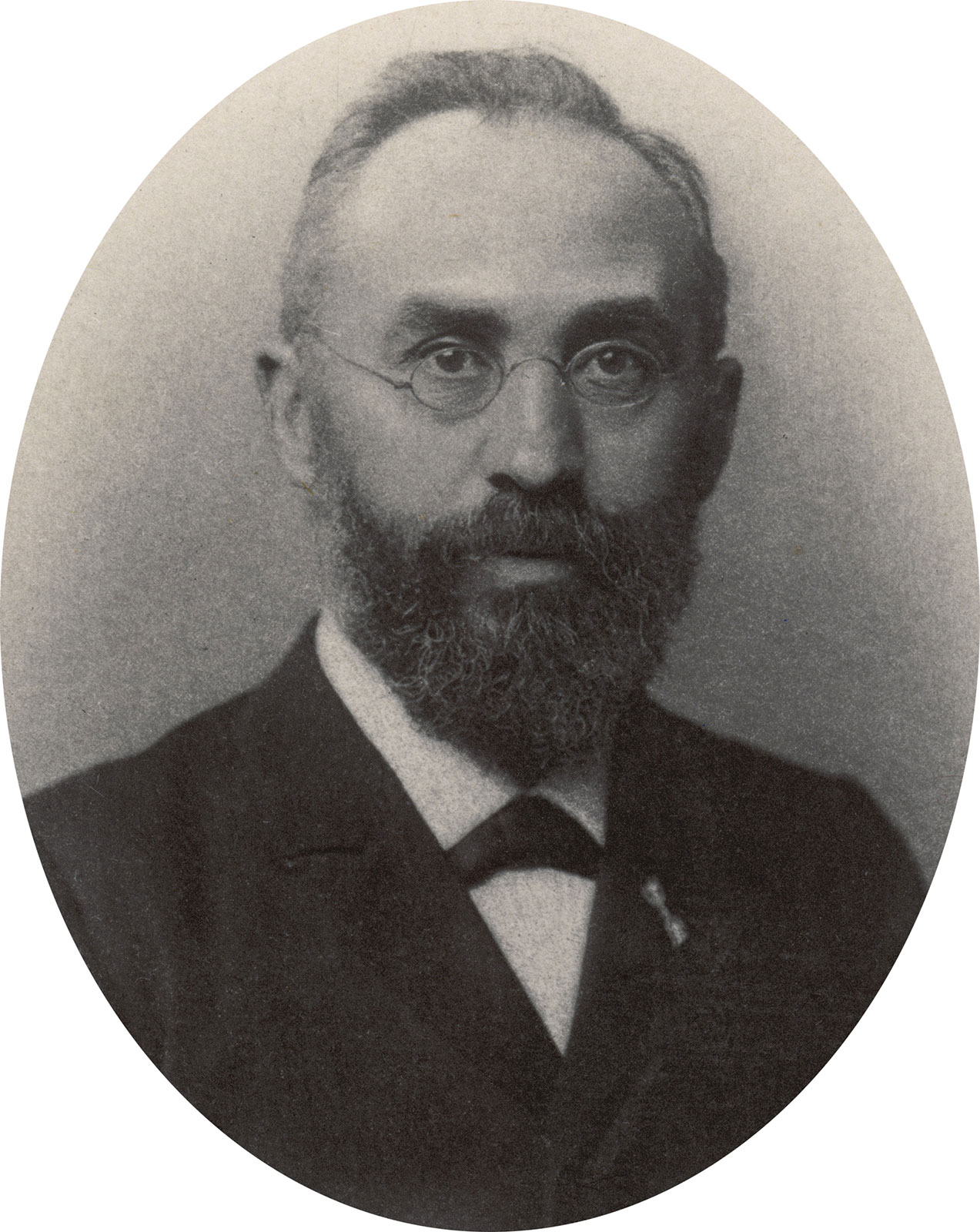
In a post a couple of days ago I mentioned the Dutch physicist Hendrik Lorentz, whose work helped establish the foundations of the theory of special relativity.

Hendrik Lorentz (1853-1928)

Doing a quick google about Lorentz I came across this remarkable silent footage of his funeral in 1928 in the town of Haarlem in the Netherlands.

from the Wikipedia page of Lorentz:

The funeral took place at Haarlem at noon on Friday, February 10. At the stroke of twelve the State telegraph and telephone services of Holland were suspended for three minutes as a revered tribute to the greatest man the Netherlands has produced in our time. It was attended by many colleagues and distinguished physicists from foreign countries. The President, Sir Ernest Rutherford, represented the Royal Society and made an appreciative oration by the graveside.

The footage of the funeral procession shows a lead carriage followed by ten mourners, followed by a carriage with the coffin, followed in turn by at least four more carriages, passing by a crowd at the Grote Markt, Haarlem from the Zijlstraat to the Smedestraat, and then back again through the Grote Houtstraat towards the Barteljorisstraat, on the way to the “Algemene Begraafplaats” at the Kleverlaan (northern Haarlem cemetery).
Einstein later gave a eulogy at a memorial service at Leiden University.

It was clearly a very grand affair which demonstrates high regard in which Lorentz was held not only by physicists but by the wider public.


The Relativity of Beards

Posted in Beards, History, The Universe and Stuff with tags , , , , on December 4, 2019 by telescoper

In my first-year module on Mechanics and Special Relativity, I’ve just moved on to the part about Special Relativity and this afternoon I’m going to talk about the Lorentz-Fitzgerald contraction or, as it’s properly called here in Ireland, the Fitzgerald-Lorentz contraction.

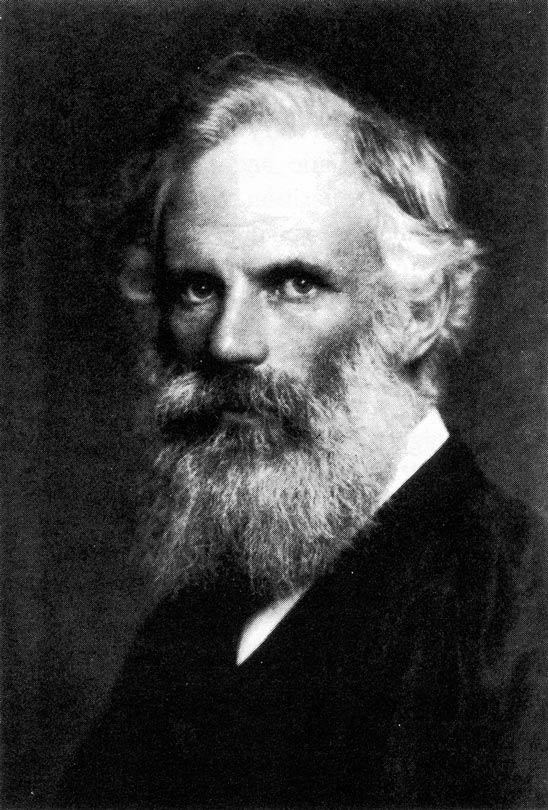
The first thing to point out is that the physicists George Francis Fitzgerald and Hendrik Lorentz, though of different nationality (the former Irish, the latter Dutch), both had fine beards:

George Francis Fitzgerald (1851-1901)

Hendrik Lorentz (1853-1928)

One of the interesting things you find if you read about the history of physics just before Albert Einstein introduced his theory of special relativity in 1905 was how many people seemed to be on the verge of getting the idea around about the same time. Fitzgerald and Lorentz were two were almost there; Poincaré was another. It was like special relativity was `in the air’ at the time. It did, however, take a special genius like Einstein to crystallize all that thinking into a definite theory.

Special relativity is fun to teach, not least because it throws up interesting yet informative paradoxes (i.e. apparent logical contradictions) arising from  that you can use to start a discussion. They’re not actually paradoxes really logical contradictions, of course. They just challenge `common sense’ notions, which is a good thing to do to get people thinking.

Anyway, I thought I’d mention one of my favorite such paradoxes arising from a simple Gedankenerfahrung (thought experiment) here.

Imagine you are in a railway carriage moving along a track at constant speed relative to the track. The carriage is dark, but at the centre of the carriage is a flash bulb. At one end (say the front) of the carriage is a portrait of Lorentz and at the other (say the back) a portrait of Fitzgerald; the pictures are equidistant from the bulb and next to each portrait is a clock.The two clocks are synchronized in the rest frame of the carriage.

At a particular time the flash bulb goes off, illuminating both portraits and both clocks for an instant.

It is an essential postulate of special relativity that the speed of light is the same to observers in any inertial frame, so that an observer at rest in the centre of the carriage sees both portraits illuminated simultaneously as indicated by the adjacent clocks. This is because the symmetry of the situation means that light has to travel the same distance to each portrait and back.

Now suppose we view the action from the point of view of a different inertial observer, at rest by the trackside rather than on the train, who is positioned right next to the centre of the carriage as the flash goes off. The flight flash travels with the same speed in the second observer’s frame, but this observer sees* the back of the carriage moving towards the light signal and the front moving away. The result is therefore that this observer sees the two portraits light up at different times. In this case the portrait of Fitzgerald is lit up before the portrait of Lorentz.

Had the train been going in the opposite direction, Lorentz would have appeared before Fitzgerald. That just shows that whether its Lorentz-Fitzgerald contraction or Fitzgerald-Lorentz contraction is just a matter of your frame of reference…

But that’s not the paradoxical thing. The paradox is although the two portraits appear at different times to the trackside observer, the clocks still appear show the same time….


*You have to use your imagination a bit here, as the train has to be travelling at a decent fraction of the speed of light. It’s certainly not an Irish train.


Astronomical Archaeology and the 1919 Eclipse Expeditions

Posted in History with tags , , , on November 21, 2019 by telescoper

Regular readers of this blog (Sid and Doris Bonkers) will know that in the past year I’ve written some articles and given some talks this year about the total solar eclipse on May 29 1919 at which an experiment was performed to test Einstein’s theory of general relativity.

I recently found out about another artefact of that expedition which has turned up in Denmark. More specifically it was discovered in the basement under the Niels Bohr Institute building on Juliane Maries Vej in Copenhagen. In the archive that is situated there they found records of astronomical observations that go more than 120 years back in time recorded on thin glass photographic plates. You can read more about these discoveries here.

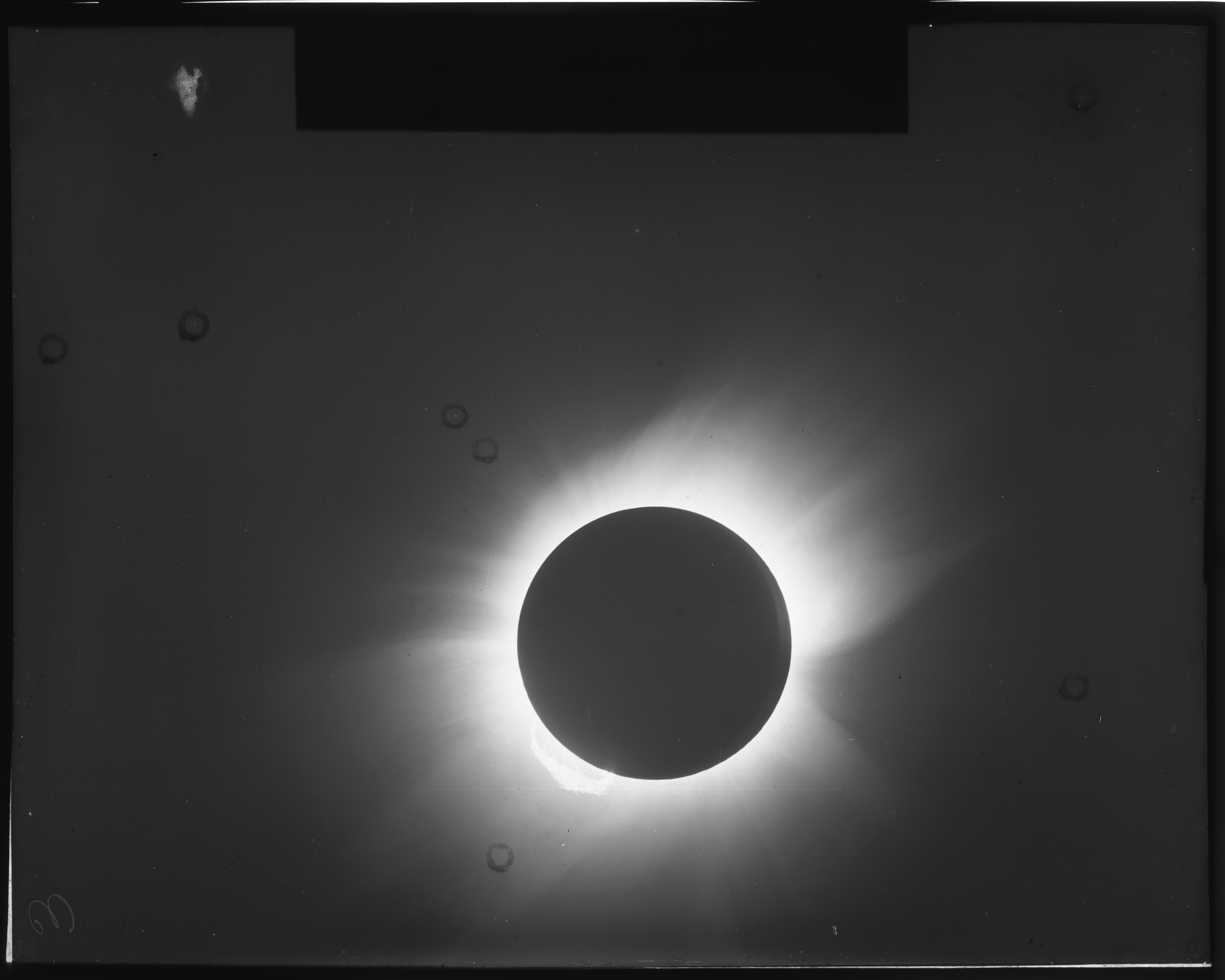
Anyway, one of the plates that turned up in Copenhagen shows this image:

A copy of one of the Sobral Eclipse plates

This image is a low-resolution version from a high-resolution scan of the plate (kindly sent to me by Johan Fynbo) concerned which I believe to be a contact copy (rather than an original) of one of the plates made by Andrew Crommelin’s team in Sobral in 1919. I know that a number of such copies were made in the aftermath of the experiment and similar plates have turned up in several locations.

If you look carefully you can see a number of dark rings (one of them quite clear because of the contrast with the solar corona).  These rings surround the stars used to measure the gravitational deflection of light by the sun; you can see the others more clearly if you click on the image to make it larger.

I think this plate illustrates one of the difficulties of this measurement: the gravitational deflection is larger for lines of sight close to the Sun, but the corona is likely to be in the way precisely for those same stars.


The Bechet-Lyttelton Session

Posted in History, Jazz with tags , on November 17, 2019 by telescoper

Every now and again on this blog I like to mark significant anniversaries, so I’m quite annoyed that I’ve missed one by a few days. It’s perhaps not very well known that the great Sidney Bechet came to England in 1949 and did a concert and a recording session with Humphrey Lyttelton’s band while he was here. That recording session took place just over 70 years ago, on 13th November 1949.

What’s also not very well known is how controversial this session was at the time, because in the immediate post-war years the Musician’s Union had persuaded the UK government to ban American artists from performing over here. Humph was having none of it, thank goodness, and here we have the legacy. Here is the unmistakable Sidney Bechet on soprano sax, playing a traditional blues called I told you once, I told you twice with Humph on trumpet, Wally Fawkes on clarinet and, stealing the show, the superb (and, to my ears, rather modern-sounding) Keith Christie on trombone.

According to Humph’s memoirs, after the concert they played together, Bechet summoned Humph to his dressing room in order to deliver a kind of end-of-term report on the band in which he pointed out little criticisms of their playing. Bechet was a forceful character and often a harsh critic but when he got to Keith Christie he expressed nothing but unqualified admiration. There’s not much higher praise than that in the world of jazz…