Archive for the History Category

Margaret Skinnider – in her own words

Posted in History with tags , , on June 20, 2019 by telescoper

A few weeks ago, occasioned by a stroll around St Stephen’s Green in Dublin, I put up a post that included the the remarkable story of Margaret Skinnider.

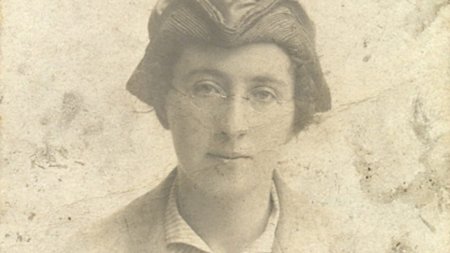
Before the 1916 Easter Rising Margaret Skinnider was a school teacher. During the hostilities she initially acted as a scout and a runner, carrying messages to and from the GPO, but when given the chance she proved herself a crack shot with a rifle and showed conspicuous courage during the heavy fighting in and around St Stephen’s Green. In particular, on 27th April she lead a squad of men in an extremely dangerous mission against a British machine gun position, during which she was hit three times by rifle bullets and very badly wounded.

Anyway, I found this fascinating recording of Margaret Skinnider herself telling the story of her part in the 1916 Easter Rising.

After the War of Independence and the subsequent Civil War were over, Margaret Skinnider returned to her career as a primary school teacher. She died in 1971.

Special 1919 Eclipse Centenary Offer!

Posted in History with tags , on June 13, 2019 by telescoper

A little later than planned, a paper what I wrote for Contemporary Physics to commemorate the centenary of the 1919 Eclipse Expeditions has now appeared online. The print edition will be available in due course.

Here is the abstract:

Unfortunately the paper is behind a paywall, but as a special dispensation I am to offer FIFTY free downloads of the paper to friends, colleagues and random people on the internet.

If you’d like to download a FREE copy of the PDF of the paper A revolution in science: the eclipse expeditions of 1919 then you may do so by clicking this link. How’s that for clickbait?

UPDATE: the free copies have now all gone so I removed the link.

To be honest I’m not sure what stops you sending the PDF to anyone else, but apparently those are the rules…

D-Day 75 Years On

Posted in Art, History with tags , , , , on June 6, 2019 by telescoper

Today is the 75th anniversary D-Day, the start of the Allied landings on the beaches of Normandy. I thought I’d mark the occasion by posting a slightly edited version of a piece I wrote about 9 years ago about this very famous picture:

This remarkable photograph was taken at 8.32am on 6th June 1944 on “Queen Red” beach, a sector in the centre-left of Sword Area, during the early stages of the D-Day invasion. The precise location is near La Brèche, Hermanville-sur-Mer, Normandy. The shutter clicked just as the beach came under heavy artillery and mortar fire from powerful German divisions inland.

Some time ago I came across a discussion of this image in the Observer. As the article describes, it consists of “a series of tableaux that look like quotations from religious art”. The piece goes on

In the foreground and on the right are sappers of 84 Field Company Royal Engineers. Behind them, heavily laden medical orderlies of 8 Field Ambulance Royal Army Medical Corps (some of whom are treating wounded men) prepare to move off the beach. In the background, men of the 1st Battalion, the Suffolk Regiment and No 4 Army Commando swarm ashore from landing craft.

The sapper in the bottom left, looking directly into the camera, is Jimmy Leisk who was born in Shetland. His strained expression gives the impression that he’s trying to escape from the photograph; through his eyes we get a glimpse of the grim reality of armed conflict. His colleague, turning away from the lens, seems to be calling to the men behind, but the image of his head and upper body links with the more distant figures forming a dramatic arc that pulls you into the centre of the picture before veering off to the right. Each element of this image tells its own story, but apart from one person in the foreground, all the faces are all hidden from view. I’m sure these anonymous figures were all just as frightened as the man in the foreground, but their individual identities are lost as they blend into graphic depiction of the monumental scale of the invasion. It’s a truly wonderful work of art, and a brilliant piece of storytelling, at the same level as an Old Master, but this is made all the more remarkable by the fact that the photographer was risking his life to take this picture.

This photograph, which was taken by Sergeant Jim Mapham of the Army Film and Photography Unit, was described by the US Press as “the greatest picture of the war”.

Jim Mapham was one of seven cameramen of the AFPU who went in on D-Day: Sgt Ian Grant, Sgt Christie, Sgt Norman Clague (killed), Sgt Desmond O’Neill (wounded), Sgt Billie Greenhalgh (wounded) and Sgt George Laws. Their work forms an extraordinary record of the invasion and is still widely used by the media – but rarely credited.

Robert Capa, the famous Hungarian photographer, was also on the beaches that morning, pinned down in the waves by enemy fire. But while he clambered on to a landing craft to get his pictures back to London, Sgt Mapham moved inland with the invasion force…

Jim Mapham survived the D-Day campaign and entered Germany with the army to document the fall of the Third Reich and the horrors of the Belsen concentration camp. He died in 1968. Until today I’d never heard of him. His name should be much more widely celebrated. I understand that the complete set of photographs he took on D-Day can be found in the Imperial War Museum‘s photographic archive.

As a final comment let me add that, contrary to popular myth, the landings at the Sword beaches were by no means a pushover. It’s true that the American forces, especially at Omaha beach, suffered heavier casualties on the actual landings – primarily because they failed to get their tanks and heavy artillery pieces ashore. However, the British troops at Sword were the only ones at any of the five landing areas to encounter strong German Panzer divisions on D-Day.

The main assault force at Sword beach was the British 3rd Infantry Division and its primary objective on the day of the invasion was to capture the city of Caen. As it turned out, the fighting was so heavy that they didn’t manage to take Caen until over a month after D-Day.

In fact it is worth remembering that the Allies failed to achieve any of their goals for D-Day itself: as well as Caen, Carentan, St. Lô, and Bayeux all remained in German hands. Only two of the beaches (Juno and Gold) were linked on the first day, and it wasn’t until 12 June that all five beachheads were connected. The battle to secure and expand the foothold took far longer than anticipated and the success of the operation was by no means the foregone conclusion that some would have you believe.

Lights all askew in the Heavens – the 1919 Eclipse Expeditions (Updated)

Posted in History, Talks and Reviews, The Universe and Stuff with tags , , , , , on June 3, 2019 by telescoper

Here is a video of my talk at the Open Meeting of the Royal Astronomical Society on April 12 2019. Was it really so long ago?

You can find the slides here:

The 1919 Eclipse: That Was The Talk That Was…

Posted in History, The Universe and Stuff with tags , , , , , on May 29, 2019 by telescoper

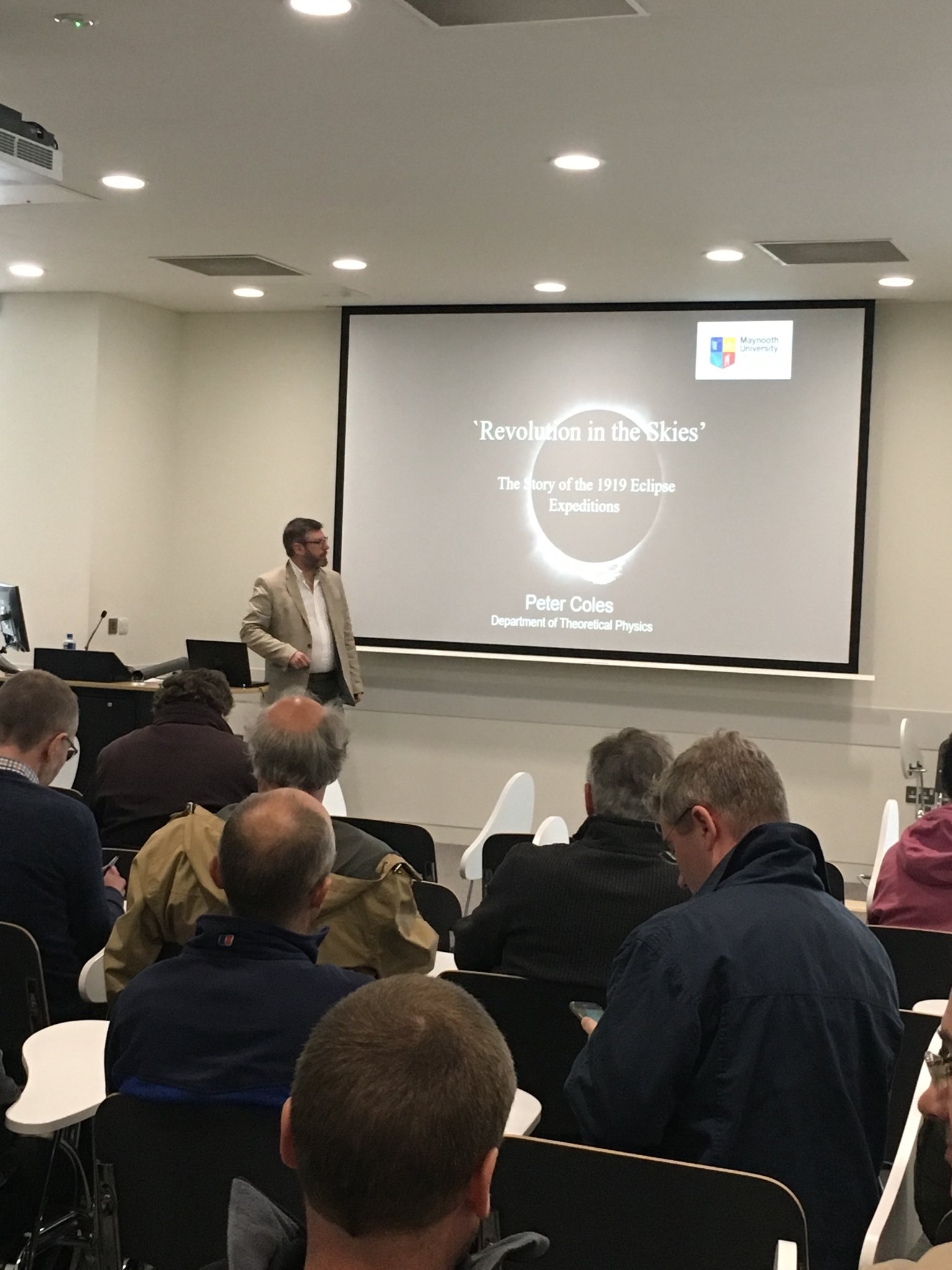
Well, I did my talk this afternoon to mark the centenary of the 1919 Eclipse Experiment that was performed on May 29th 1919. It’s a good job we changed the venue to a bigger lecture theatre than originally booked because even the new one was full! Thanks to everyone who came, and I hope you enjoyed the talk!

Anyway, here are the slides if you’d like to see them:

Here is a picture of me about to start:

Now that the centenary has passed I promise to post a bit less about this topic, although there are still a few things coming up that I might mention…

The Centenary of the 1919 Eclipse Expeditions

Posted in History, The Universe and Stuff with tags , , , , on May 29, 2019 by telescoper

Well, the big day has arrived. Today, 29th May 2019, is the centenary of the 1919 Solar Eclipse during which an experiment was carried out to test Einstein’s theory of general relativity. I’m giving a public talk this afternoon and will post the slides afterwards.

In the meantime, however, I’ll just re-post his little piece which is based on an article I wrote some years ago for Firstscience.

–0–

The Eclipse that Changed the Universe

A total eclipse of the Sun is a moment of magic: a scant few minutes when our perceptions of the whole Universe are turned on their heads. The Sun’s blinding disc is replaced by ghostly pale tentacles surrounding a black heart – an eerie experience witnessed by hundreds of millions of people throughout Europe and the Near East last August.

But one particular eclipse of the Sun, eighty years ago, challenged not only people’s emotional world. It was set to turn the science of the Universe on its head. For over two centuries, scientists had believed Sir Isaac Newton’s view of the Universe. Now his ideas had been challenged by a young German-Swiss scientist, called Albert Einstein. The showdown – Newton vs Einstein – would be the total eclipse of 29 May 1919.

Newton’s position was set out in his monumental Philosophiae Naturalis Principia Mathematica, published in 1687. The Principia – as it’s familiarly known – laid down a set of mathematical laws that described all forms of motion in the Universe. These rules applied as much to the motion of planets around the Sun as to more mundane objects like apples falling from trees.

At the heart of Newton’s concept of the Universe were his ideas about space and time. Space was inflexible, laid out in a way that had been described by the ancient Greek mathematician Euclid in his laws of geometry. To Newton, space was the immovable and unyielding stage on which bodies acted out their motions. Time was also absolute, ticking away inexorably at the same rate for everyone in the Universe.

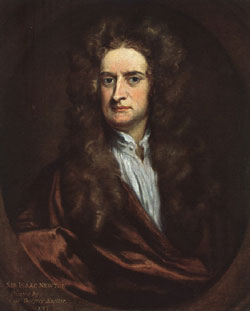
Sir Isaac Newton, painted by Sir Godfrey Kneller. Picture Credit: National Portrait Gallery,

For over 200 years, scientists saw the Cosmos through Newton’s eyes. It was a vast clockwork machine, evolving by predetermined rules through regular space, against the beat of an absolute clock. This edifice totally dominated scientific thought, until it was challenged by Albert Einstein.

In 1905, Einstein dispensed with Newton’s absolute nature of space and time. Although born in Germany, during this period of his life he was working as a patent clerk in Berne, Switzerland. He encapsulated his new ideas on motion, space and time in his special theory of relativity. But it took another ten years for Einstein to work out the full consequences of his ideas, including gravity. The general theory of relativity, first aired in 1915, was as complete a description of motion as Newton had prescribed in his Principia. But Einstein’s description of gravity required space to be curved. Whereas for Newton space was an inflexible backdrop, for Einstein it had to bend and flex near massive bodies. This warping of space, in turn, would be responsible for guiding objects such as planets along their orbits.

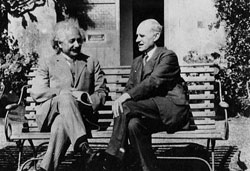
Albert Einstein (left), pictured with Arthur Stanley Eddington (right). Picture Credit: Royal Greenwich Observatory.

By the time he developed his general theory, Einstein was back in Germany, working in Berlin. But a copy of his general theory of relativity was soon smuggled through war-torn Europe to Cambridge. There it was read by Arthur Stanley Eddington, Britain’s leading astrophysicist. Eddington realised that Einstein’s theory could be tested. If space really was distorted by gravity, then light passing through it would not travel in a straight line, but would follow a curved path. The stronger the force of gravity, the more the light would be bent. The bending would be largest for light passing very close to a very massive body, such as the Sun.

Unfortunately, the most massive objects known to astronomers at the time were also very bright. This was before black holes were seriously considered, and stars provided the strongest gravitational fields known. The Sun was particularly useful, being a star right on our doorstep. But it is impossible to see how the light from faint background stars might be bent by the Sun’s gravity, because the Sun’s light is so bright it completely swamps the light from objects beyond it.

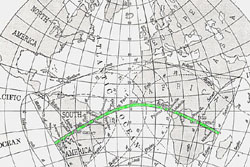
A scientific sketch of the path of totality for the 1919 eclipse. Picture Credit: Royal Greenwich Observatory.

Eddington realised the solution. Observe during a total eclipse, when the Sun’s light is blotted out for a few minutes, and you can see distant stars that appear close to the Sun in the sky. If Einstein was right, the Sun’s gravity would shift these stars to slightly different positions, compared to where they are seen in the night sky at other times of the year when the Sun far away from them. The closer the star appears to the Sun during totality, the bigger the shift would be.

Eddington began to put pressure on the British scientific establishment to organise an experiment. The Astronomer Royal of the time, Sir Frank Watson Dyson, realised that the 1919 eclipse was ideal. Not only was totality unusually long (around six minutes, compared with the two minutes we experienced in 1999) but during totality the Sun would be right in front of the Hyades, a cluster of bright stars.

But at this point the story took a twist. Eddington was a Quaker and, as such, a pacifist. In 1917, after disastrous losses during the Somme offensive, the British government introduced conscription to the armed forces. Eddington refused the draft and was threatened with imprisonment. In the end, Dyson’s intervention was crucial persuading the government to spare Eddington. His conscription was postponed under the condition that, if the war had finished by 1919, Eddington himself would lead an expedition to measure the bending of light by the Sun. The rest, as they say, is history.

The path of totality of the 1919 eclipse passed from northern Brazil, across the Atlantic Ocean to West Africa. In case of bad weather (amongst other reasons) two expeditions were organised: one to Sobral, in Brazil, and the other to the island of Principe, in the Gulf of Guinea close to the West African coast. Eddington himself went to Principe; the expedition to Sobral was led by Andrew Crommelin from the Royal Observatory at Greenwich.

British scientists in the field at their observing site in Sobral in 1919. Picture Credit: Royal Greenwich Observatory

The expeditions did not go entirely according to plan. When the day of the eclipse (29 May) dawned on Principe, Eddington was greeted with a thunderstorm and torrential rain. By mid-afternoon the skies had partly cleared and he took some pictures through cloud.

Meanwhile, at Sobral, Crommelin had much better weather – but he had made serious errors in setting up his equipment. He focused his main telescope the night before the eclipse, but did not allow for the distortions that would take place as the temperature climbed during the day. Luckily, he had taken a backup telescope along, and this in the end provided the best results of all.

After the eclipse, Eddington himself carefully measured the positions of the stars that appeared near the Sun’s eclipsed image, on the photographic plates exposed at both Sobral and Principe. He then compared them with reference positions taken previously when the Hyades were visible in the night sky. The measurements had to be incredibly accurate, not only because the expected deflections were small. The images of the stars were also quite blurred, because of problems with the telescopes and because they were seen through the light of the Sun’s glowing atmosphere, the solar corona.

Before long the results were ready. Britain’s premier scientific body, the Royal Society, called a special meeting in London on 6 November. Dyson, as Astronomer Royal took the floor, and announced that the measurements did not support Newton’s long-accepted theory of gravity. Instead, they agreed with the predictions of Einstein’s new theory.

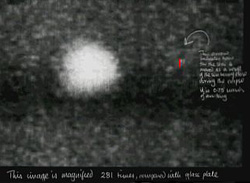
The final proof: the small red line shows how far the position of the star has been shifted by the Sun’s gravity. Each star experiences a tiny deflection, but averaged over many exposures the results definitely support Einstein’s theory. Picture Credit: Royal Greenwich Observatory.

The press reaction was extraordinary. Einstein was immediately propelled onto the front pages of the world’s media and, almost overnight, became a household name. There was more to this than purely the scientific content of his theory. After years of war, the public embraced a moment that moved mankind from the horrors of destruction to the sublimity of the human mind laying bare the secrets of the Cosmos. The two pacifists in the limelight – the British Eddington and the German-born Einstein – were particularly pleased at the reconciliation between their nations brought about by the results.

But the popular perception of the eclipse results differed quite significantly from the way they were viewed in the scientific establishment. Physicists of the day were justifiably cautious. Eddington had needed to make significant corrections to some of the measurements, for various technical reasons, and in the end decided to leave some of the Sobral data out of the calculation entirely. Many scientists were suspicious that he had cooked the books. Although the suspicion lingered for years in some quarters, in the end the results were confirmed at eclipse after eclipse with higher and higher precision.

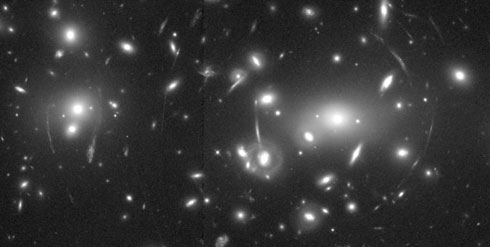
In this cosmic ‘gravitational lens,’ a huge cluster of galaxies distorts the light from more distant galaxies into a pattern of giant arcs. Picture Credit: NASA

Nowadays astronomers are so confident of Einstein’s theory that they rely on the bending of light by gravity to make telescopes almost as big as the Universe. When the conditions are right, gravity can shift an object’s position by far more than a microscopic amount. The ideal situation is when we look far out into space, and centre our view not on an individual star like the Sun, but on a cluster of hundreds of galaxies – with a total mass of perhaps 100 million million suns. The space-curvature of this immense ‘gravitational lens’ can gather the light from more remote objects, and focus them into brilliant curved arcs in the sky. From the size of the arcs, astronomers can ‘weigh’ the cluster of galaxies.

Einstein didn’t live long enough to see through a gravitational lens, but if he had he would definitely have approved….
A Story of St Stephen’s Green

Posted in History with tags , , , , , on May 26, 2019 by telescoper

I had a bit of spare time before the Opera on Friday and the weather was fine so I decided to go for a walk around the park in St Stephen’s Green.

I have walked past St Stephen’s Green many times but have never previously been inside, or if I have it was so long ago that I’ve now forgotten.

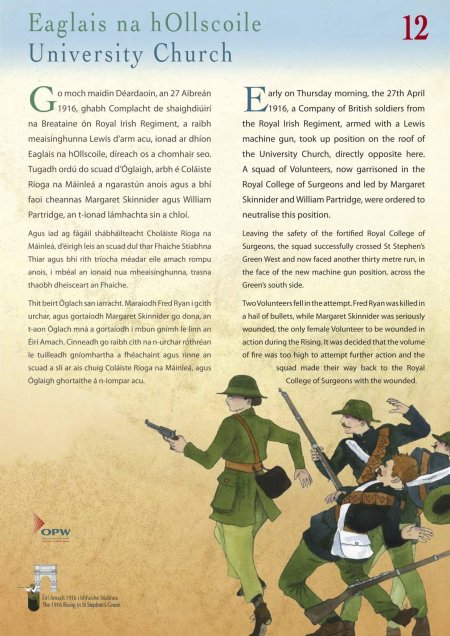
On my way around I noticed that there are posters here and there marking the events of the 1916 Easter Rising. Here’s an example:

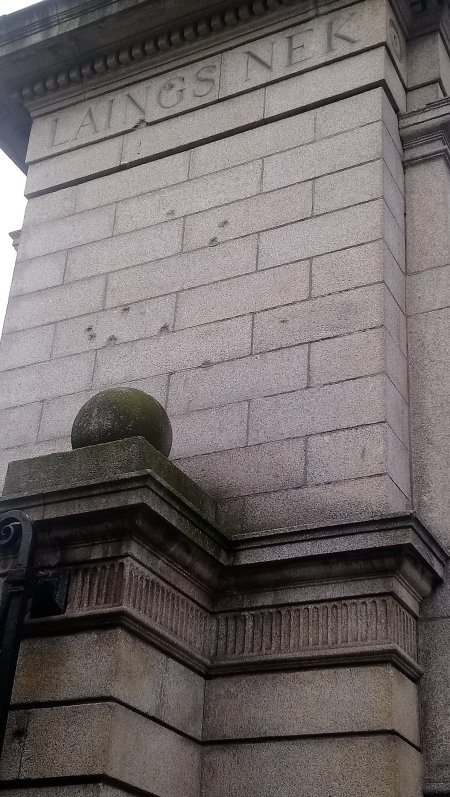
The artwork is a bit ‘Boy’s Comic’ style but the descriptions are fascinating especially because the Park and the area around it are pretty much unchanged in more than a hundred years since the momentous events of 1916 so it’s not difficult to imagine the scene as it was then. There are still bullet holes in the Fusiliers Arch at the North West Corner of the Green, as there are in a number of other locations around Dublin.

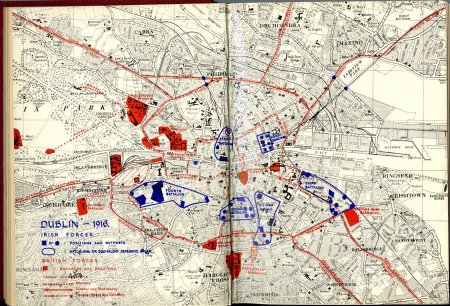
St Stephen’s Green is inside the area marked ‘Citizens Army‘. One look at the map will tell you why this was considered an important location to control as it is at the junction of several main roads. On the other hand if you actually visit the location you will see a big problem, namely that the Green itself is surrounded on all sides by very tall buildings, including the swanky Shelbourne Hotel to the North.

When a contingent of about 120 members of the Citizens Army arrived in St Stephen’s Green on Easter Monday, 24th April 1916, they immediately began erecting barricades outside, and digging trenches inside, the Park. They did not, however, have the numbers needed to seize and hold the buildings around it except for the Royal College of Surgeons building to the West.

The following morning, Tuesday 25th April, the British moved two machine guns into position, one in the Shelbourne Hotel and the other in the United Services club, along with numerous snipers. From these vantage points British soldiers could shoot down into the Park making it impossible for the rebels to move around.

The position inside the Green being untenable the Rebels effected an orderly (but perilous) withdrawal to the Royal College of Surgeons which they had fortified for the purpose. And that’s where they stayed until the end of the Rising.

The British realised that there was no need to assault the RCS building, as the force inside was contained and offered no real threat. From the roof of the building the Rebels watched helplessly as the British systematically reduced the resistance around the Rebel Headquarters in the GPO Building to the North, using artillery fired from College Green. Smoke rose into the sky as one entire side of O’Connell Street went up in flames and the perimeter slowly tightened around the GPO.

In the early hours of the morning of Thursday 27th April the occupants of the RCS were alarmed to see that British soldiers had installed another machine gun on the roof of the University Church on the South side of St Stephen’s Green along with snipers in adjacent buildings.

This was a very dangerous development that required a rapid response. A plan was devised that involved sending a squad of about 30 to break into buildings on the South side of the Green and start fires therein that would force the British to withdraw. This action is the subject of the poster shown above.

This is a photograph of the remarkable Margaret Skinnider, who is shown in the graphic leading the attempted assault. Before the Rising she was a school teacher. During the hostilities she initially acted as a scout and a runner, carrying messages to and from the GPO, but when given the chance she proved herself a crack shot with a rifle and showed conspicuous courage during the heavy fighting in and around St Stephen’s Green.

Skinnider insisted on leading the assault on Thursday 27th April despite the obviously high risk as it would involve running about 30 yards in full view of the machine gun position.

Under the cover of darkness, the detachment made its way out of the RCS to the South West corner of the Green safely enough but when men began breaking windows in Harcourt Street in order to gain entry to buildings there, the sound alerted the British soldiers who realised what was happening and opened fire as the Rebels made their move. Margaret Skinnider was leading from the front and she was inevitably among the casualties: she was hit three times by rifle bullets and very badly wounded.

Such was the volume of fire that the assault was abandoned and the surviving members of the squad retreated to the RCS where they remained until the general surrender on Saturday (29th April).

Skinnider was taken to hospital after the Rising ended but escaped and made her way to Scotland. She later returned to Ireland to take part in the War of Independence and subsequent Civil War. When the latter ended, in 1923, she went back to her job as a teacher in a primary school. She passed away in 1971 at the age of 79.

Fascism is coming..

Posted in History, Politics with tags , on May 19, 2019 by telescoper

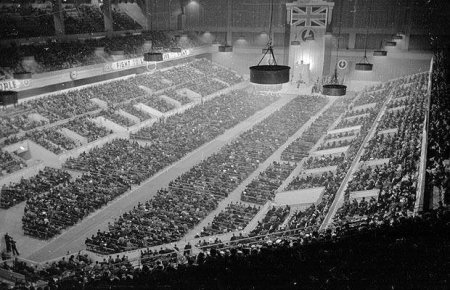
Rally for Oswald Mosley’s British Union of Fascists, Earl’s Court, London July 1939.

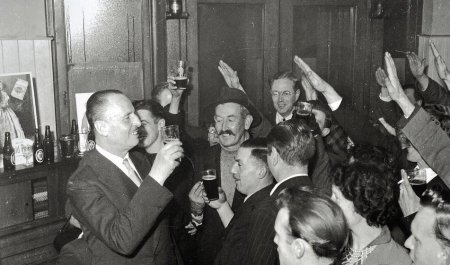
Beer-brandishing ‘Man of the People’, Oswald Mosley.

Fascism is coming; probably a slimy Anglicised form of Fascism, with cultured policemen instead of Nazi gorillas and the lion and the unicorn instead of the swastika.

George Orwell, from The Road to Wigan Pier, 1937.

Unsound History of the Sound of Space

Posted in History, The Universe and Stuff on May 16, 2019 by telescoper

Here’s a fascinating blog on the astronomy history which is well worth reading, so I thought I’d reblog to draw it to your attention!


Among others, it features Robert Grosseteste who I wrote about here.

thonyc's avatarThe Renaissance Mathematicus

Those readers, who have been around for a number of years, will know that from time to time the Renaissance Mathematicus has hosted guest posts. One thing that we are very proud of is the very high standard of the authors, who have delivered up, at our invitation, those literary #histSTM highpoints. We only host the best! Todays guest post continues this tradition with a real star of the world of science, science writing and #histSTM, Tom McLeish FRS. Tom was Professor of Physics at Durham University, where he was one of the initiators and chief investigators of the on going Ordered Universe international research project: InterdisciplinaryReadings of Medieval Science: Robert Grosseteste (c.1170–1253).

800px-Grosseteste_bishop !4th Century portrait of Robert Grosseteste, Bishop of Lincoln Source: Wikimedia Commons
Tom is now Professor of Natural Philosophy in the Department of Physics at the University of York (I think he’s doing a slow…

View original post 1,264 more words

Eddington at the `Del-Squared V Club’

Posted in History, The Universe and Stuff with tags , , , on May 15, 2019 by telescoper

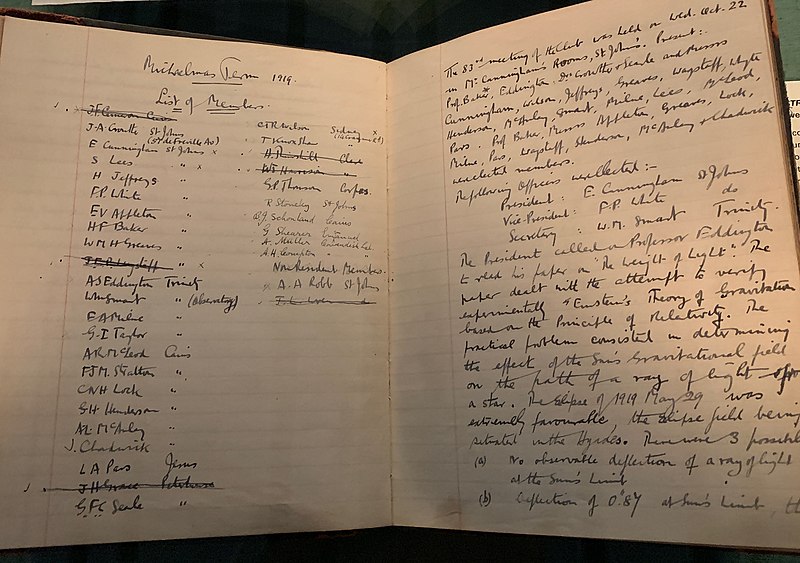
I’m up to my eyeballs in matters Eddingtonian these days preparing for the big centenary, so I thought I’d share this which I was reminded about this morning. The official results of the 1919 Eclipse Expeditions were announced at a joint meeting of the Royal Society and Royal Astronomical Society on November 6 1919. Members of a certain physics graduate student society at Cambridge, however, were treated to a sneak preview in October of that year, to which the minutes of the 83rd Meeting of the `Del-Squared V Club’ attest:

Arthur Stanley Eddington gave a talk at that meeting, a brief note of which appears on the right-hand page of the minute book shown above. You can see the Newtonian value for the expected deflection of 0.87 seconds at the bottom of the page. There’s also a nice reference to `The Weight of Light’. I had no idea Eddington was a lightweight speaker, but there you are.

I don’t think the Del-Squared V Club exists* any more, so I won’t make the joke that if you want to phone them up you have to go through the operator

*I’m reliably informed that it has been defunct since 1970.