Archive for the History Category

Pride 2025

Posted in History, LGBTQ+, Maynooth with tags , , , , , , , , on June 13, 2025 by telescoper

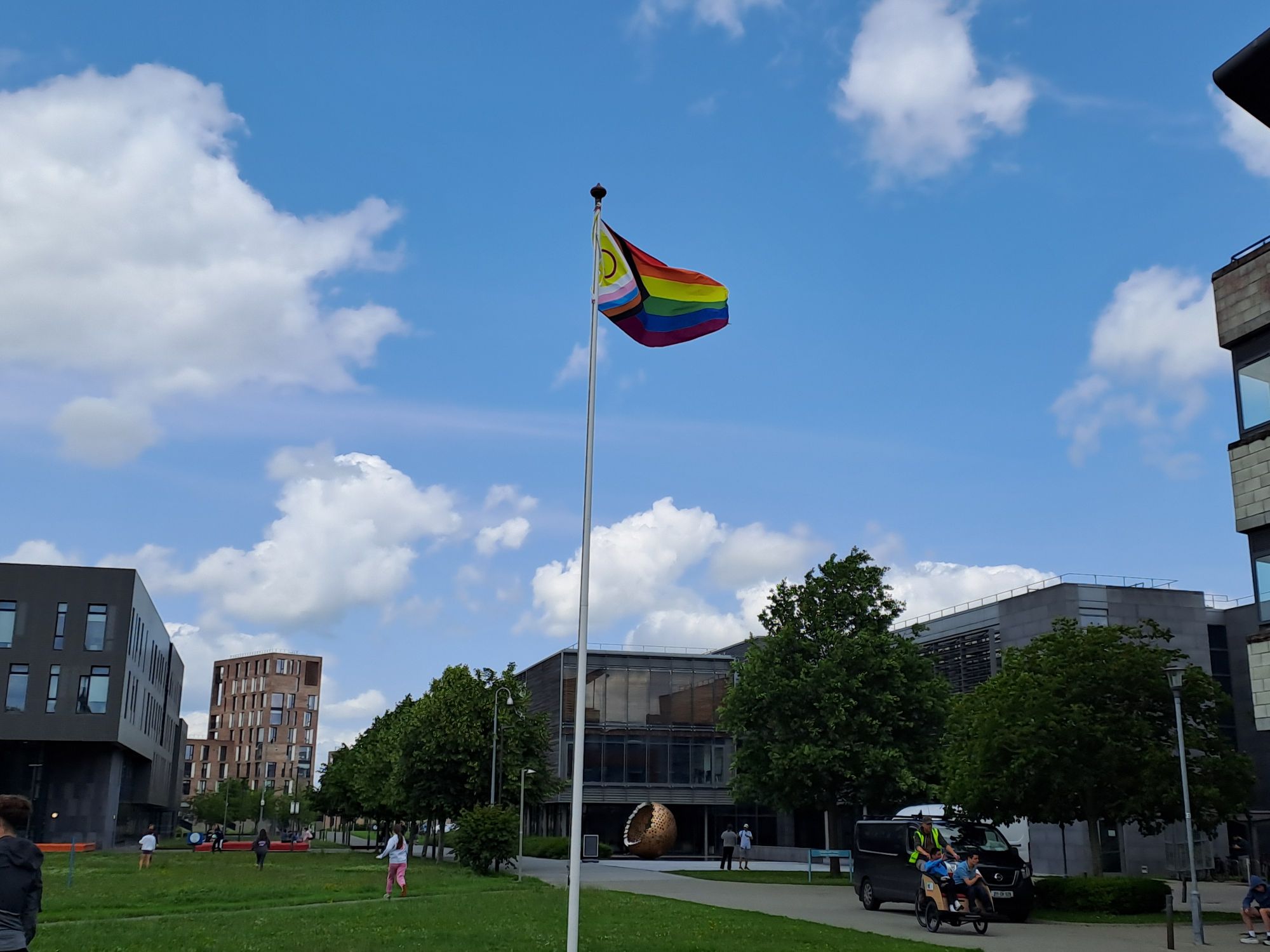
It’s 13th June, which means it’s almost halfway through this year’s Pride Month. I’ve been so busy that I am very late in posting about Pride 2025. I usually post something to mark Pride Month on 1st June (e.g. here). In fact I hadn’t even noticed the Pride Progress Flag flying on Maynooth Campus (between the Arts Block and John Hume Building) until today. I didn’t see anything on Maynooth’s social media about Pride either. I didn’t see the flag yesterday when I left the Science Building and assumed it wasn’t there. It was however raining heavily so my view may have been obscured by the rain on my spectacles, so I went back today to check. I am relieved it is there, as we need such symbols now more than ever.

With its origins as a commemoration of the Stonewall Riots of 1969, Pride remains both a celebration and protest. It’s more necessary than ever now because of the sustained abuse being aimed at trans people from all quarters, including those in political power and those sad losers who have nothing better to do that spend all day tweeting their bigotry on social media. Bigots will always be bigots, but the lowest of the low are those that masquerade as some sort of progressive while spouting their hate and prejudice.

Someone asked me the other day whether we still needed Pride. I replied that I think Pride will be necessary for as long as there are people who are annoyed by its existence. As well as a celebration and a protest, Pride is an opportunity for us all to show solidarity against those who seek to divide us. Though many LGBTQIA+ people in many countries – even those that claim to be more liberal – still face discrimination, hostility and violence, Pride Month always reminds me of how far we’ve come in the past 50 years but also serves as a reminder that the rights we have won could so easily be taken away. As I get older, I find I have become more and more protective towards younger LGBTQ+ people. I don’t want them to have to put up with the crap that I did when I was their age.

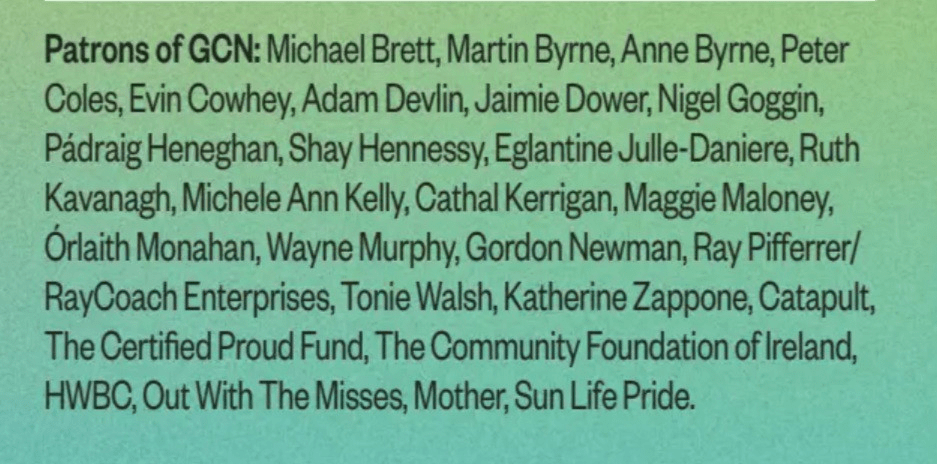
To mark this year’s Pride I decided to become a patron of Gay Community News, a free magazine that is, I hope, a vital resource to for the Irish LGBTQ+ community. I hope to take part in the Dublin Pride March on 28th June too. More generally, I would like to wish all LGBTQIA+ people around the world, but especially staff and students at Maynooth University, a very enjoyable and inspiring Pride 2025!

The Borgias are having an orgy

Posted in History with tags , on June 10, 2025 by telescoper

And now for something completely different.

Lá Saoire i mí Mheitheamh

Posted in Biographical, History, Irish Language, Maynooth on June 2, 2025 by telescoper

It’s a Bank Holiday Monday here in Ireland, which makes for a nice end-of-term break for some of us. Not all staff had exams early enough to finish in time like I did, however, and no doubt some had to spend the weekend marking exam scripts. I am fortunate to have been able to accomplish everything I intended over the weekend – nothing at all – and today I’ll be able to recover from that exertion.

The June Bank Holiday (Lá Saoire i mí Mheitheamh) in Ireland is the equivalent of last week’s late May Bank Holiday in the UK, in that both have their origin in the old festival of Whitsuntide (or Pentecost) which falls on the 7th Sunday after Easter. Because the date of Easter moves around in the calendar so does Whit Sunday, but it is always in late May or early June; this year it falls on Sunday 8th June.

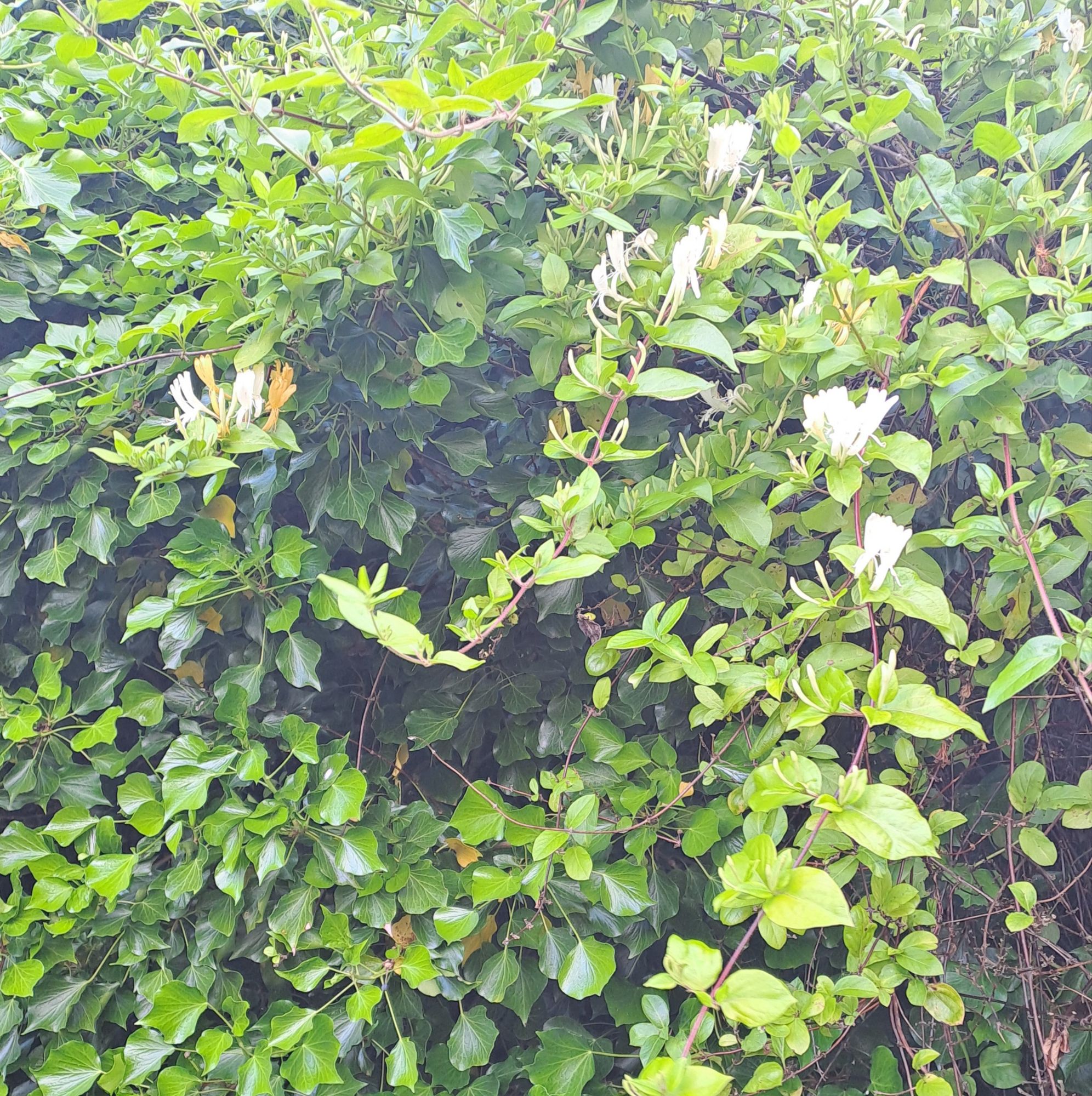
As if in celebration, the honeysuckle in my garden has started to flower:

The day after Pentecost was traditionally a holiday known as Pentecost Monday or Whit Monday. This enabled people to attend extra church services and organize local fairs and cultural events. Pentecost Monday became a public holiday in Ireland following the Bank Holidays Act 1871 which applied before Ireland became independent. Following the Holidays (Employees) Act 1973, this holiday was moved to the First Monday of June. This new date was first observed in 1974. This is why
we have the first Monday in June off work instead of the last Monday in May.

Although I’m only at beginners’ level in Irish, the phrase Lá Saoire i mí Mheitheamh gives me a chance to bore you about it. It’s actually quite a straightforward phrase until you reach the last word. “Lá” means “day” and “Saoire” means “leave” or “vacation” so “Lá Saoire” means “holiday”; “i” is a prepositional pronoun meaning “in” and “mí” means “month”. So far so good.

The word for June, however, is Meitheamh (at least when it is in the nominative singular case). Irish is an inflected language, which means that words change form according to their grammatical function. As an Indo-European language, Irish is distantly related to Latin which has six grammatical cases for nouns (actually seven if you count the rarely used locative case). Irish has only four cases – there’s no ablative and, curiously, no distinction between nominative and accusative. That leaves nominative, dative, genitive, and vocative. The dative – used after simple prepositions – is only rarely distinct from the nominative so basically the ones you have to learn are the genitive and the vocative.

In Latin cases are indicated by changes to the end of a word, but in Irish they involve initial mutations. In the example of “mí Mheitheamh” meaning “month of June”, requiring the genitive form of “June”, the initial consonant “M” undergoes lenition (softening) to sound more like a “v”. In old Irish texts this would be indicated by a dot over the M but in modern orthography it is indicated by writing an “h” after the consonant. This is called a séimhiú (pronounced “shay-voo” ). Note the softened m in the middle of that word too but it’s not a mutation – it’s just part of the regular spelling of the word, as is the -mh at the end of Meitheamh. There’s also a softened “t” in the middle of Meitheamh which makes it vrtually disappear in pronunciation. Meitheamh is thus pronounced something like “Meh-hiv” whereas “Mheitheamh” is something like “Veh-hiv”.

Gheobhaidh mé mo chóta…

International Day Against Homophobia, Biphobia and Transphobia

Posted in History, LGBTQ+ with tags , , , on May 17, 2025 by telescoper

Today is May 17th, which means that it is International Day Against Homophobia, Transphobia and Biphobia. If you’re wondering why May 17th was chosen, it’s to commemorate May 17th 1990, which is when the World Health Organisation removed homosexuality from its list of “mental illnesses”.


Attitudes in many places are more enlightened than they were decades ago. Next week, for example, sees the 10th anniversary of the equal marriage referendum in Ireland.  But the rights we have won  could easily be  (and indeed are being ) lost if we do not defend them.


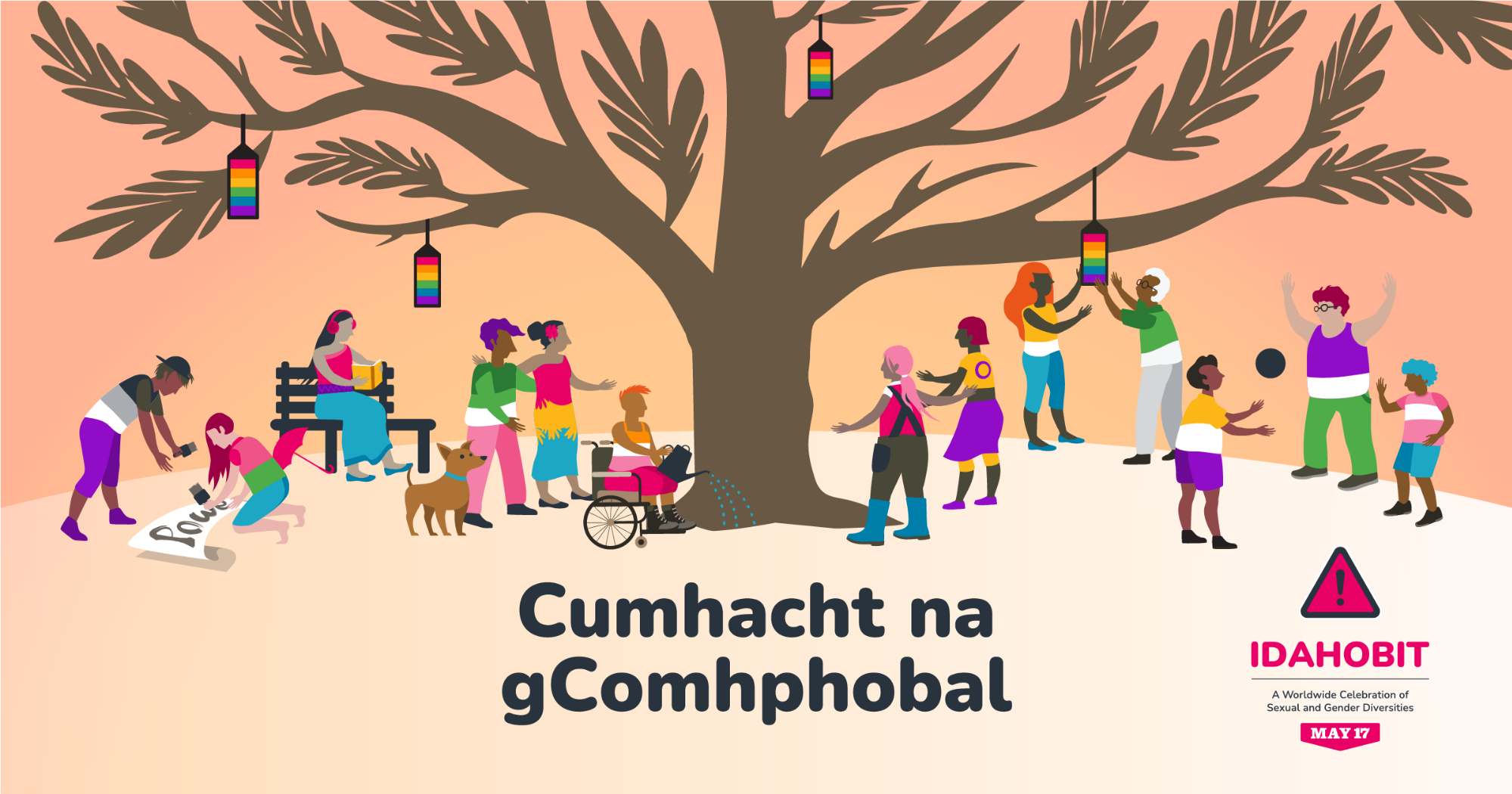
The theme for IDAHOBIT2025  is “The Power of Communities”, shown above in Irish. Even if you are not a member of our community we still need your support. Here is a useful guide I posted a few years ago about how to be a good ally.

The Day of St Patrick

Posted in History, Maynooth with tags , , , on March 17, 2025 by telescoper

Well, it’s St Patrick’s Day, which is a public holiday here in Ireland, so Lá Fhéile Pádraig sona daoibh go léir!
This morning I watched the Parade in Maynooth. It didn’t rain, but it was a strangely subdued affair notable for the lack of music. The isn’t much of an atmosphere if the participants are walking along in silence! You can’t have Craic agus Ceol if there’s no Ceol. I only counted two tractors too; usually there are many more than that. Fortunately, I have a calendar that offers a tractor for every month to make up for this disappointment. Still, it was good to see the kids enjoing themselves. The highlight for me this year was the Coakley Septic Tank Cleaning Truck, which just outdid the Thornton’s Refuse Collection Vehicle for sheer splendour.

Anyway, I should take the opportunity to write something about St Patrick. Not much is known for certain but it seems he was born in Britain, probably in the late 4th Century AD, probably somewhere around the Severn Estuary, and probably in Wales. It also appears that he didn’t know any Latin. When a young man, it seems he was captured by Celtic marauders coming up the River Severn and taken as a slave to Ireland. He eventually escaped back to Britain, but returned to Ireland as a missionary and succeeded somehow in converting the Irish people to Christianity.


Or did he? This interesting piece suggests his role was of lesser importance than many think.

However it happened, Ireland was the first country to be converted to Christianity that had never been part of the Roman Empire. That made a big difference to the form of the early Church here. The local Celtic culture was very loose and decentralized. There were no cities, large buildings, roads or other infrastructure. Life revolved around small settlements and farms. When wars were fought they were generally over livestock or grazing land. The early Irish Church that grew in this environment was quite different from that of continental Europe. It was not centralized, revolved around small churches and monasteries, and lacked the hierarchical structure of the Roman Church. Despite these differences, Ireland was quite well connected with the rest of the Christian world.Irish monks – and the wonderful illuminated manuscripts they created – spread across the continent, starting with Scotland and Britain. Thanks to the attentions of the Vikings few of these works survive but the wonderful Lindisfarne Gospels, dating from somewhere in the 8th Century were almost certainly created by Irish monks. The Book of Kells was probably created in Scotland by Irish Monks.

The traffic wasn’t entirely one-way however. A few years ago I saw a fascinating documentary about the Fadden More Psalter. This is a leather-bound book of Psalms found in a peat bog in 2006, which is of similar age to the Lindisfarne Gospels. It took years of painstaking restoration work to recover at least part of the text (much of which was badly degraded), but the leather binding turned out to hold a particularly fascinating secret: it was lined with papyrus. The only other books from the same period with the same structure that are known are from the Coptic Church in Egypt. That doesn’t mean that whoever owned the Fadden More Psalter had actually been to Egypt, of course. It is much more this book made its way to Ireland via a sort of relay race. On the other hand, it does demonstrate that international connections were probably more extensive than you might have thought.

Anyway, back to St Patrick’s Day. Saint Patrick’s Day is celebrated on March 17th, the reputed date of his death in 461 AD. Nobody really knows where St Patrick was born, though, so it would be surprising if the when were any better known. In any case, it wasn’t until the 17th Century that Saint Patrick’s feast day was placed on the universal liturgical calendar in the Catholic Church. Indeed, St Patrick has never been formally canonized. In the thousand years that passed any memory of the actual date of his birth was probably lost, so the choice of date was probably influenced by other factors, specifically the proximity of the Spring Equinox (which is this year on Thursday March 20th).

The early Christian church in Ireland incorporated many pre-Christian traditions that survived until roughly the 12th century, including the ancient festival of Ēostre (or Ostara), the goddess of spring associated with the spring equinox after whom Easter is named. During this festival, eggs were used a symbol of rebirth and the beginning of new life and a hare or rabbit was the symbol of the goddess and fertility. In turn the Celtic people of Ireland probably adapted their own beliefs to absorb much older influences dating back to the stone age. St Patrick’s Day and Easter therefore probably both have their roots in prehistoric traditions around the Spring Equinox, although the direct connection has long been lost.

Another Edgeworth!

Posted in History with tags , , , , , , on March 6, 2025 by telescoper
Edgeworthia chrysantha Grandiflora (Paper Bush)

Time for another addition to a mini-series of posts about the Edgeworth family (see here and here); an Edgeworth expansion, if you will. This morning I stumbled across the name of a plant, Edgeworthia chrysantha Grandiflora, also known as the Paper Bush (because it is used in Japan to make high quality paper). It is also available for purchase in Ireland (e.g. here). I think I’ll buy one for the garden!

When I saw the name of this interesting-looking shrub, I immediately suspected it was named after a member of the illustrious Irish Edgeworth family and so it was. The genus was named in honour of Michael Pakenham Edgeworth, an Irish botanist and official in the Bengal Civil Service, then stationed in India, and for his half-sister, writer Maria Edgeworth. Michael and Maria were among 22 children fathered by Richard Lovell Edgeworth, who was a founder member of the Royal Irish Academy. In a manner not untypical of the Anglo-Irish landed gentry, the Edgeworths renamed their local town, which is in County Longford, from Meathas Troim (anglicized form Mostrim) to Edgeworthstown. Michael Pakenham Edgeworth lived from 1812 until 1881 was a member of the Linnaean Society and, among other things, pioneered the use of photography in botanical studies.

Roger Penrose: Discoverer of Black Holes?

Posted in History, The Universe and Stuff with tags , , , , , , , , , on February 27, 2025 by telescoper

I got home from a busy day on campus to find the 21st February issue of the Times Literary Supplement had landed on my doormat having arrived today, 27th February. It used to take a couple of weeks for my subscription copy to reach Ireland but recently the service has improved. Intriguingly, the envelope it comes in is postmarked Bratislava…

But I digress. This is the cover:

The text below the title “Light on darkness” under the graphic reads “Roger Penrose, discoverer of black holes, by Jennan Ismael”. Nice though it is to see science featured in the Times Literary Supplement for a change and much as I admire Roger Penrose, it is unreasonable to describe him as “the discoverer of black holes”.

A black hole represents a region of space-time where the action of gravity is sufficiently strong that light cannot escape. The idea that such a phenomenon might exist dates back to John Michell, an English clergyman, in 1783, and later by Pierre-Simon Laplace but black holes are most commonly associated with Einstein’s theory of general relativity.  Indeed, one of the first exact solutions of Einstein’s equations to be found describes such an object. The famous Schwarzschild solution was obtained in 1915 by Karl Schwarzschild, who died soon after on the Eastern front in the First World War. The solution corresponds to a spherically-symmetric distribution of matter, and it was originally intended that it could form the basis of a mathematical model for a star. It was soon realised, however that for an object of any mass M there is a critical radius (Rs, the Schwarzschild radius) such that if all the mass is squashed inside Rs then no light can escape.  In terms of the mass M, velocity of light c, and Newton’s constant G, the critical radius is given by Rs = 2GM/c2 . For the mass of the Earth, the critical radius is only 1cm, whereas for the Sun it is about 3km.

Since the pioneering work of Schwarzschild, research on black holes has been intense and other kinds of mathematical solutions have been obtained. For example, the Kerr solution describes a rotating black hole and  the Reissner -Nordstrom solution corresponds to  a black hole with an electric charge.  Various theorems have also been demonstrated relating to the so-called `no-hair’ conjecture: that black holes give very little outward sign of what is inside.

Some people felt that the Schwarzschild solution was physically unrealistic as it required a completely spherical object, but Roger Penrose showed mathematically that the existence of a trapped surface was a generic consequence of gravitational collapse, the result that won him the Nobel Prize in 2020. His work did much to convince scientists of the physical reality of black holes, and he deserved his Nobel Prize, but I don’t think it is fair to say he “discovered” them.

I would say that, as is the case for discoveries in many branches of science, there isn’t just one “discoverer” of black holes: there were important contributions by many people along the way.

P.S. If you want to limit the application of the word “discovery” to observations then I think that the discovery of black holes is down to Paul Murdin and Louise Webster who identified the first really plausible candidate for a black hole in Cygnus X-1, way back in 1971…

P.P.S. The term “Black Hole” was, as far as I know, coined by John Wheeler in 1967.

Roger Penrose is 93.

The Quickening of the Year Again

Posted in Biographical, History, Maynooth with tags , , , , , , , on February 3, 2025 by telescoper

Today would be the first day of teaching in Semester 2 at Maynooth University, were it not for the fact that it is a Bank Holiday in Ireland. The holiday marks Imbolc, an old Celtic festival occurring halfway between the winter solstice and vernal equinox in the Northern hemisphere. In the modern calendar the date is 1st February. In Ireland Imbolc is often referred to as a Lá Fhéile Bríde,  St Brigid’s Day, after St Brigid of Kildare, whose feast day is 1st February. In the old pagan calendar, this day is regarded as the first day of spring, as it is roughly the time when the first spring lambs are born, daffodils, etc, start to appear, and the days get noticeably longer. It corresponds to the Welsh Gŵyl Fair y Canhwyllau and is also sometimes called, rather beautifully, The Quickening of the Year. It’s a time for rebirth and renewal after the darkness of winter.

I noticed some scepticism on social media about 1st February being the first day of spring, but it makes sense to me. I feel the same way about May being the start of summer too. From living 7 years in Ireland, I’ve always found May/June the most summery months – as far as that means anything in Ireland!

In the Northern hemisphere, in astronomical terms, the solar year is defined by the two solstices (summer, around June 21st, and winter, around December 21st) and the equinoxes (spring, around March 21st, and Autumn, around September 21st). These four events divide the year into four roughly equal parts of about 13 weeks each. If you divide each of these intervals in two you divide the year into eight pieces of six and a bit weeks each. The dates midway between the astronomical events mentioned above are the cross-quarter days, of which Imbolc is one. Here they are represented on a diagram:

The timings are rough because the dates of the equinoxes and solstices vary from year to year. Imbolc is often taken to be the 2nd of February (Groundhog Day) and Samhain is sometimes taken to be October 31st, Halloween but hopefully you get the point that although the Pagan festivals have been appropriated by the Christian church, they have much older origins.

Until 2023 only three of the four cross-quarter days were associated with public holidays in Ireland; there wasn’t a holiday for Imbolc. In 2022 however, the Government decided to create a new Bank Holiday that corrected this anomaly by introducing a new St Brigid’s Day holiday on the first Monday on or after 1st February (or on Friday if 1st February falls on that day), which also happens to be the first national holiday in Ireland to be named after a woman. The first such holiday was Monday, 6th February 2023 and the second was on Monday 5th February 2024. This is the third.

But I digress.

I am glad to have today’s holiday just before teaching starts. Having completed my examination marking duties promptly I was planning to use last week to get my teaching materials ready. Unfortunately I wasn’t at all well for most of the week – though I recovered by Friday – and am way behind schedule. Fortunately, I’ve taught one of the modules (Computational Physics) many times before so not much preparation is required although it is a bigger class than I’ve had on previous occasions which means extra work in due course grading the CA components. The other module, Particle Physics is new for me at Maynooth, though I have taught it elsewhere. This also has a bigger class than I was expecting for a final-year module and my first lecture on it is tomorrow. I’m going to have to spend most of today quickening the writing of the lecture notes and preparing assignments.

P.S. Not particularly relevantly, Particle Physics is an anagram of Happier Cyclists.

The Celestial Stranger – Thomas Traherne

Posted in History, Music, Poetry with tags , , on February 2, 2025 by telescoper

I promised yesterday that I would post the poem that gives its title to the song cycle, The Celestial Stranger, which was performed at the National Concert Hall on Friday night, so here it is as it appeared in the programme:

It’s very interesting to see such thoughts expressed in the mid-17th Century!

Thomas Traherne is an interesting poet in many ways and the associated story of his poetical manuscripts is strange and fascinating. The son of  a cobbler, Traherne was a devoutly religious man who lived most of his short life (1637-1674) in relative obscurity as a clergyman and theologian. He was a prolific writer of both prose and poetry, but very little of his work was published during his lifetime. A vast number of handwritten manuscripts survived his death, however, and many of these remained in the safekeeping of a local family in his native Herefordshire. However, in 1888 the estate of this family was wound up, sold, and the manuscripts became dispersed. Eventually, in 1897, one set of papers was  accidentally discovered in a bookstall. Traherne’s first volume of verse was published in 1903 and a second collection followed in 1908.

When these poems finally found their way into the literary world they were greeted with astonishment as well as deep appreciation and they were widely  influential: T.S. Eliot was a great admirer of Traherne, as was Dorothy L Sayers. There are also truly wonderful musical settings of some of Traherne’s poetry made by a young Gerald Finzi in his cantata Dies Natalis.

Over the years further manuscripts  have also come to light – literally, in one case, because in 1967 another lost Traherne manuscript was found, on fire, in a  rubbish dump and rescued in the nick of time! As late as 1997 more works by Traherne were discovered among 4,000 manuscripts in the Library of Lambeth Palace, the London residence of the Archbishop of Canterbury. The Lambeth manuscripts, from which the above poem is taken, are mostly prose writings, actually, but there are many poems in there too.

Traherne is sometimes described as the last metaphysical poet. However, it seems to me he might equally be described as the first romantic poet. The themes he tackles – love of nature and loss of childhood innocence – and his visionary, rhapsodic style have as much in common with William Blake and, especially, William Wordsworth as they do with better known metaphysical poets such as John Donne.

Google Garbage

Posted in History, mathematics with tags , on January 5, 2025 by telescoper

In the course of double-checking the time of perihelion for yesterday’s post I did a quick Google search. What came up first was this:

Google search results nowadays are prefaced by a short summary like this one, presumably generated by some sort of AI. This one – like many others I’ve seen recently – is just plain wrong. The time of perihelion was 13.28 Universal Time, not 09.00.

I am old enough to remember when Google Search first appeared in 1998. It was so much better than other search engines at that time, largely because of the PageRank algorithm; see this piece for a bit of the history and the reason it worked so well. Some years ago, however, Google Search underwent a transition from being a useful facility for web browsers to a piece of adtech useful only for marketing companies who pay to have their sites artificially boosted. Every time you do a search nowadays you have to scroll through a deluge of promoted pages that have very little to do with what you searched for. Google is now so corrupted as to be virtually useless. Adding garbled AI junk to the mixture is just making it worse. It’s not only frustrating but potentially dangerous. Information can be manipulated for purposes other than selling things; the systematic spread of misinformation by those in power has potentially catastrophic consequences.