Archive for the History Category

Haydn and the Herschels

Posted in History, Music, The Universe and Stuff with tags , , , , , on February 14, 2017 by telescoper

Last night I was listening to a broadcast of a concert performance of Haydn’s “Creation” on BBC Radio 3, featuring the London Philharmonic under the direction of Sir Roger Norrington. During the interval (between Parts I and II) the presenter Sara Mohr-Pietsch cast doubt in the story (which I’ve heard quite often), that Joseph Haydn was at least partly inspired to write The Creation by a trip he took during a stay in England to see the observatory of astronomer William Herschel. This story is repeated in a number of places around the web, including here, from which source I quote:

On 15 June 1792. Joseph Haydn visited William Herschel – basoonist, composer, astronomer – at his observatory near Slough. Herschel introduced Haydn to the Milky Way and, quite possibly, the planet Uranus, which he’d discovered ten years earlier. Some say Haydn took this glimpse of the infinite as the inspiration for his oratorio The Creation. Seems plausible.

It does indeed seem plausible. It is a matter of record that Haydn did  visit the Observatory House in Slough on 15th June 1792, which is where William Herschel lived with his sister Caroline at the time. (Interestingly, the day before this visit Haydn was at Ascot watching the horse-racing.)

However, according to William Herschel’s own records he wasn’t at the Observatory House on this day. In fact he had been away since May 1792 visiting various locations in England and Wales, before eventually arriving in Glasgow to receive an honorary degree. The notion that Herschel provided Haydn with the inspiration to write The Creation is therefore false.

Or is it?

William Herschel may not have been at home when Haydn called on 15th June 1792, but Caroline certainly was: Haydn’s name is recorded in her visitor’s book on that date. In his diary Haydn makes a note of the dimensions of the telescope (40ft) but does not mention actually looking through it, which is not surprising if he was there during the day.  There’s no other record of this visit of which I’m aware that says for sure what happened on that day, but Caroline certainly could have described what she had observed during her career as an astronomer, both on her own and with William, and also shown Haydn drawings, catalogues and star charts. Caroline Herschel was an extremely accomplished astronomer in her own right, so who’s to say it was not she rather than her brother who provided Haydn with the inspiration for his oratorio?

So it could well be that it was Herschel that inspired The Creation after all, but Caroline rather than William…

One Hundred Years of the Cosmological Constant

Posted in History, The Universe and Stuff with tags , , , , , , on February 8, 2017 by telescoper

It was exactly one hundred years ago today – on 8th February 1917 – that a paper was published in which Albert Einstein explored the cosmological consequences of his general theory of relativity, in the course of which he introduced the concept of the cosmological constant.

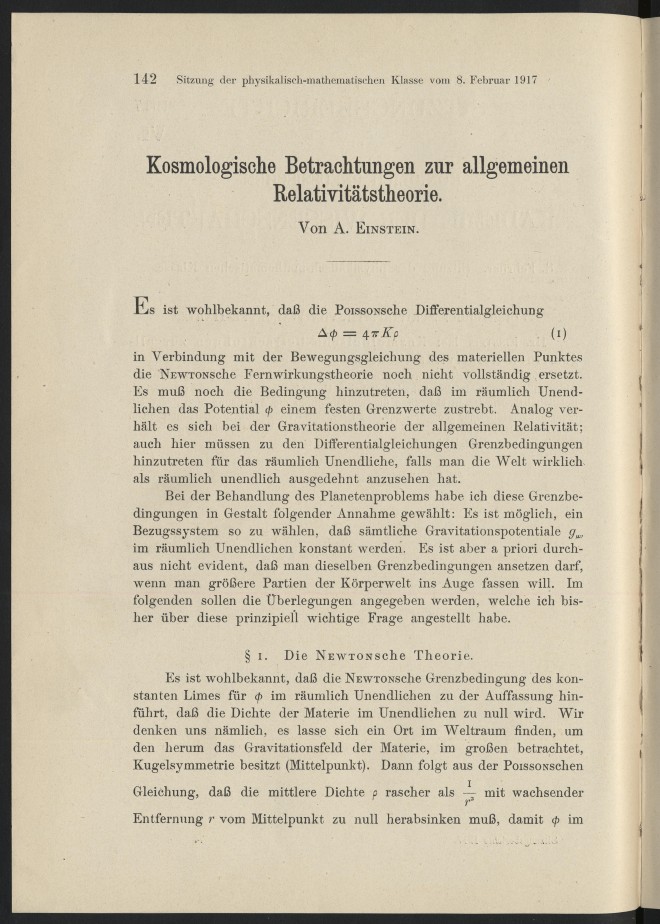
For the record the full reference to the paper is: Kosmologische Betrachtungen zur allgemeinen Relativitätstheorie and it was published in the Sitzungsberichte der Königlich Preußischen Akademie der Wissenschaften. You can find the full text of the paper here. There’s also a nice recent discussion of it by Cormac O’Raifeartaigh  and others on the arXiv here.

Here is the first page:

cosmo

It’s well worth looking at this paper – even if your German is as rudimentary as mine – because the argument Einstein constructs is rather different from what you might imagine (or at least that’s what I thought when I first read it). As you see, it begins with a discussion of a modification of Poisson’s equation for gravity.

As is well known, Einstein introduced the cosmological constant in order to construct a static model of the Universe. The 1917 paper pre-dates the work of Friedman (1923) and Lemaître (1927) that established much of the language and formalism used to describe cosmological models nowadays, so I thought it might be interesting just to recapitulate the idea using modern notation. Actually, in honour of the impending centenary I did this briefly in my lecture on Physics of the Early Universe yesterday.

To simplify matters I’ll just consider a “dust” model, in which pressure can be neglected. In this case, the essential equations governing a cosmological model satisfying the Cosmological Principle are:

\ddot{a} = -\frac{4\pi G \rho a }{3} +\frac{\Lambda a}{3}

and

\dot{a}^2= \frac{8\pi G \rho a^2}{3} +\frac{\Lambda a^2}{3} - kc^2.

In these equations a(t) is the cosmic scale factor (which measures the relative size of the Universe) and dots are derivatives with respect to cosmological proper time, t. The density of matter is \rho>0 and the cosmological constant is \Lambda. The quantity k is the curvature of the spatial sections of the model, i.e. the surfaces on which t is constant.

Now our task is to find a solution of these equations with a(t)= A, say, constant for all time, i.e. that \dot{a}=0 and \ddot{a}=0 for all time.

The first thing to notice is that if \Lambda=0 then this is impossible. One can solve the second equation to make the LHS zero at a particular time by matching the density term to the curvature term, but that only makes a universe that is instantaneously static. The second derivative is non-zero in this case so the system inevitably evolves away from the situation in which $\dot{a}=0$.

With the cosmological constant term included, it is a different story. First make \ddot{a}=0  in the first equation, which means that

\Lambda=4\pi G \rho.

Now we can make \dot{a}=0 in the second equation by setting

\Lambda a^2 = 4\pi G \rho a^2 = kc^2

This gives a static universe model, usually called the Einstein universe. Notice that the curvature must be positive, so this a universe of finite spatial extent but with infinite duration.

This idea formed the basis of Einstein’s own cosmological thinking until the early 1930s when observations began to make it clear that the universe was not static at all, but expanding. In that light it seems that adding the cosmological constant wasn’t really justified, and it is often said that Einstein regard its introduction as his “biggest blunder”.

I have two responses to that. One is that general relativity, when combined with the cosmological principle, but without the cosmological constant, requires the universe to be dynamical rather than static. If anything, therefore, you could argue that Einstein’s biggest blunder was to have failed to predict the expansion of the Universe!

The other response is that, far from it being an ad hoc modification of his theory, there are actually sound mathematical reasons for allowing the cosmological constant term. Although Einstein’s original motivation for considering this possibility may have been misguided, he was justified in introducing it. He was right if, perhaps, for the wrong reasons. Nowadays observational evidence suggests that the expansion of the universe may be accelerating. The first equation above tells you that this is only possible if \Lambda\neq 0.

Finally, I’ll just mention another thing in the light of the Einstein (1917) paper. It is clear that Einstein thought of the cosmological as a modification of the left hand side of the field equations of general relativity, i.e. the part that expresses the effect of gravity through the curvature of space-time. Nowadays we tend to think of it instead as a peculiar form of energy (called dark energy) that has negative pressure. This sits on the right hand side of the field equations instead of the left so is not so much a modification of the law of gravity as an exotic form of energy. You can see the details in an older post here.
This is the Strangers’ Case

Posted in History, Literature with tags , , , on January 30, 2017 by telescoper

This speech, delivered by Sir Ian McKellen at the Cambridge Union a couple of years ago, is from the play Sir Thomas More  and is widely attributed to William Shakespeare. It’s from Act 2 Scene 4, at which point in the drama Thomas More (who was then London’s Deputy Sheriff) is called upon to put down an anti-immigration riot in the Parish of St Martin Le Grand, that took place on 1st May 1517. In reality  More’s intevention wasn’t effective, and it took the arrival of 5000 troops to disperse the mob.

As well as being powerful for many other reasons, this speech especially fascinating because a hand-written manuscript (thought to be by Shakespeare himself) survives and is kept in the British Library.

The backdrop to this story is that, between 1330 and 1550 about 64,000 immigrants from all across Europe came to England in search of better lives. Locals blamed them for taking their jobs and threatening their culture. Tensions reached breaking point in 1517 and a mob armed with stones, bricks, bats, boots and boiling water attacked the immigrants and looted their homes.  Five hundred years on, and we still haven’t learned.

Here is the text of the speech. As you will see, it basically amounts to the argument “do as you would be done by”, but it is much more powerful when performed by an actor, so do watch the clip too!

Grant them removed, and grant that this your noise
Hath chid down all the majesty of England;
Imagine that you see the wretched strangers,
Their babies at their backs and their poor luggage,
Plodding to the ports and coasts for transportation,
And that you sit as kings in your desires,
Authority quite silent by your brawl,
And you in ruff of your opinions clothed;
What had you got? I’ll tell you: you had taught
How insolence and strong hand should prevail,
How order should be quelled; and by this pattern
Not one of you should live an aged man,
For other ruffians, as their fancies wrought,
With self same hand, self reasons, and self right,
Would shark on you, and men like ravenous fishes
Would feed on one another….

Say now the king
Should so much come too short of your great trespass
As but to banish you, whither would you go?
What country, by the nature of your error,
Should give you harbour? go you to France or Flanders,
To any German province, to Spain or Portugal,
Nay, any where that not adheres to England,
Why, you must needs be strangers: would you be pleased
To find a nation of such barbarous temper,
That, breaking out in hideous violence,
Would not afford you an abode on earth,
Whet their detested knives against your throats,
Spurn you like dogs, and like as if that God
Owed not nor made not you, nor that the claimants
Were not all appropriate to your comforts,
But chartered unto them, what would you think
To be thus used? this is the strangers case;
And this your mountainish inhumanity.

Chance’s Beard to Darwin

Posted in Beards, History with tags , , , , on January 25, 2017 by telescoper

One of my global team of unpaid researchers emailed me to tell about this short video, one of a series called Curious Objects commissioned by Cambridge University, which tells the story of a rather hairy encounter between Charles Darwin and a man called Dr Frank Chance. Dr Chance attempted to counter Darwin’s claim in Descent of Man that beard hair is always lighter than hair on the head – and went as far as sharing some of his own trimmings with the great man himself (although he seems to have had plenty of his own).

Is it true that beard hair is always lighter than scalp hair? And what about other hair…..the downstairs kind even?

Collapse at Sophia Gardens

Posted in Cardiff, History with tags , , on January 10, 2017 by telescoper

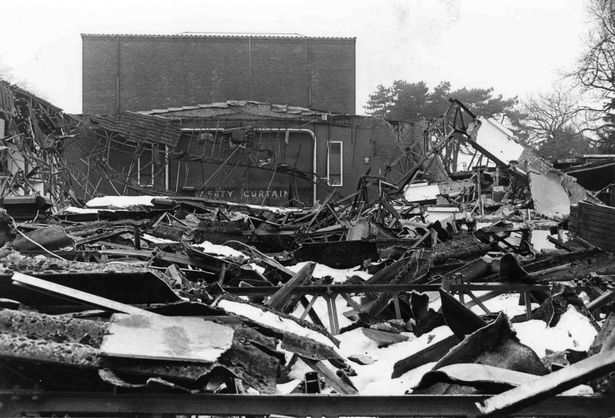
If the title of this post attracted the attention of cricket fans then I apologize, because it’s not about goings-on at the SWALEC Stadium in Cardiff but at the Sophia Gardens Pavilion which no longer exists (for reasons which will become obvious) but was an entertainment and exhibition venue built in 1951 as part of the Festival of Britain celebrations. You can see a (rather hilarious) Pathé News item about a fashion show held there in 1952 here.  It was also the venue in 1958 for the Empire and Commonwealth Games, held between July 18 and 26th, for boxing and wrestling matches. Owing to post-war austerity, the supply of building materials was heavily controlled so it was necessary to adapt a war surplus aeroplane hangar to provide the framework for the Pavilion. The hangar was obtained from Stormy Down aerodrome near Pyle, Bridgend in late 1949. The cost of dismantling and transporting it was £3,400 and rebuilding it in Sophia Gardens was estimated to cost £40,000. The Pavilion when completed seated approximately 2,500 people, and the final cost of construction was £80,000. It was opened officially on Friday 27th April 1951.

I was about to leave the office just now when I was reminded – by Derek The Weather – that at this time of year in 1982 (i.e. 35 years ago) Cardiff was in the grip of exceptionally severe weather. In fact it started snowing heavily on 7th January and carried on for 48 hours without a pause. It snowed so heavily, in fact, that the weight of snow caused the roof of the Sophia Gardens Pavilion to collapse:

cardiff-sophia-gdns

Fortunately no-one was inside. After the roof collapsed the Pavilion was demolished and the land it stood on is now a car park (a little way South of the cricket ground). I don’t know precisely when this event occurred, but it had happened by 13th January 1982. I know this because he collapse of the building led to the cancellation of a concert due to take place there on 13th January 1982 by Black Sabbath, which is apparently a popular beat combo of some sort.

Anyway, it looks like we’re due for some snow in the UK over the next few days although perhaps not in Cardiff and perhaps not heavy as 1982. Strangely, I have no memory of 1982 being a particularly severe winter. I was living in Newcastle at the time, but the weather maps suggest the severe conditions covered most of the country.

The “Pont” in Pontcanna

Posted in Cardiff, History with tags , on January 10, 2017 by telescoper

Regular readers of this blog (Sid and Doris Bonkers) will know that I currently reside in an area of Cardiff known as Pontcanna, which is part of the administrative district of the city known as Riverside.  Although Pontcanna does have a distinct identity as a community, there’s no precise definition that I can find of exactly where it is. Even Cardiff City Council doesn’t really recognize its existence: all my official mail has  “Riverside” in the address. Although I tell everyone I live in Pontcanna, I don’t have any official evidence that I do!

I’ve also often wondered about the origin of the name, as it definitely suggests a bridge of some sort (Pont is Welsh for bridge, cf  the French) and there are no bridges in the area. The name Canna is generally taken to refer to Saint Canna, whose name  is also associated with Canton, an area of modern Cardiff adjacent to Riverside but until the 19th Century a village in its own right. Since this is a very old name it’s logical to infer that the bridge is no more. However, the thing that always puzzled me is that the area of Pontcanna is actually quite small, and actually not all that close to the River Taff (the main river through Cardiff), which is even further from Canton, so there’s no obvious site for a bridge to have been, even if the bridge itself is long gone.

A chance conversation in a pub the other day however led me to a website that offers a solution to this conundrum., namely that the “Pont” in Pontcanna does not relate to a bridge over the River Taff, but over a small brook that used to run through the area shown on old maps and known (in English)  as the “White House Brook”.  This interpretation also casts doubt on the idea that “Canna” has anything to do with Saint Canna: it is possible that it derives instead from an old Welsh verb meaning “to whiten” although I’m by no means confident in that.

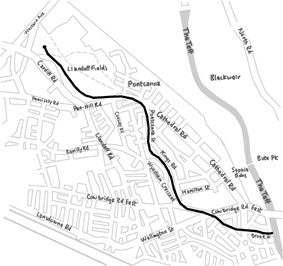
Here, according to my source, is the route of this brook:

cannamap

I’m sorry it’s low resolution, but it’s basically an annotated scan of a historical map. You can compare that with a modern map of the area around my house:

pontcanna

The River Taff can be seen to the upper right of the modern map. The White House Brook ran down what is now Cathedral Road before turning along the route of what is now Pontcanna Street. 

Construction of the  large houses on Cathedral Road, and others on surrounding streets, began around 1896, at a time when Cardiff’s population was expanding rapidly. Prior to that this area was mainly farmland, with a few cottages here and there. It is also part of the River Taff flood plain and was criss-crossed with ditches containing small streams, of which the White House Brook was the largest.

As the area became developed, water from these streams was diverted to form the sewer system for the new buildings and the White House Brook progressively dried up. What little remains of it now runs in a culvert, which eventually empties into the Taff.

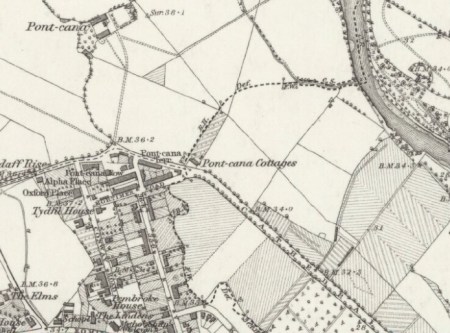
The bridge presumably disappeared at the same as the brook went underground around 1896, but the most likely candidate for it is a small bridge that stood near a row of cottages that lay between a small church (at the site of the Presbyterian Chuch on Gileston Road, marked on the modern map) and the end of what is now Teilo Street. These can be seen on this map, which  Bryn Jones directed me to (see comment below):

pontcanna_1886

The “Pont-cana cottages” (sic) were also demolished to make way for the new houses on Cathedral road and new roads either side of it. The best guess for the site of the bridge is close to the junction between Teilo Street and Cathedral Road. Note that in the first  map, Pontcanna is marked to the River Taff side of Cathedral road which is probably where the bridge was situated, very close to the end of my street. I feel more justified than ever in saying that I live in Pontcanna!

P.S. This map also shows another location marked “Pont-cana” to the North, on what are now called Llandaff Fields. I think refers to Pontcanna Farm, presumably named after the bridge. Perhaps the Pontcanna cottages may have been homes for farm workers?

P.P.S. Incidentally, I learned from this site that until 1858, Cathedral Road was only accessible by paying a toll at a booth on Cowbridge Road! Even in the old days, Pontcanna was an exlusive area!

The Trumpet Shall Sound

Posted in History with tags , , , , , , , on December 15, 2016 by telescoper

Following on from yesterday’s post about Handel’s Messiah I thought I’d include this very nice performance of The Trumpet Shall Sound, featuring the excellent bass voice of Alastair Miles with Crispian Steele-Perkins playing the solo trumpet part. One of the reasons for posting it – other than the obvious one (that it’s great) – is that I was thinking about it after Tuesday’s  concert.  The trumpet part at the performance I went to was played (superbly) by Dean Wright on a modern (valved) trumpet, but that wasn’t invented until many years after Handel’s time.

The historical development of the trumpet is a fascinating story but the most interesting technical developments actually happened long after Handel wrote Messiah (which was in 1741).  The keyed trumpet – a forerunner of the modern valved variety – wasn’t invented until the late 18th Century. In fact Joseph Haydn wrote his Trumpet Concerto specifically to demonstrate the capabilities of this instrument; that piece wasn’t first performed until 1800. The modern valved trumpet didn’t begin to appear until about 1818. Before that orchestras used the natural trumpet, which has no valves or other means of controlling the flow of air through the instrument and is therefore only really capable of playing harmonics (rather like a bugle).  Other notes can be generated, but only with some difficulty, using the lip. This kind trumpet is the sort of instrument that would have been played in Handel’s time. The so-called baroque trumpet  is actually a 20th century invention created for musicians who want the “period sound” of  a natural trumpet but with the additional flexibility that comes from having “vents” in the tube that can be covered with the fingers. This is the kind of instrument that Crispian Steele-Perkins is playing in the video. It is valveless but has two finger holes which the trumpeter can close and open with the thumb and little finger of the right hand for fine pitch control.


The Great Rewrite: Secularism and Nineteenth-Century Wales

Posted in History, Politics on November 27, 2016 by telescoper

Lengthy but fascinating piece about the rise of secularism in Wales. I’m a member of the National Secular Society, by the way.

Campaigners pay tribute to Fidel Castro, ‘most iconic post-1945 beard wearer’

Posted in History on November 26, 2016 by telescoper

R.I.P. Fidel Castro. He had his faults, but there’s no denying the cultural significance of his beard..

kmflett's avatarKmflett's Blog

Beard Liberation Front

Media Release

26TH November

Keith Flett 07803 167266

Campaigners pay tribute to Fidel Castro, ‘most iconic post-1945 beard wearer’

castro2

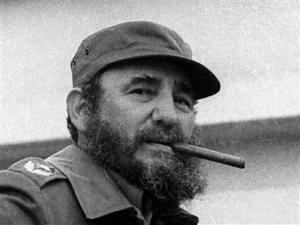
The Beard Liberation Front, the informal network of beard wearers, has paid tribute to Fidel Castro, who has died at 90, as the most iconic post-1945 beard wearer.

Castro, like Che Guevara, did not always have facial hair but grew a beard as his politics moved to the left in the 1950s.

Subsequently his beard came to be seen as a symbol, worldwide, of opposition to US foreign policies in the 1960s

A 1975 US Senate Intelligence Committee heard that in the 1960s the CIA believed that if Castro’s beard fell out this would undermine his standing with the Cuban people. Plots were hatched to put thallium salt in Castro’s cigar or his shoes which would have caused his beard hairs to fall out.

The plots were…

View original post 45 more words

November 18th 1916: The End of the Somme Offensive

Posted in History with tags , , , on November 18, 2016 by telescoper

If you think a lot has happened between this summer and now, it is perhaps worth reflecting on the fact that the Battle of the Somme, which started on July 1st 1916, only came to an end on November 18th 1916, i.e. one hundred years ago today. The last phase of the Somme Offensive was the Battle of the Ancre which lasted from November 13th until November 18th. Though the key objective (of eliminating a German salient) was not met, and casualties were heavy, this battle is considered a qualified success for the British Army, who secured the key position of Beaumont Hamel, though the village itself was almost completely destroyed during the fighting:


beaumont-hamel

The battlefield at Beaumont-Hamel, taken in November 1916

Incidentally, Beaumont-Hamel had seen fighting since the very first day of the Battle of the Somme. On July 1st 1916, 700 men of the Newfoundland Regiment gave their lives there as they went “over the top” and were promptly mown down by machine guns. There is an important memorial to their sacrifice there.

The statistics of the Somme Offensive are truly horrific. In total well over a million men were killed or seriously wounded during the 141 day campaign. By the time it finished the British, French and Commonwealth armies had advanced a maximum of about 6 miles. Most historians describe the outcome as “inconclusive”, largely on the grounds equal numbers of soldiers were slaughtered on each side.  It was a stalemate, but the price paid in blood was appalling.

The carnage didn’t end with the Somme. As the “Great War” stumbled on, battle after battle degenerated into bloody fiasco. Just a year later the Third Battle of Ypres saw another 310,000 dead on the British side as another major assault on the German defences faltered in the mud of Passchendaele. By the end of the War on 11th November 1918, losses on both sides were counted in millions.