Archive for the History Category

Computable Numbers, 80 Years on..

Posted in History, mathematics, Uncategorized with tags , , , , on May 28, 2016 by telescoper

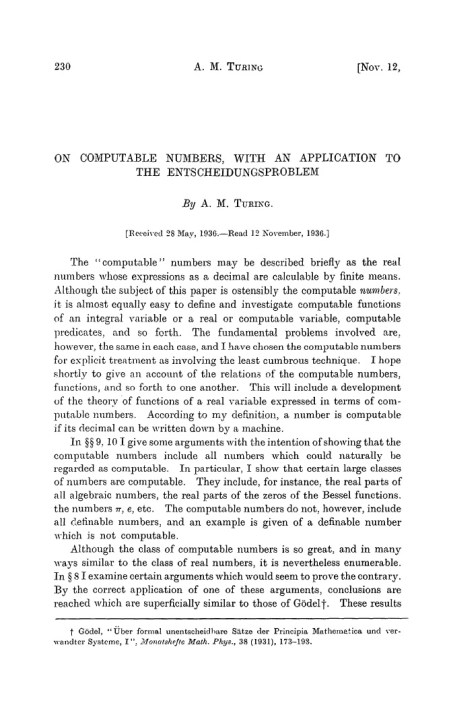
There’s been rather a lot of sad news conveyed via this blog recently, so I thought that today I’d mark a happier event. Eighty years ago today (i.e. on 28th May 1936), a paper by Alan Turing arrived at the London Mathematical Society. Entitled “On Computable Numbers, with an Application to the Enstscheidungsproblem“, this was not only enormously influential but also a truly beautiful piece of work. Turing was only 23 when he wrote it. It was delivered to the London Mathematical Society about 6 months after it was submitted,  i.e. in November 1936..

Here’s the first page:

Turing

The full reference is

Proc. London Math. Soc. (1937) s2-42 (1): 230-265. doi: 10.1112/plms/s2-42.1.230

You can find the full paper here. I heartily recommend reading it, it’s wonderful.


Jazz and Physics

Posted in History, Jazz, The Universe and Stuff with tags , on May 26, 2016 by telescoper

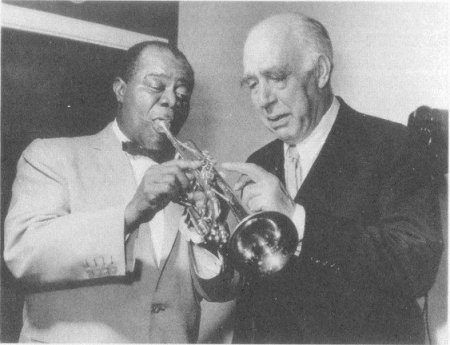
No time for a full post today, so I’ll just share this intriguing picture I found on the interwebs of two great figures from very different fields: Jazz trumpet legend Louis Armstrong and pioneering quantum physicist, Niels Bohr.

Armstrong-Bohr

When I first saw this I assumed it had been photoshopped, but I’m reliably informed that the picture is genuine and that it was taken in Copenhagen in 1959. Other than that I know nothing of the circumstances in which it was taken. I’d love to hear from anyone who knows the full story!

In Memoriam – HMS Hood

Posted in History on May 24, 2016 by telescoper

Today is a solemn anniversary which surprisingly hasn’t been marked in the media. On this day 75 years ago, i.e. 24th May 1941, the Royal Navy battlecruiser HMS Hood was sunk by the German Battleship Bismarck in the Battle of the Denmark Strait. Of a ship’s complement of 1418 only three survived the sinking of HMS Hood; it was one of the greatest maritime disasters of the Second World War. I’m not one for dwelling excessively on the past, but I think it’s a shame this event has not been better remembered. We owe a lot to people like the 1415 who gave their lives that day, so I’m glad I remembered in time to pay my respects.

image

The Thermal Syndicate

Posted in Biographical, History with tags , , , on May 16, 2016 by telescoper

image

I found the above map of the Tyne via the Tyne & Wear Archives on Twitter. It dates from the 1960s, and it caught my attention because it shows the area where I was born, between Walker and Wallsend.

I remember  the Shipyards very well, especially the famous Neptune Yard of Swan Hunter. In the early 70s the huge ESSO Northumberland loomed above the terraced streets like a monster but now shipbuilding has all but vanished. So have most of the other industries lining the river, for that matter.

The other thing this map jogged my memory about was the Thermal Syndicate building. This was the site of a glassworks and the source of large quantities of silver sand, which my Dad used to buy and sell on to schools and playgroups as part of his educational supplies business, before it went under in the 1980s. The name always intrigued me as it made me imagine it was run by gangsters pushing winter underwear.

The Terror of Maths

Posted in History, The Universe and Stuff with tags , , , , on May 9, 2016 by telescoper

I’m not sure whether to be amused or appalled by the story of the Professor whose flight was delayed in order for him to be interrogated because a fellow passenger saw him doing some mathematical calculations. I know some people who find mathematics scary but that’s taking things too far! I wonder if the passenger was Simon Jenkins?

I was wondering whether the calculation was concerned with plane geometry but that seems not to be the case. The academic concerned is an Economist and he was studying a differential equation. That surprises me. I hadn’t realised economists knew about calculus. Or about anything else, for that matter.

The BBC coverage of the story used the following image:

scary_maths

The physicists among you will recognize this as a representation of some of Maxwell’s Equations. I very much doubt they played a part in the work of  our Economics Professor, so presumably this is just one of the  BBC’s stock of generic “scary maths” images.

Other things worth noting are that this version of Maxwell’s Equations isn’t written in SI units, the standard notation in the UK and Europe. As a matter of fact it uses cgs units, which suggests it may be an American import. Nor is it really correct anyway, because the time derivative inside the brackets should surely be partial.

All of which goes to demonstrate how Mathematics is usually viewed in the media and, by extension, the public at large: like an arcane book written in an incomprehensible  language that should be viewed with suspicion or ridicule by any sensible person.

There is nothing new about this, of course. I’m reminded that in 1870, during the Franco-Prussian Way, Norwegian mathematician Sophus Lie was arrested in France on suspicion of being a German spy because the authorities thought his mathematical notes were coded messages of some sort.

In reality, mathematics is the most open and universal language of all and, as such, is a powerful force for human good. Among many other things, quantitative reasoning and proper logic help to defend us against those who lie and distort the facts in order to gain power. Mathematics may not be the easiest language to learn, but it’s well worth the effort, even if you can only master the basics.


Mystery Photograph

Posted in Art, History on April 13, 2016 by telescoper

In lieu of a blog post today, I thought I’d post an intruiging photograph. See if you can figure out what this shows:

Mystery

If you want to know the answer you can find out here, where you can find many other pictures from the same source.

Why? You endeavoured to embroil me with weomen…

Posted in History with tags , on April 10, 2016 by telescoper

Here’s a post about an episode in the life of Sir Isaac Newton which I first came across when reading about Samuel Pepys. Many assume that Newton’s behaviour was a result of mental illness on his part, but that’s by no means clear. I can think of many possible reasons why he might have acted the way he did, including that he just found the behaviour of other people too perplexing…

corpusnewtonicum's avatarCorpus Newtonicum

Why. It is a word that I frequently entertain when I study Isaac Newton. There is no scientist about whom so much is written, yet I feel that we only know so little about the man. Most Newton biographers provide us with detailed descriptions of his life and works, using the abundance of source materials available: Newton’s correspondence, descriptions by himself and others of various episodes of his life, Trinity College and Cambridge University attendance records, and so on. Every biographer, in his own way, tries to understand some of the more poignant moments in Newton’s life. Likewise, many struggle.

View original post 1,034 more words

Sonnet No. 98

Posted in History, Poetry with tags , , , on April 5, 2016 by telescoper

It’s been a while since I posted any of Shakespeare’s sonnets. A brief mention on the radio this morning that William Shakespeare died 400 years ago this month convinced me to rectify that omission and, since it is April, I thought I’d put up this one, No. 98. As with the rest of the first 126 of these poems, it is addressed by the poet to a “fair youth”, i.e. from an older man to a younger one. These sonnets deal with such themes as love, beauty, mortality, absence and longing, framed by the affectionate relationship between two men of very different ages:

From you have I been absent in the spring,
When proud-pied April, dressed in all his trim,
Hath put a spirit of youth in every thing,
That heavy Saturn laughed and leaped with him.
Yet nor the lays of birds, nor the sweet smell
Of different flowers in odour and in hue
Could make me any summer’s story tell,
Or from their proud lap pluck them where they grew.
Nor did I wonder at the lily’s white,
Nor praise the deep vermilion in the rose;
They were but sweet, but figures of delight
Drawn after you, you pattern of all those.
Yet seemed it winter still, and you away,
As with your shadow I with these did play.


Panama

Posted in History, Jazz with tags , , , on April 4, 2016 by telescoper

For some reason today’s news made me think of this famous old record by Bunk Johnson.

Bunk Johnson was born in New Orleans way back in 1879 and he made his name playing trumpet in the very early days of jazz, including – if his own account can be believed – a stint with the legendary Buddy Bolden.  He was regarded by many, including Louis Armstrong no less, as one of the top trumpeters in New Orleans in the period between 1905 and 1915. Jazz had begun with the  marching bands that performed in New Orleans but then largely moved into the bordellos of Storyville, the biggest (legal) red light district in the history of the United States. When Storyville was closed down in 1917 most professional jazz musicians lost their only source of regular income. However, a few years later, in 1919, the United States Senate proposed the 18th Amendment to the Constitution which prohibited the manufacture, distribution and sale of alcohol for human consumption and ushered in the era of Prohibition. This turned Chicago into a bootlegger’s paradise and jazz musicians flocked there to perform in the numerous speakeasies. That’s why the great New Orleans Jazz records of the 1920s were all made in Chicago and it also caused the music to evolve in new directions.  Bunk Johnson did not join the mass exodus to Chicago and his career faded into obscurity, ending entirely in 1931 when he had his front teeth knocked out in a brawl and could no longer play the trumpet.

However, in 1942, Bunk Johnson was rediscovered as a very old man by some young jazz fans who travelled to New Orleans and recorded him playing with a band of local musicians in the basement of a house courtesy of a new set of dentures. Despite the poor sound quality of the recording, the resulting tracks proved incredibly popular, ushering in the New Orleans Revival that began in the United States and then propagated across to Europe after the war to the extent that many revivalist bands even sedulously acquired the “recorded-in-a-garage” sound. Bunk Johnson passed away in 1947 but George Lewis, who plays clarinet on this track, carried the flag for “authentic” New Orleans jazz for many years after that, visiting Europe on many occasions. My Dad played the drums with him a few times..

P.S. I’ve always felt particularly sorry for  Walter Decou, who played piano on the famous Bunk Johnson records of 1942, because apparently he was pounding away like a good ‘un but you can barely hear a note from him on any of them!


R.I.P. Asa Briggs (1921-2016)

Posted in History with tags , , on March 16, 2016 by telescoper
ASA

Asa Briggs (1921-2016)

The frivolity of yesterday’s post it’s time today for a piece of sad news. Eminent historian and distinguished former Vice Chancellor Asa Briggs (Lord Briggs of Lewes) has passed away at the age of 94.

There will be many others who can comment more meaningfully on his immense contribution to academic research, but it seems to me that Asa Briggs was a rare example of a historian whose work transcended the boundaries of academic research. Even an ignorant astrophysicist like me has read his marvellous Social History of England , for example. He was Vice Chancellor of Sussex University from 1967 until 1976, but when he retired from his post as Provost of Worcester College, Oxford, in 1991, he lived in Lewes which is just a few miles up the road from the Falmer campus so his association with the University remained strong.

Having twice been based at Sussex during my career I was of course familiar with Asa’s name and work but it wasn’t until two years ago that I finally got to meet him, at a Commemoration Dinner in the Royal Pavilion. For some reason I was seated next to him at this event and we talked about a wide range of subjects, including football. He was quite frail at that time, but full of good humour and very friendly. In short he was excellent company and clearly a very nice man.

Rest in Peace Asa Briggs (1921-2016).