Archive for the History Category

Frederick Douglass and the Freedom of Newcastle

Posted in History with tags , , on February 2, 2016 by telescoper

You can learn a lot by looking at Google, even if you don’t use it to search for anything.

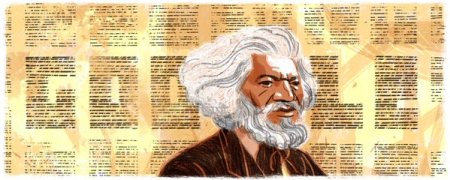
I found out – via the Twitter feed of Bonnie Greer – that yesterday’s Google Doodle was this:

Google_Douglass

The picture is a representation of Frederick Douglass (1818-1895), whose name was quite new to me until yesterday but whose remarkable life story turns out to have a strong connection with my home town of Newcastle upon Tyne.

Douglass was a prominent social reformer and campaigner against slavery, and for other forms of social justice, including equal rights for women. The most famous expression of his political philosophy is the following quote:

I would unite with anybody to do right and with nobody to do wrong.

Once a slave himself, Douglass escaped from bondage in 1838 and, while on the run, wrote his first autobiography Narrative of the Life of Frederick Douglass, an American Slave which quickly became a best seller on both sides of the Atlantic. He eventually made his way to England, where he went on a speaking tour,  impressing audiences around the country with the power of his oratory, his obvious intellect, and the conviction with which he held his political beliefs.

Slavery was unlawful under English common law at that time so technically Douglass was a free man from the moment he set foot in England, but the same would not be true if he returned to America. His English supporters wanted him to remain here, but he had a wife and three children in the United States and wanted to return and continue the campaign against slavery there. But as soon as he set foot back in America he was likely to be seized and returned to his “owner”.

Then, in a remarkably generous gesture, the people of Newcastle upon Tyne solved his problem. They collected enough money to pay his “owner”, Thomas Auld, for his freedom. He returned to America in 1847, a free man, where he remained true to his beliefs and spent the next 48 years continuing his various campaigns. He died of a stroke in 1895, aged 77.

Frederick Douglass was undoubtedly a remarkable man, passionate and courageous with a great gift for public speaking. A Google Doodle is a small honour for such a hero but I’m sure it has at least led to many others besides myself finding out just a little bit more about him.

And if you’ll forgive me for saying so, it also gives me yet another reason to be proud to be a Geordie.  Perhaps it’s true that the people of Newcastle upon Tyne are the most generous in the UK

P.S. Newcastle upon Tyne is not in the Midlands.


Ligatures, Diphthongs and Supernovae

Posted in History, Pedantry, The Universe and Stuff with tags , , , , , , , , on January 18, 2016 by telescoper

At the weekend I noticed a nice article by John Butterworth on his Grauniad blog about where Gold comes from. Regular readers of this blog (Sid and Doris Bonkers) know that I am not at all pedantic but my attention was drawn to the plural of supernova in the preamble:

Supernovas

I have to confess that I much prefer the latin plural “supernovae” to the modernised “supernovas”, although most dictionaries (including the One True Chambers) give these both as valid forms.  In the interest of full disclosure I will point out that I did five years of Latin at school, and very much enjoyed it…

When I tweeted about my dislike for supernovas and preference for supernovae some replied that English words should have English plurals so that supernovas was preferred (although I wonder if that logic extends to, e.g. datums and phenomenons). Others said that supernovae was fine among experts but for science communication purposes it was better to say “supernovas” as this more obviously means “more than one supernova”. That’s a reasonable argument, but I have to admit I find it a little condescending to assume that an audience can cope with the idea of a massive star exploding as a consequence of gravitational collapse but be utterly bewildered by a straightforward latin plural.

One of the reasons I prefer the Latin plural – along with some other forms that may appear archaic, e.g. Nebulae – is that Astronomy is unique among sciences for having such a long history. Many astronomical terms derive from very ancient sources and in my view we should celebrate this fact because it’s part of the subject’s fascination. That’s just my opinion, of course. You are welcome to disagree with that too.

Anyway, you might be interested to know a couple of things. One is that the first use of “super-nova” recorded in the Oxford English Dictionary was in 1932 in a paper by Swedish astronomer Knut Lundmark. This word is however formed from “nova” (which means “new” in Latin) and the first use of this term in an astronomical setting was in a book by Tycho Brahe, published in 1573:

Brahe_book(I’ll leave it as an exercise to the student to translate the full title.)

Nowadays a nova is taken to be a much lower budget feature than a supernova but the “nova” described in Tycho’s book was was actually a supernova, SN1572 which he, along with many others, had observed the previous year. Historical novae were very often supernovae, in fact, because they are much brighter than mere novae. The real difference between these two classes of object wasn’t understood until the 20th Century, however, which is why the term supernova was coined much later than nova.

Anyway, back to pedantry.

A subsequent tweet from Roberto Trotta asserted  that in fact supernovae and supernovas are both wrong; the correct plural should be supernovæ, in which the two letters of the digraph “ae” are replaced with a single glyph known as a ligature. Often, as in this case, a ligature stands for a diphthong, a sort of composite vowel sound made by running two vowels together.   It’s one of the peculiarities of English that there are only five vowels, but these can represent quite different sounds depending on the context (and on the regional accent). This  means that English has many hidden diphthongs. For example,  the “o” in “no” is a diphthong in English. In languages such as Italian, in which the vowels are very pure, “no” is pronounced quite differently from English. The best test of whether a vowel is pure or not is whether your mouth changes shape as you pronounce it: your mouth moves as you say an English “no”, closing the vowel that stays open in the Italian “no”…

So, not all diphthongs are represented by ligatures. It’s also the case that not all ligatures represent diphthongs. Indeed some are composed entirely of consonants. My current employer’s logo features a ligature formed from the letters U and S:

image

The use of the ligature æ arose in Mediaeval Latin (or should I say Mediæval?). In fact if you look at the frontispiece of the Brahe book shown above you will see a number of examples of it in its upper-case form Æ. I’m by no means an expert in such things but my guess is that the use of such ligatures in printed works was favoured simply to speed up the typesetting process – which was very primitive – by allowing the compositor to use a single piece of type to set two characters. However, it does appear in handwritten documents e.g. in Old English, long before printing was invented so easier typesetting doesn’t explain it all.

Use of the specific ligature in question caught on particularly well in Scandinavia where it eventually became promoted to a letter in its own right (“aesc”) and is listed as a separate vowel in the modern Danish and Norwegian alphabets.  Early word-processing and computer typesetting software generally couldn’t render ligatures because they were just too complicated, so their use fell out of favour in the Eighties, though there are significant exceptions to this rule. Latex, for example, always allowed ligatures to be created quite easily. Software – even Microsoft Word – is much more sophisticated than it used to be, so it’s now not so much of a problem to use ligatures in digital text. Maybe they will make a comeback!

Anyway, the use of æ was optional even in Mediaeval Latin so I don’t think it can be argued that supernovæ is really more correct than supernovae, though to go back to a point I made earlier, I do admit that a rambling discussion of ligatures and diphthongs would not add much to a public lecture on exploding stars.


17 Equations that Changed the World

Posted in History, The Universe and Stuff with tags , , on December 14, 2015 by telescoper

Yesterday I posted about a map that “changed the world”. Clearly the world changed a lot and for many different reasons because when I got home I noticed the following picture on Facebook, depicting 17 equations that also “changed the world”:


17 Equations

This is from a book by mathematician Ian Stewart.

Of course it’s actually 20 equations, because there are four Maxwell Equations. It is an interesting selection. Are there any surprising omissions?


William Smith and the First National Geological Map

Posted in History, The Universe and Stuff with tags , , , on December 13, 2015 by telescoper

Friday was the last day of teaching term here at the University of Sussex. Aided by the general winding down of things I managed the unusual feat of geting up to London in time to catch some of the monthly discussion meeting of the Royal Astronomical Society, which was on A Critical Assessment of Cluster Cosmology. Usually I only just manage to get there in time for some of the Ordinary Meeting which follows the specialist meetings at 4pm. And sometimes I only get there in time for the drinks reception at Burlington House followed by the RAS Club dinner at the Athenaeum!

I may write something about Cluster Cosmology if I get time before Christmas, but I thought I’d post an item now inspired by one of the talks in the Ordinary Meeting by Tom Sharpe of Lyme Regis Museum and Cardiff University. This talk was timed to mark the 200th anniversary of the publication of the first ever geological map of England and Wales in 1815. To make it even more topical, the talk was given in the lecture theatre of the Geological Society of London where an original print of the Map is on permanent display:

William Smith Map

The person responsible for this map, which was the first to show nationwide geological strata, was a chap called William Smith who surveyed England and Wales on foot and on horseback, travelling over 10,000 miles to make it. It was a remarkable achievement which, among many other things, led the way to great changes in the understanding of geological time. Unfortunately his work didn’t have much impact when it was first published. Smith, who was evidently not a very astute businessman, eventually went bankrupt and spent some time in a debtor’s prison.

The map itself is extremely beautiful as well as very clever in the way it uses colours and shading to represent three-dimensional information on a two dimensional surface.

Anyway, there is a book  entitled  The Map that Changed the World  written by Simon Winchester which tells the story of William Smith and his map. I haven’t read it but I’m told it’s excellent. I’ll probably buy a copy with the book tokens I inevitably get for Christmas!


Bayes’ Theorem or Price’s Theorem?

Posted in History, The Universe and Stuff with tags , on December 4, 2015 by telescoper

Richard_Price_West

I’m indebted to a fellow blogger for drawing my attention to the person shown in the above picture, Dr Richard Price who has been described as “the most original thinker ever born in Wales”, and who has a Society named after him.

Price was a moral philosopher, nonconformist preacher and also a mathematician of some note. Of particular interest to this blog is the role he played in the development of what is now known as Bayes’ Theorem, after the Reverend Thomas Bayes.

However, the paper in the Philosophical Transactions of the Royal Society that contains the first published form of this theorem was not published until 1763, over a year after Bayes’ death and, as you can see if you follow the link, is attributed jointly to “Mr Bayes and Mr Price”.  It appears that there was an original manuscript written by Bayes around about 1755  which was communicated to Price when Bayes died in 1761 and then presented for publication over a year later; Price had been asked to act as “literary executor” of Bayes’ estate.

Unfortunately the original manuscript has never been found and it is therefore impossible to say for sure how much Price contributed to the final version. However, a relatively recent and very interesting article  raises this question, and argues (reasonably convincingly to my mind) that Bayes’ part stops at page 14 of 32 pages. It is therefore quite possible that Price wrote over half the paper himself although most historical discussions of this matter simple state that Price “edited” Bayes’ work.

It has to be said that the paper is not exactly a model of clarity and pertains only to a particular case of the full theorem. The form in general use today was first published by Laplace in 1812, so it should really be called Laplace’s Theorem, but Laplace did give generous credit to the work of Bayes which is no doubt why the name stuck.

I don’t suppose we will know for sure exactly how much Price contributed to the development of Bayes’ theorem, but this may be yet another example of the law that any result in science or mathematics that has a person’s name attached to it has the wrong name attached to it!

Finally, I will mention that the Richard Price Society has started a petition to the Welsh government. I’m taking the liberty of copying the purpose of this petition here:

We call on the Welsh government to acknowledge the important contribution of Dr Richard Price not only to the eighteenth century Enlightenment, but also to the making of the modern world that we live in today, and develop his birthplace and childhood home into a visitor information centre where people of all nationalities and ages can discover how his significant contributions to theology, mathematics and philosophy have shaped the modern world.

Tynton Farm in Llangeinor, the birthplace and childhood home of Dr Richard Price is for sale. Once derelict, the farm has been sensitively restored and almost all of the original features have been preserved. The Richard Price Society is aware that the house attracts visitors from all corners of the globe and this is attested by the previous owner’s Visitors Book that was signed by visitors to the farm. The position of the farm and its provenance would make it an ideal learning centre where people can find out just what an important person he was and remains. This is an opportunity to buy the property at market value and help celebrate the achievements of Wales’ intellectual giant and apostle of liberty.


I have signed it, and hope you will consider doing likewise!


100 Years of General Relativity

Posted in History, The Universe and Stuff with tags , on November 25, 2015 by telescoper

Many people have been celebrating the centenary of the birth of Einstein’s Theory of General Relativity this year, but it’s not obvious precisely what date to select. I’ve decided to go for today, partly because the News on BBC Radio 3 did when I work up this morning, but also because there is a well-known publication that mentions that date:

einsteingr

The 25th November 1915 was the date on which Einstein presented the “final” form of his theory to the Prussian Academy of Sciences. You can find a full translation of the paper “The Field Equations of Gravitation” here. You will see that he refers to a couple of earlier papers in that work, but I think this one is the first presentation of the full theory. It fascinated me when I was looking at the history of GR for the textbook I was working on about 20 years ago that the main results (e.g. on cosmology, the bending of light and on the perihelion of mercury) are spread over a large number of rather short papers rather than all being in one big one. I guess that was the style of the times!

So there you are, General Relativity has been around for 100 years. At least according to one particular reference frame…


Oh, and here’s a cute little video – funded by the Science and Technology Facilities Council – celebrating the centenary:


Campaigners warn on Guy Fawkes night pogonophobia

Posted in Beards, History on November 5, 2015 by telescoper

No beards on your bonfire please!!

kmflett's avatarKmflett's Blog

Beard Liberation Front

PRESS RELEASE           2nd November

Contact Keith Flett     07803 167266

CAMPAIGNERS WARN ON GUY FAWKES BONFIRE NIGHT POGONOPHOBIA

guy

The Beard Liberation Front, the informal network of beard wearers, has warned of Guy Fawkes pogonophobia as bonfires around the country burn effigies of a hirsute man on Thursday evening and the following weekend.

Pogonophobia is the ancient Greek for an irrational fear or hatred of facial hair, known as beardism in modern English.

The BLF says that November 5th is the traditional highlight of the pogonophobes year as they burn an effigy of what they assume to be a dangerous radical figure with a beard, although few will openly discuss their often deep seated concerns about beard wearers

BLF Organiser Keith Flett said the irony is that Guy Fawkes was a deeply reactionary character who, had he lived now, would almost certainly not have had a beard under any…

View original post 32 more words

Why I wear a poppy

Posted in Biographical, History with tags , , on November 3, 2015 by telescoper

Once again we’re coming up to Remembrance Sunday, an occasion to remember those who have given their lives in conflicts past and present. This is always held on the second Sunday in November in the United Kingdom, so that it is close to the date of anniversary of the armistice that formally ended the First World War, on 11th November 1918. Another way to commemorate this  is the observance of two minutes’ silence at 11am on 11th November itself. I plan to do that, next Wednesday (which is the 11th November). I’ve kept my calendar free at 11am precisely for that purpose.

Then there  is the wearing of a poppy. The poppy appeal raises money for veterans and their families, but the wearing of these little red paper flowers is something that not everyone feels comfortable with. Some people think that to wear a poppy is to celebrate militarism or even Britain’s imperialist past. I don’t see it that way at all. In fact, if someone asked me to wear a badge to support Britain’s participation in the invasion of Iraq, I’d certainly refuse.

I wrote about my reaction to the horror and futility of war some time ago, so I’ll try not to repeat myself except to say that, to me, the poppy is not about celebrating war or military prowess or imperialism, it’s simply about remembering those who died. In fact, one of the main reasons the paraphernalia of  Remembrance Day observances (the Poppy, the Cenotaph, the Tomb of the Unknown Soldier, etc) were set up in the first place was to remind not just people but also governments of the devastation caused by World War One. That’s why the Remembrance Day ceremonial laying of wreaths takes place in Whitehall, right at the heart of government. The ritual  was specifically intended to be a warning to the politicians who had brought the conflict about not to allow it to happen again.

As a young lefty student I grappled with the implications of the poppy appeal. The Peace Pledge Union produces white poppies, as an overtly anti-war symbol of remembrance. For a time I wore a white poppy but, although I am against war, I don’t think a policy of non-violence would have helped much against Hitler’s Nazi regime and therefore can’t really call myself an out-and-out  pacifist. One year I wore both white and red poppies, but since then I’ve decided to stick with a red one.

Of course many in the Establishment would like the poppy to turn into a symbol of obedience, a kind of alternative national flag. Some people choose not to wear it precisely because it has that implication. The sight of some hypocritical warmongerers wearing the poppy at the Cenotaph on these occasions sickens me, but their betrayal does not make me want to stop wearing it myself. Neither does the fact that our politicians seem content to give away the freedoms that so many died to protect.

People have  a wide range of views about the poppy and its meaning. There is no “right” answer – every person’s attitude is shaped by a number of factors, not least by whether or not they have lost a loved one in any form of armed conflict.  Some of us wear wear a poppy, some don’t. It’s a matter of choice. The fact that we have a choice is important in itself. I would probably refuse to wear a poppy myself if someone tried to make it compulsory.

Some poppy sellers use the slogan  Wear Your Poppy With Pride, but the original meaning  is much better expressed by the original, Lest We Forget. I’m not sure I wear mine with pride at all, in fact. What I feel is really more like shame, at the wastefulness and stupidity of armed conflict. I count myself incredibly lucky that I have never had to live through anything like that, not only because I’ve had a relatively peaceful and comfortable life, but also because I have never been tested in the way previous generations were. I wear the poppy to acknowledge their bravery and to recognize my own good fortune.  When I stand for the two minutes silence I remember those all who fell fighting on all sides of all wars, and  fallen civilians too.

When the newsreader Jon Snow decided not to wear a poppy on TV a few years ago, there were angry complaints. I’m sure he didn’t mean disrespect to the cause but disliked the pressure being put on him to conform. I can see his point. It has to be voluntary if it is to mean anything at all. . But in the end I agree with Euan Ferguson’s piece in the Observer a few years ago:

I don’t like pressure being put on people to conform. Orthodoxy and fear are always to be regretted and today’s society is over-condemnatory, swift to its manufactured outrage. But this change seems to have come from below, not been ordered by bullies: the daily reports of life and death in the forces, of the danger other 20-year-olds daily find themselves facing. And is the symbolism of the poppy being degraded as it is customised? No. You can’t do much to the fabulous simplicity of this symbol. And the poppy doesn’t preach: it’s not about “right” or “wrong” wars, but about brave dead soldiers. And the message was, never, Remember in the way we tell you to remember. It is, simply, Lest We Forget.

So, yes. I am wearing a poppy again this year. Lest we forget.

GEORDIE LAMP

Posted in History with tags , , on November 2, 2015 by telescoper

This reminds me of one of the two plausible explanations for the origin of the word “Geordie” – that miners from the Newcastle area favoured lamps of the type invented by George Stephenson described in this article, while those in the rest of the country (including the Midlands) used the Davy Lamp, invented around the same time in 1815.

The other explanation of the origin of Geordie relates to the 1715 Jacobite rebellion, when the city of Newcastle upon Tyne closed its gates to the rebel army from Scotland and declared its loyalty to King George I. The rebels were eventually defeated at the Battle of Preston.

The word “Geordie” is thus either 200 or 300 years old depending on which account you believe…

imechearchive's avatarIMechE Archive and Library

This year marks 200 years since the invention of the Geordie Lamp – a revolutionary invention by George Stephenson – which is on view off our reception until Christmas.

Committee for the Renumeration of George Stephenson for hi Committee for the Remuneration of George Stephenson for his Safety Lamp Invention

In 1812, Stephenson was an engine-wright at Killingworth High Pit. In this role, he was in charge of all of the colliery machine of the Grand Allies. Because this machinery was not only above ground, but also below, Stephenson spent a lot of time actually down in the mines carrying out maintenance and repairs. He was all too well aware of the poor working conditions that the miners had to deal with, and the casualties that took place due to firedamp explosions. Indeed, in a previous role, he had been working at the West Moor pit in when a firedamp explosion killed 10 miners.

Firedamp is the combination of…

View original post 520 more words

R.I.P. Lisa Jardine

Posted in History with tags , on October 26, 2015 by telescoper


Lisa Jardine

As soon as I got home from Oxford yesterday I heard the very sad news of the death of writer, scholar and broadcaster Lisa Jardine, who has passed away at the age of 71.

Today’s newspapers are filled with tributes from people who are fair better qualified than me to discuss her career as a historian (e.g. here and here). I can’t leave her death unmarked, but I’ll restrict myself to some personal recollections. Lisa Jardine worked at Queen Mary College when I was employed there (from 1990-1998) . I won’t claim to have known her well but I did meet her quite a few times, usually in the Senior Common Room bar.  She seemed to me to be a rarity:  a historian who was genuinely interested in, and knowledgeable about,  science. In fact she knew an enormous amount about a huge range of different subjects, but was also extremely engaging and approachable, though she didn’t suffer fools gladly (if at all). She was a delight to talk to; conversations with Lisa were always both entertaining and educational.  What I’ll remember most, however, is her deliciously cheeky sense of humour and the  marvellous twinkle in her eye. It’s hard to believe that she has gone.

Rest in Peace, Lisa Jardine (1944-2015).

P.S. In case you weren’t aware, Lisa Jardine was the daughter of famous polymath Jacob Bronowski who was of Polish-Jewish origin. I mention that not to detract from Lisa’s own achievements as an academic, but to draw attention to yet another family of “migrants” that has enriched our nation’s culture.