Archive for the History Category

Hubble versus Slipher

Posted in History, The Universe and Stuff with tags , , , , , on September 15, 2012 by telescoper

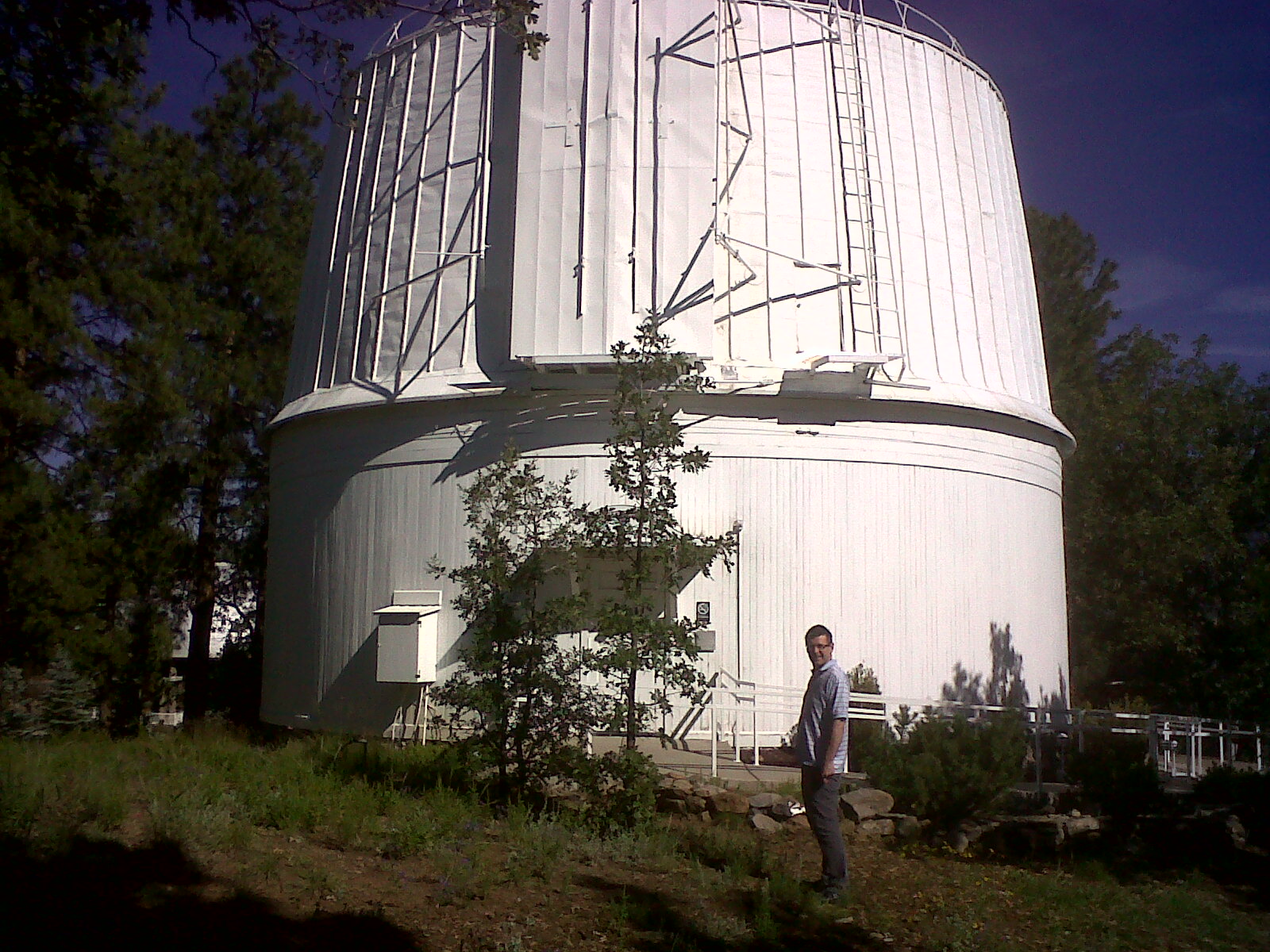
Since I’m here at a conference celebrating the scientific achievements of Vesto M. Slipher, I thought I’d take the opportunity to make a few remarks about Slipher’s work and legacy.

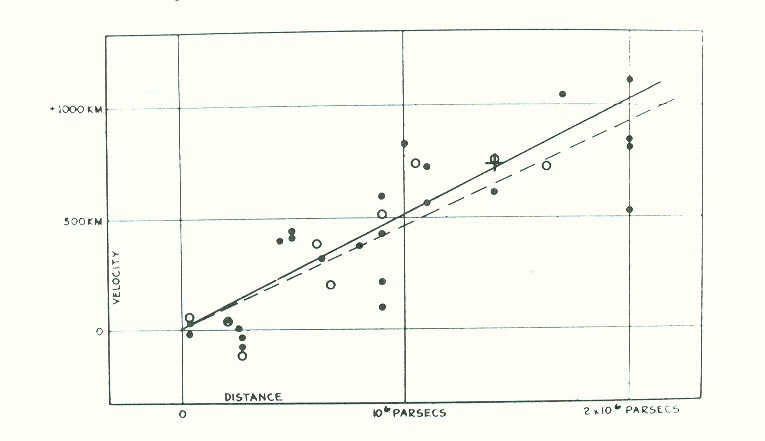
I often use this picture in popular talks to illustrate the correlation between distance (x-axis) and apparent recession velocity (y-axis) that has become universally known as Hubble’s Law. This is an early version of such a plot published by Edwin Hubble in 1929.

In public talks I rarely have time to go into the details of this, but it is worth saying that only the results on the x-axis were Hubble’s own measurements. Hubble only contributed half of the above plot, i.e. the distance measurements, and these turned out to be wrong by a factor of about 10 owing to an incorrect identification of the stars used as standard candles. All the recession velocities on the y-axis – obtained by looking at the displacement of lines in the target galaxy’s spectrum – were in fact obtained by Vesto Slipher at the Lowell Observatory here in Flagstaff, Arizona. Hubble used these data from Slipher with permission, but gave no credit to Slipher in the references to his 1929 work. A later, and more convincing, version of this plot published in 1931 by Hubble and Humason, was accompanied by a generous acknowledgement to Slipher’s contribution. However, by then, Hubble’s name was firmly associated with the plot and Slipher’s contribution was largely forgotten for many years subsequently.

This episode isn’t at all atypical of Hubble’s behaviour. He was an extremely ambitious man who was an expert in the art of promoting himself and the Mount Wilson Observatory where he worked. Slipher was a very different type of man: quiet, self-effacing, and very much a team player, dedicated to scientific accuracy rather than his own reputation.

It’s worth saying further that the key observation that led to the understanding that the Universe is expanding is the fact that most of the spectra obtained by Slipher, over the years subsequent to his first measurement of the spectrum of the Andromeda Nebula (M31) celebrated by this conference, showed a redshift indicating velocity away from the observer. Even without distance measurements this leads directly an interpretation in terms of cosmic expansion. Ironically, the first spectrum he obtained, M31 shows a blue shift, as do a few others plotted with negative velocities in the above diagram, but the more distant sources exclusively show a redshift.

As a scientist should be, Slipher was very careful about the interpretation of this result. The more distant objects are fainter and thus more difficult to observe. Could it arise from some systematic artifact? Or could there be an unknown physical effect that produces a redshift dependent on the size of the source? These questions could only be answered when accurate distances to the nebulae were established, so Hubble’s contribution was by no means negligible. It’s completely untrue, however, to say that Hubble discovered the expansion of the Universe, so there’s yet another example of Stigler’s Law of Eponymy whenever anyone talks about the Hubble expansion.

One of the great things about coming to this meeting was the chance to meet Alan Slipher, grandson of Vesto Slipher. He and other members of his family refer to Vesto as “VM”, by the way, which I hadn’t realised before. VM lived a long life, dying in 1969 just short of his 94th birthday, so Alan knew him well until age 17 or so. He spoke most warmly and movingly after yesterday’s conference dinner about his memories of his grandfather, who he clearly looked up to. His words confirmed the impression I’d already formed, that Slipher was an extremely cautious and serious scientist as well as a kindly and humble man.

The contrasting personalities of Slipher and Hubble are further illustrated by correspondence between the two that is archived at the Lowell Observatory. Slipher comes across as kindly and cooperative, Hubble as pompous and self-regarding. I know which of the two I admire the best, both and scientist and human being.

Grave Thoughts

Posted in Biographical, History, Jazz, Literature with tags , , , , , on August 12, 2012 by telescoper

It being a lovely day in Copenhagen yesterday I decided to go for a long walk. My destination was the famous Assistens Kirkegård which is in the Nørrebro district of the city. You might think that was a rather morbid choice of place to go for a stroll in the sunshine, but actually it’s not that way at all. It’s actually a rather beautiful place, a very large green space criss-crossed by tree-lined paths. We British have a much more reserved attitude to cemeteries than the Danes seem to have, at least judging by yesterday; joggers and cyclists pass through Assistens Cemetery at regular intervals, and many people were having picnics or just sunbathing between the gravestones.  And of course there were many tourists wandering around, myself included. I found this matter-of-fact attitude to the dead rather refreshing, actually.

Incidentally, I was also surprised to see a number of Jewish burials among the Christian ones. I don’t know if this happens in British graveyards.

Part of the attraction of Assistens Kirkegård – the name derives from the fact that it was originally an auxiliary burial place, outside the main city, designed to take some of the pressure off the smaller cemeteries in the inner areas – is the large number of famous people buried there.  The cemetery is extremely large (about 25 hectares), and the maps don’t show the locations of all the famous people laid to rest there, but I did find quite a few.

Here for example is the memorial to one of the most famous Danes of all, Hans Christian Andersen

Going by the number of signposts pointing to it, this must be one of the most popular sites for visitors to the cemetery, along with the grave of the philosopher Søren Kierkegaard. One can also quite easily locate the memorial which marks the last resting place of Niels Bohr and various other members of his family:

But it’s not only Danes that are buried here. There’s a corner of one plot occupied by a number of famous American Jazz musicians, including pianist Kenny Drew and, most famously of all, tenor saxophonist Ben Webster whose gravestone is rather small, but clearly very well tended, no doubt by a Danish jazz lover:

Unfortunately, I was unable to locate one of the graves I wanted to find, that of the great Heldentenor Lauritz Melchior. I was surprised to find his name was absent from the main index. I know he was cremated and his ashes buried there, and I even found a picture of his memorial on the net, but the cemetery is so large that without further clues I couldn’t find it. I’ll have to go back on a subsequent visit after doing a bit more research.

It’s very interesting that some of the smaller graves are extremely well-tended whereas many of the more opulent memorials are in a state of disrepair. My ambition is to be forgotten as quickly as possible after my death so the idea of anyone erecting some grandiose marble monument on my behalf fills me with horror, but I have to say I do find graveyards are strangely comforting places. Rich and poor, clever and stupid, ugly and beautiful; death comes to us all in the end. At least it’s very democratic.

And after about three hours strolling around in the cool shade of the trees in Assistens Kirkegård the thought did cross my mind there still seems to be plenty of room…

The Shell House Raid

Posted in Biographical, History with tags , , , , , , , , , on August 10, 2012 by telescoper

An early morning walk around Copenhagen this morning reminded me of a longer visit I made here about 25 years ago, during which I rented a room in a nice large apartment on Frederiksberg Allé, which is in a rather posh part of the city called Frederiskberg. The landlord, who also lived on the premises, was a Mr Vagn Jul Pedersen, a nice old man who had lived in that part of the city all his life. One evening we sat talking over a beer or two and he told me of a terrible thing that he had seen during the latter stages of the Second World War when he was a young man, and I thought some of you might be interested to learn about it.

In March 1945, the British decided to carry out a low-level bombing attack on a target in Copenhagen, which was under German occupation at the time. The mission was given the codename Operation Carthage and its primary objective was the Shellhus (“Shell House”) originally owned by the oil company, but commandeered by the Nazis for wartime use as the Gestapo headquarters. The request to bomb the Shellhus came from the Danish Resistance, despite the fact that it was known that the top floor of the building was being used to house Danish prisoners as a kind of human shield.

I have based the following on a post I found elsewhere on the net. You can also read the official RAF account here.

By the end of 1944 the Danish resistance movement in Copenhagen was in danger of being wiped out by the Geheime Staatspolizei (Gestapo). Many of their leaders were arrested and a lot of material was filed in the Gestapo archives in the Shell house. Leading members of the resistance-movement requested an attack by air on the Shell House via the Special Operations Executive (SOE) in London.

Eventually on 21 March 1945, 20 de Havilland Mosquito fighter-bombers from 2nd TAF escorted by 28 Mustang Mk. III fighters from 11 Group took off from RAF Fersfield in Norfolk, England. 18 of the Mosquito bombers were F.B. Mk. VIs and 2 were Mosquito B. Mk. IVs from the Photographic Reconnaissance Unit (PRU). The Mosquito force attacked in 3 waves: 1st wave with 7 Mosquitoes (one PRU); the 2nd wave with 6 Mosquitoes; and finally the 3rd wave with 7 Mosquitoes (one PRU). The primary objective for the Mustangs was to engage, distract, suppress and, if possible, destroy anti-aircraft “Flak” batteries concentrated in central Copenhagen.

The first wave approached their target from the South West but, as they passed Enghave Station, which is near the famous Carlsberg brewery, Mosquito SZ 977, with Pilot W/Cdr. Peter A Kleboe and Navigator F/O K Hall, struck a 30 metre lamppost or pylon; the wingtip of the Mosquito then hit the roof of No 106 Sonder Boulevard. The two 500lb bombs carried by the aircraft ripped off and exploded, killing twelve civilians. Flying at roof-top level over a densely populated area it was inevitable that there would be casualties if a plane crashed or were shot down, but the Fates that day were in an especially cruel mood and far worse was to follow.

The stricken Mosquito “T for Tommy” crashed seconds later in a garage near the Jeanne d`Arc French Catholic school on Frederiksbergs Allé. The front part with the cockpit with the two crew members landed on Dr. Priemesvej; they were badly burned and later died of their injuries. Pilot W/C Peter A. Kleboe and Navigator F/O Reginald J.W. Hall were laid to rest in Bispebjerg Cemetery on 28 March 1945.

The rest of the first wave found and bombed the Gestapo Headquarters successfully. In all six bombs exploded in the Western wing and, of the nine prisoners in this part of the building, six were killed instantly and another died when jumping from the 5th floor to the ground.

But the tragedy that had begun to unfold at Frederiksberg Allé was about to get even darker. The 2nd wave of Mosquitoes became confused by the smoke and flames from the crashed Mosquito and thought it must be their target. Two of the Mosquitoes in the 2nd wave dropped their bombs on the French school and only one proceeded to bomb the Shell House. The 3rd wave approached Copenhagen from the West, and again became confused. All but one of the Mosquitoes dropped their bombs by mistake on the French Jeanne d`Arc Catholic School killing 86 children and 16 adults out of 482 children and adults, while 67 children and 35 adults were wounded.

This is the site of the modern Shell House, the original being completely destroyed during Operation Carthage. It’s quite easy to find, on the North side of Kampmannsgade, just to the East of Sankt Jørgens Sø, between Nyropsgade and Vester Farimagsgade. It’s actually quite close to the splendid modern Tycho Brahe Planetarium.

Inside the doorway at the far right of this building as seen in the above view is the following inscription, giving the names of the Danish resistance members who died that day

You can see here below a map showing the location. Enghave Station is to the South-West, the natural direction from which the incoming planes would have come. The Mosquito “T for Tommy” must have veered North, i.e. to its left, after its collision with the pylon in order to have crashed where it did.

Reading about this terrible episode, I was at first surprised that so many pilots misidentified the target, especially since the correct one is so close to Sankt Jørgens Sø, a prominent expanse of water that makes up one of a string of shallow lakes that extend along most of the Western side of Copenhagen’s city centre, which one would have thought was easily identifiable by its absence at the French School. The pilots had, after all, been shown detailed models of the location before the raid. But then I’m sitting at a desk with a map in front of me, not screaming along at 400mph, over rooftops bristling with anti-aircraft guns, into the teeth of withering Flak fire.

I walked the distance from the Jeanne D’arc School to the Shell House and I reckon it’s not much further than 1km, perhaps less as the Mosquito flies. That’s just seconds at the speed the planes would have been flying. That, together with the general confusion of smoke, gunfire and fear, could easily account for the navigational errors.

Owing to the presence of planes from the RAF photographic unit, there is remarkable film footage shot during the actual raid, some of which can be seen in the following film. It’s interesting how little Copenhagen’s skyline has changed; much of the city is immediately recognizable. There is also some very moving eye-witness testimony.

Even to a non-expert like me this was clearly an extremely dangerous mission. Mr Pedersen told me he saw Mosquitoes flying between the houses, along some of Copenhagen’s admittedly very wide roads, below the level of the rooftops; presumably the anti-aircraft guns were unable to aim downwards. A total of 4 Mosquitoes and 2 Mustangs were lost to flak with 9 crewmen KIA and 1 POW. Incidentally, one of the two Mustangs shot down that day crashed in Fælledparken, the park just behind the Niels Bohr Institute.

Mounted on the wall of the present Shell House is a bronze cast of a propeller from one of the downed Mosquitoes. A plaque is placed below the propeller with the names of the 9 crew members who were killed in the attack.

A total of 133 Danes died during and after the raid, including 86 children and 18 adults (including many nuns, and some bystanders who had tried to help) at the French School. At the Shell House, 8 Gestapo prisoners were killed and 18 managed to escape; 55 German soldiers and 47 Danish employees of the Gestapo died. In those days they hadn’t invented bland phrases like “collateral damage” to disguise the real horror of war, and it wasn’t possible to use unmanned drones as deployed by the US in their covert “war on terror”. Although Operation Carthage did achieve its objective, the loss of innocent life was so appalling it remains difficult to see it as a success.

I remember very well the tears in Mr Pedersen’s eyes when he told me about what had happened at the French School that day; it was only later that he found out what the actual objective of the raid was. At the end he said “You are lucky that you will never have to witness anything like that.” That goes for all of us who have had the good fortune to live in a time of peace. But let’s not forget the other parts of space-time where things are/were very different.

Dr Dee

Posted in History, Music, Opera, The Universe and Stuff with tags , , , , , on July 10, 2012 by telescoper

Last Friday evening, after my afternoon shift at the Royal Society Summer Exhibition, I took the chance to go and see something a bit different, in the shape of English National Opera’s production of  Dr Dee at the Coliseum. I hadn’t really known what to expect of this beforehand, actually, but needed to find a bit of distraction in London and was fortunately able to persuade my lovely friends Joao and Kim to come with me to try it out.

Dr Dee is based on the life of John Dee, the famous Elizabethan mathematician, astrologer, courtier, and spymaster. Written by Mr Damon Albarn, former lead singer of the popular beat combo Blur, it’s not exactly an opera but more of a renaissance-style pageant depicting the life of this mysterious character in a series of dramatic tableaux. Not being at all naturalistic in style it would have been quite difficult to follow what was going on without the programme notes, but each episode was brilliantly realised with dramatic staging, dancing and stunning visual effects. Rufus Norris was responsible for the overall direction of the piece. Hat’s off to him. I wasn’t really expecting the music to be so interesting, either; mixing pop vocals with orchestral music from the period could have been awful, but actually I warmed to it very quickly.

An influential polymath, Dee was, for a time, a trusted confidante of Elizabeth I and he was recruited by Sir Francis Walsingham to set up a network of informants and decipher Catholic codes in the build-up to the attempted invasion of England by the Spanish Armada. Dee is also purported to be the inspiration behind Prospero in Shakespeare’s The Tempest. What’s particularly interesting about him from an historical perspective is that lies at the crossroads between magic and science. A gifted mathematician, Dee developed an obsession for the occult after meeting a very dodgy character called Edward Kelly, who persuaded Dee that he could talk to angels in their own language with the help of a crystal ball, a technique known as scrying. Dee eventually went mad and was alienated not only from Elizabethan society but also from his own family. Had he lived at a slightly different time, he could well have ended up burned as a heretic. His story reminds us that the distinction between rationality and irrationality has not always been so clear. Alchemy and the occult could co-exist in many great minds alongside mathematics and empirical study so it should not surprise us that science and pseudoscience both seem able to thrive in modern culture.

The run of Dr Dee at ENO has now ended, but I’m definitely glad I plucked up the courage to go and see it. It’s a truly imaginative work and produced a memorable theatrical experience.

Big Bang: Who’s the Daddy?

Posted in History, The Universe and Stuff with tags , , , , on June 8, 2012 by telescoper

Time, I think, for a frivolous Friday poll.

I stumbled across a post on the Physics World Blog concerning a radio broadcast about Georges Lemaître.

Here’s a description of said programme:

Few theories could claim to have a more fundamental status than Big Bang Theory. This is now humanity’s best attempt at explaining how we got here: A Theory of Everything. This much is widely known and Big Bang Theory is now one of the most recognisable scientific brands in the world. What’s less well known is that the man who first proposed the theory was not only an accomplished physicist, he was also a Catholic priest. Father Georges Lemaître wore his clerical collar while teaching physics, and not at Oxford, Cambridge or MIT but at the Catholic University of Leuven in Belgium. It was this unassuming Catholic priest in an academic backwater who has changed the way we look at the origins of the universe. His story also challenges the assumption that science and religion are always in conflict. William Crawley introduces us to the “Father” of the Big Bang.

The question is whether the word “Father” in the last sentence should be taken as anything more than a play on the title he’d be given as a Catholic priest?

Lemaître’s work was highly original and it undoubtedly played an important role in the development of the Big Bang theory, especially in Western Europe and in the United States. However, a far stronger claim to the title of progenitor of this theory belongs to Alexander Alexandrovich Friedman, who obtained the cosmological solutions of Einstein’s general theory of relativity, on which the Big Bang model is based, independently of and shortly before Lemaître did. Unfortunately the Russian Friedman died in 1925 and it was many years before his work became widely known in the West. At least in my book, he’s the real “father” of the Big Bang, but I’m well aware that this is the source of a great deal of argument at cosmology conferences, which makes it an apt topic for a quick poll:

P.S. I prefer to spell Friedman with one “n” rather than two. His name in his own language is Алекса́ндр Алекса́ндрович Фри́дман and the spelling “Friedmann” only arose because of later translations into German.

Why not pardon Turing?

Posted in History, Politics with tags , , , , on February 9, 2012 by telescoper

I couldn’t resist a quick comment or two on the government’s decision not to issue a posthumous pardon to Alan Turing, in the matter of his his criminal conviction for homosexuality, recently announced by Lord McNally. This is Lord McNally’s reply to a question asked by Lord Sharkey:

The question of granting a posthumous pardon to Mr Turing was considered by the previous Government in 2009.

As a result of the previous campaign, the then Prime Minister Gordon Brown issued an unequivocal posthumous apology to Mr Turing on behalf of the Government, describing his treatment as “horrifying” and “utterly unfair”. Mr Brown said the country owed him a huge debt. This apology was also shown at the end of the Channel 4 documentary celebrating Mr Turing’s life and achievements which was broadcast on 21 November 2011.

A posthumous pardon was not considered appropriate as Alan Turing was properly convicted of what at the time was a criminal offence. He would have known that his offence was against the law and that he would be prosecuted. It is tragic that Alan Turing was convicted of an offence which now seems both cruel and absurd-particularly poignant given his outstanding contribution to the war effort. However, the law at the time required a prosecution and, as such, long-standing policy has been to accept that such convictions took place and, rather than trying to alter the historical context and to put right what cannot be put right, ensure instead that we never again return to those times.

In other words he is using the argument that Turing was properly convicted of behaviour that was considered an offence at the time so that conviction should not be negated.

This argument is entirely specious. A pardon is an act of clemency or forgiveness, exercised under the royal prerogative whenever advised by the government. It is not the mechanism for overturning wrongful convictions, so the observation that this conviction was lawful at the time is a red herring. Moreover, in what I consider to be an entirely analogous situation, all soldiers convicted and executed for cowardice in World War I actually received pardons in 2006. Their actions were also considered punishable at the time. This sets a clear precedent. Why is the Turing case logically different?

The answer to that is that if Turing were to receive a pardon, why should all the other gay people convicted of the criminal offence of being homosexual not also receive pardons? Why does it matter logically in this case that Turing was a brilliant mathematician who made immense contributions to the Allied effort during World War II? What about those gay men who were prevented from joining the services because of their sexuality? Why should one’s brilliance or eminence in a given field lead one to be treated differently under the law? Wouldn’t that just be saying “yes, he was gay, which is a problem, but we’ll forgive him because he made up for it in other ways”?

I think the government’s primary motivation for denying a pardon in this case is in fact the argument I just gave: that they should then have to pardon everyone convicted of homosexuality…

Of course you might ask in that case why it is that people are campaigning for a pardon for Turing in particular? Why not campaign for a universal pardon? I admit that it’s slightly illogical to do so, but it’s a question of pragmatism. Arguing the case for Turing in particular provides a focus which hopefully will lead to a wider resolution of the issue.

Asking for a posthumous pardon isn’t asking for very much, but I suspect the government is more worried about those people still alive who were convicted of homosexuality before 1967, which is when such acts were decriminalized. The case for denying pardons in this situation, when pardons were granted in the case of the executed WWI troops, therefore rests entirely on the possibility that there may be some pesky people who were convicted of homosexuality in the past but who unfortunately, unlike Turing, are not yet dead.

That’s the message this decision sends from the government to gay people.

Sinfonia Antarctica

Posted in History, Music with tags , , , , , , , , on February 8, 2012 by telescoper

Just time for a quick post while I eat my breakfast this morning about last night’s Scott Centenary Concert at St David’s Hall Cardiff. The concert was given by the City of London Sinfonia (conducted by Stephen Layton) and last night’s performance was actually the third date in a tour which takes them next to Cheltenham and then to the Cadogan Hall in London. I mentioned this concert in a post last week.

The main music for the evening was written by Vaughan Williams. The concert started with excerpts from his score for the 1948 film Scott of the Antarctic, interspersed with dramatic readings from Scott’s own diaries and letters, by actor Hugh Bonneville. Apparently Vaughan Williams found the subject matter of the film so compelling that he wrote a huge amount of music, most of it before even seeing the screenplay, and only a small part was actually used in the movie soundtrack. He later re-worked much of this material into a full symphony, The Sinfonia Antarctica, his 7th, which was performed in full after the interval. Musically speaking, therefore, the opening piece was really a taster for the full work, but the readings were deeply moving.

Scott kept full diaries all the way from the beginning to the end of the expedition so they describe the journey in remarkable detail, and with no little poignancy. The initial optimism gradually tempered turned to crushing disappointment when they discovered that Amundsen had beaten them to the South Pole. When they turned  home to try to reach safety before the Antarctic winter closed in around them, Scott’s diary asks for the first time “I wonder if we’ll make it.”  Passages describing the awful death of Petty Officer Evans and Captain Oates’ noble sell-sacrifice were included, and the last terrible days when, without food or fuel, the three remaining companions were entombed in their tent by a raging blizzard, were depicted by Scott’s increasingly fragmentary and heartbreaking notes. One can’t really imagine the depth of their suffering, of course, but the desolation of their last hours is obvious. Their bodies were not found until 8 months later.

Before the interval we heard a new commission, Seventy Degrees Below Zero, by Cecilia McDowell, featuring tenor Robert Murray. This was an orchestral setting of various parts of the scientific record of Scott’s Last Expedition. I have to say I didn’t really like the piece: the vocal lines lacked interest and the orchestral music lacked any real sense of variation or development. Robert Murray struggled to project, his rather thin tenor voice not really suited to the music.

After the interval we had a complete performance of the Sinfonia Antarctica. Although I enjoyed it very much, I’m still not sure how well this hangs together as a symphony. There’s no doubt, however,  that it contains a number of strokes of genius. The opening theme, heard at various points later on in the piece, manages to conjure up  the Antarctic landscape – not only the snow and ice but also its singular desert-like aridity – as well as a deep sense of tragedy. The second movement featuring soprano Katherine Watson and women’s voices from the Bath Camerata and Wells Cathedral School Chamber Choir in wordless singing produced a wonderful unearthly atmosphere. Later on, there’s a passage featuring an organ which gave me the chance to  hear he magnificent organ at St David’s Hall for the first time.

Projected above the orchestra throughout the performance were still photographs actually taken during the expedition. Some of these – like the one shown above – were stunning, but after a while I found them a bit of a distraction from the music.

Overall, an interesting concert rather than a brilliant one, which was well received by the (relatively small) audience at St David’s.

Terra Nova

Posted in Art, History, The Universe and Stuff with tags , , , , , , , on February 3, 2012 by telescoper

We’re currently enduring a spell of cold weather here in Cardiff, although I think it might be rather milder here then elsewhere in the UK. My garden thermometer showed a mere -5 C when I looked at it at 7.15 this morning. The other day we had a meeting of half-a-dozen people in one of our large teaching rooms and it was absolutely freezing. I don’t know what was wrong with the heating. Yesterday I actually did a lecture in the same room, but with 80-odd “warm bodies” (or “students” as they are sometimes known) in there, it was bearable.

The cold here of course is nothing compared with that endured by Captain Scott‘s ill-fated expedition to the South Pole, but I mention it here for a number of reasons. First, the centenary of the death of Scott and his companions is coming up next month; the tragedy unfolded in March 1912. There’s actually a very special concert coming up next week, featuring Vaughan Williams’ wonderful music written for the classic film Scott of the Antarctic (which, incidentally, you can actually watch in full on Youtube). I’m definitely going along, and will probably review the performance next week, but quite a number of my colleagues are also going, for reasons which will become obvious..

The concert is special because of the very strong connections between the Scott Expedition and the City of Cardiff. Much of the financial support needed to fund the trek to the South Pole was raised from Cardiff businessmen and Scott’s ship, the Terra Nova, actually set sail from Cardiff (in June 1910) on its journey, first to New Zealand and thence to Antarctica.

Incidentally, an article in this morning’s Western Mail relates to a historic painting of the departure of the Terra Nova which is about to be auctioned:

Cardiff Bay has certainly changed a great deal since 1910, but quite a lot is recognizable, especially the Pierhead Building, which can be seen to the right. The actual docks, the locations of which are revealed by the lines of masts of tall ships, are now mainly filled in. But there is at least one other reminder of this occasion to be found at Cardiff Bay, a large waterfront bar itself called Terra Nova

There’s also a deep connection with the South Pole, and the Antarctic generally, for many members of the Astronomy Instrumentation Group here in the School of Physics & Astronomy at Cardiff University, quite a few of whom have actually been to the South Pole in connection with various experiments, including Quad,  Boomerang and BLAST, because of the unique observing conditions there.

A Potted Prehistory of Cosmology

Posted in History, The Universe and Stuff with tags , , , , , , , , , , , , , , , , , , , , , on January 26, 2012 by telescoper

A few years ago I was asked to provide a short description of the history of cosmology, from the dawn of civilisation up to the establishment of the Big Bang model, in less than 1200 words. This is what I came up with. Who and what have I left out that you would have included?

–0–

 Is the Universe infinite? What is it made of? Has it been around forever?  Will it all come to an end? Since prehistoric times, humans have sought to build some kind of conceptual framework for answering questions such as these. The first such theories were myths. But however naïve or meaningless they may seem to us now, these speculations demonstrate the importance that we as a species have always attached to thinking about life, the Universe and everything.

Cosmology began to emerge as a recognisable scientific discipline with the Greeks, notably Thales (625-547 BC) and Anaximander (610-540 BC). The word itself is derived from the Greek “cosmos”, meaning the world as an ordered system or whole. In Greek, the opposite of “cosmos” is “chaos”. The Pythagoreans of the 6th century BC regarded numbers and geometry as the basis of all natural things. The advent of mathematical reasoning, and the idea that one can learn about the physical world using logic and reason marked the beginning of the scientific era. Plato (427-348 BC) expounded a complete account of the creation of the Universe, in which a divine Demiurge creates, in the physical world, imperfect representations of the structures of pure being that exist only in the world of ideas. The physical world is subject to change, whereas the world of ideas is eternal and immutable. Aristotle (384-322 BC), a pupil of Plato, built on these ideas to present a picture of the world in which the distant stars and planets execute perfect circular motions, circles being a manifestation of “divine” geometry. Aristotle’s Universe is a sphere centred on the Earth. The part of this sphere that extends as far as the Moon is the domain of change, the imperfect reality of Plato, but beyond this the heavenly bodies execute their idealised circular motions. This view of the Universe was to dominate western European thought throughout the Middle Ages, but its perfect circular motions did not match the growing quantities of astronomical data being gathered by the Greeks from the astronomical archives made by the Babylonians and Egyptians. Although Aristotle had emphasised the possibility of learning about the Universe by observation as well as pure thought, it was not until Ptolemy’s Almagest, compiled in the 2nd Century AD, that a complete mathematical model for the Universe was assembled that agreed with all the data available.

Much of the knowledge acquired by the Greeks was lost to Christian culture during the dark ages, but it survived in the Islamic world. As a result, cosmological thinking during the Middle Ages of Europe was rather backward. Thomas Aquinas (1225-74) seized on Aristotle’s ideas, which were available in Latin translation at the time while the Almagest was not, to forge a synthesis of pagan cosmology with Christian theology which was to dominated Western thought until the 16th and 17th centuries.

The dismantling of the Aristotelian world view is usually credited to Nicolaus Copernicus (1473-1543).  Ptolemy’s Almagest  was a complete theory, but it involved applying a different mathematical formula for the motion of each planet and therefore did not really represent an overall unifying system. In a sense, it described the phenomena of heavenly motion but did not explain them. Copernicus wanted to derive a single universal theory that treated everything on the same footing. He achieved this only partially, but did succeed in displacing the Earth from the centre of the scheme of things. It was not until Johannes Kepler (1571-1630) that a completely successful demolition of the Aristotelian system was achieved. Driven by the need to explain the highly accurate observations of planetary motion made by Tycho Brahe (1546-1601), Kepler replaced Aristotle’s divine circular orbits with more mundane ellipses.

The next great development on the road to modern cosmological thinking was the arrival on the scene of Isaac Newton (1642-1727). Newton was able to show, in his monumental Principia (1687), that the elliptical motions devised by Kepler were the natural outcome of a universal law of gravitation. Newton therefore re-established a kind of Platonic level on reality, the idealised world of universal laws of motion. The Universe, in Newton’s picture, behaves as a giant machine, enacting the regular motions demanded by the divine Creator and both time and space are absolute manifestations of an internal and omnipresent God.

Newton’s ideas dominated scientific thinking until the beginning of the 20th century, but by the 19th century the cosmic machine had developed imperfections. The mechanistic world-view had emerged alongside the first stirrings of technology. During the subsequent Industrial Revolution scientists had become preoccupied with the theory of engines and heat. These laws of thermodynamics had shown that no engine could work perfectly forever without running down. In this time there arose a widespread belief in the “Heat Death of the Universe”, the idea that the cosmos as a whole would eventually fizzle out just as a bouncing ball gradually dissipates its energy and comes to rest.

Another spanner was thrown into the works of Newton’s cosmic engine by Heinrich Olbers (1758-1840), who formulated in 1826 a paradox that still bears his name, although it was discussed by many before him, including Kepler. Olbers’ Paradox emerges from considering why the night sky is dark. In an infinite and unchanging Universe, every line of sight from an observer should hit a star, in much the same way as a line of sight through an infinite forest will eventually hit a tree. The consequence of this is that the night sky should be as bright as a typical star. The observed darkness at night is sufficient to prove the Universe cannot both infinite and eternal.

Whether the Universe is infinite or not, the part of it accessible to rational explanation has steadily increased. For Aristotle, the Moon’s orbit (a mere 400,000 km) marked a fundamental barrier, to Copernicus and Kepler the limit was the edge of the Solar System (billions of kilometres away). In the 18th and 19th centuries, it was being suggested that the Milky Way (a structure now known to be at least a billion times larger than the Solar System) to be was the entire Universe. Now it is known, thanks largely to Edwin Hubble (1889-1953), that the Milky Way is only one among hundreds of billions of similar galaxies.

The modern era of cosmology began in the early years of the 20th century, with a complete re-write of the laws of Nature. Albert Einstein (1879-1955) introduced the principle of relativity in 1905 and thus demolished Newton’s conception of space and time. Later, his general theory of relativity, also supplanted Newton’s law of universal gravitation. The first great works on relativistic cosmology by Alexander Friedmann (1888-1925), George Lemaître (1894-1966) and Wilhem de Sitter (1872-1934) formulated a new and complex language for the mathematical description of the Universe.

But while these conceptual developments paved the way, the final steps towards the modern era were taken by observers, not theorists. In 1929, Edwin Hubble, who had only recently shown that the Universe contained many galaxies like the Milky way, published the observations that led to the realisation that our Universe is expanding. That left the field open for two rival theories, one (“The Steady State”, with no beginning and no end)  in which matter is continuously created to fill in the gaps caused by the cosmic expansion and the other in which the whole shebang was created, in one go, in a primordial fireball we now call the Big Bang.

Eventually, in 1965, Arno Penzias and Robert  Wilson discovered the cosmic microwave background radiation, proof (or as near to proof as you’re likely to see) that our Universe began in a  Big Bang…

Backwater Blues

Posted in History, Jazz with tags , , , , on January 5, 2012 by telescoper

Although the risk of flooding has abated somewhat in these parts, the various alerts reminded me that I should post this classic piece of music. It’s not only a definitive example of the art of the blues, sung by the incomparable Bessie Smith with James P. Johnson on piano, but also an important piece of American social history, as it documents the Mississippi River flood of 1927, which brought death and devastation to seven southern states, including Tennessee and Arkansas as well as  Mississippi. It’s mistitled “Black Water” on the clip – it should be “Backwater”, but whatever its name it’s definitely the Blues.