It’s the first day of the sixth week of the second semester at Maynooth University, which means that the half-term break that incorporates St Patrick’s Day (17th March) is approaching rapidly. It also means that we’re in the middle of Seachtain na Gaeilge, an annual international festival promoting the Irish language and culture, in Ireland and all around the world.
My own attempts to learn Irish have not been very successful, but I do think it’s a fascinating language and will definitely try harder when I have time (i.e. when I have retired). In lieu of being able to speak or write fluently as Gaeilge, I thought I’d share a short poem that illustrates many interesting features of the language, including: the modification of the noun Gaeilge to form the adjective Ghaelige, the different pronunciation of “s” when followed by a broad or slender vowel, the softening effect of “h” after a consonant, the modification of saoil (world) to tsaoil when preceded by the definite article an, the prepositional pronoun liom meaning “with me”, etc. etc. The title means “Speak the Irish language with me” – teanga is, literally, tongue.
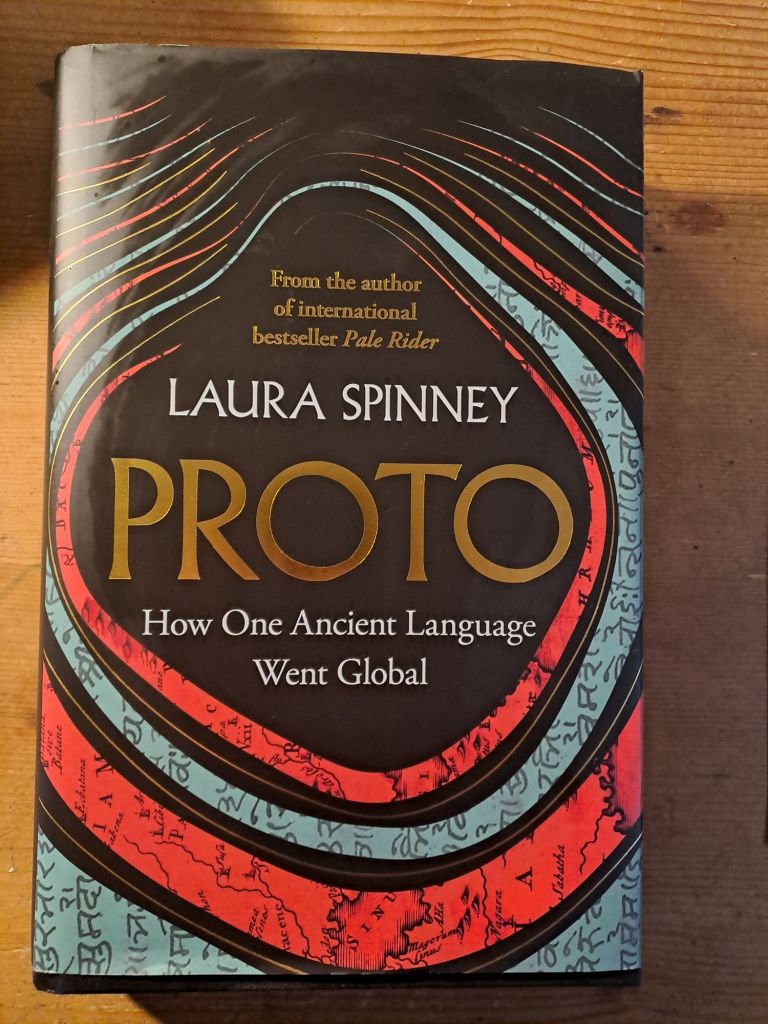
I interrupted the sequence of novels I’ve been reading recently to absorb a non-fiction book, Proto by Laura Spinney (left). I find linguistics a fascinating subject and when I saw a review of this recently and couldn’t resist. I’m glad I bought it because it’s absolutely fascinating. It is the story – or at least a very plausible account of the story of the lost ancestor of the Indo-European languages, the methods that have been used to reconstruct “Proto”, and why it was the spark that generated so many other languages across Europe, Eurasia and India.
The topic is very complex and I won’t attempt to describe it all in depth here; each chapter could be a book in itself because each family of languages within the Indo-European group – including lost ones such as Tocharian – has its own fascinating story. There are chapters focussing on the origins of language itself, the possibilities surround Proto (a language that was never written and probably exists in many dialects), Anatolian, Tocharian, Celtic, Germanic and Italic, the Indo-Iranian group (based on Sanskrit), Baltic and Slavic, and Albanian, Armenian and Greek. The last of these is fascinating because it used a method of writing borrowed from a non-Indo-European source that became the origin of the European alphabet.
The story of which all these are subplots begins around the Black Sea shortly after end of the last Ice Age. In this area there lived mesolithic hunter-gatherers who had survived the ice who interacted with farmers moving up from the direction of modern day Syria. Their languages would have merged in some way to allow them to describe things that their neighbours had that they didn’t. Hunter-gatherers would not have words for, e.g., ploughing or barley while farmers would have fewer words for spears and other hunting equipment. Into this mix, the argument goes, came a third group, a fully nomadic culture called the Yamnaya people. These people and their successors subsequently underwent vast migrations from the steppes across the continent and were responsible for spreading the Proto-Indo-European languages. That’s a hypothesis, not a proven fact, but it is plausible and has a reasonable amount of evidence in its favour.
Recent progress in this field has been driven not only by linguists but also by archaeologists and geneticists, with each aspect of this triangulation vital. It was reading about archaeology in this book that prompted me to write a post about the Nebra Sky Disc. There are some fascinating snippets from palaeogenetics, too. Full DNA sequences are now known for about 10,000 individuals who lived in prehistoric times.
One extraordinary find involves two burials of individuals who both lived about 5,000 years ago. Their DNA profiles match so well that they were probably second cousins or first cousins once removed. The thing is that one of them was buried in the Don Valley, north-east of Rostov in modern-day Russian, while the other was found 3,000 km away in the Altai mountains. Assuming they were both buried where they died, the implications for the distance over which people could move in a lifetime are remarkable.
Another fascinating genetic snippet applies to Irish, a Celtic language. The Celtic languages derive from a proto-Celtic source that probably arose about 1000 BC. Around 2450 BC one of the cultures preceding the Celts arrived in Britain and Ireland, now called the Bell Beaker People because of their taste in pottery. The genetic record shows that the DNA of the Beaker folk replaced about 90% of the previous local gene pool, and all of the Y chromosomes; for some reason men of the earlier culture stopped fathering children. A similar change happened in Ireland, about 200 years later.One possible inference is that there was a violent conquest involving the erasure of the male population, but we don’t know for sure that it was sudden and catastrophic.
Whatever language the Beaker people brought with them was not Celtic (though it may have been Indo-European). The fascinating conundrum is that when Celtic languages arrived in Ireland whoever brought them left not a trace in the genetic record. This is unlike any of the similar changes in language use throughout European pre-history. Either the population responsible has not been identified or the language was spread through communication (e.g. for trade) rather than settlement. Irish may be a Celtic language, but there is little evidence of significant numbers of Celts settling here and bringing it with them.
Some time ago I wrote a post about the Celtic languages, which you might want to look at if you’re interested in this topic. A lot of that post I now realize to be very simplistic, but to add one other snippet I should mention that the name of Turkish football team Galatasaray translates to “Palace of the Celts” after the Celtic-speaking people who settled in Anatolia; these were the Galatians to whom Paul addressed his Epistle.
I thoroughly recommend this fascinating book. It made me want to find out more about so many things. It also gacve me additional motivation to pursue an idea I had a while ago to do a Masters in Linguistics wehn I retire from physics…
In case you weren’t aware, the Summer Solstice in the Northern hemisphere took place this morning Saturday June 21, 2025 at 02:42 UTC (03:42am local Irish Time). Among other things, this means that today is the longest day of the year (as defined by the interval between sunrise and sunset).
According to this website, the interval between sunrise and sunset in Dublin today will be 17 hours and 12 seconds. which is a whole second longer than yesterday (!) and six seconds longer than tomorrow.
In the Northern hemisphere, days will get shorter from the Summer Solstice until the Winter Solstice in December.
The nights are drawing in. Although sunset does carry on getting a bit later for a few days, the days definitely start getting shorter from now on. I explained this in earlier posts here.
Incidentally, the word for “solstice” in the Irish language is grianstad which translates literally as “sun-stop”. The Summer Solstice is Grianstad an tSamhraidh“. The nominative singular word for “Summer”, a masculine noun in Irish, is Samhradh, but in the construction used here, “of summer”, it is in the genitive case so becomes Samhraidh. Moreover, when a masculine noun beginning with s- in the singular genitive is preceded by the definite article an) it experiences an initial mutation in the form of a t-prothesis; hence (an tSamraidh is “of the Summer”.
The Winter Solstice is Grianstad an Gheimhridh. The word for winter is Geimhreadh, which is masculine, and has a genitive form Geimhridh. In this case, however, because it doesn’t begin with “S” there is no t-prothesis but instead a lenition (séimhiú) that softens the initial “G” indicated by the “h”. Hence Grianstad an Gheimhridh, “Sun-stop of the Winter”.
It’s a Bank Holiday Monday here in Ireland, which makes for a nice end-of-term break for some of us. Not all staff had exams early enough to finish in time like I did, however, and no doubt some had to spend the weekend marking exam scripts. I am fortunate to have been able to accomplish everything I intended over the weekend – nothing at all – and today I’ll be able to recover from that exertion.
The June Bank Holiday (Lá Saoire i mí Mheitheamh) in Ireland is the equivalent of last week’s late May Bank Holiday in the UK, in that both have their origin in the old festival of Whitsuntide (or Pentecost) which falls on the 7th Sunday after Easter. Because the date of Easter moves around in the calendar so does Whit Sunday, but it is always in late May or early June; this year it falls on Sunday 8th June.
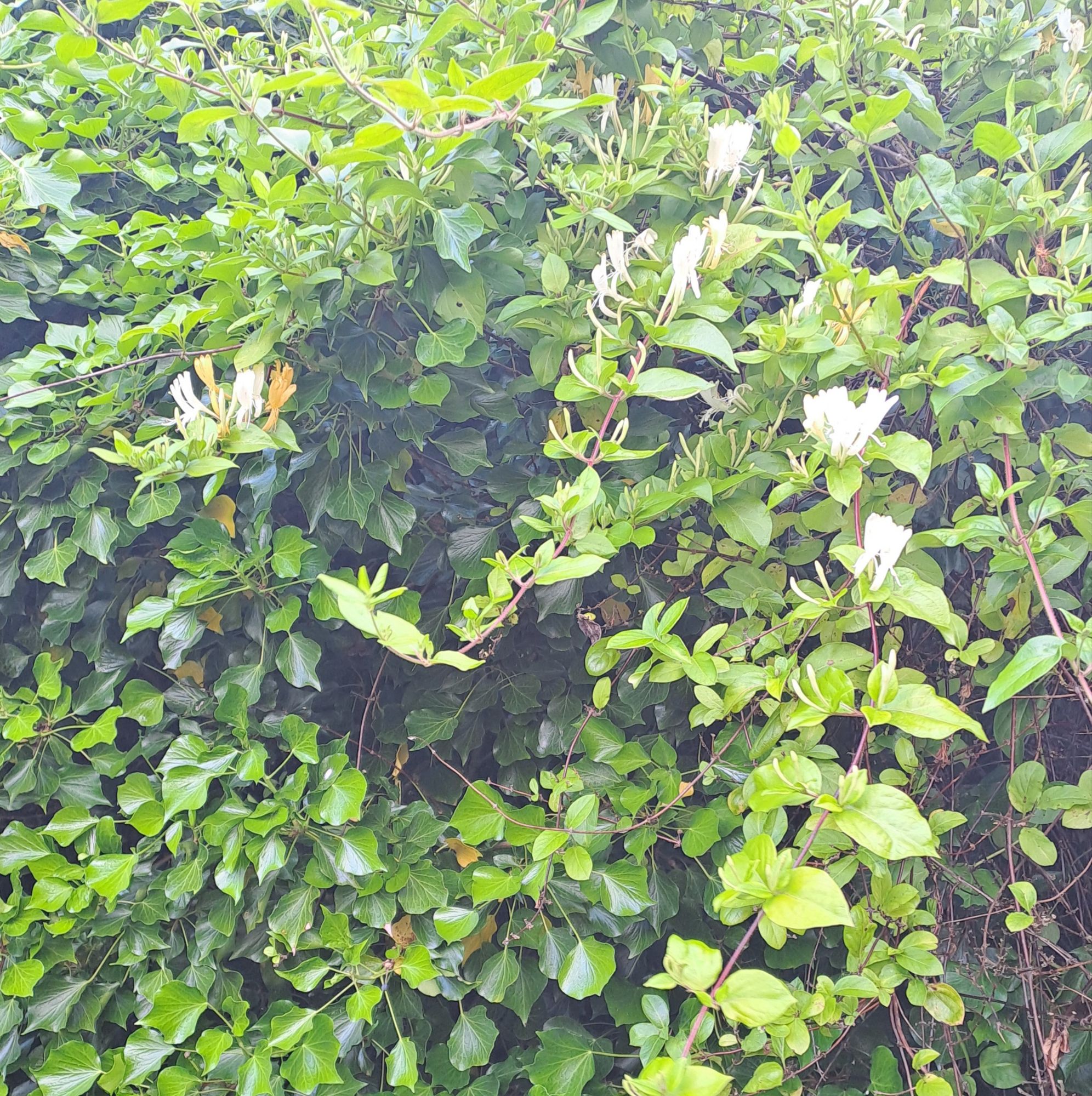
As if in celebration, the honeysuckle in my garden has started to flower:
The day after Pentecost was traditionally a holiday known as Pentecost Monday or Whit Monday. This enabled people to attend extra church services and organize local fairs and cultural events. Pentecost Monday became a public holiday in Ireland following the Bank Holidays Act 1871 which applied before Ireland became independent. Following the Holidays (Employees) Act 1973, this holiday was moved to the First Monday of June. This new date was first observed in 1974. This is why
we have the first Monday in June off work instead of the last Monday in May.
Although I’m only at beginners’ level in Irish, the phrase Lá Saoire i mí Mheitheamh gives me a chance to bore you about it. It’s actually quite a straightforward phrase until you reach the last word. “Lá” means “day” and “Saoire” means “leave” or “vacation” so “Lá Saoire” means “holiday”; “i” is a prepositional pronoun meaning “in” and “mí” means “month”. So far so good.
The word for June, however, is Meitheamh (at least when it is in the nominative singular case). Irish is an inflected language, which means that words change form according to their grammatical function. As an Indo-European language, Irish is distantly related to Latin which has six grammatical cases for nouns (actually seven if you count the rarely used locative case). Irish has only four cases – there’s no ablative and, curiously, no distinction between nominative and accusative. That leaves nominative, dative, genitive, and vocative. The dative – used after simple prepositions – is only rarely distinct from the nominative so basically the ones you have to learn are the genitive and the vocative.
In Latin cases are indicated by changes to the end of a word, but in Irish they involve initial mutations. In the example of “mí Mheitheamh” meaning “month of June”, requiring the genitive form of “June”, the initial consonant “M” undergoes lenition (softening) to sound more like a “v”. In old Irish texts this would be indicated by a dot over the M but in modern orthography it is indicated by writing an “h” after the consonant. This is called a séimhiú (pronounced “shay-voo” ). Note the softened m in the middle of that word too but it’s not a mutation – it’s just part of the regular spelling of the word, as is the -mh at the end of Meitheamh. There’s also a softened “t” in the middle of Meitheamh which makes it vrtually disappear in pronunciation. Meitheamh is thus pronounced something like “Meh-hiv” whereas “Mheitheamh” is something like “Veh-hiv”.
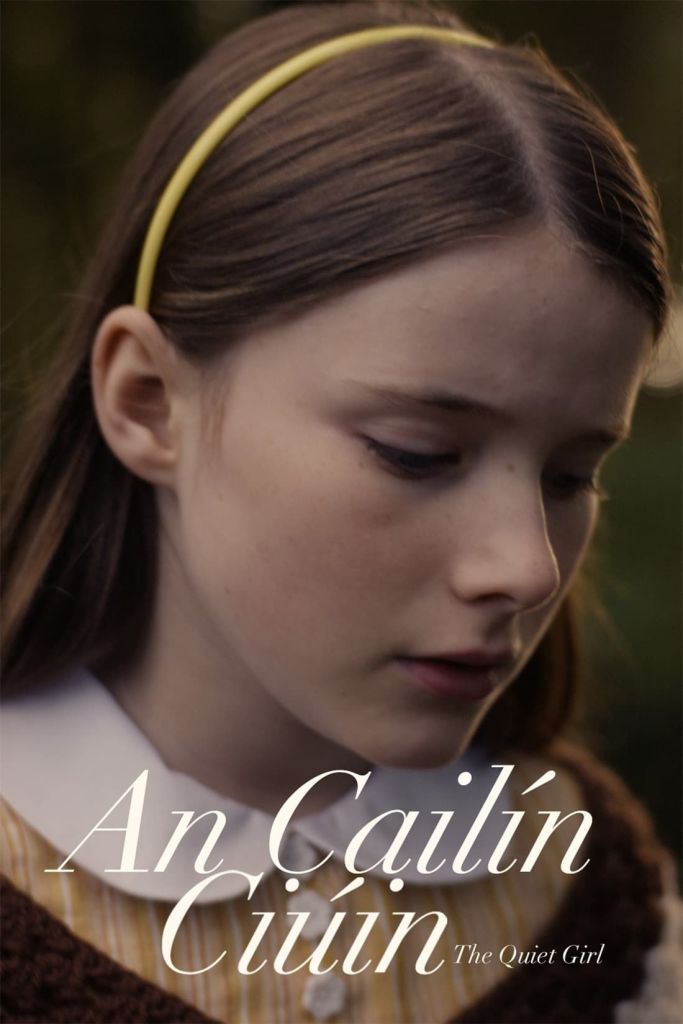
Now that the Christmas dinner and follow-up leftovers are done, I thought I’d just mention a very beautiful film I watched on the TV late on Christmas Day – An Cailín Ciúin (in English: The Quiet Girl). I was quite surprised to see it scheduled then, but TG4 is known for bold and imaginative programming.
It’s (mostly) in the Irish language, but don’t let that put you off; there are subtitles. It’s gentle, poignant and wonderfully observed. A little gem, in fact. I’d encourage you to see it if you can. It’s a fine film all round, but I can’t resist pointing out Catherine Clinch in the central role of Cáit, the quiet girl herself. She had never acted in front of a camera before this film, which makes her subtly expressiven performance all the more remarkable.
Here’s a fascinating video about a project looking into Ogham, an early-mediaeval way of writing that dates back to about the 4th Century AD.
As the video reflects, there’s some controversy about whether the ‘g’ is pronounced but most Irish people I know would say “Oham” rather than “Ogam”. Anyway, this video reports on a research collaboration between the University of Glasgow and Maynooth University that aims to harness Digital Technologies to Transform Understanding of Ogham Writing, from the 4th Century to the 21st.
As I’ve mentioned before on this blog, over the past year or so I’ve been trying to catch up on my reading. My stack of books I’ve bought but never read is now down to half-a-dozen or so.
With sabbatical drawing to a close, the next major life even appearing on the horizon is retirement. Since that will involve a considerable reduction in income, and consequently money to buy books, and my house already has quite a lot of books in it, I thought I’d join the local public library so that when I’ve cleared the backlog of bought books, I’ll read books from the library instead.
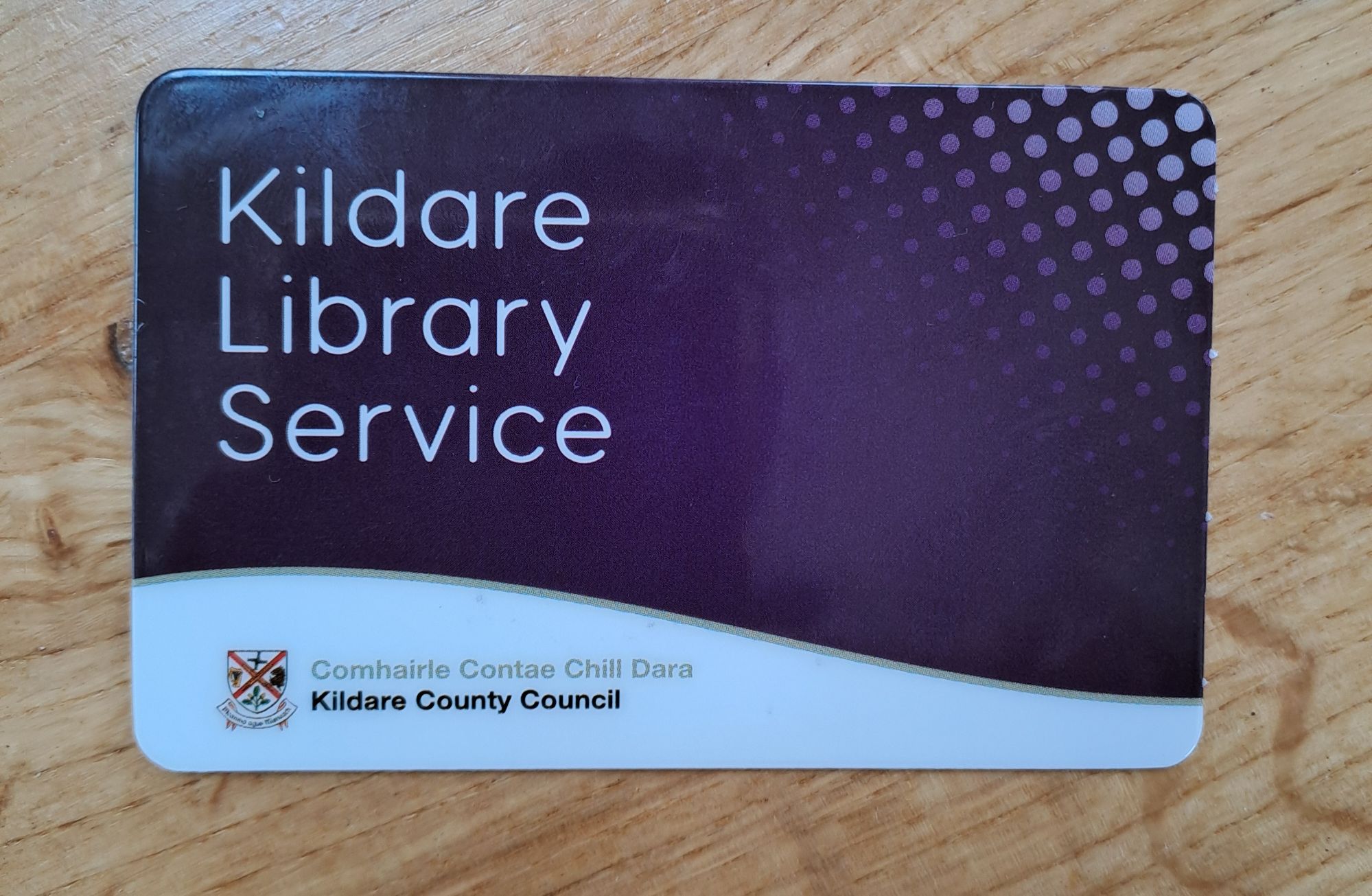
With that in mind, I just joined the public library on Main Street, Maynooth, which is only about 15 minutes’ walk from my house. It’s a small branch library but is part of a larger network across County Kildare, with an extensive online catalogue from which one can acquire books on request. All this is free of charge.
Once I got my card, I had a quick look around the Maynooth branch. It has a good collection of classic literature (including poetry) as well as Irish and world history, which will keep me occupied for quite a while. The normal loan period is 3 weeks, which provides an incentive to read the book reasonably quickly.
I borrowed books in large quantities from public libraries when I was a child. I’m actually looking forward to getting into the library habit again.
Since I’ve got my own computer again now I thought I’d celebrate by doing one of those rambling, inconsequential posts I haven’t had time to do recently.
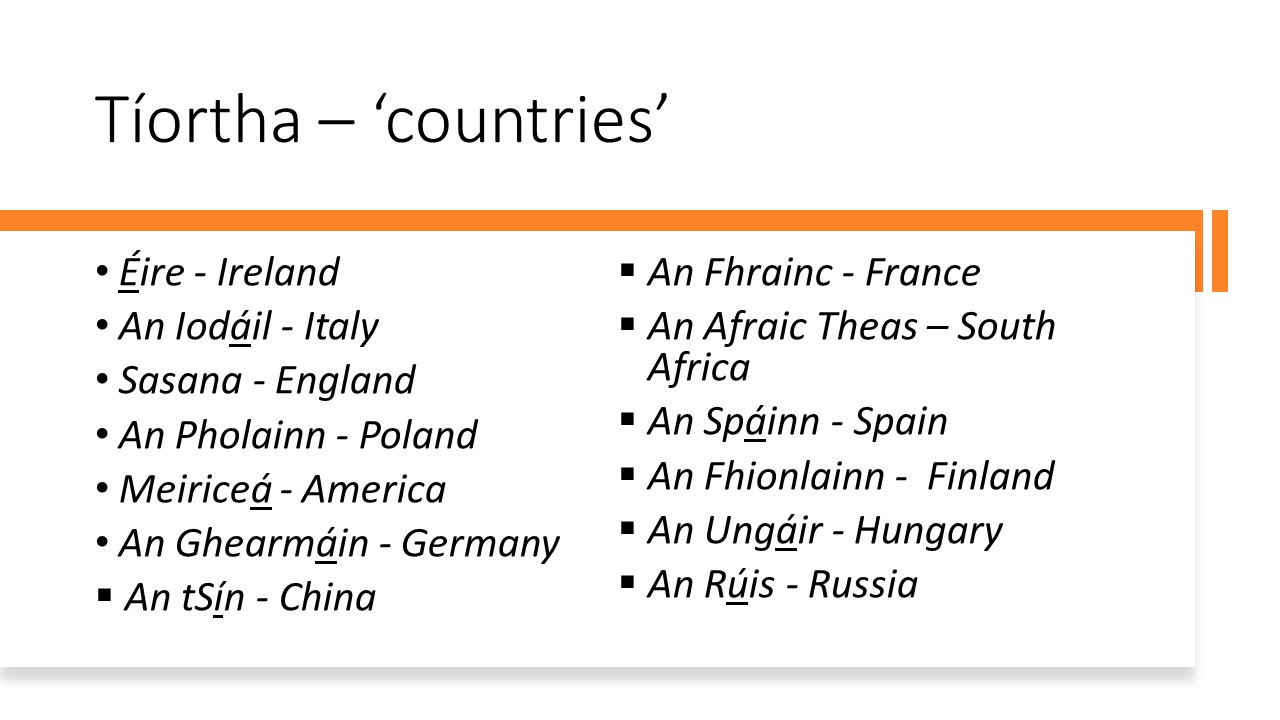
Last week, in the run up to the European Championship semi-final between England and The Netherlands, I for some reason decided to look up what “The Netherlands” is in the Irish language. I did know this once, as it came up when I was trying to learn Irish a few years ago but I had forgotten. I remembered “England”, which is Sasana (cf. Saxon). Anyway, the answer is An Ísiltír. I’ll return to that in a moment.
Here are some other names:
Anyway, a couple of things may be interest. One is that you can see that most country names in Irish are introduced by An. This is the definite article in Irish; there is no indefinite article. This contrasts with English in which only a few names start with the definite article, “The Netherlands” being one. The exceptions in Irish include England (Sasana) and Scotland (Albain). Wales is An Bhreatain Bheag (literally “Little Britain”). Of relevance to the final of the European Championship, Spain is An Spáinn.
I should also mention that some nouns suffer an initial consonant mutation (in the form of lenition, i.e. softening) after the direct article. In modern Irish this is denoted by an h next to the initial consonant, hence Fhrainc, for example; the Irish word for “French” is Fraincis.
The second interesting thing pertains to An Ísiltír itself. The second part of this, tír, means “country” or “nation” – see the plural in the heading above – and the first, Ísil, means “low”. An Ísiltír is therefore literally “The Low Country”. I shared this fascinating insight on social media and found in the replies a mention that the Welsh name for The Netherlands is Yr Iseldiroedda meaning literally “The Low Lands”. The first part of this is clearly similar to the Irish, but the second is the plural of a different word meaning ground or earth or an area of land. There is a word tir in Welsh that means ground or earth or an area of land but it does not mean country or nation like the very similar Irish word; the word for that is gwlad. In Irish the word for land or ground or earth (or turf) is talamh.
Welsh and Irish belong to distinct branches of the Celtic group of languages, the first wave of Indo-European languages to sweep across Europe. I blogged about this here. Celtic languages therefore share roots with many other Indo-European languages and very basic words in many branches of the tree often bear some similarity in form, if slight but significant differences in meaning. It seems that tír/tir illustrates this rather well. These two words also have a very similar form to the French terre which is derived from the Latin terra. And so I disappeared down an etymological rabbit hole and found that all these words are probably derived from a Proto-Indo-European word meaning “dry”, presumably through reference to “that which is dry” as opposed to the wet bits (although neither Ireland nor Wales is famous for being particular dry).
And to bring this little excursion back full circle, the Irish word tirim means “dry”…
On foot of the investigation, the board of SFI wrote to the five senior staff members with the findings.
Irish Independent, 29th May 2024
The use of the idiomatic phrase “on foot of” (meaning “as a result of” or “following”, etc, as distinct from “on foot”, meaning “by walking”) seems quite commonplace in Hiberno-English, even in judicial proceedings, but I’ve never encountered it at all outside Ireland. This gives me an excuse to direct your attention to this post from elsewhere about this very matter from which I stole the title of this short post. I suspect the phrase in question may be formed by direct translation from a construction in the Irish language, which would explain why it isn’t used outside Ireland, but I’m happy to be corrected if wrong…
The views presented here are personal and not necessarily those of my employer (or anyone else for that matter).
Feel free to comment on any of the posts on this blog but comments may be moderated; anonymous comments and any considered by me to be vexatious and/or abusive and/or defamatory will not be accepted. I do not necessarily endorse, support, sanction, encourage, verify or agree with the opinions or statements of any information or other content in the comments on this site and do not in any way guarantee their accuracy or reliability.



 In the Dark