Archive for the Irish Language Category

A Chara

Posted in Irish Language, Uncategorized on May 11, 2022 by telescoper

Having spent a great deal of time recently writing reference letters I thought about how at least to start a letter in the Irish language (though I’m nowhere near fluent enough to continue).

It turns out the correct formal way to begin a letter in Irish to someone you don’t know is “A chara” which means literally “O friend” to be compared with the opening you might write in English “Dear Sir/Madam”. The plural version is A chairde.

The Irish form is interesting for a number of reasons. For one thing it is ungendered so there’s no need for the clumsy “Sir/Madam”. For another it presupposes that the person you are writing to is a friend, which is far less frosty than the English alternative.

The Irish word cara is related to many similar words in other European languages, especially the Italian caro and the French cher and like them can be used as an adjective meaning “dear”. If you want to address a letter to someone you know you can write, for example, A Phádraig, a chara which would mean “Dear Patrick”.

A chara is also interesting from a grammatical point of view because the nominative case of the word for friend is cara but in the vocative case (introduced by the particle “a”) it is modified in a manner called a séimhiú which involves lenition of the initial consonant, hence a chara. The plural form of cara is cairde, which also attracts a séimhiú in the same way as the singular form, becoming chairde. In older forms of written Irish this would have been denoted by a dot over the consonant, but in modern script the modification is indicated by inserting an h.

One of the pronunciational things I struggled with when I was attempting to learn Irish last year was the difference between the c in cara and the ch in chara. The c in Irish is usually pronounced like a k in English but in its weakened form ch it only changes slightly: it’s not like the c in census nor the ch in cheese.

If you try saying the letter k out loud as a child would – “kuh” – you will find it involves contact between your tongue and the roof of your mouth. Move the point of contact back to the rear of your mouth and it becomes deeper and thicker; move it towards your front teeth and it becomes narrower and slightly higher in pitch. That’s the difference between the broad and narrow “c”. It’s very hard to spot in spoken Irish, particularly for a beginner!

There is a vocative case in other European languages ancient and modern, e.g. Latin, but that involves changes at the end of a noun rather than the beginning. The particle “a” which introduces it in Irish plays the same role as “o” in archaic and/or poetic English usage but is part of everyday usage in Irish. It is not a preposition because it doesn’t have any particular meaning other than to introduce the vocative case.

Carúl Inis Córthaidh

Posted in Irish Language, Music on December 20, 2021 by telescoper

The Wexford Carol is a traditional Christmas song whose origin is obscure. It is often said to date from the 12th Century, or even earlier, but music historians consider it more likely to be from the 15th or 16th Century. Whatever its provenance, it’s a fascinating folk melody with a haunting, timeless quality to it.

The song is associated with Enniscorthy in County Wexford so is called in the Irish Language Carúl Inis Córthaidh or Carúl Loch Garman, Wexford being one of those towns in Ireland with an Irish name (Loch Garman) that bears no phonetic relationship whatsoever to its English name. Anyway the song is very well known and there are a lots of versions floating around, but is usually sung in English so I thought I’d post a version in Irish. Altogether now “Ó, tagaigí uile is adhraigí …”

On Lúnasa

Posted in Biographical, Education, History, Irish Language, Maynooth on August 1, 2021 by telescoper

It’s the first of August which means it is the ancient Celtic festival of Lughnasadh (which, in modern Irish, is Lúnasa). This coincides with the English Lammas Day one of many Christian festivals which have pagan origins. Traditionally 1st August marks the start of the harvest season and is celebrated accordingly, with rites involving the first fruit and bread baked from flour obtained from the first corn.

Tomorrow being the first Monday in August it is a Bank Holiday in Ireland called Lá Saoire i mí Lúnasa. This holiday was created by the Bank Holiday Act of 1871 when Ireland was under British rule. While the holiday was subsequently moved to the end of August in England and Wales it has remained at the start of August in Ireland, which is a far better place for it in my opinion.

In the Northern hemisphere, from an astronomical point of view, the solar year is defined by the two solstices (summer, around June 21st and winter, around December 21st) and the equinoxes (spring, around March 21st, and Autumn, around September 21st). These four events divide the year into four roughly equal parts of about 13 weeks each.

Now, if you divide each of these intervals in two you divide the year into eight pieces of six and a bit weeks each. The dates midway between the astronomical events mentioned above are (roughly) :

  • 1st February: Imbolc (Candlemas)
  • 1st May: Beltane (Mayday)
  • 1st August: Lughnasadh (Lammas)
  • 1st November: Samhain (All Saints Day)

The names I’ve added are taken from the Celtic/neo-Pagan (and Christian terms) for these cross-quarter days. These timings are rough because the dates of the equinoxes and solstices vary from year to year. Imbolc is often taken to be the 2nd of February (Groundhog Day) and Samhain is sometimes taken to be October 31st, Halloween. But hopefully you get the point.

Incidentally, the last three of these also coincide closely with Bank Holidays in Ireland, though these are always on Mondays so often happen a few days away. I find it intriguing that the academic year for universities here in Ireland is largely defined by the above dates dates.

The first semester of the academic year 2021/22 starts on September 20th 2021 (the Autumnal Equinox is on September 22nd) and finishes on 17th December (the Winter Solstice is on December 21st ).  Halloween (31st October) is actually a Sunday this year so the related bank holiday is on Monday 25th October; half term (study week) always includes the Halloween Bank Holiday. The term is pushed forward a bit because it finishes on a Friday and it would not be acceptable to end it on Christmas Eve!

After a break for Christmas and a three-week mid-year exam period Semester Two starts 31st January 2022. Half-term is then from 14th to 18th March (the Vernal Equinox; is on March 20th) and teaching ends on May 6th.  More exams and end of year business take us to the Summer Solstice and the (hypothetical) vacation.

So we’re basically operating on a pagan calendar.

Another tradition seems to be that examinations come straight after bank holidays, both in May and August. The repeat examination period begins on August 4th this year. You can interpret that in two ways: one is that students have a guaranteed day off to do revision; the other is that the bank holidays in May and August are ruined by the need to prepare for exams…

Cá bhfuil tú i do chónaí?

Posted in Biographical, Irish Language, Maynooth with tags , , , on April 3, 2021 by telescoper

I had another Irish language class on Thursday, in between various other things. I’m finding it a struggle since I don’t get much time in between the classes to revise or practice and also because there is quite a lot to learn that is very different from languages with which I am familiar. I spent a lot of time at school learning Latin and tend to filter new languages through that experience, which works reasonably well for French, Spanish and Italian but isn’t very good for Irish.

Some things in Irish are simpler than Latin: there are effectively only four cases for nouns in Irish as there is no real distinction between nominative and accusative. I mean the two cases are grammatically distinct but there is no difference in the word depending on whether it is subject or object of a verb. The other three cases are vocative (preceded by the particle a), genitive and dative. There is no ablative case; the dative is used instead.

Other things are more complicated. Last week we discovered that there are two versions of the verb “to be”. One is bí (which, as in most other European languages, is irregular in declination); the other is called the copula (“an chopail”)  which is used in limited (but quite common) circumstances such as linking a noun with a predicate clause. Confusingly, the form of the copula used in the present tense is “is” but it’s not part of the verb “to be”.

We learnt about these things when talking discussing the question

Cá bhfuil tú i do chónaí?

which is “where do you live?”, literally “Where are you in your habitation?”.  The way to answer this is something like

Tá mé i mo chónaí i Maigh Nuad. 

these sentences both involve the verb to be in the second person and first person respectively. Instead of Tá mé you could use Táim which is the equivalent of using “I’m” for “I am” in English.

It’s more complicated than that though because some place names have to be modified in this construction using an urú (eclipsis):

Maigh Nuad (Maynooth) begins with an M which is not modified but Doire (Derry) becomes nDoire, etc. The mutation from c to g after the preposition i also happens in Welsh, e.g. in the phrase Croeso i Gymru but in Irish you add the changed letter in front of the original rather than replacing it. For example, if I were living in Cork I would say

Tá mé i mo chónaí i gChorchai. 

The g is understood to replace the C for pronunciation purposes.

That brings us on to Irish place names, which are often very different from their anglicized versions. Here are a few examples:

  • Maigh Nuad (Maynooth)
  • Corcaigh (Cork)
  • Port Láirge (Waterford)
  • Doire (Derry)
  • Tir Eoghain (Tyrone)
  • Aontroim (Antrim)
  • Fear Manach (Fermanagh)
  • Béal Feirste (Belfast)
  • Gaillimh (Galway)
  • Thiobraid Árann (Tipperary)

The last one is not actually a long way from where I am. You can guess most of them but it’s a little confusing that the English versions are often conflations of two Irish words.

In the Name of the Fada

Posted in Biographical, Irish Language, Television with tags , , on March 13, 2021 by telescoper

As we head into next week’s study break in the middle of which is the St Patrick Day Bank Holiday, I thought I’d share this video. It’s the first episode of a series in which comedian Des Bishop, who missed out on Irish language lessons at school, moves to Conamara for 9 months to learn Irish. In the Name of the Fada is not to be confused with famous film, the “Fada” of the title referrring to the síneadh fada, the only diacritic mark in modern Irish. I wrote about it here.

This programme actually covers quite a lot of the vocabulary I’ve learned in the last six weeks or so. The rest of the episodes can easily be found on Youtube too.

Bíodh deireadh seachtaine agus sos deas agaibh!

Seachtain na Gaeilge

Posted in Biographical, Irish Language with tags , on March 4, 2021 by telescoper

Thursdays are very busy days for me this Semester not least because I have to squeeze in my Irish language class at lunchtime in between lectures meetings and an afternoon computational physics lab.

Although learning a new language is challenging I am enjoying it very much and slowly getting the hang of it. I find the pronunciation rather difficult. Today we encountered the difference between the broad “c” and the slender “c” which I found indistinguishable at first hearing, but figured it out well enough to get all the questions correct on the listening test. It’s basically a slight difference in the position of the back of your tongue against the palate.

Another thing in Irish that takes some getting used to is that many words contain a string of vowels, not all of which are pronounced. At least part of the reason for that is that vowels next to consonants are often only there in order to tell you how to pronounce the consonant rather than being voiced themselves.

In today’s class we also learned how to ask such questions as Cé as tú? (which means “where are you from?”) and during the course of that we learned the Irish form of some names of countries. Interestingly some countries, such as France (An Fhrainc), have an article in front whereas others, such as England (Sasana) do not. I also learned that the Irish word for Wales is An Bhreatain Bheag which translates literally as “Little Britain”. I’m not sure the Welsh will be best pleased to learn that…

Anyway, from now until St Patrick’s Day is Seachtain na Gaeilge an annual festival of the Irish language and culture during which we are all encouraged to use our Irish language skills, however limited.

Here is the President of Ireland Michael D. Higgins introducing this year’s Seachtain na Gaeilge.

[twitter_follow screen_name=’telescoper’]

Irish Bingo Lingo

Posted in Education, Irish Language with tags , on February 20, 2021 by telescoper

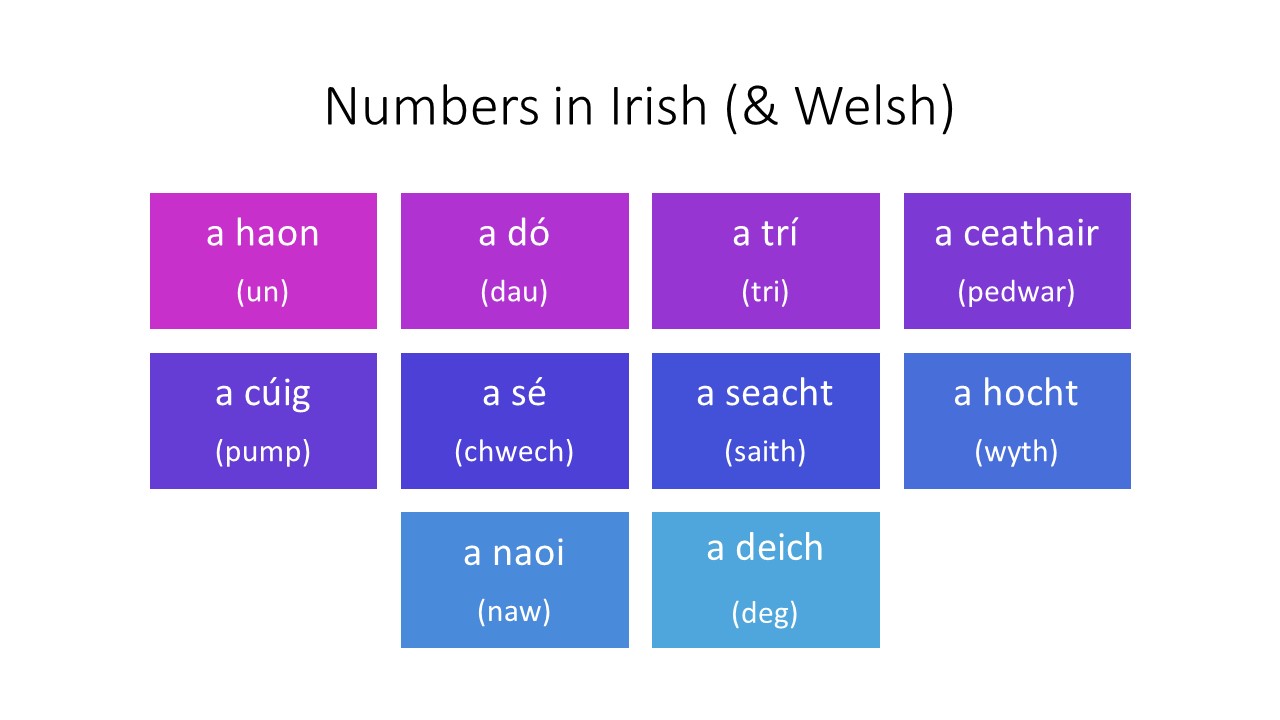
This week I had my third lunchtime Irish language class during which, among a few other things, we learned about numbers (just 1-10 so far). After some practice in pronunciation, we then had some practice in comprehension by playing Bingo in Irish. Out of interest I’ve put up the Irish numbers along with their counterparts in Welsh for reasons which will become clear:

The first thing to note is the presence of the particle “a” in front of the number in Irish. This is a consequence of something I didn’t know about before taking this course. In Irish there are different ways of using numbers depending on whether you’re using them just as numbers (in which case you put the “a” in front) or if you’re using them to denote a quantity of things or people (in which cases you don’t put the “a” in front but have to use a particular grammatical construction involving the thing being counted). Numbers in Irish are not used simply as adjectives, as in for example English. That’s not how it works in any other language I know. So far we haven’t been taught about these other counting systems so I can’t say any more.

The second thing concerns the similarity of these numbers to those in many other European languages, which is not surprising since they share an Indo-European origin. Integers are such basic things that they are embedded at a very deep level in languages. The Irish numbers resemble those in French particularly strongly. This may be a consequence of modern Irish being influenced by Norman French or may just be evidence of the common root.

Notice the comparison with Welsh, however, which gives very clear evidence of the ancient mutation that led to the distinct language branches of p-Celtic and q-Celtic. Look at the number 4. In Irish, this is a ceathair (which is pronounced “a ka-hir”; the t is weakened by the following h) which resembles the French quatre. There is no q in the standard Irish alphabet but the sound is similar. In Welsh we have pedwar which, apart from the initial letter being a “p”, is structurally similar to the Irish version. A similar change in initial consonant happens with the number five.

Anyway I’m enjoying learning Irish. It’s a very interesting challenge. In the rest of the class we learned how to answer questions like What is your name (Cad is ainm duit?) followed by an exercise in giving names to celebrities shown in photographs. I firmly established my status as the Old Fogey of the class in this part, by being unable to identify a person called Shakira who, I’m told, is a popular vocal artiste of some sort.

Celtic Europe

Posted in History, Irish Language with tags , , , , on February 6, 2021 by telescoper

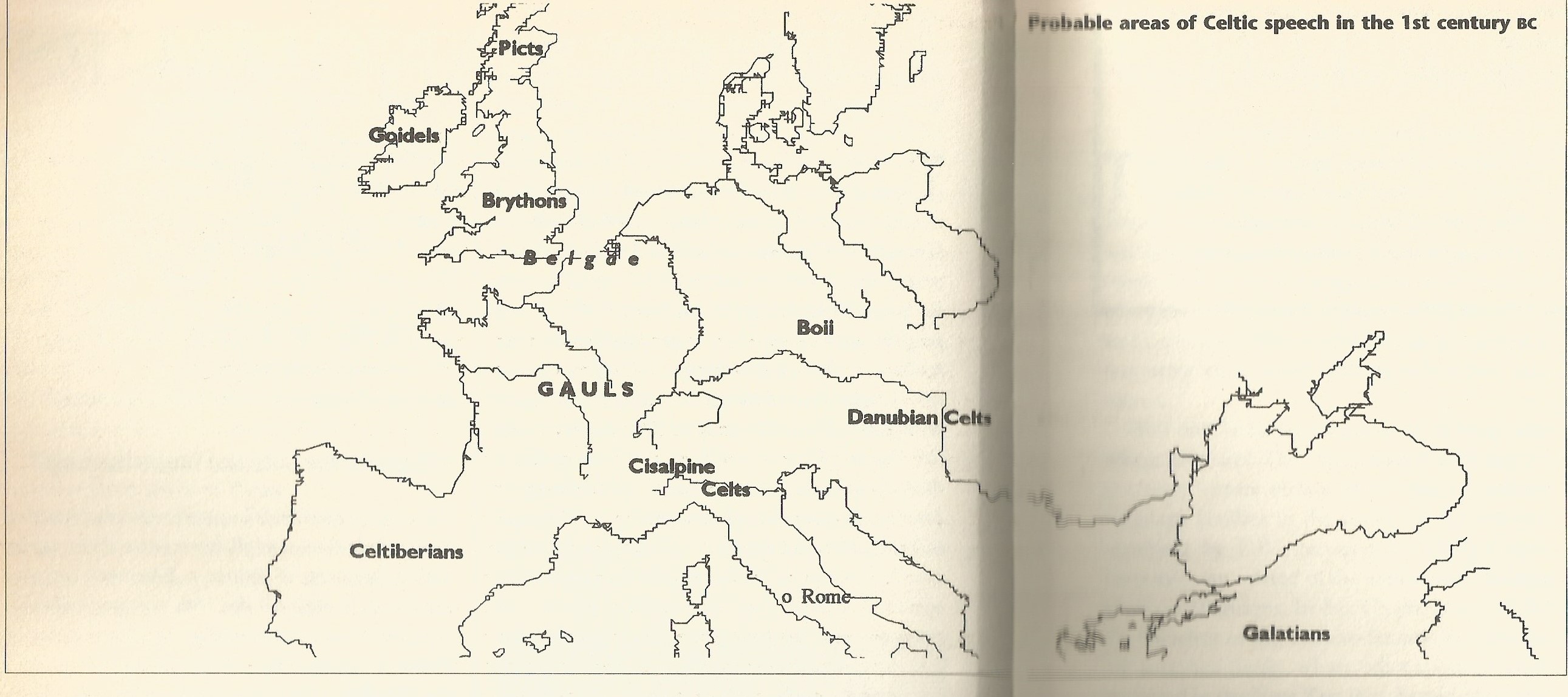
The Extent of Celtic Europe, from “Dictionary of Languages” by Andrew Dalby

Following on from Thursday’s post I thought I’d show the above map that shows the spread of Celtic languages in Europe. I’m sorry that the picture isn’t great but I scanned the map from a big hardback book and the map spreads across the fold as you can see.

The Celtic languages at the time depicted in the map (1st Century BC) were all oral languages, but when the Roman Empire spread across Europe about two thousand years ago it came into contact with the major dialects. Evidence for these can be found in place names, from Mediolanum (modern-day Milan, originally in cisalpine Gaul) to Singidunum (the Roman name for modern-day Belgrade) and Laccobriga (Lagos in Southern Portugal).

Belgium gets its name from the Belgae, regarded by Julius Caesar as the bravest and most fearsome of the tribes of Gaul. There are also words recorded in early inscriptions and in reconstructions based on later texts from which it is possible to glean clues about these languages. The picture that emerges is of a network of dialects spoken by Celtic peoples that inhabited a swathe of Continental Europe from the Iberian peninsula in the West to Galatia in the East, much of the Danube valley, and from Cisalpine Gaul (now part of Italy) in the South to modern-day Germany in the North.

Galatia (in classical Asia Minor) merits a special mention. St Paul’s Letter to the Galatians was addressed to the young Christian churches in this Celtic-speaking enclave which was then a distant province of the Roman Empire.

Linguists refer to the language that was spoken in Ireland at this time as Goidelic and it sits apart from the others because Ireland was never part of the Roman Empire. Brythonic is the name given to the dialects spoken in Britain. Continental Celtic is the name given to the dialects stretching all the way from Spain to Galatia of which the largest group was Gaulish. The language of the Scottish highlands Pictish may have been a separate subdivision but I don’t think anybody really knows because the language is extinct.

None of these groups was homogeneous. The Celts lived in relatively small communities and there were many regional variations even within each major group. Irish has four main dialects, roughly aligned with the four provinces. In Description of Ireland (1577), Richard Stanyhurst wrote:

As the whole realme of Ireland is sundred into foure principal parts so eche parcell differeth very much in the Irish tongue, euery country hauing his dialect or peculiar manner in speaking the language.

Our Irish teacher speaks the Irish of Connacht in which some pronunciations are very different from Leinster, which is the province I live in. As an absolute beginner this is the least of my worries at the moment.

The Goidelic group comprises Irish, Manx and Scottish Gaelic; and the Brythonic group that comprises Welsh, Cornish and Breton. These are sometimes referred to as q-Celtic and p-Celtic, respectively, although not everyone agrees that is a useful categorization. It stems from the fact that the “q” in Indo-European languages morphed into a “p” in the Brythonic languages. The number five in Irish is a cúig which has a q sound (though there is no letter q in the Irish alphabet); five in Welsh is pump. Contrast with the number two: a dó in Irish and dau in Welsh.

Incidentally, Scottish Gaelic is not the language spoken by the Celtic people who lived in Scotland at the time of the Romans, the Picts, which is lost. Scottish Gaelic is actually descended from Middle Irish due to migration and trading contacts. The Ulster dialect of Irish is in turn much influenced by reverse migration from Scotland. Languages do not evolve in isolation or in any simple linear trajectory.

Contrary to popular myth, Breton is not a Continental Celtic language but was taken to Brittany by a mass migration of people, which peaked in the 6th Century AD, from South-West Britain, fleeing the Anglo-Saxons. The Saxons won a great victory in battle at Dyrham (near Bath) in 577 after which they advanced through Somerset and Devon, splitting the Celts of Cornwall and Wales and leading to the formation of two distinct Brythonic language groups, Welsh and Cornish. Breton is much closer to Cornish than Welsh.

The Continental Celtic languages are all extinct, except for fascinating remnants that linger here and there in local dialect words in French and Spanish.

Language Lessons

Posted in History, Irish Language, Maynooth with tags , , , , , , , , , , on February 4, 2021 by telescoper

Thursday is Computational Physics Day this term so this morning I delivered the first Panopto lecture of that module and in the afternoon we had our first laboratory session. The students are all at home of course so we had to run the lab with them using their own laptops rather than the dedicated Linux cluster we have in the Department and interacting via Microsoft Teams.  The first lab is very introductory so it was really just me presenting and them following on their machines without too much interaction. The ability to share a screen is actually very useful though and I imagine using it quite a lot to share Spyder. It went fairly well, I think, with all the students getting started out on the business of learning Python.

In between lecturing the morning and running the laboratory session this afternoon I had the chance to study another kind of language. Soon after I first arrived in Maynooth I got an email from Maynooth University about Irish language classes. Feeling a bit ashamed about not having learned Welsh in all my time in Cardiff, I thought I’d sign up for the Beginners class and fill in a Doodle Poll to help the organizers schedule it. Unfortunately, when the result was announced  it was at a time that I couldn’t make owing to teaching, so I couldn’t do it. That  happened a couple of times, in fact. This year however I’ve managed to register at a time I can make, though obviously the sessions are online.

I’m not sure how wise it is for me to try learning a new language during a term as busy as this, but I have to say I enjoyed the first session enormously. It was all very introductory, but I’ve learnt a few things about pronunciation – unsurprisingly the Irish word for pronunciation fuaimniú is unsurprisingly quite difficult to pronounce – and the difference between slender and broad vowels. I also learnt that to construct a verbal noun, instead of putting -ing on the end as you would in English, in Irish you use the word ag in front of the verb.

That’s not to say I had no problems. I’m still not sure I can say  Dia duit (hello) properly. The second “d” is hardly pronounced. 

Irish isn’t much like Welsh, which I failed to learn previously.  Although Irish and Welsh are both Celtic languages they are from two distinct groups: the Goidelic group that comprises Irish, Manx and Scottish Gaelic; and the Brythonic group that comprises Welsh, Cornish and Breton. These are sometimes referred to as q-Celtic and p-Celtic, respectively, although not everyone agrees that is a useful categorization. Incidentally, Scottish Gaelic is not the language spoken by the Celtic people who lived in Scotland at the time of the Romans, the Picts, which is lost. Scottish Gaelic is actually descended from Middle Irish. Also incidentally, Breton was taken to Brittany by a mass migration of people from South-West Britain fleeing the Anglo-Saxons which peaked somewhere around 500 AD. I guess that was the first Brexodus.

Welsh and Irish don’t sound at all similar to me, which is not surprising really. It is thought that the Brythonic languages evolved from a language  brought to Britain by people from somewhere in Gaul (probably Northern France), whereas the people whose language led to the Goidelic tongues were probably from somewhere in the Iberia (modern-day Spain or Portugal). The modern versions of Irish and Welsh do contain words borrowed from Latin, French and English so there are similarities there too.

Only a diacritic mark appears in Irish, the síneadh fada (`long accent’), sometimes called the fada for short, which looks the same as the acute accent in, e.g., French. There’s actually one in síneadh if you look hard enough. It just means the vowel is pronounced long (i.e. the first syllable of síneadh is pronounced SHEEN). The word sean (meaning old) is pronounced like “shan” whereas Seán the name is pronounced “Shawn”.

One does find quite a few texts (especially online) where the fada is carelessly omitted, but it really is quite important. For example Cáca is the Irish word for `cake’, while the unaccented Caca means `excrement’…

I took the above text in Irish and English from the front cover of an old examination paper. You can see the accents as well as another feature of Irish which is slightly similar to Welsh, the mysterious lower-case h in front of Éireann. This is a consequence of an initial mutation, in which the initial character of word changes in various situations according to syntax or morphology (i.e. following certain words changing the case of a noun or following certain sounds). This specific case is an an example of h-prothesis (of an initial vowel).

In Welsh, mutations involve the substitution of one character for another. For example, `Wales’ is Cymru but if you cross the border into Wales you may see a sign saying Croeso i Gymru, the `C’ having mutated. The Irish language is a bit friendlier to the learner than Welsh, however, as the mutated character (h in the example above) is inserted in front of the unmutated character. Seeing both the mutated and unmutated character helps a person with limited vocabulary (such as myself) figure out what’s going on.

Mutations of consonants also occur in Irish. These can involve lenition (literally `weakening’, also known as aspiration) or eclipsis (nasalisation). In the case of eclipsis the unmutated consonant is preceded by another denoting the actual sound, e.g. b becomes m in terms of pronunciation, but what is written is mb. On the other hand, lenition is denoted by an following the unmutated consonant. In older forms of Irish the overdot (ponc séimhithe) -another diacritic – was used to denote lenition.

Anyway, I’ve seen Dia duit written Dia dhuit which might explain why the d sounds so weak. We live and learn. If I keep at it long enough I might eventually be able to understand the TG4 commentary on the hurling..
Stormy Samhain Super Saturday

Posted in Biographical, Covid-19, Irish Language, Maynooth, Rugby with tags , , on October 31, 2020 by telescoper

So we have arrived at October 31st, Hallowe’en or, in pagan terms, Samhain. This, a cross-quarter day – roughly halfway between the Autumnal Equinox and the Winter Solstice represents the start of winter (“the dark half of the year“) in the Celtic calendar.

Incidentally, Samhain is pronounced something like “sawin”. The h after the m denotes lenition of the consonant (which in older forms of Irish would have been denoted by a dot on top of the m) so when followed by a broad vowel the m is pronounced like the English “w”; when followed by a slender vowel or none “mh” is pronounced “v” or in other words like the German “w” (which makes it easier to remember). I only mention this because I hope to be starting Irish language lessons soon, something I always wish I’d done with Welsh when I lived in Cardiff.

Anyway, it’s a wild blustery day with the wind howling down the chimney of my house in Maynooth sounding like a ghost. At least thanks to the present Level 5 restrictions I won’t have to endure trick-or-treaters this evening. Or will I? Should I sit quietly at home with the lights off again?

Today’s schedule will revolve around the final round of matches in this year’s Six Nations championship. The settled order of nature having been disturbed by Covid-19 back in March it has only just become possible to finish the competition with three games today. Ireland travel to France for the last game this evening, after England play Italy and Wales play Scotland. Ireland currently head the table, but they have a difficult task in Paris: they need not only to win to secure the Championship but to do so by a bonus point because England will almost certainly get a bonus point against a poor Italian side. The Irish press are talking up the national team’s chances of winning handsomely, but it seems to me rather unlikely especially because France too have a chance of the title if they beat Ireland and get a bonus point. Both sides clearly have to attack, which should make for a good contest.

For what it’s worth, my predictions are: Wales to beat Scotland, England to beat Italy (with a bonus point) and France to beat Ireland (but no bonus point). That combination would make England the champions, with France second and Ireland third.

Update: 16.05. Wales 10 Scotland 14. My predictions are not off to a good start. Scrappy, error-strewn game with Scotland’s try from a maul that shredded the Welsh defence the highlight of the game. Bad result for Wales but it is good to see Scotland back as a force to be reckoned with.

Update: 18.45. England improved dramatically after a poor first half, and eventually ran out winners by 34 points to 5. That means their points difference is +44 compared to Ireland’s +38. Ireland need a win by 7 or more points (or with a bonus point) to win the Championship.

Update: 21.00. Half-time France 17 Ireland 13. France leading without having played particularly well, thanks to two big Irish errors. Ireland need to score 10 points more than France in the 2nd half.

Update 22.00. Final score France 35 Ireland 27. France won with a bonus point but not by a sufficient margin to win the Championship, which goes to England, with France second and Ireland third. It didn’t go exactly as I predicted but I wasn’t far off!