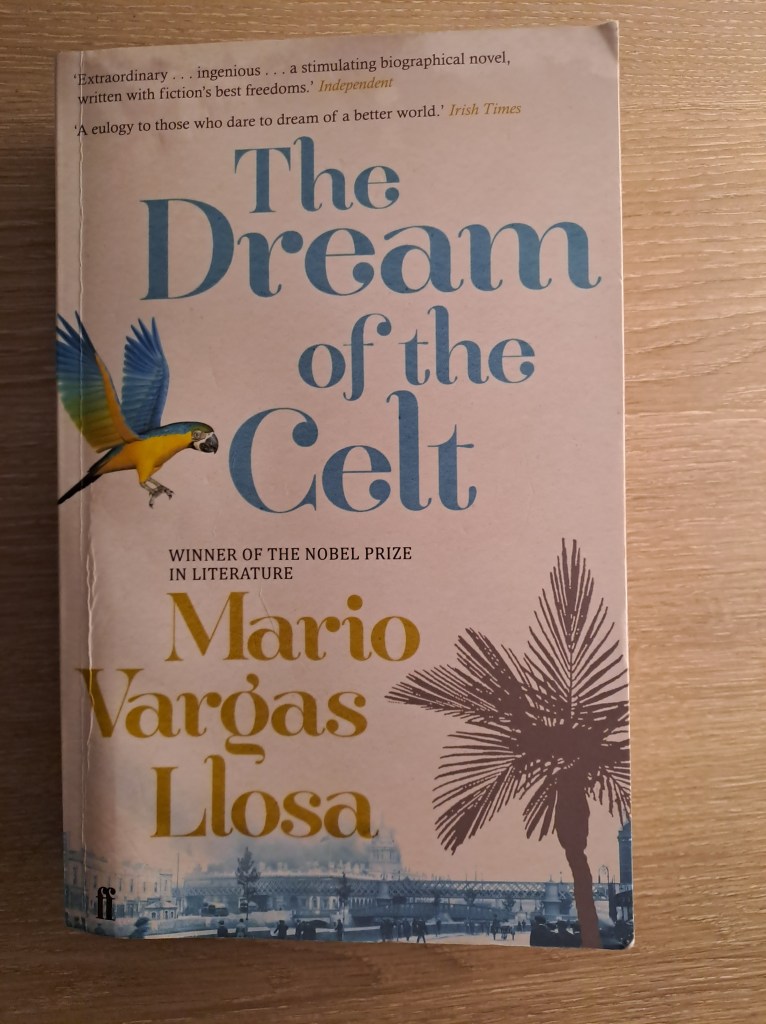
Knowing that I would be spending even less time watching TV while in Barcelona than I would back in Maynooth, I packed a number of books from the substantial pile that I haven’t yet got around to. The first I’ve finished is The Dream of the Celt by Peruvian author Mario Vargos Llosa which tells the fascinating but ultimately tragic story of Roger Casement using a mixture of thoroughly researched journalistic reportage and fictionalized extrapolations that try to bring this enigmatic character to life.
Roger Casement was born in Sandycove, Dublin, but spent some of his childhood in England. He served with great distinction as a diplomat, and a fierce advocated of human rights, first in the Congo, where he compiled a devastating report of the brutal exploitation of indigenous people, and then in Peru where he exposed even worse cruelty being exacted on native men women and children who were used as forced labour in the rubber plantations. He was knighted in 1911 for his humanitarian efforts.
When he first started out in the diplomatic service, Casement apparently believed that colonization would be a civilizing influence, bringing free trade, the rule of law, and Christianity instead of repression and violence. His bitter experience changed his view entirely, and he became increasingly associated with the cause of England’s first colony, and became a fervent advocate of Irish nationalism. He found himself travelling to Germany during the First World War to procure arms for an Irish rebellion and to raise an Irish Regiment from Irish prisoners of war captured fighting for the British. In the latter he was not successful – he persuaded only about 50 POWs to join the cause. He did succeed in obtaining weapons but the ship smuggling them to Ireland was intercepted and scuttled to avoid the weapons falling into British hands.
Incidentally, Casement was against the Easter Rising of 1916. He thought it would be futile unless it could be combined with a German attack on England. Ireland was not sufficiently important geopolitically for the Kaiser to mount such an operation. The other leaders of the Rising wanted Casement to stay in Germany as it proceeded but he travelled to Ireland in a submarine, was captured, tried for high treason, found guilty, and hanged at Pentonville Prison on 3rd August 1916. He was 51. His executioner later remarked that he was ‘‘the bravest man it fell to my unhappy lot to execute.’
W.B. Yeats wrote a poem about Roger Casement, the last verse of which is:
Come speak your bit in public That some amends be made To this most gallant gentleman That is in quicklime laid.
Leading up to Casement’s execution there was a concerted campaign for clemency, i.e. the commutation of his death sentence, as had happened with some involved directly in the rebellion. But then came the Black Diaries. Parts of these, describing in Casement’s own words his many sexual adventures with men and boys, were leaked to the press by British intelligence services. At a time when homosexuality was still a crime, that effectively ended any hope of avoiding the gallows. The Black Diaries are of questionable authenticity, and many who believe they were genuine think Casement was merely writing about fantasies rather than reality. Maybe writing about things he couldn’t do was a way for him to relieve sexual tension? We’ll never know for sure.
After his execution Casement’s body was subject to a rectal examination to ascertain whether he had had anal sex as described in the books. He was buried in an unmarked grave and it wasn’t until 1965 that his remains were returned to Ireland to be interred at Glasnevin cemetery.
The author tells this story by interspersing Casement’s last weeks and months in Pentonville with flashbacks to his time in the Congo, the Peru, Germany and Ireland. The protagonist did write extensive notes on his travels but they are somewhat disorganized, so he had to make reasonable guesses to fill in the gaps. The conversations with other characters are imagined to make it seem more like a novel than a straight historical biography. This approach makes for a fascinating read, although I did find it somewhat repetitive in places.
Sir Roger Casement, as reconstructed in this book, is a fascinating character, but how close the account is to how he really was as a person is something we’ll never know. In a strange way, that mystery is part of the appeal.
At the end of a long week I’m now waiting for the oven to heat up for my dinner (salmon) and while it’s doing that I thought I’d share an old record or two by a popular beat combo of days gone by.
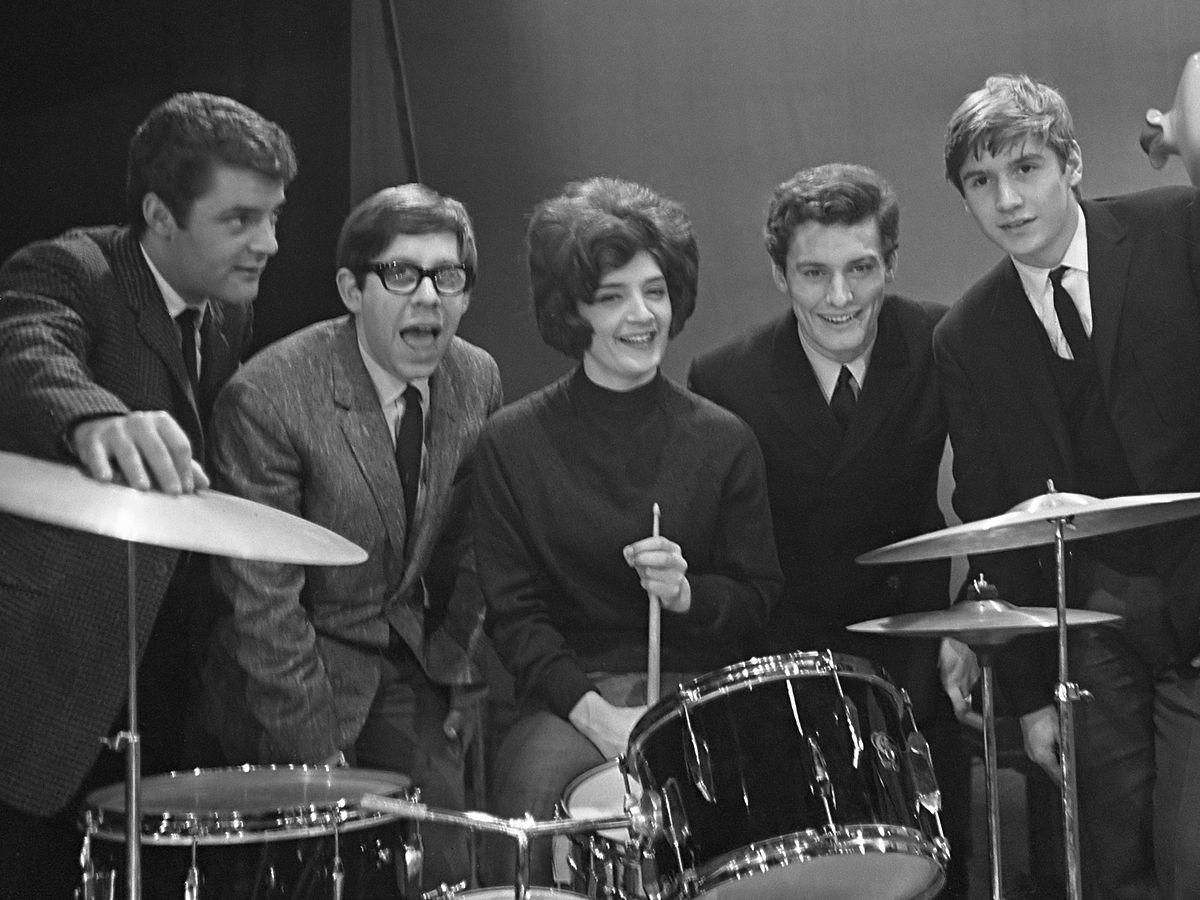
The Honeycombs in 1964
Have I The Right? was a big hit in 1964 for The Honeycombs. The video is redolent of the 1960s – the music, the photography, the clothes are very much of that period – the one exception being the drummer, Honey Lantree, who was one of the first female drummers in a hit band; she passed away five years ago. She was the sister of the bass player John Lantree. who is on the left in the above picture.
The band was produced by pioneering sound engineer Joe Meek (who I’ve blogged about before). Joe Meek like to have a strong blend of low frequencies in the mix, but Honey Lantree tended to use bass drum rather sparingly, hence Joe Meek’s suggestion that the band should stamp their feet during the “Come Right Back” bit of the chorus. Anyway, it’s what kinds nowadays call “a banger”…
The Honeycombs are generally regarded as a one-hit wonder, which is one hit more than most bands manage, but is a shame because their first album Here Are The Honeycombs has some great music on it. Take this, for example, their third follow-up single Eyes:
This record has an an interesting melody, hypnotic atmosphere all of its own and some great work on the drums by Honey Lantree. I think it’s great, actually, but it wasn’t a commercial success largely because it didn’t get played on the BBC at the time. Why not? Well, look at the lyrics:
Eyes, I’ve seen in some crowded places Staring from lonely faces Wanting someone to want them too
Eyes that night after night are trying to keep themselves from crying making believe their dreams are true
But eyes of, someone who’s in love Who would ever have thought that I’d find them there
Eyes that watch as we drew together wondering if we could ever find all the love they’ve never known
Eyes that now we have left behind us In places you never find us where people go cause they’re alone
Now I gaze in the eyes of the one I love Now no longer alone and afraid and sad…
Although it’s not explicit, the song is about a guy getting off with another guy in a crowded gay bar while the other customers look on. The BBC wouldn’t touch that sort of thing back in 1964!
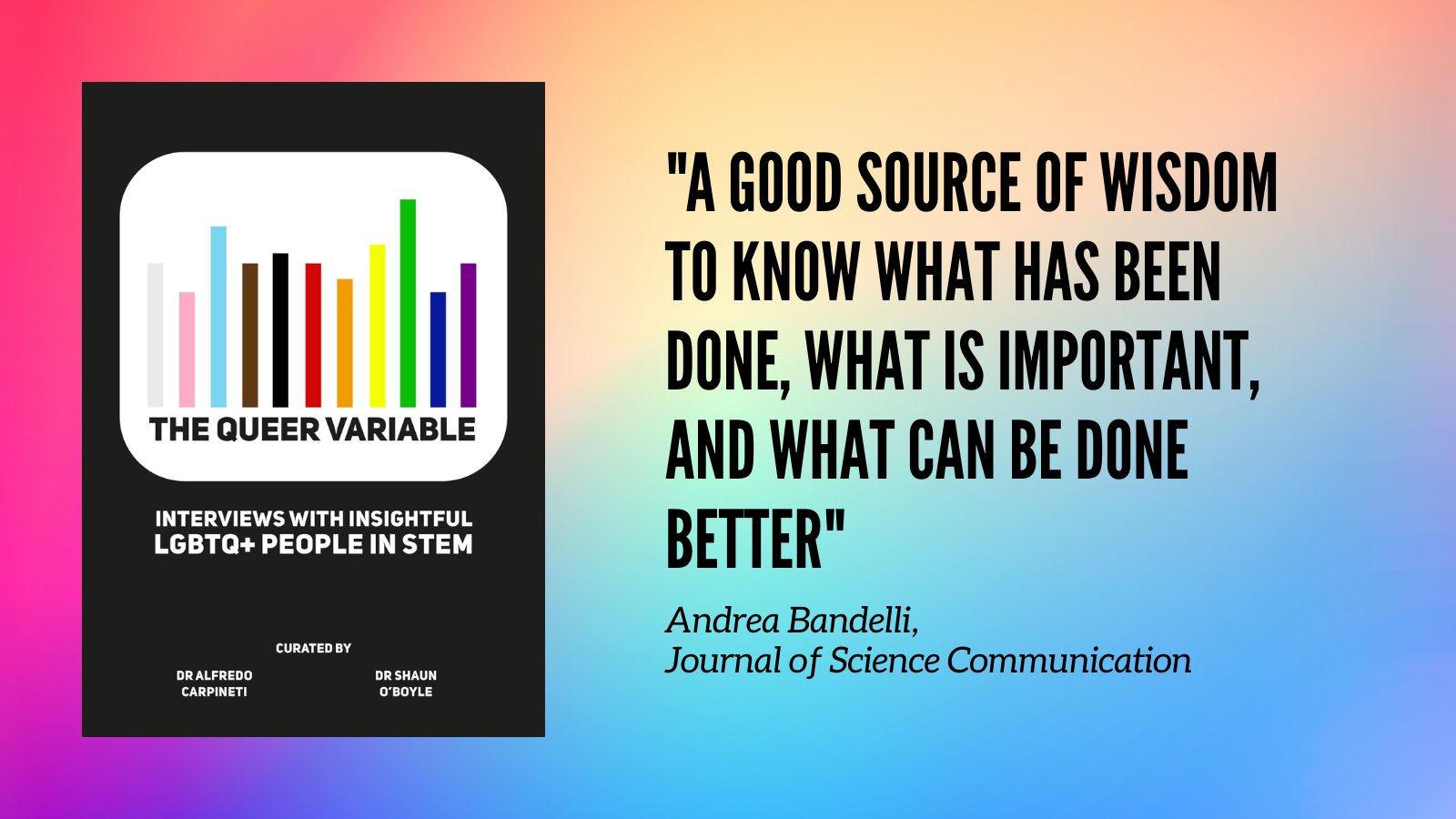
As it’s Pride Month I’d take this opportunity to re-advertise The Queer Variable which is a collection of 40 interviews with people who are studying or working in Science, Technology, Engineering, and Maths (STEM) and who are part of the LGBTQ+ community. You can find out more about the book and download it for free as a PDF or an e-book (whatever that is) here.
“The Queer Variable” is an edited collection of interviews with 40 LGBTQ+ people who experienced the full range of issues — positive and negative — that queer people in STEM regularly face. Through their own voices they describe how unnecessarily difficult certain academic environments can be, and how many chances to do good science go to waste when institutions and their leaders implicitly and explicitly discourage LGBTQ+ people from advancing their careers in STEM. The book contains a wealth of good advice for university leaders, lab directors, teachers and many others in leadership positions on how to make their organisations inclusive, diverse and respectful of everyone.
Andrea Bandelli (2022). Together in diversity: insights and wisdom from LGBTQ+ people working in STEM JCOM 21(06), R03.
I am one of the people interviewed for the book. My interview is actually the first in the book, which suggests I might have been the first person interviewed. Most of the interviews took place between 2020 and 2021, but I seem to remember doing mine (over a rather choppy Zoom connection) back in late 2019 when I was a mere lad of 56 years old and before the Covid-19 pandemic. That all seems a very long time ago now!
Anyway, many thanks to Alfredo Carpineti and Shaun O’Boyle for compiling this collection and making it available. I hope people will find it useful.
Incidentally, one of the sponsors of this project is Science Foundation Ireland whose Director General, Prof. Philip Nolan (former President of Maynooth University) is quoted thusly:
SFI is delighted to support this important publication, which highlights the diverse spectrum of talent and experience among our LGBTQ+ research colleagues. STEM research must benefit all of our society and therefore STEM careers must also be welcoming and accessible to all members of our society. I thank all of the contributors for sharing their powerful personal stories and for providing insights into the challenges they have faced on their career journeys. By raising their voices, they are helping break down barriers for future generations.
I’ve mentioned on here before that I had an English teacher at school who used to set interesting creative writing challenges, in which we would be given two apparently disconnected topics and asked to write something that connected them together. The inspiration was ‘Only Connect’, the epigraph of E.M. Forster’s novel Howard’s End. Since I’ve spent all afternoon in an Exam Board meeting I thought I’d do a little bit of connecting now.
Les sanglots longs
Des violons
De l’automne
Blessent mon coeur
D’une langueur
Monotone.
Tout suffocant Et blême, quand Sonne l’heure, Je me souviens Des jours anciens Et je pleure;
Et je m’en vais Au vent mauvais Qui m’emporte Deçà, delà, Pareil à la Feuille morte.
I posted the above poem by Paul Verlaine for two reasons. One is that lines from the poem were broadcast on the eve of the Normandy Landings. The landings themselves began in the morning of June 6th 1944 and the excerpt – the last three lines of the first verse – formed a coded message broadcast to the French resistance by Radio Londres, 5th June 1944 at 23.15 GMT, informing them that the Allied invasion of France was imminent and that sabotage operations should commence.
The other reason is that that it was just two weeks ago that I attended a concert featuring settings by Benjamin Britten of prose poems taken from Les Illuminations by Arthur Rimbaud. I didn’t know until that Verlaine and Rimbaud were lovers and that they lived for some time together in London. Their relationship was on the tempestuous side – at one point Verlaine fired a gun at Rimbaud, wounding him in the hand. Here’s a detail from a painting showing the two of them (Verlaine on the left, Rimbaud on the right).
It was said of Rimbaud that, as well as writing remarkable poetry, he was cute-looking, had a very dirty sense of humour, drank a bit too much, and liked lots and lots of rough sex. I think I would have liked him (although perhaps not enough to risk being shot by his jealous older boyfriend).
Anyway, this provides me with an excuse not only to commemorate D-Day but also Pride Month!
It’s 1st June 2023, which means that it’s the first day of Pride Month 2023. I’m looking forward to the Pride Festival with a March and Parade in Dublin later this month, of which I’m planning to attend at least part, even if I am obviously far too old for that sort of thing. Another thing that happens this month is that I turn 60!
Incidentally, this will be the 40th anniversary of the first official Dublin Pride.
With its origins as a commemoration of the Stonewall Riots of 1969, Pride remains both a celebration and protest. It’s more necessary than ever now because of the sustained abuse being aimed at trans people from all quarters, including those in political power and those sad losers who have nothing better to do that spend all day tweeting their bigotry on social media. Bigots will always be bigots, but the lowest of the low are those that masquerade as some sort of progressive while spouting their hate and prejudice. As well as a celebration and a protest, Pride is an opportunity for us all to show solidarity against those who seek to divide us.
Though many LGBTQIA+ people in many countries – even those that claim to be more liberal – still face discrimination, hostility and violence, Pride Month always reminds me of how far we’ve come in the past 50 years. Recently my own celebration of Pride is very subdued as it tends to makes me feel old and irrelevant as well as worried that we might be headed back to the bigotry and intolerance of the past; the rights we have won could so easily be taken away. But as I get older, I find I have become more and more protective towards younger LGBT+ people. I don’t want them to have to put up with the crap that I did when I was their age.
I would like to wish all LGBTQIA+ people around the world, but especially staff and students at Maynooth University, a very enjoyable and inspiring Pride 2023!
A few days ago I mentioned on this blog the case of a gay teenager in Navan being beaten up by boys from the same school; there was a news report here. Five youths were subsequently arrested but have now been released without charge. I felt a strong sense of dismay when I heard the news of their release, as the decision to let them go seemed to declare open season on homophobic violence. It may however because the assailants have to be treated as minors.
Press coverage related to this story has generally condemned the sharing on social media of a video showing the violent assault. There are quite a few people, however, including me, who think that the Gardaí would not have taken any action at all had they not been shamed into doing so by the publicity generated by the video.
Regular readers of this blog will probably understand why this case resonates with me: a similar thing happened to me way back in the 1980s. There are differences, of course. For one thing, I was rather older – in my mid-twenties rather than mid-teens. For another, the incident wasn’t reported to the police. There wasn’t any point in those days. The Brighton police at that time were notorious for dismissing complaints of gay-bashing despite the fact it was an endemic problem. People I knew who had reported such incidents usually found themselves being investigated rather than their assailants. In those days the law did not recognize homophobic offences as hate crimes. Far from it, in fact. Attacking a gay person was, if anything, considered to be a mitigating circumstance. This attitude was fuelled by a number of high-profile cases (including a number of murders) where gay-bashers had been acquitted or charged with lesser offences after claiming their victim had provoked them.
Another difference is that I didn’t go to hospital. I had a black eye, a fat lip and a lot of bruises, and had been unconscious for a time, but there didn’t seem to be any serious physical damage. The psychological effects were far from negligible, though, and I have experienced intermittent mental health problems ever since, sometimes needing to be hospitalized for psychiatric treatment. You can read about this here; a short summary is that I should have got help with this much earlier. The important thing now is that the boy who was targeted in Navan gets proper treatment and counselling. I wish him a speedy recovery.
Here’s something I wrote in 2010 after in the blog post describing my own experience of homophobic violence:
Now fast-forward about 20 years. Attitudes have definitely changed, and so has the law. Certain types of criminal offence are now officially recognized as hate crimes: the list treats sexual orientation as equivalent to race, gender, religious belief and disability in such matters. The Police are now obliged to treat these with due seriousness, and penalties for those found guilty of crimes exacerbated by homophobia are consequently more severe.
Recently, there are increasing signs of a backlash against LGBT+ people, most obviously in America but also here in Ireland. Much of this is fueled by toxic rhetoric of the Far Right who seem to want to target trans people. Social media, especially Twitter are awash with transphobic abuse and threats of violence for the reason that trans people are perceived to be easy targets. It’s up to the rest of us to make sure this strategy does not work.
I worry that the rights that the LGBT+ community has taken so long to win, could so easily be taken away. If we are complacent and pretend that everything is fixed because we have equal marriage then we will soon see those rights being eroded. LGBT+ people have to remain active and visible, show solidarity with one another, and keep pushing against all forms of discrimination, harassment and bullying wherever it happens. And the first step in doing that is to raise awareness that there is a serious problem.
I was reflecting on my own encounter with violence the other day. I try not to think about that very much, but I found myself wondering where the four guys who attacked me are now. They were about the same age as me, so will be around 60 now. Do you think the hate they expressed with their fists back in the 1980s has gone away? More importantly, do you think it reasonable that I should believe that? I don’t. The hate is still out there and will find its expression at the slightest provocation.
The reference to hate crimes in the above quote relates to the UK, of course. I was a little surprised to see that until very recently there was no legal definition of a hate crime in Ireland. Legislation has only just been introduced on this subject, with cross-party support. Among other provisions:
The new legislation will criminalise any intentional or reckless communication or behaviour that is likely to incite violence or hatred against a person or persons because they are associated with a protected characteristic. The penalty for this offence will be up to five years’ imprisonment.
The protected characteristics in the new legislation are: race; colour; nationality; religion; national or ethnic origin; descent; gender; sex characteristics; sexual orientation; and disability.
It remains to be seen how the new law works in practice.
I just remembered that today is May 17th which means that it is International Day Against Homophobia Transphobia and Biphobia, This is a worldwide celebration of sexual and gender diversities and a chance to show solidarity against bigotry and intolerance.
A video circulating today on social media in Ireland showing a teenager being beaten up because he is gay reminds us that we need this now more than ever; there’s a news report here. I hope the culprits are brought to justice. The rising tide of violence and discrimination against LGBTQI+ individuals is encouraged by those who spread poisonous rhetoric in the media and online.
I was very sad to hear this morning of the death at the age of 67 of Paul O’Grady, who was best known (to me) in the form of Lily Savage, the best of the drag acts to be found in London when I lived there years ago. I remember seeing Lily Savage many times, including one memorable night at the old Drill Hall near Tottenham Court Road, which was a hilarious occasion enjoyed by everyone there (including a smattering of celebrities in the audience). The best bit of the best drag shows is always how the performer deals with hecklers. Paul O’Grady had a ready wit and a very acerbic tongue which made Lily Savage a must-see act. I wasn’t the only one to be surprised when Lily Savage got her own mainstream television show in the 90s, as much of her material was very “blue”, and I wondered how she would fare with the inevitable toning down of the material. The transition to Telly, however, turned out to be a great success.
Paul O’Grady “retired” Lily Savage some years ago, but still appeared on TV as himself to great popular acclaim. I never knew him personally but some old friends of mine from London got to know him very well, including going on holiday with Paul and his partner Andre (whom he married in 2017). They all said Paul was a lovely and friendly person and just as funny in private as he was on stage or on television. I send my condolences to his friends and family.
Drag has of course been around for centuries. Cross-dressing in the theatre, in film, and in opera, where it plays a central role in many plots especially in comedies. Who can forget the wonderful Alastair Sim in the St Trinian’s movies? More recently, Danny La Rue (who, incidentally, was born in Cork) was a regular performer on television in my youth and was for a time Britain’s highest paid entertainer.
But Paul O’Grady was a bit different. He successfully navigated a tricky journey to bring Lily Savage from the underground world of gay bars and clubs into the realm of popular culture at a time overshadowed by Section 28 and the AIDS crisis. Paul O’Grady was a powerful advocate for LGBTQ+ rights. His visibility and humour made the world a better place for many of us. His was a life well lived.
It is especially sad that Paul O’Grady’s death coincides with widespread and growing hostility to drag queens from far right bigots, who are intent on attacking anyone associated in any way with the LGBTQ+ community. The banning of drag shows – which has already happened in some States of the USA- is just part of this agenda; transphobia is another, as is the anti-migrant movement. It’s all about manufacturing hostility to distract attention away from the real problems of society. The list of targets is growing. Before long, any lifestyle perceived to be unconventional in any way will come under attack. The wave of bigotry sweeping across the world is intended to sweep diversity aside and leave in its wake a bleak landscape of dreary uniformity.
The career of Ireland’s own Rory O’Neill (aka Panti Bliss), who was a popular contestant on Dancing with the Stars, mirrors that of Paul O’Grady. I recently went to an event featuring Rory O’Neill. He had left Panti at home for the occasion but it was extremely interesting and enjoyable – and a bit sweary! – to hear him talk about his life and experiences, especially why he became an activist and how he started out as a drag performer. I have the same sort of admiration for Rory as I had for Paul. We need more like them.
I also have personal reasons for being grateful for drag queens. When I was a youngster (still at School) I occasionally visited a gay bar in Newcastle called the Courtyard. I was under age for drinking alcohol let alone anything else – the age of consent was 21 in those days – but I got a kick out of the attention I received and flirted outrageously with the much older clientele. I never took things further but never had to buy my own drinks, let’s put it that way.
Anyway, one evening I left the pub to get the bus home – the bus station was adjacent to the pub – but was immediately confronted by a young bloke who grabbed hold of me and asked if I was a “poof”. Before I could answer, a figure loomed up behind him and shouted “Leave him alone!”. My assailant let go of me and turned round to face my guardian angel, or rather guardian drag queen. No ordinary drag queen either. This one, at least in my memory, was enormous: about six foot six and built like a docker, but looking even taller because of the big hair and high heels. The yob laughed sneeringly, whereupon he received the immediate and very muscular response of a powerful right jab to the point of the chin, like something out of a boxing manual. His head snapped back and hit the glass wall of a bus shelter. Blood spurted from his mouth as he slumped to the ground.
I honestly thought he was dead, and so apparently did my rescuer who told me in no uncertain terms to get the hell away. Apart from everything else, the pub would have got into trouble if they’d known I had even been in there. Instead of waiting around in Marlborough Crescent, I ran to the next stop where I got a bus after a short wait.
When I got home I was frightened there would be something on the news about a violent death in the town centre, but that never happened. It turns out the “gentleman” concerned had bitten his tongue when the back of his head hit the bus shelter. It must have been painful, but not life-threatening. My sympathy remains limited. I stayed away from the pub after that.
I think there’s a moral to this story, but I’ll leave it up to you to decide what it is.
Posted in LGBTQ+ on November 20, 2022 by telescoper
Today is Transgender Day of Remembrance. The day honours the memory of those who have lost their lives as a result of transphobia and anti-transgender violence.
In 2021, the deadliest year on record, around the world at least 375 gender non-conforming people lost their lives to violence, almost a quarter of them attacked in their own homes.
Just last night a gunman attacked an LGBTQ bar in Colorado at an event run by a drag artist, killing at least five people. Violent events like this are a direct consequence of the words of those who use their media platforms to broadcast transphobic rhetoric and create an atmosphere of intolerance and hostility. That goes not only for bigoted politicians but also those squalid twitter trolls with nothing better to do than to abuse and harass.
The views presented here are personal and not necessarily those of my employer (or anyone else for that matter).
Feel free to comment on any of the posts on this blog but comments may be moderated; anonymous comments and any considered by me to be vexatious and/or abusive and/or defamatory will not be accepted. I do not necessarily endorse, support, sanction, encourage, verify or agree with the opinions or statements of any information or other content in the comments on this site and do not in any way guarantee their accuracy or reliability.



 In the Dark