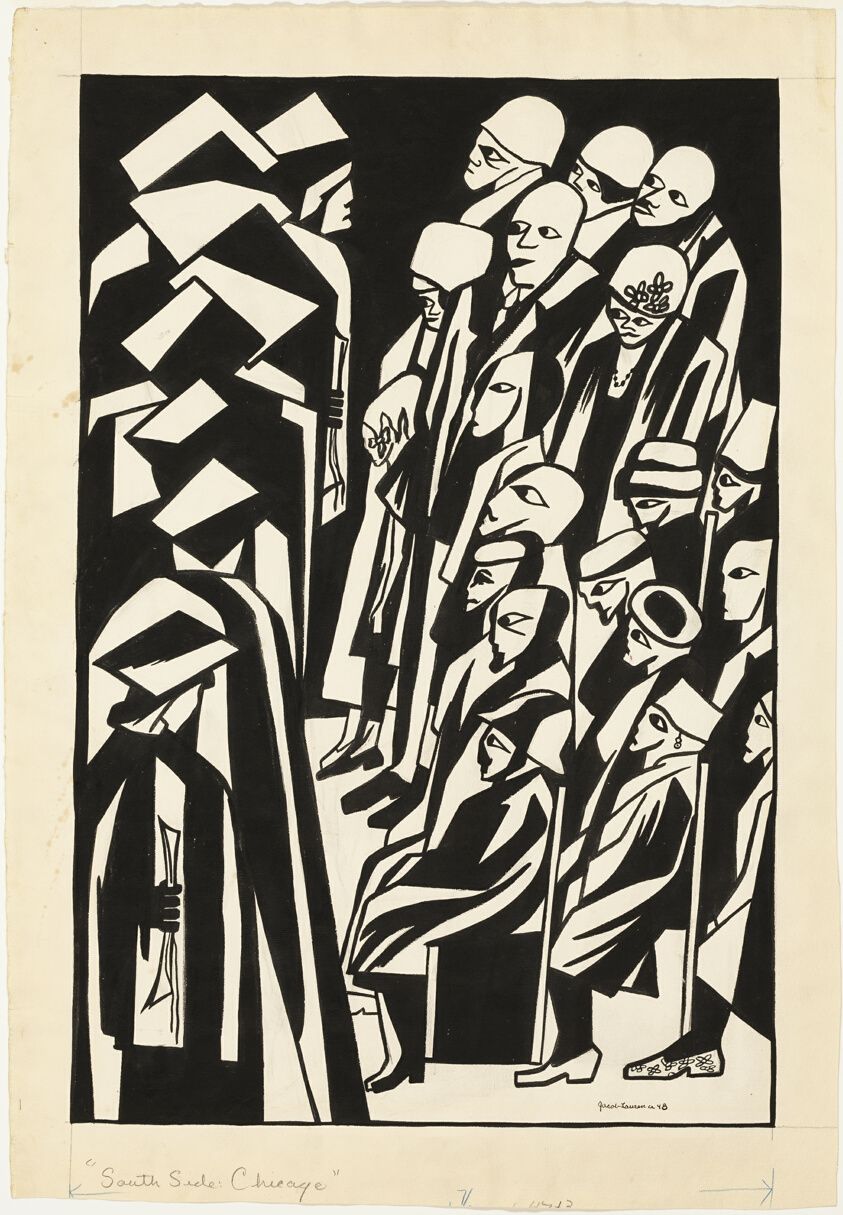
by Jacob Lawrence (1948, ink over graphite on paper, 72 × 49.8 cm, Art Institute of Chicago, USA)
This work, Graduation, is one of six drawings that Jacob Lawrence made as illustrations for Langston Hughes’s 1949 book of poetry, One-Way Ticket.

by Jacob Lawrence (1948, ink over graphite on paper, 72 × 49.8 cm, Art Institute of Chicago, USA)
This work, Graduation, is one of six drawings that Jacob Lawrence made as illustrations for Langston Hughes’s 1949 book of poetry, One-Way Ticket.
Today is National Poetry Day in the UK and Ireland but, instead of posting a poem like I usually do on this occasion, I thought I’d do a bit of reflecting on Shakespeare’s Sonnets. What prompted this is an article in the Times Literary Supplement I mentioned in a post on Monday. The cover picture shows a newly-discovered miniature by Nicholas Hilliard that is claimed to be of Henry Wriothesley, 3rd Earl of Southampton, and patron of William Shakespeare:
On the 20th May 1609, a collection of 154 Sonnets by William Shakespeare was published, which arguably represents at least as high a level of literary achievement as his plays. The “Master Mistress” in the title of the TLS article is a reference to Sonnet No. 20 in the collection, published on 20th May 1609, of 154 Sonnets by William Shakespeare, which arguably represents at least as high a level of literary achievement as his plays. Here is Sonnet No. 20 in the form usually printed nowadays:
A woman’s face with nature’s own hand painted,
Hast thou the master mistress of my passion,
A woman’s gentle heart but not acquainted
With shifting change as is false women’s fashion,
An eye more bright than theirs, less false in rolling:
Gilding the object whereupon it gazeth,
A man in hue all hues in his controlling,
Which steals men’s eyes and women’s souls amazeth.
And for a woman wert thou first created,
Till nature as she wrought thee fell a-doting,
And by addition me of thee defeated,
By adding one thing to my purpose nothing.
But since she pricked thee out for women’s pleasure,
Mine be thy love and thy love’s use their treasure.
The somewhat androgynous facial appearance of Henry Wriothesley – seen in other portraits – has led some to suggest that the above Sonnet was addressed to him. Others think that the poem was addressed to a young male actor (a “boy player“) who played female roles on the stage, as was usual in Shakespeare’s time. It was illegal for women to perform on stage until 1660.

The dedication in the First Folio edition of the Sonnets, published in 1609, is shown on the left. The initials “T.T.” are accepted to stand for the name of the publisher Thomas Thorpe but the identity of “Mr. W.H.” is unknown. Of course “W.H.” is a reversal of the “H.W. ” that could be Henry Wriothesley, but would the publisher really use “Mr” to refer to a member of the nobility? Another curiosity is the prevalence of full stops, which is more characteristic of inscriptions carved in stone than on printed pages.
The First Folio edition was the only edition of the Sonnets published in Shakespeare’s lifetime and the circumstances of its publication remain uncertain to this day and not only because of identity of “Mr W.H.” For example, if it was authorised by Shakespeare, why did Shakespeare himself not write the dedication? Some have argued that it must have been published posthumously, so Shakespeare must have been dead in 1609, whereas most sources say he died in 1616.

Most of the poems (126 out of 154) contain poetic statements of love for a young man, often called the “Fair Youth”. However, there is also a group of sonnets addressed to the poet’s mistress, an anonymous “dark lady”, which are far much more sexual in content than those addressed to the “Fair Youth”. The usual interpretation of this is that the poet’s love for the boy was purely Platonic rather than sexual in nature. If Mr W.H. was a boy player then he would have been very young indeed, i.e. 13-17 years old…
Anyway, it was certainly a physical attraction: verse after verse speaks of the young man’s beauty. The first group of sonnets even encourage him to get married and have children so his beauty can continue and not die with his death. Sonnet 20 laments that the youth is not a woman, suggesting that this ruled out any sexual contact. These early poems seem to suggest a slightly distant relationship between the two as if they didn’t really know each other well. However, as the collection goes on the poems become more and more intimate and it’s hard for me to accept that there wasn’t some sort of involvement between the two. Although homosexual relationships were not officially tolerated in 17th Century England, they were not all that rare especially in the theatrical circles in which Shakespeare worked.
Oscar Wilde wrote a story called “A Portrait of Mr. W.H.” which suggests he is a young actor by the name of “Will Hughes”. The main evidence for this is Sonnet 20.
Look at the First Folio version:

The initial capital and emphasis of “Hews” seen in line 7 is very unusual and suggests that it is a joke (one of many in this poem), in the form of a pun on the preceding “hew”. It is suggested that “Hews” is actually “Hughes”. Ingenious, but I’m not convinced. There were many other meanings of “hew” in use in Shakespeare’s time; it was a variant spelling of “ewe” for example.
We’ll probably never know who Mr W.H. was – presumably not Smith – or indeed what was the real nature of his relationship to Shakespeare but we do not need to know that to read and enjoy the poems.
I do have a fundamental misgiving, though, about the assumption that the “Onlie begetter” of these sonnets means the person to whom they are addressed, or who inspired them. That assumption entirely disregards the “Dark Lady” sequence. There are at least two addressees so neither can be the only begetter, if that is what begetter is supposed to mean.
I think it more likely Mr W.H., whoever he was, is the person who caused the collection to be created and/or published, perhaps by sponsoring the First Folio. It’s also possible that these poems may have been commissioned over the years by Mr. W.H. and/or others – experts think they were written over a period of at least 16 years – and only published together at much later date. It is indeed said that some of verses were circulated in private well before they were published, though they may perhaps have been edited or otherwise tidied up for the 1609 edition. Perhaps Shakespeare supplemented his income by writing sonnets to order?
This line of thought also took me to another question: why does everyone assume that all 126 of the “Fair Youth” sonnets are about the same person? That person is never named and only occasionally described. Some of the 126 are thematically linked, but overall it is a collection rather than a sequence. Some are humorous and some are very serious indeed. Some are downright cryptic. I think it quite possible, especially if the poems really were written over a period of 16 years, that they not all addressed to the same individual. Once you accept the evident truth that there is more than one recipient, then why not more than two?
Some have taken this even further and asked: do we really know that all 154 sonnets were written by the same person? The same question is asked about Shakespeare’s work generally. Was there really one person behind his plays, or were they collaborative efforts.
Finally, I wonder for what purpose these sonnets were written. Were they actually sent to the addressee(s) as expressions of love, like letters, or were they private meditations, like one might write in a journal?
I don’t suppose we’ll ever really know the answers to these questions, but I find it fascinating that the origin of such a famous collection is enshrouded in so many mysteries! I promise to post more of them here in due course.
Regular readers of this blog know that I have a habit of reading the Times Literary Supplement which I buy not only for the book reviews, but also for its excellent crossword. I’ve even won the crossword competition prize a few times. You can find an assortment of posts related to the TLS here.
Recently the Times Literary Supplement underwent something of a makeover, changing the design and switching from a weekly to fortnightly publication. The first new-style issue was published on September 5th. Here is the cover:
The cover article is about the possible identity of the “Mr W.H.” to whom William Shakespeare dedicated his collection of Sonnets; see here. I may write something about that in the not too distant future, as I’ve been reading these again recently.
Anyway, my subscription definitely specifies a “weekly print edition delivered to my door”, so that has gone out the window. I wasn’t best pleased to have the terms of my subscription changed unilaterally like that. Of course I could just read the online edition, but I don’t like reading too much on a screen. I’ve never adapted to reading books on a Kindle either. And crosswords are impossible that way. The old format TLS was rather like a tabloid newspaper, which I found easy to read and handle, and of 28 pages per edition. The new format has 48 pages (which is not 2 times 28) and is rather cramped and crowded and with heavier paper to make it look there’s more to it than there is.
The look and feel they seem to have gone for is “Generic Weekend Supplement”, as you can see if you compare it with last week’s Irish Times Weekend Magazine:
The latter supplement has 52 pages instead of 48 and has more advertisements inside but is otherwise similar.
So why mention this? Well one thing is that the number of crosswords provided by the TLS per year has now reduced by half, which to me reduces the value of the subscription significantly. Moreover, the first issue of the new style supplement was published on September 5th, but didn’t arrive through my letterbox until 24th September. That’s 19 days. The deadline for entries to the crossword competition was September 15th.
Now the old-style issues used to take about 10 days to cross the Irish Sea, which I thought was bad, but 19 days is just awful. One theory of this is that the TLS launches issues with the same momentum, so that the new edition, having about twice the mass, has half the speed and therefore takes roughly twice as long to reach the subscriber. Checking the envelope, incidentally, I see that it was postmarked Bratislava. There must be a very cheap – but slow – way of sending post from the UK to Ireland via Slovakia.
Anyway, I’ve decided not to renew my subscription to the TLS, as I did with Private Eye recently. I cancelled my subscription to the Eye not because I was offended by anything in it, but because it was taking a ridiculously long time to arrive. I can still pick up copies of both publications in the local newsagent. I’m sure Paddy will keep copies of both to one side if I ask him.
Alternatively, I might switch from the TLS to the London Review of Books or some similar. Does anyone have recommendations?
So are you to my thoughts as food to life,
Or as sweet-season'd showers are to the ground;
And for the peace of you I hold such strife
As 'twixt a miser and his wealth is found.
Now proud as an enjoyer, and anon
Doubting the filching age will steal his treasure;
Now counting best to be with you alone,
Then better'd that the world may see my pleasure:
Sometime all full with feasting on your sight,
And by and by clean starved for a look;
Possessing or pursuing no delight
Save what is had, or must from you be took.
Thus do I pine and surfeit day by day,
Or gluttoning on all, or all away.
by William Shakespeare (1564-1616)
Your love and pity doth the impression fill
Which vulgar scandal stamp’d upon my brow;
For what care I who calls me well or ill,
So you o’er-green my bad, my good allow?
You are my all the world, and I must strive
To know my shames and praises from your tongue;
None else to me, nor I to none alive,
That my steel’d sense or changes right or wrong.
In so profound abysm I throw all care
Of others’ voices, that my adder’s sense
To critic and to flatterer stopped are.
Mark how with my neglect I do dispense:
You are so strongly in my purpose bred
That all the world besides methinks are dead.
by by William Shakespeare (1564-1616)
I find myself returning once again to Shakespeare’s sonnets, especially to the sequence of 126 poems that the poet addressed to a “Fair Youth“. This one is written in quite difficult language (for me) with some obscure words and phrases such as “adder’s sense”, “o’er-green” and “steel’d sense”. It’s almost as if parts of it are written in code. Nevertheless the overall meaning of the poem is clear: it revolves around the beautiful “You are my all the world” in line 5, shining out through the thickets, with “all the world” repeated in the last line for extra effect. The poet is saying that nobody’s opinion of him matters at all except that of his beloved. Know the feeling?
The last episode of Simon Schama‘s BBC TV series A History of Britain, called “The Two Winstons”, follows the story of the Second World War and its immediate aftermath through the eyes of two very different Englishmen, George Orwell and Winston Churchill. Near the end of the programme Schama talks about the year 1948, when a very sick Orwell wrote his last major novel, Nineteen Eighty-Four. I’ve reconstructed this section from the subtitles on my DVD of the series.
It starts with a direct quote from 1984
In our world there will be no love but the love of Big Brother, no laughter but that of triumph. No art, no science, no literature, no enjoyment, but always and only, Winston, there will be the thrill of power. If you want a picture of the future, imagine a boot stamping on a human face forever.
It continues with the voice of Simon Schama as narrator
To clear his head of the static hum of postwar London, Orwell went as far away as he could without actually leaving Britain, to the very edge of the kingdom – the Hebridean island of Jura. No electricity, no telephone, post twice a week, maybe.
And it was here, in the remotest cottage he could find, typing in bed with the machine on his knees, knowing he hadn’t long to live, that Orwell concentrated on what mattered most to him, and to Britain – the fate of freedom in the age of superpowers. As Churchill issued his grim warnings, Orwell created a common or garden plain man’s Winston – Winston Smith. The year was 1948.
When we think of 1984, most of us think of the tyranny of drabness and mass obedience ruled by Big Brother, a world of doublespeak where war is peace and lies are truth. But Orwell’s last masterpiece is most powerful and most lyrical when it describes Winston’s resistance to dictatorship, a guerrilla action fought, not with guns and barricades, but by literally taking liberties, a walk in the country, an act of love, the singing of an old nursery rhyme.
Winston Smith did all these forbidden things, prompted by a dim memory of a time when they were absolutely normal. The last refuge of freedom against Big Brother is memory. The greatest horror of 1984 is the dictator’s attempt to wipe out history.
I thought of the last sentence when I read about Donald Trump’s plan to rewrite American history for the 250th anniversary of the Declaration of Independence, but that’s just one example amid the rise of authoritarian regimes around the world. In the context of the TV programme, Schama was making a case for the importance of history as a discipline, but there is something else important to say: we should not forget the past but, perhaps even more importantly, neither should we forget about the future we wanted to see. The present is not the future I hoped for when I was younger, even in 1984, but the story isn’t over yet.
The name of the author is the first to go
followed obediently by the title, the plot,
the heartbreaking conclusion, the entire novel
which suddenly becomes one you have never read, never even heard of,
as if, one by one, the memories you used to harbor
decided to retire to the southern hemisphere of the brain,
to a little fishing village where there are no phones.
Long ago you kissed the names of the nine muses goodbye
and watched the quadratic equation pack its bag,
and even now as you memorize the order of the planets,
something else is slipping away, a state flower perhaps,
the address of an uncle, the capital of Paraguay.
Whatever it is you are struggling to remember,
it is not poised on the tip of your tongue
or even lurking in some obscure corner of your spleen.
It has floated away down a dark mythological river
whose name begins with an L as far as you can recall
well on your own way to oblivion where you will join those
who have even forgotten how to swim and how to ride a bicycle.
No wonder you rise in the middle of the night
to look up the date of a famous battle in a book on war.
No wonder the moon in the window seems to have drifted
out of a love poem that you used to know by heart.
by Billy Collins (b 1941)
Yes, yours, my love, is the right human face.
I in my mind had waited for this long,
Seeing the false and searching for the true,
Then found you as a traveller finds a place
Of welcome suddenly amid the wrong
Valleys and rocks and twisting roads. But you,
What shall I call you? A fountain in a waste,
A well of water in a country dry,
Or anything that's honest and good, an eye
That makes the whole world seem bright. Your open heart,
Simple with giving, gives the primal deed,
The first good world, the blossom, the blowing seed,
The hearth, the steadfast land, the wandering sea.
Not beautiful or rare in every part.
But like yourself, as they were meant to be.
by Edwin Muir (1887-1959)
Now on a bit of a roll, I’ve finished reading the third of the six novels I bought earlier this year. The first of these I read was Foster, by Claire Keegan who also wrote the latest, Small Things Like These. There’s much in common between these two works, not only in the beautifully spare writing style with which the stories are told, but also in the message hope of they find in grim circumstances.
The current book is revolves around a character called Tom Furlong, a hard-working and moderately successful timber and coal merchant who makes deliveries around his neighbourhood. It is set in the 1980s, in a time of economic recession, shortly before Christmas. Tom is happily married with five daughters. Tom doesn’t know who his father was; he was raised by a kindly Protestant lady. One day making his delivery round takes him to the local convent, where he sees the harsh treatment of young unmarried mothers in the Magdalene laundry run by the nuns; later visiting the same place to deliver coal he finds a young girl locked in the coalhouse, in the freezing cold. These and other episodes unsettle Tom, by making him think about how lucky he has been, largely thanks to the kindness of others, and how small things can make a huge difference to how one’s life turns out. What he does at the end of the story is not a small thing at all, and we aren’t told how it works out, but it is an act of kindness and he does it for all the right reasons, so we feel it will somehow all work out for the best.
The last novel I wrote about was a work of historical fiction, and so is this. Although it is set in the 1980s, that was a time in which social attitudes in Ireland were much more dominated by the Roman Catholic Church than they are now, the cruelty of the mother-and-baby homes being just one example. Keegan is at pains to point out that the convent is right next door to the local school, two aspects of the same system of social control.
Small Things Like These was published in 2021 and has already been made into a film featuring Cillian Murphy. I haven’t seen the film, unlike Foster in which case I saw the film based on it, An Cailín Ciúin, before reading the book. I must see the film.
P.S. At the end I found myself thinking of these lines from Wordsworth’s Tintern Abbey
As have no slight or trivial influence
On that best portion of a good man's life,
His little, nameless, unremembered, acts
Of kindness and of love.

After the excitement of today’s Hurling Final, I finished the second of the six novels I bought earlier this year. Star of the Sea by Joseph O’Connor is set in 1847 and onboard the ship that gives the novel its name, bound for New York from Ireland, carrying desperate passengers fleeing the Great Famine, which provides the overall context for the story.
It’s worth quoting a couple of paragraphs from the author’s introduction to the novel:
We tourists take pleasure in the emptiness of Connemara. There are reasons why such a silence exists. You would not think, as you amble the sleepy lanes, as you are stilled by the twilight descending on the mountain, that you are walking through a space that was once a disaster zone: the Ground Zero, perhaps, of Victorian Europe. These meadows, those pebbled fields, saw astonishing suffering. There was heroism too; there was extraordinary courage and love. But these wine-dark boglands and rutted boreens witnessed tragedy so immense that those that witnessed it, like Grantley Dixon in my novel, would never forget the sight.
All this happened in the 1840s , that decade in which a million of the Irish underclass died as a consequence of famine. residents of the richest kingdom on earth, they lived only a few hundred miles from the empire’s capital, London. But that did not save them; nothing saved them. Abandoned by the dominant of Ireland and Britain, perhaps two million of the desperate became refugees. We might call them `asylum seekers’ or `economic migrants’. They fled their homeland by any means possible, often on ships like the Star of the Sea. Their language, Gaelic, already in decline virtually disappeared overnight. `Mharbh an gorta achanrud‘, one Gaelic speaker remembered. ‘The famine killed everything’.
O’Connor writes unflinchingly about the effects of famine, the poverty, deprivation and starvation, as well as the squalid rqat-infested conditions the `economic migrants’ were forced to endure on their month-long voyage to America. This in itself is interesting, as it has always seemed to me quite surprising that so few Irish authors have written books about An Gorta Mór. But while the Great Hunger is always present, and is what precipitates most of the action, this book is about many other things besides.
The story begins on Star of the Sea with a mysterious character who is taken to walking the decks at night. We learn very early on that his name is Pius Mulvey and his intention is to commit murder. But who is he to kill, and how, and why? The answer to the last of these questions is revealed through a series of flashbacks that reveal connections between him and several passengers in First Class, including a bankrupt Lord Merridith attempting to escape his creditors, Merridith’s wife and family, an aspiring novelist (the Grantley Dixon mentioned above), and a maidservant (Mary Duane) whose connection to them and to Mulvey is deeply tragic. The narrative is interspersed with excerpts from the log of the ship’s Captain, sundry clippings from contemporary newspapers and magazines, including examples of vile anti-Irish racism from the satirical magazine, Punch, and folk songs of the time. It’s all very carefully and cleverly plotted.
It’s partly a mystery novel, partly a suspense thriller, and partly a social commentary worthy of Dickens (who actually appears in the book, in chapters describing Pius Mulvey’s past life in London). It takes a master story-teller to bring all these elements together convincingly, and that is what Joseph O’Connor clearly is. It is not exactly a whodunnit, but I will nevertheless refrain from posting any spoilers as the ending is very clever (as indeed is the whole book). I’ll just say that I found the whole book immensely satisfying and I recommend it highly, as a novel that has real depth as well as being a true page-turner.
Star of the Sea was published in 2002, and was a best-seller then. It’s taken me too long to discover it. I must read more by Joseph O’Connor, but I have four others on my list to finish first!