Archive for the Literature Category

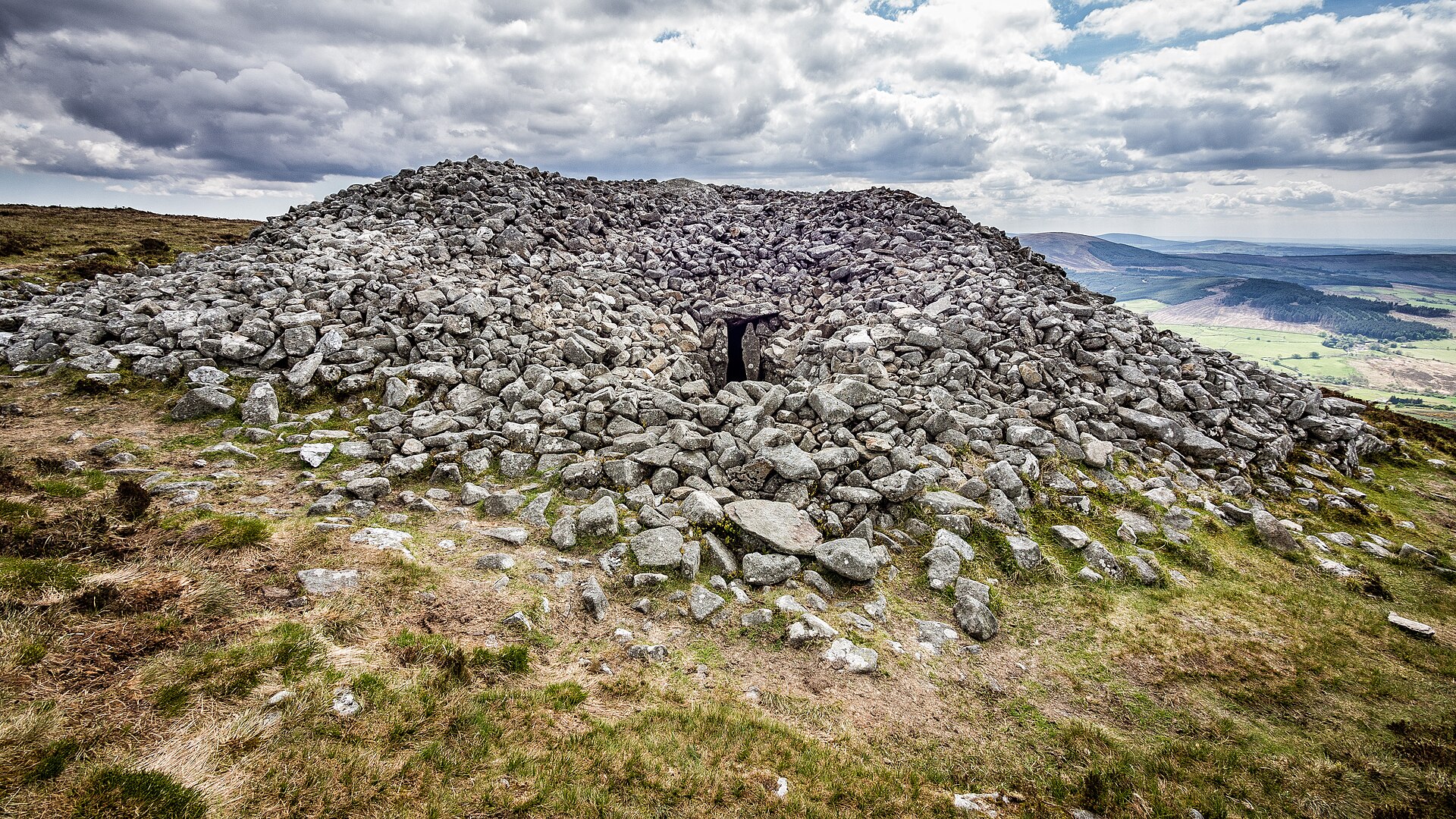
Climbing to Seefin Passage Tomb on the Summer Solstice – Tarn MacArthur

Posted in Poetry with tags , , on June 20, 2025 by telescoper
Seefin Passage Tomb, County Wicklow, photographed by Joe King – Own work, CC BY-SA 3.0, https://commons.wikimedia.org/w/index.php?curid=26328239

The Summer Solstice in the Northern Hemisphere takes place tomorrow, on Saturday June 21 2025, at 02:42 UTC (03:42am local Irish Time). In advance of the big event I thought I’d share this poem I found online, which seems appropriate to the occasion.

No one knows what calls us, days like this
that seem to stretch all sense of reason:
the hillside scrub abuzz with silver-washed

and dark green fritillary, the red grouse
and hare, a lone buzzard counterpoised
on the breeze overhead, near motionless,

weighing the balance of each warm
and distant heartbeat. And who would
claim the old gods dead when the sudden

cadence of your breath slips to the sound
of something pulsing through from the far side
of the ridge, neither ghost nor glossolalia

but wholly of the earth, like the hum
that guided you through summer nights
in childhood when you found yourself alone,

and a field too far from home, as the light
began to fade. Sometimes what we love
is the incongruity of things: the latent sense

of having been here yet having never been
before, that strangely familiar clutch of stones,
how every shadow beckons with a promise

of safekeeping. If, as someone said,
it’s true that the souls to match our souls
lie patiently in wait to take our places

when we step aside, then we should lower
our sights from the brilliance of the sky
and down towards this aperture of darkness.

To enter the tomb is to enter the one world
we know, the cool walls of the passage
summoning us forth with the chance hope

of an earthly meeting. Alone, you are
not alone, the carved stone appears to say.
Nothing is eternal, and everything remains.

by Tarn MacArthur

Bloomsday 2025

Posted in Literature with tags , , , on June 16, 2025 by telescoper

So it’s 16th June, a very special day in Ireland – especially Dublin – because 16th June 1904 is the date on which the story takes place of Ulysses by James Joyce. Bloomsday – named after the character Leopold Bloom – is an annual celebration not only of all things Joycean but also of Ireland’s wider cultural and literary heritage.

If you haven’t read Ulysses yet then you definitely should. It’s one of the great works of modern literature. And don’t let people put you off by telling you that it’s a difficult read. It’s a long read,  that’s for sure -it’s over 900 pages – but the writing is full of colour and energy and it has a real sense of place. It’s a wonderful book. I’ve read it three times now, once as a teenager, once in my thirties, and again last year when I’d reached sixty.

Anyway, here’s an excerpt with an astromomical theme, which seems to me to fit this blog:

With what meditations did Bloom accompany his demonstration to his companion of various constellations?

Meditations of evolution increasingly vaster: of the moon invisible in incipient lunation, approaching perigee: of the infinite lattiginous scintillating uncondensed milky way, discernible by daylight by an observer placed at the lower end of a cylindrical vertical shaft 5000 ft deep sunk from the surface towards the centre of the earth: of Sirius (alpha in Canis Maior) 10 lightyears (57,000,000,000,000 miles) distant and in volume 900 times the dimension of our planet: of Arcturus: of the precession of equinoxes: of Orion with belt and sextuple sun theta and nebula in which 100 of our solar systems could be contained: of moribund and of nascent new stars such as Nova in 1901: of our system plunging towards the constellation of Hercules: of the parallax or parallactic drift of socalled fixed stars, in reality evermoving wanderers from immeasurably remote eons to infinitely remote futures in comparison with which the years, threescore and ten, of allotted human life formed a parenthesis of infinitesimal brevity.

I’ll also mention that, starting at 8am on  RTÉ Radio 1 Extra (but also available at other times on the RTÉ player), you  can listen to the classic radio broadcast of Ulysses from 1982.

He Asked About the Quality – C.P. Cavafy

Posted in LGBTQ+, Poetry with tags , , , on June 15, 2025 by telescoper
He left the office where he'd been given
a trivial, poorly paid job
(something like eight pounds a month, including bonuses)-
left at the end of the dreary work
that kept him bent all afternoon,
came out at seven and walked off slowly,
idling his way down the street. Good-looking,
and interesting: showing as he did that he'd reached
his full sensual capacity.
He'd turned twenty-nine the month before.

He idled his way down the main street
and the poor side-streets that led to his home.

Passing in front of a small shop that sold
cheap and flimsy merchandise for workers,
he saw a face inside, a figure
that compelled him to go in, and he pretended
he wanted to look at some coloured handkerchiefs.

He asked about the quality of the handkerchiefs
and how much they cost, his voice choking,
almost silenced by desire.
And the answers came back in the same mood,
distracted, the voice hushed,
offering hidden consent.

They kept on talking about the merchandise-
but the only purpose: that their hands might touch
over the handkerchiefs, that their faces, their lips,
might move close together as though by chance-
a moment's meeting of limb against limb.

Quickly, secretly, so the shop owner sitting at the back
wouldn't realize what was going on.

by C.P. Cavafy (1863-1933; from Collected Poems, translated by Edmund Heeley and Philip Sherrard)

R.I.P. Edmund White (1940-2025)

Posted in Biographical, LGBTQ+, Literature, R.I.P. with tags , on June 6, 2025 by telescoper

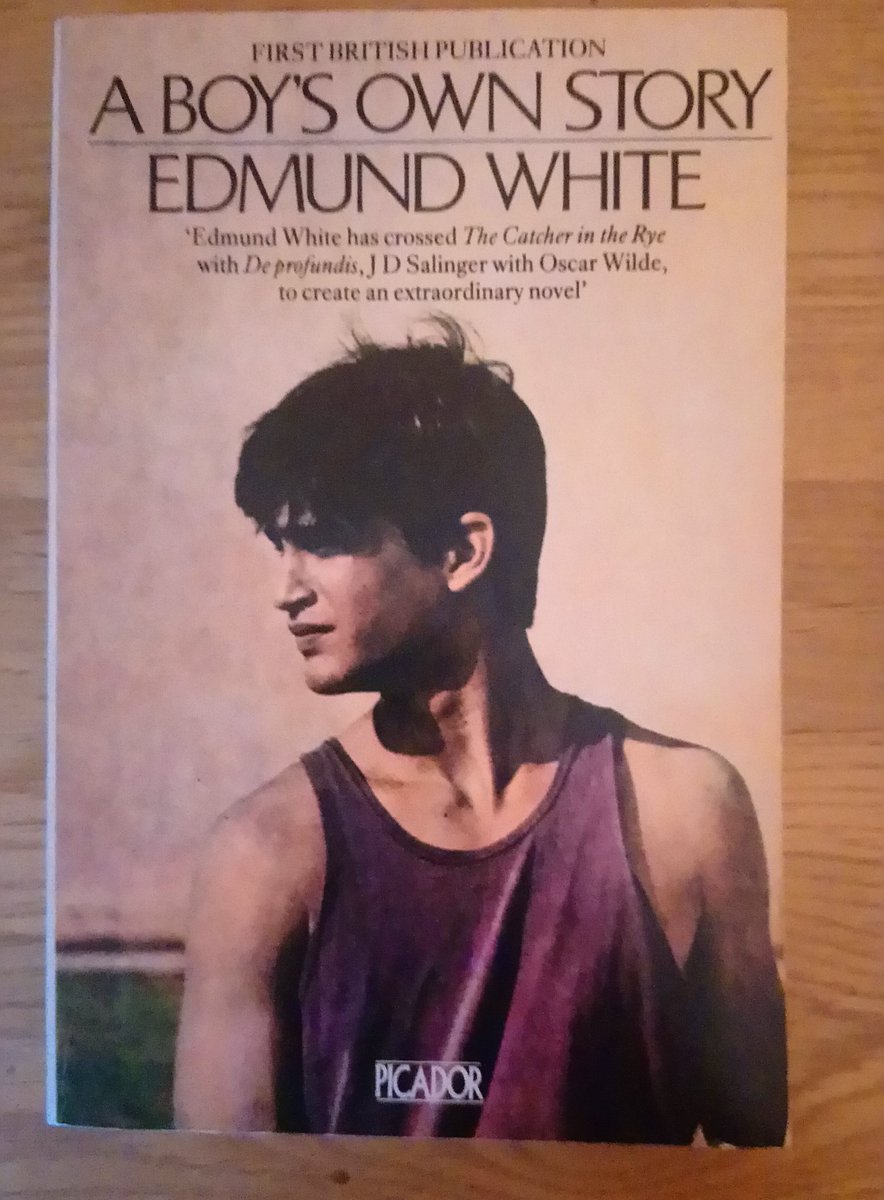
I was saddened to hear of the death on Tuesday at the age of 85 of novelist Edmund White. Like many gay men of my age I read his semi-autobiographical novel A Boy’s Own Story as a teenager, and it had a profound effect on me.

It’s the story of an adolescent boy coming to terms with his sexuality in the American mid-West during the 1950s. It is as frank about the description of gay sex as it is truthful about the confusion that goes with being a teenager. When I bought it I didn’t realize it was going to be so sexually explicit, as the whole subject of gay sex was very much taboo in those days. I didn’t think it was possible to write about such things in such a matter-of-fact way and at the same time so beautifully. The book is also unflinching in its description of the personality flaws of the central character.

The Irish Times has a collection of reflections by various writers on Edmund White that say far more, and far more eloquently, than I ever could. I’ll just say, as a (now) sixty-something gay man that Edmund White helped me on my journey to self-acceptance when I was a struggling teenager all those years ago, and for that I will always be profoundly grateful.

Rest in peace, Edmund White (1940-2025).

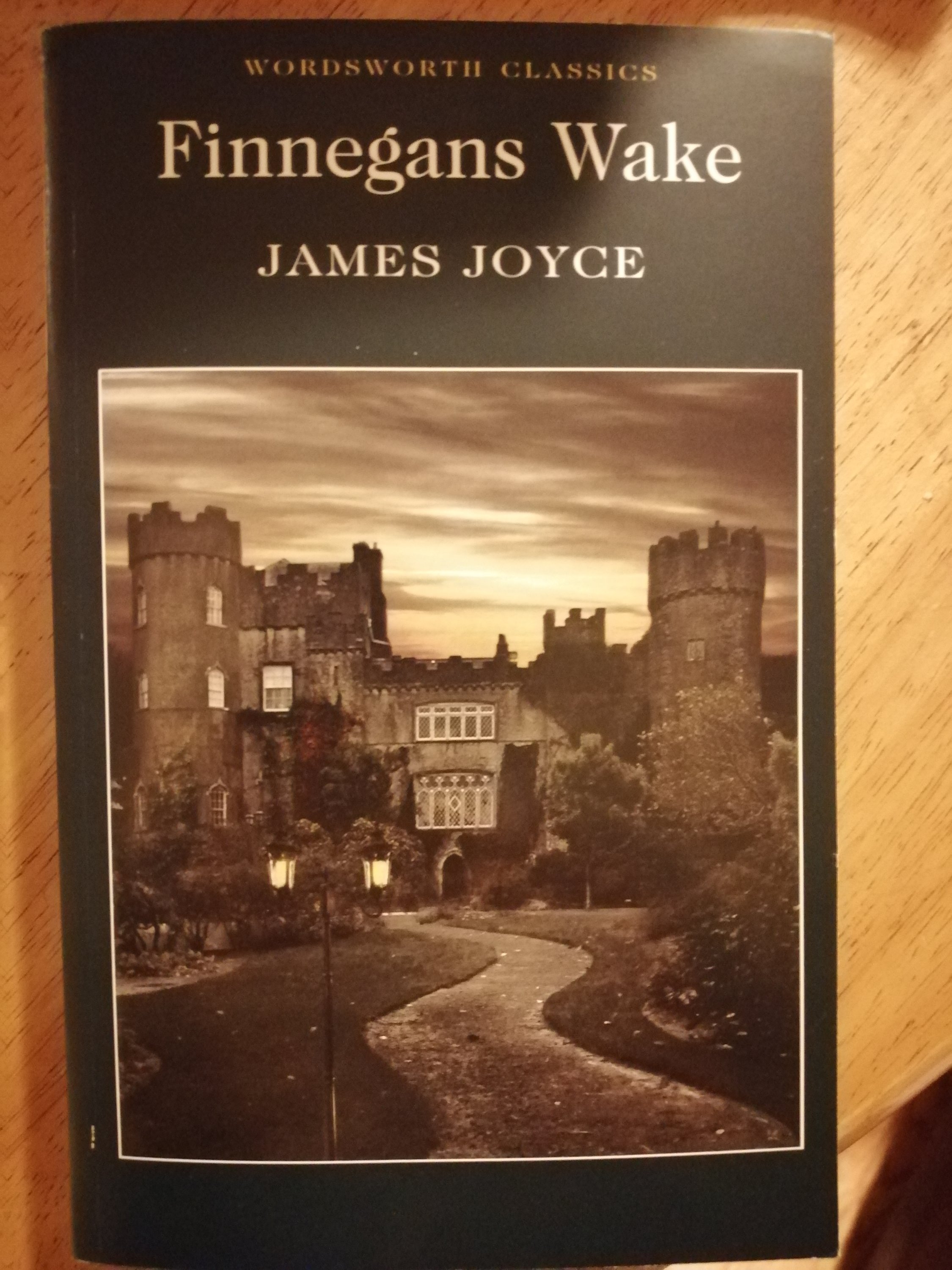
Finnegan’s Wake – The Dubliners

Posted in Literature, Music with tags , , on May 28, 2025 by telescoper

Taking a short break from examination duties I thought I would post this version of the song Finnegan’s Wake. It was first published in America in the mid-19th century, it is a ballad about the wake of a hod-carrier by the name of Tim Finnegan who is too fond of whiskey. One day, with a hangover, he falls off a ladder and dies. His wake gets a bit rowdy and eventually a bottle of whiskey is thrown over his body, which brings him miraculously back to life.

It’s been in my mind since I got talking at lunch with some colleagues a while ago about James Joyce‘s famous novel Finnegan’s Wake largely because of the connection with particle physics via the word “quark” and thence to the Arthurian legends; for more of that see here. Anyway, one of the people there knew the song on which Joyce based his book and proceeded to sing a few verses of it, much to the surprise of the people sitting around us.

The interesting thing about the title is that Joyce dropped the apostrophe so it is not really about the wake of Tim Finnegan but lots of Finnegans waking up. The implication is that, in a way, we’re all Tim Finnegan. That’s exactly the sort of play on words – or in this case play on punctuation – that Joyce revelled in and with which Finnegans Wake is peppered.

Another reason for posting this is for a chance to see the iconic beards of the Dubliners, especially lead singer Ronnie Drew. Enjoy!

Litotes – Paul Muldoon

Posted in Poetry with tags , , , on May 18, 2025 by telescoper
Though it wasn’t until 411 BC he took up the oar
in the Peloponnesian War
against “man-loosening” Lysander,

our hero was not unknown
to Thucydides, who’d evenhandedly intone
“What’s sauce for Aegeus is sauce for the gander.”

Despite his background
being less than sound,
he nonetheless managed to drive a phaeton

through the Spartan ranks
or, on more than one occasion, an oar-bank.
If his circumstances were quite often straitened

he couldn’t say no
to manning up and having a go
at the slightest hint of an old school oligarchy.

No scanty there, then?
Faced with the very same problem time and again
he would resort to being snide or snarky

and immediately made a dent
in it. It was no small accomplishment
that he somehow managed to claim kin with Nestor

and, since he was far
from the sharpest ray in the earthstar,
was quite likely an ancestor

of the not exactly inspiring Greek
who would eke
out an existence in the precincts of the Abbey

where he’d been married sword in hand, ye Gads,
turning out to be not half bad
or, as Thucydides would have it, “None too shabby.”

by Paul Muldoon (b. 1951).

I recently discovered the poetry of Paul Muldoon who, as once described in the New York Times, “… takes some honest-to-God reading. He’s a riddler, enigmatic, distrustful of appearances, generous in allusion, doubtless a dab hand at crossword puzzles.” This poem is from Joy in Service on Rue Tagore (2024), which is published by Faber & Faber.

An Island of Strangers

Posted in Literature, Politics with tags , , , on May 13, 2025 by telescoper

In the light of Keir Starmer’s deplorable Faragist rhetoric about Britain becoming an ‘Island of Strangers’, and the obscene deportations and detentions without legal process of immigrants in the United States, I thought I’d repost this speech from the play Sir Thomas More which is widely attributed to William Shakespeare. It’s from Act 2 Scene 4, at which point in the drama Thomas More (who was then London’s Deputy Sheriff) is called upon to put down an anti-immigration riot in the Parish of St Martin Le Grand, that took place on 1st May 1517. In reality  More’s intevention wasn’t effective, and it took the arrival of 5000 troops to disperse the mob.

As well as being powerful for many other reasons, this speech especially fascinating because a hand-written manuscript (thought to be by Shakespeare himself) survives and is kept in the British Library.

The backdrop to this story is that, between 1330 and 1550 about 64,000 immigrants from all across Europe came to England in search of better lives. Locals blamed them for taking their jobs and threatening their culture. Tensions reached breaking point in 1517 and a mob armed with stones, bricks, bats, boots and boiling water attacked the immigrants and looted their homes.  Five hundred years on, and we still haven’t learned.

Here is the text of the opening part of the speech ‘This is the strangers case’.

Grant them removed, and grant that this your noise
Hath chid down all the majesty of England;
Imagine that you see the wretched strangers,
Their babies at their backs and their poor luggage,
Plodding to the ports and coasts for transportation,
And that you sit as kings in your desires,
Authority quite silent by your brawl,
And you in ruff of your opinions clothed;
What had you got? I’ll tell you: you had taught
How insolence and strong hand should prevail,
How order should be quelled; and by this pattern
Not one of you should live an aged man,
For other ruffians, as their fancies wrought,
With self same hand, self reasons, and self right,
Would shark on you, and men like ravenous fishes
Would feed on one another….

Say now the king
Should so much come too short of your great trespass
As but to banish you, whither would you go?
What country, by the nature of your error,
Should give you harbour? go you to France or Flanders,
To any German province, to Spain or Portugal,
Nay, any where that not adheres to England,
Why, you must needs be strangers: would you be pleased
To find a nation of such barbarous temper,
That, breaking out in hideous violence,
Would not afford you an abode on earth,
Whet their detested knives against your throats,
Spurn you like dogs, and like as if that God
Owed not nor made not you, nor that the claimants
Were not all appropriate to your comforts,
But chartered unto them, what would you think
To be thus used? this is the strangers case;
And this your mountainish inhumanity.

Better an Island of Strangers than an Island of Starmers, I’d say…

May and the Poets – Leigh Hunt

Posted in Poetry with tags , , , , on May 1, 2025 by telescoper

I almost forgot that today is Poetry Day Ireland which this year has a theme of “May Day” so here’s a romantic yet whimsical offering that seems tailor-made to mark the start of the month of May.

There is May in books forever;
May will part from Spenser never;
May's in Milton, May's in Prior,
May's in Chaucer, Thomson, Dyer;
May's in all the Italian books:—
She has old and modern nooks,
Where she sleeps with nymphs and elves,
In happy places they call shelves,
And will rise and dress your rooms
With a drapery thick with blooms.
Come, ye rains, then if ye will,
May's at home, and with me still;
But come rather, thou, good weather,
And find us in the fields together.

by James Henry Leigh Hunt (1784-1859)

Easter Monday (In Memoriam E.T.) – Eleanor Farjeon

Posted in Poetry with tags , , , , , , on April 21, 2025 by telescoper
In the last letter that I had from France
You thanked me for the silver Easter egg
Which I had hidden in the box of apples
You liked to munch beyond all other fruit.
You found the egg the Monday before Easter,
And said, 'I will praise Easter Monday now -
It was such a lovely morning'. Then you spoke
Of the coming battle and said, 'This is the eve.
Good-bye. And may I have a letter soon.'

That Easter Monday was a day for praise,
It was such a lovely morning. In our garden
We sowed our earliest seeds, and in the orchard
The apple-bud was ripe. It was the eve.
There are three letters that you will not get.

by Eleanor Farjeon (1881-1965)

Eleanor Farjeon, who is probably best known for having written the words to the hymn Morning has Broken, wrote this poem shortly after she heard news of the death of her close friend the poet Edward Thomas (the E.T. in the title) who was killed in action at the Battle of Arras on Easter Monday, 9th April 1917.

Sonnet No. 19

Posted in Poetry with tags , , , , on April 11, 2025 by telescoper
Devouring time, blunt thou the lion's paws
And make the earth devour her own sweet brood,
Pluck the keen teeth from the fierce tiger's jaws
And burn the long-liv'd phoenix in her blood,
Make glad and sorry seasons as thou fleet'st,
And do what e'er thou wilt, swift-footed time,
To the wide world and all her fading sweets:
But I forbid thee one most heinous crime,
O carve not with thy hours my love's fair brow,
Nor draw no lines there with thine antique pen,
Him in thy course untainted do allow
For beauty's pattern to succeeding men.
Yet do thy worst, old time, despite thy wrong,
My love shall in my verse ever live young.

by William Shakespeare (1564-1616)

(I don’t know why it’s been such a long time since I last posted one of Shakespeare’s sonnets.)