Archive for the Literature Category

Snow, by Louis MacNeice

Posted in Poetry with tags , on March 13, 2013 by telescoper

I’ve posted this before, but it seems appropriate to post it again today…

The room was suddenly rich and the great bay-window was
Spawning snow and pink roses against it
Soundlessly collateral and incompatible:
World is suddener than we fancy it.

World is crazier and more of it than we think,
Incorrigibly plural. I peel and portion
A tangerine and spit the pips and feel
The drunkenness of things being various.

And the fire flames with a bubbling sound for world
Is more spiteful and gay than one supposes–
On the tongue on the eyes on the ears in the palms of your hands–
There is more than glass between the snow and the huge roses.

by Louis MacNeice (1907-1963).

Always seeking greater silence

Posted in Poetry with tags , , , on March 11, 2013 by telescoper

Just a quick plug for a fascinating programme I heard on BBC Radio 3 last night about the great Welsh poet R.S. Thomas. It’s called Always Seeking Greater Silence and it is available on iPlayer for your listening pleasure.

Here’s an excerpt from the published description of the programme:

RS Thomas was a man full of contradictions, but one constant was his passion for birdwatching. Towards the end of his life he said that ‘the deity has chosen to reveal himself to me via the world of nature’. He also declared that he preferred to be alone with nature than be with human beings. Bird imagery in particular provided him with a means of symbolising renewal, nourishment and femininity in his poetry, but also of exploring his faith in God. Increasingly towards the end of his life, his bird poems explored the space between faith and doubt. In ‘Sea-watching,’ he directly associates bird-watching with prayer: ‘Ah, but a rare bird is/ rare. It is when one is not looking/ at times one is not there/ that it comes’.

I have the utmost admiration for R.S. Thomas as a poet, but I do wonder how effective he was as a priest looking after his flock when he could come out with statements like the following:

I’ve had more pleasure from being alone with the natural creation than I have with human beings. Human beings are responsible for so much unhappiness and cruelty and failure that one is not terribly enthusiastic about them.

This rather bleak view of humanity explains to some extent why so many of his poems are about the natural world rather than people, but he is unlike many other “nature poets” in that his voice is unflinching and devoid of sentimentality. Although not religious myself, I also deeply respect his openness about his struggle with faith and doubt – he seems to me to have been a man who was deeply allergic to superficiality, a trait which also manifests itself in his verse.

It is the centenary of the birth of R.S. Thomas on 29th March 2013. I hope I remember to mark the occasion with an appropriate poem.

A Song for St David’s Day

Posted in Poetry with tags , , , on March 1, 2013 by telescoper

It’s St David’s Day today, so

Dydd Gŵyl Dewi Hapus!

I’m about to head off to three hours of mandatory Health and Safety Training so I’ll do a quick but appropriate post. I have posted this before, but I think it’s beautiful so make no apology for posting it again. It’s called Children’s Song and it’s by the great Welsh poet, R.S. Thomas.

We live in our own world,
A world that is too small
For you to stoop and enter
Even on hands and knees,
The adult subterfuge.
And though you probe and pry
With analytic eye,
And eavesdrop all our talk
With an amused look,
You cannot find the centre
Where we dance, where we play,
Where life is still asleep
Under the closed flower,
Under the smooth shell
Of eggs in the cupped nest
That mock the faded blue
Of your remoter heaven.

by R.S. Thomas (1913-2000)

You will be hearing from us shortly

Posted in Poetry with tags , on February 26, 2013 by telescoper
 You feel adequate to the demands of this position?
 What qualities do you feel you
 Personally have to offer?
                                        Ah.

 Let us consider your application form.
 Your qualifications, though impressive, are
 Not, we must admit, precisely what
 We had in mind. Would you care
 To defend their relevance?
                                        Indeed.

 Now your age. Perhaps you feel able
 To make your own comment about that,
 Too? We are conscious ourselves
 Of the need for a candidate with precisely
 The right degree of immaturity.
                                        So glad we agree.

 And now a delicate matter: your looks.
 You do appreciate this work involves
 Contact with the actual public? Might they,
 Perhaps, find your appearance
 Disturbing?
                                        Quite so.

 And your accent. That is the way
 You have always spoken, is it? What
 Of your education? We mean, of course,
 Where were you educated?
                                And how
 Much of a handicap is that to you,
 Would you say?

                Married, children,
 We see. The usual dubious
 Desire to perpetuate what had better
 Not have happened at all. We do not
 Ask what domestic desires shimmer
 Behind that vaguely unsuitable address.

 And you were born--?
                                        Yes. Pity.

 So glad we agree.

by U. A. Fanthorpe (1929-2009).

Gremlins in the Vault

Posted in Literature with tags , , , on February 24, 2013 by telescoper

Here I am, on campus again (this time on a Sunday). Just going to finish off some urgent things in advance of a busy week next week: tomorrow in London for the first meeting of the 2013 Astronomy Grants Panel; Tuesday all day interviewing for a new faculty position in Physics, Wednesday preparing the University’s equivalent of the 5-year plan; most of Thursday interviewing prospective PhD students; continued, p. 94….

Anyway, I thought I’d warm up my typing fingers this afternoon with a quick post that’s got nothing to do with my job and will probably generate negligible interest among my readers, but the subject got on my mind so here goes anyway. Regular readers of this blog (both of them) will know that I’m a bit of a fan of detective stories. I haven’t blogged much about Crime Fiction per se but I have referred to various examples in the course of other posts. Having recently given up entirely on television and done a bit more travelling on buses and trains, I’ve had a bit more time to read so have started to clear the sizable backlog of books I’ve bought but never actually opened.

All of which brings me to The Vault by Ruth Rendell. This is the 24th book to feature her detective Inspector Wexford, although Wexford, having retired,  is no longer an Inspector in this book. The plot of The Vault revolves around the discovery of four bodies (two male, and two female) in a coal hole belonging to a posh house in St John’s Wood. Wexford is drawn into the subsequent investigation by a friend of his who is still a policeman and thereafter the story interweaves two different genres (the Police procedural and the psychological thriller) in Rendell’s inimitable style, alongside beautifully nuanced description of the parts of London in which the drama unfolds.

In parenthesis I’d say that Ruth Rendell is one of the few crime novelists whose writing transcends the limitations of the crime genre and establishes her as a major literary figure in her own right, a feat only rarely accomplished in the history of detective fiction, the American Dashiel Hammett being another example.

When I bought it I didn’t realize that it was a kind of sequel to her earlier novel A Sight for Sore Eyes in which Wexford does not appear. In The Vault, set 12 later, Wexford only has the four initially unidentified bodies to work on; he hasn’t read the earlier book either. Anyway, to cut a long (detective) story short, three of the bodies relate to the earlier plot whereas the fourth was added to the coal-hole collection about 10 years later. As for the initial three, it seems two were victims of the murderous third who accidentally fell into the hole after disposing of their bodies there.

I enjoyed the atmosphere and detail of Ruth Rendell’s writing as much as ever, but when I’d finished the book I was troubled by one glaring problem with the plot. If the murderer, Teddy Brex, had indeed fallen into the coal hole by accident, who closed the manhole cover that sealed him in? It’s essential to the plot that nobody find the bodies for a dozen years, but surely if the lid had been open someone would have looked inside? Worried that I was just being dense and had missed some detail, I searched around the net and found a blog review on which a similar comment was made.

Part of the pleasure of reading a mystery novel, as is the case with a crossword puzzle, is to see the pieces fall nearly into place at the end. That’s always happened with Ruth Rendell’s books before, but this one left me profoundly unsatisfied. For a writer of her quality, the lapse was most disappointing. It won’t put me off reading other books, of course. Maybe it’s all explained in the earlier book, but that doesn’t mean it’s not a flaw in this one.

Anyway, this particular fly in the ointment led to an interesting little exchange on Facebook about plot errors in The Day of the Jackal so I thought it might be fun to use it as an example, and see if anyone out there in internetshire can think of similar narrative gremlins affecting films or novels? They don’t have to be detective stories, of course, although for reasons described above I think they are especially irksome in that context.

The comment box beckons, but make sure you don’t fall in…

Stars and Planets

Posted in Poetry with tags , , on February 20, 2013 by telescoper

Trees are cages for them: water holds its breath
To balance them without smudging on its delicate meniscus.
Children watch them playing in their heavenly playground;
Men use them to lug ships across oceans, through firths.

They seem so twinkle-still, but they never cease
Inventing new spaces and huge explosions
And migrating in mathematical tribes over
The steppes of space at their outrageous ease.

It’s hard to think that the earth is one –
This poor sad bearer of wars and disasters
Rolls-Roycing round the sun with its load of gangsters,
Attended only by the loveless moon.

by Norman MacCaig (1910-1996).

Fifty Years On

Posted in Poetry with tags , , on February 12, 2013 by telescoper

I missed a sad anniversary yesterday. Fifty years ago, on 11th February 1963, the poet Sylvia Plath took her own life by putting her head in a gas oven. I’ve posted this poem before, but make no apology for posting it again as an act of remembrance..

They enter as animals from the outer
Space of holly where spikes
Are not thoughts I turn on, like a Yogi,
But greenness, darkness so pure
They freeze and are.

O God, I am not like you
In your vacuous black,
Stars stuck all over, bright stupid confetti.
Eternity bores me,
I never wanted it.

What I love is
The piston in motion —-
My soul dies before it.
And the hooves of the horses,
Their merciless churn.

And you, great Stasis —-
What is so great in that!
Is it a tiger this year, this roar at the door?
It is a Christus,
The awful

God-bit in him
Dying to fly and be done with it?
The blood berries are themselves, they are very still.

The hooves will not have it,
In blue distance the pistons hiss.

by Sylvia Plath (1932-63). Rest in peace.

The Rolling English Road

Posted in Poetry with tags , , on February 2, 2013 by telescoper

Before the Roman came to Rye or out to Severn strode,
The rolling English drunkard made the rolling English road.
A reeling road, a rolling road, that rambles round the shire,
And after him the parson ran, the sexton and the squire;
A merry road, a mazy road, and such as we did tread
The night we went to Birmingham by way of Beachy Head.

I knew no harm of Bonaparte and plenty of the Squire,
And for to fight the Frenchman I did not much desire;
But I did bash their baggonets because they came arrayed
To straighten out the crooked road an English drunkard made,
Where you and I went down the lane with ale-mugs in our hands,
The night we went to Glastonbury by way of Goodwin Sands.

His sins they were forgiven him; or why do flowers run
Behind him; and the hedges all strengthening in the sun?
The wild thing went from left to right and knew not which was which,
But the wild rose was above him when they found him in the ditch.
God pardon us, nor harden us; we did not see so clear
The night we went to Bannockburn by way of Brighton Pier.

My friends, we will not go again or ape an ancient rage,
Or stretch the folly of our youth to be the shame of age,
But walk with clearer eyes and ears this path that wandereth,
And see undrugged in evening light the decent inn of death;
For there is good news yet to hear and fine things to be seen,
Before we go to Paradise by way of Kensal Green.

by G.K. Chesterton (1874-1936).

The Old Familiar Faces

Posted in Poetry with tags , , on January 29, 2013 by telescoper

I have had playmates, I have had companions,
In my days of childhood, in my joyful school-days,
All, all are gone, the old familiar faces.

I have been laughing, I have been carousing,
Drinking late, sitting late, with my bosom cronies,
All, all are gone, the old familiar faces.

I loved a love once, fairest among women;
Closed are her doors on me, I must not see her —
All, all are gone, the old familiar faces.

I have a friend, a kinder friend has no man;
Like an ingrate, I left my friend abruptly;
Left him, to muse on the old familiar faces.

Ghost-like, I paced round the haunts of my childhood.
Earth seemed a desart I was bound to traverse,
Seeking to find the old familiar faces.

Friend of my bosom, thou more than a brother,
Why wert not thou born in my father’s dwelling?
So might we talk of the old familiar faces —

How some they have died, and some they have left me,
And some are taken from me; all are departed;
All, all are gone, the old familiar faces.

by Charles Lamb (1775-1834).


The Strangest Man

Posted in Literature, The Universe and Stuff with tags , , , , , on January 27, 2013 by telescoper

Since getting rid of my telly a few weeks ago I’ve reverted to a previous incarnation as a bookworm, and have been tackling the backlog of unread volumes sitting on my coffee table at home. Over the last couple of days I’ve spent the evenings reading The Strangest Man by Graham Farmelo, a biography of the great theoretical physicist Paul Dirac.

I’m actually quite ashamed that it has taken me so long to get around to reading this. I’ve had it for two years or more and really should have found time to do it before now. Dirac has long been one of my intellectual heroes, for his unique combination of imagination and mathematical rigour; the Dirac equation is one of the topics I most enjoy lecturing about to physics students. I am also immensely flattered to be one of his academic descendants: Paul Dirac was the PhD supervisor of Dennis Sciama, who supervised my supervisor John Barrow, making me (in a sense) his great-grandson. Not that I’ll ever achieve anything of the magnitude he did.

The book is pretty long, and I suppose one of the factors putting me off reading it was that I thought it might be heavy going. That turned out to be far from the case. It’s wonderfully well written, never getting bogged down in details, and cleverly interweaving Dirac’s life and scientific career together against a vivid historical backdrop dominated by the rise of Nazism in Germany and the tragedy of World War 2. It also beautifully conveys the breathless sense of excitement as the new theory of quantum mechanics gradually fell into place. Altogether it’s a gripping story that had me hooked from the start, and I devoured the 400+ pages in just a couple of evenings (which is quick by my standards). I’ve never read a scientific biography so pacey and engaging before, so it’s definitely hats off to Graham Farmelo!

Among the book’s highlights for me were the little thumbnail sketches of famous physicists I knew beforehand mostly only as names. Niels Bohr comes across as a splendidly warm and avuncular fellow, Werner Heisenberg as a very slippery customer of questionable political allegiance (likewise Erwin Schrödinger), Ernest Rutherford as blunt and irascible. I was already aware of the reputation of Wolfgang Pauli had for being an absolute git; this book does nothing to dispel that opinion. We tend to forget that the names we came to know through their association with physics also belonged to real people, with all that entails.

I was also interested to learn that Dirac and his wife Manci spent their honeymoon in 1937, as the clouds of war gathered on the horizon, in Brighton, which Farmelo describes as

..a peculiarly raffish town., famous for its two Victorian piers jutting imperiously out to sea, for the pale green domes of its faux-oriential pavilions, its future-robot and a host of other tacky attractions.

So in most respects it hasn’t changed much, although one of the two piers  has since gone for a Burton.

So what of Dirac himself? Most of what you’re likely to hear about him concerns his apparently cold and notoriously uncommunicative nature. I never met Dirac. He died in 1984. I was an undergraduate at Cambridge at the time, but he had moved to Florida many years before that. I have, however, over the years had occasion to talk to quite a few people who knew Dirac personally, including Dennis Sciama. All of them told me that he wasn’t really anything like the caricature that is usually drawn of him. While it’s true that he had no time for small talk and was deeply uncomfortable in many social settings, especially formal college occasions and the like, he very much enjoyed the company of people more extrovert than himself and was more than willing to talk if he felt he had anything to contribute. He got on rather well with Richard Feynman, for example, although they couldn’t have had more different personalities. This gives me the excuse to include this wonderful picture of Dirac and Feynman together, taken in 1962 – the body language tells you everything there is to know about these two remarkable characters:
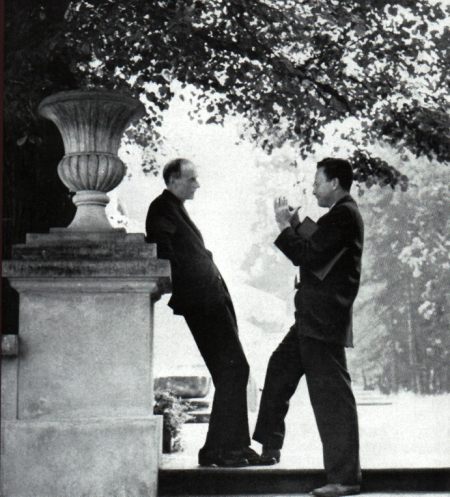
feyndir2

Feynman is also an intellectual hero of mine, because he was outrageously gifted not only at doing science but also at communicating it. On the other hand, I suspect (although I’ll obviously never know) that I might not have liked him very much at a personal level. He strikes me as the sort of chap who’s a lot of fun in small doses, but by all accounts he could be prickly and wearingly egotistical.

On the other hand, the more I read The Strangest Man the more I came to think that I would have liked Dirac. He may have been taciturn, but at least that meant he was free from guile and artifice. It’s not true that he lacked empathy for other people, either. Perhaps he didn’t show it outwardly very much, but he held a great many people in very deep affection. It’s also clear from the quotations peppered throughout the book that people who worked closely with him didn’t just admire him for his scientific work; they also loved him as a person. A strange person, perhaps, but also a rather wonderful one.

In the last Chapter, Farmelo touches on the question of whether Dirac may have displayed the symptoms of autism. I don’t know enough about autism to comment usefully on this possibility. I don’t even know whether the term autistic is defined with sufficient precision to be useful. There is such a wide and multidimensional spectrum of human personality that it’s inevitable that there will be some individuals who appear to be extreme in some aspect or other. Must everyone who is a bit different from the norm be labelled as having some form of disorder?

The book opens with the following quote from John Stuart Mill’s On Liberty, which says it all.

Eccentricity has always abounded when and where strength of character has abounded; and the amount of eccentricity in a society has generally been proportional to the amount of genius, mental vigor, and courage which it contained. That so few now dare to be eccentric, marks the chief danger of the time.

Another thought occurred to me after I’d finished reading the book. Dirac’s heyday as a theoretical physicist was the period 1928-1932 or thereabouts. Comparatively speaking, his productivity declined significantly in later years; he produced fewer original results and became increasingly isolated from the mainstream. Eddington’s career followed a similar pattern: he did brilliant work when young, but subsequently retreated into the cul-de-sac of his Fundamental Theory. Fred Hoyle is another example – touched by greatness early in his career, but cantankerous and blinded by his own dogma later on. Even Albert Einstein, genius-of-geniuses, spent his later scientific life chasing shadows.

I think there’s a tragic inevitability about the mid-life decline of these geniuses of theoretical physics, because the very same determination and intellectual courage that allowed them to break new ground also rendered them unwilling to be deflected by subsequent innovations elsewhere. And break new ground Dirac certainly did. The word genius is perhaps over-used, but it certainly applies to Paul Dirac. We need more like him.