Then let not winter’s ragged hand deface,
In thee thy summer, ere thou be distilled:
Make sweet some vial; treasure thou some place
With beauty’s treasure ere it be self-killed.
That use is not forbidden usury,
Which happies those that pay the willing loan;
That’s for thy self to breed another thee,
Or ten times happier, be it ten for one;
Ten times thy self were happier than thou art,
If ten of thine ten times refigured thee:
Then what could death do if thou shouldst depart,
Leaving thee living in posterity?
Be not self-willed, for thou art much too fair
To be death’s conquest and make worms thine heir.
Posted in Education, Poetry on January 12, 2013 by telescoper
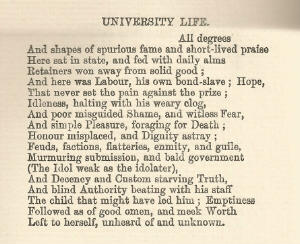
I came across this bit of poetry by William Wordsworth and thought I’d post here because quite a few of the readers of this blog might share his low opinion of University Life!
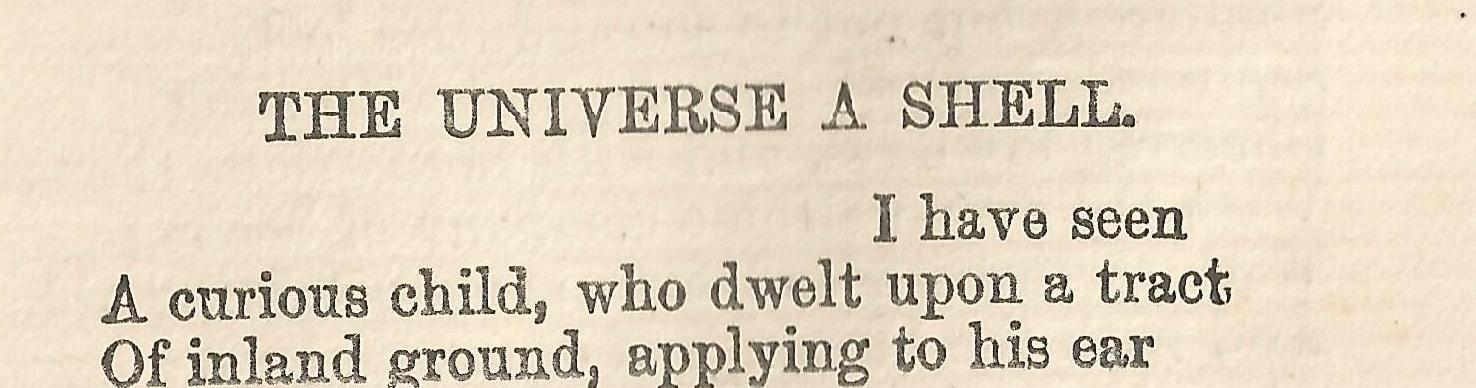
One of my very first blog posts (from way back in 2008) was inspired by an old book of poems by William Wordsworth that I’ve had since I was a child. I was reading it again this evening and came across this short excerpt, near the end of the book, from The Excursion, and entitled for the purposes of the book The Universe a Shell. It struck me as having a message for anyone who works on the science of things either too big or too small to be sensed directly on a human scale, so I thought I’d post it.
I decided to scan it in rather than copy it from elsewhere on the net, as I really love the look of that old faded typeface on the yellowing paper, even if it is a bit wonky because it went over two pages. I’ve been fond of Wordsworth for as long as I can remember and, like a few other things, that’s something I’ll never feel the need to apologize for…
Water in the millrace, through a sluice of stone,
plunges headlong into that black pond
where, absurd and out-of-season, a single swan
floats chaste as snow, taunting the clouded mind
which hungers to haul the white reflection down.
The austere sun descends above the fen, an orange cyclops-eye, scorning to look longer on this landscape of chagrin; feathered dark in thought, I stalk like a rook, brooding as the winter night comes on.
Last summer’s reeds are all engraved in ice as is your image in my eye; dry frost glazes the window of my hurt; what solace can be struck from rock to make heart’s waste grow green again? Who’d walk in this bleak place?
Well, I’m up early to get the train Up North, so I thought I’d just sign off for the holiday with a little gift. I have posted this before but, on the grounds that you can’t have too much of a good thing, here it is again. Plus, of course, this will be my last Christmas in Wales…
There are only two kinds of people in the world: those who have heard Dylan Thomas reading his wonderful short autobiographical story A Child’s Christmas in Wales; and those who haven’t. I’ve heard it hundreds of times, like a favourite piece of music. Technically it’s a prose work, but it’s prose that’s so close to poetry that it really defies categorisation. Either way, the language certainly has a musical quality, and the author’s voice brings it to life in a way nobody else has ever been able to. It’s also shot through with flashes of a dry offbeat humour that tickles my fancy any time of the year but at Christmas time I think it’s just magical.
I posted this poem after the terrible events in Norway last year. Sadly the awful killings in Newton, Connecticut make it relevant again.
The full title is A Refusal to Mourn the Death by Fire of a Child in London and it was written by Dylan Thomas. Published just after the end of the Second World War, it was written some time earlier when Thomas heard news of a young girl who had burned to death when the house she was in was set on fire during an air raid. Here is the poet himself reading it.
The idea behind the poem is complex, and its message double-edged, but Thomas finds a perfect balance between horror and sadness, and between indignation and heartbreak. Children shouldn’t have to die, and neither should anyone else whose life is cut short by another’s hand, but we have to accept that they can and do. There’s no consolation to be found in mourning and in any case it’s hypocritical to favour one death with elegies, when suffering is so widespread. The best we can do is allow the dead some dignity and their families and loved ones some time to grieve.
Never until the mankind making Bird beast and flower Fathering and all humbling darkness Tells with silence the last light breaking And the still hour Is come of the sea tumbling in harness
And I must enter again the round Zion of the water bead And the synagogue of the ear of corn Shall I let pray the shadow of a sound Or sow my salt seed In the least valley of sackcloth to mourn
The majesty and burning of the child’s death. I shall not murder The mankind of her going with a grave truth Nor blaspheme down the stations of the breath With any further Elegy of innocence and youth.
Deep with the first dead lies London’s daughter, Robed in the long friends, The grains beyond age, the dark veins of her mother, Secret by the unmourning water Of the riding Thames. After the first death, there is no other.
How like a winter hath my absence been
From thee, the pleasure of the fleeting year!
What freezings have I felt, what dark days seen!
What old December’s bareness every where!
And yet this time remov’d was summer’s time;
The teeming autumn, big with rich increase,
Bearing the wanton burden of the prime,
Like widow’d wombs after their lords’ decease:
Yet this abundant issue seem’d to me
But hope of orphans and unfather’d fruit;
For summer and his pleasures wait on thee,
And, thou away, the very birds are mute:
Or, if they sing, ’tis with so dull a cheer,
That leaves look pale, dreading the winter’s near.
The views presented here are personal and not necessarily those of my employer (or anyone else for that matter).
Feel free to comment on any of the posts on this blog but comments may be moderated; anonymous comments and any considered by me to be vexatious and/or abusive and/or defamatory will not be accepted. I do not necessarily endorse, support, sanction, encourage, verify or agree with the opinions or statements of any information or other content in the comments on this site and do not in any way guarantee their accuracy or reliability.


 In the Dark