Archive for the Literature Category

**** Energy

Posted in Poetry, The Universe and Stuff with tags , , , , , on March 30, 2009 by telescoper

The phrase expletive deleted was made popular at the time of Watergate after the release of the expurgated tapes made by Richard Nixon in the Oval Office when he was President of the United States of America. These showed that, as well as been a complete crook, he was practically unable to speak a single sentence without including a swear word.

Nowadays the word expletive is generally taken to mean an oath or exclamation, particularly if it is obscene, but that’s not quite what it really means. Derived from the latin verb explere (“to fill out”) from which the past participle is expletus, the meaning of the word in the context of English grammar is  “something added to a phrase or sentence that isn’t strictly needed for the grammatical sense”.  An expletive is added either to fill a syntactical role or, in a poem, simply to make a line fit some metrical rule.

Examples of the former can be found in constructions like “It takes two to Tango” or “There is lots of crime in Nottingham”; neither  “it” nor “there” should really be needed but English likes to have something before the verb.

The second kind of use is illustrated wonderfully by Alexander Pope in his Essay on Criticism, which is a kind of guide to what to avoid in writing poetry. It’s a tour de force for its perceptiveness and humour. The following excerpt is pricelessly apt

These equal syllables alone require,
Tho’ oft the open vowels tire;
While expletives their feeble aid do join;
And ten low words oft creep in one dull line

Here the expletive is “do”,  and it is cleverly incorporated in the line talking about expletives, adding  the syllable needed to fit with a strict pentameter. Apparently, poets often used this construction before Pope attacked it but it quickly fell from favour afterwards.

His other prosodic targets are the “open vowels” which means initial vowels that produce an ugly glottal sound, such as in “oft” (especially ugly when following “Tho”). The last line is brilliant too, showing how using only monosyllabic “low” words makes for a line that plods along tediously just like it says.

It’s amazing how much Pope managed to fit into this poem, given the restrictions imposed by the closed couplet structure he adopted. Each idea is compressed into a unit of twenty syllables, two lines of ten syllables with a rhyme at the end of each. This is such an impressive exercise in word-play that it reminds me a lot of the skill showed by the best cryptic crossword setters. Needless to say I’m no more successful at writing poetry than I am at setting crossword clues.

After my talk in Dublin last Friday, somebody in the audience asked me what I thought about Dark Energy. There’s some discussion in the comments after my post on that too.

The Dark Energy is an ingredient added to the standard model of cosmology to reconcile  observations of a flat Universe with a matter density that seems too low to account for it.

Other than that it makes the  cosmological metric work out satisfactorily (geddit?), we don’t understand what Dark Energy means and would rather it wasn’t there.  Most people think the resulting model is inelegant or even ugly.

In other words, it’s an expletive…

The Eightsome Reels

Posted in Crosswords, Literature with tags , on March 24, 2009 by telescoper

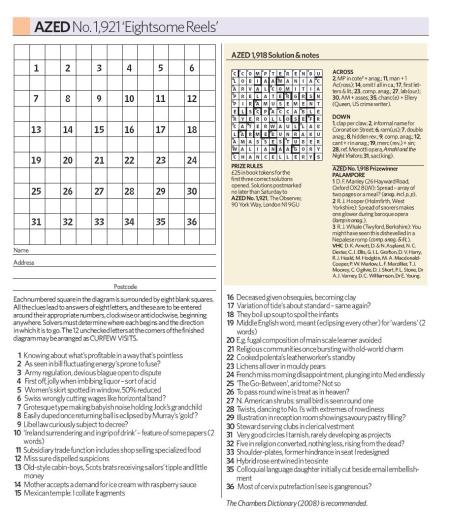
As an ardent cruciverbalist, I couldn’t resist posting this week’s Observer Crossword just to show you one of the interesting variations that Azed comes up with from time to time:

azed

It’s probably a bit small to read  the clues, or even the instructions, but the point to grasp is that the answers are all 8 letters long and they have to be fitted in the squares surrounding the corresponding number. The trouble is that you’re not told which square to start from, or whether the letters are to be entered clockwise or anticlockwise.

Hmmm.

The only way I know to start one of these puzzles is to solve several adjacent clues before entering them in the diagram and then see if I can find a way to fit them together on a bit of scrap paper. The structure of the diagram guarantees many checked letters (i.e. overlaps) between neighbouring answers so once you have a few then the subsequent ones get easier to fit in. These puzzles are usually difficult to start though.

Fortunately, however, in this one  I managed to get four  answers quite quickly:

2. As seen in bill fluctuating energy’s prone to fuse?

This is “liquable”, from “qua” meaning “as” in anagram of “bill”+e for energy, meaning able to melt.

3. Army regulation, devious blague open to dispute

Is clearly “arguable” (army regulation=ar+anagram of blague, “open to dispute” is the definition).

8. Easily duped once returning ball is eclipsed by Murray’s `gold’?

A little harder, but the word “once” suggests an obsolete spelling so the answer is “gullable” (“ball” backwards in “gule”, a Scottish form of “gold”, hence the reference to Murray).

9. Libel law curiously subject to decree?

Is “willable” (anagram of “libel law”; “subject to decree” being the definition).

With those four answers to fit in the squares around 2,  3, 8 and 9 I had plenty of checked letters and could find only one way to make it work. The remaining clues fell into place eventually, although it took me well over an hour to finish it on Sunday afternoon.

Nice puzzle though.

In the ongoing Azed competition for budding crossword cluers, I’m not doing so well. I did pick up a “highly commended” for my last clue, in competition No. 1918,  for the word PALAMPORE (a kind of Nepalese bedcover, don’t you know), but From the dizzying heights of 28th place, I’ve slipped down the table to 33rd.  Still, the winning clue for PALAMPORE was a real beauty:

Spread – array of two pages or a meal?

This involves an anagram of “pp+or a meal” with two different definitions of spread in the cryptic part. Very ingenious, and certainly better than my attempt (which I’m ashamed to include). Esteem to D.F. Manley, who wrote this clue and who is heading the Azed Honours Table for this year after 9 competitions.

Black March

Posted in Poetry with tags , on March 14, 2009 by telescoper

By way of a contrast with yesterday’s silliness, I thought I’d mark the time of year with one of my favourite poems by one of my favourite poets, Stevie Smith. Her verses are quirky and enigmatic, sometimes frivolous and sometimes profound and sometimes somehow both of those at the same time. Some of her work is quite religious in nature, but she had a very ambivalent attitude to God.

This particular poem was written near the end of her life and it’s quite typical of her thoughts about death at that time. She had contracted a brain tumour and knew the end was coming soon. It didn’t frighten her at all, as the verse makes clear. She died in 1971, just a few months after writing this and without having to endure a lengthy illness.

There’s always something (usually the weather) that reminds me of this poem at this time of year and I dig out my old book of Stevie Smith’s collected verse and read it again.

This is Black March.

I have a friend
At the end
Of the world.
His name is a breath

Of fresh air.
He is dressed in
Grey chiffon. At least
I think it is chiffon.
It has a
Peculiar look, like smoke.

It wraps him round
It blows out of place
It conceals him
I have not seen his face.

But I have seen his eyes, they are
As pretty and bright
As raindrops on black twigs
In March, and heard him say:

I am a breath
Of fresh air for you, a change
By and by.

Black March I call him
Because of his eyes
Being like March raindrops
On black twigs.

(Such a pretty time when the sky
Behind black twigs can be seen
Stretched out in one
Uninterrupted
Cambridge blue as cold as snow.)

But this friend
Whatever new names I give him
Is an old friend. He says:

Whatever names you give me
I am
A breath of fresh air,
A change for you.

Starless and Bible Black

Posted in Jazz, Literature, Poetry with tags , , , , , on March 7, 2009 by telescoper

A few weeks ago in my bit about the great jazz composer and pianist Thelonious Monk, I mentioned another great musician, Stan Tracey. He was Ronnie Scott’s house pianist for many years, as well as being a composer and leader of his own band. It’s only the fact that he stayed all his life in England that prevented him from gaining wider recognition. No less a musician than Sonny Rollins asked (of British Jazz fans)

Does anyone here realise how good he is?

Well, I think they do but he remains relatively unknown outside these shores.

Amongst the collection of old LPs that I am gradually making into CDs using the USB turntable I got for Christmas is one of the greatest British jazz albums, Under Milk Wood, which was written by Stan Tracey and recorded by his band in 1965.

Living in Wales, I’m somewhat ashamed that I didn’t do this one before because it is of course inspired by the “play for voices” with the same name by Dylan Thomas. The music is brilliant throughout, vividly evoking the atmosphere of various episodes in the play, but my favourite track is about the very first lines. Stan Tracey’s piano and Bobby Wellins‘ saxophone hauntingly evoke the atmosphere of the opening of Under Milk Wood which, if you’ll forgive me for quoting a rather lengthy extract, shows Dylan Thomas extraordinarily imaginative use of language, superb control of rhythm even in a prose setting. His poems are wonderful to listen to as well as to read, especially when read by the poet himself with his sonorous yet lilting voice; if you want a short example try this example, steeped in a sense of nocturnal melancholy

In My Craft or Sullen Art

In my craft or sullen art
Exercised in the still night
When only the moon rages
And the lovers lie abed
With all their griefs in their arms,
I labour by singing light
Not for ambition or bread
Or the strut and trade of charms
On the ivory stages
But for the common wages
Of their most secret heart.

Not for the proud man apart
From the raging moon I write
On these spindrift pages
Nor for the towering dead
With their nightingales and psalms
But for the lovers, their arms
Round the griefs of the ages,
Who pay no praise or wages
Nor heed my craft or art.

Anyway, the play Under Milk Wood‘s famous opening goes along these lines:

It is Spring, moonless night in the small town, starless and bible-black, the cobblestreets silent and the hunched, courter’s-and-rabbits’ wood limping invisible down to the sloeblack, slow, black, crowblack, fishingboat-bobbing sea. The houses are are blind as moles (though moles see fine tonight in the snouting, velvet dingles) or blind as Captain Cat there in the muffled middle by the pump and the town clock, the shops in mourning, the Welfare Hall in widows’
weeds. And all the people of the lulled and dumbfound town are sleeping now.

Hush, the babies are sleeping, the farmers, the fishers, the tradesmen and pensioners, cobbler, schoolteacher, postman and publican, the undertaker and the fancy woman, drunkard, dressmaker, preacher, policeman, the webfoot cocklewomen and the tidy wives. Young girls lie bedded soft or glide in their dreams, with rings and trousseaux, bridesmaided by glow-worms down the aisles of the organplaying wood. The boys are dreaming wicked of the bucking ranches of the night and the jollyrodgered sea. And the anthracite statues of the horses sleep in the fields, and the cows in the byres, and the dogs in the wet-nosed yard; and the cats nap in the slant corners or lope sly, streaking and needling, on the one cloud of the roofs.

You can hear the dew falling, and the hushed town breathing.

Only your eyes are unclosed to see the black and folded town fast, and slow, asleep.

And you alone can hear the invisible starfall, the darkest-before-dawn minutely dewgrazed stir of the black, dab-filled sea where the Arethusa, the Curlew and the Skylark, Zanzibar, Rhiannon, the Rover, the Cormorant, and the Star of Wales tilt and ride.

Listen. It is night in the chill, squat chapel, hymning in bonnet and brooch and bombazine black, butterfly choker and bootlace bow, coughing like nannygoats, sucking mintoes, fortywinking hallelujah; night in the four-ale, quiet as a domino; in Ocky Milkman’s lofts like a mouse with gloves; in Dai Bread’s bakery flying like black flour. It is tonight in Donkey Street, trotting silent, with seaweed on its hooves, along the cockled cobbles, past curtained fernpot, text and trinket, harmonium, holy dresser, watercolours done by hand, china dog and rosy tin teacaddy. It is night neddying among the snuggeries of babies.

Look. It is night, dumbly, royally winding through the Coronation cherry trees; going through the graveyard of Bethesda with winds gloved and folded, and dew doffed; tumbling by the Sailors Arms.

Time passes. Listen. Time passes.

Here are Stan Tracey and Bobby Wellins with Stan Tracey’s meditation on that piece, Starless and Bible Black, played in a way that’s as moving and ethereal as the sound of time passing….

Blackbird has Spoken

Posted in Biographical, Poetry with tags , , , on February 25, 2009 by telescoper

Over the last few days we’ve been having something approximating springtime here in Cardiff. It has been sunny and quite warm, my garden has started to come to life, and the crocuses have appeared in Bute Park. It’s also getting to the time when I won’t feel guilty for walking home in daylight. Soon I’ll even be able to walk home through Bute Park, which closes when it gets dark, currently at 5.15.

I hope this all continues into a pleasant spring and summer, without the heavy continuous rain we had last year. I’m not betting on it though.

However, the clement weather has given me one headache recently. With sunrise happening a bit earlier and the good weather giving the local wildlife something to shout about, the dawn chorus has been waking me up around 4am.

Or, actually, it’s not so much a chorus as a solo. A very loud blackbird has taken to sitting right next to my bedroom window and singing at the top of its voice.

I’m very fond of blackbirds. Once while I was in the garden in my old house in Beeston, a blackbird flew onto a fence post about a yard away from me and sat there looking at me as I stood with a spade in my hand. I looked back. We looked at each other for ages, the blackbird turning its head every now and again so as to peer at me with a different eye. I slowly raised my arm and extended a palm. To my absolute delight the bird hopped onto my open hand. It stayed there only a minute or so, probably until it realised my fingers weren’t actually big fat worms like it thought. For that moment, though, I felt a bit like a latter-day St Francis of Assisi.

Blackbirds have a very attractive song, but this one seems particularly loud and he certainly does go on a bit. For about a week now I’ve been unable to get back to sleep after being woken by this critter, and instead got up and had a cup of tea while he says what he has to say. Columbo finds his song quite interesting too, although the bird is always out of reach…

Years ago, I used to suffer very badly from insomnia so being awake at 4am is not an unfamiliar experience to me, although it’s much nicer to be woken by birdsong than to be unable to sleep in the first place. This all reminded me of a devastatingly brilliant poem called Aubade and written by Philip Larkin that was published in the Times Literary Supplement in 1977. This is one of the last poems written by Larkin, and is undoubtedly one of the greatest.

Written by a jazz-loving bachelor who drank too much, someone not unlike myself in some respects, I found it uncanningly accurate in its depiction of the bleak thoughts that tend to engulf you when you’re alone and awake in the silence before dawn. But I can assure you the mood is a whole lot lighter when you have a blackbird (and a cat) for company!

I work all day, and get half drunk at night.
Waking at four to soundless dark, I stare.
In time the curtain edges will grow light.
Till then I see what’s really always there:
Unresting death, a whole day nearer now,
Making all thought impossible but how
And where and when I shall myself die.
Arid interrogation: yet the dread
Of dying, and being dead,
Flashes afresh to hold and horrify.

The mind blanks at the glare. Not in remorse
– The good not used, the love not given, time
Torn off unused – nor wretchedly because
An only life can take so long to climb
Clear of its wrong beginnings, and may never:
But at the total emptiness forever,
The sure extinction that we travel to
And shall be lost in always. Not to be here,
Not to be anywhere,
And soon; nothing more terrible, nothing more true.

This is a special way of being afraid
No trick dispels. Religion used to try,
That vast moth-eaten musical brocade
Created to pretend we never die,
And specious stuff that says no rational being
Can fear a thing it cannot feel, not seeing
that this is what we fear – no sight, no sound,
No touch or taste or smell, nothing to think with,
Nothing to love or link with,
The anaesthetic from which none come round.

And so it stays just on the edge of vision,
A small unfocused blur, a standing chill
That slows each impulse down to indecision
Most things may never happen: this one will,
And realisation of it rages out
In furnace fear when we are caught without
People or drink. Courage is no good:
It means not scaring others. Being brave
Lets no-one off the grave.
Death is no different whined at than withstood.

Slowly light strengthens, and the room takes shape.
It stands plain as a wardrobe, what we know,
Have always known, know that we can’t escape
Yet can’t accept. One side will have to go.
Meanwhile telephones crouch, getting ready to ring
In locked-up offices, and all the uncaring
Intricate rented world begins to rouse.
The sky is white as clay, with no sun.
Work has to be done.
Postmen like doctors go from house to house.

Poems of Space

Posted in Books, Talks and Reviews, Poetry, The Universe and Stuff with tags , , , , , , , on February 1, 2009 by telescoper

A couple of weeks ago I bought a copy of Dark Matter: Poems of Space, an anthology of poems old and new with astronomical connections edited by Maurice Riordan and Dame Jocelyn Bell Burnell.

I quite like having anthologies because if you open one randomly you’re not absolutely sure what’s going to crop up, which can lead to pleasant surprises. But they’re also unsatisfactory to read through from cover to cover because there are huge differences in style and substance that are difficult to adjust to on a poem-by-poem basis. Random access is definitely better than sequential for this type of thing, so rather than attempt to study it all, over the last fortnight or so I’ve been taking regular dips into this particular collection, and very interesting it has been too.

The book contains over 200 poems mostly by different authors, although there is more than one contribution from a few (including Shelley and Auden). It’s a mixture of the familiar and the brand new, including some commissioned especially for this book. I couldn’t possibly write about the whole, but a few things struck me as I sampled various tidbits.

The first is that while many of these poems celebrate the beauty and majesty of the heavens, and some even embrace the wonder of scientific discovery, quite a few are quite anti-scientific. Two examples spring to mind (both of them paradoxically by favourite poets of mine!). This excerpt from The Song of the Happy Shepherd, a very early poem by WB Yeats is a good example

………………………………Seek, then,
No learning from the starry men,
Who follow with the optic glass
The whirling ways of stars that pass –
Seek, then, for this is also sooth,
No word of theirs – the cold star-bane
Has cloven and rent their hearts in twain,
And dead is all their human truth.

Hardly a ringing endorsement of observational astronomy, although strictly speaking it only refers to optical techniques so I suppose those working in radio-, X-ray and other types of astronomy are off the hook.

Incidentally, if I’d been given the task of picking a poem by Yeats for this collection it would have been this:

HAD I the heavens’ embroidered cloths,
Enwrought with gold and silver light,
The blue and the dim and the dark cloths
Of night and light and the half light,
I would spread the cloths under your feet:
But I, being poor, have only my dreams;
I have spread my dreams under your feet;
Tread softly because you tread on my dreams.

It’s not really much to do with astronomy or space but it’s one of his most beautiful lyrical verses, with a wonderful use of repetition (e.g. light, dreams, spread, tread) and assonance (light/night, spread/tread).

Anyway, another example of this kind of attitude displayed by Yeats Happy Shepherd is provided by Walt Whitman:

WHEN I heard the learn’d astronomer;
When the proofs, the figures, were ranged in columns before me;
When I was shown the charts and the diagrams, to add, divide, and measure them;
When I, sitting, heard the astronomer, where he lectured with much applause in the lecture-room,
How soon, unaccountable, I became tired and sick;
Till rising and gliding out, I wander’d off by myself,
In the mystical moist night-air, and from time to time,
Look’d up in perfect silence at the stars.

I think I’ve been to enough boring seminars to understand how he feels, but the theme of both these poems is that  studying the stars or applying science to them somehow robs them of their wonder. I think many non-scientists probably go along with this view: it’s beautiful to gaze at the sky but reducing it to measurements and graphs somehow ruins it.

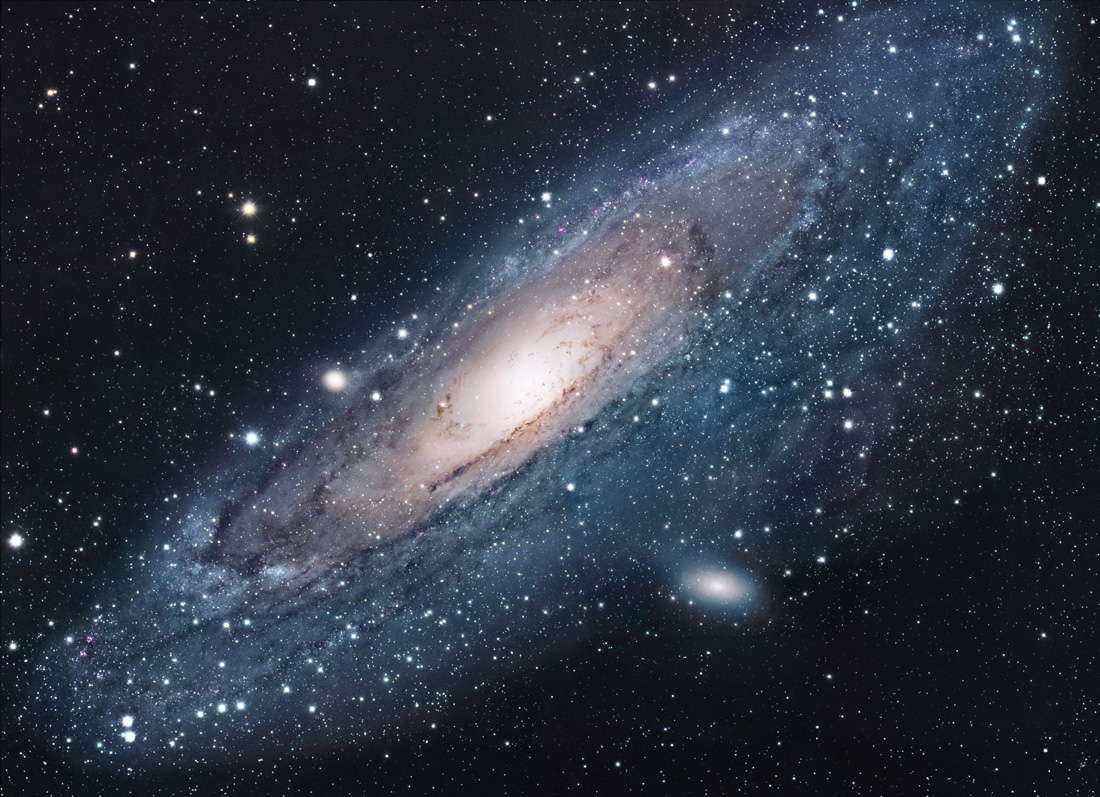
Andromeda_gendler_smOf course I don’t agree.  Without professional astronomers we would never have discovered that, say, the Andromeda Nebula (shown above) was a galaxy just like our own Milky Way containing thousands of millions of stars like our Sun  and that it is rotating about its axis with a timescale of hundreds of millions of years. Knowing things like this surely increases the sense of wonder rather than decreasing it?

On the other hand it is true that the nature of science makes it rather prosaic. When scientists try to write for a popular readership they often spice up their accounts with quotations from poems, even if the quotes aren’t really all that appropriate. Perhaps some will turn to this collection for a source of such snippets. I know I will!

Another thing that struck me was that I always tended to think that engagement between science and poetry was a relatively recent thing, typified by WH Auden’s humorously perplexed After Reading a Child’s Guide to Modern Physics:

Our eyes prefer to suppose
That a habitable place
Has a geocentric view,
That architects enclose
A quiet Euclidian space:
Exploded myths – but who
Could feel at home astraddle
An ever expanding saddle?

But in fact the metaphysical poets of the 17th century also grappled with such issues. Consider this fragment from John Donne’s An Anatomy of the World:

We think the Heavens enjoy their spherical,
Their round proportion embracing all.
But yet their various and perplexed course,
Observed in divers ages, doth enforce
Men to find out so many eccentric parts,
Such divers down-right lines, such overthwarts,
As disproportion that pure form….

That could almost have been written about the possibility of a lop-sided universe that I’ve blogged about here and there, and which is a major topic of current cosmological research.

Other reactions I had were more personal. There is a poem in the collection by Fleur Adcock, who visited the Royal Grammar School in Newcastle when I was there. She judged a poetry reading competition (which I didn’t win) for which the test piece was Stevie Smith’s Not Waving but Drowning. I remember that she was quite a glamorous-looking lady, but she got everybody’s name wrong in her presentation address. She must be getting on a bit by now.

I have also met one of the other poets represented here too, Gwyneth Lewis, who was elected the first national poet for Wales and also spent some time as poet-in-residence in the School of Physics & Astronomy at Cardiff University where I now work. She wrote a number of poems about science but is probably most famous for writing the words “In These Stones Horizons Sing” which are incorporated in the design of the facade of the Wales Millennium Centre.

Anyway, I thoroughly recommend this book which is a rich treasury of verse ancient and modern. Some of the lovely things in it are quite new to me and I am definitely going to read more by some of the poets represented in it. That’s the way to use an anthology: go and read more systematically whoever catches your eye.

Being an old-fashioned romantic I think I’ll finish off with an excerpt from William Wordsworth‘s epic The Prelude. Regular readers (both of you) will know that I greatly admire Wordsworth and, for me, The Prelude is one of the highest pinnacles in all of English literature.

The universal spectacle throughout
Was shaped for admiration and delight,
Grand in itself alone, but in that breach
Through which the homeless voice of waters rose,
That dark deep thoroughfare, had Nature lodged
The Soul, the Imagination of the whole.

The Fall Before

Posted in Poetry with tags on January 15, 2009 by telescoper

Browsing the BBC website for any evidence of at all of good news amid the continuing fiasco that is the British banking system, the murderous onslaught in Gaza, and the defeat of Newcastle United in last night’s FA Cup replay, I happened upon a quite interesting little item from which I picked out the following:

The use of the word ‘fall’ or ‘the fall’ to mean autumn is commonly assumed to be an Americanism, but in fact it is found in the works of Michael Drayton (1563-1631), Thomas Middleton (1580-1627) and Sir Walter Ralegh (1554-1618).

There is also a quotation from John Dryden (1631-1700) to back this up:

What crowds of patients the town doctor kills, Or how, last fall, he raised the weekly bills.

This is more appropriate for the USA than the UK nowadays as over here we now have the wonderful National Health System.

While contributing to a discussion on the e-astronomer, which subsequently evolved into an extended exercise in pedantry here, it struck me that many words we British think of as being Americanisms were in fact in common use over here in the 16th and 17th Centuries. This period marks the birth of American English as the language used by the colonials evolved fairly independently thereafter until films and television re-established contact in the 20th Century and set up a feedback loop. “Fall” seems to be another example of a word which carried on being used in mainstream American usage but was replaced over here by “autumn”.

Another example that strikes me is “gotten” which is commonplace in the USA but rarely used in England except in phrases like “ill-gotten gains”. It is used in Scotland and in other dialects, but in mainstream English is considered to be archaic, and the form “got” is generally used instead. As the past participle of the verb “to get”, however, it is by no means grammatically incorrect and it was a standard form in English during the 16th century and abounds in Shakespeare, such as in the phrase “He was gotten in drink” from The Merry Wives of Windsor.

Conversely and curiously we still use the form “forgotten” for the past participle of “forget” and the form “forgot” (as a participle) is considered archaic or poetic. The phrase “I have forgot much, Cynara! Gone with the wind” occurs in Ernest Dowson’s famous poem Non Sum Qualis Eram Bonae Sub Regno Cynarae, but it wouldn’t be considered correct in modern English prose.

There’s no real logic to all this, which is what makes it interesting…

Although hearing or reading the word “gotten” in contributions from the other side of the pond no longer jars, and I’ve always found the word “fall” to be rather poetic anyway, there are still some divergences that I can’t cope with. Once on a trip to the States I was alarmed when informed that the plane would be landing momentarily.

Crucial Verbalism

Posted in Crosswords, Literature with tags , , , , , on December 13, 2008 by telescoper

It’s a cold and rainy day and I’m lacking the inspiration to do anything energetic before making dinner, so I thought I’d pick something to blog about. Looking back over the past three months or so, I realise I’ve at least mentioned most things that I’m interested in, at least those that I’m willing to write about on here. But there is one other thing I haven’t covered yet and which I spend a lot of my spare time doing (especially during seminars) and that is solving cryptic crossword puzzles. In fact I simply can’t put a crossword down until I’ve solved all the clues, behaviour which I admit is bordering on the pathological. Still, I think of it as a kind of mental jogging, forcing your brain to work in unaccustomed ways is probably good for its fitness for other more useful things.

I can’t remember when I first started doing these, or even how I learned to do them. But then people can learn languages simply by picking them up as they go along so that’s probably how I learned to do crosswords.

If you’ve never done one of these puzzles before, you probably won’t understand the clues at all even if you know the answer and I can’t possibly explain them in a single post. In a nutshell, however, they involve clues that usually give two routes to the word to be entered in the crossword grid. One is a definition of the solution word and the other is a subsidiary cryptic allusion to it. Usually the main problem to be solved involves the identification of the primary definition and secondary cryptic part, which are usually heavily disguised.

The secondary clue can be of many different types. The most straightforward just exploits multiple meanings. For example, take

Fleeces, things often ordered by men of rank [6]

The answer to this is RIFLES which is defined by “fleeces” in one sense, but “men of rank” (soldiers) also order their arms hence giving a different meaning. Other types include puns, riddles, anagrams, hidden words, and so on. Many of these involve an operative word or phrase instructing the solver to do something with the letters in the clue, e.g.

Port’s apt to make you steer it erratically [7]

has the solution TRIESTE, which is an anagram of STEER+IT, port being the definition.

Most compilers agree however that the very best type of clue is of the style known as “&lit” (short for “and literally what it says”). Such clues are very difficult to construct and really beautiful when they work because both the definition and cryptic parts comprise the same words read in different ways. Here’s a simple example

The ultimate of turpitide in Lent [5]

which is FEAST. Here we have “e” as the last letter of turpitude in “fast” (lent) giving “feast” but a feast is exactly what the clue says too. Nice.

Some clues involve more than one element of this type and some defy further explanation altogether, but I hope this at least gives you a clue as to what is involved.

Cryptic crosswords like the ones you find in British newspapers were definitely invented in the United Kingdom, although the crossword itself was probably born in the USA. The first great compiler of the cryptic type used the pseudonym Torquemada in the Observer. During the 1930s such puzzles became increasingly popular with many newspapers, including famously The Times, developing their own distinctive style. People tend to assume that The Times crossword is the most difficult, but I’m not sure. I don’t actually buy that paper but whenever I’ve found one lying around I’ve never found the crossword particularly hard or, more importantly, particularly interesting.

As a Guardian reader, I have to say I enjoy their crosswords best, primarily because each day brings a different setter each of which has a different style to the others. Unlike some other newspapers they are not anonymous, but identified by a weird and wonderful collection of pseudonyms (Janus, Rufus, Shed, Logodaedalus, Gordius, Chifonie, Paul, Quantum, Brummie, etc). The best of them is the great Araucaria (whose name comes from the Monkey-Puzzle tree) and who is revered by crossword fans the length and breadth of the country for the brilliance of his clues. Araucaria is such a witty compiler that his clues often have you laughing out loud when you see how they fall into place. He is, in fact, a retired clergyman called John Graham who has been setting clues for the Guardian and other newspapers and magazines for over forty years. In fact, the Financial Times has a compiler called Cinephile who is the same person. (CINEPHILE is an an anagram of CHILE PINE, which is another word for the Monkey-Puzzle tree).

As it happens, today’s Guardian prize crossword was by Araucaria and, as usual, it was fun although it wasn’t as difficult as many of his. He followed a common tactic of connecting several clues together but as soon as you realise that

Writers’ relation to 10, maybe [6]

is BRONTE (note the position of the apostrophe indicating several writers with the same name, cryptic part is “bro” for relation and an anagram of “ten”) then the various references to the Brontes were straightforward. The only really difficult other clue is

Picture rhyme for MC in MND [10]

the answer to which is ILLUSTRATE (MND is Midsummer Night’s Dream, which explains the rhyme reference to PHILOSTRATE, a character in that play).

I also like to do the bi-weekly crossword set by Cyclops in Private Eye which has clues which are not only clever but also laced with a liberal helping of lavatorial humour and topical commentary which is right up my street. Many of the answers (“lights” in crossword parlance) are quite rude, such as

Local energy source of stress for Bush [5]

which is PUBES (“pub” from “local”+ E for energy +S for “source of stress”; Bush is the definition).

On Saturdays the Guardian crossword involves a prize so I religiously send my completed grid in the post. There are many hundreds of correct entries per week so it’s quite unlikely to win – the winner is drawn “at random” from all the correct entries. I’ve won the prize nine times over the years, an average of once every two years or so, with the result that I now have more dictionaries than I know what to do with. I don’t actually think a dictionary is a very good prize for a crossword puzzle, as surely every solver has one already! A few years ago The Guardian used to offer fancy fountain pens and watches, which are more like it. I also won a digital radio from the Financial Times puzzle, but I’ve got out of the habit of doing that one nowadays. The same is true for Salamanca in the New Statesman, which I won a couple of times years ago but have stopped doing since I lost interest in the rest of the magazine. I send off the answers to the Eye crossword every time but have never won it yet. That one has a cash prize of £100.

Anyway, Torquemada, who I mentioned above, was eventually followed as the Observer’s crossword compiler by the great Ximenes (real name D.S. Macnutt) who wrote a brilliant book called the Art of the Crossword which I heartily recommend if you want to learn more about the subject.

One of the nice stories in his book concerns the fact that crossword puzzles of the cryptic type were actually used to select recruits for British Intelligence during the Second World War, but this had a flip side. In late May 1944 the chief crossword setter for the Daily Telegraph was paid a visit by some heavies from MI5. It turned out that in a recent puzzle he had used (quite innocently and by sheer coincidence) the words MULBERRY, PLUTO, NEPTUNE and OVERLORD all of which were highly confidential code words to be used for the forthcoming D-Day invasion…

The current Observer crossword setter is the estimable Azed (real name Jonathan Crowther) who follows in the footsteps of his predecessor Ximenes. On balance I think this is consistently the best crossword I have ever done, although it is often a source of total frustration because it is quite convoluted and idiosyncratic. It is a bit different from other puzzles because it doesn’t involve any black squares like you would find in the standard `Everyman’ type of grid. This makes a very dense and intricate task for the solver, but does have the advantage that clues intersect more frequently than in the usual type. The problem with solving Azed is usually getting started as the clues are quite difficult and the words often very obscure. The one concession is that all answers are usually in the Chambers dictionary, and if they aren’t the compiler gives another hint. I’ve been tackling Azed for so long now that the Chambers has become in my mind a much more definitive dictionary than the OED. I also have several copies at home in different rooms, and one in my office at work.

Solving the Azed puzzle is hard enough, but for the special competition puzzles every four weeks one also has to supply a clue of one’s own. The winners of this competition are selected by Azed himself and there is an archive on the web of successful clues. As well as the winner of each competition, there is an annual prizewinner who produces the most good clues over the set of 13 competitions each year, and a roll of honour of all contributed clues that are deemed worthy. I’ve gradually clawed my way up this league table from 118th in 2006-7 to 46th in 2007-8 and, after four of the thirteen rounds this year, I’m currently in 28th place. I have to admit though that I am envious of the talents of many of the other competitors who routinely produce brilliant clues that even my best ones can’t compete with. For the same reasons that I don’t really enjoy setting examination questions, I don’t really like writing clues as much as solving them. My position in the roll of honour belies the fact that I’ve never produced a single clue that has won any of the individual competitions. I’m always the bridesmaid. You can find some of my more successful clues on the archive here.

Among those who have done exceedingly well in this competition over the years are the novelist Colin Dexter (in the form of N.C. Dexter) and a chap called C.J. Morse who is in fact the man that provided the name Dexter used for the crossword-loving chief Inspector in his famous detective novels. In turns out that C.J. Morse recently had his eightieth birthday and, as a special present, last Sunday’s Azed puzzle included some of his competition clues, which are real crackers. I won’t repeat them here though as you can find them all on the archive. However, solvers were invited to submit a clue to the word MORSE for the purposes of the competition, so at least I can tell you what my attempt was. Here we go:

His signal art no astronomer can comprehend [5]

By way of explanation, anagram of “astronomer” can give “morse” plus “art no”; comprehend is used in the slightly unusual sense of “comprise”; signal in the sense of “remarkable” plus reference to Morse system of signals. In the context of this puzzle, to celebrate the skills of Mr Morse, I also think this overall qualifies as an “&lit”.

I doubt if it competes with the best of the entries but I’m still quite proud of it.

Pluralia Tantum

Posted in Literature, Pedantry with tags , , , on December 5, 2008 by telescoper

Meanwhile, over on the e-astronomer, Andy Lawrence recently posted an item about the lamentable tendency of astronomers to abuse the English language. The focus of his venom was “extincted”, a word used by many astro-types as an adjective to describe the state of affairs when light from a source (e.g. a quasar) has suffered “extinction” by intervening matter. “Extinction” is formed from the verb “extinguish” in the same way that “distinction” is formed from “distinguish”. Nobody would describe a professor as “distincted” (certainly not if it is Andy Lawrence) so, clearly, “extincted” is inappropriate. Actually if you really want to nit-pick you could object to “extinction” being applied to an object such as a  quasar, when it isn’t actually the object that is suffering from it but the light it has emitted.

But as a gripe, this is fair enough I’d say. Andy went on to encourage his legions of adoring readers to contribute their own pet hates, preferably with an astronomical orientation. My contribution was “decimate” which  means “to remove the tenth part” or “to reduce by ten percent”, from the Roman practice of punishing disobedient legions by killing every tenth man, but is often regrettably now used to mean “annihilate” or “obliterate”. You might think this hasn’t got much to do with astronomy but, sadly, it does. Indeed, a press release from STFC discussing the recent ten percent cuts to its grants budget states that consequent reduction in PDRAS

..will not cause the decimation of physics departments as has been speculated in media reports.

I would expect a civil servant to have done a bit better, so presumably this was written by an astronomer too. At any rate, it is precisely wrong.

You might argue that things like this don’t matter.  Language evolves,  and if modern usage deviates from its previous meanings then we should just let it change. I fully accept the dynamic nature of language and do not by any means object to all such changes. Society changes and so must the words we use. But if a change is (a) a result of sloppiness and (b) results in the loss of a very good use to be replaced by a bad one, then I think educated people should stand their ground and fight it. If we don’t do that language doesn’t just change, it decays.

Most of us practising scientists have to spend a lot of our time writing scientific papers, departmental memos, grant applications and even books. I think many astronomers see this activity as a chore, take no pleasure from it, and invest the minimum care on it. I was fortunate to have a really excellent writer, John Barrow, as my thesis supervisor and he convinced me that it was worth making the effort to write the best prose I could whatever the context. Not only does this attitude eliminate the ambiguity which is the bane of scientific writing. Taking pains over style and grammar also allows one to feel the pleasure of craftsmanship for its own sake. With John’s guidance and encouragement, I learned to enjoy writing through the satisfaction experienced by finding neat forms of words or nice turns of phrase. You never really feel good about what you do if you scrape through at the miminum acceptable level. Try to make the effort and you will be more fulfilled and the long hours of slog you spend putting together a complicated paper will at least be enlivened by a genuine sense of delight when things fall neatly into place, and a warm glow of achievement when you read it back and it sounds not just acceptable but actually good.

But I digress.

One of the other contributors to Andy’s list of examples of bad grammar was a chap called Norman Gray who objected to astronomers’ use of the word “data” as a plural noun, as in “the data indicate” rather than “the data indicates”. I was taken aback by this because I was expecting the opposite objection.

He has a lengthy rant about this on his own blog so I won’t repeat his arguments in detail here, merely a synopsis. The word “data” is formed from the latin plural of the word “datum” (itself formed from the past participle of the latin verb “dare”, meaning “to give”) hence meaning “things given” or words to that effect. The usage of “data” that we use now (to refer to measurements or quantitative information) seems not to have been present in roman or mediaeval times so Norman argues that it is a deliberate archaism to treat it as a latin plural now. He also argues that “data” in modern usage is a “mass noun” so should on that grounds also be treated as singular.

For those of you who aren’t up with such things, English nouns can be of two forms: “count” and “non-count” (or “mass”). Count nouns are those that can be enumerated and therefore have both plural and singular forms:  one eye, two eyes, etc. Non-count nouns (which is a better term than “mass nouns”) are those which describe something which is not enumerable, such as “furniture” or “cutlery”. Such things can’t be counted and they don’t have a different singular and plural forms. You can have two chairs (count noun) but can’t have two furnitures (non-count noun).

Count and non-count nouns require different grammatical treatment. You can ask “how much furniture do you have?” but not how many. The answer to a “how much” question usually requires a unit or measure word (e.g. “a vanload of furniture”) but the answer to a “how many” question would be just a number. Next time you are in a supermarket queue where it says “ten items or less” you will appreciate that it the sign is grammatically incorrect. “Item” is most definitely a count noun, so the correct form should be “ten items or fewer”..

Anyway, Norman Gray asserts that (a) “data” is a non-count noun and that (b) it should therefore be singular. Forms such as “the data are..” are out (“a vile anacoluthon”) and “the data is…” is in.

So is he right?

Not really.  Unkind though it may be to dismantle a carefully constructed obsession, I think his arguments have quite a few problems with them.

For a start, it seems clear to me that there are (at least) two distinct uses of the word data. One is clearly of non-count type. This is the use of “data” to describe an undifferentiated unspecified or unlimited quantity of information such as that stored on a computer disk. Of such stuff you might well ask “how much data do you have?” and the answer would be in some units (e.g. Gbytes). This clearly identifies it as a mass noun.

But there is another meaning, which is that ascribed to specified pieces of information either given (as per the original latin) or obtained from a measurement. Such things are precisely defined, enumerable and clearly therefore of count-noun form. Indeed one such entity could reasonably be called a datum and the plural would be data. This usage applies when the context defines the relevant quantum of information so no unit is required. This is the usage that arises in most scientific papers, as opposed to software manuals. “In Figure 1, the data are plotted…” is correct. Although it sounds clumsy you could well ask in such a situation “how many data do you have?” (meaning how many measurements do you have) and the answer would just be a number. Archaism? No. It’s just right.

To labour the point still further,  here are another two sentences that show the different uses:

“If I had less data my disk would have more free space on it.” (Non-count)

“If I had fewer data I would not be able to obtain an astrometric solution.” (Count).

Contrary to Norman’s claims, it is not unusual for the same words (if they’re nouns) to have both count and non-count forms in different contexts. I give the example of “whisky” as in “my glass is full of whisky” (non-count) versus “two whiskies, please, barman”. His objection to this was that in the second case a whisky is an artefact of a metonymic shift which takes the word “whisky” to refer to the glass containing it.

Metonymy involves using a word related to a thing rather than the word for thing itself, as in “I have hungry mouths to feed”; it’s not really the mouths that are fed, but the people the mouths belong to. In fact there’s a bit of this going on when people talk about sources being “extincted” rather than their light.

This invalidates the example because, Norman alleges, the resulting meaning is different. This objection is a bit silly because the whole point is that the two forms should have different meanings, otherwise why have them? In any case the  example  simply involves me asking for two well-defined quantities of whisky. I’m not convinced of the relevance of metonymy here. What I care about is the whisky, not what it comes in, and when I drink the whisky I don’t drink the glass anyway. Metonymy would apply if I talked about drinking a couple of glasses. Consider “I drank two whiskies, one after the other” versus “I drank two glasses one after the other”. In both cases what has actually been drunk?

There are countless other examples (pun intended). “Fire” can be a mass noun “fire is dangerous”) but also a count noun (“the firemen were fighting three fires simultaneously”). Another nice one  is “hair” which is non-count when it is on someone’s head (“my hair is going grey”) but count when  they, in the plural, are being split.

Interestingly, though, the  non-count forms of these nouns are all singular. Indeed, many non-count nouns exist only in the singular: such nouns are called singularia tantum. Examples include “dust” and “wealth”. So,  if we accept that “data” can be a non-count noun, does that mean that it should necessarily be treated as singular when it does take on that role?

An example that might be taken to support this view could be “statistics” (the field thereof) which is a non-count noun. Although it appears to be derived from a plural, you would certainly say “statistics is a hard subject”  rather than “statistics are a hard subject”.  On the other hand “statistics” can refer to a set, each element of which is a statistic (i.e. a number), thus giving another example of a noun that can be of either count or non-count form; you might reasonably say “the statistics are impressive” in the count case.  The non-count form “statistics” is a better  example of metonymy than the example above, as it refers to the study of the (count) statistics rather than to the things themselves.

In fact there are also mass nouns, described as pluralia tantum, which exist only in the plural. A (not entirely accurate) list is given here. Examples include scissors and pants, for which the normal measure  is a “pair”. Although these are technically non-count nouns (in the sense that you can’t have one scissor, etc) they don’t shed much light on the example in front of us. Perhaps more pertinent is the word “clothes” which is of non-count type but which is certainly plural. You can’t have one “clothe” (or any other number for that matter) but you would definitely say “your clothes are dirty”.

A more subtle example with relevance to the latin root of “data” is “media” which can refer to broadcast media (non-count) or plural of medium (count).  “The media are out to get me”  seems a correct construction to me, so the non-count form of this noun is a plurale tantum (singular of pluralia tantum).

So,  just because a word may be a non-count noun, it doesn’t necessarily have to be singular.

To summarise,  my argument is that (a) it is not correct to assert “data” is a mass noun. It may or may not be, depending on the context. If it is acting as a count noun (which I contend is the case in most science writing) then it is definitely plural. Furthermore, even in cases where it is clearly a mass noun, and especially if you reject the alternative meaning as a count noun, then  it is still by no means obvious that it must be treated as singular (because of the existence of the plurale tantum). In fact I would go a bit further and argue that you can only justify the singular non-count form at all if you accept that there is a count alternative. To be honest, though, I think I prefer the singular interpretation in the non-count case, as in “statistics”. It just sounds better.

If anyone has managed to read all the way through this exercise in pedantry I’d be interested to see any comments on my analysis of data.

On First Looking into Chapman’s Homer

Posted in Poetry, The Universe and Stuff with tags , , on November 19, 2008 by telescoper

As a present to those who appear disgruntled by my comments about exoplanets here and there, this is from John Keats:


Much have I travell’d in the realms of gold,
    And many goodly states and kingdoms seen;
    Round many western islands have I been
Which bards in fealty to Apollo hold.
Oft of one wide expanse had I been told
    That deep-brow’d Homer ruled as his demesne;
    Yet did I never breathe its pure serene
Till I heard Chapman speak out loud and bold:
Then felt I like some watcher of the skies
    When a new planet swims into his ken;
Or like stout Cortez when with eagle eyes
    He star’d at the Pacific–and all his men
Look’d at each other with a wild surmise–
    Silent, upon a peak in Darien.
 

This famous sonnet was written in October 1816 and is considered the highlight of Keats’s first volume of poetry. It was originally a gift for his friend, Charles Cowden Clarke. The two men had spent an evening reading George Chapman’s superb 17th century translation of the Iliad and Odyssey.

Please note lines 9 and 10. I’m sure they capture the excitement of discovery although Keats probably wasn’t using the correct IAU nomenclature. I’m not sure about the bit about being “silent” either.