Archive for the Poetry Category

For the Cosmonauts

Posted in Poetry, The Universe and Stuff with tags , on July 15, 2009 by telescoper

Last week I bought a copy of Moonrise, a collection of poems by Meirion Jordan. He was born in Swansea and read Mathematics at Somerville College, Oxford. His poems, which often deal with themes inspired by science, are sometimes witty or satirical and sometimes simply a bit wild.  They’re also beautifully composed, with a very natural structure and playful use of language.

I wanted to give his book a bit of a plug so here he is on Youtube reading For the Cosmonauts, which one of two pieces comprising the Epilogue to his book.  This is the text

I, Yuri Gagarin, having not seen God,
wake now to the scrollwork of a body,
to my own white fibres leafing into the bone:
know that beyond this dome of rain there is
only the nothing where the soul sweers
out its parallax like a distant star and truth
brightens to X, to gamma, through a metal sail.

So I return to you, cramming your pockets
with the atmosphere and the evening news,
fumbling for gardens in the moon’s shadow,
in its waterfalls of silence. I wish for you
familiar towns, their piers and amusement arcades
unpeopled at dusk, the unicorn tumbling by
on china hooves behind the high walls
of parks, among congregating lamps.

May you find Earth rising there, between
your steepled hands. May your voyages
end. May you have a cold unfurling
of limbs each morning, when I am fallen
out of the world.

Here is the poet himself reading it

You can order the book directly from the publisher by clicking on the link above.

Midsummer Madness

Posted in Biographical, Music, Poetry with tags , , on June 21, 2009 by telescoper

I’ve just realised that the Summer Solstice happened this morning at about 6.47am British Summer Time (5h 46m 45s UTC). Astronomy buffs will know that’s the time when the Sun reaches its most northerly position in the sky, leading to the longest day in the northern hemisphere.

Since it’s also the bicentennial year of Felix Mendelssohn it was a no-brainer to decide to celebrate by picking one of the beautiful pieces he wrote as music for the play A Midsummer Night’s Dream by William Shakespeare.

Whenever anyone mentions that play I can’t help remembering the version of it we did at School. I only got to act in two plays when I was a schoolboy, but they were both authentically Shakespearean in the sense that all the parts, including the female ones, were played by boys. It was an all-boys school, you see. My best role was undoubtedly as Lady Macbeth in the Scottish play – a much more interesting part than her husband, if you ask me. The only other attempt at acting I ever engaged in was in A Midsummer Night’s Dream. Although I say so myself, my Bottom was the talk of the sixth form.

(I was going to say “and thereby hangs a tail”, but decided not to…)

I should also mention that I also saw Andy Lawrence playing the same part in the Queen Mary Players production of The Dream. I wonder if he remembers doing that?

Curiously, the phrase from which I got the title of this post (“this is very midsummer madness”) is not from this play but from Twelfth Night, a play whose title refers to winter time. I think it might have been a joke.

Anyway, I’m rambling. This clip is a plug for a new recording which sounds pretty good to me. I’ve picked the wonderful Notturno:

Postscript: I’m aware that some people might have been offended by some of the clerihews recently posted on this site. Sometimes the lure of a rhyme can take these into areas best left unvisited. I’d therefore like to offer these, the closing lines of A Midsummer Night’s Dream, by way of an apology. I’ve also now taken the Clerihews themselves offline, owing to a number of attempts to post  abusive and/or threatening comments on that page (none of which came from anyone actually named there).

If we shadows have offended,
Think but this, and all is mended,
That you have but slumber’d here
While these visions did appear.
And this weak and idle theme,
No more yielding but a dream,
Gentles, do not reprehend:
if you pardon, we will mend:
And, as I am an honest Puck,
If we have unearned luck
Now to ‘scape the serpent’s tongue,
We will make amends ere long;
Else the Puck a liar call;
So, good night unto you all.
Give me your hands, if we be friends,
And Robin shall restore amends.

I’m glad at least that nobody tried to do a clerihew about Puck. I mean, how could you possible find a rhyme for “Robin Goodfellow”?

Days of Wine and Roses

Posted in Jazz, Poetry with tags , , , on June 15, 2009 by telescoper

Today I finished all my exam marking, and decided to celebrate by drinking a glass or two of wine while I sat in my garden. The lovely roses that have recently been in bloom are already starting to fade and drop their petals. For obvious reasons, this reminded me of this little poem by Ernest Dowson.

The title is Vitae Summa Brevis Spem Nos Vetat Incohare Longam, which I translate from my half-remembered schoolboy Latin as something like “the brief span of Life forbids us from conceiving an enduring hope”. It’s a quotation from one of the Odes of Horace (Book I, Ode 4, line 15).

They are not long, the weeping and the laughter,
Love and desire and hate:
I think they have no portion in us after
We pass the gate.

They are not long, the days of wine and roses:
Out of a misty dream
Our path emerges for a while, then closes
Within a dream.

The phrase “days of wine and roses” became the title of an excellent film dealing with the effects of alcoholism on family life, for which Henry Mancini wrote a song with the same title that went on to become a Jazz standard. Here is a lovely version played live by the great Bill Evans (who featured in another recent post of mine).

In the rather melancholy spirit of this post, I’ll add that Bill Evans died in 1980 just about a month after this performance.

Professorial Misconduct

Posted in Poetry with tags , , on May 26, 2009 by telescoper

The British political establishment is currently mired in scandal owing to revelations about the widespread abuse of  so-called “second home” expenses allowance by greedy and unscrupulous Members of Parliament.  Combined with the country’s ongoing economic difficulties, this will undoubtedly lead to equally widespread disillusionment with the way our country is being run which will probably also lead to increased support of extremist parties in the forthcoming Local and European elections on 4th June.

You might have hoped that the ivory towers of academe might be immune from this epidemic of sleaze but, alas, that’s not so. Take the recent election to the Oxford Professorship of Poetry, which is claimed to be the most prestigious academic post in the country (apart from mine, of course). The Nobel laureate Derek Walcott – whom I’ve blogged about beforewithdrew from the race after an anonymous source circulated a dossier containing allegations of sexual harassment committed by him during the course of employment at Harvard. It contained pages from a book  entitled “The Lecherous Professor”  detailing Walcott’s attempts to persuade a female student to have sex with him; Walcott had received an official reprimand over this episode and had been forced to make  a written apology for his actions. A later case involving a sexual harassment claim against him (from 1996) also came to light, but that was apparently settled out of court.

I find it difficult to be too sympathetic to Derek Walcott, and  I do think he probably did the right thing by withdrawing. While it is true that students are adults (in reality and in the law), a Professor is obviously in a position of responsiblity for, and power over, his or her students. For a male Professor to ask a female student if she wants to have sex with him does not in itself constitute harassment but to do so repeatedly after refusals clearly does, and so does any attempt to influence events by suggesting changes to grades. To abuse an academic position in order to secure sexual favours is clearly wrong and the disciplinary action taken against Walcott  seems to me to have  been justified. Even if there is no actual coercion, I think it is still very unprofessional behaviour for an academic to pursue a sexual relationship with one of their students as it could lead them into dangerous territory. I know of quite a few successful relationships that have started out that way, though, and  I don’t want to be  sound censorious about behaviour between consenting adults. In general  I don’t think a person’s sexual life is at all relevant to their suitability for a job.  What I mean is that Walcott’s prior inapproriate acts do cast doubt on his suitability for this particular position.

Despite the revelations about his past, I still admire Walcott’s poetry enormously. Beautiful literature, just like beautiful music and art, is not made by saints but by people. We all have our flaws.

Anyway, Walcott’s withdrawal from the election left the way open for Ruth Padel (distant relative of Charles Darwin), who was duly elected to the Chair last week. She had distanced herself from the circulation of the anti-Walcott dossier and stated her regret that Walcott had withdrawn, but it subsequently transpired that she had actually drawn his past behaviour to the attention of some journalists via email. This news caused further uproar, with the result that she yesterday resigned the post only a week or so after having been elected to it.

Oxford University will now hold another election, but this fiasco has already put a stain on the Chair and makes Oxford’s academic world look petty and vindictive, at least to people who didn’t realise how petty and vindictive academics are anyway.

Even if Ruth Padel did not have anything to do with the circulation of the dirty dossier, I think it still was a mistake for her to send emails drawing attention to it. Having allowed herself to be drawn into the affair I think she made the right decision to resign in order to bring the sorry business to an end. It’s all a bit sad, though, and I hope there aren’t any more skeletons in relevant cupboards next time the election is run.

And the issue still remains of who it was that dished the dirt on Derek in the first place? If it was someone or some people wanting to help Ruth Padel win the Oxford position then it seriously backfired. Handwriting experts have been looking at the evidence to try and identify the culprit. Inspector Morse would have been in his element.

The Darling Buds of May

Posted in Poetry with tags , on May 20, 2009 by telescoper

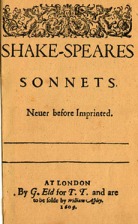
Four hundred years ago today, on the 20th May 1609, William Shakespeare published a collection of 154 Sonnets which arguably represent just as high a  level of literary achievement as his plays.  At any rate they’ve survived in popularity just as well and also furnished a huge number of memorable phrases including, appropriately enough for the time of year, the title of this post. This was, in fact, the only edition of the Sonnets published in Shakespeare’s lifetime and the circumstances of its publication remain uncertain.

Most of the poems concern Shakespeare’s love for a young man,  “Mr WH, the Onlie Begetter of the Sonnets”. However, there is a also group of sonnets addressed to his mistress, an anonymous “dark lady”,  which are far much more sexual in content than those addressed to the “Fair Youth”. The usual interpretation of this is that Shakespeare’s love for the boy was purely Platonic rather than sexual in nature.  Anyway, it was certainly a physical attraction.  Verse after verse speaks of the young man’s beauty. The first group of sonnets even encourage him to get married and have children so his beauty can continue and not die with his death. Sonnet 20 laments that the youth is not a woman, suggesting that this ruled out any sexual contact.  These early poems seem to suggest a slightly distant relationship between the two as if they didn’t really know each other well. However, as the collection goes on the poems become more and more intimate and it’s hard for me to accept that there wasn’t some sort of involvement between the two.  Although homosexual relationships were not officially tolerated in 17th Century England, they were not all that rare especially in the theatrical circles in which Shakespeare worked.

We’ll probably never know who Mr WH was – not Smith presumably – or indeed what was the real nature of his relationship to Shakespeare but we still have the poems. I do think it’s worth remembering, though, that these deep and moving expressions of romantic love were not written from a man to a woman, but from one man to another.  Here is perhaps the most famous one of all, Sonnet 18

Shall I compare thee to a summer’s day?
Thou art more lovely and more temperate:
Rough winds do shake the darling buds of May,
And summer’s lease hath all too short a date;
Sometime too hot the eye of heaven shines,
And often is his gold complexion dimm’d;
And every fair from fair sometime declines,
By chance or nature’s changing course untrimm’d;
But thy eternal summer shall not fade,
Nor lose possession of that fair thou ow’st;
Nor shall Death brag thou wander’st in his shade,
When in eternal lines to time thou grow’st:
So long as men can breathe or eyes can see,
So long lives this, and this gives life to thee.


Christopher Logue

Posted in Jazz, Poetry with tags , on May 3, 2009 by telescoper

Poetry is in the news today.

Yesterday’s announcement that the 23rd  Poet laureate is to be Carol Anne Duffy has generated as much comment about her sexual orientation as the undoubted quality of her verse.

But that’s not the point of this post.

I don’t know why but all the stuff in the papers reminded of a very rare recording I heard years ago the poet Christopher Logue with a Jazz group led by the drummer Tony Kinsey.

Christopher Logue is now in his eighties and is probably best known as a regular contributor to the satirical magazine Private Eye (to which I have not yet cancelled my subscription). Among other things in the Eye, he edits the hilarious Pseuds Corner, a collection of the most pretentious drivel culled from newspapers and magazines.

But he’s also a fine poet in his own right and has been for many years.

The first time I heard this old recording made in the late 1950s, I didn’t listen very carefully to the words. I thought it was just a very funny skit – a posh British guy doing beat poems couldn’t possibly be serious, could it?   Especially if it sounds like Allen Ginsberg meets Julian Clary…

..but listening to it again, and especially studying the words it’s grown on me so much I now think it’s a minor masterpiece.

large_8be9743ce0f84fa88d982cbdb1949b9cThere is an audio-only version on Youtube, but it refuses to be embedded. Click here if you want to hear the performance on record.

Now read the lyrics:

1.

Lithe girl, brown girl
Sun that makes apples, stiffens the wheat
Made your body a joy
Tongue like a red bird dancing on ivory
To stretch your arm
Sun grabs at your hair
Like water was falling

Tantalize the sun if you dare
It will leave shadows that match you
Everywhere
Lithe girl, brown girl
Nothing draws me towards you
The heat within you beats me home
Like the sun at high noon

Knowing these things
Perhaps through
Knowing these things
I seek you out
Listening for your voice
For the brush of your arms against wheat
For your step among poppies grown underwater
Lithe girl, brown girl

2.

Steep gloom among pine trees
Waves’ surge breaking
Slow lights that interweave
A single bell

As the day’s end falls into your eyes
The earth starts singing in your body
As the waves sing in a white shell
And the rivers sing within you
And I grow outwards on them
As you direct them
Whither you make them run

I follow for you like a hare
Running reared upright to the hunter’s drum
You turn about me like a belt of clouds
the silence, though it is stupid
Mocks the hours I lay
Troubled by…… nothing

Your arms – translucent stones wherein I lie
Exhausted
And future kisses
Die
Lust
Your mysterious voice
Folds close echoes
That shift throughout the night
Much as the wind
Which moves darkly over the profitable fields
Folds down the wheat
From all its height

3.

In the hot depth of summer
The morning is close, storm-filled
Clouds shift –
White rags waving goodbye
Shaken by the frantic wind as it goes and
As it goes
The wind throbs over us
Love-making silenced

Among the trees like a tongue singing
A warning or just singing the wind throbs
And the quick sparrow’s flight is slapped by the wind
Swift thief destructive as waves
Weightless without form
Struck through and through with flame
Which breaks
Soughing its strength out
At the gates of the enormous, silent, summer wind

4.

That you may hear me
My words narrow occasionally
Like gull-tracks in the sand

Or I let them become
Tuneful beads
Mixed with the sound

Of a drunk hawk’s bell
Flick me your wrists…..
Soft as grape skin – yes

Softer than grapeskin I make them
Which is a kind of treachery against the world

Yet
You who clamber
Over all the desolations of mine
Gentle as ivy
Eat the words’ meaning

Before you came to me
Words were all that you now occupy
And now they’re no more these words
Than ever they knew of my sadness

Yet
Sometimes
Force and dead anguish still drags them
And yes

Malevolent dreams still betimes
Overwhelm them and then

In my bruised voice
You hear other bruised voices
Old agues crying out of old mouths

Do not be angry with me
Lest the wave of that anguish
Drown me again

Even as I sit
Threading a collar of beads for your hands
Softer than grape skin
Hung with a drunk hawk’s bell

I think these are beautiful poems made even more effective by the musical setting. In fact they are loose re-workings of some of the famous love poems of Pablo Neruda. Logue moved far away from the Neruda’s originals, but put them into impressionistic free verse, which he reads in his plummy English accent, while the band provides appropriate backing for the sentiments of the poetry as well as providing improvised passages in between the verses.

Looking at this now, I have no idea why I thought it was meant to be funny.
Spiritus Mundi

Posted in Poetry with tags , , on April 14, 2009 by telescoper

I found this poem by Simon Pomery a while ago in the Times Literary Supplement. Something made me cut it out of the paper and keep it. Part of the reason that it made an impression on me was probably that it is taken from a lengthy verse translation of one of Seneca‘s Moral Epistles called Divina Lux (a couple of other fragments of which you can find here) and this is a work I studied a bit in latin classes at School. You can also find prose translations of some of the 124 such Epistles Seneca wrote very near the end of his life here.

The soul of the world abides.
It doesn’t distinguish between
those born in town or country:
it makes its home in the wild sea,
the blur and seam of the horizon,
the cloud-racked firmament itself.
The space that separates the gods
from men unites them also, where stars,
like watchmen, sleep out in the open.

Seneca espoused a Stoic philosophy that was developed later by Marcus Aurelius, whose Meditations is one of my favourite books, although I’ve forgotten too much of my schoolboy Latin to read it in the original. I do, however, keep the paperback English translatlon with me when I go travelling. It is one the greatest works of classical philosophy, but it’s also a collection of very personal thoughts by someone who managed to be an uncompromisingly authoritarian Emperor of Rome at the same time as being a tender and introspective person.

Not that I’ve ever in practice managed to obey his exhortations to self-denial…

Shadows of Sylvia

Posted in Poetry with tags , , , , , , on April 5, 2009 by telescoper

The other day I decided to visit a few bookshops in Cardiff in order to spend the money I won in the TLS Crossword competition. It seemed only right to use it that way. These days I seem to buying poetry books more often than anything else. I’m not sure what that means.

I treated myself to the collected poems of Derek Walcott, whose work I have never really looked at before. He hails from St Lucia in the West Indies, and won the Nobel Prize for literature in 1992. His poems are truly wonderful, full of allusions to classical history and mythology, but with a distinctive Caribbean flavour all his own.  Definitely money well spent.

One of the other books I bought was a collection of peoms by Sylvia Plath, called The Colossus. This is one of those smart editions from Faber & Faber that are just the right size to fit into your pocket for a long journey on train or plane. I have had Ariel for some time, and have been meaning to read more of her verse for a long time but somehow never got around to it.

The only two things that most people are likely to know about Sylvia Plath are (1) that she was married to another poet, Ted Hughes , and (2) that she killed herself in 1963 by putting her head in a gas oven. The manner of her death endowed her with a cult status, which was further amplified when the collection called Ariel was eventually published after her death. In fact The Colossus was the only collection of her poems that was published during her life.

Although it’s a very banal way to put it, Sylvia Plath led a troubled life. She had a history of mental illness and nervous breakdown. Her poems are mostly of a confessional nature, unsurprisingly bleak, but often searingly intense and shot through with vivid imagery.  It’s not exactly easy reading, but if it’s catharsis you’re looking for, go no further. She’s even good for a quote or two about astronomy. How’s this, for example, from the poem Years (which didn’t make it into the collection of poems I blogged about a while ago):

O God, I am not like you
In your vacuous black,
Stars stuck all over, bright stupid confetti.
Eternity bores me,
I never wanted it.

One of the things that spurred me on to read a bit more of Sylvia Plath was the news  that her son, Nicholas Hughes, had committed suicide at the age of 46; as a young boy he was asleep in bed when his mother had ended her own life. There was also a very moving story in yesterday’s Guardian by writer Jeremy Gavron, whose mother Hannah Gavron also took her own life, in circumstances very similar to Sylvia Plath, in 1965.

Of course there’s been a lot of rather morbid stuff written about whether Sylvia Plath was somehow responsible for the eventual death of her son, whether the propensity to suicide may be inherited, whether it was all Ted Hughes’ fault, and so on. I think all this tells us is that one person can never really understand another’s pain and the greater the pain, the greater the incomprehension also.

A few years ago when I was external examiner, I was on a train from Nottingham to Cambridge going to an examiners meeting at the University of Cambridge. I had a window seat near the front of the carriage on the right hand side. Just outside Peterborough, the train was on a curved stretch of track so I could see the line in front of us. There was a level crossing with the barriers down and cars waiting either side. I could see quite clearly a female figure standing in the middle of the crossing but as the train got closer to her she vanished from view, obscured by the train. I heard the train’s warning signal and, seconds later, the driver shouted out “Oh No..”.

There was a horrible thump and the train lurched as it travelled over something that had gone underneath. The gruesome sound of a human body being sliced apart by metal wheels is something I’ll never forget. The train came to a halt, and the driver opened the door to his compartment. Icould see that blood had sprayed over the driver’s window. The poor driver looked like a ghost. He said that when he sounded the alarm the lady had turned and walked along the track towards the train. She looked directly into his eyes as the train hit her.

Eventually, perhaps an hour later, transport police and an ambulance arrived at the scene and a replacement driver was brought to us; train drivers can never carry on after such an event.  Some even have to quit the job. A police chaplain came too. The police and ambulance people collected the remains, made measurements, interviewed various people who had seen what happened and declared it a suicide. We moved to the next station, March, and got off onto the platform, the front of the train quickly hidden from us by a large piece of white canvas.

There had been time for the transport policemen to talk to the passengers who were all, like me, rattled by the experience. They (the police) had been through this all before, they said. That particular level crossing was  a place people came to specifically for that reason. Nobody could say why there and not somewhere else. Apparently it’s the same on the London Underground. Some stations have many suicides of people jumping in front of trains, others virtually none. Who can say why.

Suicides are not as rare as you might think. In the United Kingdom each year about one person in ten thousand takes their own life; we’re actually quite a long way down the league table for suicide rates. Men are about three times as likely to do it as women. My cousin Gary did it about five years ago. There are several per week just at railway stations or on railway lines across the United Kingdom.

When I was told these facts I was completely shocked. It has never crossed my mind to take my own life, especially not in a way that seems designed to cause other people suffering too.  The time comes all too soon anyway.

This intriguing video features Sylvia Plath reading probably her most famous poem Lady Lazarus.

The Waste Land

Posted in Poetry, Science Politics, The Universe and Stuff with tags , , , , on April 1, 2009 by telescoper

APRIL is the cruellest month, sending
Clover into the dead land, ditching
The great for the dire, erring
Dead heads caused spring pain.
Keith Mason fucked it up, smothering
Good science with tons of shit, ending
Our little dream; we’re the losers.

After The Waste Land, Part I: The Burial of the Dead, by T.S. Eliot.

**** Energy

Posted in Poetry, The Universe and Stuff with tags , , , , , on March 30, 2009 by telescoper

The phrase expletive deleted was made popular at the time of Watergate after the release of the expurgated tapes made by Richard Nixon in the Oval Office when he was President of the United States of America. These showed that, as well as been a complete crook, he was practically unable to speak a single sentence without including a swear word.

Nowadays the word expletive is generally taken to mean an oath or exclamation, particularly if it is obscene, but that’s not quite what it really means. Derived from the latin verb explere (“to fill out”) from which the past participle is expletus, the meaning of the word in the context of English grammar is  “something added to a phrase or sentence that isn’t strictly needed for the grammatical sense”.  An expletive is added either to fill a syntactical role or, in a poem, simply to make a line fit some metrical rule.

Examples of the former can be found in constructions like “It takes two to Tango” or “There is lots of crime in Nottingham”; neither  “it” nor “there” should really be needed but English likes to have something before the verb.

The second kind of use is illustrated wonderfully by Alexander Pope in his Essay on Criticism, which is a kind of guide to what to avoid in writing poetry. It’s a tour de force for its perceptiveness and humour. The following excerpt is pricelessly apt

These equal syllables alone require,
Tho’ oft the open vowels tire;
While expletives their feeble aid do join;
And ten low words oft creep in one dull line

Here the expletive is “do”,  and it is cleverly incorporated in the line talking about expletives, adding  the syllable needed to fit with a strict pentameter. Apparently, poets often used this construction before Pope attacked it but it quickly fell from favour afterwards.

His other prosodic targets are the “open vowels” which means initial vowels that produce an ugly glottal sound, such as in “oft” (especially ugly when following “Tho”). The last line is brilliant too, showing how using only monosyllabic “low” words makes for a line that plods along tediously just like it says.

It’s amazing how much Pope managed to fit into this poem, given the restrictions imposed by the closed couplet structure he adopted. Each idea is compressed into a unit of twenty syllables, two lines of ten syllables with a rhyme at the end of each. This is such an impressive exercise in word-play that it reminds me a lot of the skill showed by the best cryptic crossword setters. Needless to say I’m no more successful at writing poetry than I am at setting crossword clues.

After my talk in Dublin last Friday, somebody in the audience asked me what I thought about Dark Energy. There’s some discussion in the comments after my post on that too.

The Dark Energy is an ingredient added to the standard model of cosmology to reconcile  observations of a flat Universe with a matter density that seems too low to account for it.

Other than that it makes the  cosmological metric work out satisfactorily (geddit?), we don’t understand what Dark Energy means and would rather it wasn’t there.  Most people think the resulting model is inelegant or even ugly.

In other words, it’s an expletive…