Archive for the mathematics Category

Ahead of Teaching

Posted in Biographical, Education, mathematics, Maynooth, Music with tags , , , , on February 3, 2019 by telescoper

It’s 3rd February 2019, which means that today is two days after Imbolc, a Gaelic festival marking the point halfway between the winter solstice and vernal equinox. This either happens 1st or 2nd February, and this year it was former, i.e. last Friday In Ireland this day is sometimes regarded as the first day of spring, as it is roughly the time when the first spring lambs are born. It corresponds to the Welsh Gŵyl Fair y Canhwyllau and is also known as the `Cross Quarter Day’ or (my favourite) `The Quickening of the Year’.

I wrote a post about this time last year, on the day I gave my first ever lecture in Maynooth University, on Computational Physics, in a theatre called Physics Hall. That was on Thursday February 1st 2018. It’s hard to believe that was a full year ago. Time certainly has gone quickly this year.

Owing to the vagaries of the academic calendar we’re a week later getting back to teaching this year than last year so my first Computational Physics lecture won’t be until this Thursday (7th February) at 9am, but sadly it won’t be in Physics Hall, which I rather liked, but in Hall C – a much less atmospheric venue, but one rather closer to my office, which will be handy if I forget anything (which I am prone to do). There are about 25 students taking this module, a few down on last year, which means they should fit comfortably into our computer lab. I’m not surprised they moved the lecture, really. The capacity of Physics Hall is 90, and even last year I only had about 30 students. Still, it did have a piano (which Hall C does not):

Computational Physics doesn’t start until Thursday. Before that I have to start my other module: Engineering Mathematics II. This (what you would probably call a `service course’) covers a mixture of things, mainly Linear Algebra but with some other bits thrown in for fun, such as Laplace transforms. Interestingly I find the Mathematical Physics students do not encounter Laplace Transforms in the first year, but perhaps engineers use them more often than physicists do? I think I’ve written only one paper that made use of a Laplace transform. Anyway, I have to start with this topic as the students need some knowledge of it for some other module they’re taking this semester. I reckon six lectures will be enough to give them what they need. That’s two weeks of lectures, there being three lectures a week for this module.

By coincidence rather than good planning, the timetable for this module is quite nice. I have lectures on Monday, Tuesday and Wednesday and then the students have a choice of tutorial (on either Thursday or Friday). That means I can get through a decent amount of material each week before each tutorial. I don’t do the tutorials, by the way: that’s left to one of our PhD students, who gets paid for doing that and correcting the weekly coursework. There are about 50 students on this module, divided into two courses: Electronic Engineering and Robotics and Intelligent Devices. We don’t have Civil or Mechanical or Chemical Engineering, etc at Maynooth.

Campus has been very quiet for the last week or so. The exam period finished in late January but lectures don’t start until tomorrow morning (Monday 4th February) so there have been few students around. No doubt it will be a different story tomorrow. I’ve done my first week’s notes and compiled my first problem set so I’m more-or-less ready to go. First lecture at 2pm tomorrow in Hall H, which is one of the rooms I taught in last term so at least I know where it is!


Meaningful Betting

Posted in Biographical, mathematics, Politics with tags , , , , on January 15, 2019 by telescoper

I’ve now finished my first batch of marking (Astrophysics & Cosmology) and I now have a few days to do other things until the next (larger) set of scripts arrives from Vector Calculus and Fourier Series which takes place on Saturday.

Before going home I turned my attention to the news of tonight’s “Meaningful Vote” in the House of Common’s about whether or not to accept the Withdrawal Agreement negotiated between PM Theresa May and the European Union. The Government is widely expected to lose the vote but it’s not clear by what margin. Interested to see what the betting markets think I had a look just now at the Betfair exchange and found this, on the basic question of whether the vote will pass or not:

(You might want to click on the image to make it clearer.) You can find the live odds here.

You will see that this is quite an active market – with over €700K being wagered. Odds of greater than 40 to 1 against a `yes’ vote but most of the action is on `no’. Note that quite a few punters are laying on this outcome, with odds of about 25-1 on. (The way odds are shown in the second row is that 1.04 means you with 4p for every £1 staked).

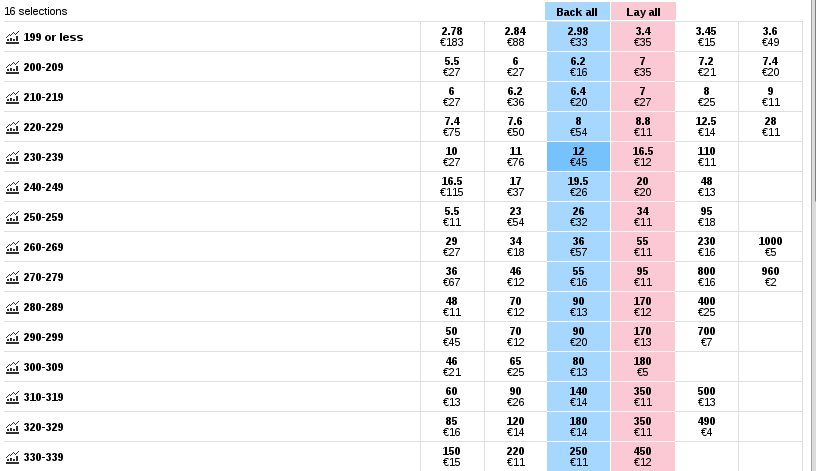
Clearly, therefore, the markets think the vote will fail. What is less clear is how many MPs will vote in favour of the Government. Here is the corresponding Betfair market:

The shortest odds are for the first option, i.e. for 199 or fewer voting with the Government, but there is activity across the whole range of possibilities. The press are talking about a defeat by 225 votes, but for what it’s worth I don’t think it will be such a large margin. I’m not going to bet on it, but I expect it to be defeated by less than 150 votes.

UPDATE: Not for the first time I was wrong. The vote was Ayes 202 Noes 432, a majority of 230 against. That means there were no abstentions.

Bill Bonnor on Cosmology with Negative Mass

Posted in mathematics, The Universe and Stuff with tags , , , , , on December 10, 2018 by telescoper

My post from Friday about negative mass in cosmology reminded me of my days at Queen Mary and discussions I had at that time with Bill Bonnor, who retired in 1985 but was a regular visitor to the weekly Relativity Seminars. I was sad to discover just now that Bill actually passed away in 2015 (at the age of 94) so I thought I would post a little note as a short tribute.

Bill Bonnor was an old-school mathematical relativist, which I definitely am not, but I recall talking to him quite a lot in the coffee room because we had a shared interest in gambling games. He had a liking for the fixed-odds competition in the football pools, which he played with considerable success.

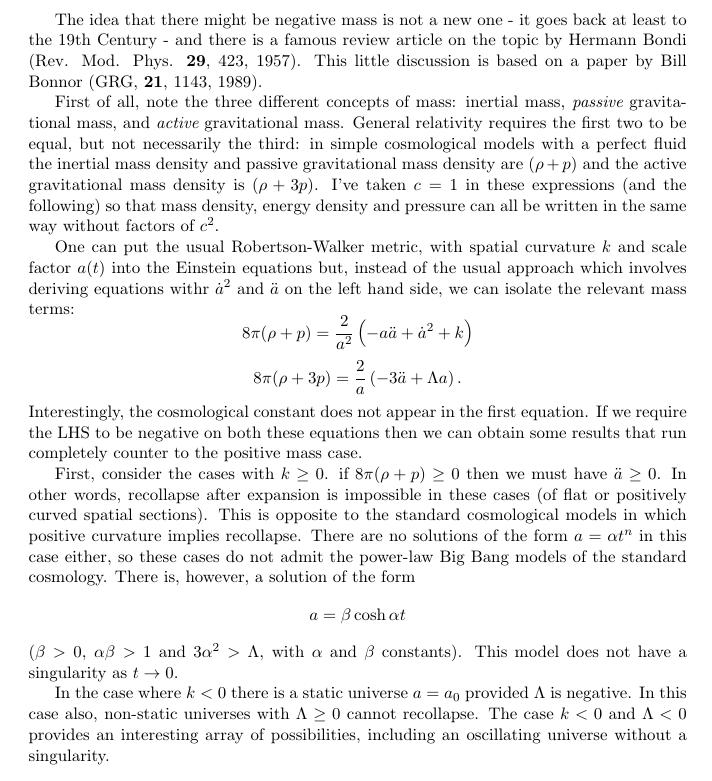
Anyway, Bill Bonnor published a paper in 1989 about Negative Mass in General Relativity. It’s not all about cosmological implications of negative mass, but I’ve just typed up a quick summary. In fact I used some of this in a university examination question many moons ago!

Before reading this, you might wish to look up active the terms gravitational mass, passive gravitational mass, inertial mass and equivalence principle, which you can find discussed here (for example).

Acute Geometry Problem

Posted in Cute Problems, mathematics on December 3, 2018 by telescoper

I saw a plea for help on Twitter from Astronomer Bryan Gaensler who is stuck with his son’s homework.

So please give him a hand by solving this to find a, b and c.

Your time starts now.

Halloween in LaTeX

Posted in History, mathematics on October 21, 2018 by telescoper

I forget where I found this list of spooky LaTeX commands but, with the dreaded Halloween coming up soon, I thought I’d share it here.

Anyway, it reminded of the mathematical curve known in English as The Witch of Agnesi, the witch of which is a mistranslation of the Italian versiera meaning a ‘sheet’ (ie the rope connecting to a ship’s sail) rather than a shortened version of ‘avversiera’ meaning ‘a female devil’ or ‘witch’.

Vector Calculus Weather

Posted in mathematics, The Universe and Stuff with tags , , on October 12, 2018 by telescoper

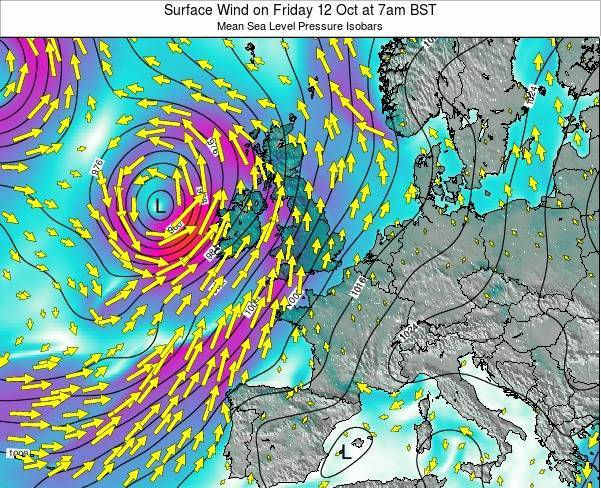
As it happens I did a lecture today about vector fields as part of my module on vector calculus. Whenever I did similar lectures in the past I used the day’s weather map as an illustration, so this morning I downloaded what turned out to be a particularly dramatic example. The curl of the velocity field around the weather system off the west coast of Ireland this morning was definitely non-zero…

Storm Callum turned out to be not as damaging as feared. Apparently it was rather windy in Maynooth overnight, but I slept right through it.

The Problem of the Moving Triangle

Posted in Cute Problems, mathematics with tags , , on August 16, 2018 by telescoper

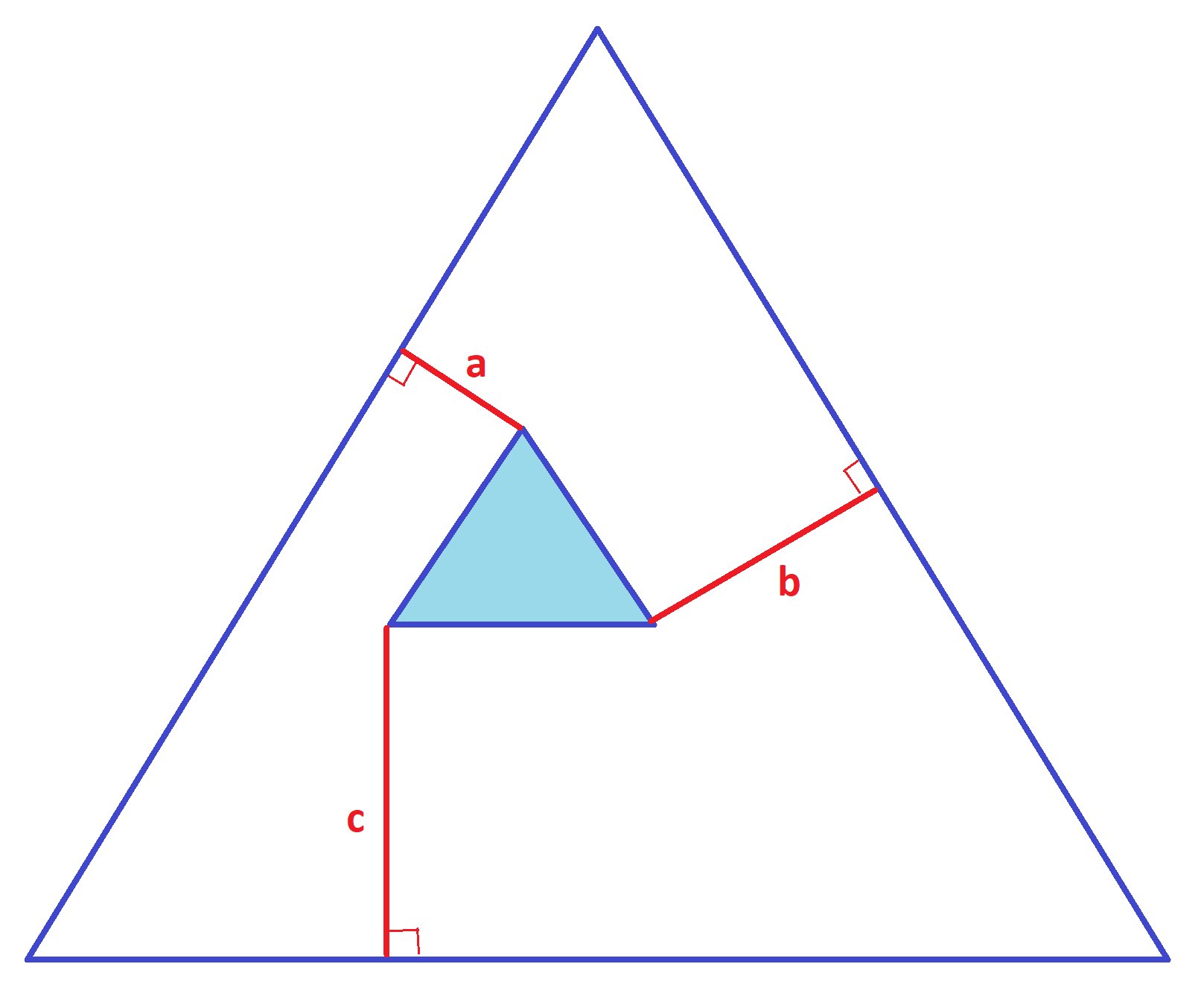
I found this nice geometric puzzle a few days ago on Twitter. It’s not too hard, but I thought I’d put it in the `Cute Problems‘ folder.

In the above diagram, the small equilateral triangle moves about inside the larger one in such a way that it keeps the orientation shown. What can you say about the sum a+b+c?

Answers through the comments box please, and please show your working!

The Problem with Odd Moments

Posted in Bad Statistics, Cute Problems, mathematics with tags , , on July 9, 2018 by telescoper

Last week, realizing that it had been a while since I posted anything in the cute problems folder, I did a quick post before going to a meeting. Unfortunately, as a couple of people pointed out almost immediately, there was a problem with the question (a typo in the form of a misplaced bracket). I took the post offline until I could correct it and then promptly forgot about it. I remembered it yesterday so have now corrected it. I also added a useful integral as a hint at the end, because I’m a nice person. I suggest you start by evaluating the expectation value (i.e. the first-order moment). Answers to parts (2) and (3) through the comments box please!

Answers to (2) and (3) via the comments box please!


SOLUTION: I’ll leave you to draw your own sketch but, as Anton correctly points out, this is a distribution that is asymmetric about its mean but has all odd-order moments equal (including the skewness) equal to zero. it therefore provides a counter-example to common assertions, e.g. that asymmetric distributions must have non-zero skewness. The function shown in the problem was originally given by Stieltjes, but a general discussion can be be found in E. Churchill (1946) Information given by odd moments, Ann. Math. Statist. 17, 244-6. The paper is available online here.

Does Physics need Philosophy (and vice versa)?

Posted in mathematics, The Universe and Stuff with tags , , on June 1, 2018 by telescoper

There’s a new paper on the arXiv by Carlo Rovelli entitled Physics Needs Philosophy. Philosophy Needs Physics. Here is the abstract:

Contrary to claims about the irrelevance of philosophy for science, I argue that philosophy has had, and still has, far more influence on physics than is commonly assumed. I maintain that the current anti-philosophical ideology has had damaging effects on the fertility of science. I also suggest that recent important empirical results, such as the detection of the Higgs particle and gravitational waves, and the failure to detect supersymmetry where many expected to find it, question the validity of certain philosophical assumptions common among theoretical physicists, inviting us to engage in a clearer philosophical reflection on scientific method.

Read and discuss.

When Log Tables aren’t Log Tables

Posted in Education, mathematics, Maynooth with tags , , , , , on May 17, 2018 by telescoper

Every now and then – actually more frequently than that – I reveal myself in Ireland as an ignorant foreigner. The other day some students were going through a past examination paper (from 2014) and I was surprised to see that the front cover (above) mentioned  `log tables’.

Now I’m old enough to remember using tables of logarithms (and other mathematical tables  of such things as square roots and trigonometric functions, in the form of lists of numbers) extensively at school. These were provided in this book of four-figure tables (which can now buy for 1p on Amazon, plus p&p).

As a historical note I’ll point out that I was in the first year at my school that progressed to calculators rather than slide rules (in the third year) so I was never taught how to use the former. My set of four-figure tables which was so heavily used that it was falling to bits anyway, never got much use after that and I threw it out when I went to university despite the fact that I’m a notorious hoarder.

Anyway, assuming that the mention of `log tables’ was a relic of many years past, I said to the group of students going through the old examination paper that it seemed somewhat anachronistic. I was promptly corrected, and told that `log tables’ are in regular use in schools and colleges throughout Ireland, but that the term is a shorthand for a booklet containing a general collection of mathematical formulae, scientific data and other bits of stuff that might come in useful to students; for an example appropriate to the Irish Leaving Certificate, see here. One thing that they don’t contain is a table of logarithms…

Students in Physics & Astronomy at Cardiff University are also given a formula booklet for use during examinations. I don’t remember having access to such a thing as an undergraduate, but I don’t object to it. It seems to me that an examination shouldn’t be a memory test, and giving students the basic formulae as a starting point if anything allows the examiner to concentrate on testing what matters much more, i.e. the ability to formulate and solve a problem. The greatest challenge of science education at University level is, in my opinion, convincing students that their brain is much more than a memory device…