Archive for the mathematics Category

Trump’s Tariff Tirade

Posted in Finance, mathematics, Politics with tags , , , , , , on April 3, 2025 by telescoper

I didn’t watch the speech tirade by “US President” Donald Trump* last night in which he unveiled his new tariff plan, but people have been talking about this all day so I couldn’t resist a quick comment. There’s a lot I don’t know about economics and trade policy but one thing I do know is that the trad-weighted average tariff on goods from the USA entering the EU is about 3%, not the 39% that Trump alleged. I did therefore wonder where he got this number and all his other “reciprocal tariffs” from. Fortunately a little digging around revealed the answer.

On the left you see part of the chart showing tariffs country-by-country and the second is an extract from the published methodology which would be hilarious were the consequences not so serious.

You will see that the second column on the chart is headed “Tariffs charged on the USA”, with 39% listed for the European Union. This number is calculated using the “formula” on the right which has absolutely nothing to do with tariffs charged. Moreover, the denominator contains the product εφ with the values ε=4 and φ=0.25 given in the text so εφ = 1. The expert mathematician who derived this formulae seems to have missed the fact that ε is not less than zero (first sentence) if it is equal to 4, but we’ll let that pass. In fact I can’t be bothered to point out the other errors because no matter how egregious they are, there is no chance of Trumpty Dumpty reversing his decisions anyway.

To sum up, the notional tariff in column 2 is just the difference between imports and exports (the country’s trade surplus) divided by imports. The numbers in the third column of the chart on the left are just half those in the second column (give or take rounding errors). There is also a minimum of 10%, which applies even to countries with which the USA has a trade surplus. China faces huge tariffs because it has a large trade surplus with the USA. The EU’s 20% tariff is nothing to do with the tariffs it charges but is due to the fact that it has a trade surplus with the USA; the UK has a lower tariff rate than the EU because it has a smaller trade surplus  with the USA. That’s it.

I heard a Trump-supporting numpty attempting to justify the calculation shown in the chart on the grounds that it is really an “unfairness index”, it apparently being unfair and worthy of punishment if a country sells more to the USA than the USA sells to it. Following this line of reasoning, I have decided that all shops are unfair because I always buy more from them than they buy from me.

P.S. I was thinking that in future retaliation I should boycott goods from the USA but this would be an empty gesture because I don’t really buy any anyway. Looking up top imports from the USA to Ireland I find, for example, Bourbon (which I never buy because it is undrinkable) and confectionery (which I don’t buy because I don’t have a sweet tooth). Then I found peanuts, which I do buy occasionally, and will not buy in future. However in the grand scheme of world trade, peanuts are small potatoes.

*I apologize for forgetting to mention that Donald Trump is a convicted felon.

Crossword Solution and Problem

Posted in Crosswords, mathematics with tags , , , , on March 22, 2025 by telescoper

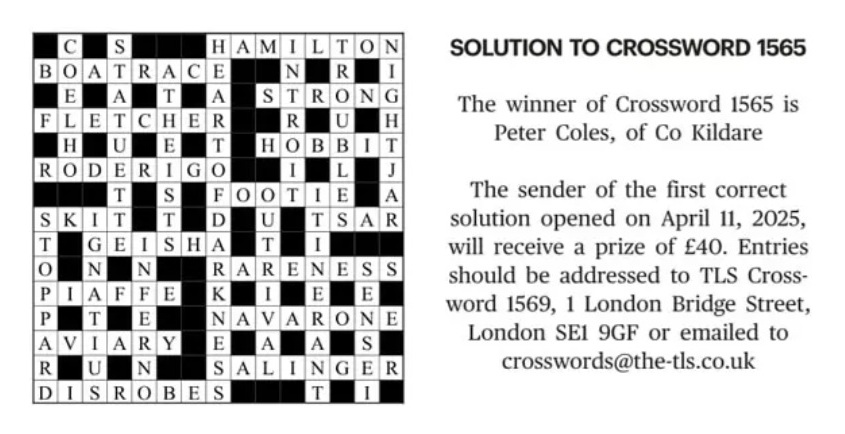
I got an email last week pointing out that I had won another prize in the Times Literary Supplement crossword competition 1565. They have modernised at the TLS, so instead of sending a cheque for the winnings, they pay by bank transfer and wanted to check whether my details had changed since last time. You can submit by email nowadays too, which saves a bit in postage.

Anyway, I checked this week’s online edition and found this for proof:

I checked when I last won this competition, which I enter just about every week, and found that it was number 1514, almost exactly a year ago. There are 50 competitions per year rather than 52, because there are double issues at Christmas and in August, so it’s actually just over a year (51 puzzles) since I last won. I’ve won the crossword prize quite a few times but haven’t been very careful at keeping track of the dates. I think it’s been about once a year since I started entering.

All this suggested to me a little problem I devised when I was teaching probability and statistics many years ago:

Let’s assume that  the same number of correct entries, N, is submitted for each competition. The winner each time is drawn randomly from among these N. If there are 50 competitions in a year and I submit a correct answer each time, winning once in these 50 submissions, then what can I infer about N?

Answers on a postcard, via email, or, preferably, via the Comments!

If Oscar Wilde were a Torus

Posted in mathematics with tags , , , , on March 3, 2025 by telescoper

Beautiful Equations

Posted in Biographical, mathematics, The Universe and Stuff with tags , , , , on February 25, 2025 by telescoper

I did a lecture today about the Dirac Equation (which is almost 100 years old, having been first presented in 1928). You might think this is a difficult topic to lecture on, but it’s really a piece of cake:

This reminds me that a a while ago I posted about an interesting article on the BBC website that discussed the way mathematicians’ brains appear to perceive “beauty”. A (slightly) more technical version of the story can be found here. According to functional magnetic resonance imaging studies, it seems that beautiful equations excite the same sort of brain activity as beautiful music or art.

The question of why we think equations are beautiful is one that has come up a number of times on this blog. I suspect the answer is a slightly different one for theoretical physicists compared with pure mathematicians. Anyway, I thought it might be fun to invite people offer suggestions through the comments box as to the most beautiful equation along with a brief description of why.

I should set the ball rolling myself, and I will do so with the Dirac Equation:

dirac_equation

This equation is certainly the most beautiful thing I’ve ever come across in theoretical physics, though I don’t find it easy to articulate precisely why. I think it’s partly because it is such a wonderfully compact fusion of two historic achievements in physics – special relativity and quantum mechanics – but also partly because of the great leaps of the imagination that were needed along the journey to derive it and my consequent admiration for the intellectual struggle involved. I feel it is therefore as much an emotional response to the achievement of another human being – such as one feels when hearing great music or looking at great art – as it is a rational response to the mathematical structure involved. But it’s not just that, of course. The Dirac Equation paved the way to many further developments in particle physics. It seems to encapsulate so much about the behaviour of elementary particles in so few symbols. Some of its beauty derives from its compactness- it uses up less chalk in a mathematical physics lecture.

Anyway, feel free to suggest formulae or equations, preferably with a brief explanation of why you think they’re so beautiful.

P.S. Paul Dirac was my (academic) great-grandfather.

Introducing the Clartiverse™

Posted in Education, mathematics with tags , , , , on February 16, 2025 by telescoper

The recent decision by Maynooth University to appoint a Ranking Strategy and Insights Officer in an attempt to raise the University’s position in university league tables has inspired me to create a new spinout company to provide a service for higher education institutions who want to improve their standing in rankings while avoiding the expense and complication of actually improving the institution or indeed while continuing to pursue policies that drive performance in the opposite direction.

I have decided to name my new company CLARTIVERT™ and the extensive suite of services we will provide is called the Clartiverse™.

The idea of CLARTIVERT™ is to produce, in return for a modest payment equivalent to the salary cost of a Ranking Strategy and Insights Officer, a bespoke league table that guarantees a specified position for any given institution. This can be either your own institution whose position you would like to raise or some competitor institution that you wish to lower. We then promote the league table thus constructed in the world’s media (who seem to like this sort of thing).

The idea behind this company is that the existing purveyors of rankings deliberately manufacture artificial “churn” in the league tables by changing their weighting model every year. Why not take this process to its logical conclusion? Our not-at-all dodgy software works by including so many metrics that an appropriate combination can always be chosen to propel any institution to the top (or bottom). We then produce We achieve all this by deplying a highly sophisticated branch of mathematics called Linear Algebra which we dress up in the fancy terms “Machine Learning” and  “Artificial Intelligence” to impress potential buyers.

To begin we will concentrate on research assessment. This is, of course, covered by existing league tables but our approach is radically different. We will desploy a vastly expanded set of metrics, many of which are currently unused. For example, on top of the usual bibliometric indicators like citation counts and numbers of published papers, we add number of authors, number of authors whose names start with a given letter of the alphabet, letter frequencies occuring in published texts, etc. We adopt a similar approach to other indicators, such as number of academic staff, number of PhD students, number of research managers, initial letters of names of people in these different categories, distribution of salaries for each, and so on.

As well as these quantities themselves we calculate mathematical functions of them, including polynomials, exponentials, logarithms and trigonometricfunctions; sine and cosine have proved very useful in early testing. All these indicators are combined in various ways: not only added, but also subtracted, multiplied, and/or divided until a weighted combination can be found that places your institution ahead of all the others.

In future we will roll out additional elements of the Clartiverse™ to cover other aspects of higher education including not only teaching and student satisfaction but also more important things such as commercialisation and financial impropriety.

P.S. The name Clartiver is derived from the word clart and is not to be confused with that of any other companies providing similar but less impressive services.

Marking Progress

Posted in Biographical, Education, mathematics, Maynooth with tags , on January 14, 2025 by telescoper

I’ve been at home marking examinations almost all day and have decided to knock off until tomorrow when hopefully I can finish the job. I say almost all day because I took a break this afternoon to back to campus to collect some papers that I didn’t get yesterday because they were from students sitting the examination for various reasons in alternative venues on campus rather than the main examination room.

What I do with examination scripts is mark one question at a time rather than one script at a time. What I mean by that is that I go through every script marking all the attempts at Question 1, then I start again and do all the Questions 2, etc. I find that this is much quicker and more efficient than marking all the questions in each script then moving onto the next script. The reason for this is that I can upload into my mind the model answer for Question 1 so that it stays there while I mark dozens of attempts at it so I don’t have to keep referring to the marking scheme. Other advantages are that it’s easier to be consistent in giving partial credit when you’re doing the same question over and over again, and that also you spot what the common mistakes are more easily.

It’s a fairly monotonous job and I find my concentration starts to wander if I try to do too many in one go. Fortunately the exam papers are organized in batches (separated by elastic bands as in the photograph) so I usuallly take a break – as a sort of self-reward- after each batch to break things up. Each batch usually takes a couple of hours or so, so the breaks often end up as times to have lunch and tea. In terms of the timing it’s rather like a game of cricket, actually.

Today I corrected Question 1 in two batches before lunch, then another between lunch and tea. At that point I took a walk into town to do a few errands and then collected the remaining scripts from campus, which I have now just finished correcting. Some people will accuse me of being lazy, taking breaks like this, but I think it’s more efficient to do it this way. Trying to mark examinations for hours on end inevitably leads to more errors, so in the long run it takes longer to complete the job. Slow and steady does it.

I remember using a similar approach when I wrote my thesis many years ago. That’s a much bigger job, of course, but I found what worked for me was to plan out each chapter in terms of sections of roughly equal length, write each in turn and take a break when I’d finished it. Writing a thesis of around 200 pages may seem a daunting task, but if you split it into 1000-word chunks spread over three months or so it’s quite manageable – and you can plan to take time out for relaxtion along the way to avoid getting too burned out by the process.

Anyway, I’ve now finished all the attempts at Question 1 in this examination, including those in the extra scripts I picked up today. Question 1 consists of a set of short problems and is altogether worth 50% of the examination mark, so I’m actually abouty halfway through the marking. There three questions left, each longer than the pieces of Question 1 and worth 25% of the overall mark. Students are supposed to answer two. I’ll start on Question 2 in the morning and hopefully by this time tomorrow evening I will have marked all three, and that will be that. Until the next one…

Marking Time Again

Posted in Education, mathematics, Maynooth with tags , on January 13, 2025 by telescoper

Lecturers at Maynooth University are supposed to be available on the telephone to deal with queries from students concerning their examinations. This morning I was “on call” for the first time in 2025 and indeed the first time since 2023. Since I live in Maynooth I decided to come into campus in case of a query so I could go to the examination hall to deal with it if required. In the event, however, the examination passed off without incident and nobody called.

I wasn’t twiddling my thumbs all morning though. It seemed a good opportunity to go through the accumulated coursework for this module applying various exemptions for medical or other reasons so that when I’ve marked the scripts I can immediately combine the results with the CA component.

So here I am again, with a stack of an examination scripts to mark. The picture shows about 50 papers, part of the collection from my module on Differential Equations and Transform Methods. I want to get them out of the way as quickly as possible as I have another paper coming up next week and have a lot of other things to do before term starts at the beginning of February. I plan to spend the next couple of days correcting these, adding up the marks, combining those with the coursework, and preparing everything for upload to the system. I want to get this task out of the way as quickly as possible as I have another paper coming up next week and have a lot of other things to do before term starts at the beginning of February.

Google Garbage

Posted in History, mathematics with tags , on January 5, 2025 by telescoper

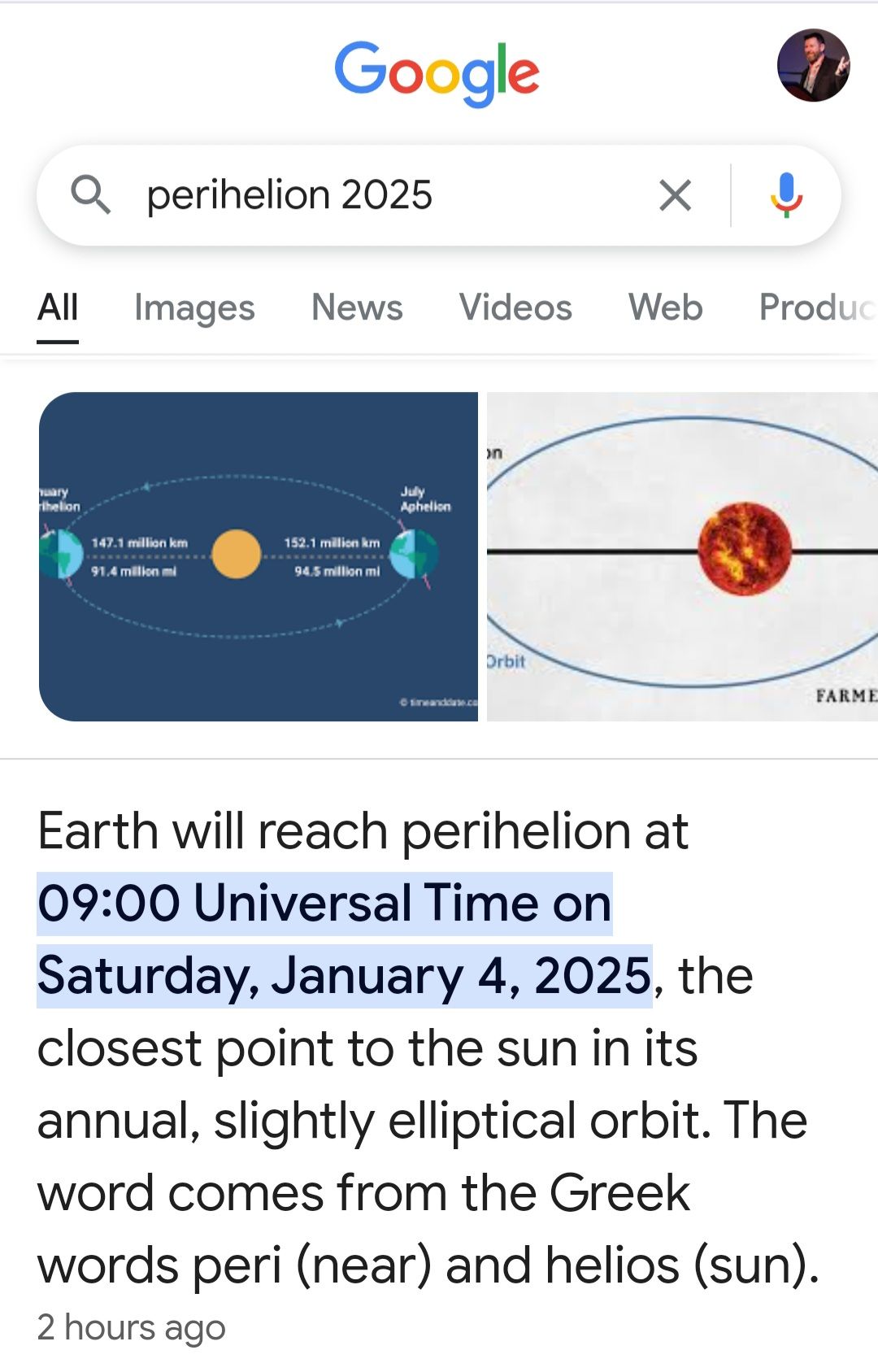
In the course of double-checking the time of perihelion for yesterday’s post I did a quick Google search. What came up first was this:

Google search results nowadays are prefaced by a short summary like this one, presumably generated by some sort of AI. This one – like many others I’ve seen recently – is just plain wrong. The time of perihelion was 13.28 Universal Time, not 09.00.

I am old enough to remember when Google Search first appeared in 1998. It was so much better than other search engines at that time, largely because of the PageRank algorithm; see this piece for a bit of the history and the reason it worked so well. Some years ago, however, Google Search underwent a transition from being a useful facility for web browsers to a piece of adtech useful only for marketing companies who pay to have their sites artificially boosted. Every time you do a search nowadays you have to scroll through a deluge of promoted pages that have very little to do with what you searched for. Google is now so corrupted as to be virtually useless. Adding garbled AI junk to the mixture is just making it worse. It’s not only frustrating but potentially dangerous. Information can be manipulated for purposes other than selling things; the systematic spread of misinformation by those in power has potentially catastrophic consequences.

Midpoint at Maynooth

Posted in Biographical, Education, mathematics, Maynooth with tags , , , , on November 11, 2024 by telescoper

Amid all the excitement last week I forgot that it was the sixth teaching week of the Semester. That means that we’re now past the halfway point. Among other things that meant that examination papers were due in on Friday (8th November). That means two papers for each module I’m teaching, one to be sat in January and another for the repeat opportunity in August, so that’s four altogether.

I always find setting examination questions very difficult. In theoretical physics we want to stretch the stronger candidates at the same time as allowing the weaker ones to show what they can do. It’s a perennial problem how to make the questions neither too easy nor too difficult, but it is compounded this time by the fact that I’m teaching two modules for the very first time so judging the right level is tricky.

Another issue is that I’m once again in a situation in which I have to set examination papers without having taught all the material. At least I’ve covered the first half of the content so I have some idea of what the students found difficult, but that’s not the case for the second half. It should be a bit easier next year once I’ve experience of covering the whole syllabus. Assuming, of course, that I’m teaching the same modules again next year, which is by no means guaranteed…

I’m teaching a module on Differential Equations and Complex Analysis for 4th year students and just about ready to switch to the part that comes after the and. I taught a bit of Complex Analysis when I was at Sussex and I’m quite looking forward to it, although it does pose a particular challenge. Some of the class are doing a Double Major in Theoretical Physics and Mathematics, and have done quite a lot of Complex Analysis before, while others are doing a Single Major in Theoretical Physics and haven’t really done any. I have to somehow find a way to satisfy these two different groups. The only way I can think of to do that is to teach the subject as a physicist rather than a pure mathematician, with an emphasis on examples and real-world applications rather than in the abstract. We’ll see how this works out over the next few weeks.

P.S. On the subject of Complex Analysis, I just remembered this post from a few years ago.

Sturm und Liouville

Posted in Biographical, Education, mathematics with tags , , , , , on October 4, 2024 by telescoper

It’s Friday afternoon at the end of Week 2 here at Maynooth so I’ve now completed the 4th lecture of my 4th-year module Differential Equations and Complex Analysis. We’ve now in the section of Sturm-Liouville Theory. I’ve never taught this module before and, as always, teaching a new thing reminds me of all the things I had forgotten since I was a student. In this particular case, I still have the notes I took when I was studying this topic as an undergraduate. It’s scary to think the notes shown above were written by me 40 years ago!

Anyway, as I like to know something about the people behind the names, Sturm-Liouville Theory is named after Jacques Charles François Sturm (1803–1855)* and Joseph Liouville (1809–1882). Contrary to what I’d always assumed, Sturm was not German but was born in Geneva, which is now in Switzerland but which had been annexed by revolutionary France in 1798 so technically speaking he was born in France. Liouville was born in Saint-Omer, near Calais, which to my knowledge has never been part of Switzerland but has been part of the Spanish Netherlands.

*Given the dates, Sturm must have collaborated with Liouville after his earlier work with Drang