Archive for the mathematics Category

Introducing the Clartiverse™

Posted in Education, mathematics with tags , , , , on February 16, 2025 by telescoper

The recent decision by Maynooth University to appoint a Ranking Strategy and Insights Officer in an attempt to raise the University’s position in university league tables has inspired me to create a new spinout company to provide a service for higher education institutions who want to improve their standing in rankings while avoiding the expense and complication of actually improving the institution or indeed while continuing to pursue policies that drive performance in the opposite direction.

I have decided to name my new company CLARTIVERT™ and the extensive suite of services we will provide is called the Clartiverse™.

The idea of CLARTIVERT™ is to produce, in return for a modest payment equivalent to the salary cost of a Ranking Strategy and Insights Officer, a bespoke league table that guarantees a specified position for any given institution. This can be either your own institution whose position you would like to raise or some competitor institution that you wish to lower. We then promote the league table thus constructed in the world’s media (who seem to like this sort of thing).

The idea behind this company is that the existing purveyors of rankings deliberately manufacture artificial “churn” in the league tables by changing their weighting model every year. Why not take this process to its logical conclusion? Our not-at-all dodgy software works by including so many metrics that an appropriate combination can always be chosen to propel any institution to the top (or bottom). We then produce We achieve all this by deplying a highly sophisticated branch of mathematics called Linear Algebra which we dress up in the fancy terms “Machine Learning” and  “Artificial Intelligence” to impress potential buyers.

To begin we will concentrate on research assessment. This is, of course, covered by existing league tables but our approach is radically different. We will desploy a vastly expanded set of metrics, many of which are currently unused. For example, on top of the usual bibliometric indicators like citation counts and numbers of published papers, we add number of authors, number of authors whose names start with a given letter of the alphabet, letter frequencies occuring in published texts, etc. We adopt a similar approach to other indicators, such as number of academic staff, number of PhD students, number of research managers, initial letters of names of people in these different categories, distribution of salaries for each, and so on.

As well as these quantities themselves we calculate mathematical functions of them, including polynomials, exponentials, logarithms and trigonometricfunctions; sine and cosine have proved very useful in early testing. All these indicators are combined in various ways: not only added, but also subtracted, multiplied, and/or divided until a weighted combination can be found that places your institution ahead of all the others.

In future we will roll out additional elements of the Clartiverse™ to cover other aspects of higher education including not only teaching and student satisfaction but also more important things such as commercialisation and financial impropriety.

P.S. The name Clartiver is derived from the word clart and is not to be confused with that of any other companies providing similar but less impressive services.

Marking Progress

Posted in Biographical, Education, mathematics, Maynooth with tags , on January 14, 2025 by telescoper

I’ve been at home marking examinations almost all day and have decided to knock off until tomorrow when hopefully I can finish the job. I say almost all day because I took a break this afternoon to back to campus to collect some papers that I didn’t get yesterday because they were from students sitting the examination for various reasons in alternative venues on campus rather than the main examination room.

What I do with examination scripts is mark one question at a time rather than one script at a time. What I mean by that is that I go through every script marking all the attempts at Question 1, then I start again and do all the Questions 2, etc. I find that this is much quicker and more efficient than marking all the questions in each script then moving onto the next script. The reason for this is that I can upload into my mind the model answer for Question 1 so that it stays there while I mark dozens of attempts at it so I don’t have to keep referring to the marking scheme. Other advantages are that it’s easier to be consistent in giving partial credit when you’re doing the same question over and over again, and that also you spot what the common mistakes are more easily.

It’s a fairly monotonous job and I find my concentration starts to wander if I try to do too many in one go. Fortunately the exam papers are organized in batches (separated by elastic bands as in the photograph) so I usuallly take a break – as a sort of self-reward- after each batch to break things up. Each batch usually takes a couple of hours or so, so the breaks often end up as times to have lunch and tea. In terms of the timing it’s rather like a game of cricket, actually.

Today I corrected Question 1 in two batches before lunch, then another between lunch and tea. At that point I took a walk into town to do a few errands and then collected the remaining scripts from campus, which I have now just finished correcting. Some people will accuse me of being lazy, taking breaks like this, but I think it’s more efficient to do it this way. Trying to mark examinations for hours on end inevitably leads to more errors, so in the long run it takes longer to complete the job. Slow and steady does it.

I remember using a similar approach when I wrote my thesis many years ago. That’s a much bigger job, of course, but I found what worked for me was to plan out each chapter in terms of sections of roughly equal length, write each in turn and take a break when I’d finished it. Writing a thesis of around 200 pages may seem a daunting task, but if you split it into 1000-word chunks spread over three months or so it’s quite manageable – and you can plan to take time out for relaxtion along the way to avoid getting too burned out by the process.

Anyway, I’ve now finished all the attempts at Question 1 in this examination, including those in the extra scripts I picked up today. Question 1 consists of a set of short problems and is altogether worth 50% of the examination mark, so I’m actually abouty halfway through the marking. There three questions left, each longer than the pieces of Question 1 and worth 25% of the overall mark. Students are supposed to answer two. I’ll start on Question 2 in the morning and hopefully by this time tomorrow evening I will have marked all three, and that will be that. Until the next one…

Marking Time Again

Posted in Education, mathematics, Maynooth with tags , on January 13, 2025 by telescoper

Lecturers at Maynooth University are supposed to be available on the telephone to deal with queries from students concerning their examinations. This morning I was “on call” for the first time in 2025 and indeed the first time since 2023. Since I live in Maynooth I decided to come into campus in case of a query so I could go to the examination hall to deal with it if required. In the event, however, the examination passed off without incident and nobody called.

I wasn’t twiddling my thumbs all morning though. It seemed a good opportunity to go through the accumulated coursework for this module applying various exemptions for medical or other reasons so that when I’ve marked the scripts I can immediately combine the results with the CA component.

So here I am again, with a stack of an examination scripts to mark. The picture shows about 50 papers, part of the collection from my module on Differential Equations and Transform Methods. I want to get them out of the way as quickly as possible as I have another paper coming up next week and have a lot of other things to do before term starts at the beginning of February. I plan to spend the next couple of days correcting these, adding up the marks, combining those with the coursework, and preparing everything for upload to the system. I want to get this task out of the way as quickly as possible as I have another paper coming up next week and have a lot of other things to do before term starts at the beginning of February.

Google Garbage

Posted in History, mathematics with tags , on January 5, 2025 by telescoper

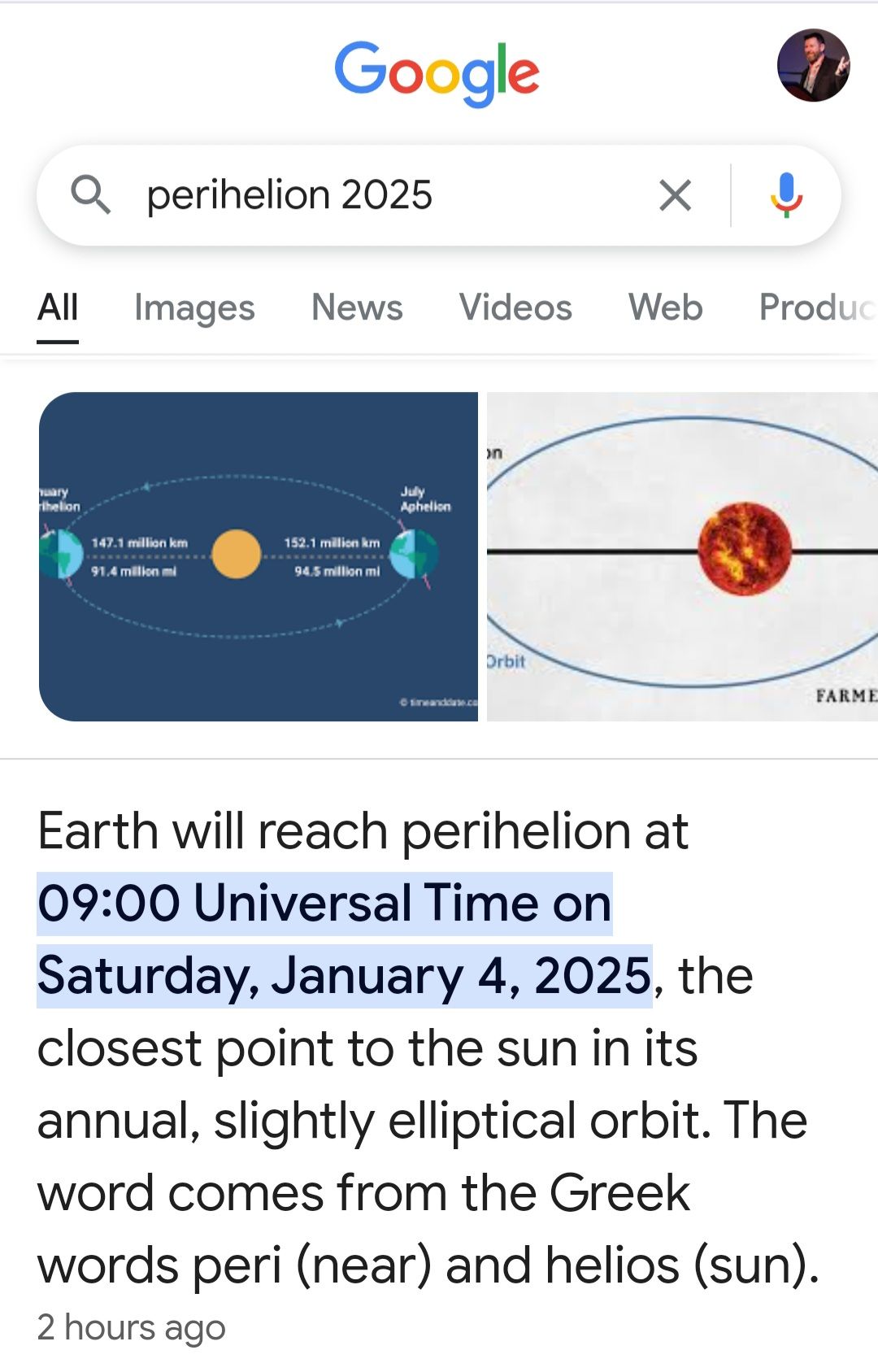
In the course of double-checking the time of perihelion for yesterday’s post I did a quick Google search. What came up first was this:

Google search results nowadays are prefaced by a short summary like this one, presumably generated by some sort of AI. This one – like many others I’ve seen recently – is just plain wrong. The time of perihelion was 13.28 Universal Time, not 09.00.

I am old enough to remember when Google Search first appeared in 1998. It was so much better than other search engines at that time, largely because of the PageRank algorithm; see this piece for a bit of the history and the reason it worked so well. Some years ago, however, Google Search underwent a transition from being a useful facility for web browsers to a piece of adtech useful only for marketing companies who pay to have their sites artificially boosted. Every time you do a search nowadays you have to scroll through a deluge of promoted pages that have very little to do with what you searched for. Google is now so corrupted as to be virtually useless. Adding garbled AI junk to the mixture is just making it worse. It’s not only frustrating but potentially dangerous. Information can be manipulated for purposes other than selling things; the systematic spread of misinformation by those in power has potentially catastrophic consequences.

Midpoint at Maynooth

Posted in Biographical, Education, mathematics, Maynooth with tags , , , , on November 11, 2024 by telescoper

Amid all the excitement last week I forgot that it was the sixth teaching week of the Semester. That means that we’re now past the halfway point. Among other things that meant that examination papers were due in on Friday (8th November). That means two papers for each module I’m teaching, one to be sat in January and another for the repeat opportunity in August, so that’s four altogether.

I always find setting examination questions very difficult. In theoretical physics we want to stretch the stronger candidates at the same time as allowing the weaker ones to show what they can do. It’s a perennial problem how to make the questions neither too easy nor too difficult, but it is compounded this time by the fact that I’m teaching two modules for the very first time so judging the right level is tricky.

Another issue is that I’m once again in a situation in which I have to set examination papers without having taught all the material. At least I’ve covered the first half of the content so I have some idea of what the students found difficult, but that’s not the case for the second half. It should be a bit easier next year once I’ve experience of covering the whole syllabus. Assuming, of course, that I’m teaching the same modules again next year, which is by no means guaranteed…

I’m teaching a module on Differential Equations and Complex Analysis for 4th year students and just about ready to switch to the part that comes after the and. I taught a bit of Complex Analysis when I was at Sussex and I’m quite looking forward to it, although it does pose a particular challenge. Some of the class are doing a Double Major in Theoretical Physics and Mathematics, and have done quite a lot of Complex Analysis before, while others are doing a Single Major in Theoretical Physics and haven’t really done any. I have to somehow find a way to satisfy these two different groups. The only way I can think of to do that is to teach the subject as a physicist rather than a pure mathematician, with an emphasis on examples and real-world applications rather than in the abstract. We’ll see how this works out over the next few weeks.

P.S. On the subject of Complex Analysis, I just remembered this post from a few years ago.

Sturm und Liouville

Posted in Biographical, Education, mathematics with tags , , , , , on October 4, 2024 by telescoper

It’s Friday afternoon at the end of Week 2 here at Maynooth so I’ve now completed the 4th lecture of my 4th-year module Differential Equations and Complex Analysis. We’ve now in the section of Sturm-Liouville Theory. I’ve never taught this module before and, as always, teaching a new thing reminds me of all the things I had forgotten since I was a student. In this particular case, I still have the notes I took when I was studying this topic as an undergraduate. It’s scary to think the notes shown above were written by me 40 years ago!

Anyway, as I like to know something about the people behind the names, Sturm-Liouville Theory is named after Jacques Charles François Sturm (1803–1855)* and Joseph Liouville (1809–1882). Contrary to what I’d always assumed, Sturm was not German but was born in Geneva, which is now in Switzerland but which had been annexed by revolutionary France in 1798 so technically speaking he was born in France. Liouville was born in Saint-Omer, near Calais, which to my knowledge has never been part of Switzerland but has been part of the Spanish Netherlands.

*Given the dates, Sturm must have collaborated with Liouville after his earlier work with Drang

Back to Teaching

Posted in Education, mathematics, Maynooth with tags , , on September 24, 2024 by telescoper

So, after an absence from teaching of over a year, this afternoon I returned to the lecture theatre to give a double session on the module EE206 Differential Equations and Transform Methods. I was a bit apprehensive about having a two-hour slot and it is fair to say that I felt a bit knackered after it, but `then I am getting on a bit. I did have time for a ten-minute break in the middle during which the students could relax and stretch their legs a little. Some of them even came back afterwards.

This module is meant for students on two courses, Electronic Engineering and Robotics and Intelligent Devices, so I will have to think of relevant examples. I’ve got the RLC circuit, of course, but I’ll have to more than that!

If you’re interested you can find an old summary of the module here to see what topics are covered.

The good news from my point of view is that I have a decent room to teach in – complete with chalk boards – and the students seemed pleasant and engaged. I always like to get some interaction going in my classes so it was good to find a reasonable number of people willing to offer answers to questions I asked and indeed willing to ask me questions or request clarification. Overall, I was quite pleased with how it went. You will have to ask the students to see if they agree. At any rate I did manage to get through everything I planned to cover. The class size is about 55, incidentally.

Anyway, today I just warmed up for the module with some revision of basic calculus. I had pessimistically imagined that the students would have forgotten what they did in the first year about this, but in fact quite a few of them remembered quite a lot. I have my second session with this group on Thursday, though that should be a bit easier as it is only one hour instead of two. I will start differential equations proper then.

My remaining teaching sessions this week are all in the Arts Building. I have been quite worried that the rooms I am supposed to use would not be ready in time, but I took a walk around yesterday morning and they are ready (although construction work is going on elsewhere in the block). I was thinking I might have to give these lectures via a remote connection from home as in the old days of the pandemic, but that fortunately is not the case.

Lá Saoire i mí Lúnasa

Posted in Biographical, Education, mathematics, Maynooth with tags , , , on August 5, 2024 by telescoper

Today, Monday 5th August 2024, being the first Monday in August, is a Bank Holiday in Ireland. This holiday was created by the Bank Holiday Act of 1871 when Ireland was under British rule. While the August Bank holiday was subsequently moved to the end of August in England and Wales, it has remained at the start of August in Ireland. Today is also a Bank Holiday in Scotland, though the Scots have the best of both worlds and have a holiday at the end of August too.

The first day of August marks the old pagan festival of Lughnasadh, named after the God Lugh, on which is celebrated the beginning of the harvest season. This coincides with the English Lammas Day one of many Christian festivals with pagan origins. Traditionally this marks the start of the harvest season and is celebrated accordingly, with rites involving the first fruit and bread baked from flour obtained from the first corn. It is also one of the cross-quarter days, lying roughly half-way between the Summer Solstice and the Autumnal Equinox (in the Northern Hemisphere).

It seems to be a tradition in Maynooth that the Bank Holidays in May and August are are adjacent to examinations. This year they start on Wednesday (7th August). I am, however, still on sabbatical so I don’t have any correcting duties. That doesn’t mean I can’t wish all the students taking repeat examinations all the best in their endeavours.

This month is the last of my sabbatical. I officially return to normal duties on 1st September, but that is a Sunday so I won’t return to the office until Monday 2nd September. That is if I have an office. There’s a lot of reorganization going on and currently I don’t know where I’ll be based. At least I know what I’ll be teaching in Semester 1 though: a fourth-year Mathematical physics course on Differential Equations and Complex Analysis and a second-year Engineering Mathematics course. These are not what I would have chosen if I had a free hand (I’d rather teach physics than mathematical methods) but I’ve had it excessively easy for the last year so can’t complain. With a bit of luck I might get a project student or two as well, if the students haven’t forgotten who I am!

Cosmology Talks – To Infinity and Beyond (Probably)

Posted in mathematics, The Universe and Stuff with tags , , , , , , , , , , , , , on March 20, 2024 by telescoper

Here’s an interestingly different talk in the series of Cosmology Talks curated by Shaun Hotchkiss. The speaker, Sylvia Wenmackers, is a philosopher of science. According to the blurb on Youtube:

Her focus is probability and she has worked on a few theories that aim to extend and modify the standard axioms of probability in order to tackle paradoxes related to infinite spaces. In particular there is a paradox of the “infinite fair lottery” where within standard probability it seems impossible to write down a “fair” probability function on the integers. If you give the integers any non-zero probability, the total probability of all integers is unbounded, so the function is not normalisable. If you give the integers zero probability, the total probability of all integers is also zero. No other option seems viable for a fair distribution. This paradox arises in a number of places within cosmology, especially in the context of eternal inflation and a possible multiverse of big bangs bubbling off. If every bubble is to be treated fairly, and there will ultimately be an unbounded number of them, how do we assign probability? The proposed solutions involve hyper-real numbers, such as infinitesimals and infinities with different relative sizes, (reflecting how quickly things converge or diverge respectively). The multiverse has other problems, and other areas of cosmology where this issue arises also have their own problems (e.g. the initial conditions of inflation); however this could very well be part of the way towards fixing the cosmological multiverse.

The paper referred to in the presentation can be found here. There is a lot to digest in this thought-provoking talk, from the starting point on Kolmogorov’s axioms to the application to the multiverse, but this video gives me an excuse to repeat my thoughts on infinities in cosmology.

Most of us – whether scientists or not – have an uncomfortable time coping with the concept of infinity. Physicists have had a particularly difficult relationship with the notion of boundlessness, as various kinds of pesky infinities keep cropping up in calculations. In most cases this this symptomatic of deficiencies in the theoretical foundations of the subject. Think of the ‘ultraviolet catastrophe‘ of classical statistical mechanics, in which the electromagnetic radiation produced by a black body at a finite temperature is calculated to be infinitely intense at infinitely short wavelengths; this signalled the failure of classical statistical mechanics and ushered in the era of quantum mechanics about a hundred years ago. Quantum field theories have other forms of pathological behaviour, with mathematical components of the theory tending to run out of control to infinity unless they are healed using the technique of renormalization. The general theory of relativity predicts that singularities in which physical properties become infinite occur in the centre of black holes and in the Big Bang that kicked our Universe into existence. But even these are regarded as indications that we are missing a piece of the puzzle, rather than implying that somehow infinity is a part of nature itself.

The exception to this rule is the field of cosmology. Somehow it seems natural at least to consider the possibility that our cosmos might be infinite, either in extent or duration, or both, or perhaps even be a multiverse comprising an infinite collection of sub-universes. If the Universe is defined as everything that exists, why should it necessarily be finite? Why should there be some underlying principle that restricts it to a size our human brains can cope with?

On the other hand, there are cosmologists who won’t allow infinity into their view of the Universe. A prominent example is George Ellis, a strong critic of the multiverse idea in particular, who frequently quotes David Hilbert

The final result then is: nowhere is the infinite realized; it is neither present in nature nor admissible as a foundation in our rational thinking—a remarkable harmony between being and thought

But to every Hilbert there’s an equal and opposite Leibniz

I am so in favor of the actual infinite that instead of admitting that Nature abhors it, as is commonly said, I hold that Nature makes frequent use of it everywhere, in order to show more effectively the perfections of its Author.

You see that it’s an argument with quite a long pedigree!

Many years ago I attended a lecture by Alex Vilenkin, entitled The Principle of Mediocrity. This was a talk based on some ideas from his book Many Worlds in One: The Search for Other Universes, in which he discusses some of the consequences of the so-called eternal inflation scenario, which leads to a variation of the multiverse idea in which the universe comprises an infinite collection of causally-disconnected “bubbles” with different laws of low-energy physics applying in each. Indeed, in Vilenkin’s vision, all possible configurations of all possible things are realised somewhere in this ensemble of mini-universes.

One of the features of this scenario is that it brings the anthropic principle into play as a potential “explanation” for the apparent fine-tuning of our Universe that enables life to be sustained within it. We can only live in a domain wherein the laws of physics are compatible with life so it should be no surprise that’s what we find. There is an infinity of dead universes, but we don’t live there.

I’m not going to go on about the anthropic principle here, although it’s a subject that’s quite fun to write or, better still, give a talk about, especially if you enjoy winding people up! What I did want to say mention, though, is that Vilenkin correctly pointed out that three ingredients are needed to make this work:

  1. An infinite ensemble of realizations
  2. A discretizer
  3. A randomizer

Item 2 involves some sort of principle that ensures that the number of possible states of the system we’re talking about  is not infinite. A very simple example from  quantum physics might be the two spin states of an electron, up (↑) or down(↓). No “in-between” states are allowed, according to our tried-and-tested theories of quantum physics, so the state space is discrete.  In the more general context required for cosmology, the states are the allowed “laws of physics” ( i.e. possible  false vacuum configurations). The space of possible states is very much larger here, of course, and the theory that makes it discrete much less secure. In string theory, the number of false vacua is estimated at 10500. That’s certainly a very big number, but it’s not infinite so will do the job needed.

Item 3 requires a process that realizes every possible configuration across the ensemble in a “random” fashion. The word “random” is a bit problematic for me because I don’t really know what it’s supposed to mean. It’s a word that far too many scientists are content to hide behind, in my opinion. In this context, however, “random” really means that the assigning of states to elements in the ensemble must be ergodic, meaning that it must visit the entire state space with some probability. This is the kind of process that’s needed if an infinite collection of monkeys is indeed to type the (large but finite) complete works of shakespeare. It’s not enough that there be an infinite number and that the works of shakespeare be finite. The process of typing must also be ergodic.

Now it’s by no means obvious that monkeys would type ergodically. If, for example, they always hit two adjoining keys at the same time then the process would not be ergodic. Likewise it is by no means clear to me that the process of realizing the ensemble is ergodic. In fact I’m not even sure that there’s any process at all that “realizes” the string landscape. There’s a long and dangerous road from the (hypothetical) ensembles that exist even in standard quantum field theory to an actually existing “random” collection of observed things…

More generally, the mere fact that a mathematical solution of an equation can be derived does not mean that that equation describes anything that actually exists in nature. In this respect I agree with Alfred North Whitehead:

There is no more common error than to assume that, because prolonged and accurate mathematical calculations have been made, the application of the result to some fact of nature is absolutely certain.

It’s a quote I think some string theorists might benefit from reading!

Items 1, 2 and 3 are all needed to ensure that each particular configuration of the system is actually realized in nature. If we had an infinite number of realizations but with either infinite number of possible configurations or a non-ergodic selection mechanism then there’s no guarantee each possibility would actually happen. The success of this explanation consequently rests on quite stringent assumptions.

I’m a sceptic about this whole scheme for many reasons. First, I’m uncomfortable with infinity – that’s what you get for working with George Ellis, I guess. Second, and more importantly, I don’t understand string theory and am in any case unsure of the ontological status of the string landscape. Finally, although a large number of prominent cosmologists have waved their hands with commendable vigour, I have never seen anything even approaching a rigorous proof that eternal inflation does lead to realized infinity of  false vacua. If such a thing exists, I’d really like to hear about it!

Mathematical Mystics at Maynooth

Posted in History, mathematics, Maynooth with tags , , , on January 25, 2024 by telescoper

I’m indebted to my colleague David Malone for sending me this small excerpt from an old issue of the Kalendarium of St Patrick’s College, Maynooth, dating back to the 1960s, which deals with the appointments of new members of staff

Halfway down you will see a reference to Mathematical Mystics!

This is obviously a mistake. It should of course be Mathematical Psychics Physics. I also think the name of the Mathematical Mystics lecturer should be Tigran Tchrakian. I think these are both transcription errors from somebody’s very bad handwriting! The current Department of Theoretical Physics at Maynooth was formerly known by the title Mathematical Physics.

There are some other points of interest. in Experimental Physics you will find mention of a young Susan Lawlor who is now better known as Susan McKenna-Lawlor, a very eminent astrophysicist who specialized in space instrumentation, now in her eighties.

I’m also amused by the existence of a lecturer in Elocution

The historical background of St Patrick’s College is that it was primarily a Catholic theological institution (founded in 1795) although it taught secular courses and was a recognized college of the National University of Ireland from 1910. It was only in the mid-1960s that it was opened to lay students, which expanded the numbers considerably. In 1997 that the secular part separated and formed NUI Maynooth (now known by the marketing people as Maynooth University). The remaining theological institution is known as St Patrick’s Pontifical University (or St Patrick’s College or just Maynooth College).

A major role for St Patrick’s College was the training of priests and I suppose it was important that priests should be well spoken, hence the lectures on elocution…

Near the top in connection with Sociology you can see the title An tAth which is the Irish language way of writing the abbreviation “Fr” for “Father”, indicating a priest; “father” is athair and the an is a definite article. Note the lower case t in front of Ath which is an example of prothesis.

Finally, right at the top of the page you can see the name Donal Linehan, which will be familiar to Irish rugby fans but I don’t know if there’s a family connection between the former Ireland intentional who is now a TV commentator and the lecturer in Roman and Civil Law.