Archive for the Maynooth Category

Elliptical Discussions

Posted in Cute Problems, Education, Maynooth, The Universe and Stuff with tags , , on April 7, 2022 by telescoper

It’s the ninth week of Semester 2 and I’m coming to the end of lectures and laboratory sessions for my Computational Physics module; for the remaining three weeks (plus the Easter vacation) the students in this class will be mainly concentrating on the mini-projects that form part of the assessment.

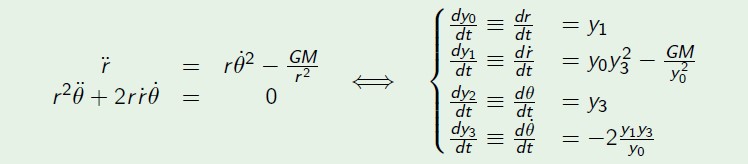
This afternoon, though we had a session on how to transform higher-order differential equations into sets of coupled first-order ODEs suitable for vectorization and consequent solution using standard techniques. The problem we focussed on today was the simple problem of orbital motion of a test particle under the gravitational force in plane-polar coordinates, which can be prepared for physical solution thusly:
This sort of thing reminds me of my undergraduate theory project at Cambridge, where I did a similar thing to solve the equations governing the action of a four-level laser, though that was in Fortran rather than Python. In my own solution I used Python’s off-the-shelf solver odeint.

I like the orbital motion problem a lot because it’s a bit more than a coding exercise: students have to think about how to choose initial data, how to test the their code and interpret the results. Even before that there’s the issue of what units to use; SI units are a bit daft for astronomical problems. For solar system calculations it makes sense to use Astronomical Units for distances and years for time; in such a system it’s easy to work out that GM is just 4π2, which avoids having to deal with ridiculously large or ridiculously small numbers.

Anyway, the fun thing about this lab was that once everyone had got their code working they could try setting initial data to get a circular orbit as a special case, explore how the shape of elliptical orbits depends on the input data, how to make an unbound orbit, and so on. It’s important to understand the output of a numerical calculation in terms of basic physical principles. All that led to a discussion in class of solar system exploration, transfer orbits, what would happen if the mass of the Sun suddenly changed, or if G was a function of time, and lots of other things.

I find sessions like this that encourage students to explore problems themselves very rewarding and I think they add a valuable extra dimension to standard teaching formats. I hope the projects that they’ll be doing from now on – involving topics in areas ranging from atomic physics, cosmology, particle physics and climate science, and done in groups – will provoke even more discussion of this type.

A Bird in Rhetoric House

Posted in Maynooth with tags , , , on April 6, 2022 by telescoper

Following on from my post of yesterday, I just remembered that I recently saw this on Twitter:

Geo the Jackdaw

This is Geo the Jackdaw paying a visitor to the Geography Department of Maynooth University which is located in Rhetoric House. He was a regular visitor there before the Covid-19 campus closure and suddenly reappeared a few days ago after a gap of two years.

Geo is very tame, as you can see, but also full of mischief – he especially enjoys playing with pencils, knocking things over, and tearing up bits of paper.

In fact there are a great many jackdaws on campus – and lots of rooks too – but they’re mostly not as bold as Geo. Two jackdaws regularly visit my garden but they’re not at all domesticated and scarper as soon as I make an appearance, which is just as well because they’re usually engaged in some sort of vandalism.

Accommodation Not Wanted

Posted in Biographical, Maynooth with tags , , on April 6, 2022 by telescoper

A month ago I posted an item about the fact that I had offered the spare room in my house as accommodation for a refugee from the War in Ukraine. Over 20,000 refugees have now arrived in Ireland but I have just been told that the accommodation I offered is not suitable. That’s mainly because the greatest need is for homes suitable for families with children rather than single persons; I only have one room and it doesn’t have en suite facilities. Also most of the refugees are female and the assessors would probably be nervous about placing a woman in a house with a strange man like me.

I feel slightly less bad about this than I might have done before reading that only about 40-50% of the accommodation pledged to the Irish Red Cross has been assessed as suitable.

I also note that a number of host families are finding the job of providing accommodation to often traumatized people very difficult and many refugees have been returned to processing centres because the hosts are unable to cope. I might well have ended up feeling the same.

Anyway, at least I offered. I would have felt bad if I hadn’t. Now I’ll just have to try to find some other way to help…

A Bird in the House

Posted in Biographical, Maynooth with tags , , on April 5, 2022 by telescoper

I’m told that in some cultures it is believed that a bird flying into your house is a sign of impending death. I hope that isn’t true because I’ve been having regular avian visitations recently.

It started last week when, after a spell of lovely sunny days, the weather suddenly took a turn for the worse. One day I went outside to put some rubbish in the bin. I left the patio doors from the kitchen/diner to the garden open for just a few minutes and closed them when I got back in. It was a few minutes later that I heard a flapping sound and looked up to see a robin trying to get out through one of the windows by my kitchen sink. It must have sneaked in while I was preoccupied, presumably because it was a lot warmer inside than out. It must have had the house under surveillance to have managed to get in during such a narrow window of opportunity.

I was a bit worried for the robin’s safety as I have seen birds get into a panic when they find themselves indoors and I thought it might do itself an injury. It was a regular event at my junior school years ago for a sparrow to get in and fly around in a panic before teacher managed to open a window and shoo it out. More recently I remember a pigeon somehow contrived to fall down the chimney in my house in Nottingham, emerging flapping and fluttering and scattering soot everywhere. It was very difficult to get that one to leave as it was completely disoriented. My cat nearly caught it a couple of times before it finally escaped.

Anyway, the robin situation wasn’t anything like that. Although I thought my reappearance in the kitchen might spook it, it seemed to recognize me as the human person who provides food. It just hopped onto the top of the open door leading from the kitchen to the hall and stared at me. I went slowly back to the patio doors, opened them both and stood aside. After sizing up the necessary flight path, the robin made a perfectly orderly exit. Robins seem harder to frighten than some other birds.

Since then the robin has been a regular visitor to the house, entering whenever the doors are open and leaving when it has had enough. It’s been inside more-or-less every day for a week (but not today).Once it helped itself to some leftovers in a pan on the hob but most visits have just taken the form of a general inspection: poking around in the shelves, checking out the furniture, and so on. I should try to take a photograph of it, but I’ve never yet had a camera to hand during a visit. I suppose the robin is now quite comfortable coming into my house and may become a regular guest. I don’t mind, although I hope it minimizes the amount of guano it deposits.

Rory O’Neill aka Panti Bliss

Posted in Biographical, LGBTQ+, Maynooth, Politics with tags , , , on April 2, 2022 by telescoper

Yesterday I attended an event at the Maynooth Students Union featuring Rory O’Neill, an LGBT+ rights activist who strongly involved in the campaign for Equal Marriage leading up to the referendum of 2015. Rory is perhaps better known in his drag persona, Panti Bliss. Rory left Panti at home for this event but it was extremely interesting and enjoyable – and a bit sweary! – to hear him talk about his life and experiences, especially why he became an activist and how he started out as a drag performer.

One of the things I remember very well was how he has spent time in countries where homosexuality is still unlawful talking to young LGBT+ people who a lack of hope that life can get better. He countered that Irish society even just a couple of decades ago was deeply homophobic and is now much more inclusive towards LGBT+ people. It’s not perfect, of course, but it’s a heck of a lot better than it was. Ireland proves that things do get better.

Although I’m a bit older than Rory, didn’t grow up in Ireland, and have had a very different career, much of his story did nevertheless resonate with me. I’ve said a number of times on this blog that if someone had told me back in 1988 (when the infamous Section 28 was brought in by the Thatcher Government to attack a community already reeling from the effects of AIDS) that in 25 times there would be equal marriage in the UK I simply would not have believed them. Rory said something very similar yesterday.

Anyway, although there wasn’t a huge turnout for the event yesterday I’m very glad I attended and am grateful for the Maynooth Access Programme for organizing it. The event also gives me an excuse to post this clip of Panti Bliss giving a brilliant (and now famous) speech at the Abbey Theatre in 2014.

New Professorial Position in Astrophysics or Cosmology at Maynooth!

Posted in Maynooth, The Universe and Stuff with tags , , , , on March 31, 2022 by telescoper

You may recall that back in November 2021 we received word that Maynooth University had been awarded one of ten new senior professorial positions under the Strategic Academic Leadership Initiative (SALI). I blogged about this scheme here. The position we have been awarded is a Chair (Full Professorship) in Observational Astrophysics or Cosmology; you can find Maynooth University’s official response to the original announcement here.

The wheels have turned fairly slowly since the announcement but today at last the applications opened for the new Chairs, including the one in Maynooth. You can find the full announcement of the competition for all the positions here; you can apply for the position at Maynooth here. I think the advertisement will appear on a number of the standard job platforms (such as the Times Higher) too, although this is all being managed centrally. The deadline is in July 2022, and the provisional start date is January 2023 (although this is flexible).

Update: you can find an advertisement for the position on the Times Higher website here. A more complete advertisement can be found here.

The key rationale for these SALI positions is clear from the statement from Simon Harris, the Minister responsible for Third Level education in Ireland:

“Championing equality and diversity is one of the key goals of my department. The Senior Academic Leadership Initiative (SALI) is an important initiative aimed at advancing gender equality and the representation of women at the highest levels in our higher education institutions.

We have a particular problem with gender balance among the staff in Physics in Maynooth, especially in Theoretical Physics where all the permanent staff are male, and the lack of role models has a clear effect on our ability to encourage more female students to study with us.

The wider strategic case for this Chair revolves around broader developments in the area of astrophysics and cosmology at Maynooth. Currently there are two groups active in research in these areas, one in the Department of Experimental Physics (which is largely focussed on astronomical instrumentation) and the other, in the Department of Theoretical Physics, which is theoretical and computational. We want to promote closer collaboration between these research strands. The idea with the new position is that the holder will nucleate and lead a new research programme in the area between these existing groups as well as getting involved in outreach and public engagement.

It is intended that the position to appeal not only to people undertaking observational programmes using ground-based facilities (e.g. those provided by ESO, which Ireland recently joined), or those exploiting data from space-based experiments, as well as people working on multi-messenger astrophysics, gravitational waves, and so on.

Exciting as this position is in itself, it is part of wider developments and we are expecting to advertise further job opportunities in physics and astronomy very soon! I’d be happy to be contacted by any eligible person wishing to discuss this position (or indeed the general situation in Maynooth) on an informal basis.

P. S. For those of you reading this from outside Ireland the job includes a public service pension, a defined benefit scheme way better than the UK’s USS.

Deciphering the past using ancient Irish genomes

Posted in Education, History, Maynooth with tags , , , , on March 30, 2022 by telescoper

I thought I’d use the medium of this blog to advertise the forthcoming Dean’s Lecture at Maynooth University by Prof. Daniel Bradley of Trinity College Dublin which takes place tomorrow evening at 7pm.

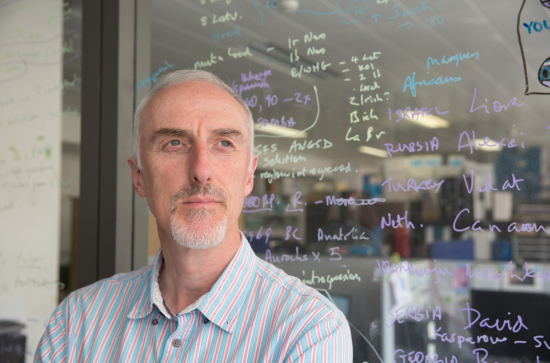
Prof. Bradley

The abstract is:

Our genomes are our biological blueprints. Their DNA code also carries the traces of our family ancestry and at a deeper level, the history of the population we come from. With modern instruments we can sequence for the first time the DNA of people who lived thousands of years ago and read their long-lost biological stories. Genomes from ancient Ireland, including from those buried in famous megalithic tombs such as Newgrange and Poulnabrone dolmen, highlight the great migrations that brought different waves of people to the island, and also give us hints of the very different societies that prevailed in our prehistory.

I’ll be attending the lecture in person on Maynooth University campus but it will also be streamed via Youtube so if you find this sort of thing as fascinating as I do but can’t attend in person please do register here in order to get the link that will enable you to join the live stream.

Update: it was very interesting!

Maynooth University Library Cat Update

Posted in Biographical, Maynooth on March 29, 2022 by telescoper

The recent spell of good weather has given Maynooth University Library Cat plenty of opportunities to laze around in the sunshine. I saw him on two occasions yesterday, separated by about 90 minutes, and he didn’t seem to have moved at all in that interval. I suppose he’s conserving energy, no doubt for some nefarious nocturnal purpose.

Unfortunately the weather seems to be about to change, with overnight rain forecast tonight and much colder temperatures from tomorrow. Maybe this will provoke our resident feline to adopt such extreme measures as retreating into his box, or perhaps even moving about occasionally to stay warm.

Summer Time Again

Posted in History, Maynooth on March 27, 2022 by telescoper

Well, Spring has definitely arrived. We’ve had glorious weather for over a week now, exactly as I like it – sunny and not too hot. Yesterday for the first time this year I pegged my washing out on the line in the garden, and of course today the clocks went forward so we’re now on Irish Summer Time.

Among the many sensible decisions made recently by the European Parliament was to approve a directive that will abolish `Daylight Saving Time’. I’ve long felt that the annual ritual of putting the clocks forward in the Spring and back again in the Autumn was a waste of time effort, so I’ll be glad when this silly practice is terminated.
It would be better in my view to stick with a single Mean Time throughout the year. This was supposed to happen in 2021 but I suppose has been delayed because of the pandemic.

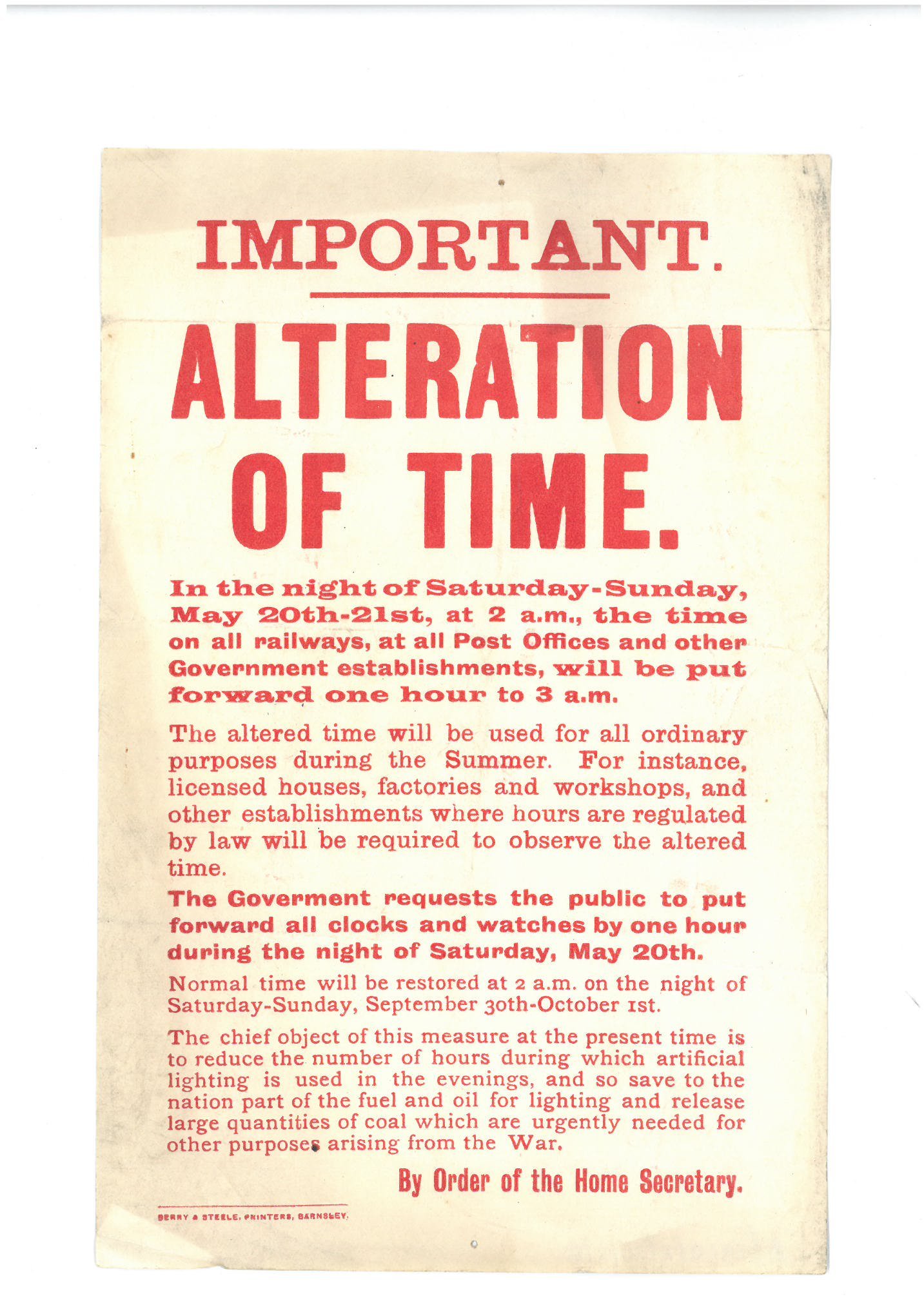
The marvellous poster above is from 1916, when British Summer Time was introduced. You might be surprised to learn that the practice of changing clocks backwards and forwards is only about a hundred years old. in the United Kingdom. To be honest I’m also surprised that the practice persists to this day, as I can’t see any real advantage in it. Any institution or organization that really wants to change its working hours in summer can easily do so, but the world of work is far more flexible nowadays than it was a hundred years ago and I think few would feel the need.

Anyway, while I am on about Mean Time, here is a another poster from 1916.

Until October 1916, clocks in Ireland were set to Dublin Mean Time, as defined at Dunsink Observatory, rather than Mean Time as defined at Greenwich. The adoption of GMT in Ireland was driven largely by the fact that the British authorities found that the time difference between Dublin and London had confused telegraphic communications during the Easter Rising earlier in 1916. Its imposition was therefore, at least in part, intended to bring Ireland under closer control of Britain. Needless to say, this did not go down well with Irish nationalists.

Ireland had not moved to Summer Time with Britain in May 1916 because of the Easter Rising. Dublin Mean Time was 25 minutes 21 seconds behind GMT but the change was introduced at the same time as BST ended in the UK, hence the alteration by one hour minus 25 minutes 21 seconds, i.e. 34 minutes and 39 seconds as in the poster.

Geometric Algebra

Posted in Education, Maynooth, The Universe and Stuff with tags , , , on March 26, 2022 by telescoper

Yesterday we had a very nice pedagogical seminar in the Department of Theoretical Physics by one of our PhD students, Gert Vercleyen, who talked about something that isn’t really to do with his main research topic. A departmental seminar is a good environment for research students to gain experience giving presentations. Anyway, the abstract for this talk was:

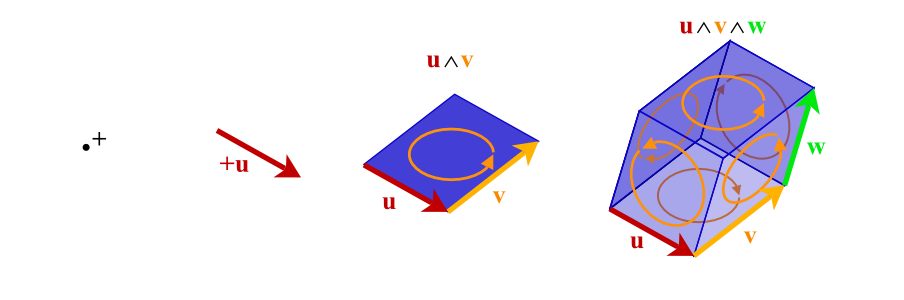
Anyone doing a degree in physics, engineering, or mathematics will, at a very early stage, need to learn how to deal with vectors. Typically the theory of vectors comes with several products, like the dot product which is useful for determining lengths and angles, the cross product which allows one to find orthogonal vectors, and in 2D the complex product which allows one to easily describe rotations and dilations. Each of these products has its benefits and problems. The dot product is not invertible, the complex product only works in 2D, and the cross product has too many issues to put in this abstract. The goal of the talk is to present an alternative product of vectors, the geometric product, that works in any dimension, allows one to get geometric data, and can be used to apply geometric transformations. I will describe how the usual products can be obtained from the geometric product and work out various examples. 

I was familiar with the basic ideas of this approach (related to Clifford algebra) which encompasses many ideas used frequently in theoretical physics – including quaternions for example (I have to mention them as I’m in Ireland) – in a single elegant formalism. I have never actually used it for anything however. Maybe that will change, though, as many interesting ideas suggested themselves during the talk.

If you’d like to learn a bit more at an introductory level about Geometric Algebra you could do a lot worse than read this paper which, unbelievably, is almost 30 years old. I mentioned at the end of the talk that the first author of this paper, Steve Gull, taught the first course in Mathematics for Natural Sciences I took when I was in the first year at Cambridge way back in 1982. Although he crammed a huge amount into that course, including the “standard” way of talking about vectors, rotations thereof using matrices, and a bit of cartesian tensors, he didn’t talk about Geometric Algebra.

I do think however that there is a case for starting in Year 1 with geometric algebra instead of the way we do it nowadays, not least because as well as being an elegant formalism it lends itself very easily to computational implementation; indeed, I note that there is a Python implementation of Clifford Algebra (which I have not yet played with). Also I think it’s harder to “unlearn” traditional methods and adapt to new ones as you get older.