Archive for the Maynooth Category

Out of the REF

Posted in Biographical, Cardiff, Maynooth with tags , , , , on November 25, 2020 by telescoper

I was talking over Zoom with some former colleagues from the United Kingdom last week, and was surprised to learn that, despite the Covid-19 pandemic, the 2021 Research Excellence Framework is ploughing ahead next year, only slightly delayed. There’s no stopping bureaucratic juggernauts once they get going…

One of the major plusses of being in Ireland is that, outside the UK academic system, there is no REF. One can avoid the enormous workload and stress generated by this exercise in bean-counting My memories of the last REF in 2014 when I was Head of School at Sussex are quite painful, as it went badly for us then. I hope that the long-term investments we made then will pay off, though, and I hope things turn out better for Sussex this time especially for the Department of Physics & Astronomy for which the impact and environment components of the assessment dragged the overall score down.

The census period for the new REF is 1st August 2013 to 31st July 2020. Not being involved personally in the REF this time round I haven’t really paid much attention to the changes that have been adopted since 2014. One I knew about is that the rules make it harder for institutions to leave staff out of their REF return. Some universities played the system in 2014 by being very selective about whom they put in. Only staff with papers considered likely to be rated top-notch were submitted.

Having a quick glance at the documents I see two other significant differences.

One is that in 2014, with very few exceptions, all staff had to submit four research outputs (i.e. papers) to be graded. in 2021 the system is more flexible: the total number of outputs must equal 2.5 times the summed FTE (full-time equivalent) of the unit’s submitted staff, with no individual submitting more than 5 and none fewer than 1 (except in special cases related to Covid-19). Overall, then there will be fewer outputs than before, the multiplier of FTE being 2.5 (2021) instead of 4 (2014). There will still be a lot, of course, so the panels will have a great deal of reading to do. If that’s what they do with the papers. They’ll probably just look up citations…

The other difference relates to staff who have left an institution during the census period. In 2014 the institution to which a researcher moved got all the credit for the publications, while the institution they left got nothing. In 2021, institutions “may return the outputs of staff previously employed as eligible where the output was first made publicly available during the period of eligible employment, within the set number of outputs required.” I suppose this is to prevent the departure of a staff member causing too much damage to the institution they left.

I was wondering about this last point when chatting with friends the other day. I moved institutions twice during the relevant census period, from Sussex to Cardiff and then from Cardiff to Maynooth. In principle, therefore, both former employees could submit my outputs I published while I was there to the 2021 REF. I only published a dozen or so papers while I was at Sussex – the impact of being Head of School on my research productivity was considerable – and none of them are particularly highly cited so I don’t think that Sussex will want to submit any of them, but they could if they wanted to. They don’t have to ask my permission!

I doubt if Cardiff will be worried about my papers. Among other things they have a stack of gravitational wave papers that should all be 4*.

Anyway, thinking about the REF an amusing thought occurred to me about Research Assessment. My idea was to set up a sort of anti-REF (perhaps the Research Inferiority Framework) based not on the best outputs produced by an institutions researchers but on the worst. The institutions producing the highest number of inferior papers could receive financial penalties and get relegated in the league tables for encouraging staff to write too many papers that nobody ever reads or are just plain wrong. My guess is that papers published in Nature might figure even more prominently in this

Astrophysics & Cosmology Masterclass at Maynooth

Posted in Education, Maynooth, The Universe and Stuff with tags , , on November 24, 2020 by telescoper

Stealing the idea from our long-running Particle Physics Master Class (which sadly had to be cancelled this year for Covid-19 related reasons, but will resume in 2021), the Department of Theoretical Physics at Maynooth University has decided to launch a Masterclass in Astrophysics & Cosmology. The first one will be on January 14th 2021.

This will be a half-day virtual event via Zoom. It’s meant for school students in their 5th or 6th year of the Irish system, but there might be a few of them or their teachers who see this blog so I thought I’d share the news here. You can find more information, including instructions on how to book a place, here.

Here is the official poster and the programme:

I’ll be talking about cosmology early on, while John Regan will talk about black holes. After the coffee break one of our PhD students will talk about why they wanted to study astrophysics. Then I’ll say something about our degree programmes for those students who might be interested in studying astrophysics and/or cosmology as part of a science course. We’ll finish with questions either about the science or the study!

Four Weeks To Go

Posted in Biographical, Covid-19, Education, Maynooth with tags , , , , , on November 23, 2020 by telescoper

As I await another Zoom meeting I remembered this cartoon from last week’s Private Eye, which sums up the prevalent mood amongst academics these days (and no doubt people in other kinds of job too).

At the start of this morning’s Panopto lecture I realised that there are still 4 weeks left of this Semester before the Christmas break. I was a bit surprised by that as this term seems to have lasted a decade already. The time certainly hasn’t zoomed by. Still, at least I’ve more-or-less kept up with my planned schedule of lectures in both of my modules without slipping. I may even be able to finish lectures to my 2nd year Vector Calculus in time to do a bit of revision in the final week.

That’s not to say other things haven’t slipped. The greatly increased time for teaching needed to move everything online hasn’t left much time for research or anything else. I keep meaning to work in the evenings to deal with outstanding things but mostly I find once I’ve done the necessary admin and teaching stuff all I can do is sleep. It seems that I’ll have to work over Christmas to finish off the backlog. Given that I didn’t have a holiday this summer that’s not ideal, but it’s unlikely I’ll be going anywhere over the “festive” season owing to Coronavirus restrictions so I might as well make the best of it.

We don’t have much idea how things will work out next Semester. The politicians seem to be wanting universities to have more on-campus teaching in the New Year. They also want to end the current restrictions to end before Christmas. In fact the current regime is suppose to end on December 2nd, which is next week, and cases are still running around 400 per day. I don’t think they can do both of these and for the Covid-19 situation to remain under any semblance of control. I think the likeliest scenario is that cases surge over the next few weeks and the Christmas break and we have to go back into full restrictions in January or February.

There is however the prospect of a vaccine or vaccines being available fairly early next year so maybe the end of this is in sight. I really hope we can get back to campus normality at some point in 2021. I do feel very sad about the effect all these restrictions has been having on the students. It’s not just having to have remote lectures. I think having a lecturer in the same room is an advantage, but the loss of it is not the worst issue. We encourage our students to work with each other in their learning, and I’m sure students learn at least as much from each other as they do from the lecturer. Peer group learning is more difficult when your peers are sitting in separate locations most of the time.

Earlier today I found myself using the phrase “getting back to normal” in connection with plans for next teaching year. Then I realise that we staff know what we mean by “normal” but our first-year students don’t. I have a feeling that may might find it more difficult to adjust to the old normal than they did to the new one.

And in any case many of our students in all years did not take up accommodation in Maynooth at the start of this year because of the remote teaching. Even if we did on campus lectures or tutorials next term, I suspect many will stay at home anyway to avoid substantial cost of rented accommodation. We will therefore have to continue making material available online whatever happens.

Anyway, what may or may not happen next Semester is to a large extent out of my hands so I won’t be making any firm decisions on what approach I will be taking until much closer to the start of Semester 2 In the meantime the goal is to fight the exhaustion and try get through to the end of term in one piece.

Job Opportunities in Quantum Information Processing in Maynooth

Posted in Maynooth, The Universe and Stuff with tags , , , on November 23, 2020 by telescoper

Gratuitous Graphic purporting to represent Quantum Information Processing

Regular readers of this blog may recall an announcement that the Department of Theoretical Physics scored a notable success, or rather Dr Professor Jiri Vala did, in securing funding as part of a project called Quantum Computing in Ireland: A Software Platform for Multiple Qubit Technologies. To be eligible for this kind of funding, projects must involve businesses and this particular project includes IBM Ireland Ltd, MasterCard Ireland, Rockley Photonics and Equal 1 Laboratories, the latter two being SMEs based in the Dublin area. The project also involves the Tyndall National Institute (Cork); University College Dublin; and Maynooth University. This is the first large collaboration in Ireland in this area.

Well, now that the funds have actually arrived, I  thought I’d use the medium of this blog to pass on the information that the Department of Theoretical Physics at Maynooth University is looking two appoint not one but two theoretical physicists as postdoctoral researchers to work on this project.

The first position (for which you can find further details here) is  to work on modelling and simulations of quantum photonic systems for quantum information processing.

The second position (further details here) is to work on the evelopment of compilers, quantum control protocols and algorithms for quantum information processing in quantum photonic systems.

The deadline for both positions is Sunday 6th December 2020, so there’s not much time to apply!

Please feel free to pass this on to anyone you think may be interested!


Dreams, Planes and Automobiles

Posted in Biographical, Covid-19, Education, Maynooth, The Universe and Stuff with tags , , , , , on November 20, 2020 by telescoper

I’ve blogged before about the strange dreams that I’ve been having during this time of Covid-19 lockdowns, but last night I had a doozy. I’ve recently been doing some examples of Newtonian Mechanics problems for my first-year class: blocks sliding up and down planes attached by pulleys to other blocks by inextensible strings; you know the sort of thing.

Anyway, last night I had a dream in which I was giving a lecture about cars going up and down hills taking particular account of the effects of friction and air resistance. The lecture was in front of a camera and using a portable blackboard and chalk, but all that was set up outside in the middle of a main road with traffic whizzing along either side and in the presence of a strong gusty wind. I had to keep stopping to pick up my notes which had blown away, dodging cars as I went.

It would undoubtedly make for much more exciting lectures if I recorded them in such a situation, but I think I’d be contravening traffic regulations by setting up in the middle of the Straffan Road. On the other hand, I could buy myself a green screen and add all that digitally in post-production…

Covid Questions for Ireland

Posted in Covid-19, Maynooth with tags , , on November 15, 2020 by telescoper

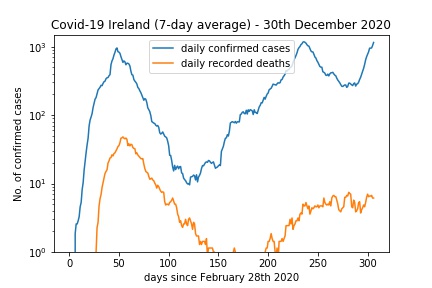
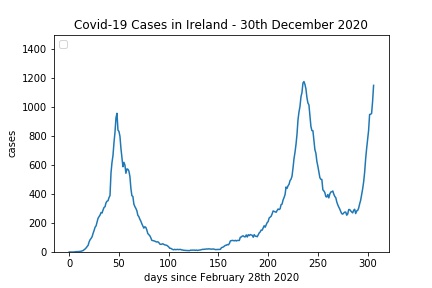
I’ve just done my daily update of Covid-19 numbers here and thought I’d show the latest figure:

There are now 262 data points on these graphs. When I started doing the updates I thought it might carry on for two or three months -i t’s now been almost nine and there’s no end in sight.

As you can see the 7-day average of new cases has been falling steadily since entered the period of Level 5 restrictions that is now about half-way through. That, of course, is good news. The problem is that the rate of decrease is really quite slow. The number of new cases on each day for the last week (including today) were: 270, 270, 362, 395, 482, 456, and 378 (today). That is fairly flat, the steep downward trend of the previous week apparently faltering. As a rough guess I’d say that by the time we come out of the current period of restrictions (at the beginning of December) we’ll probably still be having over a hundred new cases per day.

I think that level is far too high for comfort, but the current government is probably going to find it difficult to resist the political pressure to exit the lockdown in time for Christmas. If that does happen, I can see another lockdown looming in January. My superiors at Maynooth University are talking about having on-campus teaching again next Semester, but I think that’s highly unlikely in the circumstances.

Things are even worse in Northern Ireland where the number of new cases announced today was 478. Daily cases have been running higher there than in the Republic for some time, despite the fact that the six counties of Northern Ireland have a population of just 1.9 million compared to the 4.9 million of the 26 counties  in the Republic.

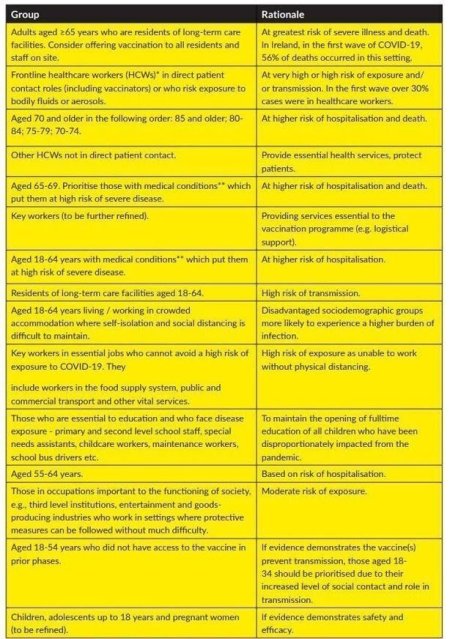
That brings me to the issue of the Pfizer Covid-19 vaccine that everyone is getting excited about. Assuming that it passes the various tests needed for it to be approved, Ireland would get about 2 million doses from the stock procured by the European Union.  The population of Ireland is about 4.9 million, and each person would require two doses, which means that supply will only enable about 20% of the population to be vaccinated.

(Actually I don’t know whether the 2 million refers to people that can be vaccinated or individual doses, but even if it’s the former that still accounts for only 40% of the population.)

The question then is who should be prioritized? I think we’d all agree that all health care workers should be vaccinated ASAP but that’s only about 25,000 people (source). Who should get the other doses? Most people seem to be assuming that those at highest risk of mortality should be vaccinated, but there’s also a case to be argued that  it should it should be those groups within which the virus is most likely to spread that should get it, which is presumably the otherwise healthy population.

I don’t know the answer, but it will be interesting to see how this all develops. In any case as far as I can see it there’s very little prospect of high levels of population immunity being reached by this time next year. And that’s even if the vaccine is available soon, which is by no means clear will be the case. As a matter of fact I wouldn’t bet against me still having to do daily updates on Covid-19 statistics for most of next year.


Newton’s Laws in Words

Posted in History, Maynooth, The Universe and Stuff with tags , , , on November 13, 2020 by telescoper

I’ve been teaching my first-year Mathematical Physics students about Newton’s Laws of Motion so decided to record this little video as an aside discussing the history terminology and use of language.

Unfortunately the only microphone I have is the one built into my laptop and it tends to suffer sometimes from a crackle caused (I think) by the fan inside the machine interfering with the mike. I guess the noise appears when the CPU is working hard causing the machine to heat up so the fan works harder. The sound on video recordings I make this low budget way do break up from time to time, which is rather irritating. Obviously I need to buy an external microphone and when I do I might record this again but in the meantime you’ll just have to put up with it breaking up a couple of times!

Standing Up for Online Lectures

Posted in Covid-19, Education, mathematics, Maynooth with tags , , , , on November 3, 2020 by telescoper

I have a break of an hour between my last lecture on Vector Calculus (during which I introduced and did some applications of Green’s Theorem) and my next one on Mechanics & Special Relativity (during which I’m doing projectile motion), so I thought I’d share a couple of thoughts about online teaching.

I started the term by doing my lectures in the form of webcasts live from lecture theatres but since we returned from the Study Break on Monday I’ve been doing them remotely from the comfort of my office at home, which is equipped with a blackboard (installed, I might add, at my own expense….)

I still do these teaching sessions “live”, though, rather than recording them all offline. I toyed with the idea of doing the latter but decided that the former works better for me. Not surprisingly I don’t get full attendance at the live sessions, but I do get around half the registered students. The others can watch the recordings at their own convenience. Perhaps those who do take the live webcasts appreciate the structure that a regular time gives to their study. Even if that’s not the reason for them, I certainly prefer working around a stable framework of teaching sessions.

“Why am I still using a blackboard?” I hear you ask. It’s not just because I’m an old fogey (although I am that). It’s because I’m used to pacing myself that way, using the physical effort of writing on the blackboard to slow myself down. I know some lecturers are delivering material on slides using, e.g., Powerpoint, but I have never felt comfortable using that medium for mathematical work. Aside from the temptation to go too fast, I think it encourages students to see the subject as a finished thing to be memorized rather than a process happening in front of them.

I did acquire some drawing tablets for staff to enable them to write mathematical work out, which is useful for short things like tutorial questions, but frankly they aren’t very good and I wouldn’t want to use them to give an hour long lecture.

In addition to these considerations, my decision to record videos in front of a blackboard was informed by something I’ve learnt about myself, namely that I find I am much more comfortable talking in this way when I’m standing up than sitting down. In particular, I find it far easier to communicate enthusiasm, make gestures, and generally produce a reasonable performance if I’m standing up. I know several colleagues who do theirs sitting down talking to a laptop camera, but I find that very difficult. Maybe I’m just weird. Who else prefers to do it standing up?

Domestic Post

Posted in Biographical, Maynooth, Politics with tags , , , on November 1, 2020 by telescoper

O wild West Wind, thou breath of Autumn’s being.
Thou, from whose unseen presence the leaves dead
Are driven, like ghosts from an enchanter fleeing.

Those lines from Ode to the West Wind by Percy Bysshe Shelley came to my mind this morning not only because it’s blowing a gale outside but also because it is just after Halloween Samhain which was a noisy night because of all the fireworks, but at least I wasn’t disturbed by trick-or-treaters. I guess none of them made it past the barbed wire and electric fence…

Anyway, being confined to quarters for the day has allowed me to catch up on some domestic matters, including dealing with my first ever demand for payment of Local Property Tax (LPT) which arrived on Friday: before I bought my own home, my landlord paid the LPT on the flat I was living in. Coincidentally, along with the bill for the Local Property Tax came a letter from the Department of Employment Affairs and Social Protection (DEASP) confirming that they had changed my address on their records. I told them two months ago.

The Local Property Tax plays a similar role in Ireland to that of the Council Tax in the United Kingdom, and is also based on some notional estimate of the value of your home, but it’s quite a lot lower than in the UK. Although my house in Maynooth is worth considerably more than my Pontcanna residence the property tax is less than a third here than it is in Cardiff. You might think that’s a good thing, but the consequence is that there is a much poorer provision of local services here. In fact Local Government as a whole is a much lesser thing here than it is on the other side of the Irish Sea. Although there are elections to the local councils (in my case Kildare County Council) as there are in the UK, the ability of the councils to do anything useful is very limited.

One particular aspect of this is that householders in Ireland have to arrange their own refuse collection via a private company; in Cardiff the refuse collection service was provided by the Council. When I took over the house I asked the previous owner about refuse collections and, since I had no experience of any of the companies listed as offering this service, I simply carried on with the company she had used.

And so it came to pass that my weekly refuse and recycling collection is carried out by Bord na Móna (literally “The Turf Board”), a company set up in 1946 to supply peat as a form of fuel. Although you can still buy peat around these parts to burn on the fire, it is a very dirty fuel and harvesting it causes damage to the peat bogs in the Irish Midlands that provide a unique habitat for wildlife and plants of various kinds. Bord na Móna has therefore been diversifying into more sustainable lines of business with the intention of withdrawing entirely from peat production in the next decade or so. Among these new activities are renewable energy generation and recycling, the latter being relevant to this post.

The refuse collection, carried out through a subsidiary called AES, is quite a sophisticated operation. I have four wheelie bins (one for recycling, one for organic & food waste, one for glass, and one for general waste). Each of these bins is microchipped and the amount of general waste collected recorded at each collection. I am of frugal habits and don’t usually produce very much waste, especially general waste, though I have had a number of things delivered to the house since I moved in which always requires disposal of a considerable amount of packaging. Happily they also send a free SMS reminder of what bin to put out when.

Anyway to return to the opening theme of this post, I’ve discovered a “feature” of my new house. Being situated at the end of a row of similar properties with a wall to one side to mark the end of the row, it seems that leaves which have been blown along the road collect in great heaps on the path leading to my front door. I have to go out quite regularly with a shovel to clear them away. At present I put them in the organic refuse bin, but I’m thinking of getting a compost bin for the garden. It seems I am becoming quite domesticated in my old age.

Postscript: no sooner did I finish this post than all the power went off in the house.

Postscript to the postscript. It came on again after about 2½ hours in my area, but as I write it is still off in parts of Maynooth.

Stormy Samhain Super Saturday

Posted in Biographical, Covid-19, Irish Language, Maynooth, Rugby with tags , , on October 31, 2020 by telescoper

So we have arrived at October 31st, Hallowe’en or, in pagan terms, Samhain. This, a cross-quarter day – roughly halfway between the Autumnal Equinox and the Winter Solstice represents the start of winter (“the dark half of the year“) in the Celtic calendar.

Incidentally, Samhain is pronounced something like “sawin”. The h after the m denotes lenition of the consonant (which in older forms of Irish would have been denoted by a dot on top of the m) so when followed by a broad vowel the m is pronounced like the English “w”; when followed by a slender vowel or none “mh” is pronounced “v” or in other words like the German “w” (which makes it easier to remember). I only mention this because I hope to be starting Irish language lessons soon, something I always wish I’d done with Welsh when I lived in Cardiff.

Anyway, it’s a wild blustery day with the wind howling down the chimney of my house in Maynooth sounding like a ghost. At least thanks to the present Level 5 restrictions I won’t have to endure trick-or-treaters this evening. Or will I? Should I sit quietly at home with the lights off again?

Today’s schedule will revolve around the final round of matches in this year’s Six Nations championship. The settled order of nature having been disturbed by Covid-19 back in March it has only just become possible to finish the competition with three games today. Ireland travel to France for the last game this evening, after England play Italy and Wales play Scotland. Ireland currently head the table, but they have a difficult task in Paris: they need not only to win to secure the Championship but to do so by a bonus point because England will almost certainly get a bonus point against a poor Italian side. The Irish press are talking up the national team’s chances of winning handsomely, but it seems to me rather unlikely especially because France too have a chance of the title if they beat Ireland and get a bonus point. Both sides clearly have to attack, which should make for a good contest.

For what it’s worth, my predictions are: Wales to beat Scotland, England to beat Italy (with a bonus point) and France to beat Ireland (but no bonus point). That combination would make England the champions, with France second and Ireland third.

Update: 16.05. Wales 10 Scotland 14. My predictions are not off to a good start. Scrappy, error-strewn game with Scotland’s try from a maul that shredded the Welsh defence the highlight of the game. Bad result for Wales but it is good to see Scotland back as a force to be reckoned with.

Update: 18.45. England improved dramatically after a poor first half, and eventually ran out winners by 34 points to 5. That means their points difference is +44 compared to Ireland’s +38. Ireland need a win by 7 or more points (or with a bonus point) to win the Championship.

Update: 21.00. Half-time France 17 Ireland 13. France leading without having played particularly well, thanks to two big Irish errors. Ireland need to score 10 points more than France in the 2nd half.

Update 22.00. Final score France 35 Ireland 27. France won with a bonus point but not by a sufficient margin to win the Championship, which goes to England, with France second and Ireland third. It didn’t go exactly as I predicted but I wasn’t far off!