Archive for the Maynooth Category

Self Assessments

Posted in Biographical, Education, Finance, Maynooth with tags , , on January 17, 2019 by telescoper

My first batch of examination marking having been completed satisfactorily and my next paper not taking place until the weekend (Saturday morning, to be precise), I naively hoped that I could devote myself to research for a few days this week as I am behind schedule in completing a couple of papers. Unfortunately this has not been as straightforward as I’d hoped. I’ve spent all of today doing various administrative things (expenses claims, examination reports, and a part of the Department’s Quality Review Self-Assessment document which is due in near the end of the month.

In case you are unfamiliar with such things, a Quality Review is an exercise that takes place from time to time for every Department or Administrative Unit in the University (and indeed for every university in Ireland). For the Department of Theoretical Physics at Maynooth University, the last one took place in 2009). The process begins with the aforementioned Self-Assessment document which basically lays out what the Department is trying to do, the processes by which it uses to do it, reflects on the effectiveness of those processes, and outlines ideas for how they can be improved. All the staff in the Department have been engaged in writing bits of this document, which is now gradually coming into shape.I’ve had a relatively light involvement in this because I haven’t been here for very long, but it has consumed quite a lot of staff effort.

When complete, the Self Assessment report is sent to a range of people both inside and outside the University and there is then a visitation during which the panel talks to staff and students and has a look around the Department. We’re expecting our `inspection’ to take place in March. After that the panel gives feedback to the Department in a report. The panel’s comments are made publicly available, as is appropriate for a publicly-funded body. The report emerging from the last Quality Review of the Department of Mathematical Physics (as it was then called ) can be found here (pdf). It’s all quite a lot of work – the latest Departmental meeting devoted to this yesterday lasted three and a half hours, and we’ve had several meetings like that! fortunately, it  will all be finished by next week. Better is the end of a thing than the beginning thereof.

 

Talking of Self Assessment, I realized last night with a panic that I hadn’t yet done my UK income tax return for 2017/18, also due in by the end of January. I spent this lunchtime getting all the bits of paper in order, and completed the task online fairly quickly as I’ve done it many times before. It turns out that yet again HMRC owes me a substantial refund. They haven’t handled my income tax properly since I left Sussex in 2016 as a matter of fact. Despite repeated attempts to get them to apply the rules correctly they have basically taxed all my income at source at the higher rate (40%) only to pay it back when I submitted my return. Fortunately, I am now domiciled in Ireland so won’t have to deal with HMRC much again.

Anyway, I should complete most of the outstanding administrative stuff this evening and if I do that I can clear a day for research, or at least writing up papers…


Out and Back

Posted in Biographical, LGBTQ+, Maynooth on January 13, 2019 by telescoper

So here I am, back home in Maynooth, after a very enjoyable day and a bit in London during which I learnt a huge amount and met so many lovely people. If only all science conferences were so much fun!

Incidentally, next year’s LGBT+ STEMinar will take place in Birmingham (2020), and the one after that in Oxford (2021). I’m told the first such event had about 40 participants but it’s now struggling to find big enough venues. The attendance at this year’s event was strictly limited by the capacity of the lecture room in the new IOP building. Hopefully the next will have a bigger theatre to enable even more people to come.

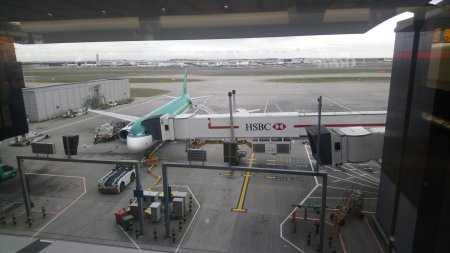
As well as being my first LGBT+ STEMinar this was also the first time I’ve ever flown on Aer Lingus. I was quite impressed, with flights in both directions being ahead of schedule. In fact I got back in such good time yesterday afternoon that I was able to get a much earlier bus than I had thought possible and found myself at home well before 7pm.

This trip gave me the chance for the first time to use the newer and swankier Terminal 2 in Dublin, which is a lot comfier than Terminal 1 (from which FlyBe and other budget airlines operate). It was Terminal 2 at Heathrow too, which is where I had awful problems with Eurowings earlier this year, but there were no problems this time. Both Dublin and Heathrow airports were very quiet. There is probably a post-Christmas lull in air travel at this time of year.

I did quite a lot of walking around London on Friday and Saturday, including walking to the Athenaeum from King’s Cross for the RAS Club. It’s hard to believe I lived in London for quite a long time (1990-98) as I am obviously a total stranger there now. I did however recognise the wonderfully cosmopolitan vibe as I walked through the West End towards Piccadilly. I was almost late for dinner as there were so many people about it was sometimes hard to make progress through the crowds. I’m also, of course, not as fast a walker as I used to be…

Anyway now that I’m back the main job for the next day or two is going to be marking examinations, no doubt preceded by numerous displacement activities..

Reflections on the Examination Period

Posted in Biographical, Education, Maynooth with tags , , on January 10, 2019 by telescoper

Tomorrow (11th January)  is the start of our mid-year examination period here at Maynooth University. It’s therefore a good opportunity to send a hearty “good luck” message to all students about to take examinations, especially those who are further on in their courses for whom these papers have greater importance. In particular I’d like to send my best wishes to students on my fourth-year module on Astrology Astrophysics and Cosmetics Cosmology, whose paper is at 9.30 tomorrow morning.

I’m a bit too busy for anything particularly profound today, as I’m off to the airport after lunch to get a flight to London for an event at the IOP tomorrow, so I thought I’d just rehash an excerpt from something I posted a while ago on the subject of examinations.

My feelings about examinations agree pretty much with William Wordsworth, who studied at the same University as me, as expressed in this quotation from The Prelude:

Of College labours, of the Lecturer’s room
All studded round, as thick as chairs could stand,
With loyal students, faithful to their books,
Half-and-half idlers, hardy recusants,
And honest dunces–of important days,
Examinations, when the man was weighed
As in a balance! of excessive hopes,
Tremblings withal and commendable fears,
Small jealousies, and triumphs good or bad–
Let others that know more speak as they know.
Such glory was but little sought by me,
And little won.

It seems to me a great a pity that our system of education – both at School and University – places such a great emphasis on examination and assessment to the detriment of real learning. In particular, the biggest problem  with physics education in many institutions is the way modular degrees have been implemented.

I’m not at all opposed to modularization in principle. I just think the way we teach modules often fails to develop any understanding of the interconnection between different aspects of the subject. That’s an educational disaster because what is most exciting and compelling about physics is its essential unity. Splitting it into little boxes, taught on their own with no relationship to the other boxes, provides us with no scope to nurture the kind of lateral thinking that is key to the way physicists attempt to solve problems. The small size of each module makes the syllabus very “bitty” and fragmented. No sooner have you started to explore something at a proper level than the module is over. More advanced modules, following perhaps the following year, have to recap a large fraction of the earlier modules so there isn’t time to go as deep as one would like even over the whole curriculum.

Students in Maynooth take 60 “credits” in a year, split into two semesters. These are usually split into 5-credit modules with an examination at the end of each semester. Projects, and other continuously-assessed work do not involve a written examination, but the system means that a typical  student will have at least 5 written examination papers in January and at least another 5 in May. Each paper is usually of two hours’ duration.

Incidentally, one big difference between our examinations in Theoretical Physics in Maynooth and those at other institutions I’ve taught at in the UK is that the papers offer no choice of questions to be answered. A typical format for a two-hour paper is that there are two long questions (broken up into bits), each of which counts for 50 marks.  Elsewhere one normally finds students have a choice of two or three questions from four. The advantage of our system is that it makes it much harder for students to question-spot in the hope that they can get a good grade by only revising a fraction of the syllabus.


But I digress.

One consequence of the way modularization has been implemented throughout the sector is that the ratio of assessment to education has risen sharply over the last decades with a negative effect on real understanding. The system encourages students to think of modules as little bite-sized bits of education to be consumed and then forgotten. Instead of learning to rely on their brains to solve problems, students tend to approach learning by memorizing chunks of their notes and regurgitating them in the exam. I find it very sad when students ask me what derivations they should memorize to prepare for examinations. A brain is so much more than a memory device. What we should be doing is giving students the confidence to think for themselves and use their intellect to its full potential rather than encouraging rote learning.

You can contrast this diet of examinations with the regime when I was an undergraduate. My entire degree result was based on six three-hour written examinations taken at the end of my final year, rather than something like 30 examinations taken over 3 years. Moreover, my finals were all in a three-day period: morning and afternoon exams for three consecutive days is an ordeal I wouldn’t wish on anyone, so I’m not saying the old days were better, but I do think we’ve gone far too far to the opposite extreme. The one good thing about the system I went through was that there was no possibility of passing examinations on memory alone. Since they were so close together there was no way of mugging up anything in between them. I only got through  by figuring things out in the exam room.

I don’t want to denigrate the achievements of students who are successful under the current system.  What I’m saying is that I don’t think the education we provide does justice to their talents. That’s our fault, not theirs…

The Open Journal of Astrophysics: Last Update for 2018

Posted in Maynooth, Open Access, The Universe and Stuff with tags , , , , , on December 20, 2018 by telescoper


As term staggers to its close tomorrow, two things this morning reminded me that I should post a final update for the The Open Journal of Astrophysics.  I’ve been regularly boring all my readers with a stream of stuff about the Open Journal of Astrophysics, but if it’s all new to you, try reading the short post about the background to the Open Journal project that you can find here.

The first item was a little piece in the latest edition of University News (which was delivered this morning) about the launch event for the journal here at Maynooth University way back in October.

I didn’t make it into the picture above as I had to leave the event before the end in order to give an undergraduate lecture, but the appearance of this piece reminds me to express once more my gratitude to Maynooth for providing such excellent support for this project.

The other event this morning was an email notification that the OJA has received yet another submission. We now have a number of papers in the pipeline, and interest seems to be picking up. I can’t say how many submissions will actually be published, but the papers we have received are working their way through the peer-review system and we’ll see what transpires.

On a related point, a few people have asked me why the Open Journal of Astrophysics is not in the Directory of Open Access Journals (DOAJ). The answer to that is simply that DOAJ requires a minimum of five papers published in a calendar year and because we had a long hiatus before the re-launch we don’t yet qualify. The way things are going we should meet the threshold for 2019 pretty quickly.

Though I stress that the Editorial Board of OJA is not going to compromise standards just to get listed on DOAJ.
we are hoping to increase the number of submissions with time (in a manageable way). As it happens, we do have funds available to promote the OJA as I think quite a large number of members of the astrophysics community still haven’t heard of it. This also makes it a little difficult to enlist referees who perhaps jump to the conclusion that this is a dodgy or predatory journal. There are many of these about, sadly, but I hope we can establish relatively easily the fact that we’re not of that ilk.

I would like here to repeat a small request I posted a while ago. Do any of you have any ideas for promoting The Open Journal of Astrophysics? We could advertise directly in journals of course, but I’m wondering if anyone out there in the interwebs has any more imaginative ideas? If you do please let me know through the comments box below.

A Sign of Ireland

Posted in Maynooth with tags , , on December 15, 2018 by telescoper

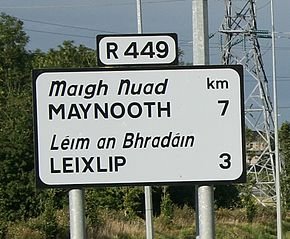
Following my post earlier this week about Irish orthography and related matters, I thought I’d share a couple of random thoughts inspired by the above road sign.

First, notice the font used for the Irish names, which is a variant of the UK Transport typeface, but is notable for the absence of any tittles (a ‘tittle’ being one of those little dots above the i and j in standard type).

The other thing, which I only found out a few days ago, is that`Leixlip’ is a name of Norse origin – it means ‘Salmon’s Leap’. Apparently there was a viking settlement there, positioned because of the abundance salmon in the River Liffey which flows through on the way to Dublin. `Leix’ is similar to, e.g., the Danish `Laks’, meaning salmon, and ‘leap’ is similar to many words in modern European languages derived from proto-Germanic sources.

There is a Salmon Leap Inn in Leixlip. I have heard very good things about the food but not yet dined there. Nowadays however Leixlip is best known for the presence of a huge Intel ‘campus’, which is home to a large semiconductor fabrication facility, among other things.

Messiah in Dublin

Posted in Biographical, Maynooth, Music with tags , , , , on December 14, 2018 by telescoper

On 10th December last year I posted a review of a performance of Handel’s Messiah in Cardiff. At the end of that item I wondered where I would be listening to Messiah in 2018. Well, the answer to that question turned out to be at the National Concert Hall in Dublin, the city where Messiah received its premiere way back in 1742.

Messiah was initially performed at Easter (on 13th April 1742) and it’s by no means clear (to me) why it ended up almost universally regarded as a Christmas piece. The work actually spans the entire biblical story of the Messiah, from Old Testament prophecy to the Nativity (Part 1), the Passion of Christ (Part II), culminating in the Hallelujah Chorus, and the Resurrection of the Dead (Part III). The Nativity only features (briefly) in Part I, which is why it’s a little curious that Messiah is so strongly associated with Christmas.

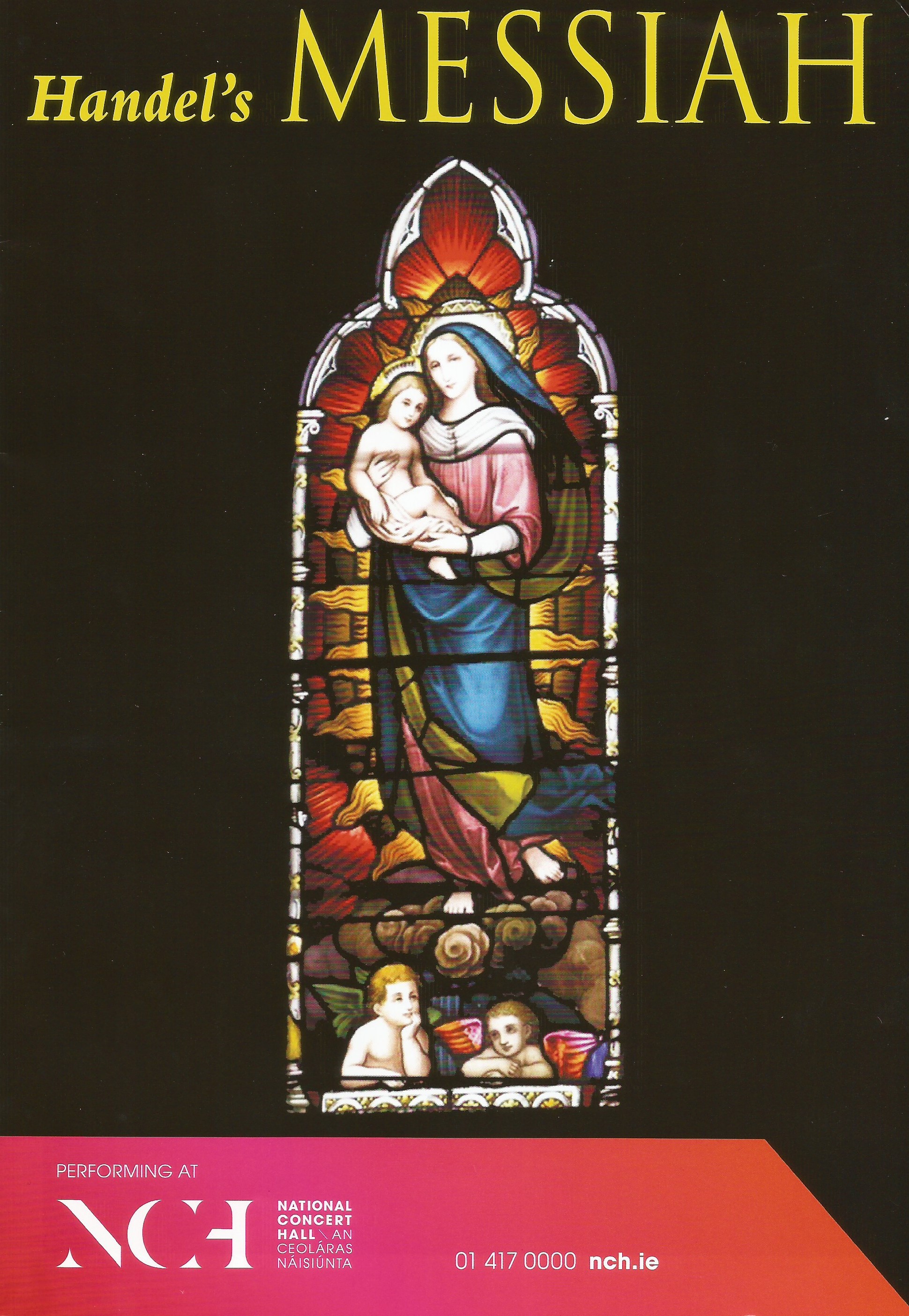
The printed programme for last night (cover shown above) included the first advertisement for the first performance of Messiah:

For the relief of the prisoners in the several Gaols and for the Support of Mercer’s Hospital in Stephen’s Street and of the Charitable Infirmary on the Inn’s Quay, on Monday 12th April will be performed at the Musick Hall in Fishamble Street, Mr Handel’s new Grand Oratorio MESSIAH…

The venue was designed to hold 600 people (less than half the capacity of the National Concert Hall) but 700 people crammed in. Ladies had been asked not to wear hoops in their dresses and gentlemen were asked not to bring their swords to help squeeze in the extra hundred. The concert raised the huge sum of £400 and Messiah was an immediate hit in Ireland.

It wasn’t the same story when Messiah was first performed in England the following year. It failed again in England when performed in 1745 but after some rewriting Handel put it on again in 1749 and it proved an enormous success. It has remained popular ever since. But it is still exceptionally popular in Dublin. There are umpteen performances of Messiah at this time of year, and the one I attended last night was one of three in the same week at the same venue, all more-or-less sold out. The Dubliners I chatted to in the bar before the concert were extremely proud that their city is so strongly associated with this remarkable work.

I don’t mind admitting that Messiah is a piece that’s redolent with nostalgia for me. Some of the texts remind me a lot of Sunday School and singing in a church choir when I was little and then, a bit later, listening to the whole thing at Christmas time at the City Hall in Newcastle. I loved it then, and still do now, well over 40 years later. I know it’s possible to take nostalgia too far – nobody can afford to spend too much time living in the past – but I think it’s good to stay in contact with your memories and the things that shaped you when you were young.

Last night’s performance was by Our Lady’s Choral Society with the RTÉ Concert Orchestra. Soloists were Sarah Brady (soprano), Patricia Bardon (mezzo), Andrew Gavin (tenor) and Padraic Rowan (bass), the latter really coming into his own in the second half with a wonderfully woody sonority to his voice, especially in No. 40:

Why do the nations so furiously rage together, and why do the people imagine a vain thing?

Topical, or what?

Our Lady’s Choral Society is an amateur outfit and, while it might not sound as slick and polished as some professional choirs, there was an honesty about its performance last night that I found very engaging. It actually sounded like people singing, which professional choirs sometimes do not. The orchestra played very well too, and weren’t forced to use the dreaded `period instruments’. There was a harpsichord, but fortunately it was barely audible. Anyway, I enjoyed the concert very much and so did the packed house. I couldn’t stay for all the applause as I had dash off to get the last train back to Maynooth, but that doesn’t mean I didn’t appreciate the music.

Incidentally, among the bass section of Our Lady’s Choral Society last night was my colleague Brian Dolan. On Monday next I’m going to another Concert at the National Concert Hall, Bach’s Christmas Oratorio. Among the choir for that performance is another of my colleagues, Jonivar Skullerud. Obviously, choral singing is the in-thing for theoretical physicists in this part of the world!

The Irish Accent

Posted in History, Maynooth with tags , , , , , , , , on December 11, 2018 by telescoper

It’s been a very busy day, as Tuesdays tend to be this term, so I thought I’d wind down with a little blog post.

Some time ago I got an email from Maynooth University about Irish language classes. Still feeling a bit ashamed about not having learned Welsh in all my time in Cardiff, I thought I’d sign up for the Beginners class and fill in a Doodle Poll to help the organizers schedule it. Unfortunately, when the result was announced it was at a time that I couldn’t make owing to teaching, so sadly I’m not learning Irish properly yet.

I have picked up a few things about the language, however, which it might be worth passing on here. Although Irish and Welsh are both Celtic languages they are from two distinct groups: the Goidelic group that comprises Irish, Manx and Scottish Gaelic; and the Brythonic group that comprises Welsh, Cornish and Breton. These are sometimes referred to as q-Celtic and p-Celtic, respectively, although not everyone agrees that is a useful categorization. Incidentally, Scottish Gaelic is not the language spoken by the Celtic people who lived in Scotland at the time of the Romans, the Picts, which is lost. Scottish Gaelic is actually descended from Middle Irish. Also incidentally, Breton was taken to Brittany by a mass migration of people from South-West Britain which peaked somewhere around 500 AD. I guess that was the first Brexodus.

Welsh and Irish don’t sound at all similar to me, which is not surprising really. It is thought that the Brythonic languages evolved from a language  brought to Britain by people from somewhere in Gaul (probably Northern France), whereas the people whose language led to the Goidelic tongues were probably from somewhere in the Iberia (modern-day Spain or Portugal). There are nevertheless some similarities. For example, `Merry Christmas’ is Nadolig Llawen in Welsh and Nollaig Shona in Irish..

Anyway, back to the topic of this post, there is only one accent in Irish (in the sense of a diacritic mark), which is the síneadh fada (`long accent’), sometimes called the fada for short, which looks the same as the acute accent in, e.g., French. There’s actually one in síneadh if you look hard enough. It just means the vowel is pronounced long (i.e. the first syllable of síneadh is pronounced SHEEN).

One does find quite a few texts (especially online) where the fada is carelessly omitted, but it really is quite important. For example Cáca is the Irish word for `cake’, while the unaccented Caca means `excrement’…

I took the above text in Irish and English from the front cover of an old examination paper. You can see the accents as well as another feature of Irish which is slightly similar to Welsh, the mysterious lower-case h in front of Éireann. This is a consequence of an initial mutation, in which the initial character of word changes in various situations according to syntax or morphology (i.e. following certain words changing the case of a noun or following certain sounds). This specific case is an an example of h-prothesis (of an initial vowel).

In Welsh, mutations involve the substitution of one character for another. For example, `Wales’ is Cymru but if you cross the border into Wales you may see a sign saying Croeso i Gymru, the `C’ having mutated. The Irish language is a bit friendlier to the learner than Welsh, however, as the mutated character (h in the example above) is inserted in front of the unmutated character. Seeing both the mutated and unmutated character helps a person with limited vocabulary (such as myself) figure out what’s going on.

Mutations of consonants also occur in Irish. These can involve lenition (literally `weakening’, also known as aspiration) or eclipsis (nasalisation). In the case of eclipsis the unmutated consonant is preceded by another denoting the actual sound, e.g. b becomes m in terms of pronunciation, but what is written is mb. On the other hand, lenition is denoted by an following the unmutated consonant.

In older forms of Irish the overdot (ponc séimhithe) -another diacritic – was used to denote lenition. Had this practice continued into the modern era there would be two Irish accents, but nowadays there is only one.

Azed and Ireland

Posted in Crosswords, Maynooth with tags , , , on December 9, 2018 by telescoper

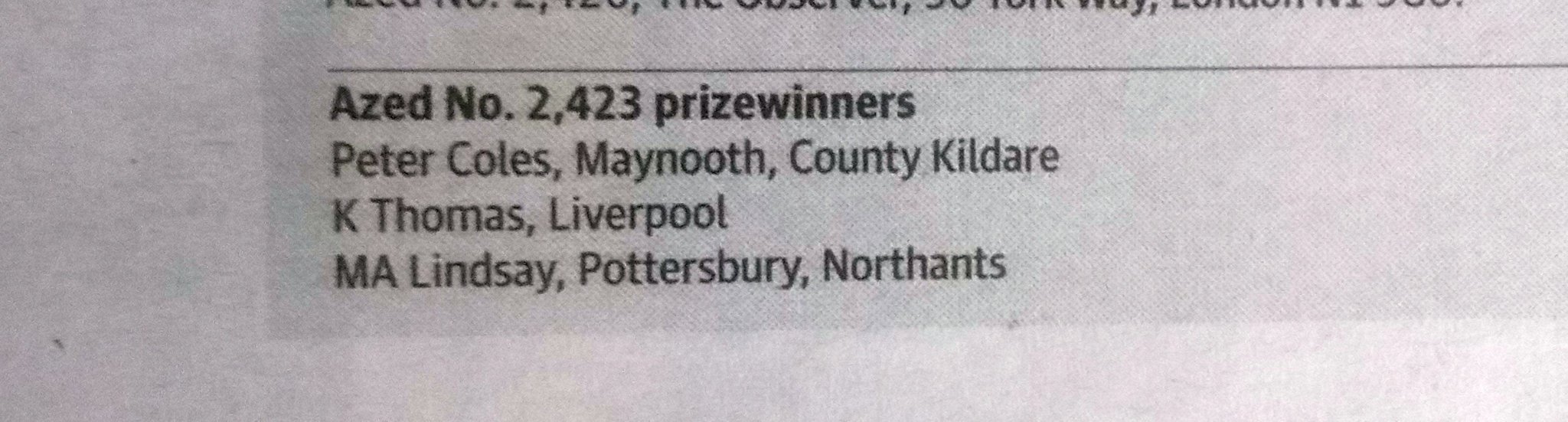
I had a nice surprise when I opened today’s Observer to the crossword page to find I had won a prize!

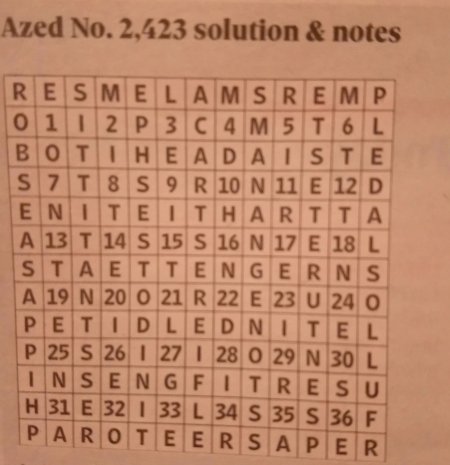
The solution to Azed 2423 printed in the paper is not, however, as I remember it.

Obviously there have been a few gremlins at the Observer.

Although I’ve been doing the Azed Crossword for the best part of twenty years this is actually the first time I’ve won the regular crossword prize, in which solvers just have to send in a completed puzzle and the winners’ names are drawn out of a hat, as opposed to the Competition puzzle (which occurs roughly every 4 weeks), in which solvers also have to supply a clue for one of the answers in the grid. It’s also worth saying that this is the first crossword prize I’ve won from Ireland. I have won a couple of other prizes (Everyman and the Times Literary Supplement) in the the past year, but I gave my address in Wales on both occasions as I was spending half time there and half in Maynooth for much of the past year.

Anyway, the prize is not a dictionary but £25 in book tokens, which should be enough to buy a dictionary should I feel the need. I think I may choose something else, however, assuming the tokens ever make it across to Ireland! I’ve not been impressed with the efficiency of the postal service to and from the UK so far…

According to the &lit archive I’ve been sending in entries for about 18 years. Since 3/4 of the Azed puzzles are of the regular type that means that if I’d done every puzzle correctly for that period I would have about 18 × 52 ×¾ ≈ 700 chances to win, which gives a crude estimate of the number of correct entries that must be sent in each week. In fact I’ve missed quite a few and probably made some mistakes. Nevertheless, a weekly entry of several hundred seems a reasonable order-of-magnitude guess. The number that enter the monthly competition is somewhat lower (around 200 usually). I don’t need to guess that – Azed himself supplies the numbers via the Azed Slip.

I’ve got a mediocre record in the Azed clue-setting Competition – I think I’m much better as a solver than a setter! – but have at least scored some successes and finished 15th (equal) in 2010/11. That turns out to have been my high-water mark, as I stopped doing the Azed puzzle regularly when I moved to Sussex in 2013, at which time I started doing the Beelzebub puzzle in the Independent on Sunday. I only re-started buying the Observer when the Independent stopped producing a print edition in March 2016.

So far I’ve struggled with the clue-writing, but I’ll soldier on with it and hopefully will hit some form at some point. Three puzzles into the latest season I’ve scored three HCs, which is at least consistent. Officially `HC’ means Highly Commended’ but I translate it as `Hard Cheese’. One needs to get a VHC (`Very Highly Commended’) at least to score points so I’m still just an `Also Ran’ this year. I got one VHC last year and hopefully can improve on that this time round, with ten puzzles still to go.

Incidentally, looking at the latest Azed Slip I notice that there are several solvers in Ireland. I’ve never noticed that before. I wonder how many have moved recently, like me?

Finally I think I’ll mention the winning clue in the last Azed Competition. The word to be clued was SPASMODICAL and the winning clue was:

À la PM’s disco dancing?

The word `dancing’ here is an anagram indicator, and the previous letters (A+LA+PMS+DISCO) form an anagram of the target word. A different wording of the clue acts as the definition, suggesting that Theresa May’s dancing at the Tory Party Conference was spasmodical. This type of clue is described as `anag. &lit’ (meaning `anagram’ and literally what it says). Undoubtedly, &lit clues are very difficult to construct, and the anagram in the above clue is extremely clever. Whether you think the &lit constitutes a fair definition of SPASMODICAL is a matter of taste. It’s perhaps a bit borderline, but probably saved by the `?’ at the end which traditionally implies some sort of funny business with the definition. In any case, this one is far less controversial than some of the others I’ve seen. For example, here it a prize-winning clue for SUBORDINATELY:

As in ‘B-role’ duty possibly

Here `possibly’ is the anagram indicator, which is fair enough, but for me the surface reading barely makes sense. Azed is the only judge, however, and he generally does seem to cut people quite a bit of slack when they attempt this type of clue.

Fintan O’Toole on “Heroic Failure: Brexit and the Politics of Pain”

Posted in Literature, Maynooth, Politics with tags , , , on December 6, 2018 by telescoper

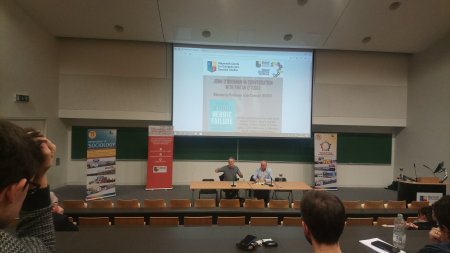
Time for a tea break and a quick post about a very interesting event this afternoon at Maynooth featuring renowned Irish journalist and author Fintan O’Toole (whose regular columns in the Irish Times I read with great interest).

This event saw John O’Brennan, Director of the Centre for European and Eurasian Studies in Maynooth in conversation with Fintan on his new book, Heroic Failure: Brexit and the Politics of Pain. The book deals with the Brexit referendum, the chaos it unleashed in British politics and the challenges posed to the island of Ireland by a ‘No Deal Brexit’. In particular the book examines how a country that once had colonies is redefining itself as an oppressed nation requiring liberation; the dreams of revolutionary deregulation and privatization that drive Arron Banks, Nigel Farage and Jacob Rees-Mogg; and the silent rise of English nationalism, the force that dare not speak its name. He also discusses the fatal attraction of heroic failure, once a self-deprecating cult in a hugely successful empire that could well afford the occasional disaster: the Charge of the Light Brigade, or Franklin lost in the Arctic. Now failure is no longer heroic – it is just failure, and its terrible costs will be paid by the most vulnerable of Brexit’s supporters, and by those who may suffer the consequences of a hard border in Ireland and the breakdown of a fragile peace.

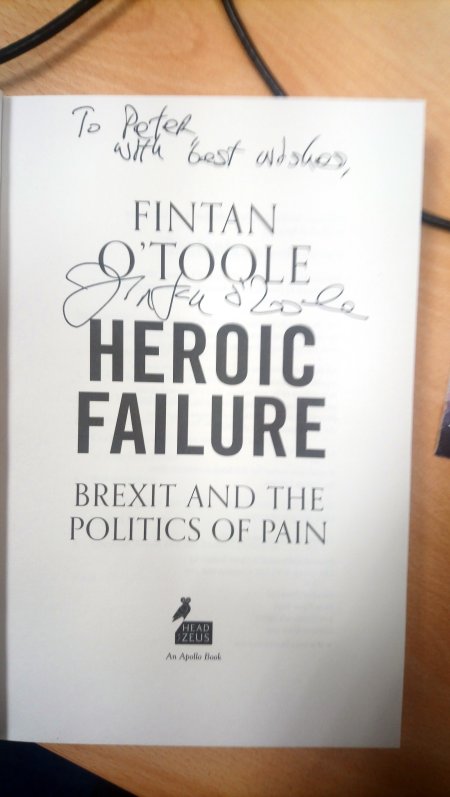
The discussion was so interesting – and Fintan O’Toole was so eloquent and amusing –  that I bought the book. The author was kind enough to sign it for me too!

There’s an extract printed on the cover that will give you a taste, but if you want more you’ll have to buy the book:

Of all the pleasurable emotions, self-pity is the one that most makes us want to be on our own…Only alone can we surrender completely to it and immerse ourselves in the steaming bath of hurt, outrage and tender regard for our terribly wronged selves. Brexit therefore makes sense of a nation that feels sorry for itself. The mystery, though, is how Britain, or more precisely England, came not to just experience this delightful sentiment but to define itself through it.

I only bought the book today so haven’t read it yet, but I will endeavour to write a review when I have.

Now back to the writing of lecture notes…

A Year In Maynooth

Posted in Biographical, Maynooth on December 1, 2018 by telescoper

Well, it’s December 1st, which means that it’s a year to the day since I started my current job in Maynooth.

I started here part-time and from December 2017 until summer 2018 I had to commute back and forth between Wales and Ireland. I’m glad I don’t have to do that anymore!

This term has been my first full-time in Maynooth and with two new modules to teach it has been hard work, but it’s been nice to get back to teaching physics again and I’m very glad I had institutional support needed to get the Open Journal of Astrophysics up and running on a permanent basis.

Terms here in Maynooth involve 12 weeks of teaching (plus a study week in the middle), and this year that means we teach all the way until Friday 21st December. That’s three weeks away, which means there’s one quarter of the teaching still to do. I’ve therefore decided to take a break this weekend before entering the home straight, which is why I’m sitting in Dublin Airport as I write this…