Archive for the Maynooth Category

The Open Journal of Astrophysics – Update

Posted in Maynooth, Open Access with tags , , , on September 13, 2018 by telescoper

The observant among you will have noticed that the website for the Open Journal of Astrophysics is currently offline. This emphatically does not mean that this project is dead so

In fact we’re in the process of moving the journal to a new platform (at the same web address) and the new site will be up and running as soon as we have completed the transfer, have tested the new configuration and done a few administrative things. All papers already published on the old site will be transferred to the new one and their DOI will remain unchanged. In fact the old site is still available, but at a secret location.

I’ll be blogging in a bit more detail about the new-look Open Journal of Astrophysics in due course, but in the mean time I’ll just make a few points.

First and foremost, if you don’t know what this project is about it is an idea I first floated over five years ago, shortly before I moved to Sussex. Although we got a website together and published a few papers, for one reason or another I didn’t have time to iron out some remaining bugs and the project stalled. However, after my move to Maynooth University I’ve been delighted to receive the support of the Maynooth University Library team and we’re now moving ahead. I know there have been a few false dawns on this project – for which I apologize – so I won’t announce the full re-opening until I’m absolutely sure everything works.

Second, and actually most importantly, the Editorial Board for the Open Journal of Astrophysics is looking for new members. We already have several distinguished editors, but the expertise we currently have is concentrated (not surprisingly) in cosmology, and we would really appreciate volunteers from other areas of astrophysics (especially stars/exoplanets, etc). If you’re interested please let me know.

Third, although the platform will look a little different (i.e. better) the overall philosophy of the Open Journal will remain as it always was, a fully `Green’ Open Access Journal, as defined by the following points:

  • There will be no charge for accessing or downloading OJA papers (i.e. no subscription fee).
  • There will be no charge for submitting, reviewing or publishing OJA papers (i.e. no `article processing charge’).
  • The OJA is a peer-reviewed journal; all papers accepted for publication will be assigned a DOI and registered with Crossref for citation tracking purposes.
  • The OJA is an arXiv overlay journal, so paper submitted to it must first be submitted to the arXiv.

Finally, I will mention that I was motivated to post this update by a piece by George Monbiot in todays’s Guardian. I don’t agree with everything Monbiot says, but he is dead right about this:

In the great majority of cases, the research reported has been funded by taxpayers. Most of the work involved in writing the papers, reviewing and editing them is carried out at public expense by people at universities. Yet this public asset has been captured, packaged and sold back to us for phenomenal fees. Those who pay most are publicly funded libraries. Taxpayers must shell out twice: first for the research, then to see the work they have sponsored. There might be legal justifications for this practice. There are no ethical justifications.

I’ve said as much myself on this blog. My point is that the academic publishing industry is not going to change of its own volition. If the Academic Journal Racket is to be rumbled, it is we (by which I mean academics and our institutions) who have to take control. Sitting on our hands while we get systematically fleeced is not an option. One way to do this is for institutions and organizations to themselves become Open Access publishers, which is precisely what my current institution is doing: Maynooth University will be the official publisher of the Open Journal of Astrophysics (and hopefully many more similar journals in the future).

Ninth Level Ireland

Posted in Education, Maynooth with tags , , , , , , on September 7, 2018 by telescoper

Today I’ve been trying to finish off a couple of things before making a short trip back to Cardiff to sort out of a few personal matters. Next week the new intake of students starts to arrive in Maynooth. Officially Welcome Week begins on 17th September but in the second half of next week there are `Orientation Talks’ aimed at guiding new students through all the options they have in the first year. The flexibility of the degree programmes here really makes these talks essential.

Yesterday I blogged about some of the differences between the Higher Education systems in Ireland and the United Kingdom. Another couple came up today. The first is that `Orientation’ over here is what UK universities usually call `Induction’. One thing is common to both systems, though. When I made my annual `joke’ about `induction’ involving passing the students through a magnetic field in order to establish their potential, it fell just as flat here as it always has done on the UK.

Another difference is that over here we don’t have graduation ceremonies; they are called conferring ceremonies. On University Challenge there is no conferring. Moreover, the ceremonies are not in July (as graduation ceremonies usually are in the UK). In fact there are three sets of ceremonies, in mid-September, late October/November, and March. The first set is next week actually. That means I won’t be able to bore my readership with explanations of the Latin grammatical origins of the words graduand and graduate as I have done in the past.

Finally, I just wanted to mention that there is a site called Ninth Level Ireland which aggregates news items, blogs and other online items about Higher Education in Ireland. That site started reblogging my posts long before I moved to Ireland, actually. I know quite a few Irish academics follow Ninth Level Ireland , and if you’re interested in matters academical then it’s well worth looking at. As you can see, it even uses the same WordPress theme as this blog.

I don’t know whether it is automated (like a `bot’) or whether items are selected by hand, but if it’s the former I suspect this post might well end up the site!

Notes from Maynooth

Posted in Biographical, Cardiff, Education, Maynooth with tags , on September 6, 2018 by telescoper

A few people have asked me to comment a little bit on difference between Higher Education Institutes in the United Kingdom and here in Ireland from the point of view of teaching and learning. I can’t do that systematically of course because I’ve only ever been at one University in Ireland, Maynooth, and that for only a year. I have however held positions that involved teaching in several UK universities (Queen Mary, Nottingham, Cardiff and Sussex) so perhaps some comments based on my own experiences might be useful. And of course I’m just talking about Theoretical Physics here, so I won’t discuss labs. It’s a very big selling point for our Theoretical Physics courses here that students don’t have to do labs (apart from Computational Physics labs, of course).

To start with something rather trivial, the `load’ for a student in most UK universities is usually 120 credits while here in Ireland it is 60. The actual workload expected of a student is the same so this just means there’s an exchange rate of 2:1 between the UK and Ireland. In the UK the load is usually split into two equal semesters with examinations in January and May after each. In the UK the 60 credits of each semester is usually split into modules. In my experience in physics these can be either 10 or 20 credits (e.g. Cardiff) or 15 credits (e.g. Sussex). The standard size here in Maynooth is 5 credits (equivalent to 10 in the UK), so most comparisons will be with a standard 10-credit module based on the Cardiff model (which I think is more common than the Sussex model).

What goes into these standard modules differs slightly. Here in Maynooth there are twelve teaching weeks per semester plus a `Study Week’ half way through, so each is 13 weeks long. For a 5-credit module there are usually two lectures per week (so 24 in total, as there are no lectures in Study Week). On top of this there are weekly tutorials (usually done by PhD students). In Cardiff there are also 2 lectures a week for the directly comparable 10 credit module, though not all modules have tutorials associated with them. There is no mid-term Study Week in Physics & Astronomy at Cardiff and teaching term is only 11 weeks, so students typically have 22 lectures in a `standard’ module.

Continually-assessed coursework at Maynooth typically counts for 20% of a module mark (as it does in Cardiff), with 80% on an examination. In both Cardiff and Maynooth a `standard’ module has a two-hour examination at the end, but there’s a big difference in style: most of the papers in Maynooth require students to answer all the questions for full marks, whereas in Cardiff it’s two out of three or three out of four (usually). The Maynooth style makes it much harder for students to question-spot.

In summary, then, the amount of contact time for a student in Maynooth is greater than in Cardiff. The student-staff ratio in the Department of Theoretical Physics in Maynooth is about 15, which is a little higher than most UK physics departments (see Table here). There are only 7 full-time academic staff with full curriculum to deliver, means that teaching loads here are quite heavy compared to the UK.
Four modules per year is typical.

That might seem a lot to some people, but I actually enjoy teaching so don’t mind at all. In fact, with the mountain of administrative stuff I had to do at Sussex, it was only the fact that I taught a full module (on Theoretical Physics) that kept me (partially) sane. This year I shall be teaching, in the Autumn Semester, a 4th-year module on Astrophysics & Cosmology and a 2nd-year module on Vector Calculus and Fourier Series and, in the Spring Semest, 3rd-year Computational Physics 1 (again) and Engineering Mathematics (for First-year engineers). I’m not sure what to expect of that last one, but I’m not going to think about it until the New Year.

Most of our students do a four-year Bachelors programme in Science (as discussed briefly here) with a very general first year. Some, however, come directly into a programme called Theoretical Physics & Mathematics (TP&M, for short) which is three-year fast-track degree. It’s harder to get into TP&M than the `Omnibus’ Science course, but it does attract some very capable students.

I should mention that the really big difference between Ireland and the UK is that the system of teaching and learning here is much less centralized and much less rigid that UK universities. The small size of the Department means that it is possible to know all the students by name and students with difficulties can always find someone to talk to. That is increasingly not the case in UK universities, which are rapidly turning into teaching factories and are subject to the pressure to do well in league tables (often with a negative impact on teaching quality).

Subject to some conditions, first-time full-time undergraduate students in `Third-level’ education in Ireland do not pay tuition fees as such, and neither do students from other EU or EEA countries. There is however an annual ‘student contribution’ of €3000 which all students pay (unless they have a grant that covers it). As far as I can see, that is effectively a fee, though it is supposed to cover student services (e.g. libraries) and examinations rather than tuition. Students taking repeat examinations generally have to pay extra for them. If you consider the `student contribution’ to be a fee (which is effectively what it is) then the Irish funding system is similar to the pre-2012 UK system, i.e. before the introduction of the current £9K fee.

Finally, one of the most striking differences between Ireland and the UK is that here a much higher proportion of students live at home with their parents while studying and commute into campus daily (some of them from quite a distance). That is quite unusual in the UK, but is fairly typical in other EU countries (e.g. Italy). The cost of accommodation is undoubtedly a factor, but I think it’s also a more general cultural thing. I’ve also noticed something here that I’ve never seen in the UK, which is that some student accommodation is let on a Monday-Friday basis, the tenant being expected to go back to the parental home at the weekends. On Fridays in term-time, you can see quite a lot of students with their bags waiting for coaches or trains to take them away for the weekend…

In a future post I might comment on non-academic differences between Ireland and the UK (e.g. tax, public services, cost of living, etc) but I think that will do for now.

A Sign of Progress

Posted in Education, Maynooth on September 1, 2018 by telescoper

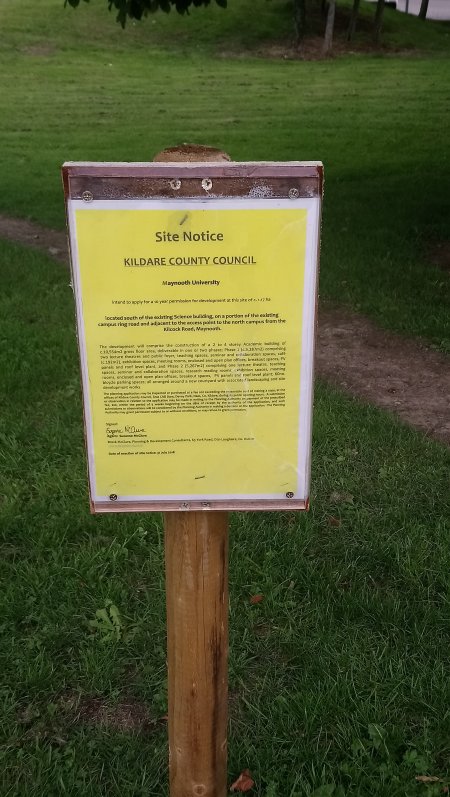
The other day I saw this sign on my way into work. It has been put up near the Science Building on Maynooth University campus, and is a planning notice that hopefully will start the process of constructing extra buildings for science in Maynooth. Among the facilities the new buildings will provide are new teaching laboratories.

Currently, most students doing Science subjects here enter on a four-year general science programme that involves doing four subjects in the first year, becoming increasingly specialised thereafter. That’s not unlike the Natural Sciences course I did at Cambridge, except that students can do both Theoretical Physics and Experimental Physics in the first year as separate choices.

I like this programme because it does not force the students to choose a specialism before they have had a taste of the subject, and that it is flexible enough to accommodate Joint Honours qualifications in, e.g., Theoretical Physics and Mathematics.

The problem we have in Maynooth is that this structure combines with the limited laboratory space in the existing Science Building to create a bottleneck in the first year. We can’t increase our intake without increasing capacity in the labs. This is especially true for Chemistry, which is taken alongside Physics by some students and Biology by others. Increasing laboratory space for chemistry will actually help other disciplines.

It will take several years to construct the new building, and there will probably be a great deal of disruption when the work starts, but in the long run I think it will be worth it.

The Russell Library, Maynooth

Posted in Books, Education, Literature, Maynooth with tags , on August 29, 2018 by telescoper

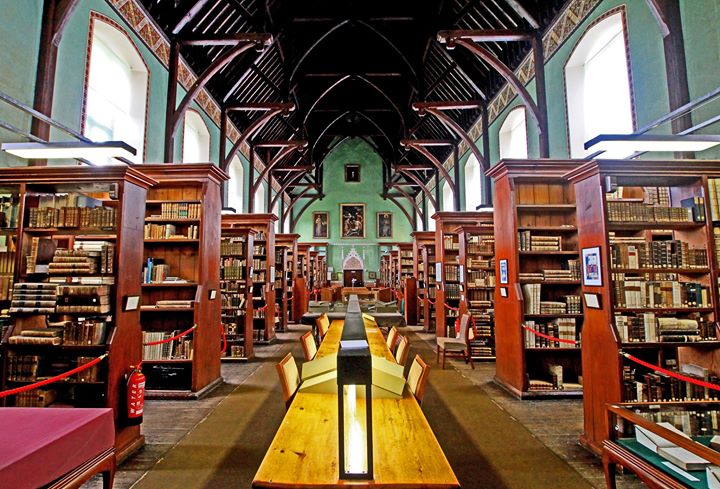
For those of you who like lovely old libraries filled with lovely old books, here’s a picture of the Russell Library, which is on the South Campus of Maynooth University:

Library Picture

According to the website:

The Russell Library houses the historical collections of St Patrick’s College, Maynooth which was founded in 1795 as a seminary for the education of Irish priests. The reading room was designed by renowned British architect and designer Augustus Welby Northmore Pugin (1812-1852) and completed in the year 1861. The Russell Library contains approximately 34,000 printed works dating from the 16th to the mid-19th century across a range of subjects including: theology, mathematics, science, geography and history. Other important collections include: medieval and Gaelic manuscripts, archival material and incunabula (pre-1501 printing).

Golf and other Hazards

Posted in History, Maynooth, Sport with tags , , , , , on August 27, 2018 by telescoper

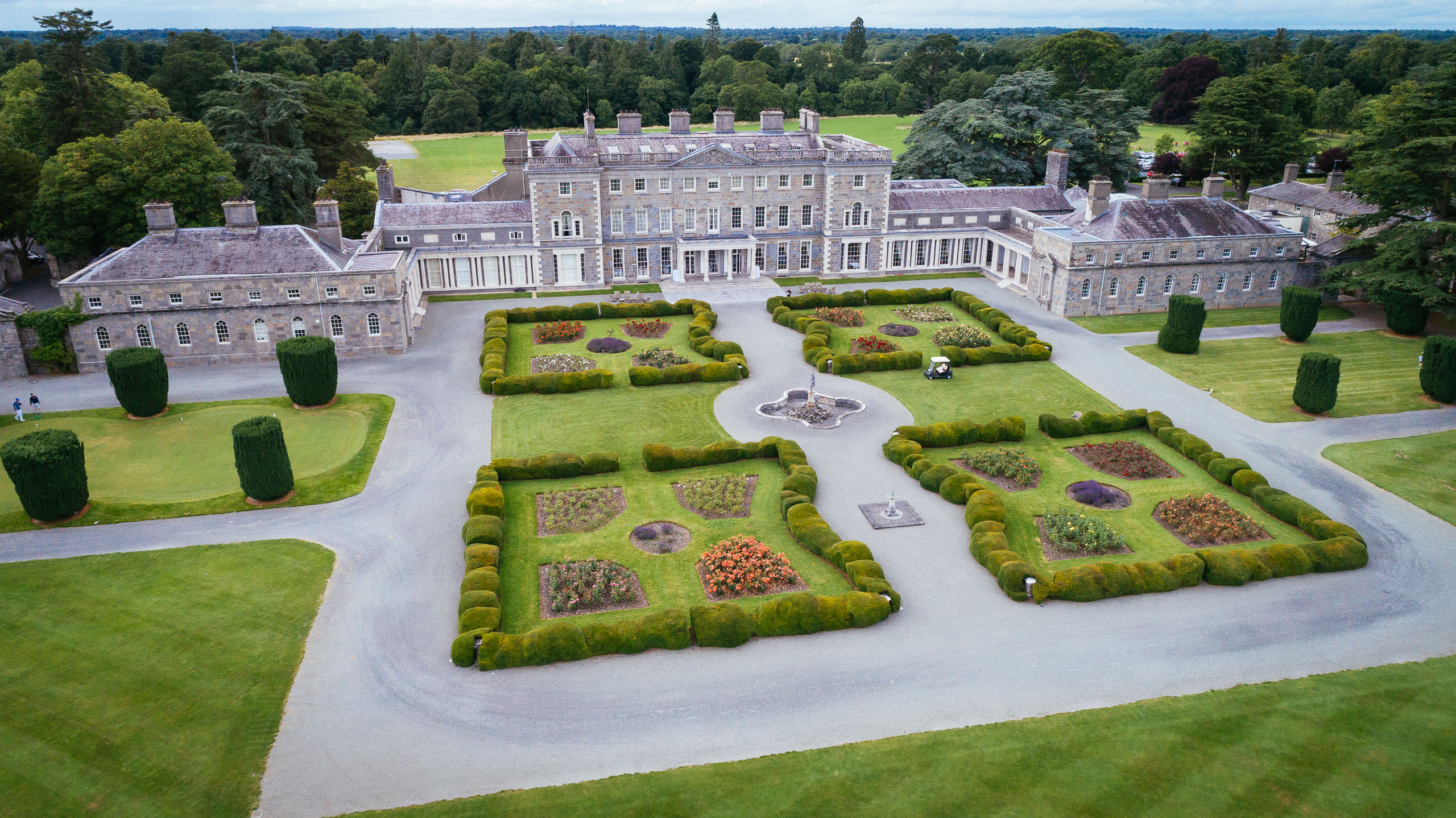
Back in the office with a few minutes to go before a meeting starts I thought I’d give a little insight into life in the throbbing metropolis that is Maynooth, County Kildare. This week sees the start of the World Amateur Team Golf Championships, which is being held at Carton House (above) which is a short walk from downtown Maynooth. Some of the competitors will be staying on Maynooth University campus for the duration, which will no doubt provide welcome revenue.

Now the game of golf is obviously of no conceivable interest to anyone, but the venue – Carton House – is quite fascinating. The current house was built on the Carton Estate in the 18th Century to accommodate the Earl of Kildare, when their fortunes had slowly recovered after Thomas Fitzgerald (`Silken Thomas’) the 10th Earl of Kildare was executed, along with several others of the Fitzgerald family, by Henry VIII for plotting a rebellion against the English. If you have been paying attention you will know that it was the Fitzgeralds who built the stone castle in Maynooth that was destroyed in the 16th Century. Carton House is at the other end of town, and is approached by a very pleasant tree-lined avenue. The extensive grounds are also surrounded by a wall. The latter-day Fitzgeralds obviously wanted to keep the hoi polloi at arm’s length.

Anyway, to cut a long story short, Carton House fell into disrepair in the second half of the 20th Century and was eventually sold off and turned into a hotel and spa resort, with two golf courses.

In the meantime, among many other things, Carton House and it its grounds were used as one of the locations for Stanley Kubrick’s (1975) film Barry Lyndon. That was of course before the beautiful landscaped gardens were destroyed and turned into golf courses. I went for a pleasant walk in the grounds earlier this summer, during the heatwave, but the path runs alongside a small lake beside one of the fairways where a group of people were openly committing acts of golf. A not-very-competent member of this group sent several balls into the water before finally managing to hit dry land with a tee shot. For a while I wished I’d brought a tin hat with me.

Age, Memory and Learning

Posted in Education, Maynooth with tags , , , , , , , on August 20, 2018 by telescoper

Today’s a big day for prospective students at Irish universities. It’s the day when the Central Applications Office (CAO, the equivalent of the UK’s UCAS) makes offers of places to students based the Leaving Certificate results that were announced last week. Thus begins the process by which universities find out how many students we will have for entry next month. Lectures here at Maynooth start on 24th September, with an induction week before that, so there promises to be quite a rush to get everything sorted out.

The first thing that struck me thinking ahead to this year’s new entry of students was that the majority of students starting this autumn either here in Ireland or in the UK were born in the year 2000. That means that I’ve been a Professor (at four different universities: Nottingham, Cardiff, Sussex and Maynooth) all the time they have been alive! Yikes I feel old!

The other thing that struck me among all the press coverage of the Leaving Certificate in Ireland is the significant amount of griping about how these examinations are basically just memory tests and the system encourages rote learning. This is something I’ve complained about before in the context of British A-levels and indeed the system of university examinations.

Over my lifetime the ratio of assessment to education has risen sharply, with the undeniable result that academic standards have fallen especially in my own discipline of physics. The modular system encourages students to think of modules as little bit-sized bits of education to be consumed and then forgotten. Instead of learning to rely on their brains to solve problems, students tend to approach learning by memorizing chunks of their notes and regurgitating them in the exam. I find it very sad when students ask me what derivations they should memorize to prepare for examinations because that seems to imply that they think their brain is no more than a memory device. It has become very clear to me over the years that school education in the UK does not do enough to encourage students to develop their all-round intellectual potential, which means that very few have confidence in their ability to do anything other than remember things. It seems the same malaise affects the Irish system too.

On the other hand, as a number of people have pointed out in opinion pieces (e.g. here) and letters (here and here), a good memory is undoubtedly an extremely important asset in its own right.

I went to a traditional Grammar school that I feel provided me with a very good education in which rote learning played a significant part. Learning vocabulary and grammar was an essential part of their approach to foreign languages, for example. How can one learn Latin without knowing the correct declensions for nouns and conjugations for verbs? But although these basic elements are necessary, however, they are not sufficient. You other aspects of your mental capacity to comprehend, translate or compose meaningful pieces of text.

The same considerations apply to STEM disciplines. It is important to have a basic knowledge of the essential elements of mathematics and physics as a grounding, but you also need to develop the skill to apply these in unusual settings. I also think it’s simplistic to think of memory and creative intelligence as entirely separate things. I seems to me that the latter feeds off the former in a very complex way. A good memory does give you rapid access to information, which means you can do many things more quickly than if you had to keep looking stuff up, but I think there’s a lot more to it than that. Our memories are an essential part of the overall functioning of our brain, which is not  compartmentalized in such a simple way.  For example, one aspect of problem-solving skill relies on the ability to see hidden connections; the brain’s own filing system plays a key role in this.

Recognizing the importance of memory is not to say that rote learning is necessarily the best way to develop the relevant skills. My own powers of recall are not great – and are certainly not improving with age – but I find I can remember things much better if I find them interesting and/or if I can see the point of remembering them. Remembering things because they’re memorably is far easier than remembering because you need to remember them to pass an examination!

The Rooks of Maynooth

Posted in Maynooth with tags , , , , on August 3, 2018 by telescoper

In a previous post I mentioned the proliferation of crows in Maynooth. It turns out that was a terminological inexactitude, in that the birds in question were actually rooks. It’s true that rooks are part of the crow family (genus Corvus, family Corvidae) which also includes ravens and jackdaws but they do have a distinctive look and character. See the above picture (taken in Maynooth but not by me; picture credit here).

The rooks have been prevalent in Maynooth for centuries. A quick google found this quote from 1802 from the poet W.M.Letts:

The men of Maynooth are like o’ the rooks,
With their solemn black coats an’ their serious looks.

This refers to the young men studying at the Roman Catholic seminary of St Patrick’s College, of whom there were 500 or so in those days. The seminarians are somewhat fewer in number now, but the rooks are still plentiful.

I wouldn’t say that rooks are the most visually attractive birds, and they do have a slightly sinister aspect, but they are very characterful creatures and I find them very amusing to watch. They’re very sociable and tend to go about their business in large groups, especially when scouring pieces of open land for insects and other things to eat. They also seem to tolerate the presence of their cousins the jackdaws (of which there are also quite a few in Maynooth, though not as many as the rooks). Jackdaws are a bit smaller, prettier, and neater in appearance than rooks (which often look very scruffy indeed). I imagine that the jackdaws look down on the rooks rather snootily, as one might one’s less sophisticated relatives. The collective noun for rooks is a `Parliament’, which also suggests that they are not held in very high regard.

Like jackdaws, rooks have two modes of locomotion along the ground: a sort of strutting walk and a two-legged hop, both of which are rather comical. Their walk makes them look like officious constables, whereas the hop is more like a child pretending to be a horse. The rooks are basically scavengers and they have a penchant for systematically emptying litter bins in their quest for scraps of food. At the rear of the apartment block in which I live there is a place for storing rubbish for collection in large dumpsters. Sometimes somebody forgets to close the lid with the inevitable result that a large group of rooks gets inside and strews garbage all over the place. When they’re not patrolling around or rooting through rubbish they tend just to sit there watching the world go by, waiting for another opportunity for mischief.

I’m told that, in the old days, the rooks of Maynooth used to gather at the Old Mill, but since that was demolished to make way for a shopping centre they seem mostly to congregate on the playing fields on or near the Royal Canal. Anyway, I’ve got used to them in the short time I’ve been in Maynooth and I always look out for them when I’m walking around.

What prompted me to write this post is that on my way to the Department yesterday morning I came across a dead rook lying on the path. It looked like it had died only recently, as there was no sign of decay. It was well away from the road, so it seemed unlikely it had been hit by a car. I suppose it just died of natural causes.

Nature After Planck…

Posted in Maynooth, The Universe and Stuff with tags , , , , , , on July 24, 2018 by telescoper

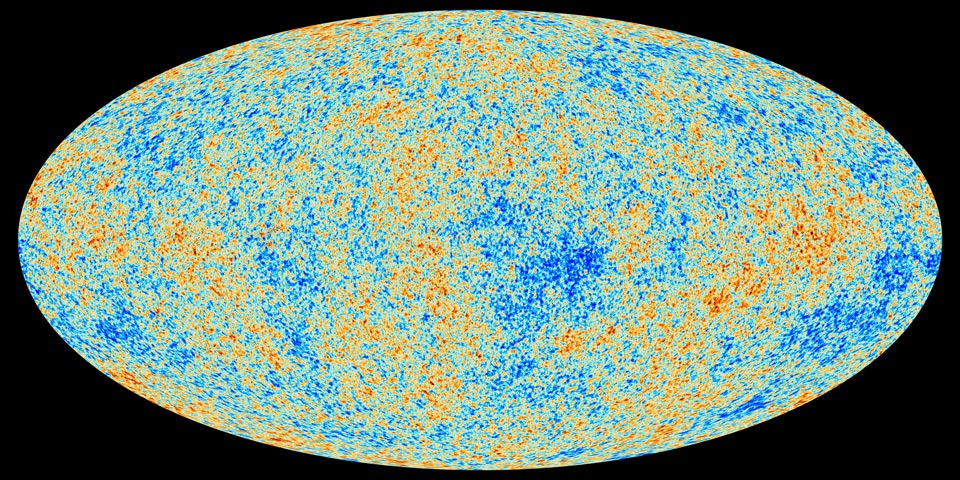
After last week’s short update about the last tranche of papers from the European Space Agency’s Planck Mission it’s time for another short update about a piece in Nature (by David Castelvecchi) that explains how researchers are moving to smaller projects studying different aspects of the cosmic microwave background.

In the spirit of gratuitous self-promotion I should also mention that there’s a little quote from me in that piece. My comment was hardly profound, but at least it gets Maynooth University a name check…

Much of Davide’s piece echoes discussions that were going on at the meeting I attended in India  last October, but things have moved on quite a bit since then at least as far as space experiments are concerned. In particular, the proposed Japanese mission Litebird has been shortlisted for consideration, though we will have to wait until next year (2019) at the earliest to see if it will be selected. An Indian mission, CMB-Bharat, has also emerged as a contender.

While the end of Planck closes one chapter on CMB research, several others will open. These are likely to focus on polarization, gravitational lensing and on cosmic reionization rather than refining the basic cosmological parameters still further.

Drought in Greater Dublin

Posted in Maynooth on July 14, 2018 by telescoper

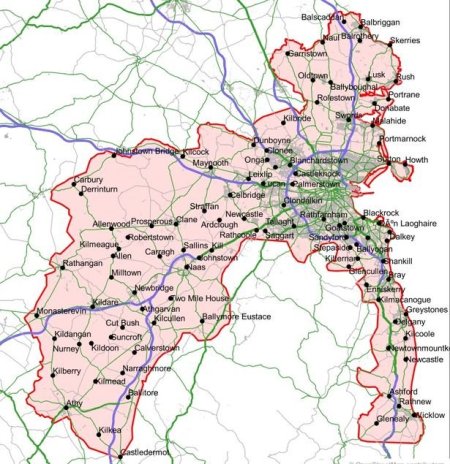
The prolonged period of dry weather we’ve been having in Ireland has led to a water shortage in Greater Dublin and some surrounding districts, including Maynooth in County Kildare (where I live). A hosepipe ban has been in place for some time and now there are restrictions on overnight water usage in Dublin, although not yet in Maynooth.

The map above shows the area affected by the hosepipe ban, which doesn’t affect me because I haven’t got a garden, but I’ve included it because it shows Maynooth and some of the neighbouring towns, in one of which I might well find myself living permanently.

The bus route from Maynooth to Dublin Airport passes through Leixlip and Lucan Village. My current residence is on Straffan Road, which leads south from Maynooth to Straffan. Other notable places are Kilcock, Celbridge, and… er…. Newcastle.