Archive for the Jazz Category

The Quintet at Massey Hall

Posted in Jazz with tags , , , , , , , , , on February 23, 2014 by telescoper

Time for a quick Jazz review, I think. This time I thought I’d pick a classic live performance from May 15th 1953 at Massey Hall in Toronto. Originally released as a vinyl LP with only 6 tracks on it, and called The Quintet of the Year, but subsequently re-released in various versions on CD, with various titles including Jazz at Massey Hall. The whole concert  is now available on Youtube here:

This concert was planned to unite the greatest stars of the bebop era who had performed together earlier in their careers but had gradually evolved different styles over the intervening years. The line-up is Charlie Parker on alto, Dizzy Gillespie on trumpet, Bud Powell on piano, Charles Mingus on bass and the great Max Roach on drums which is stellar by any criterion!

Gatherings of star jazz players have often turned out to be disappointing, largely because very great musicians can sometimes interfere negatively rather than positively with each other, not necessarily consciously but because they can have ideas incompatible with one another. This evening, however,  was a glorious exception to this rule, doubtless because all the musicians had worked together in the past, and their subsequent individual development had not taken them too far beyond their shared musical background. It is true that the ensemble passages are slight, but that doesn’t matter much because the solos are of such a remarkable and consistently high standard. Charlie Parker turns in some of the very best of his later recorded work, giving the lie to those who argue that his musical abilities were in decline at this time. He might not play as elegantly as he did on the classic Dial and Savoy sessions, but he is significantly more adventurous, with startling melodic contrasts in much of his work. At times this is a bit of a problem in that he seems to full of ideas that what comes out is a sequence of breathtaking fragments rather than a cohesive solo. This happens on A Night in Tunisia, for example, which never quite fulfills the promise of its magnificent opening break. On other tracks, though, especially Hot House his improvisations are just brilliant. It’s hard to imagine listening to this that in less than two years he would be dead.

Dizzy Gillespie matches Parker in superb fashion, betraying none of the offhandedness that often afflicted his later recorded performances, and the pyrotechnical quality of his playing is as exhilarating as it is instantly recognizable. Gillespie was an extrovert on stage and his frequent dancing around on the stage results in him going on and off mike from time to time, but it doesn’t detract from the performance once you realize why he’s fading in and out. It is, after all, a live performance and if you shut your eyes you can imagine Dizzy Gillespie the showman without any difficulty at all!

Most Jazz reviewers confine their comments on the rhythm section to a few kind words, but in this case that would be a travesty. The limitations of live recording technology in 1953 result in a rather unbalanced mix, but the flip side of that is that you can hear  particularly well the pivotal importance of the bass playing of Charles Mingus. Between them Mingus and Max Roach lay down a relentlessly propulsive beat as well as taking gripping solos; the drum workouts in Wee and Salt Peanuts are astonishing in their interplay of rhythm and texture. Trumping even them, however, is the genius of Bud Powell who plays at a level consistently high even by his own standards.

Bud Powell is a fascinating musician for many reasons. Much less of a formalist than many Jazz pianists he nevertheless seems to generate a real sense of unity, more through the  emotional drive underpinning his phrases than by imposing any set structure on his improvisations. His solo on Wee offers a fine example of this: moving inexorably towards a shattering climax as the right hand figures vary ceaselessly in their length and the chords punched out by the left hand grow more frequent and more percussive.

This album is another must-have for any serious collector of post-War jazz. The individual parts are all superb, but the whole is even greater than their sum.

PS. I had the pleasure of attending a concert at Massey Hall myself, when I was on sabbatical in Toronto in 2005/6.

Jacques Loussier and the Pekinel Twins play Bach

Posted in Jazz, Music with tags , , on February 21, 2014 by telescoper

I heard a track by this combination on the Breakfast Programme on BBC Radio 3 yesterday morning and thought I’d include something on here; it’s basically the Jacques Loussier Trio, which is famous for its Jazz re-workings of the music of Johann Sebastian Bach with the addition of the identical twins Güher  and Süher Pekinel on pianos.

Apparently some members of the Radio 3 audience didn’t take kindly to Ian Skelly’s decision to play something by this combination, but I have to say I loved it; it really put a spring in my step. I’ve remarked before on this blog that many Jazz musicians are great admirers of Bach (who was himself a talented improviser).  It’s not difficult to understand why this is the case, particularly in the case of the keyboard works, because the music always has such a rich and compelling  harmonic progression built into it – just what a Jazz musician needs. Bach’s compositions are so well constructed that they can cope with being pulled around more than those of any other composer I can think of. Above all, despite the change of musical vocabulary and the addition of a rhythm section, the best Jazz versions still somehow manage to sound  like Bach….

From the following clips you can see that the twins play from sheet music – I think the arrangement was written  by Jacques Loussier – while Loussier’s contribution is largely improvised. In the clip they play versions of Bach’s Triple Concerto in D minor BWV 1063 (with Jacques Loussier) followed the Concerto for Two Keyboards in C minor, BWV 1060  (without Loussier)…

The Shape of Jazz to Come

Posted in Jazz with tags , , , on February 8, 2014 by telescoper

The other night I was listening to the Ornette Coleman album The Shape of Jazz to Come and decided that I really should write something about it on here. Released in 1959, this was Ornette Coleman’s third album but it was the first to issue a fully coherent statement of his musical intentions and it was from this work that his influence began to spread. The prophetic title proved to be extremely accurate; what remains astonishing is that such a radical album was recorded as long ago as 1959, in what I consider to be a Golden Age of musical innovation.

What Coleman did in this album was truly revolutionary. The fundamental change involved was a complete rejection of conventional harmonic progression, i.e. the sequences of chords which underpinned and connected earlier jazz improvisations with a repeating cycle that imposed not only its own order but also its own formal restrictions. By rejecting these, Coleman gave his music complete freedom of melodic movement. His intentions are signalled even by the choice of band members. Consisting Coleman on alto saxophone, Don Cherry on trumpet, Charlie Haden on bass and Billy Higgins on drums, the quartet did not involve any chord-playing instruments at all. With the wider latitude allowed by this approach the melodic patterns are bolder and less predictable than in earlier forms of Jazz. The thematic phrases do not conform to the traditional 4 or 8-bar norms involved in traditional tunes. Freed of the necessity of catching up the next chord as it comes up in the accompaniment, improvisation can range further, crossing bar-lines at will. The resulting music was considered almost shocking in 1959, but although unconventional by the standards of the time, it can be heard to carry its own force and logic, respecting the fundamental laws of jazz improvisation while at the same time calling into question many of the assumptions on which these laws had been thought to rest.The rejection of harmonic dominance also altered other aspects of the music. Coleman’s melodic inventiveness was even enhanced by a (partial) rejection of equal-temperament tuning.

None of these changes was made just for the sake of it, and in many fundamental respects the music isn’t radical at all. The horns open and close each performance in fairly conventional style and they play clearly delineated solos. Billy Higgins keeps a steady beat going throughout, and Haden plays in between that beat and the trumpet and saxophone.  But that disguises some important differences in responsibility, especially for the bass player, Charlie Haden. Instead of following a chord sequence and knowing roughly what his line would be throughout the piece, he has to listen to the soloist and improvise a line to fit.  As always, increased freedom brings increased responsibility.

All four men are generous with their talents on this album, which is a feast of beauty and originality as well as skill and daring. It would be wrong to single out any particular track, which is why I’ve linked to the whole album, but I’d have to mention Peace, which is a lovely performance emerging from a statement of mood rather than a chord sequence; Don Cherry’s trumpet solo on that track is really remarkable. In an entirely different vein there’s Congeniality, which was the first in a long line of superbly swinging up-tempo numbers hitting a groove that Coleman was to make his own in subsequent years. There’s also Lonely Woman, which is the one tune on this album that became  a Jazz standard.

An album of extraordinary genius that was (and probably still is) way ahead of its time, The Shape of Jazz to Come is a must-have album for any serious Jazz enthusiast.

Jazz Musicians Play Classical…

Posted in Jazz, Music with tags , , , on January 30, 2014 by telescoper

I had an interesting exchange via Twitter the other day after listening to “CD Review” on BBC Radio 3. The programme included a few examples of Opera singers trying – and, in my opinion, failing – to sing like Jazz singers.

I was reminded of this discussion last night when I got home to find a lovely Clarinet sonata by Poulenc being played. It turns out that this piece was commissioned by none other than the “King of Swing”, clarinetist Benny Goodman.

I love both Jazz and Opera, but attempts to mix the two very different genres are not often successful.  Jazz and Classical music are rather like different languages and musicians are rather like poets: fully bilingual exponents who can perform their art in more than one tongue are few and far between. There are, however, notable exceptions to this rule if not among singers but among instrumentalists. I think this is largely because so many Jazz musicians are so unbelievably virtuosic on their instruments that they can play more-or-less anything they put their mind to.

Anyway, I thought I’d post a few examples of famous Jazz musicians who have proved that they can play Classical music well. Here’s the man Benny Goodman playing the Mozart Clarinet Quintet K. 581:

Wynton Marsalis playing a Haydn Trumpet Concerto:

Keith Jarrett playing the first movement of the Italian Concerto by J.S. Bach  BWV971. I would have included his version of the Goldberg Variations, but it’s on harpsichord and therefore not allowed…

I’d like to hear any further suggestions of excellent performances of Classical repertoire by Jazz musicians, so feel free to comment through the box.

Early Junction: Door of the Cosmos

Posted in Jazz, The Universe and Stuff with tags , , , on January 15, 2014 by telescoper

One of the quirks of being in Japan is the 9 hour time difference between here and the UK, which means I’m just getting up when folk back home are going to bed; and one of the consequences is that BBC Radio 3’s Late Junction is on (via the internet) in the morning. It’s playing as a write this, in fact. Yesterday morning there was a track by Sun Ra, which reminded me that 2014 is the centenary of his birth. It prompted me to look back at an old post I’d written about him where I found the track included there had been deleted from Youtube. I therefore decided to post a new version, including a different track.

Sun Ra was one of the most extraordinary composers and bandleaders of the 20th Century,  was born Herman Poole Blount in Bimingham, Alabama, on 22nd May 1914. From the 1950s, until his death in 1993, he led various combinations of musicians in bands with various permutations of names involving the word Arkestra, such as the Blue Universe Arkestra and the Solar Myth Arkestra. He himself played keyboards, sometimes solo and sometimes with huge bands  of over 30 musicians; his music touched on virtually the entire history of jazz, from ragtime to swing music, from bebop to free jazz, as well as soul and pop. He was also  one of the first musicians, in any genre, to make extensive use of electronic keyboards.

He never achieved mainstream commercial success, but was a prolific recording artist with a cult following, partly fuelled by his outrageous claims to have been born not on Earth but on Saturn and the fact that much of his music was to do with space travel. Quoted in Jazziz magazine

They really thought I was some kind of kook with all my talk about outer space and the planets. I’m still talking about it, but governments are spending billions of dollars to go to Venus, Mars, and other planets, so it’s no longer kooky to talk about space

Quite. In fact, Sun Ra developed a complex performing identity based on his music, “cosmic” philosophy, and poetry. He abandoned his birth name, took on the persona of Sun Ra (Ra being the ancient Egyptian god of the sun), and often dressed in the style of an ancient Egyptian pharoah, as in the video clip. In other words, he was very odd.

Sun Ra’s music is eclectic, outrageous and sometimes downright mystifying, but it also has a marvellous coherence to it maintained as his style evolved over four decades and is consistently imbued with a powerful sense of the Jazz tradition.  Anyway, whatever I think, the music of Sun Ra has withstood its skeptics and detractors for generations and long may it continue to do so. The world needs more of his kind of eccentric.

Here’s a number called Door of the Cosmos. See what you think.

Music for Zen Meditation

Posted in Jazz, Music with tags , , , on January 12, 2014 by telescoper

Given my current location I thought I’d try this one out readers of this blog. I bought the album Music for Zen Meditation about 20 years ago; it was recorded in 1964 and features jazz clarinettist Tony Scott with two Japanese musicians, Shinichi Yuize (who plays the koto, a 13-stringed Japanese harp) and Hōzan Yamamoto (shakuhachi, a kind of bamboo flute). I think the music, and especially Scott’s lovely tone on the clarinet, creates a wonderful sense of peace, and it’s fascinating to hear the blending of styles. However, I played some of the music for my Japanese friend Chiaki some time ago and he said it sounded like something you would hear in an elevator. Ouch!

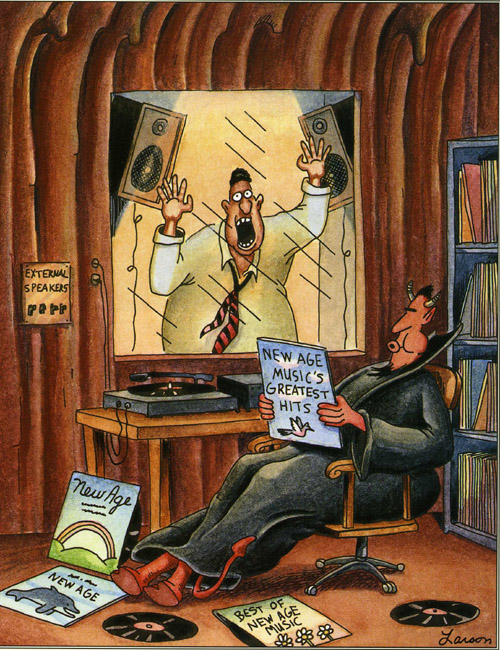
This album is often said to have been the first ever recording in the musical genre that came to be known as New Age, most of which I can’t stand. That reminds me of one of my favourite Gary Larson cartoons:

charlie_parker_hell

Music for Zen Meditation is certainly a far cry from bebop, but I’ll leave it to you to make your own mind up about it. See what you think. This track is the first one on the album and is entitled Is All Not One?

My Favo(u)rite Things

Posted in Jazz with tags , , , , on January 7, 2014 by telescoper

I’ve got a short gap in between meetings which I thought I’d fill by posting a classic piece by John Coltrane. This is the title track from the 1961 album My Favorite Things which, as it happens, is one of my favourite things. Coltrane plays soprano sax on this track; apparently he hadn’t played a soprano sax until 1960, when Miles Davis bought him one. I like its use on this particularly recording as it gives the performance a very “Eastern” sound.

You might think that a song from The Sound of Music would be unlikely material for John Coltrane to tackle, but in fact he does something extremely interesting with it: the melody is heard numerous times throughout the track, but instead of playing solos over the written chord changes, the soloists improvise over just two chords, E minor and E major, in a manner that seems influenced by Indian music. The whole thing is played in waltz time. In fact, although John Coltrane and McCoy Tyner are great on this track I can never quite manage to tear my ears away from the drummer, the late and very great Elvin Jones, who keeps an intense but fluidly swinging pulse going in 3/4 but also does so much around and across that central beat that it seems he must have more than one pair of hands…

The Jazz Legends we lost in 2013

Posted in Jazz with tags , , , , , , , on December 29, 2013 by telescoper

I’ve become rather slow to find out about things since I gave up buying  newspapers regularly. That’s why I only found out yesterday that Jazz musician Yusef Lateef had passed away on 23rd December, at the age of 93. He had a good innings, but it’s still sad to lose someone who was there at the birth of the modern era of jazz; Lateef played with Dizzy Gillespie’s band way back in the 1940s before going on to carve out his own career as a bandleader and a pioneering figure in the development of world music.

The death of Yusef Lateef got me thinking about all the other great jazz  musicians who also passed away in 2013 to whom I haven’t yet found time to pay tribute. The list I’ve selected is sadly rather long, and I could have included more. I’ve added links to examples of their playing:

  • Cedar Walton (August 19, aged 79).  Terrific piano player in the hard bop tradition, who came to prominence with Art Blakey’s band of the 1960s as pianist and arranger. Listen to him clearly enjoying himself playing Duke Ellington’s Satin Doll here.
  • Chico Hamilton (November 25, aged 92). Drummer and bandleader who, among many other things, sought to merge jazz with classical forms (e.g. by bring a flute and cello into his band). Check out Blue Sands Live , recorded at the Newport Jazz Festival in 1958.
  • Jim Hall (December 10, aged 83). Brilliant jazz guitarist, also played at the Newport Jazz Festival in 1958, with Jimmy Giuffre and Bob Brookmeyer on The Train and the River.
  • Donald Byrd (February 4, aged 80). Began his career as a bebop trumpeter, but later moved towards a more popular jazz funk/rhythm & blues/fusion style. Listen to him on his famous Blue Note recording of Cristo Redentor.
  • Marian McPartland (August 20, aged 95). British born pianist who presented a long-running radio series on piano jazz on US Radio. Here she is playing a duet with Dave Brubeck. You might just recognize the tune!
  • Stan Tracey (December 6, aged 86). Uniquely gifted British pianist with an instantly recognizable style.  House pianist at Ronnie Scott’s Club in London for many years, in which role he earned the respect and admiration of the very best musicians in the world.The one musician on this list that I’ve seen live. I’ve seen him several times, in fact, and could never take my eyes off his hands:

People such as these are irreplaceable, of course, but at least they will live on in our hearts through their music. I hope they all knew how much we loved them.

Blue Christmas

Posted in Jazz with tags , , , on December 23, 2013 by telescoper

It’s the fifth Christmas season for this blog but I’ve not yet posted this festive (?) classic by Miles Davis. The rest of the band consists of Frank Rehak (trombone), Wayne Shorter (tenor sax), Paul Chambers (bass), Jimmy Cobb (drums), and Willie Bobo (bongos); the arrangement is unmistakeably Gil Evans. The vocalist is the legendary Bob Dorough who also wrote the lyrics. “Bah Humbug” never sounded so cool!

Sweet Lorraine

Posted in Jazz, LGBTQ+ with tags , , , on November 8, 2013 by telescoper

I bought the album You’re Looking at Me (A Collection of Nat King Cole Songs by Carmen McCrae on vinyl when it came out way back in 1983, and I thought I’d share one of my favourite tracks from it on here. One of the reviews of the album that came out at the time asked why she sang Sweet Lorraine without changing any of the lyrics, presumably because it’s a love song directed at a woman and the critic thought that it didn’t work when sung by another woman. Thirty years on it’s quite possible that there’s a lady somewhere (perhaps even a lady called Carmen) looking forward to marrying her Sweet Lorraine next April when such a marriage will be legal in the United Kingdom!