Archive for the Jazz Category

Space is the Place: 100 Years of Sun Ra

Posted in Jazz, The Universe and Stuff with tags , , , , on May 22, 2014 by telescoper

When I’m struggling to find the time or the inspiration to write a blog post, serendipity usually comes to the rescue. A post on Twitter just alerted me to the fact that today is the 100th birthday of  Sun Ra, one of the most extraordinary composers and bandleaders of the 20th Century; was born Herman Poole Blount in Bimingham, Alabama, on 22nd May 1914. From the 1950s, until his death in 1993, Sun Ra led various combinations of musician in bands with various permutations of names involving the word Arkestra, such as the Blue Universe Arkestra and the Solar Myth Arkestra. He himself played keyboards, sometimes solo and sometimes with huge bands  of over 30 musicians; his music touched on virtually the entire history of jazz, from ragtime to swing music, from bebop to free jazz. He was also  one of the first musicians, in any genre to make extensive use of electronic keyboards.

He never achieved mainstream commercial success, but was a prolific recording artist with a cult following, partly fuelled by his outrageous claims to have been born not on Earth but on Saturn and the fact that much of his music was to do with space travel. Quoted in Jazziz magazine

They really thought I was some kind of kook with all my talk about outer space and the planets. I’m still talking about it, but governments are spending billions of dollars to go to Venus, Mars, and other planets, so it’s no longer kooky to talk about space

Quite. In fact, Sun Ra developed a complex performing identity based on his music, “cosmic” philosophy, and poetry. He abandoned his birth name, took on the persona of Sun Ra (Ra being the ancient Egyptian god of the sun), and often dressed in the style of an ancient Egyptian pharoah, as in the video clip. In other words, he was very odd.

At this point you’re probably thinking this is all a bit “New Age” and heading in the direction of Charlie Parker‘s Private Hell, one of my favourite Gary Larson cartoons:

However, although I admit Sun Ra’s music is eclectic, outrageous and sometimes downright mystifying, it also has a marvellous coherence to it maintained as his style evolved over four decades and is consistently imbued with a powerful sense of the Jazz tradition.  In fact, I think Charlie Parker would have approved. I know I do! Anyway, whatever I think, the music of Sun Ra has withstood its skeptics and detractors for generations and long may it continue to do so. The world needs more of his kind.

To give a taste of his music, here is the classic album Space is the Place in its entirety (at least until it gets taken off Youtube for copyright violation!):


Jim Europe’s Society Orchestra

Posted in History, Jazz with tags , , , , on April 30, 2014 by telescoper

More than a few people have commented on the fact that my musical tastes are a little old-fashioned, but here’s a piece that’s a bit old even by my standards. It’s by a band from the immediately pre-Jazz era called Jim Europe’s Society Orchestra. Led by James Reese Europe this band pre-dated the much more famous Paul Whiteman band in popularity, playing at the Carnegie Hall for example long before Whiteman’s ever did which, for a group of black musicians, was quite remarkable at a time of racial segregation in the United States.

When World War 1 started, Jim Europe enlisted in the 369th Infantry Regiment, which fought with immense distinction on the Western Front. The regiment, comprised of African-American and Puerto Rican soldiers, was dubbed the “Men of Bronze” by the French army and as the “Hellfighters” by the German army, on account of their legendary toughness. In the latter stages of the war, Jim Europe formed a military band to which he gave the name “The Harlem Hellfighters”. He died in 1919, after being stabbed in the neck by one of his own musicians.

This particular record was made over a century ago, on December 29 1913. As you might expect, the recording quality is not particularly good (to put it mildly) but it always strikes me as absolutely amazing that we can hear anything at all that was recorded so long ago. The line-up is very unusual by modern standards: two pianos, five banjo mandolins, three violins, clarinet, cornet, and a drummer. That’s on this particular tune. No personnel information is available except that it is certainly Jim Europe himself who delivers the encouraging shouts.

It’s pretty basic stuff from a musical point of view, in that everyone plays in unison and there’s no improvisation or any other development of the tune, but it’s certainly a performance full of energy and fun as well as a valuable piece of Jazz prehistory. The tune is Downhome Rag, which was written sometime in 1913 by Wilbur C Sweatman, is still performed by traditional jazz bands today. But not like this!

The Wolverines

Posted in Jazz with tags , , on April 27, 2014 by telescoper

Well, after a busy afternoon trying to get some work done in the office at the same time as worrying about whether there would be serious violence at today’s “March for England” I don’t have the energy to post anything other than a bit of music which I’ve been saving up for an occasion where a small pick-me-up was needed.

This lovely old record was made on June 10, 1927. It was issued by the Victor label with the title Wolverine Blues, by which name it’s been known ever since, but in fact it’s  a tune called The Wolverines which was written way back in 1906 by Jelly Roll Morton, who plays the piano on this track.  Anyway, it starts off as if it’s going to be a solo performance by Jelly Roll Morton on piano but then he’s joined by Johnny Dodds and his brother Warren “Baby” Dodds on clarinet and drums respectively. At first, Jelly Roll Morton just comps along quietly behind Johnny Dodds but he was never one to stay in the background for long and at about 1m 58s he springs into life to joyous effect. Listen out too for the absolutely superb work by drummer Baby Dodds who, despite having the crudest kit imaginable, lays down a carpet of infectious rhythms. Deep joy.


Matzo Balls

Posted in Jazz with tags , , , , on April 14, 2014 by telescoper

This evening sees the start of the Jewish Festival of the Passover (Pesach) which made me think of posting this piece of inspired silliness by the legendary Slim Gaillard to wish you all a Chag Sameach.

Slim Gaillard was a talented musician in his own right, but also a wonderful comedian and storyteller. He’s most famous for the novelty jazz acts he formed with musicians such as Slam Stewart and, later, Bam Brown; their stream of consciousness vocals ranged far afield from the original lyrics along with wild interpolations of nonsense syllables such as MacVoutie and O-reeney; one such performance figures in the 1957 novel On the Road by Jack Kerouac.

In later life Slim Gaillard travelled a lot in Europe – he could speak 8 languages in addition to English – and spent long periods living in London. He died there, in fact, in 1991, aged 75. I saw him a few times myself when I used to go regularly to Ronnie Scott’s Club. A tall, gangly man with a straggly white beard and wonderful gleam in his eye, he cut an unmistakeable figure in the bars and streets of Soho. He rarely had to buy himself a drink as he was so well known and such an entertaining fellow that a group always formed around him  in order to enjoy his company whenever he went into a pub. You never quite knew what he was going to do next, in fact. I once saw him sit down and play a piano with his palms facing upwards, striking the notes with the backs of his fingers. Other random things worth mentioning are that Slim Gaillard’s daughter was married to Marvin Gaye and it is generally accepted that the word “groovy” was coined by him (Slim). I know it’s a cliché, but he really was a larger-than-life character and a truly remarkable human being.

They don’t make ’em like Slim any more, but you can get a good idea of what a blast he was by listening to this record, which is bound to bring a smile even to the  most crabbed of faces….


Cornet Chop Suey

Posted in Jazz with tags , , , , , , , on April 11, 2014 by telescoper

Just time for a short lunchtime post in between loads of end-of-term business and travelling up to London for this afternoon’s meeting of the Royal Astronomical Society. I’m a bit tired, to be honest, largely owing to a late night last night at the Sussex University Mathematics Society Ball, but this is an excellent pick-me-up. You can dip into the classic “Hot Five” recordings at any point and come up with something wonderful, but I think this is one of the very best. Recorded in Chicago on February 26, 1926, Cornet Chop Suey was written by Louis Armstrong and features him on trumpet, at the centre of the amazing front line that also included Kid Ory on trombone and Johnny Dodds on clarinet. Johnny St. Cyr plays banjo and on piano is the superb Lil Armstrong (née Hardin), Louis’ first wife, who plays a very fine solo on this track.  Above all, though, it’s a vehicle for Louis Armstrong himself who is on absolutely superlative form, especially in the stop-time choruses from about 1:47 onwards. The ending’s pretty good too…

Enjoy!


Hampton Hawes – The Trio, Vol. 1

Posted in Jazz with tags , , , on March 25, 2014 by telescoper

The old blog has been generating far too much traffic over the last couple of weeks so I thought I’d try to calm things down by posting something about Jazz (which usually scares the traffic away). I was listening this album the other day and thought I’d write about it because the pianist concerned Hampton Hawes is so underrated.

The Trio – Vol. 1  was Hawes’s first LP under his own name and it proved to be the start of a long and successful association with Contemporary Records. Hawes’s playing has been described as a more-or-less literal keyboard transcription of Charlie Parker and indeed his lines do sound more like Parker than those of Bud Powell, the archetypal bebop pianist. Indeed Hawes stated that Powell had never really been influence, or at least not as much of an influence as he had been on the rest of his generation of jazz pianists. Like Charlie Parker, Hawes had a great gift for playing the blues and even when not actually playing standard 12-bar blues material he somehow managed to make almost everything he played sound like the blues; a great example from this album is the ballad Easy Livin’ which Hawes augments by inserting some blues phrases into the melody. There are three “orthodox” blues tracks on the album, although one of them Feelin’ Fine is based on an altered chord progression.

Fast tempi gave Hawes very few problems. On the album he seems completely comfortable maintaining the logic and continuity of his improvisations even while playing at about 80 bars to the minute.  I Got Rhythm is taken at a very brisk pace but Hawes is always master of the situation. The track I’ve picked from Youtube, the great Jerome Kern standard All The Things You Are, the chords of which lurk underneath a great many bebop tunes, is very different, with an out-of-tempo introduction picking up into the jaunty medium pace “bounce” that’s very characteristic of the bebop era.

Throughout the 50s and 60s, Hampton Hawes was head and shoulders above most of his competitors. Red Mitchell (bass) and Chuck Thompson (drums) remained his colleagues for years, which is no doubt why their playing is so together.


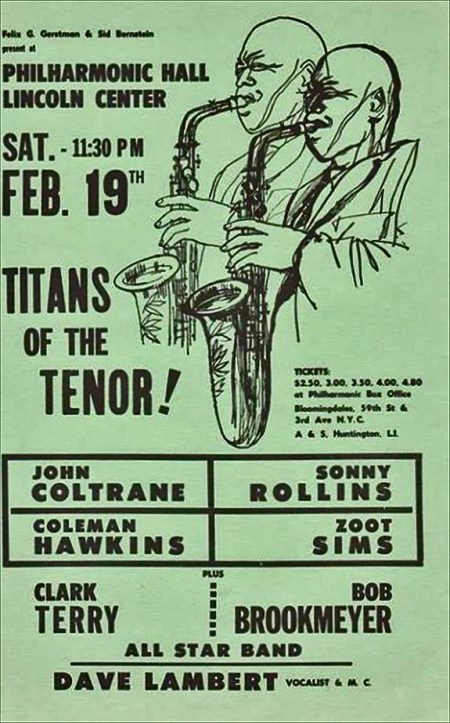
Now This is What You Call a Gig!

Posted in Jazz with tags , , , on March 5, 2014 by telescoper

No time for a proper post today, but I couldn’t resist reblogging this advertisement for what must have been an amazing concert with an amazing lineup; so amazing that Pharaoh Sanders and Albert Ayler, who were also there, didn’t even make it onto the poster!

jazzlabels's avatarthejazzword

Now This is What You Call a Gig!

It was 1966…Pharaoh Sanders and Albert Ayler were also there playing with Coltrane’s group

View original post

The Quintet at Massey Hall

Posted in Jazz with tags , , , , , , , , , on February 23, 2014 by telescoper

Time for a quick Jazz review, I think. This time I thought I’d pick a classic live performance from May 15th 1953 at Massey Hall in Toronto. Originally released as a vinyl LP with only 6 tracks on it, and called The Quintet of the Year, but subsequently re-released in various versions on CD, with various titles including Jazz at Massey Hall. The whole concert  is now available on Youtube here:

This concert was planned to unite the greatest stars of the bebop era who had performed together earlier in their careers but had gradually evolved different styles over the intervening years. The line-up is Charlie Parker on alto, Dizzy Gillespie on trumpet, Bud Powell on piano, Charles Mingus on bass and the great Max Roach on drums which is stellar by any criterion!

Gatherings of star jazz players have often turned out to be disappointing, largely because very great musicians can sometimes interfere negatively rather than positively with each other, not necessarily consciously but because they can have ideas incompatible with one another. This evening, however,  was a glorious exception to this rule, doubtless because all the musicians had worked together in the past, and their subsequent individual development had not taken them too far beyond their shared musical background. It is true that the ensemble passages are slight, but that doesn’t matter much because the solos are of such a remarkable and consistently high standard. Charlie Parker turns in some of the very best of his later recorded work, giving the lie to those who argue that his musical abilities were in decline at this time. He might not play as elegantly as he did on the classic Dial and Savoy sessions, but he is significantly more adventurous, with startling melodic contrasts in much of his work. At times this is a bit of a problem in that he seems to full of ideas that what comes out is a sequence of breathtaking fragments rather than a cohesive solo. This happens on A Night in Tunisia, for example, which never quite fulfills the promise of its magnificent opening break. On other tracks, though, especially Hot House his improvisations are just brilliant. It’s hard to imagine listening to this that in less than two years he would be dead.

Dizzy Gillespie matches Parker in superb fashion, betraying none of the offhandedness that often afflicted his later recorded performances, and the pyrotechnical quality of his playing is as exhilarating as it is instantly recognizable. Gillespie was an extrovert on stage and his frequent dancing around on the stage results in him going on and off mike from time to time, but it doesn’t detract from the performance once you realize why he’s fading in and out. It is, after all, a live performance and if you shut your eyes you can imagine Dizzy Gillespie the showman without any difficulty at all!

Most Jazz reviewers confine their comments on the rhythm section to a few kind words, but in this case that would be a travesty. The limitations of live recording technology in 1953 result in a rather unbalanced mix, but the flip side of that is that you can hear  particularly well the pivotal importance of the bass playing of Charles Mingus. Between them Mingus and Max Roach lay down a relentlessly propulsive beat as well as taking gripping solos; the drum workouts in Wee and Salt Peanuts are astonishing in their interplay of rhythm and texture. Trumping even them, however, is the genius of Bud Powell who plays at a level consistently high even by his own standards.

Bud Powell is a fascinating musician for many reasons. Much less of a formalist than many Jazz pianists he nevertheless seems to generate a real sense of unity, more through the  emotional drive underpinning his phrases than by imposing any set structure on his improvisations. His solo on Wee offers a fine example of this: moving inexorably towards a shattering climax as the right hand figures vary ceaselessly in their length and the chords punched out by the left hand grow more frequent and more percussive.

This album is another must-have for any serious collector of post-War jazz. The individual parts are all superb, but the whole is even greater than their sum.

PS. I had the pleasure of attending a concert at Massey Hall myself, when I was on sabbatical in Toronto in 2005/6.

Jacques Loussier and the Pekinel Twins play Bach

Posted in Jazz, Music with tags , , on February 21, 2014 by telescoper

I heard a track by this combination on the Breakfast Programme on BBC Radio 3 yesterday morning and thought I’d include something on here; it’s basically the Jacques Loussier Trio, which is famous for its Jazz re-workings of the music of Johann Sebastian Bach with the addition of the identical twins Güher  and Süher Pekinel on pianos.

Apparently some members of the Radio 3 audience didn’t take kindly to Ian Skelly’s decision to play something by this combination, but I have to say I loved it; it really put a spring in my step. I’ve remarked before on this blog that many Jazz musicians are great admirers of Bach (who was himself a talented improviser).  It’s not difficult to understand why this is the case, particularly in the case of the keyboard works, because the music always has such a rich and compelling  harmonic progression built into it – just what a Jazz musician needs. Bach’s compositions are so well constructed that they can cope with being pulled around more than those of any other composer I can think of. Above all, despite the change of musical vocabulary and the addition of a rhythm section, the best Jazz versions still somehow manage to sound  like Bach….

From the following clips you can see that the twins play from sheet music – I think the arrangement was written  by Jacques Loussier – while Loussier’s contribution is largely improvised. In the clip they play versions of Bach’s Triple Concerto in D minor BWV 1063 (with Jacques Loussier) followed the Concerto for Two Keyboards in C minor, BWV 1060  (without Loussier)…

The Shape of Jazz to Come

Posted in Jazz with tags , , , on February 8, 2014 by telescoper

The other night I was listening to the Ornette Coleman album The Shape of Jazz to Come and decided that I really should write something about it on here. Released in 1959, this was Ornette Coleman’s third album but it was the first to issue a fully coherent statement of his musical intentions and it was from this work that his influence began to spread. The prophetic title proved to be extremely accurate; what remains astonishing is that such a radical album was recorded as long ago as 1959, in what I consider to be a Golden Age of musical innovation.

What Coleman did in this album was truly revolutionary. The fundamental change involved was a complete rejection of conventional harmonic progression, i.e. the sequences of chords which underpinned and connected earlier jazz improvisations with a repeating cycle that imposed not only its own order but also its own formal restrictions. By rejecting these, Coleman gave his music complete freedom of melodic movement. His intentions are signalled even by the choice of band members. Consisting Coleman on alto saxophone, Don Cherry on trumpet, Charlie Haden on bass and Billy Higgins on drums, the quartet did not involve any chord-playing instruments at all. With the wider latitude allowed by this approach the melodic patterns are bolder and less predictable than in earlier forms of Jazz. The thematic phrases do not conform to the traditional 4 or 8-bar norms involved in traditional tunes. Freed of the necessity of catching up the next chord as it comes up in the accompaniment, improvisation can range further, crossing bar-lines at will. The resulting music was considered almost shocking in 1959, but although unconventional by the standards of the time, it can be heard to carry its own force and logic, respecting the fundamental laws of jazz improvisation while at the same time calling into question many of the assumptions on which these laws had been thought to rest.The rejection of harmonic dominance also altered other aspects of the music. Coleman’s melodic inventiveness was even enhanced by a (partial) rejection of equal-temperament tuning.

None of these changes was made just for the sake of it, and in many fundamental respects the music isn’t radical at all. The horns open and close each performance in fairly conventional style and they play clearly delineated solos. Billy Higgins keeps a steady beat going throughout, and Haden plays in between that beat and the trumpet and saxophone.  But that disguises some important differences in responsibility, especially for the bass player, Charlie Haden. Instead of following a chord sequence and knowing roughly what his line would be throughout the piece, he has to listen to the soloist and improvise a line to fit.  As always, increased freedom brings increased responsibility.

All four men are generous with their talents on this album, which is a feast of beauty and originality as well as skill and daring. It would be wrong to single out any particular track, which is why I’ve linked to the whole album, but I’d have to mention Peace, which is a lovely performance emerging from a statement of mood rather than a chord sequence; Don Cherry’s trumpet solo on that track is really remarkable. In an entirely different vein there’s Congeniality, which was the first in a long line of superbly swinging up-tempo numbers hitting a groove that Coleman was to make his own in subsequent years. There’s also Lonely Woman, which is the one tune on this album that became  a Jazz standard.

An album of extraordinary genius that was (and probably still is) way ahead of its time, The Shape of Jazz to Come is a must-have album for any serious Jazz enthusiast.