Archive for the Jazz Category

Ophelia

Posted in Jazz with tags , , , , , , on August 6, 2011 by telescoper

I seem to be in an unaccountably nostalgic mood this Saturday morning so as a consequence I’m going to post a musical blast from the past that I hope at least some of you will enjoy.

I first heard the following track on Humphrey Lyttelton’s Radio 2 show The Best of Jazz, which I used to listen to every Monday night when I was at School. I must have heard this sometime around 1981, i.e. about thirty years ago. From the moment I heard the first achingly beautiful phrases of theme of this tune, called Ophelia, I was entranced and it did more than any other single record to fill me with a love of modern jazz. Although I’d always loved jazz, I had tended to think of it as music “of the past” – even the “modern” jazz of e.g. Charlie Parker fell into that category – and usually made in a recording studio. This sounded so new, so exciting, and indeed so beautiful, that it filled me with the urge to hear live jazz whenever and wherever I could. It cost me a lot of money and a lot of late nights, but I think it was worth it.

The performance was recorded live at Ronnie Scott’s Club in London in June 1980 and released on the small British record label Mole Jazz, an offshoot of the famous (and sadly now defunct) record shop of the same name that used to be on Gray’s Inn Road. I loved the track Humph played so much I got the album Blues for the Fisherman straight away (by mail order) and, although I still have it, I have almost worn it away by playing it so much. It’s a brilliant, brilliant album, with the intense atmosphere of a live performance adding to the superb playing of the musicians.

The band is listed as the “Milcho Leviev Quartet featuring Art Pepper”, although that was probably for contractual reasons, as this was the same band that toured extensively as “The Art Pepper Quartet”: Art Pepper on alto saxophone, Milcho Leviev on piano, Tony Dumas on bass and Carl Burnett on drums. I was lucky enough to see this band play live at the Newcastle Jazz festival not long after I got the record and they were great then too. Art Pepper sadly passed away in 1982.

As far as I’m aware this record wasn’t  released on CD until very recently and, fortunately, a public-spirited person has put the tracks from the original album and some previous unreleased material on Youtube, so I’ve seized the opportunity to post the track which did so much to inspire me about jazz when I was 18 years old. There’s so much to enjoy in this piece, including the superb drumming of Carl Burnett and virtuosic piano of Milcho Leviev, but the star of the performance for me is Art Pepper (who also wrote the tune). His playing is at times lyrical and at times agonized, but always compelling and this band was especially good at spontaneous transitions of mood and dynamic. I love this performance, and I hope some of you will too.

Billie’s Bounce

Posted in Jazz with tags , , , , on July 28, 2011 by telescoper

I thought I’d put this up because I’ve just found it and I think it’s great. It’s an interesting facet of jazz history that the clarinet, a mainstay of jazz styles from the New Orleans roots through to the Swing Era, fell into disfavour in the post-war era with the advent of bebop when it was largely replaced by the saxophone. Very few musicians persisted with the clarinet into the era of modern jazz, but this is one that did. It’s the superb Buddy DeFranco, one of the most technically accomplished clarinettists in all of jazz – few have ever been able to match his control in the upper register. The tune they’re playing is a Charlie Parker composition called Billie’s Bounce, another tune based on the standard 12-bar blues sequence (in F) but with some alterations. As far as my chord book says, it basically goes like this:

| F7| F7 | B♭7| F7|| B♭7| B♭7|F7| F7| G7| C7| F7| C7|

while the standard blues progression in F would go like

| F7| F7| F7 |F7 | B♭7| B♭7| F7| F 7| C7| B♭7| F7| F7|

It’s a Charlie Parker trademark to have a “turnaround” at the end, with the dominant chord C7 instead of the tonic F and, as you’ll hear, these changes produce quite a different feel to the standard blues sequence.

Anyway, one thing I particularly love about this performance is the perfunctory instruction given by Buddy DeFranco at the start: “Play the Blues in F for a while”. That’s all they needed to send them on their way.

For Sidney Bechet

Posted in Jazz, Poetry with tags , , , , on June 26, 2011 by telescoper

Just stumbled across this excellent documentary about the great Sidney Bechet and couldn’t resist posting it alongside the poem by Philip Larkin that follows it, which is called For Sidney Bechet. Watching great jazz musicians play, including the rare clips of Bechet shown in the video, the thought always comes into my mind that if you took the instrument away from them, it would just carry on playing by itself…

That note you hold, narrowing and rising, shakes
Like New Orleans reflected on the water,
And in all ears appropriate falsehood wakes,

Building for some a legendary Quarter
Of balconies, flower-baskets and quadrilles,
Everyone making love and going shares

Oh, play that thing! Mute glorious Storyvilles
Others may license, grouping around their chairs
Sporting-house girls like circus tigers (priced

Far above rubies) to pretend their fads,
While scholars manqués nod around unnoticed
Wrapped up in personnels like old plaids.

On me your voice falls as they say love should,
Like an enormous yes. My Crescent City
Is where your speech alone is understood,

And greeted as the natural noise of good,
Scattering long-haired grief and scored pity.

Flying Home

Posted in Jazz with tags , , on June 24, 2011 by telescoper

Not much time to post today: I’ve got a full morning’s work finishing the drafts of two papers before flying home this afternoon….so here’s an appropriate piece of music from the late great Lionel Hampton.

Whippin’ that Jelly

Posted in Jazz with tags , , on June 3, 2011 by telescoper

Summer has most definitely arrived. It’s a gorgeous day and most of the students have finished most of their examinations, so I’m sure will be taking a well-deserved break and enjoying the sunshine. It’s also Friday, and time, I think, for a little frivolity.

I’m indebted to young Miss Liggins for drawing my attention to this old record via Facebook. It’s by a relatively obscure swing band called the State Street Swingers, which was based in Chicago during the mid-1930s. From a technical point of view the musicians weren’t anything like as proficient as the leading bands of the Swing Era, especially in the horn section, so they usually tried to make up for their relatively limited abilities by playing for laughs behind various vocalists. It doesn’t say who it is on Youtube, but the singer sounds to me like Washboard Sam. He made a lot of records with other bands for the Vocalion label, which is what this one came out on, so that’s at least consistent with my hypothesis.

The State Street Swingers only ever recorded 14 tracks, most of them involving euphemistically raunchy titles, like this one, Whippin’ that Jelly. It may not be the most sophisticated music, but I hope it at least brings a smile to your face, as it does to mine every time I listen to it!

Move

Posted in Jazz with tags , , , , on May 23, 2011 by telescoper

Well, it’s 1pm and my third-year students are just sitting down for two hours of fun with their Nuclear and Particle Physics examination. For my part I’m obliged to sit by the phone for the next two hours in case there’s a problem with the examination paper. Ideal excuse for a quick blog post while I eat my sandwich.

I also notice from my trusty wordpress dashboard that this is my 1000th post since I started blogging, way back in late 2008.  Time to indulge myself, then. I haven’t posted much jazz recently so I thought I’d share this classic recording with you. It’s from my favourite era of jazz – the late 1950s – and my favourite kind of jazz, bebop, which by then had matured, ripened and hardened considerably since its birth in the 1940s.

This gives me the excuse to mention a nice article in Saturday’s Grauniad about the poet Philip Larkin, his love for “trad” and his hatred for the “modern” jazz exemplified by bebop. It’s entirely a matter of personal taste, of course, but speaking for myself I can say that I’ve never had any problem loving jazz of all ages. For me, though, it reached a peak in the late 50s with musicians of the calibre of Miles Davis, John Coltrane, and Ornette Coleman.

This particular track features alto-saxophonist Lou Donaldson whom many jazz critics regarded as a pale imitation of the pioneering be-bop icon Charlie Parker but whose playing I’ve always admired. In my book, anyone brave enough to follow Charlie Parker deserves the highest esteem. In any case when Lou Donaldson walked into the Van Gelder studio in Hackensack, New Jersey on July 28th 2008 he clearly had fire in his belly.

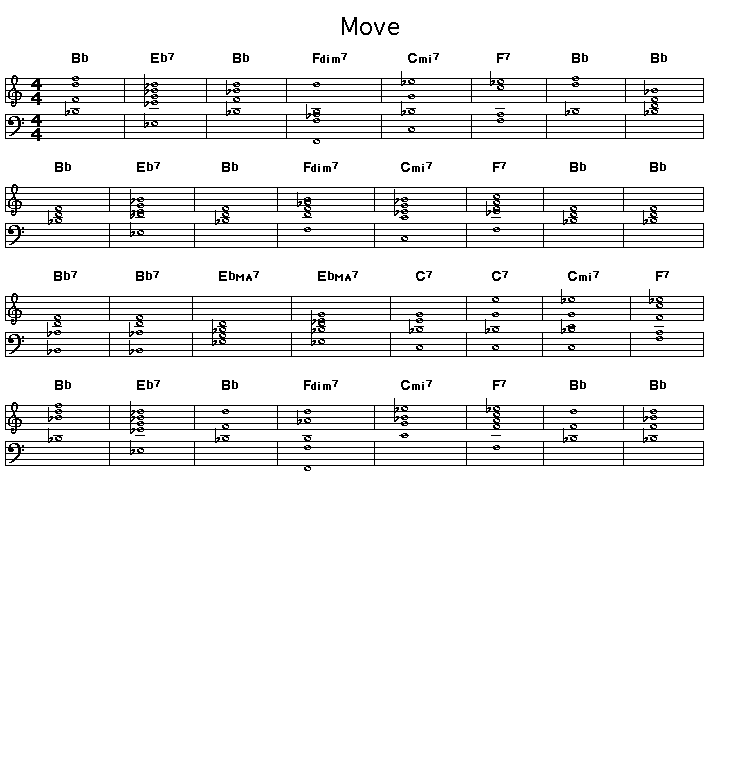
The tune is entitled Move and it was written by drummer Denzil Best. It’s quite unusual for a drummer also to be a composer, but Best wrote a number of classic jazz tunes. I even managed to find the chords that make up this one’s 32 bar AABA structure…

Many bebop compositions are based on the chord progressions of standard tunes, such as How High the Moon or I Got Rhythm, but with the melody replaced by something much more intricate than the original tune. I don’t recognize the chords above from anywhere else so it may be an entirely original composition by Denzil Best. I’m sure there’s a jazz buff out there who will correct me if I’m wrong. In any case the jagged melody is archetypal bebop stuff – complex and angular, very difficult to play but intensely exciting to listen to.

Share/Bookmark

Mr PC

Posted in Jazz with tags , , on May 16, 2011 by telescoper

I came across this just now and it completely blew me away so I thought I’d share it  here. It’s a solo version of the John Coltrane tune Mr PC  by the amazing (British-born) bassist Dave Holland. Words totally unnecessary. Wow will do.

Share/Bookmark

Salty Dog

Posted in Jazz with tags , , on April 16, 2011 by telescoper

Well, that’s the end of term and I’m now free, from teaching at least, for three weeks. I thought I’d celebrate by posting a piece of bawdy good-time jazz. Here’s the fabulous Lizzie Miles singing with a band led by the shamefully underrated but wonderfully named New Orleans trumpeter Sharkey Bonano.


Share/Bookmark

Just a gigolo

Posted in Jazz with tags , on March 30, 2011 by telescoper

Much of Thelonious Monk‘s recorded output was based on his own original compositions, which include such classics as Bemsha Swing, ‘Round Midnight, Epistrophy, Brilliant Corners and Straight, No Chaser, but this is an exception to that rule. Just a gigolo is a little ballad that he took a bit of a shine to relatively early on in his career and performed impromptu versions of it on many subsequent occasions. Monk’s unique style is a joy to listen to, and this clip gives you a chance to see him too – watching him play the piano always makes me think of a kitten playing with a ball of string. For all the genius that he was, and all the problems he had with his own mental health, he never lost sight of the child within himself.

Now this is what I call awesome


Share/Bookmark

My Sweet Lovin’ Man

Posted in Jazz with tags , , , , , on March 21, 2011 by telescoper

A high temperature and raging sore throat have confined me to the house today. I got up as usual at 7.30 but quickly realised I wasn’t going to be of much to anyone; trying to give a lecture when barely able to produce a whisper didn’t seem worth the effort. So off I went back to bed, after feeding the cat, and got up again about an hour ago.

I’ve been trying to cheer myself up by listening to – and transferring to digital using my USB turntable – some lovely old jazz records that I haven’t heard for ages. Not all of them came out well, but fortunately one of my all-time favourite records is actually on youtube anyway so I thought I’d put it up.

This is My Sweet Lovin’ Man recorded by King Oliver’s Creole Jazz Band on June 22nd 1923, in Chicago. It  is a purely mechanical recording, meaning that the musicians stood shoulder-to-shoulder  blowing into a horn causing a needle to cut the record directly onto a disk;   copies would be pressed using this master which could be played back for the listener by a gramophone, usually amplified by another horn. Obviously the technology was very limited, but it’s good enough to reveal the superb musicianship involved in creating this wonderful piece of music.

I love jazz from all eras of its history, but there can’t have been many  finer collections of musicians than this. It’s led by King Oliver, who plays cornet, with the young Louis Armstrong also playing cornet alongside him. Honoré Dutrey is the trombonist and the unmistakeable clarinet sound is supplied by the great Johnny Dodds. By the way, why is Johnny Dodds’ wikipedia article so brief? He was a colossal figure in the history of jazz! I must do something about that if nobody else does…

The piece was co-written by Lil Hardin, whose lovely piano playing is unusually well recorded on this track; pianos generally proved very difficult to record with the technology available in 1923.  Lil Hardin, incidentally, became Lil Armstrong when she married Louis Armstrong in February 1924. The rhythm men are Bud Scott on banjo and Warren “Baby” Dodds (Johnny’s brother) on drums, who provide an insistent yet fluid pulse underneath the rest of the band.

King Oliver’s band never used written arrangements; the musicians worked out the ensemble segments together and then played them from memory. When Louis Armstrong joined the band,  King Oliver  at first led on cornet, with  Armstrong providing decorative embellishments,  but  later on the two cornettists  developed such an understanding that they were able to swap leads almost telepathically. Their playing together on this track is sublime. The improvised counterpoint provided by Johnny Dodds and Honoré Dutrey is also breathtakingly beautiful. Although it was recorded in Chicago, this is the classic form of New Orleans polyphony sustained throughout at the very highest level.

I think this is one of the greatest jazz records of all time, but it also reminds me that there was  a move some time ago to refer to jazz as black classical music. It never caught on, but in this case the term seems to me to be perfectly apt. Anyway, I hope you enjoy it as much as I do.


Share/Bookmark