Duke Ellington’s tune The Mooche, composed in 1928, belongs to an era that spawned many other atmospheric classics such as Luis Russell’s Call of the Freaks and Don Redman’s Chant of the Weed. Fifty years later the menacing undertone of The Mooche was seized upon by saxophonist Steve Lacy and turned into an unforgettably raw version on his 1978 album Points (which I bought on vinyl when it first came out) in which he duets on soprano with Steve Potts, delivering the haunting minor-key theme with a sound like knives being sharpened.
Archive for the Jazz Category
The Mooche – Steve Lacy
Posted in Jazz with tags Duke Ellington, Points, soprano saxophone, Steve Lacy, Steve Potts, The Mooche on June 15, 2024 by telescoperAll The Things You Might Be
Posted in Jazz with tags All the things you are, chords, Jazz, Jerome Kern on April 29, 2024 by telescoperApparently the great American songwriter Jerome Kern didn’t like Jazz at all. It’s ironic therefore that his tune All The Things You Are is such a favourite among Jazz musicians, sometimes played as it is and sometimes forming the underlying chord progression for some other tune. Here it is, sung by the sublime Ella Fitzgerald:
The first things you learn if you try to teach yourself something about how jazz works is that there are two basic forms: the Twelve-bar Blues and the Thirty-two-bar form built from an A section and a B section (the bridge) arranged AABA. It’s true that this gets you quite a long way but it doesn’t take you long to realize that many famous Blues are not based on 8 or 16 -bar cycle and many of those that are 12-bar blues don’t have the standard progression. Then you find out that some of the most well-known Jazz standards aren’t AABA either.
All The Things You Are is an example. The chorus of this tune actually consists of 36 bars in a A1A2BA3 form with two twists on the usual 32-bar AABA song-form: A2 transposes the initial A section down a fourth, while the final A3 section adds an extra four bars. The result is much easier to lose your way when you try to improvise but, on the other hand, provides a very rich framework within which to experiment. That’s obviously why Jazz musicians like it so much.
Here is a backing track for this tune that shows you the chords without the melody. Although I’m a fairly incompetent musician I love trying to play along to this sort of thing, playing the melody for one chorus to find your feet and then just letting the chords suggest possibilities. It’s tremendous fun and very rewarding if you do manage to play something original, even if it makes Jerome Kern turn in his grave.
Mad about the Boy – Blossom Dearie
Posted in Jazz with tags Blossom Dearie, Jazz, Mad About the Boy, music, Noel Coward, Piano, Ronnie Scott's Club on April 17, 2024 by telescoperThe song Mad about the Boy was written by Noel Coward and published in 1932. It’s a song about an infatuation with a movie star and has generally been performed by female singers, although it was apparently inspired by Coward’s own crush on Douglas Fairbanks Jnr (which wasn’t reciprocated). The song became popular again in 1992 when a version recorded by Dinah Washington was used in a famous Levi commercial. . I never liked Noel Coward’s own recording – with him singing in a curious falsetto – very much at all, although I suppose it is authentic to what Coward was writing about. For a long time my favourite version was Dinah Washington’s but recently I came across this version, which has now, for me, eclipsed that one.
Blossom Dearie was a very underrated singer and pianist. Her voice – very high and girlish – was well suited to the whimsical songs she seemed to like to sing, but it meant that she wasn’t taken as seriously as a singer as she might have been. The lack of appreciation of her singing also extended to her piano playing, which was consistently excellent and innovative. No less a pianist than the great Bill Evans was a huge admirer of her musicianship, and he even attributed his use of stacked fourths in the left hand as inspired by Blossom Dearie. Other reasons to like this recording are that it was made live at Ronnie Scott’s Club in London and she goes straight into a verse that’s missed in many versions, probably because it uses the word “gay”. I love the way the accompaniment changes the mood each time she repeats the verses.
A Century of Rhapsody in Blue
Posted in History, Jazz, Music with tags Ferde Grofe, George Gershwin, Rhapsody in Blue, Ross Gorman on February 12, 2024 by telescoperIt is February 12th 2024, one hundred years to the day since the first performance of George Gershwin’s composition Rhapsody in Blue at the Aeolian Hall in New York by Paul Whiteman and his Palais Royal Orchestra with the composer himself on piano. This piece is has been a concert favourite for decades, but is usually heard in an arrangement for piano and full symphony orchestra which dates from 1942. The orchestration for that version was provided by Ferdi Grofe who had scored the original for Whiteman’s much smaller band back in 1924. Gershwin originally wrote the piece for two pianos, but didn’t know much about orchestration and had handed that task over to Grofe which the latter completed just a few days before the performance on February 12th 1924. It was not until the rehearsal with Whiteman’s band, however, that the famous opening took its now familiar shape.
The clarinet player with Paul Whiteman’s band in 1924 was a chap called Ross Gorman. It was his job to play the first few bars of Rhapsody in Blue, which had been scored for solo clarinet, consisting of a trill and then a long rising scale or arpeggio of more than two octaves. When they did the first play through Gorman didn’t play it as written but instead followed the trill with part of the scale followed by a long smeared glissando. Gorman often used smears to mimic laughing or sobbing noises, so this was a kind of trademark of his and came very naturally to him (though it is quite difficult to play a long glissando like this, especially slowly). There’s no question that it was “jazzed up” with humorous intent, but Grofe and Gershwin loved Gorman’s way of playing it, and that’s how it has been played ever since.
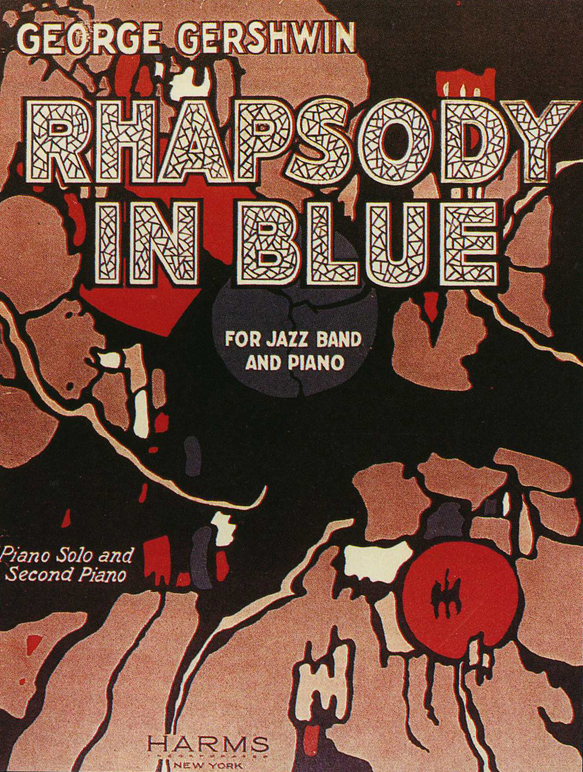
Rhapsody in Blue was a hit with the audience at its first performance, and has remained so with audiences around the world ever since. Sales of sheet music were good too! Critical reception was somewhat different, but those who disliked it were mostly judging it in comparison with classical music forms (e.g. a piano concerto) that it wasn’t attempting to be. I think it’s a piece to be enjoyed for its exuberance and atmosphere rather than thematic development or other more refined criteria.
There isn’t a recording of the original performance of 1924, but there is one of the same arrangement played by Paul Whiteman’s band in 1927 – complete with Ross Gorman on clarinet and George Gershwin again on piano. The difference is that it was played a bit faster for this recording than it was in concert so that it would fit on two sides of a 12″ record. Although I do think some modern performances of Rhapsody in Blue are too slow, this sounds to me rather rushed in places. The sound quality isn’t great either. Nevertheless, it’s an important piece of music history and it did sell over a million copies, so it would be remiss of me not to share it today!
Stormy Weather – Billie Holiday
Posted in Jazz with tags Billie Holiday, Stormy Weather on January 21, 2024 by telescoperRecorded in New York, July 27, 1952 with: Joe Newman (tp); Paul Quinichette (ts); Oscar Peterson (p); Freddy Green (g); Ray Brown (b); and Gus Johnson (d).
Blow, Blow, Thou Winter Wind
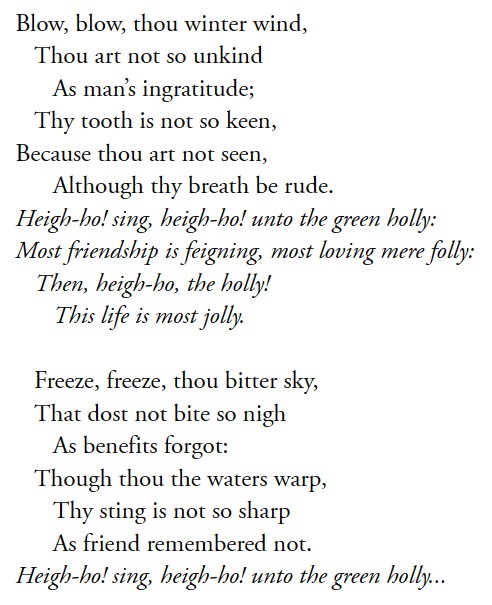
Posted in Jazz, Literature with tags As you like it, Blow Blow Thou Winter Wind, Cleo Laine, John Dankworth, Shakespeare and All That Jazz on December 27, 2023 by telescoperWith gale force winds, torrential rain and hailstones, the weather is pulling out all the stops today; so here, from the album Shakespeare and all that Jazz by Cleo Laine with a band led by John Dankworth, here is a lovely version of the song Blow, Blow, Thou Winter Wind from As You Like It by William Shakespeare
I always loved how Cleo Laine sang Jazz without trying to put on an American accent!
And here are the words, if you want to sing along at home:
Spanish Key – Miles Davis
Posted in Jazz with tags Bitches Brew, Flamenco Sketches, Miles Davis, Spanish Key on December 17, 2023 by telescoperAs I am still in Spain for a for more days before the Christmas break I thought I would share a vaguely relevant piece of music, Spanish Key from the 1970 album Bitches Brew by Miles Davis. This I don’t have time to write a long piece about this album, but I will say that of all the abrupt changes of musical direction during the career of Miles Davis, this album is probably the most startling and many jazz fans – even ardent admirers of Miles Davis – don’t like it at all. Anyway, des goûts et des couleurs on ne discute pas…
This track is particularly interesting to me because I’ve long wondered about the title and the musical structure. I’m not at all sure, but it seems likely to me that the title indicates the relationship of this piece to the track Flamenco Sketches from the classic album Kind of Blue recorded over a decade earlier. In that album, Miles was experimenting with jazz based not on traditional keys and scales, but on modes. In Flamenco Sketches there is a section based on a major phrygian mode which is commonly used in flamenco music. Spanish Key is in a very different style – much faster for one thing – but it has a similar pattern involving changes from E to D to D (phrygian) to E (phrygian) and G (mixolydian). Apparently Miles gave minimal instruction to his musicians about what to play, but did have prearranged signals to shift from one mode to another, such as happens about 3:15 in the recording when he ushers in a guitar solo by John McLaughlin, and around 12:46 when the mood abruptly changes as Miles introduces a new theme. I also think it was a stroke of genius to include a bass clarinet on this album; on this track it adds a Moorish element to the Spanish tinge.
Anyway, there’s so much going on in this track that it’s more instructive to listen to it than write about it, so here you are. Enjoy!
Stardust – Ruby Braff
Posted in Jazz with tags Ruby Braff, Stardust on October 28, 2023 by telescoperRueben “Ruby” Braff is probably better known as a cornet player than a trumpeter, but whenever he did play the trumpet he showed why Jack Teagarden dubbed him “the Ivy League Louis Armstrong”. Here’s a gorgeous performance by him of the Hoagy Carmichael classic Stardust in which he wears the influence of Louis Armstrong on his sleeve.
P.S. The pianist on this track is a young Dave McKenna.
R.I.P. Carla Bley (1936-2023)
Posted in Jazz, R.I.P. with tags Carla Bley, Fleur Carnivore, Healing Power on October 18, 2023 by telescoperTime for a little tribute to a great figure in the world of jazz, Carla Bley, who passed away yesterday at the age of 87. Carla Bley was a pianist, organist and composer who I first came across through her 1982 album Carla Bley Live! that contains one of my all-time favourite tracks, the gospel-infused The Lord is Listenin’ To Ya, Hallelujah! featuring the superb trombone playing of Gary Valente. I decided not to make that one my tribute piece because it’s really a solo vehicle for the trombonist, but instead another track from another album. This is from the 1989 album Fleur Carnivore, recorded live in Copenhagen in 1988, which I also have back home. Valente features on this one too, with his unmistakable sound like a wounded bison, but it also features some fine examples of Carla Bley’s skill as a composer/arranger as well as other soloists including long-term partner and musical collaborator Steve Swallow. It’s called Healing Power.
R.I.P. Carla Bley (1936-2023)

 In the Dark