Just to balance the books here’s a wonderful version of the classic bebop tune Anthropology, performed by Bud Powell who I mentioned in my previous post about Thelonious Monk.
This really is authentic bebop, with its complex yet propulsive drum patterns and jagged melodic lines characterized by unusual intervals and little punctuating tags at the end of each phrase in the solo. Also brilliant, but quite different to Monk, Bud Powell was very much a direct translation onto the keyboard of the saxophone and trumpet styles of Charlie Parker and Dizzy Gillespie.
The tune was written by them too, although it uses essentially the same chords as George Gershwin’s I Got Rhythm. It was a standard bebop procedure to write a new melodic line on top of an existing harmonic structure and give the result a new name. Jazz improvisation is always based on the harmonies (chord changes) rather than the tune, so this is a way to build new compositions quickly with the knowledge that the harmonic foundations would be sound. In the 40s there was a classic Charlie Parker recording session during which the band decided to do such a variation of the standard Cherokee (written by Ray Noble). In the middle of the performance they absent-mindedly played the Cherokee theme and there was a cry of anguish from the control room by the Producer who obviously hoped that if they stayed off the actual tune of Cherokee he wouldn’t have to pay composer’s royalties. So that take was abandoned, and they did another. The final version was called Koko and it’s one of the Charlie Parker classics. Many other classic bop tunes were made in this way, with different standard tunes underneath them. Necessity and budget restrictions are the mothers of invention.
Oh, and just listen to the fantastic double bass by the brilliant (and then very young) Niels-Henning Orsted Pedersen who drives it along like the clappers!
When you read about the structure of bebop it seems so complicated and obscure that it’s hard to believe that the result is such a thrill to listen to. I think it is the highest point of twentieth century music-making, both in the creativity and skill of its proponents and in the sheer excitement of its sound which is made all the more remarkable when you realise how difficult it is to play!
Some weeks ago I posted a clip of Billie Holliday and Lester Young that was part of a 1958 TV programme called Sounds of Jazz. I found another clip from that show and decided to put it on here because it’s absolutely fascinating. The star this time is the great Thelonious Monk, whose middle name was Sphere.
Thelonious Monk was a unique musician. His remarkable self-taught style of piano playing was unlike that of anyone who came before him. Look at his hands in this clip and you’ll see that his fingers are straight as he plays: he uses them a bit like mallets in order to get such a percussive sound from the instrument (although the audio is a bit muffled on this track).
Monk was often called “The High Priest of Bop” and regarded as one of the leaders of the post-war bebop revolution in Jazz alongside Charlie Parker and Dizzy Gillespie. Actually, I don’t think Monk ever really played bebop: the archetypal bop pianist was undoubtedly Bud Powell whose style was quite different to Monk. But the “High Priest” tag owed at least something to his eccentric personality: he hardly ever spoke and, aside from his music, he communicated mainly through his choice of hat.
Monk’s piano style is hard to describe – his wife Nellie once described it as “Melodious Thunk” – but I’ve always loved his music. To me his solos sound like someone talking directly at you in a strange and wonderful language that you don’t quite understand but which sounds beautiful anyway. His use of syncopation is quite different from the usual bebop musicians and it seems, to me anyway, to echo the rhythms of everyday speech. But, above all, when you hear Monk play the piano, you know immediately who it is. He had many admirers, but nobody could play like him. He was a genius.
In later life his behaviour became disturbingly erratic; he would sometimes stand up in the middle of a performance and go wandering around the stage. His music also deteriorated, I think, from the early sixties onwards. His best records are from the 40s and 50s. I think it was generally assumed that he had a drugs problem, which he may well have had, but it was eventually realised that he was suffering from a serious mental illness. Although attempts were made to treat this, he stopped playing in the 1970s and lived out the rest of his as a recluse.
I remember very well the day he died in February 1982. It was during the Newcastle Jazz Festival and on the day when the great British jazz pianist Stan Tracey was due to give a concert there. As we took our seats in the Newcastle Playhouse for the gig, an announcement was made that Thelonious Monk had died. Stan Tracey, for whom Monk had been a major musical inspiration, responded to the occasion by playing two sets exclusively consisting of tunes by his hero. It was one of the best concerts I’ve ever been to and remains strong in my memory to this day.
That also reminds me to say that as well as being a completely unique and individualistic piano player, Thelonious Monk was also a great Jazz composer who penned some of the great modern standards of the idiom: ‘Round Midnight, Straight No Chaser, Epistrophy, the list is substantial. And then of course there is the tune he plays on this clip which became something of a signature tune.
Off the record, I don’t think it’s completely fair to say that Thelonious actually wrote Blue Monk. The main theme was in fact borrowed from an earlier tune called Pastel Blue written by the trumpeter Charlie Shavers. It’s basically a straightforward 12 bar blues, lacking the twists and turns and stops and starts of his more typical compositions, but Monk recorded more varied versions of this tune than practically any other. This clip is a short rendition, but it’s fascinating to see the other characters in shot. Sitting at Monk’s piano looking straight at him is none other than Count Basie, and we also get a glimpse of blues singer Joe Turner standing at the side. Later on, there’s a shot of the great saxophonist Coleman Hawkins clearly enjoying the music as I hope you will.
I noticed this morning that I’ve passed a bit of a milestone on here. I’ve actually reached my 100th post. That probably means I’ve been spending way too much time blogging but, undaunted, here I go again.
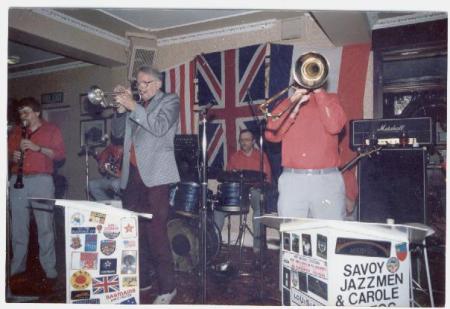
Ages ago (or it seems like ages ago) I posted an item about Humphrey Lyttelton and during the course of it I mentioned that my Dad had played the drums with Humph some years ago. I did mention in that post that I would put up a picture as soon as I found it, which I have now done. Here it is, taken probably somewhere around 1990.
I’m not entirely sure of the venue. I always thought this session took place in the Corner House in Newcastle but on closer inspection it doesn’t really look like it in this photograph so I wouldn’t bet on my memory being right. It’s not a great photograph, but that’s definitely my Dad (Alan Coles) on the drums. I don’t know the other personnel, but you do get a proper impression of how tall Humph was (he’s on trumpet, of course) .
Humph of course had his own band but many jazz venues (including the Corner House) preferred to invite soloists only to come and play with the house band. The main reason I think was that it was cheaper that way. And of course the local musicians loved it because they got to play with their heros. My Dad idolized Humphrey Lyttelton but when he finally got to play with him he was extremely nervous and didn’t particularly enjoy the evening.
Semi-professional bands like the Savoy Band shown here couldn’t afford fancy band uniforms or outfits so for some reason they all seem to settle on cheap red nylon shirts, as shown in the picture. I don’t know why because they’re not at all pleasant to wear if you’re going to be sweaty. But these shirts reminded me of a story that I’ve bored people with over many years. When I was little (in the 70s) there was a similar band in Newcastle called the Phoenix Jazz Band. They also wore horrible red nylon shirts for gigs, except for their young bass player (a guy called Gordon) who refused to do so. This uppity young student teacher turned up for gigs in a black-and-yellow hooped jersey so he looked rather like a bumble-bee or a wasp. The rest of the band called him, rather sarcastically, Sting. He soon went on to other things but the name stuck.
My dad always claimed that Sting had played the double bass in our garage – when I lived in Benwell village. I don’t remember having seen him though, and I might well have been having my leg pulled. Actually it wasn’t a garage anyway, more of a big wooden shed where he kept his drums and lots of other junk.
Anyway, I don’t know if I’ve mentioned this but I did for a while have dreams of becoming a Jazz musician myself. I wanted to be a saxophonist but my Dad persuaded me that I should learn to play the clarinet first and it would be easy then to switch to sax. I don’t think it was very good advice because they’re quite different instruments to play, but I rather think he had pushed the clarinet because he wanted me to play traditional Jazz rather than modern stuff.
I found that I had quite a good ear for music and a pretty good sense of rhythm so I mastered the rudiments fairly quickly but never got much further than that. I even got as far as sitting in with some bands, but never became a full-time member of one.
Sitting in with one of these traditional Jazz bands is a very informal business. Usually the repertoire consists of standard tunes that everyone knows and there are no real arrangements as such. The trumpet usually plays the lead for a chorus or two, with impromptu clarinet and trombone alongside, then there’s a sequence of solos (usually a couple of choruses for each player, unless you really get into it and the leader shouts “take another!”), and then you play out to the end. Other than that you make it up as you go along.
But there is one notable exception to this, a number called High Society. This probably began as a Mardi Gras parade tune but later on came to be played as an up-tempo flag-waver. Almost every Jazz band, however, plays it the same way. It starts with a sort-of call to arms with drum rolls and a few phrases on the horns a bit like a fanfare before moving into tempo and it has quite a few scored passages that are played straight (i.e. without improvisation). When it breaks eventually into the solos there is an unwritten rule that the clarinet soloist plays a standard set-piece solo obbligato, at least for one chorus, after which it’s back to the more normal improvised solo.
I don’t know how this became such a strong tradition but you can check it out yourself. There are dozens of versions of High Society played by different Jazz bands and the clarinettist will always play the same basic notes. There’s a classic recording by Jelly Roll Morton on which there are two clarinettists (Albert Nicholas and Sidney Bechet) who both play the original licks, one after the other.
The story I heard was that this solo (as well as possibly the tune itself) was written by a man called Alphonse Picou who was born in 1878 and played with the first real Jazz band in New Orleans, which was led by the legendary figure of Buddy Bolden, the first great jazz trumpeter. Bolden died in 1931 but no recordings by him have ever come to light because he stopped playing before 1910 and spent most of the rest of his life in mental institutions. It is said that Buddy Bolden’s band did make a cylinder recording, but this grail-like object has never been found.
High Society is such a well known tune and is such fun to play that it is very often part of after-hours Jam sessions at clubs like the Corner House where I did once actually play the Alphonse Picou solo from memory (or at least some sort of approximation to it), having heard it so many times on different records.
Last weekend, when I was playing around on Youtube, I chanced upon a bit of film of New Orleans Jam Session from 1958. It was looking back down a very long tunnel into ancient history but you could have knocked me down with a feather when I saw, sitting down next to the piano at the left, the great man himself, Alphonse Picou. I never thought there would be a film of him, thinking that he was, like Buddy Bolden, an almost mythical figure. I later found elsewhere, a clip from the same session of him playing his own famous solo! However, he was 80 years old and very frail at the time and he doesn’t actually play it that well so I’ll spare his posthumous blushes (he died in 1961) by picking a rather better number from the same session.
The tune I’ve picked to put on here is called Mamie’s Blues. They play it with that lovely lazily lilting beat that’s so typical of authentic New Orleans Jazz but is actually so difficult to get right. And if it wasn’t enough to see Alphonse Picou, there are several other legendary names too: Paul Barbarin (drums), George Lewis (clarinet) and Jim Robinson (trombone) amonst others. The session happened 50 years ago at which point these were all very old men and they’re all long gone now.This clip, to me, is every bit as important a piece of history as, say, an original score by Mozart.
They may all look like they’ve seen better days, but they certainly still knew how to play!
A few days ago I heard of the death at the age of 70 of the legendary jazz trumpeter, Freddie Hubbard. He had been ill for some time and had been in hospital in Los Angeles after having a heart attack about a month ago. His death closes a brilliant chapter in the book of American Jazz, as Freddie Hubbard was last survivor of triumvirate of brilliant young trumpeters who revitalised the jazz scene of the late 50s and provided an alternative direction to that of Miles Davis. The other members of this trio were Booker Little (died of kidney failure in 1961, aged 23) and Lee Morgan (shot to death in 1972, aged 33). Stylistically these players were descended from the great Clifford Brown who also died tragically young (in a car accident in 1956 at the age of 25), but Freddie Hubbard was the only one to achieve some measure of physical longevity alongside a longlasting musical reputation.
One of the first modern jazz albums I ever bought (Herbie Hancock’s Takin’ Off), featured Freddie Hubbard with Dexter Gordon on tenor sax. His solo on the track Watermelon Man is rightly acknowledged as a classic and it remains one of my absolute favourite trumpet solos to this day. In a completely different style, but also on the famous Blue Note label, he played with the outrageously brilliant Eric Dolphy on the pioneering free jazz album Out to Lunch.
I’ve been meaning to put something up about Eric Dolphy for some time because I think of him as an utter genius, but that will have to wait. I will, however, carry on in a somewhat morbid vein to point out that he died aged 36 in 1964 of diabetic shock while on tour in Berlin. He had collapsed onstage after taking an incorrect insulin dose and was taken to hospital. The doctors there, however, had no idea he was diabetic and assumed he had taken a drug overdose and failed to take the simple course of action that would have saved his life.
Freddie Hubbard was a versatile and virtuosic player, who played on a staggering number of the greatest jazz records of his time. That’s what you have to do to become a legend. I think he will probably be best remembered for the driving hard-bop style exemplified by drummer Art Blakey‘s magnificent band The Jazz Messengers, which Freddie joined in 1961 after replacing Lee Morgan as the trumpeter. This band survived many incarnations until the leader died in 1990. I saw them play live in 1980 and they were terrific.
Here they are in 1961, just after Freddie joined them, on a live version of the classic Moanin’ with Cedar Walton on piano, Curtis Fuller on trombone and Wayne Shorter on tenor sax.
I’ve been off sick for the last few days with a nasty bug, but at least it’s given me the chance to listen to quite a lot of music. Yesterday, I was playing some of the classic recordings made in the 1930s by singer Billie Holiday and saxophonist Lester Young. I’ve had these for ages but for some reason haven’t listened to them for a while. Coming back to them after a long break just strengthened my belief that they are amongst the greatest recordings ever made in music of any kind.
Billie Holiday was born in Baltimore in 1915. After a grim and traumatic childhood she dabbled with prostitution and then ended up as a night club singer where she was spotted by talent scout John Hammond who arranged for her to make recordings with Benny Goodman‘s Orchestra in 1933. Most people don’t realise this but, by 1935, this band was a pop sensation on exactly the same scale as, say, the Beatles were to achieve three decades later.
In her early recording career, Billie wasn’t so well known so she was given relatively unpromising songs to sing. With her unique sense of phrasing, and a willingness to take outrageous liberties with both melody and rhythm, she turned out to be brilliant at turning this base metal into gold; some he was undoubtedly the best singer of a bad song there has ever been. If you ever get the chance to hear her versions of When you’re smiling or Back in your own Backyard you can marvel at how she manages to say everything about life and death using only the slenderest of lyrics.
Also featuring on both of these classic tracks was the tenor saxophonist Lester Young. Nicknamed “The President”, or “Prez” for short, he was one of the greatest of all Jazz musicians. He had a sublime gift for melodic improvisations, coupled to unrivalled sense of sheer swing as befits a mainstay of Count Basie‘s magnificently propulsive big band of the late 1930s. The sound of Lester Young at full throttle with the Basie Band riffing away behind him must have been truly magnificent to hear live and is thrilling enough on record.
Although he wasn’t at all averse to a bit of rabble rousing, and loved to see people dancing as he played, Lester Young’s solos on the Billie Holiday recordings mentioned above showed the delicate side of his nature. People often say is that the reason the two of them worked so well together musically was that they had similar sense of phrasing. I don’t agree with that at all. Billie Holiday’s vocal style sound to be more like a feminine version of Louis Armstrong’s, derived from a trumpeter’s mannerisms rather than those of a saxophonist.
Lester Young and Billie Holiday became very close friends during this period, although there is no sign that they had any form of sexual relationship. Rumours have circulated that Lester Young was gay, although I don’t think there’s any evidence to back them up. It is true that he had a rather eccentric and perhaps effeminate demeanour, but it seems that’s just the way he was. During the war, Lester Young was conscripted into the US Army and this had a dreadful effect on him personally and on his career, not least because he wasn’t allowed to play his saxophone at all. The strict discipline and macho posturing of the army affected this gentle and introverted man very badly and drove him to a nervous breakdown. He was eventually discharged from the army and, although he started playing again, his career never regained the heights it had reached in the 1930s. He had frequent bouts of ill health owing to alcoholism and drug abuse and his recordings from the late forties and fifties are of uneven quality.
Billie Holiday’s career was also in decline during the 1940s, after she became addicted to heroin, and she was imprisoned on drugs charges in 1947. Cigarettes, booze and hard drugs ravaged her voice and, although she made a number of classic records in the 1950s, her vocal style was sometimes mannered and self-conscious. I definitely prefer the earlier recordings which show her at her most original. That said, there was one song from George Gershwin‘s Porgy and Bess that invariably inspired her to an intensely moving performance, including this sensational recording made just five months before her death in 1959.
But the reason for putting this all on my blog was that playing through these old records I remembered when I used to listen to Humphrey Lyttelton‘s Jazz programme on the radio. He once admitted on the air that there was a TV recording involving Billie Holiday and Lester Young that he couldn’t watch without bursting into tears. The programme “Sounds of Jazz” was made by CBS Television in the United States in 1957 and features a vast array of great musicians, including Miles Davis and Thelonious Monk. But this excerpt is the bit that always got Humph going, and I don’t wonder why.
Lester and Billie had at one time been very close indeed, but had become estranged for some reason, and hadn’t recorded together for the best part of twenty years before this. Time had exacted its toll on both of them. Prez, in fact, was very ill during this broadcase and he looks it. Barely able to stand or hold the horn, when he plays he still manages to deliver a moving and poignant solo. The camera cuts to Billie’s reaction, full of tenderness and empathy and the emotional effect is overwhelming. So intense is that moment that you tend to forget the other magnificent players on this track (including Coleman Hawkins, the other leading saxophonist of the 1930s whose style was very different, but whom Lester Young deeply admired). As Nat Hentoff later recalled
Lester got up, and he played the purest blues I have ever heard, and [he and Holiday] were looking at each other, their eyes were sort of interlocked, and she was sort of nodding and half–smiling. It was as if they were both remembering what had been — whatever that was. And in the control room we were all crying. When the show was over, they went their separate ways.
Lester Young died in March 1959, a little over a year after this performance. In a taxi returning home from his funeral, Billie told a friend that she thought she would be the next. She died in July the same year.
A few days ago I put up a short clip of The Train and the Rivertaken from the opening moments of the film Jazz on a Summer’s Day. This post contains the two last numbers to feature in the film, and the last one in particular is very very special.
At the 1958 Newport Jazz Festival, Mahalia Jackson (“The world’s greatest gospel singer”) played a lengthy set on the Sunday evening, and the whole concert is available on CD. She wasn’t really a jazz singer, but she was born in New Orleans (in 1911) and her style developed in the shadow of both the jazz and blues traditions that had their origins in her home town.
Three tracks from her 1958 concert made it into the film. Two of them are the sort of exuberant up-tempo stompers typical of Southern gospel music; there’s something about that beat that sets your pulse racing and makes it almost impossible to resist clapping your hands on the off beat. A fine example isthis highly locomotive rendition of Didn’t it Rain, a tune written by the world’s greatest composer (“Trad”) which has the crowd of jazz fans leaping about in the aisles.
As you can hear, Mahalia Jackson’s voice is simply phenomenal. She has so much power and emotional expressiveness that she is in a class on her own when it comes to this kind of music. In fact she gave singing lessons to the young Aretha Franklin, the one “soul “singer who came anywhere close to that quality of voice. But if you really want to hear music with from the soul, listen to Mahalia Jackson.
Although she had a number of hit records, Mahalia Jackson refused to sign for any major record label and performed throughout her life almost exclusively on gospel radio stations. I think she could easily have become a pop star if she had wanted to, but she saw her mission in life to communicate her faith to others through music. She also used a great deal of her earnings to help others by founding school bursaries and through other charitable works.
As in this concert, she usually performed with a backing band of piano, bass and organ but despite the lack of a drummer they build up a tremendous forward momentum.
Terrific though that track undoubtedly is, what comes next is truly sublime. The Lord’s Prayer is such a familiar piece of text to anyone brought up in the Christian tradition that it is difficult to imagine in advance of hearing this performance that it could be sung in such a way. The contrast between this and the previous track is immense, which makes it even more effective. This is no rumbustious rabble-rouser, just a simple and pure expression of her own deep religious faith.
Almost as moving as her singing are the cuts to the audience reaction – the same people who were leaping about a few minutes earlier sit in deep and respectful contemplation. And who wouldn’t.. I’m not a religious man but there is certainly religious music that moves me very deeply, and this is a prime example.
It’s not particularly relevant or topical, but I thought I’d put this up as it’s a great favourite of mine. This was the opening set from the classic film Jazz on a Summer’s Day, which is about the 1958 Newport Jazz Festival. Beautifully directed by the fashion photographer Bert Stern, this was originally intended to be a drama set against the backdrop supplied by the various concerts, but Stern lost interest in the plot storyline and it was dropped. The final cut of the film released in 1960 is basically a straight documentary about the music festival, and it’s none the worse for that.
Stern’s photography didn’t just capture the diverse personalities of the artists, who range all over the spectrum of Jazz from Louis Armstrong to Thelonious Monk. He keenly observed the audience as the performances unfolded and sprinkled some wonderfully humorous glimpses into the film. In between the music there are also some wonderful impressionistic sequences of yachts racing off the coast of Rhode Island and reflections on the water. I think the film is pure joy from start to finish and I treasure my copy of it on DVD.
The opening track of the film is The Train and the River, by the Jimmy Giuffre three. Jimmy Giuffre was an immensely gifted saxophonist and clarinet player who was also an accomplished arranger and composer who worked for many big bands. His most famous piece as an arranger was Four Brothers which he wrote for Woody Herman’s fantastic saxophone section of Stan Getz, Zoot Sims, Serge Chaloff and Herb Steward. Giuffre was at one stage a very avant-garde musician playing quite challenging material, but in 1958 he had a more accessible style that blended jazz with folk elements, as you can hear from the video.
The other members of the band are the wonderful guitarist Jim Hall and the multi-instrumentalist Bob Brookmeyer who, on this number, plays valve trombone. Notice how they cleverly interchange the lead and rythmic support so you don’t really notice that it’s such a small band. There are studio recordings of the Train and the River, but none of them are anything like as good as this live version. Unfortunately the start of the tune is missing on the video because it was played over the opening titles, but if you want the whole thing just go and buy it!
Jimmy Giuffre died in April this year, before I started blogging, so let this be a belated tribute to him. I also think it’s a fitting way to celebrate the dawn of a new era in American politics with a reminder of the tremendous vitality, creativity and diversity of the nation that brought us jazz and a fervent hope that it will rediscover its true identity in the post-Bush era. Enjoy.
I didn’t realise it when I posted my piece about Humph’s record Bad Penny Blues a couple of days ago, that there is a new film to be premiered this in London this Saturday (October 4th) called “A Life in the Death of Joe Meek”, which includes an interview with Humph.
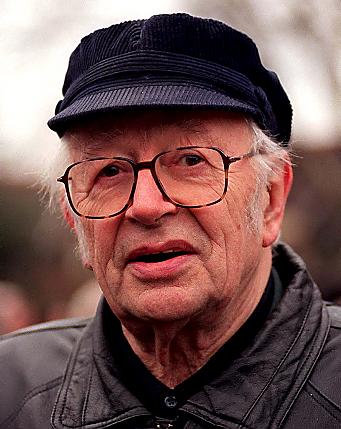
I knew I could’t blog for long without writing something about a great hero of mine, the inimitable Humphrey Lyttelton, better known to his many fans as “Humph”. He died earlier this year (on April 25 2008, at the age of 86) of complications following a heart operation. News of his death came as a massive shock to me, as it had never really occured to me that one day he would be no more. Tributes to him in the media were unsurprisingly glowing in their admiration.
In later years, Humph was best known as the chairman of the long-running radio comedy show I’m Sorry I Haven’t a Clue, subtitled “The Antidote to Panel Games” in which his gravelly but perfectly elocuted voice, schoolmasterish manner and impeccable comic timing proved the perfect foil to the antics of Barry Cryer, Tim Brooke-Taylor, Graeme Garden and many other contributors. I hope I get the chance to say a bit more about this programme in due course, as I treasure my collection of recordings of shows that still make me laugh at the umpteenth listening.
But Humph had many other strings to his bow. He was a talented cartoonist and a gifted writer, and also hosted the BBC Radio programme “The Best of Jazz” on Radio 2 for forty years, counting the great John Peel among his legions of listeners. I owe a special debt to Humph for this programme as I listened to it religiously every monday night at 9pm during my teenage years. He would open the show with “This his Humphrey Lyttelton here, with the best part of an hour of jazz between now and five to ten”. His theme tune then was Wanderlust, recorded by a subset of Duke Ellington’s orchestra with the great saxophonist Coleman Hawkins appearing as a guest and contributing a truly magnificent tenor solo near the end of the piece.
Through Humph I discovered most of the music I still listen to on a daily basis, jazz from the classic era of Louis Armstrong and Jelly Roll Morton, through the swing era of Duke Ellington, Benny Goodman and Count Basie, the postwar bebop period of Charlie Parker, Dizzy Gillespie and Thelonious Monk, Miles Davis and John Coltrane, then modernists like Ornette Coleman, Sam Rivers, Archie Shepp and onto the avant-garde of the time. Humph loved all kinds of jazz, and he communicated his encyclopedic knowledge a style flavoured by a dry sense of humour. I never met him in person, but I would have loved the chance to thank him for helping nurture in me a passion for all that wonderful music.
Humph was also a fine Jazz trumpeter and bandleader in his own right. When my father was at school in the 1950s, the Lyttelton band was the leading “traditional Jazz” band in Britain. Humph had played with many of the greats, including Louis Armstrong and Sidney Bechet, and won their admiration for his trumpet-playing.
My dad had become a Lyttelton fan at School and it was this that persuaded him to take up playing the drums. He joined the RAF for his national service, and he had the opportunity to play with various bands then and later on when he went back into civvy street. He was a life long admirer of Humph and eventually got to play with him at the Corner House in Newcastle but not until the 1990s. He told me it was one of the proudest moments of his life, although he had been so nervous he didn’t really play very well.
I have a photograph of this occasion somewhere, but I can’t find it for the moment. I’ll add it when I can get it scanned.
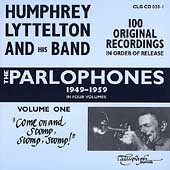
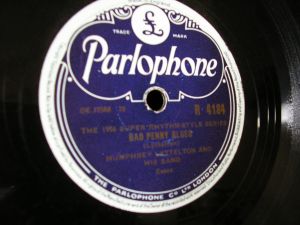
In the late 1940s Humph’s band had started to record a series of 78rpm records for the Parlophone label, starting with a lovely version of “Maple Leaf Rag” and stretching to over a hundred titles. Among these tracks was one record that actually made it into the Top 20 of the British pop charts in 1956, admittedly at Number 19, but nevertheless that’s no mean feat for a Jazz record. I should point out that this was long before my birth, but I remember hearing the track many times around the house when I was young.
The Bad Penny Blues was written by Humphrey Lyttelton and the hit recording features a quartet drawn from his band which, by the mid-1950s, had gravitated to a more mainstream jazz style, away from the “traddy” sound favoured by most contemporary jazz outfits. Indeed, he had incurred the wrath of many conservative fans by daring to include a saxophonist, the brilliant but eccentric Bruce Turner, in his outfit. Bad Penny Blues, though, featured only Humph on trumpet, Johhny Parker on piano, Stan Greig on drums and Jim Bray on bass. It was only recorded as an afterthought because it went down well at live gigs at Humph’s Jazz Club the HL Club (which later became the 100 Club, at 100 Oxford Street.)
But the real key to the success of this record was a young man by the name of Joe Meek. Starting out as a sound engineer at the Parlophone studios, Meek had quickly established an excellent reputation and in this case he was asked to take over the whole production of the record. According to Humph, they were slightly concerned at what he was doing with the microphones before they made the take but after it was done they all went home and left Meek to do some tinkering with the sound before cutting the disk. In those days, recording techniques were relatively crude and there generally wasn’t much in the way of post production, especially in jazz.
When he heard the final record, Humph was shocked. For one thing, Meek had close-miked all the instruments, including the drums – something which wasn’t generally done with jazz records for fear of (a) drowning out the rest of the band and (b) exposing the clumsiness of the drummer, the latter being a particularly problem. As Humph said, his band always sounded like the rhythm section was wearing diving boots. For this reason the drums were usually recorded with a distant mike and generally hidden in the ensemble playing. But in this case it worked out very well. Stan Greig used brushes on this track and his playing served beautifully both to propel and to punctuate the performances of the other musicians.
But it wasn’t the drums that so disturbed Humph. Meek had also fiddled with the double bass and with the left hand boogie-woogie figures of Johnny Parker’s piano, fattening them out and changing the balance to bring them right up in the final mix. He also compressed the overall sound so that the bass lines seem to press in on both the piano’s right hand and the growling muted trumpet lead, tying them closer to Greig’s insistent drum patterns and creating an unusually dense sound. The result is an intense, driving feel, with a dark undertone that is quite unlike any other jazz record of its period and redolent with the atmosphere of a smoky jazz club. I love it, especially the moment when Humph’s trumpet takes over from the piano solo. With a timely kick from the drums and against the backdrop of those bluesy thumping bass lines the band finds another gear and they build up a fine head of steam before riffing their way into the fade.
You can hear the original recording here, in a bizarre video I found on Youtube in which someone films their cassette player. I have an original 78 of this track but at the moment can’t transfer it to digital because I haven’t got a turntable, but when I do I’ll post it. Hopefully it will have better balance than the video.
Humph didn’t like the way the record had been put together, but it was an instant hit. He later joked that he hated it all the way to the bank.
Joe Meek went on to produce several classic pop records, generating many ideas that were later used by Phil Spector, but ultimately he became a tragic figure. Such commercial success as he achieved didn’t really last and he sank into debt, depression and paranoia. A gay man in an era in which homosexuality was still illegal, he became a victim of blackmail and was questioned by the police for alleged encounters with rent boys. He committed suicide in 1967 at the age of 37.
The Bad Penny Blues went on to be the “inspiration” behind Paul Macartney’s Lady Madonna,a Beatles track which has a lot of the same notes in it and also borrows the same overall feel. I can’t put it more subtly than that. George Martin, who produced the Beatles’ track, was actually in charge of the Parlophone studio at the time Bad Penny Blues was recorded…
And Humph went on to live another 52 years, bringing music and laughter to millions.
To end with, here’s a link to a later version of the tune recorded by a more recent manifestation of Humph’s band, probably in the 1980s. Note the way his technique involved the use of his eyebrows! I may be wrong, but I think the pianist on this performance is Mick Pyne and the bass is played by Dave Green. I can’t really make out the drummer.
The views presented here are personal and not necessarily those of my employer (or anyone else for that matter).
Feel free to comment on any of the posts on this blog but comments may be moderated; anonymous comments and any considered by me to be vexatious and/or abusive and/or defamatory will not be accepted. I do not necessarily endorse, support, sanction, encourage, verify or agree with the opinions or statements of any information or other content in the comments on this site and do not in any way guarantee their accuracy or reliability.