A new season is about to start at English National Opera and I’ve been spending a lot of time and money recently getting tickets for some of the operas, as well as organizing the logistics of getting to and from London. Among the forthcoming productions is a revival of Nicholas Hytner’s production of Mozart’s The Magic Flute (Die Zauberflöte, K. 620).
I can’t remember how many times I have seen this opera performed nor in how many different productions. It’s a wonderful creation because it manages to combine being utterly daft with being somehow immensely profound. The plot makes no sense at all, the settings are ridiculous (e.g. “rocks with water and a cavern of fire”), and the whole thing appears to be little more than a pantomime. Since it’s Mozart, though, there is one ingredient you can’t quibble with: a seemingly unending sequence of gorgeous music.
When I first saw The Magic Flute I thought it was just a silly but sublime piece of entertainment not worth digging into too deeply. I wondered why so many pompous people seemed to take it so terribly seriously. Real life doesn’t really make much sense, so why would anyone demand that an opera be any less ridiculous? Nevertheless, there is a vast industry devoted to unravelling the supposed “mystery” of this opera, with all its references to magic and freemasonry.
But now I can unveil the true solution of problem contained within the riddle encoded in the conundrum that surrounds the enigma that has puzzled so many Opera fans for so long. I have definitive proof that this opera is not about freemasons or magic or revolutionary politics.
Actually it is about particle physics.
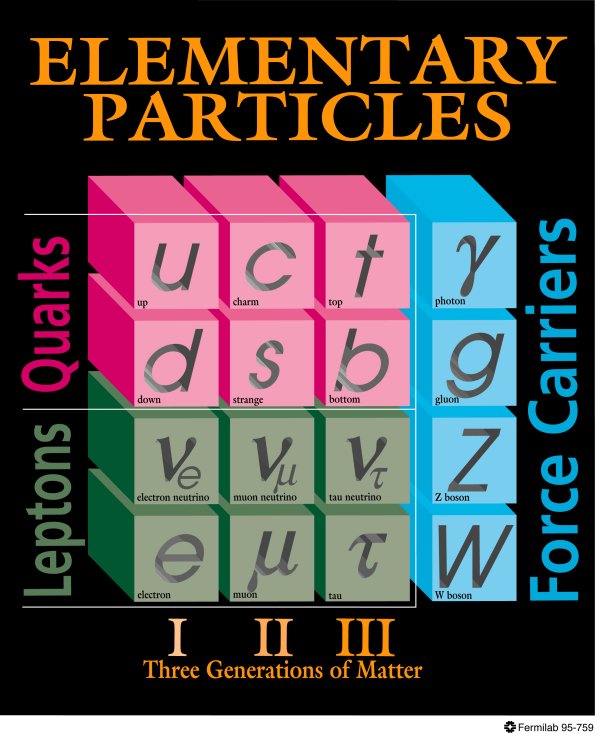
To see how I arrived at this conclusion note the following figure which shows the principal elementary particles contained within the standard model of particle physics:
To the left of this picture are the fermions, divided into two sets of particles labelled “quarks” and “leptons”. Each of these consists of three pairs (“isospin doublets”), each pair defining a “generation”. This structure of twos and threes is perfectly represented in The Magic Flute.
Let’s consider the leptons first. These can be clearly identified with the three ladies who lust after the hero Tamino in Act 1. This emotional charge is clearly analogous to the electromagnetic charge carried by the massive leptons (the electron, muon and tauon, lying along the bottom of the diagram). The other components in the leptonic sector must be the three boys who pop up every now and again to help Papageno with useful advice about when to jangle his magic bells. These must therefore be the neutrinos, which are less massive than the ladies, and are also neutral (although I hesitate to suggest that this means they should be castrati). They don’t play a very big part in the show because they participate only in weak interactions.
Next we have the quarks, also arrayed in three generations of pairs. These interact more strongly than the leptons and are also more colourful. The first generation is easy to identify, from the phenomenology of the Opera, as consisting of the hero Tamino (d for down) and his beloved Pamina (u for up); her voice is higher than his, hence the identification. The second generation must comprise the crazy birdcatcher Papageno (s for strange) and his alluring madchen who is called Papagena (c for charmed). That just leaves the final pairing which clearly is the basso profundo and fount of all wisdom Sarastro (b for bass bottom) and my favourite character and role model the Queen of the Night (t for top).
To provide corroboration of the identification of the Queen of the Night with the “top” quark, here is a clip from Youtube of a bevy of famous operatic sopranos having a go at the immensely different coloratura passage from the Act 1 aria “O Zittre Nicht, mein leiber Sohn” culminating in a spectacular top F that lies beyond the range of most particle accelerators, never mind singers.
There’s some splendid frocks in there too.
The Queen of the Night isn’t actually in the Opera very much. After this aria in Act 1 she disappears until the middle of Act 2, probably because she needs to have a lie down. When she comes back on she sings another glass-shattering aria (Der Hölle Rache kocht in meinem Herzen), which I like to listen to when I’m writing referee reports. The first line translates as “The rage of hell is boiling in my heart”.
The remaining members of the cast – The Speaker and Monostatos, as well as sundry priests, slaves, enchanted animals and the chorus – must make up the so-called Force carriers at the left of the table, which are bosons, but I haven’t had time to go through the identifications in detail. They’re just the supporting cast anyway. And there is one particle missing from the picture, the Higgs boson. This accounts for the masses of other particles by exerting a kind of drag on them so it clearly must be the Dragon from Act 1.
I missed an important anniversary this week. Had she still been alive, December 2nd 2008 would have been the 85th birthday of the most renowned opera singer of her time, Maria Callas.
She was born in 1923 in New York city of Greek parents who had moved there the previous year, and christened Maria Anna Sofia Cecilia Kalogeropoulou. Disenchanted with her deteriorating marriage, her mother abandoned her husband and took Maria and her sister back to Athens in 1937. Maria enrolled at the National Conservatoire of Greece the same year after winning a scholarship with the quality of her voice, which
was warm, lyrical, intense; it swirled and flared like a flame and filled the air with melodious reverberations.
At this age, Maria was a rather plump young lady with a rather deep voice. Initially, she aspired to be a contralto but at the Conservatoire she was encouraged instead to become a dramatic soprano. Accordingly, she underwent special training to raise her natural pitch (or tessitura) and learned how to control her remarkable voice more accurately so she could sing in a sufficiently disciplined fashion that she could take on the dazzling coloratura passages that she would perform in later years with such success. She also worked on her chest tones to broaden the scope of her voice in the mezzo region. Although she became more technically refined as a singer during this period, there were some things that didn’t change. One was the sheer power of her voice, which is something that we tend to notice less in these days of microphones and studio recordings. People who heard her sing live confess to being shocked at the sheer scale of sound she could deliver without amplification. Perhaps more tellingly, she eschewed many of the devices sopranos tended to use to control the highest notes, usually involving some alteration of the throat to produce accuracy at the expense of a thinner and more constricted tone. When Callas went for a high note, she always did so in a full-throated manner. This often produced a piercing sound that could be intensely dramatic, even to the extent of almost knocking you out of your seat, but it was a very risky approach for a live performance. Audiences simply weren’t used to hearing a coloratura sing with such volume and in such a whole-hearted way. It wasn’t always pretty, but it was certainly remarkable and often very moving. It was this aspect of her voice that led her friend Tito Gobbi (who sang with her in Tosca) to call it una grande vociaccia, which I translate in my schoolboy Italian as meaning something like “a big ugly voice”. That isn’t meant to be as disparaging as it sounds (Gobbi was a great admirer of Callas’ singing).
Having listened to lots of recordings of Maria Callas I have to admit that they are certainly not all good. Sometimes the voice didn’t come off at all. Unkindly, one colleague said that she “sang with her ovaries”. When she talked about her own noice, Callas herself often referred to it as if it were some independent creature over which she had very little control. Anyway, whatever the reason, when she was bad she was definitely bad. But I adopt the philosophy that one should judge artists (and scientists, for that matter) by their best work rather than their worst, and when Callas was good she was simply phenomenal, like a sublime and irresistible force of nature. That’s why they called her La Divina.
Although her talent was very raw in the beginning there was no question that she always had a voice of exceptional power and dramatic intensity. When she started singing professionally she immediately attracted lavish praise from the critics not just for her voice but also for her acting. As a young soprano she sang in an astonishing variety of operas, including Wagner‘s Tristan und Isoldeand Die Walküre, neither of which one would now associate with Callas.
It was in the late 194os that Callas began to take an interest in the type of opera that would really make her name. Bel canto opera was rather unfashionable at that time, probably because audiences preferred the grittier and more realistic verismo style. Virtually single-handed, Callas resurrected the bel canto canon by injecting a true sense of drama into works which had previously just been seen as vehicles for the singers to demonstrate their art. Callas brought an entirely new dimension to the great operas by Bellini (Norma, I Puritani, La Somnambula…) and Donizetti (Lucia di Lammermoor, Anna Bolena), although she was sufficiently versatile to also perform brilliantly in the verismo syle of Verdi and Puccini as well as lesser known composers such as Giordano (Andrea Chenier). Recordings of many of these performances are available, but it is sad that this glorious period of her singing career happened just a bit before high quality equipment was available so the true glory of her voice isn’t always evident.
In 1953, Callas decided that she wanted to change her appearance, perhaps so she would look more appropriate for the parts she was playing on stage. At the time she weighed almost 200lbs. In order to lose weight as quickly as possible, she followed the barbarous but highly effective expedient of swallowing a tapeworm. She lost 80lbs in a matter of months. The dramatic loss of weight changed her body and her face, emphasizing her high angular cheekbones and giving her a striking look very well suited to the opera stage. But it also affected her voice somewhat, especially at the upper end where she seems to have found it more difficult to avoid the dreaded “wobble” which was one of the alleged imperfections that critics tended to dwell upon.
Callas also had very poor eyesight which required her to wear very thick spectacles in order to see at all, a thing she refused to do onstage with the result that she was virtually blind during performances. In fact, during a performance of Tosca at Covent Garden she leant too far over a candle and her hair caught fire. Improvising magnificently, Tito Gobbi, as the loathsome Scarpia, extinguished the fire by throwing water at her before the audience had noticed. Although they weren’t much use for seeing with, her eyes were a great asset for her acting, in turns flashing like a demon then shining like an angel.
After her weight loss, Callas was suddenly no longer just a wonderful singer but also a strikingly beautiful woman. Her career took a back seat as she started to revel in the glamorous lifestyle that opened up in front of her. Her voice deteriorated and she performed rather less frequently. Eventually she embarked on a love affair with Aristotle Onassis, a notorious serial collector of trophy women. She hoped to marry him but he abandoned her to marry Jackie Kennedy, widow of John F. Kennedy.
She never really recovered from the failure of this affair, retired from singing and lived out the last years of her life as a virtual recluse in her apartment in Paris. She died in 1977.
I had heard a lot about Maria Callas when I was younger, but the recordings that I listened to (generally from the 1960s) were really not very good as her voice was undoubtedly much diminished by then. I just assumed that, as is the case with many artists, the legend of Callas was all mere hype. Then, about fifteen years ago, I was listening to BBC Radio 3 and they played the final scenes of the great 1954 recording of Norma with Callas in the title role, conducted by Tullio Serafin. I was completely overwhelmed by it and tears flowed freely from my eyes. I’ve always had a tendency to blub when I hear really beautiful music, but as I’ve got older I’ve learned not to be embarrassed by it. At least I don’t cry at football matches.
In England, Callas is probably best remembered for her performances in Tosca in Covent Garden. I have recordings of her in that role and they are really wonderful. But there are many fine recordings of Tosca by other singers, some of which are almost as good. In the case of Norma, though, there isn’t any other performance that comes within a mile of the Callas version. Or if there is, I’ve yet to hear it.
Now I know that there are some people, even opera lovers, who just don’t get Callas at all (just look at the comment boards on Youtube). I grant that she wasn’t always the most accurate singer, and I don’t think you could say her voice had a purely classical beauty. But even if you don’t like her voice you have to admit that she revitalized the opera stage and brought a new public into the theatres. I can’t imagine what the state of opera would be now, if there hadn’t been a Callas and you can’t argue that she is now an iconic figure. What I admire most about her is that, like it or loath it, her voice is instantly recognisable. In this sense, she always puts me in mind of a kind of operatic version of Billie Holliday. She’s a far cry from the many bland mediocrities that pass themselves off as opera singers nowadays.
I’m going to end with the obligatory clips from Youtube. There’s a lot of Callas on there, not all of it good. I’ve chosen a couple of items, although neither of them has a proper video. The first was performed live in 1955 in front of the notoriously difficult audience at La Scala in Milan and recorded from a radio broadcast so that the sound quality is quite poor. A studio recording of this aria, from Andrea Chenier, features most movingly in the film Philadelphia. This live version, however, is notable for a number of reasons. One is that you get some idea of the power of the Callas voice in the way she pushes aside the entire orchestra and is even able to cut through the distortions introduced by the rather primitive recording technology. The second thing is that she sings it so beautifully, with such feeling, lovely phrasing, and so much colour and vitality. Listen to the way the texture of her voice matches perfectly her changing emotions as she tells her story. The shattering, climactic high C that occurs near the end is a perfect example of what I was saying above. She stabs this note out like her life depended on it. It sends shivers down my spine and clearly had the same effect on the audience. The thunderous applause that follows the end of this aria is quite frightening in its intensity, but gives a good idea how much her public adored her. If you can put up with the lo-fi recording, this is certainly a better performance than the studio version.
The final piece has to be from Norma. I think Bellini is a wonderful composer of opera, but he doesn’t make life easy for the singers. There’s never any doubling of the vocal line by the orchestra so the singer is very exposed. This doesn’t bother Maria Callas. This is the famous aria Casta Diva, which has become a kind of signature tune for her and it’s one of the pieces that she always seemed to perform beautifully. It might be a bit hackneyed but I love it and, after all, it’s my blog. There’s also a nice compilation of pictures.
I’d be interested to hear what the general opinion of Callas is based on a sample of the two or three people who read my blog, so please feel free to add your comments!
The production of Boris Godunov now playing at the Coliseum has had mixed reviews, largely because of the performance of Peter Rose as the tormented Tsar. I usually don’t find myself agreeing very much with what music critics say and I had been looking forward to English National Opera’s take on Mussorgsky‘s opera for some time. My trip to London this weekend gave me an excuse to see it for myself and form my own opinion.
The opera is based on a play by Pushkin which tells a story based on the historical figure who ruled Russian from 1598 until 1605. In the play, Boris Godunov only becomes Tsar after murdering the son Dmitriy of the previous Tsar, Ivan IV (“the terrible”) and is plagued with ghostly visions of the dead boy. His guilt drives him into madness and eventually to death, although in this production of the opera the audience doesn’t see how he dies.
In Tim Albery’s staging, the action is shifted forwards in time to pre-revolutionary Russia, with the costumes and designed hinting a time round about 1900. The production uses Mussorgsky’s original version of the opera which is not divided into acts, but spread across seven scenes (lasting about two hours and fifteen minutes) which are performed without an interval. The limitations of the minimalistic set are more than made up for by wonderful use of lighting at one point bathes the stage in gold and at another turns it into a chill Moscow streetscape.
The update of the period allows Albery to give this production a dimension that is entirely new. The ENO chorus deliberately conjures up the idea that revolution might be imminent. At several points the chorus appear in huge numbers on stage to be held at bay by only a few soldiers with rifles. This is a very effective device, especially since the chorus is in such good voice. The passion and attack of the mob is unleashed only sparingly but when it is it is very effective in providing a vocal backdrop to the developing plot.
Mussorgky’s music for Boris Godunov is romantic, richly textured, even lush in places and full of wonderful melodies. As you can imagine from the storyline it’s also rather dark and sombre, much of it in the basso profundo region. That also goes for the singers: there is no conventional tenor role, though basses and baritones proliferate among the cast.
The one thing the music doesn’t have is a great deal of dramatic contrast, which I think must be why it appears to be difficult for the principals to bring their characters fully to life. It’s almost as if the opulence of the score holds them back. The other difficulty is that there are so many characters with not much time for the audience to get to know their personalities. Although they all sang well, I still felt they were strangers at the end. The one really outstanding performance in there was Brindley Sherratt (as the “chronicler” an old hermit called Pimen) who gave his character real depth and pathos.
And as for Boris himself? Was Boris good enough? I think Peter Rose actually sang very well and the limitations of his acting have been overemphasized by the critics. There aren’t that many opera singers who can act well, and he is certainly far from the worst I’ve seen. His voice is relatively light for a bass and he didn’t have the bottomless range that is really needed to get across the angst of the remorseful murderer. In the scenes with Pimen (another bass) he generally suffered by comparison with his opposite number’s much richer sounds at the low end of the register.
So, not for the first time, I am glad I ignored the critics and went ahead and bought my tickets for this. As it turned out I was sitting quite close to John Nettles (who plays Tom Barnaby in Midsomer Murders) and Jane Wymark (who plays his wife, Joyce, in the same series). I half-expected there to be a murder during the performance.
I had divided loyalties this evening. Tonight was a special showing of Blast-The Movie, a documentary film about an experiment involving several Cardiff astronomers. The movie has had pretty good reviews, so I originally intended to join my colleagues this evening watching it in Cardiff University’s Julian Hodge Building.
However, only last weekend I found out that tonight was also going to be the night for the Welsh premier of For You, a brand new opera composed by Michael Berkeley and with a libretto by Ian McEwan. As an added bonus, both composer and writer were going to be around to talk about the piece beforehand, so I decided to break ranks and go off to the Sherman Theatre to watch this new production by Music Theatre Wales.
The pre-performance talk was very interesting in describing how the work came about and how the collaboration between Berkeley and McEwan worked out in practice (basically words first, music after). I’d read something about this already and the opera has also been premiered in London so I’d read some of the reviews. The Guardian liked the music but was less keen on the words; the Times was uniformly positive.
So how was it? I actually thought the libretto was very fine indeed: the plot is simple but ingenious and there are some nice comedic touches to counterpoint the darkness of the overall feel. The music was what didn’t really work for me. I felt Berkeley’s score was far too dense and fussy. There’s so much going on in some passages that it subtracts from rather than adds to the text. The vocal lines often have to battle through the rest of the music like shoppers on a busy saturday afternoon on Oxford Street. Sometimes less is more.
In the opening scene the composer Charles Frieth is taking a rehearsal, with him on stage conducting the orchestra in the pit. The tuning-up sounds are carefully scored – quite a challenge for a composer, I think – and it’s a very clever opening. This idea comes back whenever there’s a particularly manic episode (usually involving the deranged Polish maid Maria), the apparent cacophony from the orchestra mirroring psychological disorder on stage. That works well too, at least the first time. But this device is used so often that it begins to irritate. If you’ve read my piece about Charles Ives you’ll realise that I’m quite partial to a bit of dissonance here and there but even I find repeated extended doses rather indigestible.
But it’s not all like that. Although it is variable, the music does have some lovely moments, including a cheeky quotation from Mozart’s The Magic Flute.
The cast was pretty good too, especially since none of the characters are particularly likeable. Baritone Alan Opie was really good as Frieth and Amanda Collins sang wonderfully well as Maria (although she did overact quite a lot). The rest of the cast was solid rather than remarkable.
Overall, I’d say it was interesting rather than wonderful, but I’m definitely glad I went.
At the interval I went to the loo for a quick pee and as I was standing there answering the call of nature I realised that the composer was using the urinal next to me. That’s something you never get with Puccini….
Another day, another opera. Today I had to duck out of the usual post-seminar drinks and food and get down to the Wales Millennium Centre in Cardiff Bay for one of only two performances in Cardiff by WNO this season of Jenufa by Leos Janacek.
You couldn’t wish for an opera more different in style and substance than Saturday’s Otello, although I suppose both operas would probably be classed as tragedies. Gone are the opulent sets and costumes and associated courtly intrigues of Otello. Instead we enter a world of drab and claustrophobic interiors within which a dark story of ordinary country folk unfolds in all its bleakness. Jenufa has a child by her lover, Steva, whom she hopes will marry her. When he refuses to do the honorable thing, Jenufa’s stepmother, Kostelnicka, drugs Jenufa and kills the baby, disposing of the body in a freezing lake. Jenufa is then persuaded to marry the dim but devoted Laca. In the final act, the baby’s body is found, Jenufa is accused and then Kostelnicka confesses her guilty act, claiming that she wanted to save Jenufa from disgrace. She goes off to be tried for the murder, while the steadfast Laca promises to stand by Jenufa come what may.
None of the characters is particularly sympathetic or even comprehensible. Laca (Peter Hoare) changes from a brutish oaf, who accidentally stabs Jenufa in the face in Act 1, to a doting husband in Act 3. Steva (Stephen Rooke) is superficially attractive but clearly a bit of a bounder. Kostelnicka (Susan Bickley) is severe, pompous and moralistic. Jenufa (Nuccia Focile) just seems a bit vacuous in Act 1 but progressively disintegrates under the stress of shame and rejection becomes increasingly morose and unpredictable as the opera goes on.
But these are not meant to be easy roles to understand. They are as inconsistent as real people, and as difficult to figure out.
On paper the plot and characterization seem very slight, but what holds it all together is Janacek’s wonderful music which seems to pull together all the rather ragged strands left dangling by the libretto. The score features lush romantic passages interspersed with snatches of folk tunes and jagged unresolved ideas that seem to mirror the fractured psychology engulfing Jenufa and Kostelnicka. Although the story is unrelentingly grim, there always seems to be something interesting going on in the music. Near the end, when Kostelnicka confesses the infanticide and accepts her punishment the music is particularly beautiful and even uplifting. However dark the deed, it seems to say, some form of redemption is always possible. How Janacek manages to conjure such a radiant burst of optimism at the end of such a dark tragedy is nothing short of miraculous.
I could listen to Janacek’s music for hours. As a matter of fact, now I think about it, that’s exactly what I did.
Last night I went to the splendid Wales Millennium Centre in Cardiff Bay to see the production of Verdi’s Otello currently being staged by Welsh National Opera. The Opera is of course based on Shakespeare’s play Othello; I never met an Italian who could pronounce “th” properly, which presumably explains the change in spelling.
The Wales Millennium Centre is an excellent venue for Opera, both because it has very comfortable seats (quite necessary for operas of three hours’ duration, like Otello) and is also quite heavily subsidised. Last night’s tickets were about a quarter of the price you would expect to pay for the stalls at the Royal Opera House in Covent Garden. Unfortunately the centre is currently having financial problems, which I hope can be resolved.
I know many music experts – including Rob Cowan, who I listen to every morning on BBC Radio 3 – regard Otello as not only Verdi’s greatest masterpiece, but also the high point of all Italian grand opera. I’m not sure I would go that far, but it is certainly a compelling work both musically and dramatically. Watching last night’s performance it struck me how well theatrical tragedies suit adaption to the operatic form. The whole point of a tragedy is that the fall is inevitable. The hero contains within himself the seeds of his own destruction which, in the case of Otello is born of his uncontrollable jealousy.
But in order to have its full effect on the audience there must be time for the depth of impending calamity to eat into the audience. The pace of opera fits very well with this requirement. Building slowly but inexorably to the gut-wrenching climax, the best Opera achieves the kind of intensity that in Sport you can only get with Test cricket.
Verdi wrote this Opera in 1887 (when he was 74) and it represented a glorious return from self-imposed retirement. He went on to wrote another Shakespeare-inspired masterpiece, Falstaff, when he was 80.
But is Otello so very good? I think there’s one big problem with it, which is the role of the villain Iago. In Shakespeare’s play, Iago has many more lines than Otello and this gives this character time to develop into a believable, and sometimes even appealing, individual. In the operatic version he is just a bad guy who is bad for the sake of it. His pointless cruelty makes him completely two-dimensional and he therefore doesn’t work for me at all as a motivating force behind the plot.
On the good side, the production looked great, especially the giant golden lion that appeared in Act 3. The costumes were good too, set in period in a very traditional provincial-opera kind of way but easy on the eye. The chorus of Welsh National Opera was outstanding and the principals all did very well. Amanda Roocroft was an especially tender and vulnerable Desdemona.
And then there was Otello himself, played by Denis O’Neill. Sixty years old but in very fine voice, and with lots of stage presence, my only problem with him was that he’s a bit too short and portly to be playing the fearsome warrior leader. Iago (David Kempster) towered over him almost comically in their scenes together. If Iago hated Otello so much why didn’t he just kill him? He looked as though he could easily beat him in a fight.
The orchestra played well and the final act in particular was paced superbly to achieve real dramatic power. Otello strangles Desdemona and then, when he realises the treachery of Iago and the innocence of the wife he has just murdered, he kills himself with a dagger.
What did you expect from an Opera, a happy ending?
The views presented here are personal and not necessarily those of my employer (or anyone else for that matter).
Feel free to comment on any of the posts on this blog but comments may be moderated; anonymous comments and any considered by me to be vexatious and/or abusive and/or defamatory will not be accepted. I do not necessarily endorse, support, sanction, encourage, verify or agree with the opinions or statements of any information or other content in the comments on this site and do not in any way guarantee their accuracy or reliability.

 In the Dark